318 points · by joecool1029 · 1y ago · 313 comments
And you can't even implement it yourself because it requires special permissions on Android, which you can only get if you're a carrier/oem-blessed app. And the early "you'll be able to build other apps, there will be an API like this: https://github.com/android-rcs/rcsjta" promises (which would put it on par with sms/mms) never materialized, despite a reference implementation that did exactly that over a decade ago.
At this point I'm just totally against RCS and I'm intentionally turning it off. Why hand all of your messaging communications over to Google, when they've got such a consistent history of being hostile? We're much better off going back to telling people not to use sms (or mms or rcs) at all because it's insecure.
That depends on your carrier, which is even worse. There are several ways to activate RCS for a phone number, as this standard is meant for carriers rather than app developers, and the carrier gets to choose which one they want.
I think the reference implementation died around the time carriers shut down their RCS servers because nobody was using them. https://github.com/Hirohumi/rust-rcs-client seems to be the most reason open RCS client at the moment (with an Android demo app).
The real need and opportunity for an RCS messenger is on the LineageOS/custom ROM scene, where these permissions are available (you can sign the ROM yourself, after all).
As for the Google stuff, RCS being routed through Google is an anomaly that will hopefully be fixed as carriers add support to it so native Android <-> iOS messaging isn't completely terrible. Progress has been slow outside of countries that still use SMS (like the USA) but eventually we'll be back to normal carrier-based carrier message exchange once things calm down a bit.
On the Android side of things, I don't expect things to change soon, as most of the restricted fields were at one point available to developers and were mostly used to stalk users across installs without their knowledge for tracking and "telemetry" purposes. A country where people actually use SMS/RCS will have to crack down on Google's lack of an RCS API.
I'm very happy that they're essentially using MLS, that's a real benefit[1]. But other chat apps can (and some do) do that too, without actively driving every single carrier globally to give Google all of your messaging activity. We're better off having diversity.
This all could reverse course and become acceptable, but I don't see how it would happen in practice. It seems much more likely that everyone will just give up and say "yeah that didn't work".
1: Though without alternate impls they can just silently MITM it and how would you know? RCS users: have you ever verified your messaging keys out of band? Do you know how? I can't find it in Messages. The "Universal Profile https://www.gsma.com/solutions-and-impact/technologies/netwo..." for RCS that describes a ton of things compliant apps have to do (many of which Google Messages does not seem to do, as far as I can tell) has no instructions at all to show users their keys or provide a common way to verify them (as far as I can tell). Client diversity provides a way to detect some attacks here, but there is currently almost no client diversity, and instead it seems to be shrinking towards just Google Messages, using Google's servers.
^ They are correct, the MLS / E2EE part of RCS is quite new and not yet implemented ~anywhere. So it gets no points until widespread, and this is now a decade after RCS's introduction. I think we can expect it to take a long time yet, if at all.
Why would you want to go into this closed model, where you’ll likely be charged per-account? How is this any better than XMPP, email, or any other IM protocol out there?
Should you use it for day-to-day messaging? No. But having it for emergencies is nice - if anything, just to bootstrap an alternative, secure channel.
But that obviously didn’t work because there are hundreds (thousands?) of cellular carriers around the world and they are the wrong people to manage such a thing.
So they basically are steering it back to “Google’s shitty iMessage.”
The universal thing isn’t the carrier anymore, the universal thing is the Internet that runs on top of it, which is perhaps why just about everyone outside the US tends to use messaging apps like WhatsApp/Signal/WeChat/etc.
> just about everyone outside the US tends to use messaging apps like WhatsApp/Signal/WeChat/etc.
This is The Way. Well, several ways, since you inevitably end up a bit fragmented, but usually a country will settle on one, usually WhatsApp. Further east Telegram is also popular.
I don't know if RCS is the way, but monopolistic messaging apps definitely aren't.
https://apple.stackexchange.com/questions/474179/how-do-i-di...
Isn't it fair to say the US has settled on iMessage and, to a lesser extent, RCS/SMS?
I'm not sure who you are calling "carriers", but it sounds like the people who own a mobile network. They buy gear off a supplier like Nokia / Huawei, contract them to install and maintain it, then make their money back over time by selling the bandwidth to consumers and hopefully a "free" phone as well.
They aren't the engineering power houses the telco's of old were, like AT&T. Rather they are reverse - a marketing powerhouse, duking it out with other marketing power houses. Their technical know how is close to 0. In fact on the retail support side, it might even be negative. When I deal with them, I come away with the impression would have trouble fixing a propelling pencil. If Google thought they could manage a massively parallel e2e messaging stack, they were deluding themselves.
This is the real reason Huawei was banned by the West. It wasn't just that it meant they were using Chinese make the gear, with opaque Chinese firmware, although I guess that was bad enough. It was that if the telco's bought Huawei, Huawei ran it for them. "Ran" means hands on, 24 hours a day, with in Huawei engineers deployed around the country keeping it ticking. Having a Chinese company running your countries mobile phone infrastructure was an impossible swallow.
In the US we don't reliably use WhatsApp, iMessage is locked down, and Signal, etc., are just for tech bros or political hacks. Yet, everyone wants to text instead of call, so we are in this world where we need to make RCS work, and they are just not putting in the effort.
The user base pales in comparison to WhatsApp but it did double in the last couple of years.
Whatever it is, Google of all org should not be at the Helm of this.
And the amount of moral policing they did to apple. Disgusting assholes. I hate Apple for a lot of reasons. iMessage is definitely not one of them.
Whoever knows how to download WhatsApp, knows how to download Signal.
This turned Signal into the defacto default in our org.
The alternative is to hand all your communications to carriers, who have a consistent history of being incompetent, extortionate and bending over to authorities to disclose everything you've ever said at the drop of a hat. Exhibit A is SMS, which is totally unencrypted, plagued by bad actors, and a cesspool of spam and fraud.
In an ideal world you could choose who does your RCS, in the same way that you can pick your email provider, but the way it's baked into the telco ecosystem makes this basically impossible.
* SMS is cheaper in America than in Europe where carriers gouge their customers for it.
* Usually this means the non-Americans are just using WhatsApp (owned by Meta/Zuckerberg) instead, which is hardly something to be proud of.
We also have free roaming in the whole Europe.
The adoption of messaging apps caused a lot of carriers to reduce or eliminate the SMS fees, as they saw the business was evaporating.
I would be pleased if everyone who uses SMS with me switched to WhatsApp. I would be more pleased if they switched to Signal, but the UX benefits of either one are significant.
Can you expand on this?
It's been a while since I've explored IPv6, but I'm on Comcast and I recently switched from OpenWRT to an Ubiquiti router and was surprised that 1) it doesn't enable IPv6 by default and 2) It asks for configuration [2] that I'm not sure how to answer. I thought everything "just worked" with Router Advertisement.
[2] https://help.ui.com/hc/en-us/articles/115005868927-UniFi-Gat...
I actually think iMessage group chats should have a minimum age limit, from a kids perspective they are no different than Snapchat et al.
The equivalent is simply lacking from Android due to RCS group chat being a broken mess.
But I don’t think either platform lets you control messaging group chat functionality this way. They just offer approved contacts and complete disable as your options to control messaging.
I also think your “amount of drama” might be badly measured simply because the majority of kids in the US use iOS.
87% of teens have an iPhone.
The Graphene folks have at least been making progress on getting it working (my understanding is that Messages expects special permissions from Android and Play Services that GrapheneOS has to specifically whitelist without blowing massive holes in the Google Play sandbox, and without those permissions it fails to verify the phone number for certain carriers — T-Mobile included, in my case). Hopefully whatever fix they come up with works for the long haul; it was really annoying to have RCS working fine for all of two weeks only for it to immediately start failing again when the required RCS endpoint switched from Google's Jibe instance to whatever T-Mobile is allegedly maintaining themselves.
The rest of the world is on WhatsApp and doesn't even know what RCS messaging is.
But here in North America,we like pain.
And in the US more people are using iMessage than SMS thanks to iPhone's 58% market share.
I don't know about you, but I personally talk with Iranians more on Whatsapp than telegram. I know the Iranian government did ban whatsapp for a while, but its still popular. I remember reading an article on here about a whatsapp leak, and it mentioned that there are over 60 million whatsapp users in Iran. Considering that Iran has a population of around 91 million, that's a huge majority of the country.
Absolutely _not_ the case here (France), the overwhelming default is SMS (and now RCS). Sure people use WhatsApp but also Telegram just as much these days, but in both cases it's _not the default_.
Maybe because it's been, I don't know, one to two decades that SMS have been unlimited in even the most basic plans.
Also RCS Just Works here, I've seen my non-Apple contacts move to RCS over time as they got OS or phone upgrades.
I'd blame NA carriers, which, from afar, seem to have a habit of screwing up in so many ways.
Slow cable Internet and 120v residential electricity are two more examples. I fortunately have fiber now, but I'll be stuck dreaming of 240v outlets and appliances for the rest of my life.
EU also mandates dedicated circuits for big appliances, so there is no difference in practice.
The two things I can think of are electric kettle and a raclette machine.
Tools are mostly battery powered those days. A home workshop would most likely be wired in 240 or three phases anyways.
What else are you missing?
Very poor quality for images and videos, emoji reactions, editable messages, deletable messages, group administration.
I was hoping when I first learnt about RCS that it could be an alternative to Meta owning everyone's comminications channels, but I've given up that hope a fair while ago.
That's not true at all. Random data point. Estonia. I have a _single_ contact that uses WhatsApp. Everybody else is reachable via FB Messenger/Discord/SMS/Signal/Google Chat/Instagram.
China is always an exception,but they are locked partially out of the whole internet
*: unless someone does a chargeback after, which makes the money disappear from your account, a major source of "oops I accidentally sent (too much) money (to the wrong person)" scams
It’s one of the main reasons why WhatsApp, iMessage, etc have such popularity. A cell connection is merely one of many means of access and carriers have no structural role whatsoever, meaning that if you’ve got cell data you’ve got messaging.
Like imagine if instead of investing in RCS, Google instead created a web-based "Advanced Messaging Protocol" or something to that effect, which specifies capabilities roughly in line with those of RCS. The big guys like Google, Apple, Meta, and MS would run their own servers, but there'd be no reason why smaller players like FastMail and Proton couldn't also run them. Most users would just roll with the major providers pre-configured on their platform of choice but more savvy users could choose their own.
That could've rolled out and been adopted and iterated upon far more quickly than RCS has.
(I use GraphenOS and couldn't make it work for the life of me)
Google had to pretend to be everyone's carrier to make RCS work because the GSMA spec assumed everyone would download/install their carriers' messenger apps to use RCS, like you would back in the day with SMS/MMS. This expectation was broken the day Google allowed app developers to write third-party SMS apps, but that hasn't bothered the spec people so far.
Who in their right mind would make this assumption? I'd hate to have to explain that one to grandma.
The iPhone was unique in that it refused to let carriers customize its operating system. That's part of why Apple had to partner with a relatively obscure carrier on launch, while Motorola/Samsung/Nokia/Sony Ericsson/Android phones launched on random carriers all the time.
Many people still buy phones from their carriers which comes with all kinds of apps pre-installed, including carrier-branded SMS apps in many cases.
Everyone in their right mind would have made that assumption when the system was designed. Only some weirdoes at Apple and a few hard-core open source enthusiasts cared.
Of course, that doesn't mean that operating system vendors such as Apple and Google can't simply implement RCS and all the weird carrier quirks they need to deal with in their own apps anyway, and to make messaging available using an API. They already do that kind of stuff with SMS, MMS, location information, internet connectivity, and practically anything else the phone does. They just decided that they're not really gonna bother with an API for this specific trick your phone can do.
Has Jibe somehow blacklisted his phone? In that case, Apple might technically be right — it’s a carrier issue, but with all major carriers, since he says they’re all using Jibe on the backend.
Anyway, I doubt he’d sound crazy, as he puts it, to the Apple Store people making this case. They might even be sympathetic, but this is probably the best he’ll get, since Apple’s whole protocol is to get you on one centrally preauthorized track or another to having a working phone.
That's my guess, yeah. The only unrelated carrier I haven't tried yet is Boost/DISH. I can hop networks on US Mobile but I don't think it'll help. So far I've tried 3 T-Mobile lines on this phone, the US Mobile line on AT&T's network, and my mom's Verizon Wireless line.
> Anyway, I doubt he’d sound crazy, as he puts it, to the Apple Store people making this case.
It's difficult: I probably should have had a write-up before going in, my list in the blog is not complete of steps I tried to get this going. Understand though that all the user facing and employee facing documentation says if it's RCS it must be the carrier.
Had an awesome senior support agent a few calls ago that knew what he was talking about. Actually described previous issues where RCS would not activate early in iOS 26 with a single sim user that had an inactive but not deleted eSIM. I believe the store also repeated a similar mention today.
The senior support agent on the phone just hadn't gotten to the point of fully ruling out an on-phone software state issue. What I mean is I restored a backup from iTunes that their diagnostics reported as incompletely restored. So after our call he wanted me to either try that again or do an iCloud backup. I did the latter, since it seemed to be described as a different restore process that's less likely to copy back a broken state to the device.
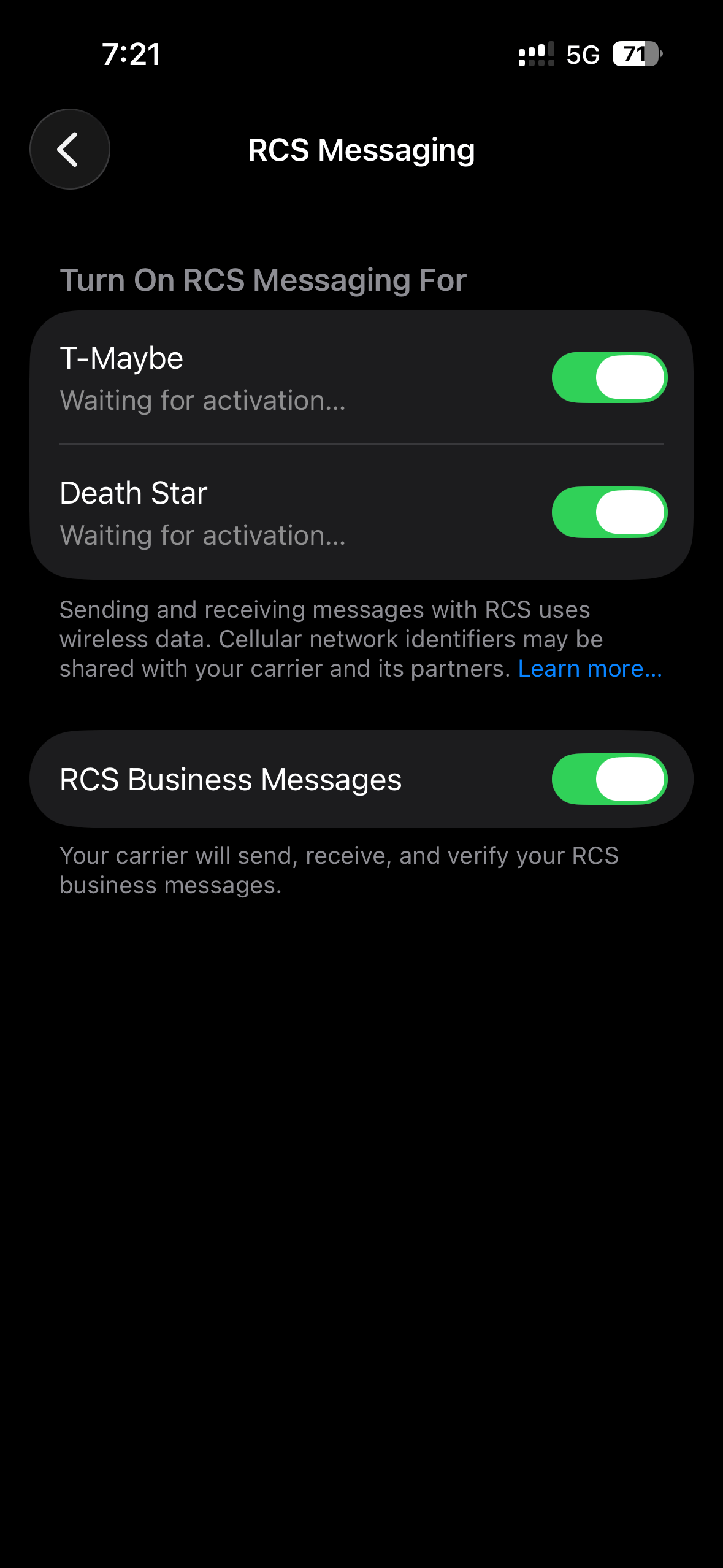
So it is entirely plausible that they banned the device, I guess. (Or they could have banned the IMEI, as mentioned)
Which means a lot of people actively don't want it and have turned it off or not elected to turn it on when setting up a new phone. I got prompted to turn it on with my now S65 a while ago and said no (I just want basic works-everywhere simple SMS, thanks, for anything fancier I've got chat-app-de-jour. It got turned on anyway so I had to find the option and turn it back off.
I disabled RCS that day and never enabled it again.
RCS has the advantage of theoretically being able to get priority through the baseband, but if you're using Google's RCS servers rather than your carrier's, that's not going to work.
It's not a coincidence that RCS still requires carrier hardware and coordination, despite being an IP messaging protocol. It's also not a coincidence that the protocol did not feature E2EE, despite even student project protocols providing that.
sounds like a violation of net neutrality
I'm not a lawyer, though, so who knows.
I’d assume this isn’t the issue here but RCS seems to be a bit fickle.
I was going to make the MMS section of this post about the 'ISIS Wallet' boondoggle that is the closest business parallel I can think of to RCS and actually did require specialized hardware support. Same 3 carriers I've been trying RCS with on the iPhone tried to make a mobile payment wallet: https://en.wikipedia.org/wiki/Softcard They rebranded it to Softcard since the 'We support ISIS' branding aged like milk. Google Wallet competed and took over the assets, sort of like what happened with RCS.
For the specialized hardware... the SIM card needed to have an embedded secure element that handled the keys for the payment system and the phone needed to support connecting to that secure element on the SIM card. I think these started to hit the market in 2010 or so, and you would have had to have a SIM card new enough to support it, here's a pic of the T-Mobile one, I had one: https://www.tmonews.com/wp-content/uploads/2013/08/Screen-Sh...
Turns out that random people can add you to groups, send spam and from what I can see you can do nothing to prevent it. I've disabled it.
So don't fret too much about not having it.
In fact, I don't think I've ever received spam through RCS, but I have through MMS and even more so through SMS. Looking back at all the spam texts I've received in the past several months, every single instance was SMS/MMS. Not a single time of RCS.
RCS isn't a Google only thing. And it isn't an "app". It is disappointing that people don't understand that RCS is a great replacement for SMS/MMS.
Everything about the concept of a phone number is confusing to me. It's a string of digits that if someone guesses, they can activate the most active notification your phone has (ringing), at any time, no matter if you know them or not. Better yet, depending on your notification and MMS app settings, they might be able to make a dick pic appear on your lock screen on a whim - big spammers of this seem to get marked by the carriers and apps pretty quickly, but for a more targeted one off, still easy.
As opposed to tcp/IP based chat apps that basically require a bilateral human-initiated handshake before someone can message you...
And there is one singular app which supports RCS.
In many ways, it's a regression from SMS. In that SMS is somewhat universal, and RCS is so specialized it's almost worthless.
No one gave a crap about RCS and no one was supporting it until Google decided that they needed a new chat app because they hadn't made everyone switch in a while.
Have you tried to restore a backup? You cant, unless it is uploaded to google cloud. No google account, no backup. (including the adress book that's tied to the account, since you are asking, they changed restore rules recently)
Have you tried denying adress book access? Whatsapp barrs you from starting a conversation. But there is the workaround with https://wa.me/+phone ...except for WhatsApp web
Have you ever tried putting Whatsapp in an Android work profile? Now try to export a chat!
Every once in a while a get the task to save all pictures of a conversation and it is usually a pain (If you think its easy, try again in Androids work profile).
From a UX perspective I would never mourn WhatsApp
https://www.reddit.com/r/GoogleMessages/comments/1be8gxk/fix...
This is how I feel about SMS, and phone numbers too for that matter. They're still around for historical reasons, but if we started anew, I can't imagine we would build out that infrastructure separately from the greater internet, and if we would have, I can't think of a reason why.
The spec also handles video calls, conference calls, sending/receiving money, and just about anything else a modern messenger does.
It just lacked E2EE for the longest time, which makes sense when you consider that the police and secret service have their tendrils in the standards body that publishes the spec.
Synchronisation is not part of the problem it's trying to solve (sending messages between devices), the same way SMS and MMS don't, so that's up to the apps implementing the protocol.
E2EE has been added very recently (https://www.gsma.com/solutions-and-impact/technologies/netwo... came out a few months ago), and post-quantum encryption is still being developed. It uses standard MLS (RFC 9420) for messaging, so verification will have to be implemented however normal MLS implementations do it. I don't know if there's a standardised way to do it, I haven't fully read the most recent RCS spec yet.
I oversimplified RCS somewhat, it's not just HTTP wrapped in carrier stuff. It's also SIP, SDP, XML, OIDC, RTP, and JSON wrapped in carrier stuff. Still, page 428 of the second link shows an example of a POST request that you can make after combining all of the tidbits of specification that came before it, and that's where the simple JSON+XML shine through the stack of protocols that are tasked with delivering it. The E2EE layer is basically just sending base64'd encrypted messages over that same interface.
I still hope for a protocol to win out that's not tied to one party.
Not to mention that the choice isn't really between your carrier and Meta, but rather Google and Meta, since most people on Android end up just using Google servers for RCS, and that choice is much more of a toss-up.
It's patently ridiculous to trust the Signal Foundation more than phone carriers? I wasn't aware that AT&T and T-Mobile are run for the benefit of humanity.
Any app that implements RCS is run by gigantic corporations, most of which I'd argue are closer to the US government than even Meta, it's not obvious to me where the ridicule comes in.
I’ve been using US Mobile myself for a little over a year, and I remember a period of about 2-3 months where most carriers had implemented RCS for iOS on their services, but US Mobile had not, so I couldn’t use RCS for a while. I don’t know what they had to implement to get RCS working on iOS, but it’s possible that their implementation does not work with iOS 26.
That skips the carrier nonsense, and it also means that for iPhone users they're not actually running on google jibe servers.
Thing is. Apple won't do this. Malicious compliance and all.
Also, the idea of wanting the carriers more involved in messaging is hilarious, just use one of the 10+ 100x better messaging platforms. The carries horribly bungled SMS/MMS and they ceded all control of RCS to google, why in the world would anyone want them involved. They barely can do their jobs as dumb pipes.
Is Google following that with Google Messages? We have no way to verify! How great for everyone.
And this is what I find so galling, it took them to version 3.0 to decide to do that?
My quick googling shows:
v1: 2016
v2: 2017
v3: 2025
So, yes "by default" in the current year it supports it but no one (including google) is using 3.0 yet. Apple has pledged to do it in iOS 26 (currently using 2.4) and Google has some proprietary e2ee on top of 2.6.
It's just all a mess, the furthest thing possible from an "open standard" (not saying anyone claimed it was, that's just what I would have prefered if we were trying to replace SMS/MMS), and hopelessly behind all other messaging platforms.
I believe they can't. RCS is implemented over IMS (IP Multimedia Subsystem), part of the mobile carrier infra and tightly tied to them (SIM card auth, APN settings pushed from the operator, etc)
... unless they become a mobile operator
Once spent 5 hours on the phone with an iMessage developer in Ireland helping them debug the issue.
At that time, we didn't have eSIM so I ended up with an Android phone for roaming and my iPhone for home country.
Many months later I got an update from Apple. It was something to do with activation. iOS used to send a hidden SMS to a server in the UK and sometimes while roaming it would time out.
It's quite the nice surprise because it's a technology you heard about years ago and now suddenly it crops up in daily life. We all gave up on it years ago too and used other IM apps like Signal, Briar or SimpleX.
In both aspects, RCS is at most cosplaying, to say nothing of using phone numbers as the primary identifier.
I’ll gladly welcome any blunder by its proponents, as it gives more people the chance to realize this.
However, I found that Apple have screwed another part of Lockdown Mode as of 18.7.2.
If a website makes use of Javascript, and is viewed in Safari then the page reloads a couple of times then crashes with no content but an error message. That can generally be fixed by turning off Javascript in Settings, or by turning off Lockdown mode for that specific web page - rather defeating its purpose.
This has been a problem (for others) for years and apparently nobody knows why or how to fix it. So go through a checklist of disabling, uninstalling, clearing, removing, inserting, restarting, updating, toggling, calling, waiting, praying.
I don't know or frankly care where the problem is but it has made me swear off RCS completely. iMessage works and SMS gets the job done when I can't use iMessage.
I know why Google is pushing RCS so hard, but that alone should be concerning.
Also the idea that anyone can send messages to anyone without permission is ridiculous. Made specially for spammers and scammers.
If phone makers want an universal message exchange standard, it should be encrypted and completely ignore telecoms interests.
https://clip.cafe/detroit-rock-city-1999/we-must-get-the-cop...
Now, if iMessage was broken, apple would surely care.
I also wonder what they're using (protocol) under the hood that lags behind other chat clients like Telegram and Signal and WhatsApp. It works, but I wonder how/if it'll continue to scale and stay competitive.
The protocol and the service behind it are state-of-the-art, but it's a tough sell if you're coming from something that just works on every device, like iMessage or WhatsApp.
I do receive spam in Signal, because i had to register a phone number.
I loose my chat history if I do not log into the desktop client for FIXNUM days.
The desktop client may crash as soon as you kill its supporting terminal.
I have tried the user name feature once and signal reported, that they had lost my username, I would need to create a new one.
I have not tried backup and restore. So far I am not in the mood for a potential failure.
This thread was depressing to me — I can't believe we're still dealing with the lack of a truly open near universally used secure messaging system.
I bridge signal to matrix on my homeserver using signal-mautrix: https://github.com/mautrix/signal
This allows me to use different phones without going through transfer/wipe. Still needs a primary device though, which was the iPhone until yesterday.
No sir, this isnt crazy, the problem is that we're paying for a service that isnt accountable for their issues.
Thats crazy.
Once again there's no direct business relationship between Google Jibe and me. The carriers ceded monopoly control to Google Jibe, at that point they have effectively become a wholesale utility; for the US market at least. Internationally this may not be the case.
Apple is adamant to say they don't handle running RCS and there's nothing to suggest in the phone logs that they do anything but connect to carrier, verify RCS provisioning from the carrier, and then try to activate on jibecloud.net and (mis)handle the response from it.
So from my view: Jibe is a black box that customer facing Apple employees are not even aware exists for RCS and the only way to handle a device Jibe service doesn't like is to replace it or swap the board, since they can't troubleshoot it. I can't see Google's documentation and my guess is carriers only handle the initial provisioning to communicate to Jibe that <blank> phone number on <blank> IMEI/IMSI should be allowed to register presence on Jibe. Just like I was able to reset my phone's state by wiping the esims and factory resetting, Jibe should have such an accessible function from either the carrier's end or Apple's end.
I actually forgot to mention in the post that I tried https://messages.google.com/disable-chat weeks ago on both numbers and then waiting days after before re-enabling. Didn't work, and transferring the lines to other phones after would activate on RCS within seconds.
For things like SMS/MMS servers, SIP servers, and other carrier infrastructure, carriers still like to run this stuff themselves. For RCS this was also the case a decade ago, but then RCS died an unceremonious death when third party messengers ate its lunch and carriers failed spectacularly trying to advertise "joyn".
Jibe is a black box that must follow the RCS specification. It's your carrier's responsibility to make that work. As long as Apple is following the RCS spec, they're right in saying it's not their problem. Your carrier should be telling Google to fix their shit.
Funny, I more or less said a few weeks ago that SIM cards do not guarantee freely being able to swap numbers between phones more than eSIMs do, because the carrier could tie the SIM's phone number to the IMEI in the backend either way. That was just kinda dismissed as a not being a real threat... and yet here it seems exactly what's happened for the RCS part of your service!
I mean, most of the world just uses WhatsApp (with the notable exception of the US which for some reason likes iMessage).
RCS is as crappy as SMS or MMS because it give carriers a say in the matter.
Interoperability should have just used plain old IP based protocols, having carriers in the mix is just asking for trouble.
SMS/MMS is simply terrible to use, but at least it follows the normal "my carrier sends messages to your carrier" approach. The alternative "my carrier sends messages to Facebook to send messages to your carrier" flow adds an unnecessary middle-man, most of which will sell your data.
Whatsapp provides metadata about my social profile and my active ours of the day to Facebook/Meta.
Carrier text message available is a bonus to me.
But since all the networks since 4G, there is no more low-level network support for things like SMS. Everything, including voice and messages, is IP- and packet-based. So the only thing the carrier does anymore is to authenticate that IP connection through your SIM card and bind your identity to the phone number. It actually doesn't really matter if messages are "network native" or through a third-party app, there is no more guaranteed timeslot and reliable delivery that SMS used to have.
And nowadays, RCS is also outsourced to Google by basically every carrier.
So RCS is the same as WhatsApp et al., only that the app you are using doesn't tell you that Google will monitor all your communications in addition to the monitoring your carrier does...
Google botched up RCS a bit in order to get it momentum, but plenty of carriers do support RCS natively as that's the only way Apple did it with iOS. Google did at least push E2EE options, but those only landed in GSM with RCS Universal Profile 3.0 and I don't think Apple has given a date for when they will support that profile on iOS. That is to say, the problems here are not inherent to RCS itself but the typical adoption and rollout problems of communication protocols.
All that aside, I'd gladly sacrifice the federated service provider flow if there were actually an equally popular federated solution to latch on to with full fallback capability to aid the remaining transition (+ the protocol actually be designed with radio power saving in mind). It's just RCS is by far the closest thing to that full package vs any other generic data messaging service.