Inside Rust's std and parking_lot mutexes - who wins?
A teardown of Rust's mutex internals plus real benchmarks so you know when to choose std or parking_lot.
blog.cuongle.dev
204 points · by signa11 · 1y ago · 130 comments
From https://github.com/rust-lang/rust/issues/93740
> One of the problems with replacing std's lock implementations by parking_lot is that parking_lot allocates memory for its global hash table. A Rust program can define its own custom allocator, and such a custom allocator will likely use the standard library's locks, creating a cyclic dependency problem where you can't allocate memory without locking, but you can't lock without first allocating the hash table.
> After some discussion, the consensus was to providing the locks as 'thinnest possible wrapper' around the native lock APIs as long as they are still small, efficient, and const constructible. This means SRW locks on Windows, and futex-based locks on Linux, some BSDs, and Wasm.
> This means that on platforms like Linux and Windows, the operating system will be responsible for managing the waiting queues of the locks, such that any kernel improvements and features like debugging facilities in this area are directly available for Rust programs.
Note that the SRW Locks are gone, except if you're on a very old Windows. So today the Rust built-in std mutex for your platform is almost certainly basically a futex though if it is on Windows it is not called a futex and from some angles is better - the same core ideas of the futex apply, we only ask the OS to do any work when we're contended, there is no OS limited resource (other than memory) and our uncontended operations are as fast as they could ever be.
SRW Locks were problematic because they're bulkier than a futex (though mostly when contended) and they have a subtle bug and for a long time it was unclear when Microsoft would get around to fixing that which isn't a huge plus sign for an important intrinsic used in all the high performance software on a $$$ commercial OS...
Mara's work (which you linked) is probably more work, and more important, but it's not actually the most recent large reworking of Rust's Mutex implementation.
What is it called?
Presumably you're referring to this description, from the Github Issue:
> > On most platforms, these structures are currently wrappers around their pthread equivalent, such as pthread_mutex_t. These types are not movable, however, forcing us to wrap them in a Box, resulting in an allocation and indirection for our lock types. This also gets in the way of a const constructor for these types, which makes static locks more complicated than necessary.
pthread mutexes are const-constructible in a literal sense, just not in the sense Rust requires. In C you can initialize a pthread_mutex_t with the PTHREAD_MUTEX_INITIALIZER initializer list instead of pthread_mutex_init, and at least with glibc there's no subsequent allocation when using the lock. But Rust can't do in-place construction[1] (i.e. placement new in C++ parlance), which is why Rust needs to be able to "move" the mutex. Moving a mutex is otherwise non-sensical once the mutex is visible--it's the address of the mutex that the locking is built around.
The only thing you gain by not using pthread_mutex_t is a possible smaller lock--pthread_mutex_t has to contain additional members to support robust, recursive, and error checking mutexes, though altogether that's only 2 or 3 additional words because some are union'd. I guess you also gain the ability to implement locking, including condition variables, barriers, etc, however you want, though now you can't share those through FFI.
[1] At least not without unsafe and some extra work, which presumably is a non-starter for a library type where you want to keep it all transparent.
https://pubs.opengroup.org/onlinepubs/9699919799/functions/V...
I.e., if I pthread_mutex_init(&some_addr, ...), I cannot then copy the bits from some_addr to some_other_addr and then pthread_mutex_lock(&some_other_addr). Hence not movable.
> Moving a mutex is otherwise non-sensical once the mutex is visible
What does "visible" mean here? In Rust, in any circumstance where a move is possible, there are no other references to that object, hence it is safe to move.
And other than during construction or initialization (of the mutex object, containing object, or related state), how common is it in Rust to pass a mutex by value? If you can pass by value then the mutex isn't (can't) protect anything. I'm struggling to think of a scenario where you'd want to do this, or at least why the inability to do so is a meaningful impediment (outside construction/initialization, that is). I understand Rust is big on pass-by-value, but when the need for a mutex enters the fray, it's because you're sharing or about to share, and thus passing by reference.
On my Linux system today Rust's Mutex<Option<CompactString>> is smaller than the pthread mutex type whether it is locked and has the text "pthread_mutex_t is awful" inside it or maybe unlocked with explicitly no text (not an empty string), either would only take like 30-odd bytes, the pthread_mutex_t is 40 bytes.
On Windows the discrepancy is even bigger, their OS native mutex type is this sprawling 80 byte monster while their Mutex<Option<CompactString> is I believe slightly smaller than on Linux even though it has the same features.
Whereas parking_lot has a ton of problematic scenarios, where after the spinlock times out, and it yields the thread to the OS, which has no idea to wake up the thread after the resource is unblocked.
It could be even argued that preventing starvation is outside the design scope of the Mutex as a construct, as it only guarantees mutual exclusion and that the highest priority waiting thread should get access to it.
A simple native lock in the standard library along with a nicer implementation (also in the standard library) that depends on the simple lock?
I doubt `parking_lot` would have been broadly used—maybe wouldn't even have been written—if `std` had this implementation from the start.
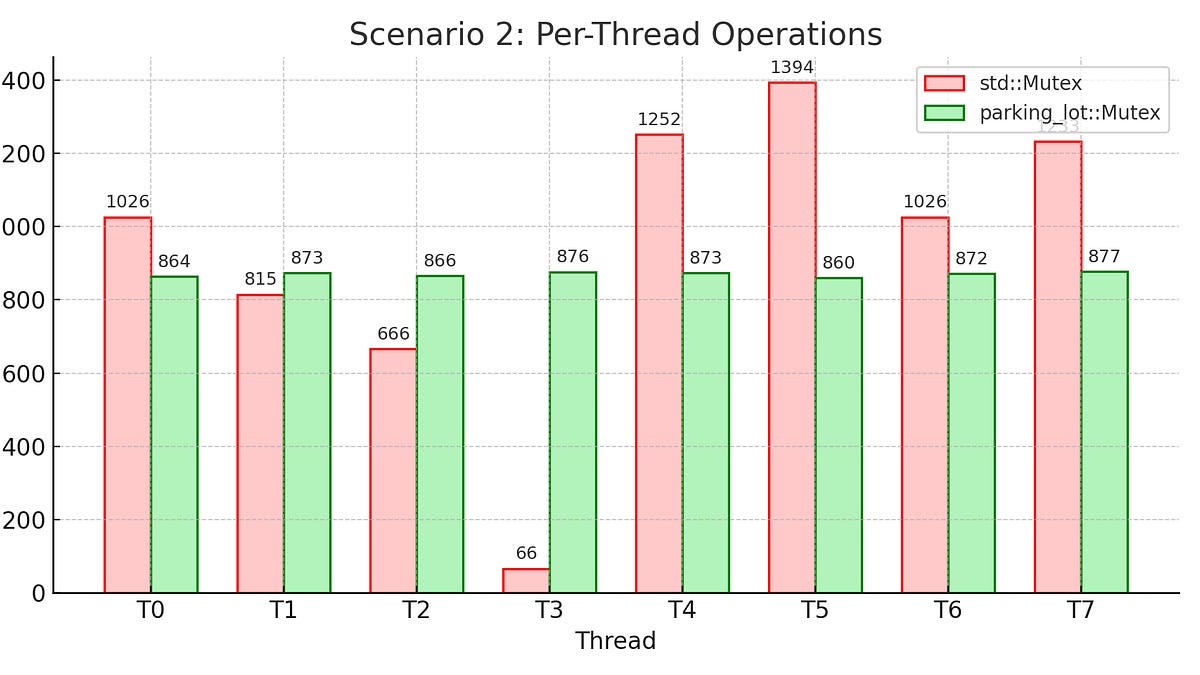
What specifically in this comparison made you think that `parking_lot` is broadly needed? They had to work pretty hard to find a scenario in which `parking_lot` did much better in any performance metrics. And as I alluded to in another comment, `parking_lot::Mutex<InnerFoo>` doesn't have a size advantage over `std::mutex::Mutex<InnerFoo>` when `InnerFoo` has word alignment. That's the most common situation, I think.
If I were to make a wishlist of features for `std::mutex` to just have, it wouldn't be anything `parking_lot` offers. It'd be stuff like the lock contention monitoring that the (C++) `absl::Mutex` has. (And at least on some platforms you can do a decent job of monitoring this with `std::mutex` by monitoring the underlying futex activity.)
I’m surprised that this only compared to std on one platform (Linux).
The main benefit of parking lot is that it makes locks very small, which then encourages the use of fine grained locking. For example, in JavaScriptCore (ParkingLot’s first customer), we stuff a 2-bit lock into every object header - so if there is ever a need to do some locking for internal VM reasons on any object we can do that without increasing the size of the object
IMHO that's a very cool feature which is essentially wasted when using it as a `Mutex<InnerBlah>` because the mutex's size will get rounded up to the alignment of `InnerBlah`. And even when not doing that, afaict `parking_lot` doesn't expose a way to use the remaining six bits in `parking_lot::RawMutex`. I think the new std mutexes made the right choice to use a different design.
> I’m surprised that this only compared to std on one platform (Linux).
Can't speak for the author, but I suspect a lot of people really only care about performance under Linux. I write software that I often develop from a Mac but almost entirely deploy on Linux. (But speaking of Macs: std::mutex doesn't yet use futexes on macOS. Might happen soon. https://github.com/rust-lang/rust/pull/122408)
[1] e.g. https://internals.rust-lang.org/t/pre-rfc-allow-array-stride...
In principle, you Rust could create something like std::num::NonZero and its corresponding sealed trait ZeroablePrimitive to mark that two bits are unused. But that doesn't exist yet as far as I know.
Which is fine since in Rust we almost always have the mutex in function scope as long as we're using it.
Yeah this is true
Rust in general doesn't support bit-level objects unless you cast things to [u8] and do some shifts and masking manually (that is, like C), which of course is wildly unsafe for data structures with safety invariants
Post that mentions the two bit lock: https://webkit.org/blog/7122/introducing-riptide-webkits-ret...
I don’t know the details of the Rust port but I don’t imagine the part that involves the two bits to require unsafe, other than in the ways that any locking algorithm dances with unsafety in Rust (ownership relies on locking algorithms being correct)
I'm a bit disappointed though, I assumed that you had a way of only using 2 bits of an object's memory somehow, but it seems like the lock takes a full byte?
https://docs.rs/parking_lot/0.12.5/parking_lot/struct.RawMut...
(unless there's somewhere else in the crate that provides an accessor for this but that'd be a weird interface)
(or you just use transmute to "know" that it's one byte and which bits within the byte it actually cares about, but really don't do that)
(slightly more realistically, you could probably use the `parking_lot_core::park` portion of the implementation and build your own equivalent of `parking_lot::RawMutex` on top of it)
(or you send the `parking_lot` folks a PR to extend `parking_lot::RawMutex` with interface you want; it is open source after all)
This is one of the biggest design flaws in Rust's std, in my opinion.
Poisoning mutexes can have its use, but it's very rare in practice. Usually it's a huge misfeature that only introduces problems. More often than not panicking in a critical section is fine[1], but on the other hand poisoning a Mutex is a very convenient avenue for a denial-of-service attack, since a poisoned Mutex will just completely brick a given critical section.
I'm not saying such a project doesn't exist, but I don't think I've ever seen a project which does anything sensible with Mutex's `Poisoned` error besides ignoring it. It's always either an `unwrap` (and we know how well that can go [2]), or do the sensible thing and do this ridiculous song-and-dance:
    let guard = match mutex {
        Ok(guard) => guard,
        Err(poisoned) => poisoned.into_inner()
    };
So in a lot of projects when I need a mutex I just add `parking_lot`, because its performance is stellar, and it doesn't have the poisoning insanity to deal with.
[1] -- obviously it depends on a case-by-case basis, but if you're using such a low level primitive you should know what you're doing
[2] -- https://blog.cloudflare.com/18-november-2025-outage/#memory-...
If a mutex has been poisoned, then something must have already panicked, likely in some other thread, so you're already in trouble at that point. It's fine to panic in a critical section if something's horribly wrong, the problem comes with blindly continuing after a panic in other threads that operate on the same data. In general, you're unlikely to know what that panic was, so you have no clue if the shared data might be incompletely modified or otherwise logically corrupted.
In general, unless I were being careful to maintain fault boundaries between threads or tasks (the archetypical example being an HTTP server handling independent requests), I'd want a panic in one thread to cascade into stopping the program as soon as possible. I wouldn't want to swallow it up and keep using the same data like nothing's wrong.
One can make a panic wrapper type if they cared: It's what the stdlib Mutex currently does:
MutexGuard checks if its panicking during drop using `std::thread::panicking()`, and if so, sets a bool on the Mutex. The next acquirer checks for that bool & knows state may be corrupted. No need to bake this into the Mutex itself.
The design with a verbose ".lock().unwrap()" and no easy opt-out is unfortunate, but conceptually, I see poisoning as a perfectly acceptable default for people who don't spend all their time musing over panics and their possible causes and effects.
I find that in the majority of cases you're essentially dealing with one of two cases:
1) Your critical sections are tiny and you know you can't panic, in which case dealing with poisoning is just useless busywork.
2) You use a Mutex to get around Rust's "shared xor mutable" requirement. That is, you just want to temporarily grab a mutable reference and modify an object, but you don't have any particular atomicity requirements. In this case panicking is no different than if you would panic on a single thread while modifying an object through a plain old `&mut`. Here too dealing with poisoning is just useless busywork.
> I'd want a panic in one thread to cascade into stopping the program as soon as possible.
Sure, but you don't need mutex poisoning for this.
Many people underestimate how many things can panic in corner cases. I've found quite a few unsafe functions in various crates that were unsound due to integer-overflow panics that the author hadn't noticed. Knowing for a fact that your operation cannot panic is the exception rather than the rule, and while it's unfortunate that the std Mutex doesn't accomodate non-poisoning mutexes, I see poisoning as a reasonable default.
(If Mutex::lock() unwrapped the error automatically, then very few people would even think about the "useless busywork" of the poison bit. For a similar example, the future types generated for async functions contain panic statements in case they are polled after completion, and no one complains about those.)
> 2) You use a Mutex to get around Rust's "shared xor mutable" requirement. That is, you just want to temporarily grab a mutable reference and modify an object, but you don't have any particular atomicity requirements.
Then I'd stick to a RefCell. Unless it's a static variable in a single-threaded program, in which case I usually just write some short wrapper functions if I find the manipulation too tedious.
While we're at it, another thing that'd be nice to get rid of is `AssertUnwindSafe`, which I find even more pointless.
[1] https://sunshowers.io/posts/cancelling-async-rust/#the-pain-...
This is completely banned in all of my projects. I have a 100k+ LOC project running in production, that is heavily async and with pervasive usage of threads and mutexes, and I never had a problem, precisely because I never hold a mutex across an await point. Hell, I don't even use async mutexes - I just use normal synchronous parking lot mutexes (since I find the async ones somewhat pointless). I just never hold them across await points.
In 99% of the cases where one thread has panic'd while holding a lock, you want to panic the thread that attempts to grab the lock. The contents of anything inside the lock is very much undefined and continuing will lead to unpredictable results. So most of the time you just want:
let guard = mutex.lock().expect("poisoned");
let guard = mutex.lock().unwrap_or_else(|poison| poison.into_inner());
This might be the case for long running server processes where you have n:m threading with long running threads and want to keep processing other requests even if one request fails. Although in that case you probably want (or your framework provides) some kind of robustness with `catch_unwind` that will log the errors, respond with HTTP 500 or whatever and then resume. Because that's needed to catch panics from non-mutex related code.
There's a tension between making DoS hard and avoiding RCE vulnerabilities, since the way to avoid an unplanned/bad code state becoming an RCE vulnerability is to crash as quickly and thoroughly as possible when you get into that state.
I had a case where if the mutex was poisened it was possible to reset the lock to a safe state (by writing a new value to the locked content).
Or you may want to drop some resource or restart some operation instead of panicing if it is poisoned.
But I agree that the default behavior should be that the user doesn't have to worry about it.
Is it safe to ignore poisoned mutexes if and only if the relevant pieces of code are unwind-safe, similar to exception safety in C++? As in, if a panic happens, the relevant pieces of code handles the unwinding safely, thus data is not corrupted, and thus ignoring the poison is fine?
I mean, think about the actual use cases here. On of my threads just panicked. Does it make sense to continue running the application? And if you answer yes, this is an error condition that can occur, then it shouldn't panick to begin with and instead handle errors gracefully, leaving the mutex unpoisoned.
Unfortunately, you sacrifice the priority inversion avoidance you would otherwise get with os_unfair_lock.
*: You may be, since you are using Rust.
Sharing as little mutable state as possible is often the best way to scale to a large number of CPU cores. RCU can help with that if you have data that is mostly read but rarely written. If your workload is balanced or even write heavy RCU is probably not a good option.
I have even had to redesign because I had too much contention on plain old atomic reference counters, almost 30 % of my runtime was reference counting of a small number of specific Arcs, and hardware performance counters pointed at cache line contention. I redesigned that code to avoid Arcs entirely which also allowed some additional optimisations, resulting in cutting approximately 40 % of my runtime in total.
So, each specific use case should be approached individually if you care about performance. And always profile and benchmark. If the code isn't performance critical, by all means do what you think is most maintainable. But measure, because you are probably wrong about what part of your code is the bottleneck unless you measure.
And how do you rewrite that code away from Arc-s?
Consider a simple case of single producer-single consumer. While one can use bounded channels to implement back-pressure, in practice when one wants to either drop messages or apply back-pressure based on message priority any solution involving channels will lead to pile of complex multi-channel solutions and select. With mutex the change will be a straightforward replace of a queue by a priority queue and an extra if inside the mutex.
In general the problem with channels is that they are not flexible enough while being rather abstract. A better abstraction is message passing with one message queue per thread like in Erlang. IMO it can cover more cases before one needs mutexes. But even with that proper back pressure and rate limiting is hard.
In C++ a mutex can wrap the object being protected.
One reason not to provide the owning mutex in C++ is that it isn't able to deliver similar guarantees to Rust because its type system isn't strong enough. Rust won't let you accidentally keep a reference to the protected object after unlocking, C++ will for example.
    #include <iostream>
    #include <mutex>
    #include <thread>

    class SharedResource {
    private:
        int value;
        std::mutex mtx;

    public:
        SharedResource() : value(0) {}

        void setValue(int newValue) {
            std::lock_guard<std::mutex> guard(mtx);
            value = newValue;
        }

        int getValue() {
             std::lock_guard<std::mutex> guard(mtx);
             return value;
       }
   };

   void threadFunction(SharedResource& resource) {
       resource.setValue(42);
      std::cout << "Value: " << resource.getValue() <<   std::endl;
    }

    int main() {
        SharedResource resource;
        std::thread t1(threadFunction, std::ref(resource));
        std::thread t2(threadFunction, std::ref(resource));

        t1.join();
        t2.join();

       return 0;
}In C++, a class like std::lock_guard also provides "Automatic unlock". AFAICT, the article argues that only Rust's API provides that.
    {
        const std::lock_guard<std::mutex> lock(mtx);
        account.balance -= amount;
        account.transaction_count++;
} // Automatically unlocked.The issue isn't automatic unlocking. From the article:
> The problem? Nothing stops you from accessing account without locking the mutex first. The compiler won’t catch this bug.
i.e., a C++ compiler will happily compile code that modifies `account` without taking the lock first. Your lock_guard example suffers from this same issue.
Nothing in the C++ stdlib provides an API that makes it impossible to access `account` without first taking the lock, and while you can write C++ classes that approximate the Rust API you can't quite reach the same level of robustness without external help.
The article wrote:
> Automatic unlock: When you lock, you receive a guard. When the guard goes out of scope, it automatically unlocks. No manual cleanup needed.
And presented Rust as being different from C++ regarding that, and the C++ example was not idiomatic, since it did not use something like std::lock_guard.
I have not addressed the rest of your comment, since it is a different topic, sorry.
Nothing too surprising.
Sourcing VS, documentation indicates Python, C/C++, GitHubCopilot, and an Extension Pack for Java in top extensions.