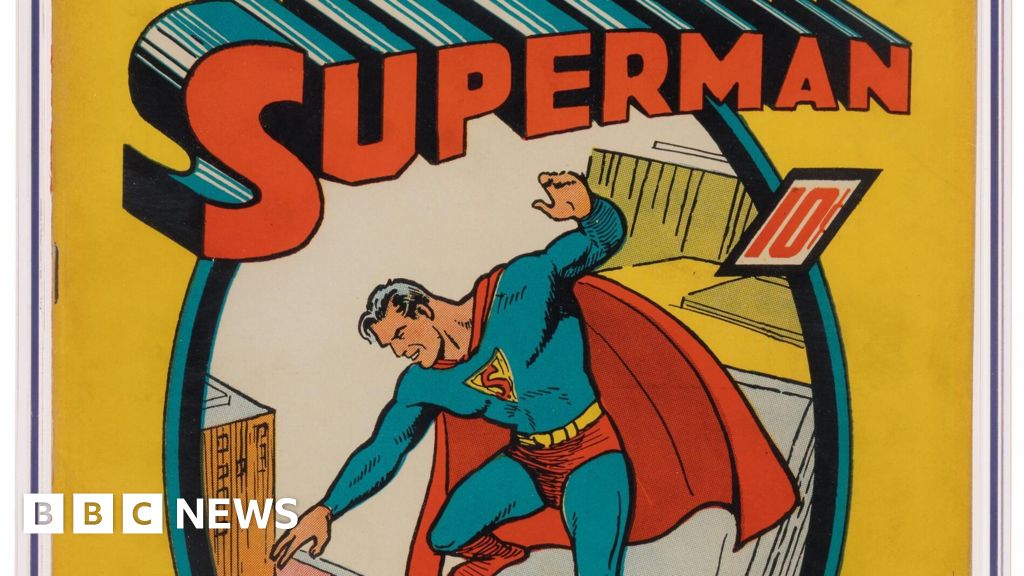
Superman edition found in mum's attic is most valuable comic ever at $9.12m
It's a bird! It's a plane! It's a new record after Man of Steel comic found in a California home is auctioned.
bbc.com
326 points · by 1659447091 · 1y ago · 207 comments
"This is a testament to memory, family and the unexpected ways the past finds its way back to us." """ Men going extreme in sentimental when they just sold a $9M collectible :).
This is a testament to outsourcing, laziness and the unexpected ways technology finds ways to change every press release.”
Most (all?) keyboards I've used only have a combined hyphen‐minus key (-) which is distinct from a dash (—) and isn't quite a hyphen (‐), so I get why most people don't care. All font dependent as well to add to the fun, and my examples here render differently in the textbox and the comment!
Person A: “We’re going to be so rich.”
Person B: “How many times do I have to tell you? It’s not about the money.”
Person A: “It’s about all the things we’ll be able to buy with it.”
Person B: “Exactly.”
-We're not doing this for the money... -... we're not? -We're doing this for a SHITTON of money!
https://www.ha.com/heritage-auctions-press-releases-and-news...
Even the same time and same day of the week there will never be exactly the same set of users online, and that’s even more true with regard to the users who are choosing to look at HN’s /newest page. So pure luck can determine whether a bunch of comic book lovers see it soon after submission and give it enough votes to get on HN’s front page, or just a bunch of people who think it’s a boring story worth ignoring.
(Personally I thought it sounded like it might have interesting comments worth reading, hence my being here, but I wouldn’t have found it interesting enough to upvote if I were one of the people who saw it on the new submissions page.)
I have had that happen multiple times as well, but those are usually the ones I posted because I am interested in the thoughtful/knowledgeable comments that happen -- so it works out either way. I assume it's because my main source being BBC -- even though the website has a good variety of interesting (non-headline news) content that is well sourced/linked -- but also because I usually end up posting during odd/off-hours for US central. Think most of the ones I post that gain any traction had ended up in the 2nd chance pool.
This one was a bit of an anomaly for me on how quickly it picked up -- personally thought the one I posted before it was a little more interesting about Rolls-Royce finding ways to limit sand/dust from damaging jet-engines, but this here is Superman after all
That’s how we roll.
The results are likely to be that all HN front page stories will eventually be LLM-sourced.
I’m not entirely against that, if the scripts do a good job of selecting stories.
Not the actual goal, of course the actual goal of Hacker News for many people is gaming SEO and startup juice.
That said, I don't doubt for a second you're right. Trust a forum of tech bros and nerds to minmax away what little joy there is left to posting here.
For the same item.
Crazy.
Heritage has great value. It is one of the few things that cannot be manufactured at will.
Also, since its uniqueness holds its value, its value becomes a "strange attractor". You can put a lot of money into one of these artifacts, fairly sure to get most or more back. Since future buyers will have a similar assurance. So it isn't money thrown away, but money stored in a medium the provides satisfaction and pride.
Not so different from buying real estate in some exclusive area for some crazy price. It really isn't that crazy if you are likely to get your money back later if you want. Likely at a higher amount due to a growing economy pushing prices up.
Crazy would be spending millions on something unique then grinding it up.
I did buy some concrete gargoyles created by a local artist, probably a replica of one from a European church. I mounted them on the driveway entrance to scare away unwanted visitors.
It’s interesting if you were thinking of the Salvator Mundi since the discrepancy between the initial appraisal and the restored sale price is two thousand times larger than your example. And it still goes to show the seemingly insane sale price was a good investment, first being sold for $80M by someone who knew he’d make a profit, then after that $120M, then $450M.
I.e. it's worth money because it's worth money.
Numbers of famous historical artists: roughly constant, increasing very slowly
Definition of famous: defined by sale price of work.
Sale price: defined by fame
Ascent to the list of famous/high sale price artists: under control.
Club: big
Your status: ain't in it.
The attribution to Leonardo is extremely dubious, but the whole thing seems to have been motivated as yet another attempt to wash the reputation of oil theocracies and their monarchs.
A more interesting example would be a convincing fake purported to be painted by a highly regarded artist who's still living and working today, and this does happen, too.
"I have a da Vinci at home."
Vs
(pointing at a picture on the phone) "I have this painting at home"
Which one impresses the other rich asshats more? Maybe even millions of dollars worth more.
Besides, I don't need to pay to test for it being legit. Just go to a bank.
If that was a true feeling, then they wouldn't sell it away as soon as they find it, as if it is something they must dispose off immediately.
Sales culture is turning all men into drama queens.
>The brothers found six comic books, including Superman #1, in the loft underneath a stack of newspapers inside a cardboard box and surrounded by cobwebs in 2024, Heritage said.
> They waited a few months before contacting the auction house, but once they did, Heritage Auctions vice-president Lon Allen visited them in San Francisco within days, according to the auction house.
>The brothers, who have chosen to withhold their names, are "in their 50s and 60s, and their mom had always told them she had an expensive comics collection but never showed them", Mr Allen said.
Men sounding too sentimental, emotional, girly, too much talking, making lots of facial expressions, trying to please or convince someone,... even though it is not hard it see it's fake. The talk was all about millions, not family silver.
I’m asking in general, since your original comment looked to be a general complaint and not only specific about this case.
Perhaps you meant to imply that it is society that pigeonholes men this way.
[1] https://www.nytimes.com/2025/11/14/world/europe/napoleon-dia...
What I am trying yo say: at least two collectors (?) or speculators (?) with deep pockets.
The cost of the reading copy would end up being less than the negative impact to the condition (and therefore value) of your mint copy from reading it a single time.
https://youtu.be/zw220bx88WA?si=vArVS22Oac02uNK5
I’d forgotten about prank monkey Homer.
With a little effort and research someone could come up with a reasonable estimate that read something like, “a typical 15-year-old reading through this comic once in a typical way would have cost the family X dollars”, and X might literally be $100k. Certainly well over $10k.
https://www.zipcomic.com/superman-1939-issue-1
And I dare say, someone spending 9 million clams on this comic book is more than likely going to have it sitting in a very UV-protected vault somewhere ..
EDIT: Sorry - I didn’t realize that zipcomic.com is infringing the copyright - adding this note to point that out, but I will maintain my original link as intended. Better to read it on DC Universe Infinite, if you have access, or maybe it’s available through Libby or Hoopla library apps.
I have a feeling this was scanned a while back, where resolution was a balance between even being able to store it digitally due to size.
If I was lucky enough to have to defend say a billion dollars from diluting over decades, a priceless comic sounds like a decent acquisition
Until they pass away and somebody finds it then puts it for sale, and so on...
While you could store your collectable in a vault, many people enjoy displaying their collectables.
[0] It’s still copyrighted, although it seems that will expire in a decade or so, though. I guess I’ll read it then.
It’s a bit hyperbolic. It’s a webpage of a comic book.
Les Poseuses Ensemble by Georges Seurat was sold for $149m. Very few people have heard of it, care about it, or even like it considering it's pointillism which no one buys modern versions of. The world of art and collectables is entirely rich people speculating that the price (not value) will go up in the future.
The same way a regular person might buy an autographed photo of a celebrity they like or something like that.
The entire NFT thing would work if it were restricted to things people want, even if that only amounts to bragging rights.
Somewhere along the way people lost track of the fact that being able to trade something doesn't denote value in itself
Whilst that may be true for the most part, much of the art dealt nowadays is never displayed, just stored somewhere incredibly tax efficient until it's value has gone up enough to warrant selling.
https://theswisstimes.ch/unlocking-the-secrets-of-the-geneva...
It seems unlikely that in that time frame it would have been a 5 digit purchase. It still may have been a significant proportion of liquid cash or net worth though. I think it'd be an interesting detail to have too.
Needless to say, I kept all my old comics.
I had seen football cards take off in value and really wanted to get into comic collecting. What I remember is the big comic books were just slightly outside the price range of a 10 year old cutting the lawn. Unlike baseball cards that cost thousands for HOF rookie cards.
I don't know how accurate it is but chatGPT gives prices that sound about right from what I remember looking at comic price guides in the 80s.
X-Men #1 $60–$150
The Incredible Hulk #1 $60–$120
Avengers #1 $80–$180
I never got to start my collection then I remember as a teenager thinking what a stupid idea it was anyway. Who the hell is ever going to be that into comic book characters?
Turns out a lot of 80s kids had the same idea!
https://en.wikipedia.org/wiki/Heritage_Auctions#Controversie...
it’s valuable for the same reason the mona lisa is valuable. it’s iconic, it is a singular object, it is one of a kind, it is a stable investment vehicle. they ain’t making more of them.
I always wonder exactly how difficult it would be to get the paper, ink, staples, etc exactly right. I'm sure it would be difficult but 9m is a big payoff if you can.
Even if you could duplicate it down to the molecule I would assume it wouldn't hold the same value since it doesn't have the same history. Assuming you'd want to sell it in good faith as a replica.
It's also not the first Superman comic, what about Action Comics #1?
Why is the Call of Cthulhu (Weird Tales, Feb 1928) about $50k?
Or in terms of characters, what makes Superman worth 3x more than MARVEL #1 or Batman?
Superman was arguably the first super-hero, and certainly the first successful/popular one. And Superman #1 is the first time a super-hero got their own dedicated comic book. It has long been generally considered the third-most desirable comic book issue in existence, after Action Comics #1 (first appearance of Superman) and Detective Comics #27 (first appearance of Batman).
This copy of Superman #1 was graded as a 9.0, which basically means it's like-new, despite being 86 years old. And it's naturally in that condition without ever undergoing restoration, which affects the value. Of all known unrestored copies of Superman #1, this copy is in the best condition.
That said, there are at least three known comic book copies that would be valued more highly: two known unrestored 9.0 copies of Action Comics #1, and one known unrestored 9.2 copy of Detective Comics #27. If any of those were to be sold at auction today, their value would almost certainly be a lot higher than $9 million, in part due to this Superman #1 auction setting a recent precedent.
[0] https://www.ha.com/heritage-auctions-press-releases-and-news...
> For decades, Allen says, nobody knew of a way to distinguish which copies came from that initial run. Then a grader noticed a key difference in a small in-house promotional spot advertising the upcoming Action Comics No. 14. In the first run, those ads included text reading “On sale June 2nd.” Subsequent print runs had updated it to “Now on sale.”
> their mum had always told them she had an expensive comic collection
And perhaps they would have too, had they not known! (Or the mother not known either.)
It almost feels like it's gambling, because it's a sentiment that leaks into modern collectibles, like card games.
I'm not saying people don't value collectibles, or value nostalgia, or that some of these things should be limited to niches - the reality is that I can't quite put it into words, but a lot of it seems propped up... Or it's a false game everyone is knowingly playing, like a big Ponzi scheme.
These superman copies, or the first editions of mtg, or even some modern vintage games, were never intended to be collectibles - people used them and played with them, created memories, and the production runs were really limited in comparison to modern day production runs, that make those items actually rare... Like few hundreds or thousands have survived in good condition - which is an achievement for toys, games and comics that get used a lot.
Nowadays people buy stuff with high production runs, they never even create memories with the stuff... They slab stuff into a "hermetic" container right away, and get it graded...
It just feels fake.
Again I don't doubt people see value in this stuff, I just feel like they're valuing for the wrong reasons, and I can't wrap my head around how is that even sustainable.
Who is going to value the memory of "remember when I bought 5 booster boxes and pulled card X from the pack, with gloves on, put it in a sleeve and sent it to be graded straight away? Now those were the days!"
It's like people want to compress the randomness of time and social behavior into a predictable cicle of months, with minimal effort and to extract the maximum value out of it.
Am I overthinking this?
I have a similar experience: a couple of years ago I started to dip my toes into the retrogaming collecting world, and at first it was fun to get all those games that I really wanted to have as a kid, but it soon devolved into trying to track down all those overpriced "rare" games. It got exhausting, and made wonder why am I even doing this? Why would I spend several hundreds on a game or a console that I didn't even knew about until one year ago, just because some random YouTube guy told me so?
Being a kid, really wanting a game or toy, finally getting it and then enjoying it to death was awesome; this is not. As you say, it doesn't feel right, so I have decided to quit.
There has been a number of investigative shows arguing the valuation of collectibles in general (comics included) is largely driven by money laundering.
Is it some kind of conspiracy theory of is this legit ?
I imagine a pristine 1st edition Tintin or Asterix would be quite valuable.