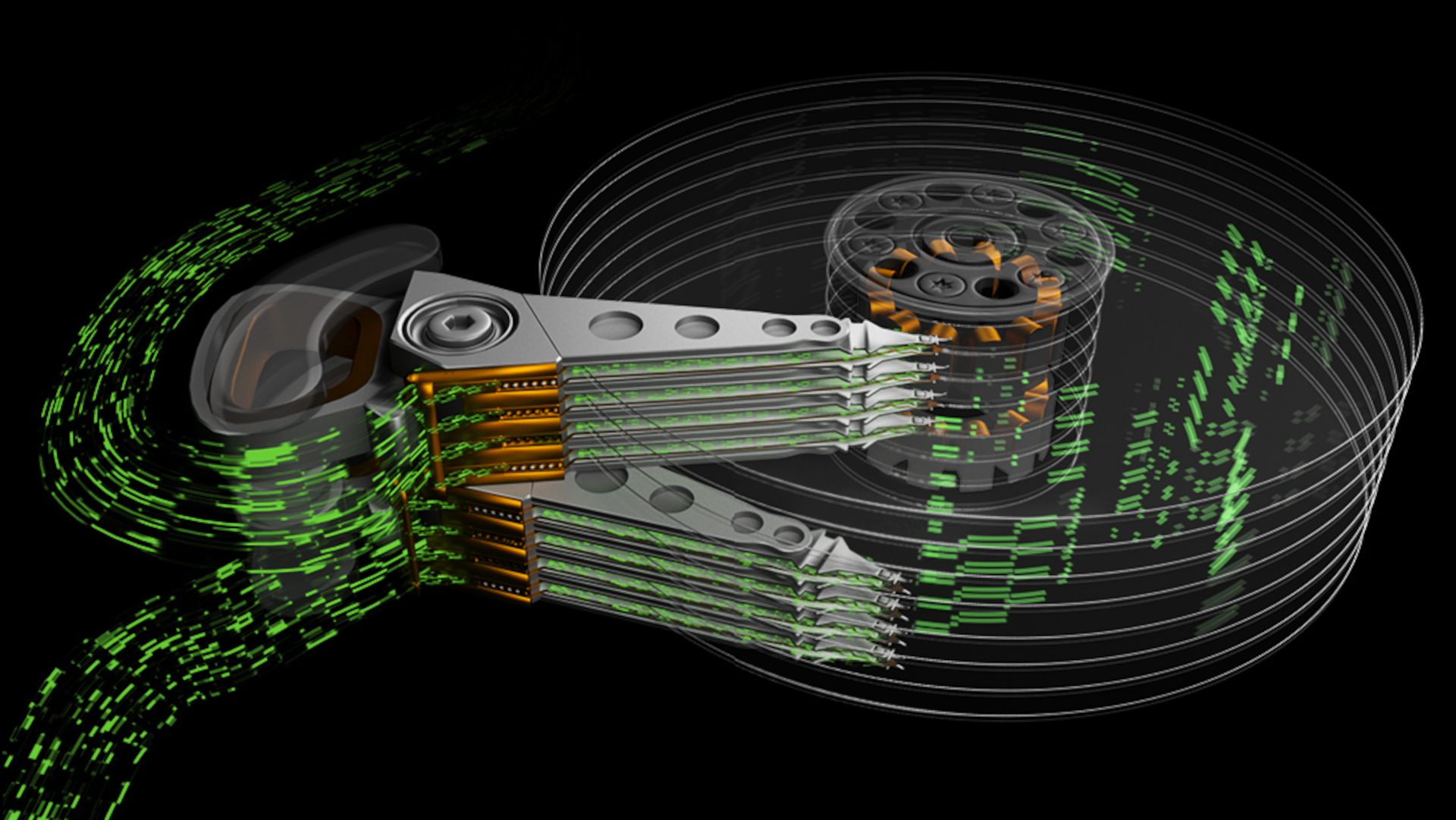
Seagate achieves a whopping 6.9TB storage capacity per platter in its laboratory — 55TB to 69TB hard drives now physically possible
Seagate is squeezing as much capacity out of its HAMR technology as it can
Tom
62 points · by elorant · 12mo ago · 48 comments
Wow so heat assisted magnetic recording is using heat to magnetically record data. Incredible explanation.
So, to write, zap the area with a laser to heat it up. The coercivity is lowered. This lets a weaker magnetic field work to magnetize the area. This allows packing more densely, as the weak field will not affect the neighbouring cooler and higher coercivity regions.
(I think.)
This is not the first time lasers have been used to write to magnetic media. Magneto-optical discs (e.g. Sony's MiniDisc) were erased using laser heat. (MO discs also were read with laser, the ferromagnetic material used had different optical properties depending on magnetization.)
Western Digital would like to have a word about shingled magnetic recording drives.
So very roughly, about 1 bit per square nanometre. Which unless I'm dropping an order of magnitude (very possible) is about 10 petabits per square centimetre, and with about 300 square centimetres for a 3.5" platter that's 3 exabits or so per side of platter.
Whether it will ever be possible to actually read or magnetize domains that small without interfering with the neighbouring domains is the question and no one knows. There have been several breakthroughs, like perpendicular recording, that have brought us much closer to the theoretical limit above, than anyone would have thought.
SSDs have a valuable place in the world, but so do spinning disks. Physical size isn't a concern for my nas (I mean, assuming we're talking < 300cm^3 for the whole setup..), but $/tb is.
There was literally a headline on the front page here a few days ago re: data degradation of SSDs during cold storage, as one example.
Or does the data decay there as well, just as a function of time since cells were written?
In other words, is this whole focus on "powered off" just a proxy for "written once" versus "live data with presumed turnover"? Or do the cells really age more rapidly without power?
Why is that? I'd have expected solid-state electronics to last longer at low temperatures.
Or is it precisely that, some near/superconductivity effects causing naughty electrons to escape and wander about?
SSD also has longer term data loss issues when unpowered. Magnetic disk is still better in that respect too.
See the 20TB+ Seagate external drives. People who just want the 3.5" SATA drives remove them from the plastic enclosure (they call it "shucking").
There are still deals to be found that are closish.
Microcenter has a 24tb external for $249 right now: https://www.microcenter.com/product/679395/seagate-24tb-expa...
amazon has a 22tb for $229 right now: https://www.amazon.com/Seagate-Expansion-22TB-External-Drive...
Those and my $189 price - which is definitely higher than I originally claimed, apologies - are all around $10/tb.
External Storage 26TB for $10.38/TB - Seagate Drive Internal Storage 24TB for $10.81/TB - Seagate Drive
SSD - $48.75 / TB Crucial !
Isn't 0.1TB a little too low? I'm sure if they only improved this little in 5 years the company would be in big trouble.
these 6.9TB platters are still in development and are not planned to be used for another 5 years.