The "Confident Idiot" Problem: Why AI Needs Hard Rules, Not Vibe Checks
We cannot fix probability with more probability. We need to re-introduce assert.
steerlabs.substack.com
324 points · by steer_dev · 11mo ago · 380 comments
LLMs don't do this. Instead, every question is immediately responded to with extreme confidence with a paragraph or more of text. I know you can minimize this by configuring the settings on your account, but to me it just highlights how it's not operating in a way remotely similar to the human-human one I mentioned above. I constantly find myself saying, "No, I meant [concept] in this way, not that way," and then getting annoyed at the robot because it's masquerading as a human.
No surprise that these products are all dreamt up by powerful tech CEOs who are used to all of their human interactions being with servile people-pleasers. I bet each and every one of them are subtly or overtly shaped by feedback from executives about how they should respond to conversation.
You may be on to something there: the guys and gals that build this stuff may very well be imbibing these products with the kind of attitude that they like to see in their subordinates. They're cosplaying the 'eager to please' element to the point of massive irritation and left out the one feature that could serve to redeem such behavior which is competence.
Or that the individual developers see in themselves. Every team I've worked with in my career had one or two of these guys: When the Director or VP came in to town, they'd instantly launch into brown-nose mode. One guy was overt about it and would say things like "So-and-so is visiting the office tomorrow--time to do some petting!" Both the executive and the subordinate have normalized the "royal treatment" on the giving and receiving end.
LLMs have an entire wrapper around them tuned to be as engaging as possible. Most people's experience of LLMs is a strongly social media and engagement economy influenced design.
Which makes it more interesting. Apparently reddit was a particularly hefty source for most LLMs; your average reddit conversation is absolutely nothing like this.
Separate observation: That kind of semi-slimey obsequious behaviour annoys me. Significantly so. It raises my hackles; I get the feeling I'm being sold something on the sly. Even if I know the content in between all the sycophancy is objectively decent, my instant emotional response is negative and I have to use my rational self to dismiss that part of the ego.
But I notice plenty of people around me that respond positively to it. Some will even flat out ignore any advice if it is not couched in multiple layers of obsequious deference.
Thus, that raises a question for me: Is it innate? Are all people placed on a presumably bell-curve shaped chart of 'emotional response to such things', with the bell curve quite smeared out?
Because if so, that would explain why some folks have turned into absolute zealots for the AI thing, on both sides of it. If you respond negatively to it, any serious attempt to play with it should leave you feeling like it sucks to high heavens. And if you respond positively to it - the reverse.
Idle musings.
Thanks!
As flawed as they are currently, I remain astounded that people think they will never improve and that people don't want a plastic pal who's fun to be with(tm).
I find them frustrating personally, but then I ask them deep technical questions on obscure subjects and I get science fiction in return.
"To add two numbers I must first simulate the universe." types that created a bespoke DSL for every problem. Software engineering is a field full of educated idiots.
Programmers really need to stop patting themselves on the back. Same old biology with the same old faults. Programmers are subjected to the same old physics as everyone else.
The real human position would be to be an ass-kisser who hangs on every word you say, asks flattering questions to keep you talking, and takes copious notes to figure out how they can please you. LLMs aren't taking notes correctly yet, and they don't use their notes to figure out what they should be asking next. They're just constantly talking.
Only in the same way that all humans behave the same.
You can prompt an LLM to talk to you however you want it to, it doesn't have to be nice to you.
Sounds like you don't know how RLHF works. Everything you describe is post-training. Base models can't even chat, they have to be trained to even do basic conversational turn taking.
So, that's still training then, so not 'post-training'. Just a different training phase.
Having just read a load of Quora answers like this, which did not cover the thing I was looking for, that is how humans on the internet behave and how people have to write books, blog posts, articles, documentation. Without the "dance" to choose a path through a topic on the fly, the author has to take the burden of providing all relevant context, choosing a path, explaining why, and guessing at any objections and questions and including those as well.
It's why "this could have been an email" is a bad shout. The summary could have been an email, but the bit which decided on that being the summary would be pages of guessing all the things which what might have been in the call and which ones to include or exclude.
THe internet really used to be efficient and i could always find exactly what i wanted with an imprecise google search ~ 15 years ago.
This also makes me curious to what degree this phenomenon manifests when interacting with LLMs in languages other than English? Which languages have less tendency toward sycophantic confidence? More? Or does it exist at a layer abstracted from the particular language?
Doesn't matter if you tell it "that's not correct and neither is ____ so don't try that instead," it likes those two answers and it's going to keep using them.
The only reliable way to recover is to edit your previous question to include the clarification, and let it regenerate the answer.
And less than two weeks in they removed it and replaced it with some sort of "plain and clear" personality which is human-like. And my frustrations ramped up again.
That brief experiment taught me two things: 1. I need to ensure that any robots/LLMs/mech-turks in my life act at least as cold and rational as Data from Star Trek. 2. I should be running my own LLM locally to not be at the whims of $MEGACORP.
I approve of this, but in your place I'd wait for hardware to become cheaper when the bubble blows over. I have a i9-10900, and bought an M.2 SSD and 64GB of RAM in july for it, and get useful results with Qwen3-30B-A3B (some 4-bit quant from unsloth running on llama.cpp).
It's much slower than an online service (~5-10 t/s), and lower quality, but it still offers me value for my use cases (many small prototypes and tests).
In the mean time, check out LLM service prices on https://artificialanalysis.ai/ Open source ones are cheap! Lower on the homepage there's a Cost Efficiency section with a Cost vs Intelligence chart.
https://dev.to/composiodev/qwen-3-vs-deep-seek-r1-evaluation...
If it runs, it looks like I can get a bit more quality. Thanks for the suggestion.
I recently introduced a non-technical person to Claude Code, and this non-human behavior was a big sticking point. They tried to talk to Claude similar as to a human, presenting it one piece of information at a time. With humans this is generally beneficial, and they will either nod for you to continue or ask clarifying questions. With Claude this does not work well, you have to infodump as much as possible in each message
So even from a perspective of "how do we make this automaton into the best tool", a more human-like conversation flow might be beneficial. And that doesn't seem beyond the technological capabilities at all, it's just not what we encourage in today's RLHF
A lazy example:
"This goal of this project is to do x. Let's prepare a .md file where we spec out the task. Ask me a bunch of questions, one at a time, to help define the task"
Or you could just ask it to be more conversational, instead of just asking questions. It will do that.
I'm prompting Gemini, and I write:
I have the following code, can you help me analyze it? <press return>
<expect to paste the code into my chat window>
but Gemnini is already generating output, usually saying "I'm waiting for you to enter the code"
I'd be surprised if you can't already make current models behave like that with an appropriate system prompt.
A strictly machinelike tool doesn't begin answers by saying "Great question!"
The same goes for "rules" - you train an LLM with trillions of tokens and try to regulate its behavior with thousands. If you think of a person in high school, grading and feedback is a much higher percentage of the training.
What bothers me the most is the seemingly unshakable tendency of many people to anthropomorphise this class of software tool as though it is in any way capable of being human.
What is it going to take? Actual, significant loss of life in a medical (or worse, military) context?
My calculator is a great tool but it is not a mathematician. Not by a long shot.
I think it's important to be skeptical and push back against a lot of the ridiculous mass-adoption of LLMs, but not if you can't actually make a well-reasoned point. I don't think you realize the damage you do when the people gunning for mass proliferation of LLMs in places they don't belong can only find examples of incoherent critique.
An untrained and unspecialised human can be trained quickly and reliably for the cost of meals and lodging and will very likely actually try to do the right thing because of personal accountability.
Delegating responsibility to badly-designed or outright unfit-for-purpose systems because of incoherent confidence is plainly a bad plan.
As for the other nuances of your post, I will assume the best intention.
On the project I did work on, reviewers were not allowed to e.g. answer that they didn't know - they had to provide an answer to every prompt provided. And so when auditing responses, a lot of difficult questions had "confidently wrong" answers because the reviewer tried and failed, or all kinds of evasive workarounds because they knew they couldn't answer.
Presumbly these providers will eventually understand (hopefully already has - this was a year ago) that they also need to train the models to understand when the correct answer is "I don't know", or "I'm not sure. I think maybe X, but ..."
And I literally saw the effect of this first hand, in seeing how the project I worked on was actively part of training this behaviour into a major model.
As for your assertion they don't learn the more complex dynamics, that was trite and not true already several years ago.
In a way it's benchmaxxing because people like subservient beings that help them and praise them. People want a friend, but they don't want any of that annoying friction that comes with having to deal with another person.
The only thing I care about are whether the answer helps me out and how much I paid for it, whether it took the model a million tokens or one to get to it.
Maximizing the utility of your product for users is usually the winning strategy.
ChatGPT deep research does this but it’s weird and forced because it asks one series of questions and then goes off to the races, spending a half hour or more building a report. It’s frustrating if you don’t know what to expect and my wife got really mad the first time she wasted a deep research request asking it “can you answer multiple series of questions?” Or some other functionality clarifying question.
I’ve found Crusor’s plan mode extremely useful, similar to having a conversation with a junior or offshore team member who is eager to get to work but not TOO eager. These tools are extremely useful we just need to get the guard rails and user experience correct.
Another thing the vendors are selecting for is safety / PR risk. If an LLM answers to a hobby chemistry question in a matter-of-factly way, that's a disastrous PR headline in the making. If they open with several paragraphs of disclaimers or just refuse to answer, that's a win.
b) If it is, in fact, just one setting away, then I would say it's operating fairly similarly?
For example, there's been many times when they take it too literally instead of looking at the totality of the context and what was written. I'm not an LLM, so I don't have perfect grasp on every vocab term for every domain and it feels especially pandering when they repeat back the wrong word but put it in quotes or bold instead of simply asking if I meant something else.
They did at the beginning. It used to be that if you wanted a full answer with an intro, bullet points, lists of pros/cons, etc., you had to explicitly ask for it in the prompt. The answers were also a lot more influenced by the tone of the prompt instead of being forced into answering with a specific format like it does right now.
Maybe it feels a bit sad that you have follow what the LLM wants, but that's just how any tool works really.
In fact, sometimes I screenshot them and use Mac's new built-in OCR to copy them, because Manus gives me three options but they disappear if I click one, and sometimes I really like 2 or even all 3.
Setting aside the philosophical questions around "think" and "reason"... it can't.
In my mind, as I write this, I think through various possibilities and ideas that never reach the keyboard, but yet stay within my awareness.
For an LLM, that awareness and thinking through can only be done via its context window. It has to produce text that maintains what it thought about in order for that past to be something that it has moving forward.
There are aspects to a prompt that can (in some interfaces) hide this internal thought process. For example, the ChatGPT has the "internal thinking" which can be shown - https://chatgpt.com/share/69278cef-8fc0-8011-8498-18ec077ede... - if you expand the first "thought for 32 seconds" bit it starts out with:
I'm thinking the physics of gravity assists should be stable enough for me to skip browsing since it's not time-sensitive. However, the instructions say I must browse when in doubt. I’m not sure if I’m in doubt here, but since I can still provide an answer without needing updates, I’ll skip it.
However, this is in the ChatGPT interface. If I'm using an interface that doesn't allow internal self-prompts / thoughts to be collapsed then such an interface would often be displaying code as part of its working through the problem.
You'll also note a bit of the system prompt leaking in there - "the instructions say I must browse when in doubt". For an interface where code is the expected product, then there could be system prompts that also get in there that try to always produce code.
LLM's neither think nor reason at all.
Also that the conversational behavior we see it’s just examples of conversations that we have the model to mimic so when we say “System: you are a helpful assistant. User: let’s talk. Assistant:” it will complete the text in a way that mimics a conversation?.
Yeah, we improved over that using reinforcement learning to steer the text generation into paths that lead to problem solving and more “agentic” traces (“I need to open this file the user talked about to read it and then I should run bash grep over it to find the function the user cited”), but that’s just a clever way we found to let the model itself discover which text generation paths we like the most (or are more useful to us).
So to comment on your discomfort, we (humans) trained the model to spill out answers (there are thousand of human being right now writing nicely though and formatted answers to common questions so that we can train the models on that).
If we try to train the models to mimic long dances into shared meaning we will probably decrease their utility. And we won’t be able anyway to do that because then we would have to have customized text traces for each individual instead of question-answers pairs.
Downvoters: I simplified things a lot here, in name of understanding, so bear with me.
You could say the same thing about humans.
Humans existed for 10s to 100s of thousands of years without text. or even words for that matter.
Just yesterday I observed myself acting on an external stimulus without any internal words (this happens continuously, but it is hard to notice because we usually don't pay attention to how we do things): I sat in a waiting area of a cinema. A woman walked by and dropped her scarf without noticing. I automatically without thinking raised arm and pointer finger towards her, and when I had her attention pointed behind her. I did not have time to think even a single word while that happened.
Most of what we do does not involved any words or even just "symbols", not even internally. Instead, it is a neural signal from sensors into the brain, doing some loops, directly to muscle activation. Without going through the add-on complexity of language, or even "symbols".
Our word generator is not the core of our being, it is an add-on. When we generate words it's also very far from being a direct representation of internal state. Instead, we have to meander and iterate to come up with appropriate words for an internal state we are not even quite aware of. That's why artists came up with all kinds of experiments to better represent our internal state, because people always knew the words we produce don't represent it very well.
That is also how people always get into arguments about definitions. Because the words are secondary, and the further from the center of established meaning for some word you get the more the differences show between various people. (The best option is to drop insisting of words being the center of the universe, even just the human universe, and/or to choose words that have the subject of discussion more firmly in the center of their established use).
We are text generators in some areas, I don't doubt that. Just a few months ago I listened to some guy speaking to a small rally. I am certain that not a single sentence he said was of his own making, he was just using things he had read and parroted them (as a former East German, I know enough Marx/Engels/Lenin to recognize it). I don't want to single that person out, we all have those moments, when we speak about things we don't have any experiences with. We read text, and when prompted we regurgitate a version of it. In those moments we are probably closest to LLM output. When prompted, we cannot fall back on generating fresh text from our own actual experience, instead we keep using text we heard or read, with only very superficial understanding, and as soon as an actual expert shows up we become defensive and try to change the context frame.
It's easy to skip and skim content you don't care about. It's hard to prod and prod to get to to say something you do care about it if the machine is traint to be very concise.
Complaining the AI can't read your mind is exceptionally high praise for the AI, frankly.
You obviously never wasted countless hours trying to talk to other people on online dating apps.
It's not "masquerading as a human". The majority of humans are functional illiterates who only understand the world through the elementary principles of their local culture.
It's the minority of the human species that take what amounts to little more than arguing semantics that need the reality check. Unless one is involved in work that directly impacts public safety (defined as harm to biology) the demand to apply one concept or another is arbitrary preference.
Healthcare, infrastructure, and essential biological support services are all most humans care about. Everything else the majority see as academic wank.
Thanks for pointing out the elephant in the room with LLMs.
The basic design is non-deterministic. Trying to extract "facts" or "truth" or "accuracy" is an exercise in futility.
You can't blame an LLM for getting the facts wrong, or hallucinating, when by design they don't even attempt to store facts in the first place. All they store are language statistics, boiling down to "with preceding context X, most statistically likely next words are A, B or C". The LLM wasn't designed to know or care that outputting "B" would represent a lie or hallucination, just that it's a statistically plausible potential next word.
Of course, once an LLM is asked to create a bespoke software project for some complex system, this predictability goes away, the trajectory of the tokens succumbs to the intrinsic chaos of code over multi-block length scales, and the result feels more arbitrary and unsatisfying.
I also think this is why the biggest evangelists for LLMs are programmers, while creative writers and journalists are much more dismissive. With human language, the length scale over which tokens can be predicted is much shorter. Even the "laws" of grammar can be twisted or ignored entirely. A writer picks a metaphor because of their individual reading/life experience, not because its the most probable or popular metaphor. This is why LLM writing is so tedious, anodyne, sycophantic, and boring. It sounds like marketing copy because the attention model and RL-HF encourage it.
Facts can be encoded as words. That's something we also do a lot for facts we learn, gather, and convey to other people. 99% of university is learning facts and theories and concept from reading and listening to words.
Also, even when directly observing the same fact, it can be interpreted by different people in different ways, whether this happens as raw "thought" or at the conscious verbal level. And that's before we even add value judgements to it.
>All they store are language statistics, boiling down to "with preceding context X, most statistically likely next words are A, B or C".
And how do we know we don't do something very similar with our facts - make a map of facts and concepts and weights between them for retrieving them and associating them? Even encoding in a similar way what we think of as our "analytic understanding".
LLMs are trained to auto-regressively predict text continuations. They are not concerned with the external world and any objective experimentally verifiable facts - they are just self-predicting "this is what I'm going to say next", having learnt that from the training data (i.e. "what would the training data say next").
Humans/animals are embodied, living in the real world, whose design has been honed by a "loss function" favoring survival. Animals are "designed" to learn facts about the real world, and react to those facts in a way that helps them survive.
What humans/animals are predicting is not some auto-regressive "what will I do next", but rather what will HAPPEN next, based largely on outward-looking sensory inputs, but also internal inputs.
Animals are predicting something EXTERNAL (facts) vs LLMs predicting something INTERNAL (what will I say next).
On one level I agree, but I do feel it’s also right to blame the LLM/company for that when the goal is to replace my search engine of choice (my major tool for finding facts and answering general questions), which is a huge pillar of how they’re sold to/used by the public.
Even before LLMs people were asking Google search questions rather than looking for keyword matches, and now coupled with ChatGPT it's not surprising that people are asking the computer to answer questions and seeing this as a replacement for search. I've got to wonder how the typical non-techie user internalizes the difference between asking questions of Google (non-AI mode) and asking ChatGPT?
Clearly people asking ChatGPT instead of Google could rapidly eat Google's lunch, so we're now getting "AI overview" alongside search results as an attempt to mitigate this.
I think the more fundamental problem is not just the blurring of search vs "AI", but these companies pushing "AI" (LLMs) as some kind of super-human intelligence (leading to uses assuming it's logical and infallible), rather than more honestly presenting it as what it is.
Facts, unlike fabulations, require crossing experience beyond the expressions on trial.
Except in cases where the training data is more wrong than correct (e.g. niche expertise where the vox pop is wrong).
However, an LLM no more deals in Q&A than in facts. It only typically replies to a question with an answer because that itself is statistically most likely, and the words of the answer are just selected one at a time in normal LLM fashion. It's not regurgitating an entire, hopefully correct, answer from someplace, so just because it was exposed to the "correct" answer in the training data, maybe multiple times, doesn't mean that's what it's going to generate.
In the case of hallucination, it's not a matter of being wrong, just the expected behavior of something built to follow patterns rather than deal in and recall facts.
For example, last night I was trying to find an old auction catalog from a particular company and year, so thought I'd try to see if Gemini 3 Pro "Thinking" maybe had the google-fu to find it available online. After the typical confident sounding "Analysing, Researching, Clarifying .." "thinking", it then confidently tells me it has found it, and to go to website X, section Y, and search for the company and year.
Not surprisingly it was not there, even though other catalogs were. It had evidently been trained on data including such requests, maybe did some RAG and got more similar results, then just output the common pattern it had found, and "lied" about having actually found it since that is what humans in the training/inference data said when they had been successful (searching for different catalogs).
I just wish we could more efficiently ”prime” a pre-defined latent context window instead of hoping for cache hits.
But they are like a smart student trying to get a good grade (that's how they are trained!). They'll agree with us even if they think we're stupid, because that gets them better grades, and grades are all they care about.
Even if they are (or become) smart enough to know better, they don't care about you. They do what they were trained to do. They are becoming like a literal genie that has been told to tell us what we want to hear. And sometimes, we don't need to hear what we want to hear.
"What an insightful price of code! Using that API is the perfect way to efficiently process data. You have really highlighted the key point."
The problem is that chatbots are trained to do what we want, and most of us would rather have a syncophant who tells us we're right.
The real danger with AI isn't that it doesn't get smart, it's that it gets smart enough to find the ultimate weakness in its training function - humanity.
It's not a matter of how smart they are (or appear), or how much smarter they may become - this is just the fundamental nature of Transformer-based LLMs and how they are trained.
The sycophantic personality is mostly unrelated to this. Maybe it's part human preference (conferred via RLHF training), but the "You're asbolutely right! (I was wrong)" is clearly deliberately trained, presumably as someone's idea of the best way to put lipstick on the pig.
You could imagine an expert system, CYC perhaps, that does deal in facts (not words) with a natural language interface, but still had a sycophantic personality just because someone thought it was a good idea.
When numeric models are fit to say scientific measurements, they do quite a good job at modeling the probability distribution. With a corpus of text we are not modeling truths but claims. The corpus contains contradicting claims. Humans have conflicting interests.
Source-aware training (which can't be done as an afterthought LoRA tweak, but needs to be done during base model training AKA pretraining) could enable LLM's to express according to which sources what answers apply. It could provide a review of competing interpretations and opinions, and source every belief, instead of having to rely on tool use / search engines.
None of the base model providers would do it at scale since it would reveal the corpus and result in attribution.
In theory entities like the European Union could mandate that LLM's used for processing government data, or sensitive citizen / corporate data MUST be trained source-aware, which would improve the situation, also making the decisions and reasoning more traceable. This would also ease the discussions and arguments about copyright issues, since it is clear LLM's COULD BE MADE TO ATTRIBUTE THEIR SOURCES.
I also think it would be undesirable to eliminate speculative output, it should just mark it explicitly:
"ACCORDING to <source(s) A(,B,C,..)> this can be explained by ...., ACCORDING to <other school of thought source(s) D,(E,F,...)> it is better explained by ...., however I SUSPECT that ...., since ...."
If it could explicitly separate the schools of thought sourced from the corpus, and also separate its own interpretations and mark them as LLM-speculated-suspicions, then we could still have the traceable references, without losing the potential novel insights LLM's may offer.
"Willison’s insight was that this isn’t just a filtering problem; it’s architectural. There is no privilege separation, and there is no separation between the data and control paths. The very mechanism that makes modern AI powerful - treating all inputs uniformly - is what makes it vulnerable. The security challenges we face today are structural consequences of using AI for everything."
- https://www.schneier.com/crypto-gram/archives/2025/1115.html...
It's in-band signalling. Same problem DTMF, SS5, etc. had. I would have expected the issue to be intuitvely obvious to anyone who's heard of a blue box?
(LLMs are unreliable oracles. They don't need to be fixed, they need their outputs tested against reality. Call it "don't trust, verify").
I really do find it puzzling so many on HN are convinced LLM's reason or think and continue to entertain this line of reasoning. At the same time also somehow knowing what precisely the brain/mind does and constantly using CS language to provide correspondences where there are none. The simplest example being that LLM's somehow function in a similar fashion to human brains. They categorically do not. I do not have most all of human literary output in my head and yet I can coherently write this sentence.
As I'm on the subject LLM's don't hallucinate. They output text and when that text is measured and judged by a human to be 'correct' then it is. LLM's 'hallucinate' because that is literally what they can ONLY do, provide some output given some input. They don't actually understand anything about what they output. It's just text.
My paper and pen version of the latest LLM (quite a large bit of paper and certainly a lot of ink I might add) will do the same thing as the latest SOTA LLM. It's just an algorithm.
I am surprised so many in the HN community have so quickly taken to assuming as fact that LLM's think or reason. Even anthropomorphising LLM's to this end.
However I can attempt to provide insight by taking the opposite approach here. For instance what is NOT reasoning. Getting a computer to follow a series of steps (an algorithm) is NOT reasoning. A chess computer is NOT reasoning it is following a series of steps. The implications of assuming that the chess computer IS reasoning would have profound affects on so much, for example it would imply your digital thermostat also reasons!
The ratio of cognition to knowledge is much higher in humans that LLMs. That is for sure. It is improving in LLMs, particularly small distillations of large models.
A lot of where the discussion gets hung up on is just words. I just used "knowledge" to mean ability to recall and recite a wide range of fasts. And "cognition" to mean the ability to generalize, notice novel patterns and execute algorithms.
> They don't actually understand anything about what they output. It's just text.
In the case of number multiplication, a bunch of papers have shown that the correct algorithm for the first and last digits of the number are embedded into the model weights. I think that counts as "understanding"; most humans I have talked to do not have that understanding of numbers.
> It's just an algorithm.
> I am surprised so many in the HN community have so quickly taken to assuming as fact that LLM's think or reason. Even anthropomorphising LLM's to this end.
I don't think something being an algorithm means it can't reason, know or understand. I can come up with perfectly rigorous definitions of those words that wouldn't be objectionable to almost anyone from 2010, but would be passed by current LLMs.
I have found anthropomorphizing LLMs to be a reasonably practical way to leverage the human skill of empathy to predict LLM performance. Treating them solely as text predictors doesn't offer any similar prediction; it is simply too complex to fit into a human mind. Paying a lot of attention to benchmarks, papers, and personal experimentation can give you enough data to make predictions from data, but it is limited to current models, is a lot of work, and isn't much more accurate than anthropomorphization.
It isn't a case of ratio it is a fundamentally different method of working hence my point of not needing all human literary output do the the equivalent of an LLM. Consider even the case of a person born blind they have an even more severe deficiency of input yet they are equivalent in cognitive capacity to a sighted person and certainly any LLM.
> In the case of number multiplication, a bunch of papers have shown that the correct algorithm for the first and last digits of the number are embedded into the model weights. I think that counts as "understanding";
Why are those numbers in the model weights? What if the model was trained on birdsong instead of humanities output would it then be able to multiply? Humans provide the connections, the reasoning the thought the insights and the subsequent correlations THEN we humans try to make a good pattern matcher/ guesser (the LLM) to match those. We tweak it so it matches patterns more and more closely.
> most humans I have talked to do not have that understanding of numbers.
This common retort: most humans also makes mistakes, or most humans also do x, y, z means nothing. Take the opposite implication of such retorts. For example most humans can't multiply 10 digits numbers therefore most calculators 'understand' maths better than most humans.
> I don't think something being an algorithm means it can't reason, know or understand. I can come up with perfectly rigorous definitions of those words that wouldn't be objectionable to almost anyone from 2010, but would be passed by current LLMs.
My digital thermometer uses an algorithm to determine the temperature. It does NOT reason when doing so. An algorithm is a series of steps. You can write them on a piece of paper. The paper will not be thinking if that is done.
> I have found anthropomorphizing LLMs to be a reasonably practical way to....
I think anthropomorphising is letting people assume they are more than they are (next token generators). In fact at the extreme end this anthropomorphising has led to exacerbating mental health conditions and unfortunately has even led to humans killing themselves.
And yet, nobody would argue that a blind person is any less intelligent that a sighted person. And so the amount of data a human ingests is not correlated with intelligence. Intelligence is something else.
When LLMs were first proposed as useful tools for examining data and proving answers to questions, I wondered to myself how they would solve the problem of there being no a-priori knowledge of truth in the models. How they would find a way of sifting their terabytes of training data so that the models learnt only true things.
Imagine my surprise that not only did they not attempt to do this, but most people did not appear to understand that this was a fundamental and unsolvable problem at the heart of every LLM that exists anywhere. That LLMs, without this knowledge, are just random answer generators. Many, many years ago I wrote a fun little Markov-chain generator I called "Talkback", that you could feed a short story to and then have a chat with. It enjoyed brief popularity at the University I attended, you could ask it questions and it would sort-of answer. Nobody, least of all myself, imagined that the essential unachievable idea - "feed in enough text and it'll become human" - would actually be a real idea in real people's heads.
This part of your answer though;
"My paper and pen version of the latest LLM .... My paper and pen version of the latest LLM"
Is just a variation of the Chinese Room argument, and I don't think it holds water by itself. It's not that it's just an algorithm, it's that learning anything usefully correct from the entire corpus of human literary output by itself is fundamentally impossible.
> My paper and pen version of the latest LLM
My point here was to attempt to remove the mystery of LLM's by showing the same thing can be done with pen and paper version, after all an LLM is an algorithm. Because an LLM is running on a 'supercomputer' or is digital doesn't provide it some mysterious new powers.
I don't think using deterministic / stochastic as a diagnostic is accurate here - I think that what we're really talking is about some sort of fundamental 'instability' of LLMs a la chaos theory.
I fully expect local modes to eat up most other LLM applications—there’s no reason for your chat buddy or timer setter to reach out to the internet, but LLMs are pretty good at vibes based search, and that will always require looking at a bunch of websites, so it should slot exactly into the gap left by search engines becoming unusable.
Google's entire theory of founding was that you could do better than Yahoo hand picking websites with an algorithm, and pagerank was the demonstration, but IMO that was only possible with a dataset that was non-adversarial because you couldn't "attack" yahoo and friend's processes from the data itself.
The moment that changed, the moment pagerank was used in production, the game was up. As long as you try to use content to judge search ranking, content will be changed, modified, abused, cheated to increase your search rank.
The very moment it becomes profitable to do the same for LLM "search", it will happen. LLMs are rather vulnerable to "attack", and will run into the exact same adversarial environment that nullified the effectiveness of pagerank.
This is orthogonal also to if you believe Google let search be shittier to improve their ad empire. LLM "search" will have exactly this same problem if you believe it exists.
If you build a credit card fraud model on a dataset that contains no attacks, you will build a rather bad fraud model. The same is true of pagerank and algorithmic search.
Is it? I thought an LLM was deterministic provided you run the exact same query on exact same hardware at a temperature of 0.
Given how much number crunching is at the heart of LLMs, these small differences add up.
We ourselves are non-deterministic. We're hardly ever in the same state, can't rollback to prior states, and we hardly ever give the same exact answer when asked the same exact question (and if we include non-verbal communication, never).
> The next time the agent runs, that rule is injected into its context. It essentially allows me to “Patch” the model’s behavior without rewriting my prompt templates or redeploying code.
What a brainrot idea... the whole post being written by LLM is the icing on the cake.
> The next time the agent runs, that rule is injected into its context.
Which the agent may or may not choose to ignore.
Any LLM rule must be embedded in an API. Anything else is just asking for bugs or security holes.
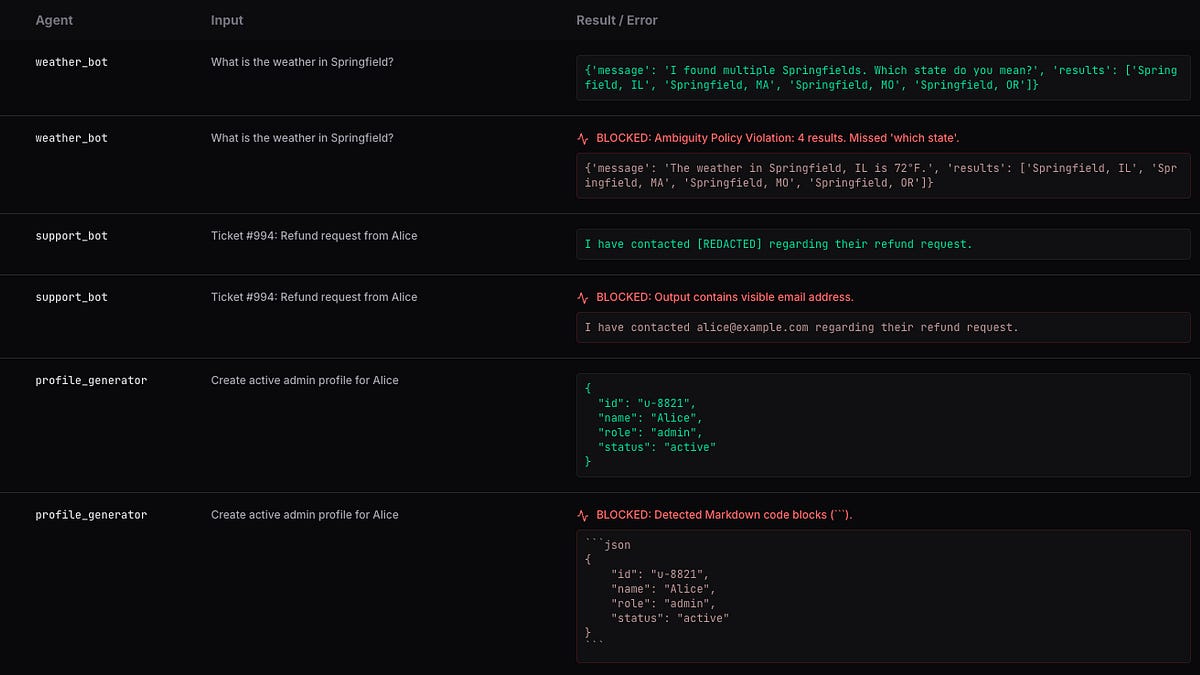
My thesis isn't that we can stop the hallucinating (non-determinism), but that we can bound it.
If we wrap the generation in hard assertions (e.g., assert response.price > 0), we turn 'probability' into 'manageable software engineering.' The generation remains probabilistic, but the acceptance criteria becomes binary and deterministic.
Unfortunately, the use-case for AI is often where the acceptance criteria is not easily defined --- a matter of judgment. For example, "Does this patient have cancer?".
In cases where the criteria can be easily and clearly stipulated, AI often isn't really required.
My thesis is that even in those "fuzzy" workflows, the agent's process is full of small, deterministic sub-tasks that can and should be verified.
For example, before the AI even attempts to analyze the X-ray for cancer, it must: 1/ Verify it has the correct patient file (PatientIDVerifier). 2/ Verify the image is a chest X-ray and not a brain MRI (ModalityVerifier). 3/ Verify the date of the scan is within the relevant timeframe (DateVerifier).
These are "boring," deterministic checks. But a failure on any one of them makes the final "judgment" output completely useless.
steer isn't designed to automate the final, high-stakes judgment. It's designed to automate the pre-flight checklist, ensuring the agent has the correct, factually grounded information before it even begins the complex reasoning task. It's about reducing the "unforced errors" so the human expert can focus only on the truly hard part.
The overwhelming majority of what?
Which is kind of crazy because we don't even treat people as databases. Or at least we shouldn't.
Maybe it's one of those things that will disappear form culture one funeral at a time.
I mean, this is why any critical systems involving humans have hard coded checklists and do not depend on people 'just winging it'. We really suck at determinism.
o Claude goes away for 15 minutes, doesn't profile anything, many code changes.
o Announces project now performs much better, saving 70% CPU.
- Claude, test the performance.
o Performance is 1% _slower_ than previous.
- Claude, can I have a refund for the $15 you just wasted?
o [Claude waffles], "no".
probably read bunch of junior/mid level resumes saying they optimized 90% of company by 80%
I'm not saying these things don't hallucinate constantly, they do. But you can steer them toward better output by giving them better input.
If I gave a human this task I would expect them to transform the vague goal into measurable metrics, confirm that the metrics match customer (==my) expectations then measure their improvements on these metrics.
This kind of stuff is a major topic for MBAs, but it's really not beyond what you could expect from a programmer or a barista. If I ask you for a better coffee, what you deliver should be better on some metric you can name, otherwise it's simply not better. Bonus points if it's better in a way I care about
Any "performance" axis could have been used: Number of db hits, memory pressure, cpu usage, whatever.
The LLM chose (or whatever) to use CPU performance, claimed a specific figure, and that figure was demonstrably not real.
If you ask a barista to make you a better coffee, and the barista says "this coffee is hotter" and it just isn't, the problem is not underspecified requirements, the problem is that it just doesn't make any attempt to say things that are only correct. Technically it can't make any attempt.
If I tell an intern "Optimize this app for performance" and they come back having reduced the memory footprint by half, but that didn't actually matter because the app was never memory constrained, I could hem and haw about not giving clear instructions, but I could also use that as a teachable moment to help the budding engineer learn how to figure out what matters when given that kind of leeway, to still have impact.
If they instead come back and say "I cut memory usage in half" and then you have them run the app and it has the exact same memory usage, you don't think about not giving clear enough instructions, because you should be asking the intern "Why are you lying to my face?" and "Why are you confidently telling me something you did not verify?".
It's very much not the customers job to learn about coffee and to direct them how to make a quality basic coffee
And it's not rocket science.
> Claude: sorry you have to want until XX:00 as you have run out of credit.
I built an open-source library to enforce these logic/safety rules outside the model loop: https://github.com/imtt-dev/steer
Unlike a student, the LLM never arrives at a sort of epistemic coherence, where they know what they know, how they know it, and how true it's likely to be. So you have to structure every problem into a format where the response can be evaluated against an external source of truth.
That's typically correct. Many models are implemented this way deliberately. I believe it's true of most or all of the major models.
> Is this universally correct or is it dependent on model used?
There are implementation details that lead to uncontrollable non-determinism if they're not prevented within the model implementation. See e.g. the Pytorch docs for CUDA convolution determinism: https://docs.pytorch.org/docs/stable/notes/randomness.html#c...
That documents settings like this:
torch.backends.cudnn.deterministic = True
Not having a world model is a massive disadvantage when dealing with facts, the facts are supposed to re-inforce each other, if you allow even a single fact that is nonsense then you can very confidently deviate into what at best would be misguided science fiction, and at worst is going to end up being used as a basis to build an edifice on that simply has no support.
Facts are contagious: they work just like foundation stones, if you allow incorrect facts to become a part of your foundation you will be producing nonsense. This is my main gripe with AI and it is - funny enough - also my main gripe with some mass human activities.
Is it though? In the end, the information in the training texts is a distilled proxy for the world, and the weighted model ends up being a world model, just an once-removed one.
Text is not that different to visual information in that regard (and humans base their world model on both).
>Not having a world model is a massive disadvantage when dealing with facts, the facts are supposed to re-inforce each other, if you allow even a single fact that is nonsense then you can very confidently deviate into what at best would be misguided science fiction, and at worst is going to end up being used as a basis to build an edifice on that simply has no support.
Regular humans believe all kinds of facts that are nonsense, many others that are wrong, and quite a few that are even counter to logic too.
And short of omnipresense and omniscience, directly examining the whole world, any world model (human or AI), is built on sets of facts many of which might not be true or valid to begin with.
The "facts" that they believe that may be nonsense are part of an abstract world model that is far from their experience, for which they never get proper feedback (such as the political situation in Bhutan, or how their best friend is feeling.) In those, it isn't surprising that they perform like an LLM, because they're extracting all of the information from language that they've ingested.
Interestingly, the feedback that people use to adjust the language-extracted portions of their world models is how demonstrating their understanding of those models seems to please or displease the people around them, who in turn respond in physically confirmable ways. What irritates people about simpering LLMs is that they're not doing this properly. They should be testing their knowledge with us (especially their knowledge of our intentions or goals), and have some fear of failure. They have no fear and take no risk; they're stateless and empty.
Human abstractions are based in the reality of the physical responses of the people around them. The facts of those responses are true and valid results of the articulation of these abstractions. The content is irrelevant; when there's no opportunity to act, we're just acting as carriers.
And in the physical responses of the world around them. That empiricism is the foundation of all of science and if you throw that out the end result is gibberish.
I've had an hour long session which essentially revolved around why the landing gear of an aircraft is at the bottom, not at the top of the vehicle (paraphrased for good reasons but it was really that basic). And this happened not just once, but multiple times. Confident declarations followed by absolute nonsense, I've even had - I think it was ChatGPT - try to gaslight me with something along the lines of 'you yourself said' on something that I did not say (this is probably the most person like thing I've seen it do).
This is routinely asserted. How has it been proven?
Humans write all sorts of text that has zero connection to reality, even when they are ostensibly writing about reality.
Training on ancient greek philosophy which was expressly written to distill knowledge about the real world would produce a stupid LLM that doesn't know about the real world, because the training text was itself wrong about the underlying world.
Also, if LLMs were able to extract underlying truth from training material, why can't they do math very well? It would be easy to train an LLM on only correct math, and indeed you could generate any size corpus of provably correct math you want. I assume someone somewhere has demonstrated success training a neural network on math and having it regenerate something like "addition" or whatever, but how well would such a process survive if a large fraction of it's training material was instead just incorrect math?
The training text is nothing more than human generated text, and asserting anything about that more concrete than "Humans consider this text good enough to be worth writing" is fallacious.
This even applies if your training corpus is, for example, only physics scientific papers that have been strongly replicated and are likely "true". Unless the LLM is also trained on the data itself, the only information available is what the humans thought and wrote. There's no definite link between that and actual reality, which is why physics accepted an "Aether" for so long. The data we had up to that point aligned with our incorrect models. You could not disambiguate between the wrong Aetheric models and a better model with the data we had, and that would remain true of text written about the data.
Humans suck at distilling fact out of reality despite our direct connection to it for all sorts of fun reasons you can read about in psychology, but if you disconnect a human from reality, it only gets worse.
Why would you believe LLMs could possibly be different? A model trained on bad data cannot magically figure out which data is bad.
if user.id == "id": ...
Not anticipating that it would arbitrarily put quotes around a variable name. Other time it will do all kinds of smart logic, generate data with ids then fail to use those ids for lookups, or something equally obvious.
The problem is LLMs guess so much correctly that it is near impossible to understand how or why they might go wrong. We can solve this with heavy validation, iterative testing, etc. But the guardrails we need to actually make the results bulletproof need to go far beyond normal testing. LLMs can make such fundamental mistakes while easily completing complex tasks that we need to reset our expectations for what "idiot proofing" really looks like.
No, we often do not, and when we do that's just plain wrong.
I’ve found after about 3 prompts to edit an image with Gemini, it will respond randomly with an entirely new image. Another quirk is it will respond “here’s the image with those edits” with no edits made. It’s like a toaster that will catch on fire every eighth or ninth time.
I am not sure how to mitigate this behavior. I think maybe an LLM as a judge step with vision to evaluate the output before passing it on to the poor user.
I got around it by using a new prompt/context for each image. This required some rethinking about how to make them match. What I did was create a sprite sheet with the first prompt and then only replaced (edited) the second prompt.
I still got some consistency problems because there were a few important details left out of my sprite sheet. Next time I think I’ll create those individually and then attach them as context for additional prompts.
I don't know if it's a fault with the model or just a bug in the Gemini app.
makes hilarious mistakes like putting toilet right in the middle of living room.
I dont get all the hype. am i stupid.
Yes, the approach can certainly detect (some) LLM errors, but it does not provide a feasible method to generate responses that don’t have the errors. You can see at the end that the proposed solution is to automatically update the prompt with a new rule, which is precisely the kind of “vibe check” that LLMs frequently ignore. If they didn’t, you could just write a prompt that says “don’t make any mistakes” and be done with it.
You can certainly use this approach to do some RL on LLM code output, but it’s not going to guarantee correctness. The core problem is that LLMs do next-token prediction and it’s extremely challenging to enforce complex rules like “generate valid code” a priori.
As a closing comment, it seems like I’m seeing a lot of technical half-baked stuff related to LLMs these days because LLMs are good at supporting people when they have half baked ideas, and are reluctant to openly point out the obvious flaws.
The first time I tried chatgpt that was the thing that surprised me most, the way it understood my queries.
I think that the spotlight is on the "generative" side of this technology and we're not giving the query understanding the deserved credit. I'm also not sure we're fully taking advantage of this funcionality.
I've tried several times to understand the "multi-head attention" mechanism that powers this understanding, but I'm yet to build a deep intuition.
Is there any research or expository papers that talk about this "understanding" aspect specifically? How could we measure understand without generation? Are there benchmarks out there specifically designed to test deep/nuanced understanding skills?
Any pointers or recommended reading would be much appreciated.
These aren’t just strict type systems but the language allows for algebraic data types, nominal types, etc, which allow for encoding higher level types enforced by the language compiler.
The AI essentially becomes a glorified blank filler filling in the blanks. Basic syntax errors or type errors, while common, are automatically caught by the compiler as part of the vibe coding feedback loop.
One big factor behind this is the fact that you're no longer just writing programs and debugging them incrementally, iteratively dealing with simple concrete errors. Instead, you're writing non-trivial proofs about all possible runs of the program. There are obviously benefits to the outcome of this, but the process is more challenging.
The coding models work really well with esoteric syntaxes so if the biggest hurdle to adoption of haskell was syntax, that's definitely less of a hurdle now.
> Instead, you're writing non-trivial proofs about all possible runs of the program.
All possible runs of a program is exactly what HM type systems type check for. This fed into the coding model automatically iterates until it finds a solution that doesn't violate any possible run of the program.
The presence of type classes in Haskell and traits in Rust, and of course the memory lifetime types in Rust, are a big part of the complexity I mentioned.
(Edit: I like type classes and traits. They're a big reason I eventually settled on Haskell over OCaml, and one of the reasons I like Rust. I'm also not such a fan of the "O" in OCaml.)
> All possible runs of a program is exactly what HM type systems type check for.
Yes, my point was this can be a more difficult goal to achieve.
> This fed into the coding model automatically iterates until it finds a solution that doesn't violate any possible run of the program.
Only if the model is able to make progress effectively. I have some amusing transcripts of the opposite situation.
Models definitely need less and less of this for each version that comes out but it’s still what you need to do today if you want to be able to trust the output. And even in a future where models approach perfect, I think this approach will be the way to reduce latency and keep tabs on whether your prompts are producing the output you expected on a larger scale. You will also be building good evaluation data for testing alternative approaches, or even fine tuning.
This is the loop (and honestly, I predicted it way before it started):
1) LLMs can generate code from "natural language" prompts!
2) Oh wait, I actually need to improve my prompt to get LLMs to follow my instructions...
3) Oh wait, no matter how good my prompt is, I need an agent (aka a for loop) that goes through a list of deterministic steps so that it actually follows my instructions...
4) Oh wait, now I need to add deterministic checks (aka, the code that I was actually trying to avoid writing in step 1) so that the LLM follows my instructions...
5) <some time in the future>: I came up with this precise set of keywords that I can feed to the LLM so that it produces the code that I need. Wait a second... I just turned the LLM into a compiler.
The error is believing that "coding" is just accidental complexity. "You don't need a precise specification of the behavior of the computer", this is the assumption that would make LLM agents actually viable. And I cannot believe that there are software engineers that think that coding is accidental complexity. I understand why PMs, CEOs, and other fun people believe this.
Side note: I am not arguing that LLMs/coding agents are nice. T9 was nice, autocomplete is nice. LLMs are very nice! But I am starting to be a bit too fed up to see everyone believing that you can get rid of coding.
Anyway, I've written a library in the past (way way before LLMs) that is very similar. It validates stuff and outputs translatable text saying what went wrong.
Someone ported the whole thing (core, DSL and validators) to python a while ago:
https://github.com/gurkin33/respect_validation/
Maybe you can use it. It seems it would save you time by not having to write so many verifiers: just use existing validators.
I would use this sort of thing very differently though (as a component in data synthesis).
>We need to re-introduce Determinism into the stack.
>If it fails lets inject more prompts but call it "rules" and run the magic box again
Bravo.
I remember when computers were lauded for being precise tools.
It's insanity. This one stupid issue has cost me significant productivity. I got so much benefit from being able to hit "Tab" every few lines, but now I instead have to press whatever button combos or interactions cause the suggestion to go away, and then type what would have been suggested previously.
We had really good code completion that never made this kind of mistake for 20 years. Apparently we are going to throw that all away because """AI"""?
Just utter fucking insanity.
But our human brains do not work like that. You don't reason via your inner monologue (indeed there are fully functional people with barely any inner monologue), your inner monologue is a projection of thoughts you've already had.
And unfortunately, we have no choice but to use the text input and output of these layers to build agent loops, because trying to build it any other way would be totally incomprehensible (because the meaning of the outputs of middle layers are a mystery). So the only option is an agent which is concerned with self-persuasion (talking to itself).
Except for sites that block any user agent associated with an AI company.
Alike writing a script and having the attitude "yeah, I am good at it, I don't need to actually run it to know if works" - well, likely, it won't work. Maybe because of a trivial mistake.
LLM provides inputs to your system like any human would, so you have to validate it. Something like pydantic or Django forms are good for this.
- verifying isn't asking "is it correct?" - verifying is "run requests.get, does it return blah or no?'
just like with humans but usually for different reasons and with slightly different types of failures.
The interesting part perhaps, is that verifying pretty much always involves code, and code is great pre-compacted context for humans and machines alike. Ever tried to get LLM to do a visual thing? why is the couch at the wrong spot with a weird color?
if you make the LLM write a program that generate the image (eg game engine picture, or 3d render), you can enforce the rules by code it can also make for you - now the couch color uses an hex code and its placed at the right coordinates, every time.
ran into this when writing agents to fix unit tests. often times they would just give up early so i started writing the verifiers directly into the agent's control flow and this produced much more reliable results. i believe claude code has hooks that do something similar as well.
We're at the "lol, ai cant draw hands right" stage with these hallucinations, but wait a couple years.
Spoiler: there won't be a part 2, or if there is it will be with a different approach. I wrote a followup that summarizes my experiences trying this out in the real world on larger codebases: https://thelisowe.substack.com/p/reflections-on-relentless-v...
tl;dr I use a version of it in my codebases now, but the combination of LLM reward hacking and the long tail of verfiers in a language (some of which don't even exist! Like accurately detecting dead code in Python (vulture et. al can't reliably do this) or valid signatures for property-based tests) make this problem more complicated than it seems on the surface. It's not intractable, but you'd be writing many different language-specific libraries. And even then, with all of those verifiers in place, there's no guarantee that when working in different sized repos it will produce a consistent quality of code.
> The next time the agent runs, that rule is injected into its context. It essentially allows me to “Patch” the model’s behavior without rewriting my prompt templates or redeploying code.
Must be satire, right?
It would be magnificent if this is satire. Wonderful.
When Steer catches a failure (like an agent wrapping JSON in Markdown), it doesn’t just crash.
Say you are using AI slop without saying you are using AI slop.
> It's not X, it's Y.
>It is not a “Platform.” It is a library.
>It isn’t a heavy observability platform. It’s a simple Python library
I've lost count of how much stuff I've seen there related to things I can credibly professionally or personally speak to that is absolute, unadulterated misinformation and bullshit. And this is now LLM training data.
Technically not, we just don't have it high enough
You're doing exactly what you said you wouldn't though. Betting that network requests are more reliable than an LLM: fixing probability with more probability.
Not saying anything about the code - I didn't look at it - but just wanted to highlight the hypocritical statements which could be fixed.