156 points · by thelastgallon · 11mo ago · 220 comments
- Weight is less of a limitation than you would think. Ship size is measured in tonnage. 40K-60K is a medium sized cargo carrying ship. So lets assume a ship like that.
- Battery weight calculations are going to be key. If you assume 170 wh/kg, 6 tonnes of battery equals about 1 mwh of battery.
- Energy usage of ships is speed dependent and it's a non linear relationship. You can save a lot of energy by going a bit slower. Going about 15 knots, a ship like this might use 15mw of power.
So the math becomes something like 6 x 15 = 90 tons of battery per hour. 5000km is about 2700 nautical miles (1 knot == 1 nautical mile/hour). So, you need about 180 hours of battery. Or about 16200 tons for a total of 15mwh x 180 = 2.7gwh of energy. That's a big battery.
The real limitation here comes from the cost of the batteries, which is dropping fast with sodium ion. The reason CATL is bringing this up is because they've been doing similar math with some informed $/kwh math. If they can get it down to around 20$/kwh, a mwh would cost 20K, and a gwh would cost 20M. So the battery would cost 54M$.
The key here is that this is still assuming 15knots. Energy usage might drop considerably if you drop it to 10 knots or even lower. You might only need 7200 tons of battery at those speeds.
The ship can handle the weight either way, though you are sacrificing useful load of course. The real constraints here are cost and speed. You pay a fat premium for a fast ship. Of course ships this size aren't cheap. A few tens of millions is normal. And they burn through many millions worth of fuel per year too. So, even though that amount of battery is expensive, the math might actually work out to these ships being cheap enough to operate that they'd earn back their battery.
You'd have to be pretty bullish about cost and performance of batteries. But CATL clearly feels that way. They have several battery chemistries at their disposal with higher densities (and cost). Over time, batteries might get cheaper and more dense. Ship designs might be optimized for batteries (e.g. structural hulls with battery). There's a lot of wiggle room here. But it's not an impossible proposition.
How many MW could a container ship carry by literally shipping energy stored in batteries?
As in they fill up entirely with batteries, sail to a desert, plug into a cable to charge on cheap solar, charge up, sail to a population center, plug in to discharge. Repeat.
For a typical 40kton cargo ship, that leaves 24,000 tons for more batteries, for a energy cargo capacity of 4.5GWh. The average US citizen uses ~770,000 BTUs of energy per day, or 0.23MWh. This "energy cargo" of this ship would provide the entire energy needs of a city of 20k people for one day. (I am being a little unfair, by assuming that everyone uses electricity for all of their energy needs in this scenario).
https://power-x.jp/en/newsroom/Introducing-the-world%E2%80%9...
I think there are some startups working on cargo train "tankers" in the US too.
An idea I had after seeing the tanker concept was to have the battery carrier also serve as a generator via wind power. If its a huge ship I suppose you could just stick a turbine on it and go where the wind is blowing. I think a more fun concept is generating power off of a smaller scale cat- or trimaran generating both propulsion and power by sailing conventionally.
I think you get about 4 MWh per TEU ( based on my 12V 100Ah battery)
so about 20 GWh
That’s only ~4x wider than the current big classes of ship. Maybe we will see twin hulls with a solar field slung in between?
The downside of course is you can no longer romantically sail by starlight (or at least, technically, by the starlight of non-Sol stars.)
You'd probably want to use a mix of local wind/solar power and a grid connection. Of course, harbors usually already have lots of infrastructure to power heavy industry (steel, refineries, etc.) and transport (e.g. rail). This just adds to that.
There are also other solutions including using container batteries and simply swapping in fresh ones. Which especially in a container harbor shouldn't be that big of a deal.
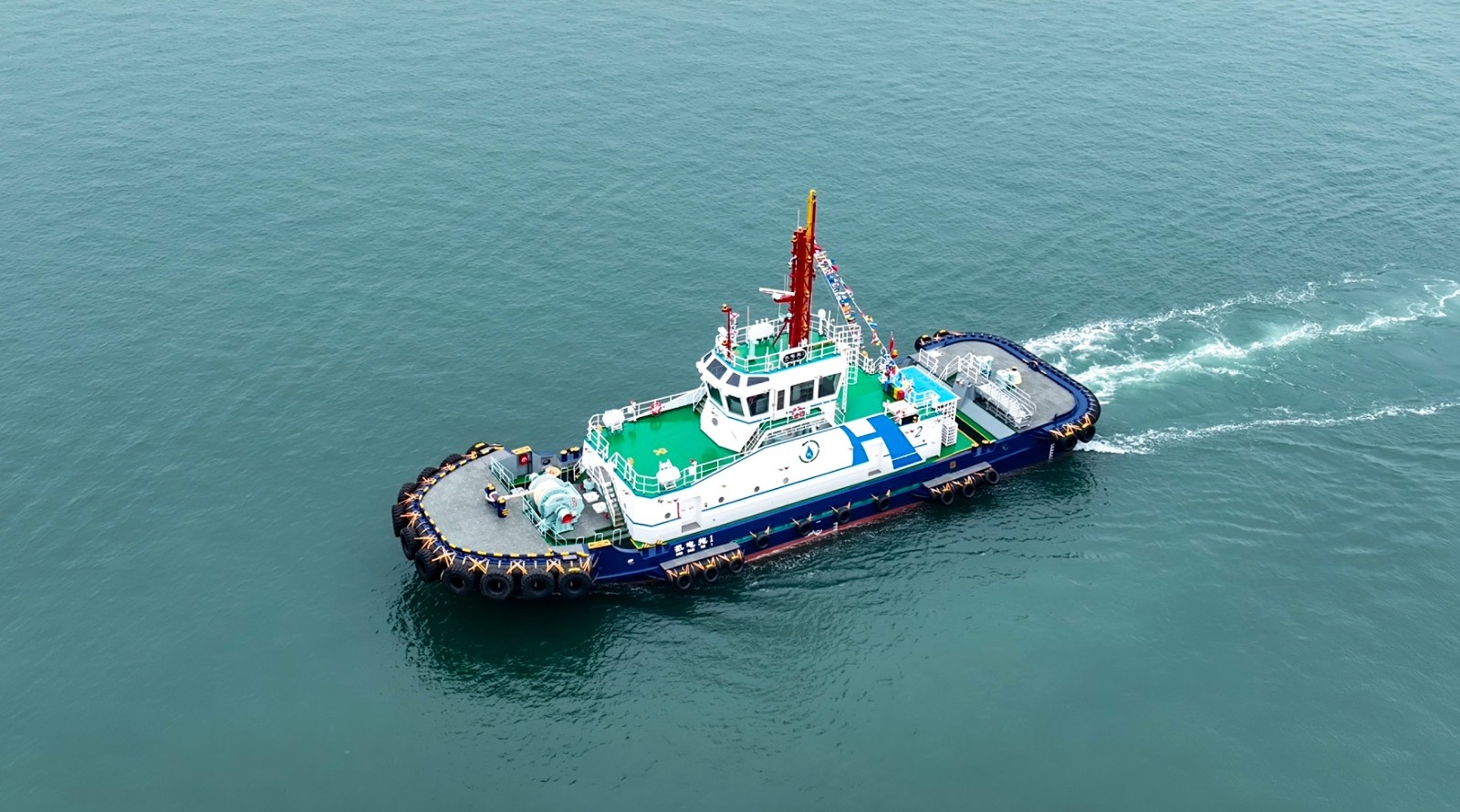
Pretty sure electric ships are not coming anywhere near long haul shipping. However for anything close to shore - it's a real future: tugboats, bunkers, tourist boats etc.
Harbors are already very large consumers of power. Sure, this adds to that demand but if you think about all the cranes, heavy industry, refineries, freight trains, etc. you can get to a few hundred mw easily. Adding more would definitely need planning. But it's not so dramatic. This just sounds like a good reason to invest in power generation.
All of the machinery is already designed to handle containers so it just becomes another type of container.
I wonder if there's significant scope for offsetting electricity consumption by adding deck renewables. Not for container ships, but maybe for tankers .. which are only needed because of fossil fuel consumption elsewhere. Hmm.
Otherwise, it's not a bad idea as you could pump the pre-charged fluids in/out and even ship the fluid around with tankers; which opens up the possibility of fueling at sea. Spills would be bad. But probably better than oil as the toxic fluids dilute more easily. But it would still be a bad day for marine life. It might work for shorter ranges.
OTOH if we look at popular shorter range routes like within Asia or Europe the calculation looks a lot more favorable.
Not to mention dedicating 15-20% of deadweight tonnage (and a higher percentage, maybe 30-40% of its gross tonnage) would make a ship instantly uneconomical, especially as the batteries must be laid along the keel for stability, meaning the ship loses the ability to carry many cargoes.
What's possible in the medium term are Heavy Fuel Oil/Electric hybrids that use battery power in regulated Emission Control Areas instead of Low Sulfur Marine Fuel Oils or Diesel, and using HFO in blue waters and to charge batteries.
Transoceanic battery-powered cargo vessels are probably 100 years away - fusion will arrive first.
Burning 250 tons of oil to get 1GWh of energy releases around 800 tons of CO2. Let's assume a $100 CO2 tax. We want to prevent the worst of global warming, right? That would add ~25% to the price of oil.
There is likely to be an oversupply of renewable (solar) energy less than 5 years from now.
So I wouldn't be so sure about that 100 year prediction.
Even if the electricity was free, the cost (both CAPEX and in mass/volume) is not close. We need an improvement in mass energy density and volumetric energy density of 200-1,000% and a complete redesign of all shipping and ports to migrate to battery transoceanic shipping.
SMRs, renewably cracked hydrocarbons, and fusion will all be mainstream beforehand.
Once again, this is one of those areas where HN commenters believe they can understand a complex industry based on Wikipedia-level stats.
Sourcing the electricity cheaper than that should be possible. E.g. wind and solar are closer to 20-30$/mwh.
The main issue is harbor infrastructure and battery production and scaling this. But from a cost point of view, sacrificing 20% cargo for an order of magnitude reduction in fuel cost is going to be very tempting.
> Transoceanic battery-powered cargo vessels are probably 100 years away - fusion will arrive first.
Or 3 years according to CATL. One of you is probably a few years off. I personally think 3 years is a bit ambitious. But ten years sounds like we might see some proof of concept at least. I have a hunch that CATL is going to be very eager to deliver such a proof of concept.
> But from a cost point of view, sacrificing 20% cargo for an order of magnitude reduction in fuel cost is going to be very tempting.
No, it's not and this shows a profound misunderstanding of the maritime sector. Not to mention, it would be at least 20% of DWT and probably 40% of gross tonnage, and all at the most valuable (lowest/most-stable) part of the hull.
> Or 3 years according to CATL.
CATL make no such claim. They claim that they will be able to show electric ocean-going vessels, which there already are. They make no claims about transoceanic shipping, other than partnering with Maersk, which as stated above, will be for hybrid propulsion to avoid expensive low-sulfur fuels in ECAs and will be charged from HFO at sea.
IMHO a hybrid approach would achieve similar to superior perfomance to the current state viz a viz cost/perfomance and enviromental impact.
Additionally as has been deployed for some longhaul trucks battery swaps can also cut down on the time to redeploy after offloading the cargo.
[1] https://gcaptain.com/berge-bulk-launches-worlds-most-powerfu...
I've wondered if thermal storage might be superior. Lower round trip efficiency if one uses resistive heating, but I think that would be ok.
Lithium hydride, heated to melting, stores something like 4 MJ/kg, more than 6x the specific energy of your assumption there (admittedly with loss on discharge due to the losses in the turbine.) If that is too expensive, graphite is another possibility, at even higher temperature.
So that gives you around twice the wh/kg but you must keep the heat energy for the entire voyage which is constantly being lost once the onboard storage is heated up. Not sure what that look like I imagine it would be difficult to keep lithium hydride at 680C very efficiently or safely in an ocean going vessel for any length of time.
That seems unreasonably low. Thermal losses can be made arbitrarily low with insulation, and this is fairly large scale, so insulation can be thick and volume per surface area can be kept low.
* a 5,000 km electric range. * 40MW continuous power requirement for a 21.5 knot cruise speed[1] for a 14000 teu container vessel: * the size and weight capacity for the batteries being the same as the fuel capacity for a 14000 teu container vessel (taking the upper figure from [2]) * the battery pack having similar gravimetric (weight) and volumetric(size) energy density as this a modern Chinese NMC EV pack[3]
The short version is that the battery vessel would require about 25,000 tonnes of batteries for a 5,000km range under those assumptions, which compares to the current fuel capacity of approximately 13,000 tonnes. Volumetrically, it's even closer - about 17,000 cubic metres, compared to about 13,000 for the bunker fuel.
Furthermore, it's worth considering just how much cargo the ship carries. One teu corresponds to about 33 cubic metres of cargo space (not counting the space taken up by the walls of the container), so the ship can carry about 462,000 cubic metres of cargo. So the additional space required to carry an additional 3,500-odd cubic metres of batteries corresponds to only about 0.8% of the ship's total cargo-carrying capacity.
I was surprised at just how doable this is, to be honest. What threw me is just how much bunker fuel ships can carry; if I'm doing the sums right, a ship like this can carry enough fuel to circumnavigate the globe a couple of times over. It may well make economic sense but it's not really necessary to have that kind of range to operate the ship safely.
[1]https://www.man-es.com/docs/default-source/marine/tools/prop... [2]https://www.freightwaves.com/news/how-many-gallons-of-fuel-d... [3]https://www.batterydesign.net/zeekr-140kwh-catl-qilin/
The battery capacity you have calculated needs about 500 shipping containers.
A large shipping vessel carries 24000 container. So make the batteries containerized, and easy to load/unload.
You could imagine pretty fast charging like this, and at some point in the near future using the same infrastructure with containerized nuclear reactors.
1. I'm ball-parking an onboard nuclear source would take up the equivalent displacement as 20-50 containers.
You can imagine this needs solving pretty hardcore optimization problems.
How many kwh are you lifting at a time with a container? How many kwh are you pumping in the same period?
These kind of infrastructure is not something you can build in 3 year. You need more than one port having that.
How?
Is bunker fuel energy density just that bad or is it something else? A 50kg tank of diesel can easily outperform a 200kg pack of batteries in an ev.
Shanghai to Los Angeles is more than double that
Fire hazards are there for any fuel, Safety systems evolve to handle them. The environmental impact would be more localized than an oil spill.
Assuming two days available to charge the vessel, you'd need about 100MW continuous. Not trivial, but doable.
As far as battery fires go, sure, but a) there are already a lot of electric ferries in service so designing safe maritime battery packs isn't a new challenge and b) the alternative isn't exactly risk free either; we've seen plenty of oil spills from ships.
I can only imaging how hard it is to put out a ship fire, but is there any reason to see that the situation would be different? Bunker fuel appears to be less flammable.
https://www.phmsa.dot.gov/sites/phmsa.dot.gov/files/2023-04/...
https://old.reddit.com/r/electricvehicles/comments/1m8wlou/e...
Ships deliberately use cheaper, less energy dense petroleum products (heavy fuel oil), for pretty much the inverse reasons why airplanes use kerosene.
Planes run on kerosene because it's universal enough, hard to run them on heavy fuel, and there is issue with high emission of the HFO over population centers which isn't as much of a problem in middle of sea
[1] https://apnews.com/article/uk-morocco-renewable-energy-xlink...
If something breaks in the middle of the ocean, it's probably better to have a few people on board who can fix it.
* https://en.wikipedia.org/wiki/Combined_diesel–electric_and_g...
* https://en.wikipedia.org/wiki/Combined_diesel–electric_and_d...
* https://en.wikipedia.org/wiki/Integrated_electric_propulsion
Allseas is putting the reactors on their vessels as well iirc.
Congratulations, you have just re-invented offshore (floating) wind turbines. https://duckduckgo.com/?t=ftsa&q=floating+wind+turbines+&ia=...
> I guess you don't have to pay anyone for the space or worry about too many regulations etc.
I'm ammused you think offshore energy is lawless. It's the same assumption that had the entire maritime community laughing at the clowns behind 'Seasteding" and the amusing MS Satoshi 'cryptoship'.
TL;DR marine is the one niche where "we had to make it a lot bigger to hold the batteries" isn't actually a big deal. If you do this the right way, you still have heaps of volume for cargo, and solar cells on the hold covers.
If you expect _oceanic_ ships in 3 year, you need to start building infrastructure today, in multiple ports.
If you need to build those infrastructure today, you need to have something standardize.
otoh, if all you want are just some prototypes, we have them today already..
- 20k square meters of hull space
- If fully covered with solar panels, on a sunny day, you could expect 1-2 MWh (when averaging in night time)
- Current diesel engines typically output 60MWh continuously while underway.
And that's not factoring in the solar panels getting covered in salt over time and losing efficiency. Plus preventing the ship from actually loading / unloading cargo efficiently.
It's not just a matter of panel efficiency either. If we had magic panels that could absorb 100% of the suns power over the 20k sqm deck, it would only equate to about four times as much (8% of the overall power need).
- Solar: 1–2 MW of average power; ~24–48 MWh of energy per day.
- Diesel: about 60 MW of mechanical power while underway; ~1,440 MWh of energy per day.
60 MWh per what? Per hour? thats just 60 MW continuous POWER or 1440 MWh ENERGY per day.
There's more than enough lithium out there, more discovered every month, and the perception that we are limited by lithium is mostly out there because certain media sources are trying to help out there fossil fuel friends by delaying the energy interchange by a few years.
Whether battery ocean shipping containers make technical sense is a different question, but I wouldn't worry about lithium use!
Lithium, rare earth metals, and a bunch of others are only "scarce" because right now China is the only country willing to put up with the pollution levels that the cheap, dirty version of their extraction produces.
Everything can be produced cleanly, safely, etc... but that comes at a price.
It's like when employers complain that "nobody wants to work". That needs to be translated to "nobody wants to work for the low wages I'm willing to pay".
If there is demand for batteries in ships, it is going to be far smaller than for cars, which is currently 80% of battery demand (the rest is mostly grid storage). So ship batteries will at most slow the fall of battery pricing by a small amount.
Honestly DJI and Boeing should get into this business. A boat's sail basically a plane's wing, aerodynamically speaking. They share a lot of similarities with endurance gliders.
Try to approximate the area needed to generate e.g. 50MW propulsion. It would be measured in hectares.
I’m too lazy to do it myself but 5 minutes of searching and calculating will show you that the area of solar panels required to move a ship is far, far, larger than the area of that ship.
Not to mention that a container ship’s deck is typically completely covered with, well, containers.
Also, lithium isn’t scarce.
I guess in theory that could be solved either with huge removable panels around the containers (to be "put aside" somewhere during the loading operations), or placing containers with solar panels (and ways to deliver the energy to the ship) on the outer sides of the cargo.
Actually, maybe the batteries themselves could be loaded as containers on the sides of the cargo, with solar panels on them; that might increase the risk for the cargo if some catch fire, though
But, I guess it wouldn't be worthwhile.
Besides PV, there's a long history of wind powered ships of course.
I wouldn't underestimate what creative and dedicated engineers can accomplish.
https://en.wikipedia.org/wiki/MV_Ampere
They are quite impressive but they are still very far away from your average ocean going cargo vessel.
Near me, we now have a hybrid ferry, no charging infrastructure, but it still uses much less fuel than before it was refit, so that's cool too. It's bigger than the one you linked and sails on a longer route: 2,499 passengers, 202 vehicles, typically serves an 8.6 mile route.
And this one, under construction now, will have a run time of 90 minutes and charge time of 40 minutes:
https://spectrum.ieee.org/electric-boat-battery-ship-ferry https://news.ycombinator.com/item?id=45844832
Sibling comment is perfectly correct that it starts small and ramps up.
From that article:
> "The ferry format, with its high-frequency turnaround, relatively short segment distances, and shore-based rapid charging, is one of the most promising early use cases for electrification in the maritime sector. Maritime electrification has gained momentum over the past few years"
Early. Momentum.
Moving some noticeable percentage of ships away from fossil fuels is still a win.
However, most large ships apparently have multiple times more fuel capacity than is required for 5,000km of range, which is what makes the electric version realistic.
A completely optimized high capacity cargo rail line can move 500 rail cars per hour. That's 1000 FEUs if we double stack containers. A lithium battery system in a FEU has around 2 MWh of storage. So that rail line has 2 GW transmission capacity if we saturate it with batteries - the same as a single high voltage transmission line. Being unable to build one of those in parallel to the rail line would be extremely sad.
Note that 500 rail cars per hour is actually an impressive feat of logistics. A normal rail yard at a port would be very happy with a sustained rate of 200 rail cars per hour, and will frequently drop below that.
In a perfect world however... endless cooling water unless they're in some shallow harbor. Would be the perfect application.
Still not, because all it takes is one thing going Seriously Fucking Wrong on another ship and boom, you got yourself a nuclear disaster. Just look at the Francis Scott Key Bridge and imagine that that ship hadn't hit a bridge support but a nuclear powered vessel.
Nuclear powered ships only make sense for ships operating in places where there is no other ship in sight for hundreds of miles (i.e. icebreakers) or for military ships that can and will shoot and sink anything with the potential of becoming a threat.
https://en.wikipedia.org/wiki/Russian_floating_nuclear_power...
Even navies are moving away from nuclear power due to how expensive it is.
Ships tend to go not change course nearly as much on a several day journey. I guess a propellor could run in reverse for regenerative breaking, but it wouldn’t help much.
There are some vessels that have single use emergency brakes, but the latest trend is to have motor 'pods' that are electrical and that can be used both for normal propulsion as well as to perform emergency stops that are quite impressive given the size of the vessels they are on. Typically an oceangoing vessel requires at least 3, but commonly 5 to 10 ship lengths to come to a full stop from moving forward under power. This is not necessarily because of limitations of the propulsion unit, but simply because stopping that much tonnage too fast would do as much damage as a collision would. With classical engines there is far more rotating mass so it would take much longer than with electrical propulsion to react before the beginning of the braking phase.
Ocean going container vessels on the other hand use massive direct drive two stroke diesel engines (usually they only have a single engine). They have no gearbox. The only way to go-astern is to literally start the engine in reverse. This can only be done up to a limited speed, otherwise the windmilling effect of the water passing through the prop would overpower the starting air.
Suffice to say, I'd put a long bet on the overwhelming majority of containerships being powered by internal combustion engines in 30 years time. If we get our act together we might have come up with an alternative / synthetic fuel by then but I wouldn't hold my breath.
Check out the https://swzmaritime.nl/news/2022/11/08/how-abbs-braking-syst... 'wonder of the seas' e-brake system.
Also wave based generators that could also act as dampers/suspension and they wouldn’t steal energy from forward motion like wind would (depending on if you’re generating wind energy or using wind to buttress the batteries).
Ideally a combination of sails coupled with batteries and wave generators sounds like it would be very energy efficient.
[0] https://www.towt.eu/en/home/
[2] https://graindesail.com/fr/voilier-cargo-grain-de-sail-3/
- Shipping container from China to the US: $3000-$9000 (tariffs?)
- Number of t-shirts per container: 35000
How much heavier are jeans than t-shirts? 10 times? That would mean an increase of $2.50 if container shipping costs double.
It says more about how dirt cheap shipping is the single enabler of globalization, even doubling the cost may not be enough to significantly shorten the supply chains.