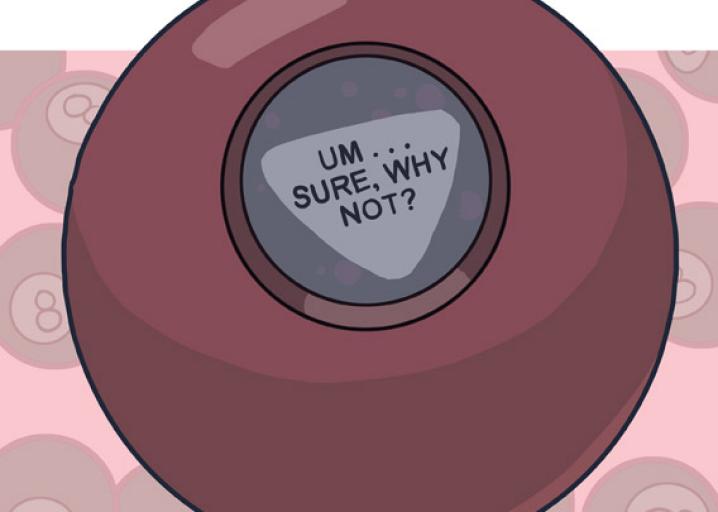
What Else Should Nate Silver Predict?
Predictions are hard—especially about the future. It must have taken superhuman will for New York Times FiveThirtyEight blogger and columnist Nate Silv ...
Slate Magazine
64 points · by barredo · 14y ago · 89 comments
But I would like to know - is there a Republican analog to Nate Silver? Someone who predicts 90% of the races at the end, does the meta-math, and has a computer model?
If there is no Republican analog, can you possibly say Nate Silver is liberal or biased? Does using a computer model and math, and blogging about your results make you a Democrat?
If Republicans actually concede that Nate Silver's results are legitimate and unbiased (if they are), than the party would have a much harder time raising money and getting out the vote.
It's better to frame it as a conspiracy so less people take it seriously.
Silver is politically liberal but he's a stats guy at heart.
The republican equivalent would be Unskewed Polls http://unskewedpolls.com/ which re-weights partisan affiliation of polls to match Rasmussen (The result: Romney is WAY ahead). It's author isn't a big stats guy and goes more off gut. This comparison isn't entirely fair though. Republican polsters and aggregators are probably private, working inside campaigns and not for a public news organization.
You can be politically liberal or conservative and not have it directly spill into your work.
No, not directly. RealClearPoltics (http://www.realclearpolitics.com) aggregates polling data, but it doesn't analyze it. Sean Trende does some analysis of the polls, but he is a lawyer and political scientist, not a mathematician.
Other than that, pollster Scott Rasmussen (http://www.rasmussenreports.com/) has a solid track record forecasting outcomes and is the closest thing to a Nate Silver analog.
Edit: > does the meta-math
BTW, I think one of the most interesting things that will come out of this election is the impact of cell phones on polling data. The meta-math is based on the sampling models for each pollster, and the models have to take land line / cell phone demographics into consideration. Many pollsters only call land lines and try to accommodate for the demographics in their polling, but it's not certain how accurate their models are.
There has been a shift in land line demographics in the last four years. Lower income people used to have land lines only and mid to upper income people had land lines plus cell. land line usage has dropped a lot. In recent years, lower income people tend to have cell phones only. It will be interesting to see how the the election results compare to the polling data.
One gets the impression that his professional reputation is more important than his ideological affiliation, and so I find him pretty credible.
"What is your political affiliation? My state has non-partisan registration, so I am not registered as anything. I vote for Democratic candidates the majority of the time (though by no means always). This year, I have been a supporter of Barack Obama."
And the next question -
"Are your results biased toward your preferred candidates? I hope not, but that is for you to decide. I have tried to disclose as much about my methodology as possible."
Sometimes, facts favour liberals, sometimes they don't.
The overrating of objectivity has been a hobbyhorse of Jack Shafer's for awhile, and he can be fun to read; here, for instance:
http://blogs.reuters.com/jackshafer/2011/09/20/media-bias-gi...
I like to tell myself that too, so I regard his work with at least a little skepticism, even though I gobble it up and bet on it.
I know too much about human biases to even try to claim that his do not influence his interpretations and work at all – I just don't think that's possible – but that is general and in all likelihood inevitable problem. I think it's pretty clear, however, that it's in his best interest to make accurate predictions, not partisan predictions.
I do not think it's really helpful to start out with that question. It puts too much focus on what's actually important. Yeah, bias can be hard to detect, but a little bias does not make models useless and when there is a lot of bias you should actually be able to point at what's wrong with the model instead of having to resort to some diffuse claims of bias.
Writing this made me think of Elisabeth Noelle-Neumann (http://en.wikipedia.org/wiki/Elisabeth_Noelle-Neumann). I disagree with many of her views and I think it would be fair to call her biased after reading her most famous work (The Spiral of Silence), but I do respect her work. There is a difference.
However that doesn't mean his models are wrong. When they show that Republicans are going to win (or have improved), he states that just as clearly as when the same is true for Democrats.
Are we reading the same blog? I've never seen him take sides on any issue.
Global warming, 2/3 Republican deny it, more than 3/4 Democrats believe it: http://www.businessweek.com/news/2012-09-30/global-warming-l...
Creationism is 38% for Democrats, 60% for Republicans: http://www.cultureofscience.com/2011/08/19/republicans-and-d...
I think Republicans are more likely not to want to mention or distribute condoms to teens in sex education, but I don't regard this as quite the same general disregard for science and math.
The political parties themselves would very much like you to believe that you're along with them for the ride on all their issues, and this no doubt accounts for much of the strongly held beliefs of both Democrats and Republicans. Push comes to shove, most people have not given much thought to the issues that politics have the most control over.
With only two choices, people are roped into supporting all kinds of things that make no sense for them. But you get "My party believes in science!" and "My party believes in God!" and it becomes part of people's political identities. And then all sorts of other issues are piled on top of it and you find yourself wondering how we got here.
It's ludicrous, really.
Not extremely well. You've cherry-picked your data to support your theory.
Specifically, I notice you don't touch on those who reject vaccinations, practice homeopathy, or believe Feng shui goes beyond aesthetics.
As someone living in a very large, liberal city and hailing from a rural, conservative town, I can tell you the Republicans of the world are not the ones debating if vaccinations cause autism. The ones I know think it's moronic & hideously irresponsible not to vaccinate your child.
It's a fairly settled issue in social science, though, that abstinence-only sex ed doesn't work. Not a hard science, perhaps, but still a science in that it's data-driven and rejects hypotheses based on new data.
http://dx.doi.org/10.1097%2FGCO.0b013e3282efdc0b
http://journals.lww.com/co-obgyn/pages/articleviewer.aspx?ye...
The correlation is with misunderstanding all three and coming to bogus conclusions.
Let's take evolution. There are lots of folks, typically Democrats, who insist that it is fundamental to all of science. (Hint - that's clearly false. Disagree? How does evolution matter outside biology? Too hard? Name three biology subfields that don't work without evolution? Too hard? Name three things in biology that were predicted using evolution?)
Democrats like to think that they're scientific, but ....
Let's take the suggestion that state of mind affects conception in humans. Clearly false when Akin said it, but what does everyone say to a couple trying to get pregnant? Yup - "you've got to maintain a positive mental attitude." (I don't know whether mental attitude matters - I'm just pointing out the double-standard.)
Of course evolution is not fundamental to ALL of science. For instance chemistry is based on current measurements, not what happened in prehistory. But you are overstating your position.
How does evolution matter outside biology?
Evolution matters to geology because specific fossils are often used as a cross-reference for the age of specific rocks. Indeed such "indicator fossils" are important economically because of how they are used in oil exploration.
There are also applications of fossils to astronomy, for instance fossil corals have been used to verify how the number of days in a year have changed over time.
Too hard? Name three biology subfields that don't work without evolution?
1. The study of evolution itself.
2. Ecology. A very large part of ecology is based on understanding the Evolutionarily Stable Strategies of living organisms. For everything from mating to parenting behaviors, what animals do is explained by how it is selected for evolutionarily.
3. Taxonomy. We classify living organisms based on the best guesses we can come up with for where their ancestors were in the evolutionary tree. We reconstruct those trees using everything from physical characteristics to molecular genetics. NONE of it makes any sense without common descent.
Too hard? Name three things in biology that were predicted using evolution?)
1. (Prediction made by Charles Darwin. Confirmed many decades later by Leakey's discovery of Lucy and other fossils.) Fossils for early humans would be localized to Africa. Based on homology, humans are clearly an ape. Since existing ape species are mostly found in Africa, our ancestors are likely to be found in Africa as well.
2. (Prediction made by Edmond O. Wilson, later confirmed by him) In slaver ants, male and female babies should be treated equally if there is a good supply of slaves, and should be treated unequally (as they are in most ants) if there aren't. The cause of the unequal treatment of males and females in an ant colony is that a quirk of genetics causes females to share 75% of genes with sisters, and only 50% with parents or brothers. Therefore female ants are willing to devote their lives to the production of more sisters. This causes preferential behavior for female larvae. In slaver ants this disappears because the slaves are controlled by the queen who is equally related to sons and daughters. Remove the slaves, and the daughters express their genetic preference.
3. (Made and confirmed many times by a variety of people.) Pylogenetic reconstructions of evolutionary tree are robust to the specific set of characteristics chosen for that reconstruction. The branching in characteristics reflects the actual ancestry of the animals, and so two sets characteristics will tend to reveal the same ancestral branching pattern. (There are exceptions where common evolutionary pressures cause disparate animals to have similar adaptations. But these are well-understood.)
Now let me guess. You don't believe in evolution, believe that you understand science, and it surprises you that I'd actually find your challenge easy. If so I would urge you to open up your mind, go to http://www.talkorigins.org/, and educate yourself.
You can't, on the basis of zero real evidence, dismiss the theory that best fits the known facts, without causing harm to the understanding of the scientific method as a whole. So it is not that the one theory is so critical to all of science, but the act of throwing it out because it offends religious sensibilities is damaging.
Gish Galloping wins you no support. It's a dishonest tactic that attempts to flood the opposition with questions that require more time to answer than they do to ask. It's a Denial of Service attack, not an argument.
> Clearly false when Akin said it, but what does everyone say to a couple trying to get pregnant? Yup - "you've got to maintain a positive mental attitude." (I don't know whether mental attitude matters - I'm just pointing out the double-standard.)
Because Akin was minimizing rape. He was trying to de-legitimize the experiences of victims of a violent crime. Do you really not understand how people get upset over that?
Anti-vaccination is a fringe movement, and party independent (Michelle Bachmann got on the anti-vax wagon). The democrats aren't putting anti-vaxxers on the house science committee.
I also don't know about anti-GMO idiocy, frankly.
Are they short-sighted or lacking compassion?
I think this kind of binary political thinking is the most insidious thought virus we face. Far more dangerous than whether or not someone believes in evolution, because it separates us and makes us believe that the "others" have traits that they really don't have. It's awful.
But I do understand the idea that religious people can be compassionate and give money away. So can atheists. So can intelligent people. So can both more and less educated people. It's orthogonal. And I never cited religion. And I was speaking in general terms based on direct, personal observation. Also I for one do not engage in "binary" political thinking -- not when I'm actually thinking internally -- though it's often useful when speaking in order to average out details and identify patterns and then express them concisely in public conversation.
And as an additional point, if by 'mission' you mean a religious mission, then I'd say that I don't consider that to be a good thing. It's a bad thing. It spreads superstition, fear, make believe, childish mental states, obedience to arbitrary authority, silly rituals and fuzzy irrational thinking. Yes it also teaches relaxing and addictive chants and tunes, and feel good phrases. And the good parts, anything dealing with peace, compassion, charity, with community interaction, can all be done without the negative that comes from the religious baggage attached to it. Also, like your complaint about binary thinking being a bad thing. I don't think education is a binary quality. You're not either educated or not. There are many intermediate degrees and shades of grey, and types. So while I do think someone can be somewhat educated and religious, I don't think they're extremely well educated or intelligent. At least not both. Otherwise one would see that that particular emperor wears no clothes. But of course this is just the conclusion reached by many of us, not all of us. To each his own.
http://www.baseballprospectus.com/author/nate_silver/
His big contribution was a model used to predict player statistics. When he first started writing about politics, I assumed the name was a coincidence.
I'm curious about the methodology as well. Why didn't you choose more standard gaussian statistics for the differences, instead of the combination linear/step model? How much difference would it make?
I prefer to have the flat region of 50% probability when the state poll difference is small, which the gaussian model doesn't have, to take into account (a) the various errors in the polling data and (b) the likelihood that people's minds can change by the time the election comes.
As to how much difference it would make, with the current model, Obama's probability is now at 81%, whereas with the Gaussian model it would be around 95%.
but he's popular mainly because he can communicate so well. doing the maths right is not that hard.
It's true he's a good writer, but the proof is in the pudding. He could be foaming at the mouth, but if he's predicting the outcomes, people will tune in.
> Silver's final 2008 presidential election forecast accurately predicted the winner of 49 of the 50 states as well as the District of Columbia (missing only the prediction for Indiana). As his model predicted, the races in Missouri and North Carolina were particularly close. He also correctly predicted the winners of every U.S. Senate race. The accuracy of his predictions won him further acclaim, including abroad,[49] and added to his reputation as a leading political prognosticator.[50]
[1] http://en.wikipedia.org/wiki/Nate_Silver#2008_U.S._elections
Also, "You're only as good as your last envelope."
And here I was under the impression that ALL predictions are about the future.
Actually, I saw this one assigned to Neil Bohr. Sounds like a Yogi-ism though.