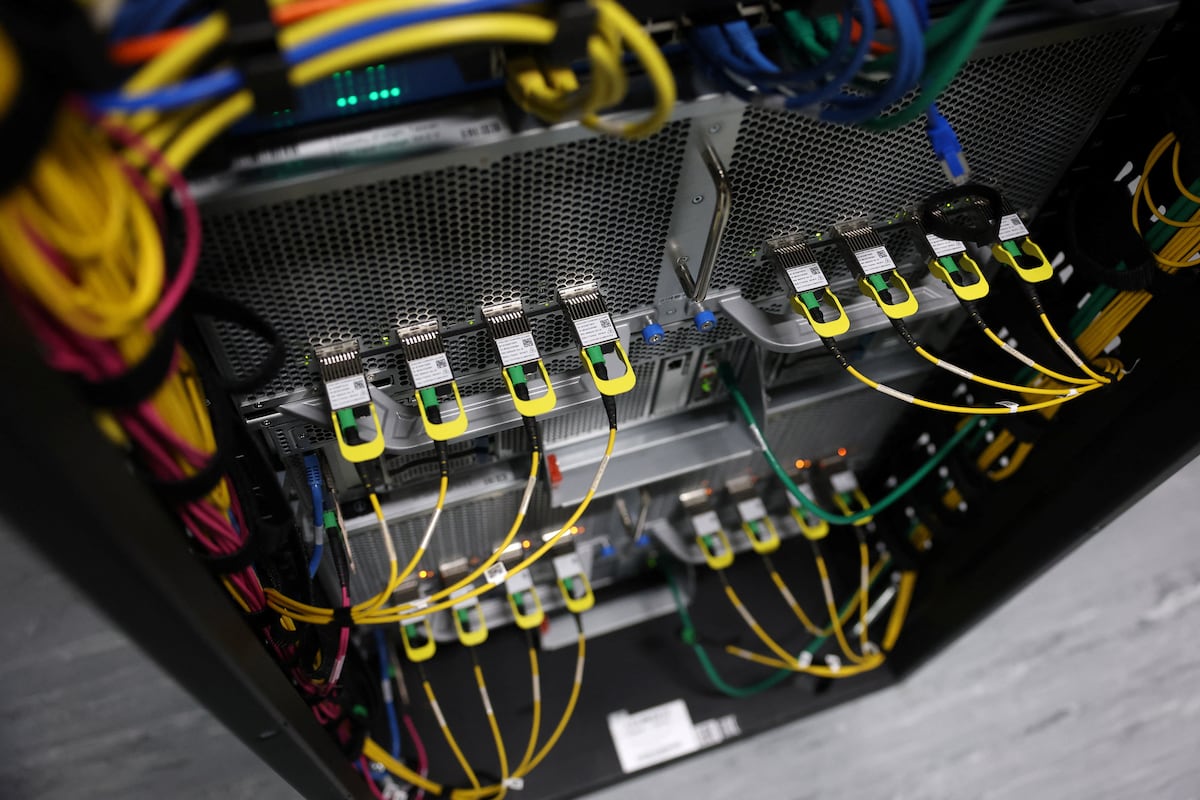
If AI replaces workers, should it also pay taxes?
The technological race among industry giants and the wave of layoffs they have announced has revived the debate about the advisability of taxing automation
EL PAÍS English
588 points · by PaulHoule · 11mo ago · 1012 comments
The fact that capital owners successfully avoid contributing to the financing of our states and social systems is, in my view, one of the fundamental problems of our time.
However, the root questions are: what should the state provide, how much, and of what nature? A secondary question then becomes how important the redistributive aspect is. That’s what you’re seemingly alluding to when you say: people work, get taxed on it, but others automate that work and this automation does not get taxed.
Following that line of thinking makes sense, but it also contradicts the core benefit of automation, which is to delete non-needed work, make things cheaper, and make the value creator richer.
If the goal of redistribution is usually that “more” people reach a higher standard of living, then adding taxes and friction to processes like automation may conflict with that goal, given that automation is arguably one of the strongest natural drivers of higher living standards overall.
Of course, the counterpoint to “what and how much should the state provide” is “who should pitch in, and how much,” which is what you’re focusing on. I mostly agree that everyone should be taxed fairly, but I also see many exemption cases, because taxes are friction and we often want certain things to be frictionless. For example, I would oppose taxes on life-saving surgeries. But where do you draw the line? What about automation that indirectly enables or improves life-saving surgery?
I like the idea of classifying it into four buckets: those that are below tax net gains for a country, those who are above and those that are above the tax net gains using just their wealth, and then the government.
The cost of providing the basic obligations and debt service of the U.S. amounts to roughly 1/3rd of the U.S. GDP, while taxation on any activity induces friction and higher costs - the bill will need to be paid either via capital markets or taxation. The investment in automation is no more important than food, or my children's education in my view.
Taxation is generally preferable for capital owners compared to currency debasement and forced debt purchases as it maintains boundaries on what the state can and cannot do. If the current trend is towards a greater share of the economy accruing to capital owners is maintained, then capital taxes will eventually need to rise to sustain state obligations.
This could be almost any tax system depending on the what one views as "fair".
The core benefit of automation is to give back time to humans to free us to do more creative things with our big beautiful brains. At least, that would be the core benefit if humanity was on a positive trajectory.
The right question is who benefits the most from state’s services. For example if a whole lot of security, legislative or admin services go to protecting the capital, then those who has the most capital need to chip in the most.
> redistribution is usually that “more” people reach a higher standard of living, then adding taxes and friction to processes like automation may conflict with that goal
This is basically a 50 year old trickle down argument. But real wages have not increased in comparison to gdp since 70s, so nothing trickled down. We are demonstratedly bad at sharing what we have achieved together, no reason to believe more tech will magically get better treatment than that.
Besides redistribution is not about shifting the curve up, but making it flatter - see gini coefficient.
> the core benefit of automation, which is to delete non-needed work, make things cheaper, and make the value creator richer.
Except the era of classical capitalism and inventor’s profit is over, since 70s it is rentiers unreciprocated extraction on top of purported value people didn’t necessarily ask for or need in the first place. Likewise most people aren’t dying for AI automation, and not even for structural threats; it is not even proven that it will provide a net total productivity gain when the hype cools down, despite being shoved down people’s throats.
Let’s not kid ourselves, there is little concern for real value creation but a capture-the-flag on a gigantic data-moated compute monopoly. Whatever democratic means enabled proper taxation would have already prevented this type of speculative berserk, failures of which I assure you will be socialized.
So friction = societal consent, internalizing externalized costs, revealing what is actually value versus monopolist’s rent. It is healthy for the society, it is healthy for capitalism.
The problem is that libertarians have been able to retcon their fan fiction into what Capitalism is and gloss over the original anti-rent seeking, anti-monopoly, pro-government oversight parts that Capitalism REQUIRES in order to stay healthy,functioning, and beneficial to society. And people just accept that 'capitalism good' = 'late 20th/early 21st century libertarian fanfiction of what capitalism is' is the definition of Capitalism, when it is very far from it and has zero relation to the functional Capitalism that lifted the world up.
Combining this late 20th/early 21st century fanfiction version of Capitalism with the current tech company goals for AI is something totally new, zero percent Capitalism, and 100% would be hated by original Capitalist thinkers as damaging.
This is extremely aggressive framing. It smashes together two wildly different kinds of citizen with wildly different, often opposing incentives and access to power: those who sell their labor for a living and those who literally own the economy. It poses them both in opposition to the government which has 1/5th the revenue of the latter.
If capital is the big bad, this framing is a mind-virus that makes the problem hard to think about and speak about.
> friction
Friction plays a key role in "the unreasonable effectiveness of capitalism." It's a big part of the reason why we can rig the game in favor of capital and not simply have the economy immediately degenerate into "capital rules, labor drools" due to the exponentials inherent in "rich people get paid for being rich in proportion to how rich they are."
Removing friction is not necessarily a net good if it contributes more to distributional problems than it relieves in deadweight loss. Nobody is a fan of deadweight loss, but I'd be a lot more sanguine about eliminating it if I thought we had a credible handle on the distributional problems. But we don't.
Since all my competitors are also running dark factories, we compete essentially on source materials + energy (assuming we have similar design/quality). Margin would be eventually razor thin. The dark factory does not make much capital gains, even as it produces 1,000 gizmo per second.
The capital gain is not much , but since we have only a handful of employees, that is enough to pay everyone a decent wage, after paying for the factory itself, source materials and energy.
How much tax do we expect to get from this gizmo company ? 10 years ago, to produce the same gizmos, I needed 5,000 employees, the unit price was way higher, and had higher revenue. But since AI and dark factories came, the prices cratered, instead of 5,000 jobs, we only have 5 jobs to produce the same.
Sure the 4,995 unemployed might be able to afford the gizmo, but the state does not receive the same taxes. So what happens to those 4,995 unemployed people ? who is paying for their health benefits and social security (retirement) ?
I am wondering how best to solve that equation ?
But that's good, right? It means that the difference between what workers get paid when they do work and what they pay when they buy things is small.
> Sure the 4,995 unemployed might be able to afford the gizmo, but the state does not receive the same taxes. So what happens to those 4,995 unemployed people ? who is paying for their health benefits and social security (retirement) ?
Let's consider the two possibilities here.
The first is that we automate everything. This is implausible, but let's consider what would happen. Well then necessities would be free, because there is no labor cost to produce arbitrarily many solar panels or skyscrapers or mine asteroids to get unlimited raw materials etc. So then you don't need taxes because nothing costs anything.
The second is that there is still work you need people to do, and then they do that, and still have jobs.
And the more stuff you do automate, the less expensive it is to produce things, and the less assistance anyone needs to afford the now-lower cost of necessities. So if you get halfway between one and two then that's still fine because costs go down in proportion to the lower demand for labor.
The real problem is if the cost of necessities are held artificially scarce through regulatory capture and zoning rules. But that's not an automation problem, that's a government problem.
So are we're simultaneously facing a big unemployment crisis, and a big shortage of health care providers and retirement care takers?
chatGPT is a sypcophant and without regulation any AI company can and or will juice their algorithms so their AI system becomes cocaine for the millions of lonely to unsatisfied people out there.
My friend has a partner of 30 years but their relationship is that of roommates. If you think she is not you that might be correct but you know someone like her and possibly many like her. Unsatisfied, not able to get that movie type love / romance / fantasy and now unfetterd AI can get these people hooked like cocaine and into the depth of zero reality!
I would change my opinion if it could be shown to have the negative physical harm that your cocaine example implies.
If you're referring to some equivalent of wealth tax or inverse of accounting for deprecations in terms of assets, then that seems pretty problematic. 1) how do you asset the value of something until someone pays something for it? Unlike homes, where you can compare roughly to those around you, this seems much more dynamic for software / AI. 2) Let's say we are able to assess the value, so now a startup with software but no revenue has to pay taxes? Where does the money come from?
Capital Gain tax occurs when you sell an asset for more than you paid for it.
AI (software) is not an asset, and I'm not sure how you'd sell it. Computers and robots are assets (although they typically depreciate not appreciate.)
Either way capital gains tax is applied to the asset not the productivity of the asset. The productivity in turn is taxed as part of income tax.
Perhaps I have misunderstood your point though?
How do we get royalties on this, like our share of the oil proceeds if we were citizens of Qatar? How do we trade our share of the contribution? There's twenty years of my posting on Reddit, Slashdot, HN, and other forums, that we know for a fact has been used in these frontier models. Great... where's my royalty check?
Pay us, not the government. We'll have to pay taxes regardless, and yes, close the tax loopholes on security-based capital gains (don't tax me for all the investment in my primary residence, that's a double dip).
I heard this called "Coasian" economics (as in Coase). I'm not sure what that actually means, though.
I support the idea of UBI with zero conditions, but not this. You didn't get royalties before AI when someone was heavily influenced by your work/content and converted that into money. If you expected compensation, then you shouldn't have given away your work for free.
Payment for content access is a sure way to limit progress and freedom. Should I pay you based on quantity, quality, or usage that relates to your content? How about the ideas you took from other people, should you pay them? Where does it stop?
I think the copyright system as it exists today is just absurd - a complete inversion of what it was supposed to do. It was meant to promote progress by protecting expression. Now look at what's happened: total concept and feel protects aesthetic gestalt, Structure and Srrangement protects how elements relate, Whelan Test protects the entire logical skeleton while AFC (abstraction filtration comparison) enables hierarchical abstraction protection.
Each rung up the ladder takes us further from "I wrote this specific thing" toward "nobody else can solve this problem in similar ways". This is how platforms get rich while common people, readers and creators, lose their freedoms and are exploited.
Alaska as a state managed to do just that and more or less has an annual UBI.
Certainly you can argue income inequality is too high and capital holders and high earners need to pay much more.
But you cannot seriously argue that capital owners "avoid contributing to the financing of our states and social systems". They pay a lot in capital gains and income taxes, even if they don't contribute as much as they should.
> In the United States, for example, about 85% of federal tax revenue comes from labor income,
That means only 15% is coming from all other taxes, including corporate taxes, capital gains taxes, and other taxes on the wealthy (estate taxes), mostly because they find creative ways -- and loopholes by design -- that allow them to reduce those taxes significantly.
Making capital gains taxes more progressive is a good first step.
Receiving a relatively low official salary (Bezos's Amazon salary was $81,840 for many years).
Not receiving dividends, so the wealth remains in stock that is not taxed annually.
Borrowing money against their stock holdings to fund their lifestyle. Loans are not considered income and are therefore not taxable, and the interest on the loans can sometimes be used as a deduction.
A loan should definitely be a taxable event and capital gains taxes should apply to rebase the value of the stock to the market value at the time the loan is taken out. Currently, very wealthy people use the loan dodge to avoid selling stocks and since the loan isn't paid off until death (usually), estate taxes wave their hands and any gains in the stock price go away, so that the next nepo generation gets to repeat the same dodge.
- And: lobbying their congressmen for tax cuts
Sure we can. Peter Thiel managed to put $5 billion in his Roth IRA.
https://www.propublica.org/article/billionaires-tax-avoidanc...
"Using stock deals unavailable to most people, Thiel has taken a retirement account worth less than $2,000 in 1999 and spun it into a $5 billion windfall... What’s more, as long as Thiel waits to withdraw his money until April 2027, when he is six months shy of his 60th birthday, he will never have to pay a penny of tax on those billions."
This is exactly the kind of thing I was looking for.
If billionaires (soon to be trillionaries) paid as much taxes as their wealth disparity compared to the middle class, a significant percent of the population would be exempt from taxes by the sheer insignificance of their contribution, and I don't mean only the poorest people.
starting your reply with an insult, great way to spark "grown up discussion"
Can we have an honest discussion that uses numbers instead of hyperbole?
Notably, that still seems pretty insulting to me. jimbokun wants to have an honest discussion about the problem, using true data instead of emotional exaggeration. This is a reasonable thing to ask IMO, but of course it seems like an insult towards the person that's making stuff up.
It’s the same pattern everywhere around the world (perhaps there are a few exceptions). Businesses can be much more creative with tax evasion as well.
Businesses don't pay taxes. People do. Every dime that a corporation pays is a reduction of capital returns to shareholders, or a reduction of investment into business activity, both of which are taxed again by the people who ultimately receive the capital.
Why should workers care about being more productive if they do not reap the rewards in terms of wages?
https://en.wikipedia.org/wiki/Decoupling_of_wages_from_produ...
Avoiding tax through various loopholes that Capital gets a seat at the table to help craft, while benefitting from externalizing the costs to taxing labor is just corruption.
Point one: higher productivity is not necessarily our goal. I could think of numerous industries that would make the world better if they did less work.
Point two: There's a moral absurdity in taxing the wages earned by labor more heavily than the returns earned by ownership. One is tangible effort, the other is an abstraction backed by law. If anything, taxing capital should be the baseline, because it's the least tied to survival. Historically, when America was at its most broadly prosperous, capital gains and corporate profits were taxed at far higher rates than today.
Point three: AI intensifies that calculus. If AI is deployed by capital to further replace or devalue labor, then taxing only the worker is punishing the displaced while rewarding the displacer. That's pure extraction. If we want social systems to survive, the burden has to fall on the owners of the machines, not the people being replaced by them.
Genuinely one of the largest and most destructive ills of our society right now is that so tremendously more of our shared prosperity as a system is directed to those who do the least to create it.
So, what do you tax? You tax land and land-like things, non-reproducible privileges(like patents and copyright), pollution and other negative externality.
Now, there's an argument to be made that we couldn't possibly be able to fund governments on the back of these taxes. Fair enough, but it should mean we minimize those taxes until the economy grows enough to fund government services.
This assumes the worker is the one benefiting from the productivity gains. We're just worked more and we don't get the added value.
Tax is one of those issues where there are actually correct and incorrect answers, thanks to many hundreds of years of active experimentation and relatively simple/robust theory. But people ignore the correct answers for social reasons.
The correct answer on tax is:
1. Figure out how much money the state needs to supply the services that are in-scope for it to an acceptable level of quality.
2. Aim to raise that much in taxes.
3. Optimize deadweight costs. That is, configure taxes to minimize the level to which the activities being taxed are discouraged and driven either out of existence or abroad.
If you do this sort of thing then you get Georgeism, you get zero capital gains, I think you get zero taxes on businesses, and a bunch of other policies I can't remember right now. The results can be economically very efficient i.e. they make everyone better off. However, almost nowhere uses them because there's nothing in the above three items about social engineering, and governments use taxation largely as a tool of social engineering. And in particular to please leftist voters who use the tax system to penalize wealth for its own sake, and to reward groups of client voters. Many governments also have a lot of trouble defining what's in scope for them and then working backwards to needed tax revenues; they prefer to raise as much tax as they can manage without totally crushing their economies and then find ways to spend it.
The industrial era problem isn't capital but that economies of scale encourage consolidation heavily and make running small business an even more uphill battle. There is at least a counterbalancing force of competitive pressure and antitrust to promote some splitting for innovation's sake as opposed to just one big stagnant monopoly winning out just because it is biggest.
When inflation is absurdly high like in Argentina, Economy does not make sense any more.
Basic economic assumption are not true and you get things like that or that "spending" is actually "saving".
I don't think it relates.
Are you sure capital owners do not contribute to our states and financial systems?
For instance, Jeff Bezos is worth $238 billion even though Amazon has a $2.6 trillion market cap. That's $2.4 trillion of value created for other shareholders plus trillions more for employees, customers, suppliers, governments, and other stakeholders.
Jensen Huang is worth $164 billion while NVIDIA’s market cap is $5 trillion. That’s $4.8 trillion of value for other people (ignoring value created for non-equity stakeholders).
etc.
I'm not saying that there should not ALSO be other ways to force contribution (e.g. via taxes), but to say they do not contribute at all is false.
1. Value created for other shareholders is a good thing
2. $ "value" directly translates to actual resources or services
3. These employees and customers would not get the same or more value elsewhere if Amazon did not exist
4. This "value" created by Amazon is better compared to the alternative (such as more resources used locally instead of global trade)
Folks that own a vast amount of stock do not pay taxes on that stock. They own the shares, and they take out loans against those shares. At some point they rollover or pay off those loans by selling some shares, but the shares have increased in value significantly in that time, or they’ve been granted new shares.
When we say “<business> has created value for shareholders”, it’s said in a way that implies that somehow that wealth creation makes its way into the tax system by virtue of the fact the wealth was ‘created’. It does not.
This is all aside from the fact that increased shareholder value means a more abundance society regardless of the increase in taxes. We could quibble over the exact distribution of who gains from the enlarged pie but it's certainly not the case the 100% of it goes to capitalists so consumers and employees also benefit.
That's not Bezos' doing alone, that's Bezos plus over a million workers that did that. If Bezos never existed in history, someone else would have filled in that market. We need to stop this myth that a few men alone create all this value and that without them we'd still be dragging plows through the mud for our farms.
On the other side, Jeff Bezos is clearly an outlier. Even if we agree that ecommerce would have existed without him, we don’t know whether someone else would have created the same scale of value.
I think it's pretty clear Amazon is quite a positive given by how many people like using it so much for it's convenient 1-stop shop, quick shipping, and hassle-free return process.
Are you saying it would be better to have to shop at 1000 different little websites with probably crappy or at least inconsistent return processes?
> capital owners successfully avoid contributing to the financing of our states and social system
Another fundamental problem is that the means of production are concentrated into the hands of a few.
I am more worried about the capability of people to use the free means of production (more precisely improve education) rather than the concentration.
Edit: and to remove any doubt, I do agree that taxation of capital is completely badly done now, but I do not think the capital is about owning the means of production but about the capital (effort) required to organize people to use the (mostly) free means of production.
40% figure is also based on individual income taxes. It drops significantly if you consider other sources (payroll etc).
Top 1% also receive preferential tax treatment and benefits disproportionately from policy changes.
[1] https://www.cbsnews.com/news/income-taxes-billionaire-tax-ra...
[2] https://www.propublica.org/article/the-secret-irs-files-trov...
So you are effectively suggesting to forcibly take their money from them and then give it back, but through a corrupt and bureaucratic system of the state.
Tax not paid by ultra wealthy goes back into he system as loans that extract interest that in turn is used to buy assets sold to pay for interest, those are then rented back to the system to extract more interest.
In essence by allowing no tax to be paid by the ultra wealthy, we facilitate the death of the middle class and transfer of everything to the very few - with mathematical precision.
Ultimately we need to ask ourselves why we have a society, what's it's purpose.
For the few or the many ?
Considering this, everybody might have to make (at some point in their lives) hard choices regarding where they choose to live. Yes, one should fight to improve the society one is living in, but there is also a saying "only the fool persists in their folly" ...
So many commnents here, yours included, make perfect sense when you simply look at them through the lens of the workers' relationship to the means of production.
Automation could be a good thing. It could mean we need to do less work and have more leisure time. Instead it gets concentrated in the hands of very few so they can become even wealthier. And the resultant layoffs are used to extract free labor from the people who remain and suppress their wages, all to eke out more profits.
Productivity increases result in lower prices in any competitive market.
By itself it wouldn't be a problem, the problem is at the same time they raise taxes for people doing OK, and salaries are mostly stagnating.
Are you talking about taxing unrealized capital gains?
Because for the situation where capital is directly replacing labor, the income generation is taxed regardless of the whether it’s generated by a human or machine.
If I hire people to make and sell hot dogs, they pay taxes on their wages. If I build an automated hot dog vending machine, I still pay taxes on the profits of selling those same hot dogs.
One can’t spend any of the money until it becomes personal assets. So what is not being taxed?
If I keep them in the company, I pay corporate tax on profits (22%) for retained earnings. And then I’d have to pay dividend tax (either 15% or 20%) atop those retained earnings to pay them out to myself as income. Or I pay myself a salary and pay regular income tax on the full amount.
Due to our progressive tax brackets and double taxation of dividends, both options end up with larger tax rates than when dealing purely with low wage human labor. We as a society collect more in taxes from one high income earner than multiple low income ones.
The oldest trick in the book is to use unrealized gains as collateral for loans - we even have banks specializing in this.
Oh, and the US has a law that erases the tax bill for dead people - you'd be stupid not to use this trick.
That is true, but there is a theory, applied very weakly, that supports this. The idea is that a decedent's estate is subject to a wealth tax on its fair market value, therefore to also subject the unrealized gains within the estate to income tax would be double taxation, which is to be avoided. The flaw is that the exemption from the estate tax is relatively high (something like $13,000K), so there would not be any double taxation is most cases, but it's treated that way nonetheless.
Debasement is an invisible tax and its effects far outweigh individuals bypassing taxes.
This thread is about the fair taxation of AI, if any.
The current interest on our national debt is greater than our military spending.
So if you increase taxes some people think it would just be throwing it into the money fire of Washington.
There needs to be a lot of changes in D.C.: term limits in congress, citizens united needs to be repealed, erc etc
For quite some time, my mortgage interest was larger than my principal.
That didn’t make it fiscally irresponsible.
https://www.marketplace.org/story/2025/07/14/how-our-debt-cr...
The government is fiscally irresponsible by design, because the government is ran by the plutocrats with all the incentives to give themselves more money at the cost of everyone else.
You know, exactly that span of time that everyone agrees on being really prosperous.
Owners of capital and means of production have succesfully gamed the system and most of the tax burden falls on us middle class idiots that pay taxes on our work.
But, of course, in such a society, the people who don't own the robots - i.e. most of us - become "economically unnecessary".
Of course, the question then is who is consuming the production, but we're not quite there yet.
So the government is going to fix this, right? Right...?
The top 1% pay 40% of the Federal income tax.
As a libertarian, I find the whole requirement for workers to secure an accountant and file individual income taxes under threat of retaliation silly. Individuals should be free to engage in activities like working for an employer, taking care of their kids or aging parents, or having sex, without paying tax to the government. Taxes should be levied on companies and robots, not humans doing everyday things.
The employer knows exactly how much they are paying each employee, and they already have accountants on staff. Why create "bullshit jobs" just for employees to file this same exact information again?
So yeah, we shouldn't wait for AI to replace workers, to abolish the individual income tax for individuals. It should have been done a long time ago. Employers can pay the tax (as they do with FICA). And in fact, we're going to have to have a tax regime that taxes robots, which would become the primary economic actors soon anyway. If corporations can have legal personhood, surely robots can too LMAO.
This is also a slippery slope. As slippery as taxing individuals, property etc.
If capital holders don’t actually deploy that capital and compete with each other, then you don’t have a capitalist system anymore. You have a feudal system, where asset holders extract resources through rents, rather than capital deployment and risk taking.
The crucial difference is between the governments actually run by the people, and the governments that claim to "represent" them.
Give unto Caesar that which is his, and let God handle the rest. The base case for the inductive proof is alarming, and I can’t see it ending well.
Then it should be asked to give a part of it for free. Not necessarily money by the way.
And so you can easily turn that argument around: the workers who actually produce the useful things are, for some reason, taxed higher than the owner who didn't lift a finger to produce anything, but is entitled to all the profits by virtue of being the capital owner.
Capitalism works when a market works; capitalism fails when a market fails. Healthcare is a great example, because there’s an obvious and inherent imbalance in demand vs supply. Firefighting is another great example. These also have externalities to the community as a whole that everyone gets, even when you don’t pay/need the service; so it makes sense to make everyone pay (taxes). Even if you never have a child, even if you send your kids to private school, you live in a society that could only exist because of a (formerly, relatively) high standard of public education. So everyone pays for schools.
The idea of government bureaucrats lining their pockets is also (formerly, relatively) ridiculous: who would get into US government bureaucracy to make money? They are all (formerly, relatively) doing it almost uniformly because they believe in the mission, because they would almost all make more money going private.
I often ask myself whether that is ethical or not. But in the end, it’s not the tooling that’s unethical. Productivity increases are good for everyone, under normal circumstances.
It’s the fact that all the gains are being collected by the already uber-wealthy that’s wrong.
So if I'm reading your comment right, you think it would be ethical under normal circumstances, but also believe we don't live under those normal circumstances? In that case i think the answer you're looking for is: it is not ethical to develop these tools under the current circumstances.
Wouldn’t that mean that it’s unethical to work on anything that improves productivity? AI, in particular?
As long as (almost) all the benefits/wealth generated by your work is captured by the 0.1%?
Because that’s the case right now.
When the product succeeds and you get offers to exit, would you sell to the uber-wealthy? They will exploit your user's data and collect the gains.
Those are the questions you should be honestly asking yourself when considering your own ethics. What's your price?
https://taxfoundation.org/data/all/federal/latest-federal-in...
How about the rich say that 50% of the economy should pay their fair share?
They don't get money through income! They get most of it through capital gains or unrealized capital gains which are taxed at special low rates and zero rates respectively.
It's transparently self-serving and completely indefensible -- though I'm sure you'll try.
Bottom 50% only 2% of wealth
50% of the economy my ass, these takes don't even pass basic accounting logic these days
Someone with $1b of assets gets far more value from a modern stable western society than someone with $10k of assets
What it would impact is how easily these people could influence the political system and get themselves out of trouble.
At $400 billion net worth, Elon Musk could retire one hundred thousand times. He literally wrote multi-million dollar checks to various politicians and ran an illegal pay-for-votes scheme in Pennsylvania. And he'll face zero consequences for it.
It's not like he has all that in money in his bank account, it's ownership of companies, their value is not real until someone else is willing to pay.
It would certainly impact their willingness to do the company-building that creates all those innovations and jobs.
With such a rule, Tesla wouldn't exist, no electric cars, no SpaceX, no cheap advanced launch tech; basically most of the modern world would be choked in the crib by taking away the incentive to build it.
1% of Americans control 30% of the wealth of the nation, and apparently 12% of property.
It's more than reasonable that people with that much wealth to their name pay the vast majority of the taxes, as it used to be.
From a nation building perspective, there's no reason to allow a couple hundred people to wield 52,000,000,000,000$ worth of assets. It means the economy has gotten far too clumpy and needs some redistribution. This isn't even really all that anti-capitalist. Capitalism can't survive long term without budding up against a government that regulates it.
How exactly do you propose that they pay their fair share when they literally do not have the money or assets to do so? Are you proposing modern day slavery? Perhaps people selling their family? I'm curious what happens if you take this line of thought to it's actual conclusion.
Maybe different depending on area, like $20,000 a year to live in NYC but only $2,000 per year to live in a rural village.
If you can't afford the fee that's OK, it just means you have to live outside of the developed areas and don't benefit from any services provided by the government. But you are free to set up a tent in the woods and live off the land.
I don't think people should be able to vote on massive tax increase laws, if it doesn't also increase their own taxes in some way.
> Three: Eliminate the corporate income tax. Completely. If companies reinvest the money into their businesses, that's good. Don't tax companies in an effort to tax rich people.
> Four: Eliminate all income and payroll taxes. All of them. For everyone. Taxes discourage whatever you're taxing, but we like income, so why tax it? Payroll taxes discourage creating jobs. Not such a good idea. Instead, impose a consumption tax, designed to be progressive to protect lower-income households.
Our fundamental problem is not that we don't tax Jeff Bezos. It's that we don't tax the people who have multiple boxes of Chinese goods coming from Amazon to their houses every day.
I really have difficulties seeing AI as anything else than yet another type of machinery. If your argument is "but it's replacing ALMOST ALL human labour" - well, the same argument was valid for tractors a hundred years ago (when almost everyone was employed in agriculture).
Tractors did not cause this phenomenon because jevons paradox kicked in and induced demand rendered the problem moot, or demand eventually exceeded what mere tractors were capable of doing for agricultural productivity.
The same can probably be said for contemporary AI, but it's tough to tell right now. There's some scant indications we've scaled LLMs as far as they can go without another fundamental discovery similar to the attention paper in 2017. GPT-5 was underwhelming, and each new Claude Opus is an incremental improvement at best, still unable to execute an entire business idea from a single prompt. If we don't continue to see large leaps in capability like circa 2021-2022, then it can be argued jevons paradox will kick in here and at best LLMs will be a productivity multiplier for already experienced white collar workers - not a replacement for them.
All this being said, technological unemployment is not something that will be sudden or obvious, nor will human innovation always stay under jevons paradox, and I think policymakers need to seriously entertain taboo solutions for it sooner or later. Such as a WPA-style infrastructure project or basic income.
I already have friends experiencing technological unemployment. Programmers suddenly need backup plans. Several designers I know are changing careers. Not to mention, the voiceover artist profession will probably cease to exist besides this last batch of known voices. Writer, editor - these were dependable careers for friends, once. A friend travelled the world and did freelance copyediting for large clients.
ChatGPT was just released three years ago.
Yup, Claude Opus 4.5 + Claude Code feels like its teetering right on the edge of Jevon's Paradox. It can't work alone, and it needs human design and code review, if only to ensure it understands the problem and produces maintainable code. But it can build very credible drafts of entire features based on a couple of hours of planning, then I can spend a day reading closely and tweaking for quality. But the code? It's professional work, and I've worked with contractors who did a lot worse.
So right now? Opus 4.5 feels like an enormous productivity booster for existing developers (which may indirectly create unemployment or increase the demand for software enough to create jobs), but it can't work on large projects on an ongoing basis without a knowledgeable human. So it's more like a tractor than anything else: It might cause programmer unemployment, but eh, life happens.
But I can increasingly see that it would only take about one more breakthrough, and next gen AI models might make enormous categories of human intellectual labor about as obsolete as the buggy whip. If you could get a Stanford grad for a couple of dollars an hour, what would the humans actually do? (Manual labor will be replaced slower. Rod Brooks from the MIT AI Lab had a long article recently on state of robotics, and it sounds like they are still heavily handicapped by inadequate hardware: https://rodneybrooks.com/why-todays-humanoids-wont-learn-dex... )
Jevon's Paradox and comparative advantage won't protect you forever if you effectively create a "competitor species" with better price-performance across the board. That's what happened to the chimps and Homo neanderthalensis. And they didn't exactly see a lot of economic benefits from the rise of Homo sapiens, you know?
AI is just the other pincer that will finish the kill shot.
I think GP's argument makes a pretty strong case that it won't, even if AI somehow successfully automates 99% of all currently existing tasks. We automated away 99% of jobs once during the agricultural revolution and it didn't result in "a broad, durable, and lasting unemployment effect" then. Quite the opposite in fact.
Maybe if AI actually automates 100% of everything then we'll need to think about this more. But that seems unlikely to happen anytime in the foreseeable future given the current trajectory of the technology. (Even 50% seems unlikely.)
The same can't even be said for contemporary AI, because lots of the jobs it's going to replace are theoretical or hype. Self-driving cars should've been here years ago, but because AI is extremely hard to improve upon once it gets to a certain level of efficacy, they haven't happened.
The question is: should we be discussing this stuff when AI hasn't started taking all those jobs yet?
In many of these discussions that line seems to get blurred and I start to get the impression people are using the specter of a vague, poorly understood hypothetical future problem to argue for concrete societal changes now.
The NBA has an incredibly high demand for 14-foot-tall basketball players, but none have shown up to apply. Similarly, if this causes our economy to increase demand for people to "execute an entire business ide from a single prompt", it does not mean unemployment can be alleviated by moving all the jobless into roles like that.
We don't need science fiction AI that will put everyone out of work for it to be ruinous. We only need half-assed AI good enough that they don't want to pay a burgerflipper to flip burgers anymore, and it'll all go to hell.
If your way of evaluating the progress of AI is a binary one, then you'll see no progress at all until suddenly it passes that bar.
But seeing that we do have incremental improvements on essentially all evals (and my own experience), even if it takes another decade we should be planning for it now. Even if it does require an entirely fundamental breakthrough like the attention paper, given the amount of researchers working on it, and capital devoted to it, I wouldn't put any money against such a breakthrough arriving before long.
Isn't ending all those programs one of the core ideas of universal basic income? Instead of having a huge bureaucracy administering targeted social welfare you cut all the overhead and just pay everyone enough to exist, regardless of whether you actually need it. It'd still be more expensive, but giving people something dependable to fall back on would hopefully increase innovation and entrepreneurship, offsetting some of the costs
On old people who can't or don't work.
If there is a magnitude increase in compute (TPUs, NPUs, etc) over the next 3-5 years then even marginal increases in LLM usability will take white collar jobs.
If there is an exponential increase in power (fusion) and compute (quantum) combined with improvements in robotics and you're in the territory where humans can entirely be replaced in all industries (blue collar, white collar, doctors, lawyers, etc).
In French we say "With "ifs" you can put Paris in a bottle."
Ex-farmhands had time to move into new jobs created by the Industrial Revolution, and it took decades. People also moved into knowledge work. What happens when AI takes all those jobs in far less time, with no other industries to offer employment?
If AI makes a few people trillionaires while hollowing out the middle class, how do we keep the lights on?
Tax the thing you care about? You don't need to care really about the definition of AI or what an AI is or anything like that, you care that some people got trillions.
Tax "making an absolute shitton of money" or "being worth an insane amount". Taxing AI specifically means you're absolutely fucked if Altman turns out to not earn that much but someone who makes a specific connector to data centres is the richest person in the world. Is Nvidia an AI company? What is AI? *Who cares?* The point is to figure out some way as a society of continuing.
> Tractors largely replaced human labour in farming about a hundred years ago
And what happened around that time? yeah it wasn't a period of smooth calmness was it? Periods of massive changes in productivity (ie lots of people going into unemployment) causes huge societal changes.
The thing that staved off revolution in the US was lots of spending, banking regulations, federal reserve, new deal and the like. Those that didn't do that, fell.
So its less about who pays tax, and more about who is going to give money to the unemployed?
The tractor created the middle class by giving more people access to jobs that paid better and provided more free time. It is yet to be proven who will benefit from the advancement of LLMs, but there is some consensus in the article that the large companies operating these LLMs will be. From there, proposing taxes on that additional profit doesn't seem ridiculous.
They even get to use fuel that has less taxes on it since they don't drive on public roads.
Theoretically, the only two things that any human go to earn money is (a) use muscles or (b) use brains.
I feel like AI plus robots covers all the territory. Maybe not quite yet - maybe we have a few more years, but what job could a human do that couldn't be done by an AI controlling a humanoid robot?
The alternative is like feeding an animal instead of letting it live the lifestyle it's adapted for. That helps it in the moment but over time its capacities atrophy and it ends up weakened, twisted and harmed with nothing to spend its natural instincts on.
Employment was a product of the industrial revolution. In the age when most everyone worked in agriculture, they owned the farm operation.
We didn't tax the tractor to bail out failing small businesses then, and I strongly suspect there is no will to tax AI to bail out failing small businesses that might succumb to AI today either. The population generally doesn't like small businesses and is more than happy to see them fail.
Tractors are taxed in Montana. We have a "business equipment tax" that works roughly like the tax on cars, but applies to assets that don't drive on the public highway such as tractors and other machinery. Republicans have waged a decades long campaign to reduce/abolish it though.
I do. Agriculture products are zero-rated. But obviously it depends on jurisdiction.
To clarify, this isn't about the farmer paying a "sales tax" or VAT as % of the price of buying the tractor.
The article is talking about something else: paying additional machine taxes to cover the loss of unemployed crop workers that would have been paying individual income taxes.
That's exactly what AI is doing.
We got lucky that when farming was being mechanized, it happened slowly and while manufacturing was still growing and could soak up the labor. When manufacturing was offshored/automated, we got less lucky and a lot of people faced a massive drop in quality of life as they lost their high paying jobs and couldn’t find equivalent ones in the service sector.
Now we’re seeing a potential massive job displacement, the force doing the displacing can likely also do many of the new jobs that may arise, and the change is happening faster than any ever before.
Capitalism doesn’t promise to create new jobs when old ones are automated, we’ve just gotten lucky in the past, and our luck has run out.
You’ve already stated what circumstances are different now.
No matter how you try to resolve this economically, it should hold that if something can be produced with minimal human labor, it shouldn't require substantial human labor to buy (in "reasonable" quantities, however you want to define and enforce that).
Without understanding the "end game" of automation (decades+ from now) it feels like we're just sleepwalking into an absurd reality where a few trillionaires own the world's fully automated food supply chain, but buying food somehow requires just as much labor as it does today.
> […] those are things that should still be solved at a much higher level of abstraction […]
I don't think that makes much sense. If a data center consumes all available electricity in a given municipality, it may provide AI services at a very low cost, but thereby makes the region uninhabitable. There is no way to "solve" this at a higher abstraction level. Or alternatively, consider a factory producing consumer goods, which emits toxic fumes; we can limit the amount of fumes the vicinity of the factory is exposed to by implementing very expensive filters—thus increasing the final price of the goods—or externalise all the negative effects—such as health risks in the population, ecological demise, and subsequently lower property values—to society, achieving a lower final price.
Currently, we often pick the latter option, because it usually has the better profit margin. I agree that it's a systemic issue that must be addressed holistically, but the actual solutions have to be implemented at all levels of the production chain. And this means the cost attached will have to be included in the price of all goods.
My point is simply this: As automation advances, the vast majority of that value (e.g. 98%) should flow back to society. Right now it's being soaked up by capitalists. There should be a reward for improving efficiency but it should be sensible.
I believe unfortunately it’s intractable because humans cannot successfully align incentives and actions at a scale large enough required to solve it
The reality is that the floor to become "useful" is relatively low, which means the few billioanires have a large pool of potentially useful people of which they only employ some, leading to no greater salaries due to labour competition.
The other potentially useful workers cannot pool together and compete as the barrier of entry in the sector is prohibitely high.
So a natural moat emerges over cost of setting up a company, workers beg for a job of which they will take for a small wage and a few billioanires control the market.
This is a much closer approximation to the market we currently see
In any case, the argument won't work for majority of the population without a college degree. Are you going to have 50+ year old truck drivers upskilling in a fancy new tool to keep a job? And again, how long until that new skill you upgraded them to is now done by AI as well.
I dont see that happening
We could, conceivably, learn from our mistakes and do something different now. But we're not.
Automation has been shoving blue collars out of the job market for a century.
A single farmer can do with his machinery today what took a dozen of people just 50 years ago.
Manufacturing has been super automated long ago.
Even in commerce automated checkout has been replacing workers for more than a decade.
In any case such a tax is not only pointless but actively dangerous, as all it achieves is making countries without such a tax more competitive.
Taxing Robots : Easier Said Than Done (2017) https://www.ctf.ca/EN/EN/Newsletters/Canadian_Tax_Focus/2017...
Robots, technological change and taxation (2017) https://www.taxjournal.com/articles/robots-technological-cha...
Why robots should be taxed if they take people's jobs (2017) https://www.theguardian.com/business/2017/mar/22/robots-tax-...
Perhaps the more interesting bit is that you only seemed to have noticed it when it is asked about white collar workers?
The average person now is far wealthier in terms of actual purchasing power than the average person 100 years ago, and that's largely because of automation making everything cheaper.
access to housing is incredibly expensive. Measuring their purchasing power for how many scented candles they can buy is pretty meaningless when they are much closer to homelessness than ever before.
The people who are "automated away" and have reduced income are also less of a consumer. In a society where most jobs are automated, who are the consumers?
1. Financial perspective. People are too focused on what "the best" is, rather than what is the most financially viable at scale, which is what really matters. At the peak of the Ethereum mining craze in 2016/2017 the GTX Titan X was the best performing GPU. But buying 200$ AMD Polaris GPUs was what gave you the most performance per $ and per watt.
2. Open source models keep being impressive and lagging only so much behind the closed source ones. It's hard to predict the future, but few years from now the most viable application might be to internally fine tune and deploy on whatever cloud or internal infra open source models. I have already many use cases in prod where Gemini Flash 2.0 did a great job, and that's an old model by today's standards (summarizing news/translation). Now I have in production a service that reviews pull requests and updates documentation/JIRA accordingly when they are merged. That requires quite more plumbing, agentic approach and thinking, but yet again open source models can do a terrific job already there.
3. At the end of the day, the lion share is going to be eaten by whoever provides the best applications, not models, but conversely we're also living in a space where more and more you can just build roughly-the-same-feature with few $ worth of APIs.
4. Even more, the biggest benefit will lie among those who will leverage AI in the best way. Companies and individuals able to really delegate successfully complex tasks making crazy savings. Who knows who's really gonna take the biggest advantage. Maybe US companies, maybe not.
Thus, in essence, I envy your certainties around the future, I personally have lots and lots of doubts and have no clue who's gonna eat whoever's lunch.
Maybe the current system would've worked if it was built on many more small companies. These monolithic corporations funneling power upward are the death of civilization, and leadership are clearly high on their own farts. Or just want to be on top in a new feudal age.
Don't tax tools or income, tax the accumulation of it: wealth.
But either way, taxing the tool is micromanaging the problem, and some powerful people cynically promote that because they can aim the details away from themselves.
In some ways taxing wealth is quite simple, because wealth is already meticulously recorded via contracts and owners go out of their way to estimate the magnitude of their wealth for example to borrow money or for other financial and economic obligations.
Another approach would be to tax capital gains at the same rate as income and introduce additional top brackets. I have a hard time to find a good faith reason for capital gains to be taxed less than labor.
I find this argument somewhat unconvincing. Where is most of the wealth? In hard assets, such as real estate and financial assets, such as stocks and bonds. The former are very difficult to hide, for obvious reasons. As for the latter, the ownership of every single share is recorded in large databases (e.g. DTCC, Clearstream and Euroclear). In that sense, the "physical location" of most of the wealth is well known, so in theory it should really not be difficult to tax it.
Nobody calls alcohol duty “micromanagement”.
For products like petrol, it’s widely known that from money paid for a liter when it’s sold, say, in the UK, more money stays in the UK’s government pocket via a complex web of taxes and duties, than profits the oil production company that supplied crude oil for that petrol.
Maybe taxing a kWh of the AI data center energy consumption should be a thing? I don’t know.
Depends on the tax. It is a lot easier to move move profits to a low tax jurisdiction than it is to move land or machinery.
> But either way, taxing the tool is micromanaging the problem, and some powerful people cynically promote that because they can aim the details away from themselves.
I definitely agree with that.
There are all sorts of problems. Do you tax this notional "income" where the work is done or where the AI runs or where the company that owns it is incorporated?
I think we have no option other than taxing loans and other money movements like that in sufficiently large scale as ordinary income. If I get a loan for USD 200k for a house once a year, I think it isn't income but if ElMo gets loans worth USD 20M a year, every year, he should pay income tax on all of that as if it was ordinary income. How he pays it? I don't care. Sell some assets. Oh and that sale is also taxable.
It is funny because in the copyright debate, AI is often treated as human. Like "we didn't steal your data, the AI just learned from it!"
Problem solved.
With increased automation, this only gets more extreme.
Taxes on labor are actually a method of extracting money form the rich capital owners.
As you mentioned it's easy for the rich people to hide their wealth and avoid taxes on its growth.
The one thing that was very hard for them to avoid or hide was purchasing labor which they had to do to enlarge their wealth. So governments taxed that.
If governments lowered the taxes on labor it wouldn't mean middle class would earn more. It would only result in capital owners paying less for work. They always pay as little as possible and how little a person is willing to work for is the same, tax or no tax. Because money in hand is what counts.
Of course since as labor is being replaced with automation this way of collecting tax on capital growth becomes less and less feasible, so things are bound to change.
Or perhaps this could serve as a kind of test: a technology that cannot be reliably used in tax evasion enforcement simply isn’t worthy of the name AI.
Or perhaps it reveals that we have structural problems, and certain concentrations of wealth with or without automation are a threat to the just and effective operation of society and should therefore be as vigorously opposed as crime or foreign attacks.
So somewhere along the line it could be very beneficial to be poor on paper.
Or are we going to blame these people for corruption while the (ultra) rich are doing this constantly?
"It's good to be the king!" (Mel Brooks)
Let's say EU and US taxes AI tokens. India doesn't, so almost all prompting done by international companies now is outsourced to India, and still not taxed.
Or do you tax AI companies and tax tokens "at source"? Then, obviously, they either lose competition with foreign (let's say Chinese) companies that do the same but are not taxed, or more likely all AI companies move out of EU and US.
I can only image the Kafkaesque tax code the government would come up with. Then it would create all sorts of weird incentives as companies attempt to minimize tax paid.
This is not a reason to stop taxing (i agree with most here that taxes should be higher), but to design taxes that can't be circumvented easily.
It really misses the forrest from the trees. You're transported into a world in which efficiencies mean that much fewer people need to work, but somehow government services and entitlements are unchanged and we need to hit roughly the same percent federal tax receipts or ... what exactly?
But ok look at it this way... What is silly about taxing a sector that is undertaxed because the current system assumed income taxes?
It's a matter of perspective. I'm pretty sure that from their perspective those people very much need to work because they need to pay taxes, rent, insurance, food etc...
What mechanism is going to ensure that the increased productivity is going to result in lower cost of living for these people such that they no longer require to spend so much of their life working to survive?
That's a pretty Matrix "human-battery" level attitude to your fellow brothers and sisters. "They need to work to pay taxes, rent, and insurance". Ie, they only exist and are allowed to live to be serfs - or cattle really.
- healthcare
- armed forces
- road/utility maintenance
bacially everything funded by taxes
Same as when one developer with AI can do the job of 3 developers and the other 2 are fired.
The thing is companies and even self-employed individuals of a certain wealth level know how to "(ab)use" it. From illegal but trivial and hard to detect tax evasion to financing personal lifestyle by having the company pay for certain luxuries (cars, computers, furniture, etc.).
If you have the wealth to have a dedicated office that dedicated office can be your man cave if you justify it with having all sorts of amenities for customers. And good luck to whoever checks taxes to find out how exactly things are used/not used.
All of that usually means that companies, company owners and high ranking managers get away with not paying taxes for a lot of things that everyone else does simply because they don't have a say within these companies.
And all of that is before you go to the tax advisor.
I am sorry, but if you do hard honest work the chances of you getting rich are beyond slim. Even worse when you do something that actually benefits society.
Hold on now, how will 'trickle-down' economics work then ? Think of the poor companies trying to provide a living for all those AI. /s
That's unique in human history
Sadly not unique in human history.
AI is on track to being able to remove a society-changing amount of jobs, wheel barrows improved worker's efficiency.
Watch the news. One crisis after another, so maybe that freed up work force and the wealth generated by "AI" should be used to tackle at least one of them.
Huge amounts of taxes and dedication of that money could be a first step.
Alternatively don't raise taxes and use the oh so great AI to tackle these issues. Should be trivial if you have ">90%" of all work freed up.
We, as a society, allow corporations to pull resources from the commons because the other side of it is that their existence provides a value through jobs and tax revenue and such.
If the equation shifts such that the benefits dry up, but the downsides only increase, why should we allow that?
The solution could be as simple as higher business taxes or as wild as universal basic income.
It could be something like all AI is forced to be open source, open weight, free at least as far as the knowledge parts.
There's certainly no God given right to exclusively benefit from an invention. We allow that for as long as we care to.
And there's nothing illogical about changing these decisions as factors change.
I am deeply sceptical of the idea that 99% of us are suddenly going to be idle any day now, so I think endless think pieces on what we should do when that day arrives are kind of pointless. But it is certainly obvious that if it did happen, we would have to reassess how we do stuff.
We don't let corporations do anything because they provide value through jobs and taxes. What company do you know that exists (beyond transiently) solely by paying taxes and employing people?
Companies are an extension of the individual, they exist to make money for the individuals that own them so that those individuals can acquire goods and services that they themselves need or desire.
How do companies make this money? Holding people at gun point and taking it is generally illegal; instead they resort to providing goods or services to some set of people who are willing to pay for them.
To provide these goods or services they need to employ people. The fewer people companies in aggregate can employ, the better for people in aggregate since those people can acquire "things" (food, jewellery, phones,...) for less of their own labour (or equivalent dollars).
If the "benefits dry up" as you say, people will stop sending their hard earned money to this company and the company will eventually cease to exist. Your fallacy was assuming the benefits were the jobs and taxes, not the goods and services provided.
Corporations don’t have to exist; they are a creation of society and thus can - and I think obviously- should be changed
All of what you said can be true and also others can and do decide to allow or disallow a group to exist.
social unrest must be priced in at this point somewhere
2. I never said tax is the end all be all of the situation. It’s one attribute we can use to combat AI take over and wealth inequality in the face of a multitude of solutions that can be executed. It is not consistent with logic as shown by the wheel barrow example and I am saying it doesn’t need to be. Understand?
https://fortune.com/2025/11/07/what-is-the-k-shaped-economy-...
(Otherwise you would buy a robot.. tax deduct it, then pay less tax by not paying wages, which basically means humans would be paying tax to offset the cost of corporates buying robot to replace their own jobs which doesn’t seem fair)
Plus, they should probably add a 50% VAT or something like that on initial purchase, which covers displaced tax for at least 1-2 years and can help cover any initial teething issues or increases in social services.
I personally don’t think I can deal with living in a society where robots are so cheap that within 5 years or whatever there’s 2-3 times the human population worth of robots. Tax it all to hell, because that sounds maddening.
Or maybe we treat them like motor cars and make people register them on an annual basis if they’re going to use them commercially… like $30k/year or something.
Landfills full of broken robots is totally something humans would do haha
If a startup that never had employees uses AI, should be it be taxed differently to a startup that never had employees that doesn't use AI? If so, what is the justification for that? It seems to me it can only be some hypothetical idea that humans might have been able to do some of the work at that company, even if they never have employed people to do that work.
Should a company be taxed more when it reduces employee count for any reason that doesn't involve AI? I'd say not, because otherwise you're forcing companies that are strapped for cash into near or actual bankruptcy instead of being able to downsize.
If a company should be taxed more for reducing employee count while also using AI, but not if they don't, wouldn't you just expect companies to outsource the AI component of the work to other companies?
It seems to me that the crux of this article is trying to find a justification to tax companies working in the AI space more without clearly articulating why.
Yes, the industries of today are going through a seismic shift, similar to the sewing revolution when sewers were losing jobs to machines, or when farm workers tilling the land by hand were replaced by machines, secretaries no longer being required as managers got computers and found it easier just to send an email themselves, etc.
In the near future, just as before, people whose skills are no longer required by industry will have to adapt to survive. But taxing industry just because it's becoming more efficient just has the effect of making that industry less competitive globally.
That's the problem. AI has the same tax problems as corporations. But US corporate taxes are historically very low and easy to evade.
In many of the world's richest nations, the wealth inequality has become super inequality.
And for the ultra rich, the recent pandemic was a boon, not a bane. This pandemic was the best time in history, if you are a billionaire.
* World’s top 1% richest elites own more wealth than 95% of humanity, says Oxfam.
* The top 1 percent richest own 43 percent of all global financial assets.
* Despite being home to 79 percent of the world’s population, Global South countries own just 31 percent of global wealth.
* According to Oxfam, the fortunes of the world’s richest people increased as much in the span of 24 months (2000-2021) as they did in 23 years. Now the bottom half of the global population would have to toil for an estimated 112 years to earn what the top 1% now rake in over just 12 months.
* “The pandemic—full of sorrow and disruption for most of humanity—has been one of the best times in recorded history for the billionaire class.”, says Oxfam.
* The world's richest people significantly increased their wealth during the pandemic, with two-thirds of the $42 trillion in new wealth going to the wealthiest 1%. Billionaires got 54% richer during pandemic. This surge in billionaire wealth occurred alongside rising poverty rates, as many individuals faced economic hardships due to the pandemic. This has raised concerns about money flowing to the well-heeled instead of to services for those hit hardest by COVID-19. It also points to broader potential implications for a sustainable reset of the global economy.
* Less than 8 cents in every dollar of tax revenue collected in G20 countries comes from taxes on wealth, says Oxfam.
* Oxfam found that the wealthiest 1% of the world population emit as much carbon pollution as the poorest two-thirds of the entire human population.
* “Only 0.4 percent of the world’s largest corporations are publicly committed to paying workers a living wage and support a living wage in their value chains”, Oxfam wrote.
* Oxfam likewise discovered that seven out of 10 of the largest corporations on the planet either have a billionaire as their CEO or have a billionaire as their principal shareholder.
* The world's richest people have significantly increased their wealth, with the top ten billionaires collectively adding over $500 billion to their fortunes this year, largely due to the booming AI sector. As of now, their combined net worth is approximately $2.5 trillion.
* 148 top corporations made $1.8 trillion in profits, 52 percent up on 3-year average, and dished out huge payouts to rich shareholders while hundreds of millions faced cuts in real-term pay.
* The world’s richest 1% own 43% of global financial assets, and the wealth of the top five billionaires has doubled since 2020, while 60% of humanity got poorer, according to a report by Oxfam.
* The five richest people on Earth in 2023 were Elon Musk, Bernard Arnault, Jeff Bezos, Larry Ellison, and Warren Buffett. Their combined wealth skyrocketed from $340 billion in 2020 to $869 billion just three years later. Adjusted for inflation, this was a real increase of 114%.
* Every year, America’s richest citizens paper over their earnings with losses and use other creative accounting strategies to shelter their fortunes, as the tax code allows them to do. As a result, the country’s billionaires pay lower tax rates than many of its millionaires do. Indeed, they pay lower tax rates than many middle-class professionals.
* Elon Musk, the world's richest man who's on track to become the world's first trillionaire, hasn't paid income tax for years.
* Many of the wealthiest individuals in the world, including billionaires like Jeff Bezos, Elon Musk, and Warren Buffett, Mark Zuckerberg, George Soros, Michael Bloomberg have been reported to pay little or no federal income taxes, due to legal tax avoidance strategies.
* Shockingly, the Billionaires in the U.S. pay a smaller tax rate than most teachers and nurses.
* ProPublica has obtained a vast cache of IRS information showing how billionaires like Jeff Bezos, Elon Musk and Warren Buffett pay little in income tax compared to their massive wealth — sometimes, even nothing.
* According to leaked tax returns highlighted in a ProPublica investigation, the 25 richest Americans paid $13.6 billion in taxes from 2014-2018—a “true” tax rate of just 3.4 percent on $401 billion of income.
* A new Oxfam analysis shows the wealth of the 10 richest U.S. billionaires increased by $365 billion in just 12 months, based on data from Forbes.
* According to a 2021 White House study, the wealthiest 400 billionaire families in the U.S. paid an average federal individual tax rate of just 8.2 percent. For comparison, the average American taxpayer in the same year paid 13 percent.
* The Tax Cuts and Jobs Act, Trump’s signature first-term domestic-policy package, helped these billionaires keep more of their money. The One Big Beautiful Bill Act, passed this summer, extends the TCJA’s tax cuts, creates new business loopholes, and lowers taxes on estates. To help offset the revenue losses, the Trump administration is stripping health coverage from millions of low-income Americans and shrinking the Supplemental Nutrition Assistance Program. The rich, including Trump, will keep getting richer. The poor will pay for it.
Sources:
https://www.oxfam.org/en/press-releases/worlds-top-1-own-mor...
https://www.oxfamamerica.org/explore/stories/do-the-rich-pay...
https://www.propublica.org/article/the-secret-irs-files-trov...
https://itep.org/tax-day-billionaires-wealth-inequality-corp...
https://www.theatlantic.com/economy/archive/2025/08/billiona...
https://www.oxfam.org/en/press-releases/wealth-five-richest-...
https://geopoliticaleconomy.com/2024/01/18/billionaires-rich...
https://www.oxfam.org/en/press-releases/less-8-cents-every-d...
https://www.weforum.org/stories/2020/10/the-rich-got-richer-...
https://www.marketplace.org/story/2023/01/16/how-the-worlds-...
https://fortune.com/2022/05/23/pandemic-billionaire-wealth-o...
https://www.cnbctv18.com/world/wealth-of-worlds-top-10-billi...
https://www.businessinsider.com/10-richest-people-ai-boom-te...
Arguably, a "public good" that companies provide is employment, and as they increase automation, they reduce that "public good" and direct more of their revenue to themselves rather as salary for their employees.
Henry George, and David Riccardo before him, figured that as productivity and thus wealth increases the value accrues to the land owners, not capital not labor.
This is because Land is the fundamental bottleneck of human activity, the core finite resource. And as everything else gets more productive, the land itself becomes more valuable.
So, yes, tax Land, and redistribute as a dividend to all citizens. After all, no one can be credited for building that Land.
The optimistic take nobody wants to hear: if AI genuinely replaces most knowledge work, we're not looking at a tax problem, we're looking at the first real chance to decouple survival from employment. That's either utopia or dystopia depending entirely on whether we're thinking in election cycles or generations.
Will include this link in my next issue of https://hackernewsai.com/
If machines can make all the work, then, who owns the machines is the only relevant question.
Chances are half of humans would vote for it too
When Amazon stopped investing and started extracting those profits everyone paid taxes on that giant money pile that wouldn’t exist without the investment. Every Amazon worker, CEO included, paid taxes all along. Amazon’s service providers and partners did. Amazon now does too, and the tax coffers have won big.
Taxation offsets from investments should be broadened (to individuals), not shamed.
- sabbaticals/funded retraining opportunities: People leave to train creating a need for labor and at the same time increasing the value of labor. This would also create liquidity in the labor market since people would have opportunity to leave their current field and go to a different one.
- strong encouragement to retire earlier: Fewer people in the workforce and more people spending retirement means more demand for jobs and more demand for goods and services.
- limit the workweek more: Same argument as retirement
All of these have positives and negatives, but unless we start thinking about things like this we will get a world where labor is at a massive disadvantage and all the issues that leads to.
The robots and automations are like the trees and bushes from our gatherer's past.
People would just take what they needed. No one would say: you are not allowed to take a berry from this bush because it's mine!!!
1. To finance the state's activities (mostly defense, social security, education, infrastructure and healthcare)
2. To disincentivize detrimental activities like smoking or fracking.
We should tax tech companies for their off-the-charts energy consumption which is not sustainable environmentally.
But taxing AI because it replaces jobs doesn't make much sense to me as the technology is supposed to produce more stuff for less overall human labour.
If the goal is to avoid concentration of wealth, governments should tax wealthy companies/individuals and redistribute by subsiding activities that are not as revenue generating but play other significant role in society, like reduce dependency on foreign imports or you know cough health cough care cough.
But the worst part is the idea of taxing automation and innovation. You might as well put a tax on intelligence and skill, because if you were dumber and hadn't learned anything, it would take more people to do your job. It's a comically stupid idea that no one is seriously considering.
It's just a distraction from taxing the usual suspects, the wealthy, who are more of a burden to government the more they own, and who are the least taxed they've ever been. Instead of being taxed by governments, they get direct cash grants, regulatory capture, intelligence agents and diplomats with a primary purpose of subverting and suborning foreign governments to their advantage, and perpetual wars to burn off their production.
The Western intellectual class is an annoying mix of morons and propagandists, often in the same person.
edit: US average wealth is 5x US median wealth.
I used to like the phrase "that idea is deeper that it first sounds", but Enron Musk ruined that for me.
We had this discussions for years with factory machines, and nothing came out of it. Don't get me wrong, I hate having taxes for everything (living in Germany with ~65% total tax strain for me if you include everything), but this is about power and stealing other peoples work.
Ask yourself if this is a race you're willing to lose
The nations that survive will be the ones that control the use of AI.
And to be quite blunt, any comment that suggests that AI is relevant to more than a handful of jobs doesn't understand how the world actually works.
But as others pointed out, this is a silly anthromorphisation of AI - it's a tool, just like any software, nothing more. Tax the companies for sure, but don't treat LLMs like people or human-like entities. There's generations of automation tools that should be taxed as such, otherwise.
I only know about this TED Talk because it was in a mandatory training course for my work, but these is the kinds of things being said: https://www.youtube.com/watch?v=KKNCiRWd_j0 (he's trying really hard with the Steve Jobs look)
Revenue would then come from the consumption of economic output via a sales tax, most likely a new, progressive tax based on your annual spending rather than a flat percentage of every sale. It could be applied on the manufacturers profits via corporation tax but taxes are for the benefit of actual people so I’d lean on the former rather than the latter. The more you rely on corporation tax the more vulnerable you are to international shenanigans.
How would you feel if your take home pay nearly doubled but you had to pay X% of your credit card bill to the taxman?
Additionally the improvements in technology enables vertical integration at much lower scales and this means there is left surface area to tax, cheap raw goods go in, cheap refined goods come out. This already scales down to such an extent I DIY many personal projects with CNCs, and by leveraging services like Send-Cut-Send and PCBWay I can build all sorts of stuff that I otherwise would have spend 10x more on. Instead of having to earn more money that is taxed in order to purchase it I can build it as a hobby. Increasing the tax on the pipeline on purchased goods would just increase the proportion of projects that are more economical for me to make. My hobby would make money if I sold the items, but since they’re for personal use this does not get taxed.
Something unusual about the AI revolution is that the increase in productivity does not appear to be mirrored by an increase in consumption. More of what people consume is entirely digital, many people spend their lives scrolling TikTok and they do appear to be satiated. Sure there is a data center boom but I think that’s more of a mania and is going to end up over built.
The computer and internet revolutions are still slowly propagating throughout the world, there are still many technological gains to be made here and I think one of the limiters to adoption is the lack of available tech talent in the long tail. AI is different as it requires far less tech talent to use and additionally makes it easier to take advantage of the computer and internet revolutions. Not only can it propagate without the same limiting factors but it facilitates the propagation of the other revolutions at the same time.
That way it’s beneficial in both directions: if they stay fully automated, they’re effectively helping to fund something like a UBI through higher taxes on their automation-driven profits. But they’re also strongly incentivized to hire humans anywhere it actually makes sense, because every real job they create directly reduces their tax burden.
You wouldn't charge your CNC Machine taxes for the productive labor it produces that could have otherwise been done by a dozen blacksmiths.
By all means have corporate and sales taxes pertaining to the owner of said tools though. Even as a right-leaning individual, it's become pretty clear to me that corporations pay too low in taxes compared to the broad 'middle class'. Corporate tax cuts don't help the common man. An extra few hundred in their pockets each month certainly would though.
https://www.npr.org/2014/07/28/335288388/when-did-companies-...
I do see and agree with the dangers of AI, but it would have been a bit less selfish if we'd been this concerned when other jobs got replaced by automation.
Instead, it should be called “automation”. If we do that, it’s immediately obvious that this article doesn’t make sense. Should automation pay taxes isn’t even coherent. The obvious answer is, those using automation pay taxes, and should continue to. Perhaps at an elevated rate to compensate for the social costs.
https://archive.org/details/ageofautomation0000sirl/mode/1up
To be clear, LLM is not real "AI", not sustainable, and already losing money with every new user.
An imperfect mirror shows only the irrational what they wish to see.
https://www.youtube.com/watch?v=yftBiNu0ZNU
I look forward to likely having a cluster of heavily discounted GPUs in a few years. =3
Theres nothing special or holy about income tax. If there’s no more income to tax, that burden gets shifted to corporate tax in some way. Whether it’s across the board or something more fussy like “taxing AI” is just implementation detail.
- Lewis Mumford, Technics and Civilization
(With the goal of pushing the company to create jobs proportional to its scale, or pay an additional Tax equivalent to the number of employees they could've payed for)
If AI is generating wealth for someone, should we tax it?
Should Amazon pay taxes for using factory robots in lieu of people?
Should fabric manufacturers pays taxes for using automated looms instead of hand weaving ?
Even if lawmakers wanted to tax AI, how would they do it? How do you measure the AI usage level at a company, or the number of workers it has displaced?
[0] https://finance.yahoo.com/news/bill-gates-wants-tax-robots-2...
It enables a bit more automation of work than it was possible earlier. Automation alone did never reduce jobs significantly.
Unless you mean "all jobs across the entire economy", this is pretty obviously false. People used to weave fabrics by hand, make screws and nails by hand, bake bread by hand. These jobs hardly exist anymore.
Of course this did not imply that all jobs disappeared and the economy collapsed. But the sense in which "AI is not replacing workers" is contingent on specific features of software development, not about automation in general.
Everyone works less, everyone works better, we will then see how much humans we still need.
Communism didn't look great next to capitalism (east europe vs. west europe) but those people were also happy.
My idea is not communism though, its a 'if you do beneficial things for society, we have resources for it'. If you are teaching kids, we the planet have resources for you.
If you take care of kids, we the planet, have resources for you.
Lets call it Civic Duty Dividend or Care Standard or Public Service Money.
That sounds nice, but who is going to decide exactly which behaviors to reward and by how much?
To avoid grift and corruption, we should probably have everyone vote on it in some kind of democratic process, right? Well that's basically what we have today with municipal elections, and looks like the consensus is we actually don't want to pay teachers all that much.
Which people were happy? Nobody hates communism more than Eastern Europeans. I don't know a single elderly (i.e. lived through communism) person in my country who doesn't hate communism. I think you have a rose tinted view of how communism worked out on Europe.
If we are oh so productive that people can make oh so much money then A) finally do collect taxes from wealthy people/companies/families and B) use those taxes to do obvious things that benefit everyone including the wealthy, like good infrastructure, healthcare, stuff that creates a stable society and seduction to face all the big problems that exist.
There are huge problems in every country and since the claim of AI is gonna create so much more productivity and wealth we should make use of the freed resources to finally tackle them instead of pushing everyone into dumb bullshit jobs.
We live in a world where rich people (and it doesn't really matter which country) use their companies to essentially live off taxes. "Oh that computer/car/jet/travel/video game/TV/house/...? I need for work. Look I have to fly to customers and oh I also have that social media thing for advertisement". Oh and then they claim they'll just leave the country if they have to pay taxes which would be oh so bad for the country they don't contribute much to.
And then the employees are essentially asked to pay the taxes to compensate. For them tax reduction means that they have to pay for things like infrastructure that largely benefits corporations themselves. But hey it looks great on the paycheck when the money you have to pay anyways isn't subtracted.
Suspect we're at a point where any single gov would struggle to control the megacorps. Not just big tech, but in general.
It's the kind of organization that could be financed by taxes on AI mega-corp.
People who advocate for things like UBI don't seem to realize that when voters don't have a share in the productivity of their nation, they become 100% a liability. The reason democracy persists is that the powers that be aren't incentivized to destroy democracy as it would harm them too. In 10 years that will no longer be the case. Arguably, you can already see this today as the future expectations affect the present.
Funnily enough, the leader of the Sumar political party (junior member of the socialist government) was ridiculed by her words about AI (some weeks ago):
https://www.elliberal.cat/2025/11/19/yolanda-diaz-hace-el-ri...
A tax on corporate profits is a tax on cost cutting already.
A tax on “AI” is a way to compartmentalize. But you can’t, and you shouldn’t.
First, you won’t be able to formalize which gains are “AI” and which are not. Is it deep learning? If so, a gunshot detector is taxed and a McDonald’s touch screen is not. Is that what you want?
Second, a host of labor savings that don’t look like “robotics” or “AI” are also not covered. If you increase the MTBF on a traffic light, you cut the labor of light replacement. Is this morally different than a McDonald’s kiosk?
What about the traffic light itself? Shouldn’t that be a cop with a whistle?
We can do this all day.
Basically if you got a business which creates a certain amount of value, the collectives' total tax income (considering possible employees' income tax) should be the same, independently of people employed and paid. 500M profit from fully automated web hosting should result effectively in the same collective tax income as 500M profit from a factory employing 10K people.
Note: I am throwing all "taxes" in a bucket. E.g. humans need health insurance, therefore the fully automated business tax needs to reflect these costs too.
That would be extremely complicated. And would of course be corrupted to the core by all kinds of different parties seeking to benefit from it.
In fact, we avoid a lot of difficult moral dilemmas because we accept the systems are crappy and just a necessary evil. The closest you claim to be to perfection, the more you have to acknowledge that some moral questions are just impossible to settle to everyone's satisfaction.
Is the life of child X more important than the life of child X because of a score calculated based on their grades, parents' income, etc? The system we have today may implicitly result in such outcomes, but at least it's not intentional.
OTOH, I don't more than partially agree.
We can stipulate that some kind of mathematical perfection is unattainable, sure. The discussion might then move to the feedback loops that detect the state of the State and offer stabilizing input.
Will it pay taxes? I think you know the answer.
For now we can tax them because they depend on us. Once they don't need us anymore, it's over, they'll let us starve and carry on.
And they have allllll those guns too...
But yes, you're right, the core problem is that in the USA, people need to justify their existence through labor. If they can't labor, they can't justify their existence (barring the slim few outliers on benefits, who are constantly under attack for being lazy or whatever).
However, if we take a step back and just consider reality for itself, we're just talking about resource allocation. Under the current system, the allocation of resources is dependent upon how much cash any given person can command, which is ostensibly connected to the value of their labor, but in reality, is clumpy and is connected first and foremost to how much cash they or their family historically had, and secondarily how valuable their labor is to capitalism, rather than to humanity. Thus investment bankers make 9x what teachers and EMTs make.
There's no reason we need to play that game. We can simply allocate the resources along more efficient terms, such as, taking the robot-harvested food, having robots put it in self driving trains and trucks, and having it delivered to people who need food.
Money is, after all, just a record of debt to facilitate trade so that transactions do not have to be completed immediately. Consider your job. You work so you can eat, but you might not be hungry at work. So, instead, you offer your employer a loan. The employer issues an IOU (money) to denote the promise to give you food later. Then, you take the IOU to the grocery store later and hand it back in to receive the food promised.
But in a world where a few people own all the core resources (land, minerals, etc.) and have all of their needs met by AI, they won't have any need for trade. They'll summon the AI to deliver anything they need.
It seems the only thing it might be able to serve is a record of who gets what after civil war captures the spoils from those rich few. But said civil war will require significant effort from all, perhaps even against their will; which is quite unlike a UBI system.
As a young software engineer with a lot to learn, I would have been better off with ChatGPT or Claude than I was with experts exchange, reading manuals and banging my head on the wall until something worked. Often the SDKs I had to work with were inconsistent, buggy or required unsafe/undocumented features to accomplish basic things. I would not categorize the time I spent struggling with those arcane tools as productive learning. It was just "shit we had to deal with" to do the job.
So today, if you are a young engineer feeling like you are way behind, feeling like an imposter, feeling like you can't catch up to the industry: welcome to the club. I've been doing this for 20 years and those feelings are never far away. Instead of trying to lean on LLMs as a crutch, though, use your imagination! The tools we have now are what make us so much more productive. Use them, but don't let them use you. If you are learning especially, write the code, and let the LLM critique your work. Otherwise, give the LLM problems and ask it how it would solve it, and learn about the concepts that come out. Treat it like a Google search that just works way better and (for now) has no ads.
It's literally the same argument as how to use IDEs. The more you understand what it's doing, the better you will be at your job.
Worrying about a hypothetical T-1000 future seems less urgent than reducing the homelessness that exists right in front of us.
Otherwise you're ceding control of the Overton window to the folks aiming for techno-serfdom.
My hesitation comes from the fact that most proposals implicitly assume a “fixed physical capability” for AI systems — something we don’t actually have yet.
In practice, social impact won’t be determined by abstractions but by power budgets, GPU throughput, reliability of autonomous systems, and years of real-world operation.
If scaling hits physical or economic limits, the eventual policy debate may look more like progressive taxation on high-wattage compute or specialized hardware than anything being discussed today.
And if fully automated systems ever run safely for several consecutive years, that would still be early enough for the Overton window to shift.
I’m not dismissing long-term thinking.
I’m pointing out the opportunity cost: attention spent on hypothetical futures tends to displace attention from problems that exist right now. That tradeoff rarely appears in the discussion.
So for me it’s just a question of balance — how much time we allocate to tomorrow’s world versus today’s neighborhood.
From my own vantage point, the future talk feels disproportionately dominant, so the T-1000 analogy came naturally.
I recall the ML phase we had before the “AI” phase and I do not remember anyone disputing that complex mathematical models can shift the economy, make or break jobs, the whole shebang.
What really irks me about comments like “AI will/won’t xyz” is the muddying of the waters by the word AI. It’s utterly meaningless but because it means nothing it has so much power. For example:
“Statistical models will take over middle class jobs”
Vs
“AI will take over middle class jobs”
In my mind, these two statements are equivalent in what they are actually saying but the latter closes off any reasonable discussion and lets the looney bin users on here (of which there are many) start with their basilisk song and dance and all the absolutely insane hot takes that come with it.
When nobody earns is the same as everyone earns the same amount (aka inflation) as long as there have been humans, there will be someone grabbing more than everyone else.
So question would be how do you make transition into a world where there's less paid work?
Either way, I'm so sick and tired of people talking about the effect on GDP. GDP is a terrible way to measure anything remotely meaningful. GDP has gone up and up and things have gotten worse and worse for more and more people; GDP could go down a lot and things could still get better for many people. Without some kind of (in)equality adjustment, GDP is meaningless at best and misleading at worst.
Arguably the value of a publicly traded corporation can be known because it is being traded continually. [1] For a privately held corporation it's quite opaque. Right now, for instance, Open AI is estimated to be worth $500B and might IPO at $1T but for all we know it could be a smoking hole in the ground in two years. Should we charge them a big bill in 2025 and then have the investors asking for a refund in 2027 when the real value is revised down to negative? Owners of imagined wealth could face big bills that, in the end, they couldn't pay. [2]
There would certainly be an incentive to avoid the taxation by minimizing bubbliness which might be a good thing but administering it would be a nightmare and manipulating the system to hide wealth would become a national sport.
[1] ... but it could be wrong seen from a future viewpoint
[2] I spent a lot of time in the 2010s calling up people in financial services on the phone and talking on the phone and there was no phrase that struck more fear into them than "mark-to-market", I could hear the voices crackle and feel the flinch. A bank or other institution that is perfectly able to make all its obligations as they unfold over time could be nominally insolvent at times when the market fluctuations down but winds up OK in the end -- the kind of accounting it would take to make wealth taxation accurate might be the end of fractional reserve banking and send us back to the giant Bitcoins of the Yap islands.
You’re literally just describing an end to private property, where a privileged government representative can take anything you have. The “government job” will become so lucrative that the position would be passed down within families, father to son. It is already known how these economic systems function, I think.
Sounds like a great way to throw the economy into a depression.
Wealth moves in lots of ways. Yes, as has been pointed out, we over value stock assets. When you own a significant percentage of a company, you can't just sell that ownership at the last trading price (the stock price would quickly crash). Wealth is also moved between national borders, allowing the wealthy to shop for the lowest tax location to stash their funds. Property can't be moved, but it can be financed with debt, making it taxed at effectively 0%. And the other side of that debt may just be an overseas shell company. There will be entire industries formed around avoiding a wealth tax, funded by the wealthy.
But probably the most capital efficient way to avoid the wealth tax is to buy politicians, influence the elections, and invest in lobbyist, which the wealthy do in the US to avoid taxes. Until money is removed from politics, I'm not holding out any hope that we'll find a way to tax the wealthy.
It has been tried. Wealth tax means rich people (who already pay most of the taxes) are leaving the country, then the state gets fewer taxes, not more.
You likely live in a wealthy country - your wealth should be taken from you and given to a poorer country.
You don't deserve a car when there's people who don't have a bicycle.
This makes it unwise to attempt to do such transfers on a large scale. That said, I would support something like a tax whose revenues are specifically directed towards improving the lives of much-worse-off people elsewhere in the world in ways that are carefully chosen so as to be less vulnerable to graft. (These would likely be in-kind benefits like latrine construction, etc., rather than monetary grants.)
The original draft was a corporate excise tax. Only after the tariffs came down did the Wall Street/Progressive coalition widen the net to wages so the Federal Reserve’s new war-credit machine could be serviced by the very labor it would soon dilute through inflation.
An alternative to putting a tax on "AI workers" could be to restore the tariff wall that protected wages. I suspect I'll be downvoted for suggesting that though.
If a company has less employees due to automation, its profits go up due to lower costs. If government tries to extract higher taxes from such company due to automation taking jobs away form people, that company will increase its prices to offset this increase in costs. But companies themselves pay no taxes, they just funnel taxes away from customers - humans. So in the end, less people will work while at the same time they will pay more taxes.
Economics 1.0.1
Social work demands judgment, trust, and moral accountability. Teachers shape citizens, not outputs. Health care relies on responsibility under uncertainty, not pattern matching. States run on legitimacy and human obligation, not efficiency alone.
Even if AI boosts productivity across these sectors, someone still funds universal care, education, and social insurance. Remove taxes and the welfare state collapses long before any ”AI government” appears.
Claiming AI replaces government skips the core question: who guarantees care when systems fail, people fall through cracks, or outcomes turn unjust? Algorithms can advise. They can’t answer politically or ethically.
Tax the concentration of wealth and power they amplify. Without that, automation doesn’t liberate society. It hollows it out.
— IBM Training Manual, 1979
The government wants us to focus on who should pay more taxes, but I think we owe it to ourselves to spend 600 comments on HOW OUR FUCKING TAXES SHOULD BE SPENT!
Great so now AI will give the government 800 million dollars per year to do what, build non-existent homeless shelters in LA?
If people are not working, then they have no income - Less taxes for state
If they have no income, they can't buy stuff or services - Less taxes for state
If companies can't sell stuff and services, they are going bankrupt - Less taxes for state
If state has no income from taxes, state is going bankrupt.
Consumers, Companies and Governments all will go bust if state are not going to massively and aggressively tax AI and automation. Then pay UBI to consumers so we can at least pretend that capitalism is still a thing.
Automatic thread spinning machines took the jobs of spinsters. Did the machines themselves pay taxes?
This unbridled greed has metastasized into a global existential threat, and needs to be aggressively eradicated.
People on the left love to say “true communism has never been tried”.
Well, when you live in a world where supposed capitalist countries forcibly take 46% of the GDP to be controlled by the government, it’s more accurate to state that “true capitalism has never been tried”.
Just saying ....
Competition is the foundation of all of the positives of market dynamics. Nothing good happens in a capitalist society without competition.
Assuming that any gains in productivity will exist _solely_ to fatten the pockets of corporate executives makes sense if you think that all goods of an industry are made by one company.
However, this isn’t what happens. Pricing in a competitive environment is largely driven by what producers can profitably outcompete and deliver. Not the maximum they can charge the consumer…
how to extract rents contributing nothing
Look, rich countries like the United States who have been obsessed with neoliberalism and laissez-faire Capitalism have spent the past fifty years continuously slashing tax rates on everything and everyone (but particularly on the wealthy and homeowners), leading to gargantuan debts and deficits. Re-ramping that taxation on labor now, when it can’t even afford core necessities due to wage stagnation and inflation via corporate greed, would be equivalent to lighting off fireworks while pumping gas: a very bad idea.
What’s needed isn’t a simple tax increase, but a fundamental rework of the tax scheme. When a majority of wealth is coming from Capital Gains (housing profits, investment returns, etc), then that’s where a majority of tax revenue should be coming from. That’s a more effective way of taxing AI and labor, provided you also rework structures to eliminate the myriad of loopholes people and businesses use to duck taxes on that income. You’d also need to rework incentive structures to limit the collapse of labor until such time as society and government can be reworked around a post-labor future: tax penalties for layoffs by profitable firms or firms who have a disproportionate amount of workforce on income-based government welfare programs, elimination of subsidies in profitable segments of the marketplace, stringent accountability standards for government contracts, labor protections in general, job guarantees, higher minimum wage, the list goes on and on.
What frustrates me is that these sorts of posts get trotted out as “big think” arguments about AI, when in reality they’re about thirty years late to the party and woefully unaware of the complexity and risks of the issue at hand. They want to debate hypothetical minutiae instead of acknowledge the present reality: that workers are being permanently displaced by AI now (or at least by AI investment), and that the big players, despite any public statements promoting or encouraging regulation of their industry or the need to help workers, are presently doing everything in their power to stop governments from addressing either of those things lest their expansion be curtailed.
I suppose most of the taxes should be paid by the electric utility, since it did most of the work. /s
EU in a nutshell.
Those two things cannot possibly be true at the same time. If wealth, energy, and leisure become unlimited, we hardly have a use case for taxes.
It's disingenuous to claim that companies are paying the fair amount of taxes on their earnings.
Plainly speaking, the human labor who will be replaced pay a higher percentage of their income in taxes that corporations.
https://observer.com/2024/11/sam-altman-openai-salary/
Simple well known and preventable accounting tricks make the rich never need to pay a fair share. Yet regular people are now even seeing their electricity bills go up because they're using the infrastructure to such an extent.
Yet the sentiment here is : Well don't be silly, they're making profits so they're paying taxes.
They're not making a profit, yet they're reducing employment, increasing services bills for everyone else.
https://www.iea.org/news/ai-is-set-to-drive-surging-electric...
Why would taking scarce resources away from productive businesses and allocating to unproductive things be good for anyone other than government bureaucrats?
But feels like we're a long way from that right now.
Until you understand how something that counter intuitive happened, you should not speculate on how AI replacing current jobs will play out!
No?
Hmmmmmm.
The Industrial Revolution mostly ate mechanical labor and created more 'thinking' and knowledge worker jobs closer to the top of the stack. AGI goes after the information / decision-making layer itself. And it's unclear how much remains once those are automated.
If "every country" is in debt, who owns the debt exactly? ... (it's not real debt)
For an example of what unlimited borrowing and money printing results in, look up Germany in 1921--1923
According to the economic notion of value, which is unique among definitions of "value" in being wealth-weighted, enshrining "mega gainz in brokerage accounts" as the ultimate social good while shrugging its shoulders at the plight of the ahem low-weight individual.
That's not really the problem, though. The problem is that rich people have most of the money and rich people care mostly about one thing: getting paid for being rich. That happens when assets go up.
Assets have a counterparty, so policy that pumps assets can do so by encouring genuine growth (difficult, unreliable) or by whacking the counterparty over the head (easy, reliable). Anti-consumer and anti-labor policy makes stocks go up, for example. NIMY policies make real-estate go up. Selling our industrial base to the Communist Party of China makes bonds go up.
Once rich people get all of the money (US gini is 0.83, are we there yet?) the objective function of the entire system shifts away from satisfying the needs of people and towards whacking counterparties of assets over the head. It's an ugly thing to see, once you know how to see it.
> bofadeez
Your name and arguments are both young-libertarian coded so let me take a shot in the dark at a personal appeal: the reason why houses are so damn difficult for you to afford is that you are the counterparty.
The purpose of a system is what it does.