64 points · by Brajeshwar · 11mo ago · 112 comments
It's not hard to math that up and see how insane doing the health insurance would be. Yes there's the catastrophic risk of a bad accident or ER visit or something, and that's worth some cost, but even saving half the premiums in a money market account not only provides a good cushion for that, but if we don't use the money we actually get to keep it!
Until they require a $50k life flight or $100k brain, heart, etc surgery.
The problem is that insurance was intended to cover the large, infrequent costs - house fires, totaled cars, etc. The deductibles are intended to influence people to pay out of pocket for the smaller expenses.
The problem with health insurance is that the deductibles, premiums, and cost of care are out of control. The laws mandate significant amounts of coverage for a plan. The costs can be as high as a house fire, but happen much more frequently within the population. You can't get a plan that just covers expenses over $10k-20k per year. You can get kind of close with the super high deductibles but it still has to cover some things before the limit. Even if you could get to that, you're still looking at high costs when you consider the odds of something like 1 out of 100 people might need a $100k procedure in a year (made up numbers).
> happen much more frequently within the population
I assume the high premium reflects this frequency -- a higher frequency than many people realize. I do not assume the insurance companies are price gouging, but rather pricing their plans to break even/slightly profit.
Compare health insurer profit margin to FAANG.
Health catastrophes are more likely than you may think, so I would suggest a HDHP+HSA at the very least. It's very difficult to self insure against a cancer diagnosis that may blow a million dollars in a year.
I'm a fairly high net worth individual with a high deductible plan. Setting aside the deductible amount in savings (often, tax free with the HSA) and keeping it every year you have good health is OP.
I think there's public-health benefits to subsidizing preventative/routine care, since
1. People are dumb and will decline to pay the $100-$300 it takes to decide whether something needs treating even if they can afford it
2. It's just kind of inhumane to make people struggling on the edge actually do the math on whether they should pay sticker price to get e.g. an ingrown nail treated or just wait and hope it doesn't get infected, costing them vastly more or losing them a toe, and that's even if the probabilistic and cost information was readily available.
3. Even if we assume a perfectly informed and rational populace, rational individual decisions aren't the same as rational societal decisions. For example, a lot of people actually probably shouldn't pay $1000 for a given vaccine, since their risk of infection is pretty low as long as enough other people are vaccinated and pretty high if enough other are not, whether or not they're vaccinated. However, across a society, paying ~$1,000 per head to get everyone vaccinated might be worth it to get to the break point where we go from 250 million lost workdays and 1 million deaths to 1 million lost workdays and 1 thousand deaths. And then if you're making 300 million vaccines instead of 500 thousand, you can probably get the price down to at least $500, maybe less.
Maybe these things shouldn't be a function of health insurance. Maybe we should just directly subsidize the specific care we want to be widely available. But a lot of other countries seem to have decided it makes sense to gather public health expenditure and cost-sharing into one umbrella also called "insurance," so I'm not convinced it would make that little sense for us.
A catastrophic health care plan has low premiums and high deductibles. You also get access to a tax advantaged savings account to save up for future events. So you can take the money you saved on premiums and pay for medical expenses tax free. Or let the money accumulate to cover future medical expenses or even retirement!
Except they don't really exist anymore. You can get really high deductibles, but the premiums are still ridiculous. The plans have to cover many non-catastrophic events now by law.
The other problem is that the cost and frequency of things like auto accidents or home damage is generally much lower than for health events, and generally include much lower caps on how much they will payout.
Self-insurance is the final catastrophic plan and the numbers keep looking better every day.
Catastrophic plans are still quite costly because they aren't really a pure insurance product. Mine is over 2k/month for 3 people on an ACA Bronze plan with HSA.
Like what?
This is the real problem with health insurance is that it covers relatively routine and non emergency healthcare services where you can ship around and have market forces encourage people to find efficiency.
I understand the "if I'm dying from a car crash I can't shop around" argument and I agree. But that's very different than shopping for a family doc you like for the half dozen times a year you or your family will need to see someone for a strep test and maybe antibiotics.
We do pay for our healthcare. We don't pay for health insurance. I get the general point you're making and I'm not trying to be pedantic, but I do think it's important to distinguish between the two in order to have a productive exchange.
I don't think you're doing anything wrong, but I do think we need a system everyone is a part of paying for, via health insurance mandate, single payer, etc.
Or we let people opt out completely, to where a family like yours just wouldn't receive care if you can't pay for it, but I don't think this is the world we want to live in.
It's from the system existing and being ready to help you.
We're not talking about widgets, onions, haircuts, or pork bellies here. You can't opt out of the system existing. And you can't opt out of the horrific consequences if the system doesn't exist.
So it's a bit silly to talk about health care like it's something that has a free market.
It’s in their interests to have the provider costs be as high as possible as it directly limits their own profits.
To put it another way, when the private equity that bought your local doctor’s office raises their prices, your insurance company wins.
The issue highlighted in this article seems to largely be due to illegal immigration, not due to a lack of support. If we curbed illegal immigration the problem would likely fix itself, although this article isn't very clear on who is or isn't a citizen in their numbers which makes it hard to use for anything useful
https://usafacts.org/just-the-facts/do-you-qualify/health/
https://usafacts.org/articles/how-will-the-obbb-impact-medic...
https://www.congress.gov/crs-product/IF11912
https://www.kff.org/racial-equity-and-health-policy/5-key-fa...
https://www.americanimmigrationcouncil.org/blog/undocumented...
> Do undocumented immigrants qualify for federal healthcare benefits?
No. Undocumented immigrants do not have access to federally funded healthcare coverage, including Medicaid, Medicare, or the Children’s Health Insurance Program (CHIP). They are also unable to purchase health insurance coverage from the Affordable Care Act (ACA) Marketplace.
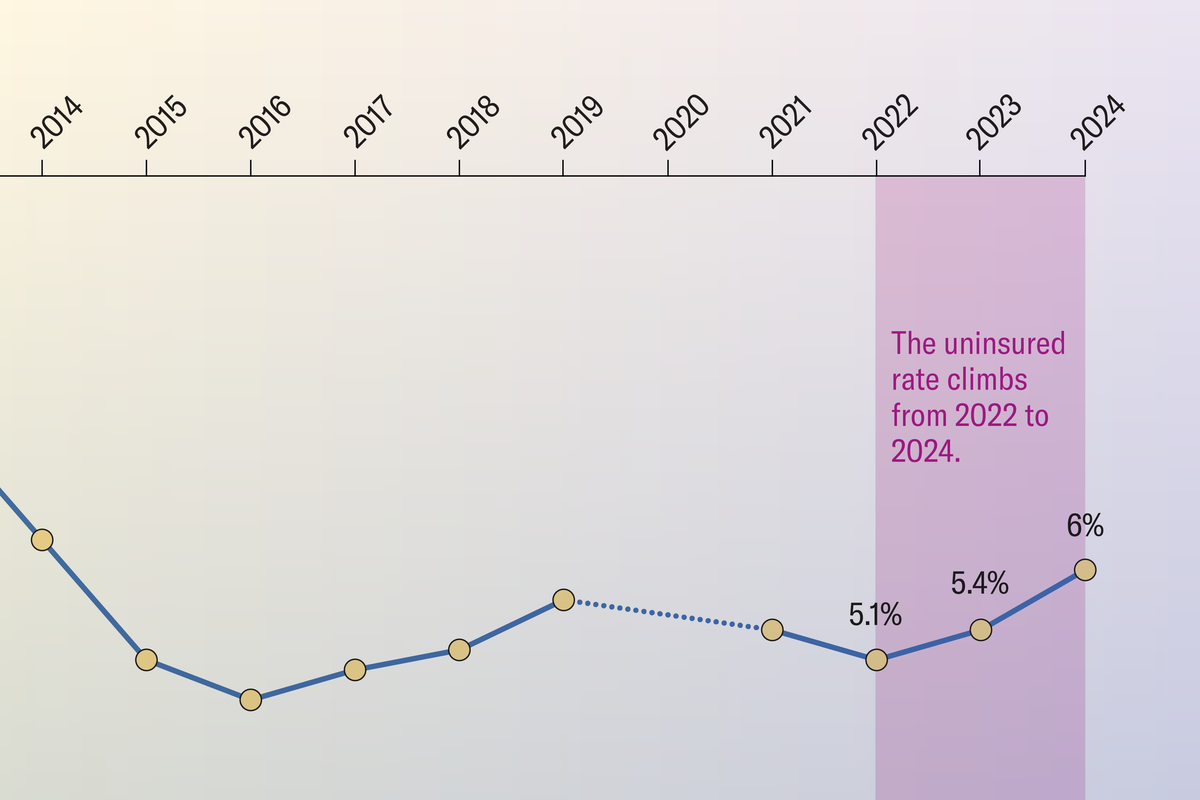
My issue with this article is it suggests there's some massive child uninsured problem in the US, but to get that number they're including foreign citizens. If we included all of south america I'm sure we could find tens of millions of uninsured people. If we included the rest of the world it might be closer to hundreds of millions. That doesn't mean there's a problem with the ACA. There could be a problem with it, but this 4 million number doesn't get us closer to an answer.
Someone will pay the bills.
"Source: The U.S. Census Bureau American Community Survey (data)". FTFA. You don't even have to read it. It's the source for the first graph. The one blown up before you even have to scroll.
They absolutely claimed the latter.
But even to the first, they didn't make any policy claims! They said it "would clearly show how poorly the economy is actually functioning." That's not true! You can have a fabulous economy (with a well-performing "GDP or...stock market") with terrible healthcare KPIs, this is basically a petrostate.
Healthcare is measured. And it's discussed. One can debate how the total-insured figure should play into policy. That wasn't that comment.
The first erroneously said the US doesn't track it, but the next two of you didn't read the rest of their post.
American healthcare for the top 10 to 15% (about $150k+) is the best in the world. By a long shot. (The bottom ninety-something percent of the world's top 1% get their care here for a reason.)
Another 40% are covered by Medicare or Medicaid [1] which, while nothing to brag about, exceeds the median OECD healthcare experience.
That leaves half of the population with crappy employer-provided healthcare, the VA, scams or no insurance at all. For most of them, until they have an accident, this coverage is fine.
In summary, you have a system that works terrifically for the rich, well for the poor and old, and well enough for the rest that reform is challenging.
[1] https://www.census.gov/library/publications/2024/demo/p60-28...
You don't actually know any poor people, do you? Their lives are not governed by your theoretical models.
And as the GP said, our healthcare - not the best of the best of our healthcare, as you cherrypicked, but the kind ordinary people have - is appalling overpriced for its mediocre quality.
--- Edit ---
For the kneejerk downvoters who seem very confused, this was released yesterday: https://thehill.com/policy/healthcare/5650010-survey-aca-cov...
This has been an issue for decades now, with countless polls to back it up.
The problem is the cost.
Most people also don't have any idea how much their insurance costs in total or how it compares to alternatives, so that would be a challenging question to write with any reasonable expectation of getting a coherent response.
> The problem is the cost.
You could say this about almost anything that isn't free, and could still say it about a number of things even if they were free.
https://thehill.com/policy/healthcare/5650010-survey-aca-cov...
Feel free to look at the many, many, many alternative polls over the years. This is well known to anyone who has done any research into the topic at all.
Let's compare notes? If I go to a hospital (emergency) for any reason, I will be seen within an hour at worst. If I'm bleeding or something I'll be seen immediately. A clinic for surgery might be same day or up to a couple of weeks, depends on severity. More specialized surgery could be 5-6 weeks. American average monthly cost for health insurance is around $600 for a family. Individuals without a family are around $450 so they kind of get screwed. The expenditures for health care, including the $600/mo are tax deductible. This number can go as high as $1200 in places like New York where income is significantly higher as is cost of living.
Overall, averaging co-payment and deductible with accidents, you should expect to spend around $3,000 / yr on average per person in total for health care as part of a family in the US. This number varies greatly by age, and both income and health care in the US is socialized so your wages determine your healthcare liability. (Make more money? Get less social services.)
This should cover everyone, but you have issues where poor people don't file taxes, and don't file for health care. Those people will still be seen in an emergency room.
Conversely, my friends and family in other countries with "free" healthcare pay roughly the same total for their medical portion of tax liability as I pay for health care in total. But their wait times are astronomically greater when it comes to receiving care.
I've often helped financially because their wait time for something like shoulder surgery might be 10 to 12 months or even longer, but the same doctor will see them in a week if it's paid privately. So I've worked out payment plans where I contribute $1k/mo for their "add-on" private care so that they can be seen in a reasonable amount of time. That's in addition to what they already paid in medical tax.
Maybe that helps to understand. From my perspective, in a lot of countries you are told that you have free healthcare, but in fact you're paying for it in taxes, and then someone in the US will still have to pay for it when you actually need it anyway. Double payment. Hope you've got friends. (Maybe that's not true for everyone, I'm just going by what I've seen and paid for myself for my own family.)
I personally think that Europe and other countries don't have better health care, it's much worse. I've lived in several countries for 1-2 months to years in each and I've never seen health care remotely on the level that I see in the US. I would venture to guess it's the best in the world.
If it's hard to understand how people live in a modern high tech country without healthcare, it's because they don't. It's just about which rich person is paying for it. Health care is very expensive, and that's true around the world. And around the world, if you don't file/register for health care, your outcomes are generally much worse. The US is no different in that regard.
Now of course, mostly people just lose a few years of life and have a number of very painful months due to delays, that it is the direct cause of death is fortunately rare.
Oh and before you say it, most of the difference in life expectancy is due to the the difference in overweight people, not medical care.
But of course people have voted everyone has care and can claim everything's great and they've done everything needed. That it doesn't translate into reality ... "is not their fault". Meanwhile you read there is such a doctor shortage in for example Southern Italy that seeing a doctor in under and hour is outright impossible ... because there isn't a doctor less than an hour's drive away from some villages, even without waitlists. And the doctor shortage is getting worse, not better.
There's a reason that if you dip your toe into ANY of the various support things, they ALL immediately apply for you.
(Kids in general and for the large part are pretty healthy, the numbers of "major health issues" that aren't broken bones/scrapes/flu are pretty small overall. So if you're poor/don't care, you just roll the dice. 999/1000 it's going to come out ahead for you.)
COBRA is older than ACA. Special enrollment in ACA under the job loss enrollment period exemption may be a better option than COBRA.
My deductible is $8300, but at least it's 100% coverage once I hit that.
They reached the bottom of the barrel just when it came to making sure children can get treatment when sick.
It's just not a real pressing problem for most people, because either they're covered by CHIP or similar, or covered by work, or just don't care.
https://news.ycombinator.com/item?id=46287251
In my country healthcare for under 18 is free. Just putting it out there.
[1]:https://www.scientificamerican.com/article/a-census-catalogu...
Medicare’s Real Fiscal Crisis Is Much Worse than Trust Fund Insolvency - https://www.cato.org/blog/medicares-real-fiscal-crisis-much-... - October 8th, 2025 ("Medicare isn’t just facing a trust fund shortfall—it’s threatening America’s entire fiscal future. While headlines warn that the Hospital Insurance (HI) Trust Fund2 will run out in 2033, the real danger comes from a different part of the program: Supplementary Medical Insurance (SMI). SMI refers to Medicare spending by Part B (doctors’ visits and outpatient services) and Part D (prescription drugs). Unlike the HI fund, SMI is set up to take whatever it needs from taxpayers—no limits, no debate. In 2024 alone, Medicare Parts B and D financed under SMI added $498 billion straight onto the national credit card. Unless Congress makes fundamental reforms to Medicare, federal healthcare spending will drive the US toward a catastrophic fiscal crisis.")
Medicare Spending at the End of Life: A Snapshot of Beneficiaries Who Died in 2014 and the Cost of Their Care - https://www.kff.org/medicare/medicare-spending-at-the-end-of... - July 14th, 2016 ("Of the 2.6 million people who died in the U.S. in 2014, 2.1 million, or eight out of 10, were people on Medicare, making Medicare the largest insurer of medical care provided at the end of life. Spending on Medicare beneficiaries in their last year of life accounts for about 25% of total Medicare spending on beneficiaries age 65 or older. The fact that a disproportionate share of Medicare spending goes to beneficiaries at the end of life is not surprising given that many have serious illnesses or multiple chronic conditions and often use costly services, including inpatient hospitalizations, post-acute care, and hospice, in the year leading up to their death.")
Is there a reason you are so argumentative about basic, seemingly indisputable facts related to this topic?
This is the key - to cover the insane costs for elderly, insurance companies have had to raise costs on the healthy, which includes children.
It’s not cheap for children, but they are the future foundation of our economy.
There are plenty of advocacy groups for universal healthcare. You could join them. You could also support electeds pressing for this, and call your elected to make it known it's a priority.
Civic engagement doesn't start and end at the ballot box.
And sure, give parents a total opt out when it comes to vaccination. Just because they're dumbfucks doesn't mean their kid need run a fever into brain-cooking temperatures out of fear of an ER bill.
It's a working national health programme. Expanding it makes more sense than starting anew. My proposal is to expand its mandate to covering pregnant mothers and children directly.