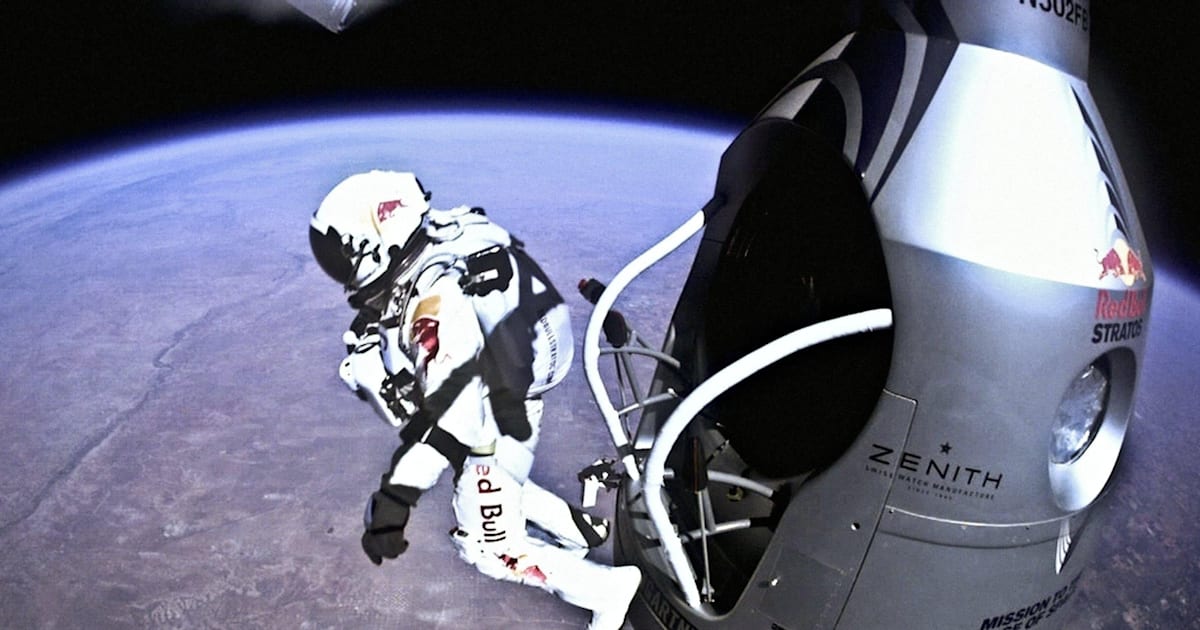
10 Years of Red Bull Stratos
.
redbullstratos.com
115 points · by flipstewart · 14y ago · 61 comments
Red Bull's marketing is impeccable. They started out with all the actionsport athletes and moved upstream to more mainstream, and I guess, more expensive sports (two Formula 1 teams, more soccer teams than I can count), while still doing these crazy things. From Parcours in Santorini, to Air Races all over the world. Seems like every crazy sporting event is sponsored by Red Bull.
I think these have allowed them to be still seen as "hip" and not just selling sugar water like Coca Cola.
It is, absolutely, a genius marketing strategy. Their primary demographic just happens to be the kinds of people who watch insane sports. Brand recognition from those events is huge, and then people just happen to drop their brand-name when talking about the events to other people.
Probably cheaper in the long-run than trying to compete with someone like Coca Cola in more traditional campaigns, and way more effective.
And like Coke and Kleenex, through sheer brand awareness, they've achieved that rare feat in which a company's brand becomes synonymous with an object. In conversation throughout the world,
Soft Drink = "Coke" Tissue = "Kleenex" Energy Drink = "Red Bull"
next day red bull was sold out in austria (which was their main market at that time)
they just took it from there.
Nevertheless, what a marketing effort! They really nailed this one.
This is also where the Western version of Red Bull is from. Originally it was an energy drink in Thailand and an Austrian partnered up with the Thai owner, adapted it to suit the Western palate and ever since then they have been going incredibly strong and long survived all energy-drink competitors that shortly popped up during the 90s.
Mateschitz's and Yoovidhya's net worth is about 5 billion each.
I don't think there is any important extreme sport event they are not involved in. Their annual "Flugtag" is legendary here in Austria! http://en.wikipedia.org/wiki/Red_Bull_Flugtag
Also very cool, they own their own aerobatics team called The Flying Bulls, and they have a B25 bomber. Why? Because they can, and that's awesome.
I'm also not sure what you mean by "the way most people think about space". The first American in space, Alan Shepard, flew a suborbital mission. I don't think you'll find many people who would argue he wasn't in space.
To be clear, there is no universally-agreed upon definition of space, let alone "the edge of space". There is no official definition of space in US law or policy. The NASA, the FAA, and the Air Force definitions (100km, 100km, 50 miles respectively) are only used for the purposes of awarding astronaut wings.
Personally, I'm fine with them calling it the edge of space to get more public attention to the mission, and they can get away with it because the cameras will show black sky and the curvature of the earth.
Makes me interested to see what the treaties say as I'd be surprised it no one thought to limit the control of countries to allow satellites to pass without permission or allow space vehicles in general.
Though as you point out there is the Karman line convention.
"The record is currently held by Col. Joe Kittinger, who in 1960 jumped from 102,800 feet as part of a U.S. Air Force mission. On this attempt, 52 years later, Kittinger is a consultant and mentor.
He has also been giving Baumgartner advice on what to expect. For example, he described what it feels like to fall through space when there is so little air: "There's no way you can tell how fast you're going, because there's no visual cues."
But Kittinger rejects any suggestion that he is jealous that Baumgartner is poised to beat his record.
"Oh no. I'm delighted," he told CNN recently. "He's advancing science, and he'll do a great job."
http://www.cnn.com/2012/10/09/us/skydiver-record-attempt/ind...
Kittinger's jumps were done as part of Project Manhigh and Project Excelsior, two U.S. military projects launched in the late 1950's (before the Gemini space program) to test whether a bailout system for astronauts could work. Kittinger had made a few military skydives, but it was an important fact that he wasn't a skydiver (as none of the Gemini astronauts would be skydivers, and know how to fly their bodies in freefall). The bailout system they were building had to be usable by even inexperienced pilots.
So Joe has often said he wasn't going up to set a record - and he hates it when people focus on that. He was just doing his job, trying to make sure the astronauts had a safe out on their way to set history. (In his view, it was only an coincidence that he set history himself along the way).
http://www.redbullstratos.com/technology/cameras-communicati...
    We're just trying to load the data for you. If you
    don't have JavaScript enabled in your browser for
    this site, please switch it on and refresh the page
    in order to view the Live Jump experience.
Added in edit: OK - on weather hold - due off an hour from now.
Without an atmosphere, the result would be deterministic and trivial to compute:
acceleration = f(t) = g
velocity = ∫ f(t) dt = g * t
position = ∫∫ f(t) dt = 1/2 g t^2
(The value of g changes slightly for this problem, in this altitude domain.)
But because of the atmosphere, the calculation of velocity as a function of altitude is much more difficult. And it turns out that the atmospheric pressure as a function of altitude is not trivially characterized. And at high altitudes, it's not even constant -- it depends on temperature, the position of the sun in the sky, even the time in the 11-year sunspot cycle.
The air resistance of a falling object is some constant k (based on the object's size and surface roughness) times the square of the velocity times the air pressure. But the air pressure is changing as the descent unfolds, so such a computation ultimately relies on a numerical solution to a differential equation.
This is why one doesn't see a trivial equation describing descent velocity for a skydiver. I have worked out skydiver velocity profiles for constant air pressure nearer the surface:
http://arachnoid.com/sage/terminal_velocity.html
But this equation, only an approximation at lower altitudes, is of no use at all for a problem like the Baumgartner jump.
He might get a teensy bit warm on the way down.
Does that help or are you looking for something more specific or unmentioned?