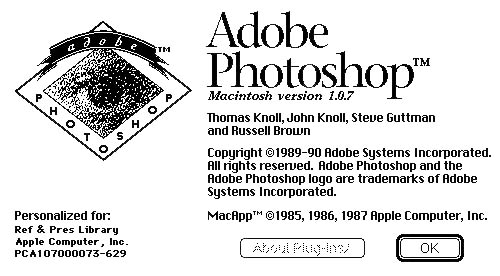
Adobe Photoshop Source Code
When brothers Thomas and John Knoll began designing and writing an image editing program in the late 1980s, they could not have imagined that they would be adding a word to the dictionary.
CHM
440 points · by tosh · 11mo ago · 152 comments
"There are only a few comments in the version 1.0 source code, most of which are associated with assembly language snippets. That said, the lack of comments is simply not an issue. This code is so literate, so easy to read, that comments might even have gotten in the way."
"This is the kind of code I aspire to write.”
I'm looking at the code and just cannot agree. If I look at a command like "TRotateFloatCommand.DoIt" in URotate.p, it's 200 lines long without a single comment. I look at a section like this and there's nothing literate about it. I have no idea what it's doing or why at a glance:
  pt.h := BSR (r.left + ORD4 (r.right), 1);
  pt.v := BSR (r.top + ORD4 (r.bottom), 1);

  pt.h := pt.h - BSR (width, 1);
  pt.v := pt.v - BSR (height, 1);

  pt.h := Max (0, Min (pt.h, fDoc.fCols - width));
  pt.v := Max (0, Min (pt.v, fDoc.fRows - height));

  IF width > fDoc.fCols THEN
    pt.h := pt.h - BSR (width - fDoc.fCols - 1, 1);

  IF height > fDoc.fRows THEN
    pt.v := pt.v - BSR (height - fDoc.fRows - 1, 1);
Good code does not make comments unnecessary or redundant or harmful. This is a myth that needs to die. Comments help you understand code much faster, understand the purpose of variables before they get used, understand the purpose of functions and parameters before reading the code that defines them, etc. They vastly aid in comprehension. And those are just "what" comments I'm talking about -- the additional necessity of "why" comments (why the code uses x approach instead of seemingly more obvious approach y or z, which were tried and failed) is a whole other subject.
pt == point, r == rect, h, v == horizontal, vertical, BSR(...,1) is a fast integer divide by 2, ORD4 promotes an expression to an unsigned 4 byte integer
The algorithms are extremely common for 2D graphics programming. The first is to find the center of a 2D rectangle, the second offsets a point by half the size, the third clips a point to be in the range of a rectangle, and so on.
Converting the idiomatic math into non-idiomatic words would not be an improvement in clarity in this case.
(Mac Pascal didn't have macros or inline expressions, so inline expressions like this were the way to go for performance.)
It's like using i,j,k for loop indexes, or x,y,z for graphics axis.
You seem to be missing my point. It's not about improving "clarity" about the math each line is doing -- that's precisely the kind of misconception so many people have about comments.
It's about, how long does it take me to understand the purpose of a block of code? If there was a simple comment at the top that said [1]:
# Calculate top-left point of the bounding box
The original assertion that "This code is so literate, so easy to read" is demonstrably false. Naming something "pt" is the antithesis of literature programming. And if you insist on no comments, you'd at least need to name is something like "bbox_top_left". A generic variable name like "pt", that isn't even introduced in the context of a loop or anything, is a cardinal sin here.
There's no context in those names to help you understand them, you have to look at the code surrounding it. And even the most well-intentioned, small loops with obvious context right next to it can over time grow and add additional index counters until your obvious little index counter is utterly opaque without reading a dozen extra lines to understand it.
(And i and j? Which look so similar at a glance? Never. Never!)
For clarity and to demonstrate, this is basically what this function is doing, but in css:
.container {
position: relative;
.obj {
  position: absolute;

  left: 50%;

  top: 50%;

  transform: translate(-50%, -50%);


}Also, breaking things down to more atomic functions wasn't the best idea for performance-sensitive things in those days, as compilers were not as good about knowing when to inline and not: compiler capabilities are a lot better today than they were 35 years ago...
I'm sure the code would be immediately obvious to anyone who would be working on it at the time.
Comments aren't unnecessary, they can be very helpful, but they also come with a high maintenance cost that should be considered when using them. They are a long-term maintenance liability because by design the compiler ignores them so its very easy to change/refactor code and miss changing a comment and then having the comment be misleading or just plain wrong.
These days one could make some sort of case (though I wouldn't entirely buy it, yet) that an LLM-based linter could be used to make sure comments do not get disconnected from the code they are documenting, but in 1990? not so much.
Would I have used longer variable names for slightly more clarity? Today, sure. In 1990, probably not. Temporal context is important and compilers/editors/etc have come a long way since then.
ORD4 = cast as 32bit integer.
BSR(x,1) simply meant x divided by 2. This is very comment coding idom back in those days when Compiler don't do any optimization and bitwise-shift is much faster than division.
The snippet in C would be:
    pt.h = (r.left + (int32_t)r.right) / 2;
    pt.v = (r.top + (int32_t)r.bottom) / 2;

    pt.h -= (width / 2);
    pt.v -= (height / 2);

    pt.h = max(0, min(pt.h, fDoc.fCols - width));
    pt.v = max(0, min(pt.v, fDoc.fRows - height));

    if (width > fDoc.fCols) {
      pt.h -= (width - fDoc.fCols - 1) / 2;
    }

    if (height > fDoc.fRows) {
      pt.v -= (height - fDoc.fRows - 1) / 2;
}If I understand it correctly, it was calculating the top-left point of the bounding box.
Because it's quite clear, everything is well named, and the filename also gives the context.
Clamps the result so it doesn’t go outside the document.
If the region is bigger than the document, it re-centers instead of snapping to (0,0).
Every comment is a line of code, and every line of code is a liability, and, worse, comments are a liability waiting to rot, to be missed in a refactor, and waiting to become a source of confusion. It’s an excuse to name things poorly, because “good comment.” The purpose of variables should be in their name, including units if it’s a measurement. Parameters and return values should only be documented when not obvious from the name or type—for example, if you’re returning something like a generic Pair, especially if left and right have the same type. We’d been living with decades of autocomplete, you don’t need to make variables be short to type.
The problem with AI-generated code is that the myth that good code is thoroughly commented code is so pervasive, that the default output mode for generated code is to comment every darn line it generates. After all, in software education, they don’t deduct points for needless comments, and students think their code is now better w/ the comments, because they almost never teach writing good code. Usually you get kudos for extensive comments. And then you throw away your work. Computer science field is littered with math-formula-influenced space-saving one or two letter identifiers, barely with any recognizable semantic meaning.
A name and signature is often not sufficient to describe what a function does, including any assumptions it makes about the inputs or guarantees it makes about the outputs.
That isn't to say that it isn't necessary to have good names, but that isn't enough. You need good comments too.
And if you say that all of that information should be in your names, you end up with very unwieldy names, that will bitrot even worse than comments, because instead of updating a single comment, you now have to update every usage of the variable or function.
This is exactly my view. Comments, while can be helpful, can also interrupt the reading of the code. Also are not verified by the compiler; curious, in the era when everyone goes crazy for rust safety, there is nothing unsafer as comments, because are completely ignored.
I do bot oppose to comments. But they should be used only when needed.
> comments are a liability waiting to rot, to be missed in a refactor, and waiting to become a source of confusion
This gets endlessly repeated, but it's just defending laziness. It's your job to update comments as you update code. Indeed, they're the first thing you should update. If you're letting comments "rot", then you're a bad programmer. Full stop. I hate to be harsh, but that's the reality. People who defend no comments are just saying, "I can't be bothered to make this code easier for others to understand and use". It's egotistical and selfish. The solution for confusing comments isn't no comments -- it's good comments. Do your job. Write code that others can read and maintain. And when you update code, start with the comments. It's just professionalism, pure and simple.
Taking his contribution for Photoshop into account, one could say that if you saw mainstream motion or still pictures in the Western world in the last three decades, you'll probably saw something influenced by him in one way or another.
> 2. Restrictions. Except as expressly specified in this Agreement, you may not: (a) transfer, sublicense, lease, lend, rent or otherwise distribute the Software or Derivative Works to any third party; or (b) make the functionality of the Software or Derivative Works available to multiple users through any means, including, but not limited to, by uploading the Software to a network or file-sharing service or through any hosting, application services provider, service bureau, software-as-a-service (SaaS) or any other type of services. You acknowledge and agree that portions of the Software, including, but not limited to, the source code and the specific design and structure of individual modules or programs, constitute or contain trade secrets of Museum and its licensors.
My personal thoughts are: open-source software is great, probably the ideal condition, but I wish the general software distribution environment was not effectively all or nothing. open-source or compiled binary. I wish that protected-source software was considered a more valid distribution model. where you can compile, inspect fix and run the software but are not allowed to distribute it. Because trying to diagnose a problem when all you have is a compilation artifact is a huge pain. You see some enterprise software like this but for the most part it either open-source or no-source.
I am a bit surprised that there is no third party patch to get photoshop 1.0 to run under modern linux or windows, not for any real utility(at this point MS paint probably has better functionality), but for the fun of it. "This is what it feels like to drive photoshop 1"
Edit: Disappointed is really not the right word but I am failing at finding the right word.
I think Adobe decided to release the code because they knew it was only valuable from a historical standpoint and wouldn't let anyone actually compete with Photoshop. If you wanted to start a new image editor project from an existing codebase, it would be much easier to build off of something like Pinta: https://www.pinta-project.com/
1) these historical source code releases really are largely historical interest only. The original programs had constraints of memory and cpu speed that no modern use case does; the set of use cases for any particular task today is very different; what users expect and will tolerate in UI has shifted; available programming languages and tooling today are much better than the pragmatic options of decades past. If you were trying to build a Unix clone today there is no way you would want to start with the historical release of sixth edition. Even xv6 is only "inspired by" it, and gets away with that because of its teaching focus. Similarly if you wanted to build some kind of "streamlined lightweight photoshop-alike" then starting from scratch would be more sensible than starting with somebody else's legacy codebase.
2) In this specific case the licence agreement explicitly forbids basically any kind of "running with it" -- you cannot distribute any derivative work. So it's not surprising that nobody has done that.
I think Doom and similar old games are one of the few counterexamples, where people find value in being able to run the specific artefact on new platforms.
> When will we get the linux port of Photoshop 1.0?
Your disappointment seems to be a form of FOMO, but there isn't actually anything that you're MO here.
The above copyright notice and this permission notice shall be included in all copies or substantial portions of the Software.
This makes the license transitive so that derived works are also MIT licensed.
[1] https://en.wikipedia.org/wiki/MIT_License?wprov=sfti1#Licens...
Words have meaning and all that.
Just supporting a modern OS's graphical API (The pre-OSX APIs are long dead and unsupported) is a major effort.
https://fsck.technology/software/Silicon%20Graphics/Software...
And, for purity/completeness, avoid Maxx Desktop and/or NSCDE; EMWM with XMToolbar it's close enough to SGI's Irix desktop.
It nailed it, first try.
I cannot, unfortunately, share a link to the website it created because of the license.
LLM translations of historical software to modern platforms is a solved problem. Try it, you'll see.
I used https://exe.dev/ and their Shelley agent to drive Claude. Give it a try, it is jaw dropping.
It wasn't even broadband that destroyed that experience, when CDs came around developers realised they had space to just stick a PDF version of the manual on the CD itself and put in a slip that tells you to stick in the CD, run autorun.exe if it didn't already, and refer to the manual on the CD for the rest!
They weren’t like textbooks, which have knowledge that tends to be relevant for decades. You’d get a new set with every software release, making the last 5-20 lbs of manuals obsolete.
You did lose some of the readability of an actual book. Hard-copy manuals were better for that. But for most software manuals, I did more “look up how to do this thing” than reading straight through. And with a pdf on a CD you had much better search capabilities. Before that you’d have to rely on the ToC, the book index and your own notes. For many manuals, the index wasn’t great. Full text search was a definite step up.
Even the good ones, like the 1980s IBM 2-ring binder manuals, which had good indexes, were a pain to deal with and couldn’t functionally match a PDF or text file on a CD for searchability.
Even some well-documented modern software is obviously documented by the programmers and programmer-adjacent.
The Office 4.3 set of manuals were large too, but didn't have the information density the AutoCAD ones did.
You might expect now and again to get some optional updates/patches later, but that was rare - and rarer still for most people to even know about them.
These days, software is never complete. Nothing is done. It's just a point-in-time state with a laundry list of bugs and TODOs that just roll out whenever. The software is just whatever git tag we're pointing to today.
I understand how/why it has become like this - but it still makes me sad.
I think all floppies are magical :)
Back in time, black were ordinary, and only white/grey ones were for licensed software, thus more desirable.
https://computerhistory.org/wp-content/uploads/2019/08/photo...
E.g: https://c7.alamy.com/comp/2AA9BC4/ajaxnetphoto-2019-worthing...
FYI.., the version I used was registered to Apple. Apparently, the Knoll brothers demoed PS to apple and they promptly shared it amongst themselves and their buddies. Almost all illegitimate copies of it are derived from that pirated copy.
Fun fact… John knolls wife was the founding member of the Photoshop ‘Widows’ club… a home to people who have lost loved ones to software.
Note this is a toxic license. Accepting it and/or reading of the code has potential for legal liability.
Still, applaud releasing the source code, even if encumbered. Preservation is most important, and any legal teeth will eventually expire with the copyright.
How would this potentially expose you to legal liability?
I feel like that has changed? Even Blender felt good the last time I used it, Firefox became kinda fine, though these are probably bad examples as they are both mainstream software. But what about OSS that is used primarily by OSS enthusiasts? What about GIMP now?
Whereas Photoshop and other "mainstream" software use terms and procedures non-programmers are more likely to be familiar with: heal this area with a patch, clone something with a clone stamp, scissors/lasso to cut something out (not saying GIMP doesn't have those)...
> To change GIMP to single-window mode (merging panels into one window), go to "Windows" in the top menu and select or check "Single-Window Mode"; this merges all elements like the Toolbox, Layers, and History into one unified view.
Unfortunately, designers are rare among the FOSS community. You can't attract real casual or professional users if you don't recognize the value of professional UI/UX.
and having the source available didnt help so far either :-))
It's not intuitive. It's actually possibly my most hated widget in the entire FOSS ecosystem.
could you please show me a good textting tool plugin for GIMP, then?
you can check their forums & other sites: the textingtools is on top of their discussion lists?
So can you expand why you think the text tool, is bad?
And thats the irony covered in my post: Even that the source is available didnt motivate someone enough so far to create better version of the built
OMG. Booch?? The father of UML is still around? Given that UML is a true crime against humanity, it just goes to show there is no justice in the world. (I want a lifespan refund for the amount of time I spent learning UML and Design Patterns back in the bad old Enterprise Java days. Oof)
For trivial CRUD apps, and maintaining modified versions of the generated code was a nightmare.
It is like the YAML junk that gets pushed nowadays in detriment of proper schemas, and validation tools we have in XML.