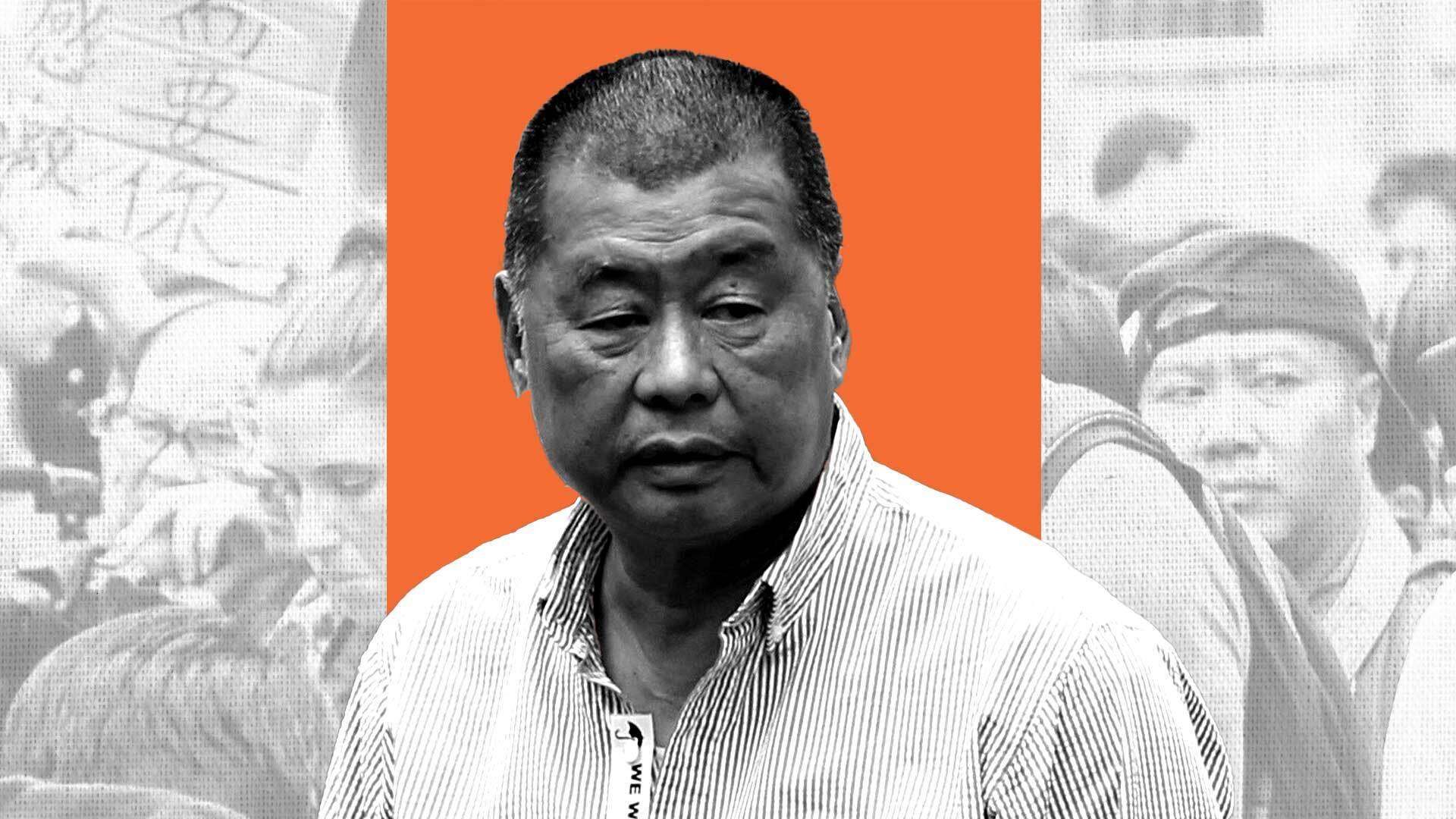
Jimmy Lai is a martyr for freedom
The self-made tycoon was convicted this week of violating Hong Kong's "national security" law. But he could have escaped it.
Reason Magazine
386 points · by mooreds · 11mo ago · 239 comments
Another crucial factor that's part of the CCP's victory in HK is that China inherited a police force essentially structured as a colonial occupying force. Police staff get benefits that include segregated housing (such as the West Kowoon Disciplined Services Quarters), which maintains morale in the ranks and allows those so inclined to live quite separately from the rest of the populace.
That prosperity was based on a system that no longer exists. Hong Kong is a normal Chinese city now.
Look into 2019 protests
There was one guy who fell down a high rise garage and there was a street cleaner who was killed by the protesters.
Compare that to when the British were taking over Hong Kong, and hundreds of protesters were killed.
I’ve always wondered what would have happened if the pandemic didn’t occur soon after.
What’s crazy is the trigger was a Hong Kong national who killed his girlfriend in Taiwan. Taiwan wanted to extradite him but there was no law in place to do so. Apparently the killer is still free today.
https://blogs.lse.ac.uk/lseih/2025/06/13/the-empires-last-ab...
[1]: https://en.wikipedia.org/wiki/British_National_(Overseas)
Canada was particularly affected. It absorbed the most immigrants, they were a larger share of the population, and this was a major increase in ethnic diversity. The resulting cultural clashes were sometimes an issue. Here is one that literally doubled car insurance rates in British Columbia around the time I left.
Three cars, 2 in front with the left-hand car being driven by a Canadian, and the back car driven by a recent immigrant. The immigrant sees the opportunity to pass, swings out into oncoming traffic, and guns it. Leaving just a few inches of room. Normal Hong Kong driving.
The Canadian has no idea that this is happening until OMG I'M ABOUT TO BE HIT! The Canadian then swerves right to avoid the emergency, and hits the car on the right.
The immigrant drives off. Presumably wondering about these crazy Canadians who don't know how to drive.
Everyone involved behaved reasonably for how they were used to driving. But the combination worked out very poorly...
https://www.quora.com/Why-did-Portugal-give-full-citizenship...
> BN(O)s are British nationals and Commonwealth citizens, but not British citizens. They are subject to immigration controls when entering the United Kingdom and do not have automatic right of abode there
Things were different before the 1981 British Nationality Act but it's not too relevant for HK as the 1981 act is before the Sino British Declaration.
And it's not like the UK had much of a choice in the first place. China threatened to invade and there is very little the UK could have done to prevent a full control.
Worth also remembering that "one country, two systems" came with an expiration date that is rapidly approaching anyway.
You can’t gloat that the sun never sets on your empire and then absolve yourself from responsibility for events that you had a heavy hand in influencing. Regardless, if you think the article is wrong, your point would he better served by providing examples of where it’s wrong and stating why.
That would be like blaming me for the Gulf War when I was in diapers.
I don't think I'm being superficial here. There are a few distinct events during the 20th century which can be attributed to the British. The handover of Hong Kong, Suez Crisis and the Balfour Declaration stand out the most.
> And it's not like the UK had much of a choice in the first place. China threatened to invade and there is very little the UK could have done to prevent a full control.
The leased territories are Chinese territory. Full stop. Hong Kong island and the ceded land could not survive alone. All of the water processing happens in the New Territories. It would have been impossible to either break up HK or defend it.
https://i.redd.it/zghghoib1k1a1.png
China has not rolled back any reforms that happened before negotiations began [0]. They did rollback the last-ditch efforts of Chris Patten [1] because at that point it was seen a malicious attempt to undermine the handover.
The mechanisms for China to take control were largely left in place by the British so they bare some responsibility, but it is the PRC asserting this control and there's an argument to be made that most of HK supports the PRC and it's their right to do what they wish with their own territory.
> Worth also remembering that "one country, two systems" came with an expiration date that is rapidly approaching anyway.
It'll be interesting to see what is kept. China's experimenting already in Hainan. They could structure Hong Kong in a similar fashion.
[0] The PRC did introduce PR with the idea that it would reduce the risk of majorities forming but the system is arguably more democratic than FPTP.
[1] https://en.wikipedia.org/wiki/1994_Hong_Kong_electoral_refor...
The fact that British HK liberalized a little at the very last second before handover is better than nothing, and the National Security Law is definitely bad, but right now the scoreboard is 7/150 years of free speech under the UK, compared to 23/28 years of free speech under PRC. It'll take another 100 years for the PRC to have a worse record than the UK.
The Netherlands has a longer history of monarchy under their current government (present monarchy founded 1813) than North Korea (current government established 1948). Does that mean you’d rather live in North Korea than the Netherlands?
The plain and obvious fact remains that Hong Kongers would have more political liberties today if the UK retained control of the territory, regardless of the complete colonial insanity of the original arrangement.
Can you name one present existing British overseas territory that has less of a right to criticize the government than Hong Kong? There are still a bunch of them to choose from from.
How would it have made a difference when the Chinese military invaded?
If investment was the key to liberalization, we would have seen far greater investment behind the then-fallen Iron Curtain, where countries had actively turned their backs on command economies. The cynic in me thinks that capital didn't like just how that had turned out. If a country's people could either violently (Romania) or peacefully (almost everywhere else) remove such totalitarian systems of politics and economics, they could also reject methods of accumulating capital that might run afoul of their values.
China, on the other hand, had not moved away from command economics at the time. Instead, the result was state capitalism. People were free to try new things that could create economic expansion, but only in a way that served the needs of the state. Anything else would be handled with the same totalitarian methods that political dissidents and class enemies were once handled with under Mao. While this has ebbed and flowed over the years, it essentially remains the system in place.
Lai is a victim of this miscalculation.
They went to China because it was cheaper. They went there in detriment of their countrymen that went without jobs, in detriment of the environment (what with all the shipping boom that followed), even in detriment of their own countries, since this would stifle development and industrialization. And they KNEW that technology transfer would follow, because China had made it clear.
No one forced them to do it. They did it knowingly in the name of short and medium-term profit. I’m not even judging if that is bad (I do THINK it’s bad overall, but I’m not arguing it here). I’m just pointing out what happened.
So now the West must not be surprised. And they aren’t! They just need to craft narratives that will paint them in good light.
It really was an intentional decision, largely on the part of the Clinton administration, to make investing in the country easier and improve the economic well being of Chinese citizens in the hopes it would inevitably lead to democratization. Clearly, those hopes were just that though
I'd say "in the hopes it would satisfy the political-donor class." The desired liberalization of the PRC was... not necessarily a falsehood, but not the main reason either.
Yes I think. At least a lot of Western policymakers did buy a "change through trade/investment" story, and it wasn't pulled from nowhere because it had worked in the past.
In postwar Japan and later South Korea, integration into the West's economic system coincided with eventual democratization, closer alignment of values, and alliance.
It was reasonable to think the same thing would work in China, but that doesn't seem to be the case.
Also the US intentionally set China up for investment by doing things like bringing them into the WTO. All that investment wouldn't have happened without some level of government support.
Didn't they have a dictatorship or two for quite a while? I think they've only been a democracy in fact, for about 35 years.
This does sound radical (and it is), but the lack of capital controls is essentially what's created the ability for corporations to engage in massive, massive labour arbitrage to the detriment of many citizens in the West (I personally, and my family have benefited from this, but that doesn't make it right).
I think the OP would frame this as the Western governments allowing Western businesses to invest in China.
Not the businesses. Governments and their advisors that encouraged it thought that. Francis Fukuyama's "end of history" bullshit was widely believed, and even now retains some influence.
You’re right in your assumption that profit-seeking was the major part of it - like, it wouldn’t have happened otherwise.
But the idea that the West trading and interacting with China would mean the populous (and perhaps government) would come to understand the benefits of a free society, and so China would trend towards a Western political system - probably gradually rather than violently - was a mainstream view from the 80s to the early 2010s.
It worked in south korea and taiwan which were severe military dictatorships before (maybe you could throw japan im there too?) so the history of capitalism liberalizing countries isn't all failures
There's literally nothing about democracy that capitalism finds necessary or even particularly attractive.
BDS is a thing. It toppled South Africa's regime and makes Israelis gnash their teeth. Part of the "sell" for investing in China, and buying Chinese products, was that we were bringing them Capitalism, which would bring them wealth and freedom. The alternative is that you're fueling a Communist regime that is going to become your rival and adversary. Maybe I'm mixing up which was explicit and which was implicit, but there's no way Americans would have been on board with everything if the latter was seen as a real possibility. So either big business knew and suppressed it, or they genuinely themselves believed that they could do business in China and not support strengthening the CCP. (And, before Xi rose to power, that was not an completely unreasonable thought.)
"Authority comes from submission"; sure someone can threaten you with physical coercion, but they can't make you want to submit. I would strongly suspect that Jimmy knew what was coming, but the point isn't "winning" in the "hollywood" sense, but rather that he did the right thing even. I would suspect not even in spite of the cost, but because of the cost.
Are principles that don't cost you anything even principles?
His original intent in setting up the news outlet was often said to be market manipulation for personal gain rather than journalism. He was also known for publishing xenophobic content targeting mainland Chinese. One of the most controversial examples was running ads that portrayed mainland tourists as “locusts” and called for them to be driven out of Hong Kong.
In addition, he donated money to prominent US neoconservatives. I’m not sure whether Western media are unaware of his earlier background in Hong Kong, or if they are deliberately choosing to whitewash his reputation.
In the US we tend to see small companies get gobbled up by huge incumbents regularly, but in China the situation is much more in flux and it's not always obvious who the winners are going to be. It's the opposite of what you would expect from a command economy, at least in the tech and consumer product sectors.
Meanwhile in the land of the free, it's consolidation galore with very little competition.
The US has a massive number of small and medium companies. For example small part machining there are dozens per city.
43% of US GDP is small and medium size business. That’s effectively 50% of China’s entire GDP.
Sure China has more, but it also has 4x the population and an economy more focused on labor intensive industry.
China now _is_ far more liberal than in the 80-s. But it's also not even close to the Western democracies.
> China, on the other hand, had not moved away from command economics at the time. Instead, the result was state capitalism.
Not really. "State capitalism" really is misleading. China is fiercely capitalistic, far more than any modern Western country. The ruling party has an unspoken agreement with the population: you stay out of politics, and they stay out of your business.
But I don't think this is sustainable. Russia had a similar social compact, and it had been broken after the Ukrainian invasion. There was too much power concentrated in one person, and it just never works.
I mean sure, unless you happen to be Jack Ma and are about to IPO your financial institution.
The miscalculation comes from thinking that the investment would actually have that effect. And I do think some people at the top knew it wouldn't have that effect, but of course, there was cheap labor to be had, and that was what they wanted more than anything else.
My opinion is still that capitalism (Western style) will win. Not because markets are never wrong but because the scope for fucking up is so much less. Markets can't decide "families can have only one child" or "we need to build 90 million units of housing" (that now sits empty). An accumulation of fuck-ups in this vein is inevitable when you have a small group of people making these kinds of decisions. In the long run, it will be fatal.
Sure they can. Just make it unaffordable to do anything else.
Actually they can. It's part of the reason why a lot of capitalist nations are seeing major problems with population stagnation and possibly shrinkage.
The problem is markets don't care at all about society. If they can require that every member of a household has to work and extract all their money as efficiently as possible, then they leave little room for society to have families.
Capitalism is geared towards minimizing workers' free time. And, unfortunately, free time is how babies get made and kids get raised.
That is where western capitalism is failing. Shouting louder and young adults to pull on bootstraps harder isn't making them have kids in their studio apartments.
South Korea and Japan are 2 examples of this train-wreck that's coming for the US and other nations.
This ascribes an agency to capitalism that doesn’t exist.
The families themselves make the choices to have more or fewer children.
Capitalism says nothing about free time. Make the connection in your argument - people without enough money work as much as they can, maybe… but I still don’t see the lower wage people I know working 16 hour days. In fact it is the people who have a use for the extra money, usually to buy free time later, as one would expect in a capitalistic system.
Family planning was also massive successful in preventing frankly 100s of millions of useless mouths from being born and concentrating resources to upskill 1-2 kids, hence their massive catchup within a few generations. Now they make more technical talent than OCED combined and will have the greatest high skill demographic dividend to milk for at least our life times, giving them 40+ years to sort out better family planning.
BTW US overspending 5-10% of GDP aka 2.5 Trillion per year on healthcare vs OECD baseline is basically more wasteful misallocation than anything PRC has ever done, including RE misallocation (3-5% waste). And at least they still have housing units left to use (being converted into affordable housing), instead of piles of paper work and personal debt. Accumulation of fuckups that are not resolvable in western style capitalism, it will be fatal medium term.
One "first principles" way to think about it is that money is power, and as the Chinese middle class grows bigger and richer, it will have more and more of the power. I expect it will want similar things as the middle class in other countries.
This may take any number of decades, which unfortunately makes this a hard theory to falsify.
I don't think it was a miscalculation. Greed always ran deep in the West too.
> If a country's people could either violently (Romania) or peacefully (almost everywhere else) remove such totalitarian systems of politics
It's not always possible. It works in some countries but not in others. For instance, it seems not possible in Russia.
> China, on the other hand, had not moved away from command economics at the time. Instead, the result was state capitalism. People were free to try new things that could create economic expansion, but only in a way that served the needs of the state.
I somewhat agree, as the sinomarxist theorem and strategem is about that (and the sinomarxists also managed to bring out many people out of poverty too), but your analysis is not entirely correct either as China has many superrich now, which is a perversion in the system. So Xi also lies here. Because how can there be so many super-superrich? This is a master-slave situation, just like in other capitalistic countries. So why then the lie about sinomarxism? They just sell it like an ideology now, not unlike the Juche crap in North Korea.
But Russia has never removed the Communists from power. It removed the Communist party, that's true. But plenty of the revolutionaries were themselves Communists; both Gorbachev and Yeltsin were very high-ranking Communists. They liked the idea of economic liberalization, but the political liberalization was only allowed as long as they stayed in power. I'm not sure Russia has seen even a single honest presidential election. The current "president" of Russia is a former KGB officer.
I'd argue that communism is the only system of government that guarantees property for all. That's somewhat a core tenant that every member in a communist society collectively owns everything.
Capitalism is optimized to reduce or eliminate property access. For example, a free market capitalist has no problems with a very rich individual buying a city and perpetually renting the property to it's employees at rates above their salary, putting them in perpetual debt to that individual. They own nothing and can't escape their circumstances. Nor can their children.
Capitalism with minimal or no regulation naturally devolves into feudalism.
> I'd argue that communism is the only system of government that guarantees property for all. That's somewhat a core tenant that every member in a communist society collectively owns everything.
If the answer is "yes", you've just reinvented a communist dictatorship. If it's a "no", then such society will run out of food and goods, and something better will rise to replace it.
So you could take your earnings, buy some yarn, knit your friend a scarf, and there's no real change in societies.
The difference is that you'd get your money from a state run industry. Your home would be guaranteed. And where you ultimately end up working would be based on your capabilities.
You are free to knit or whittle gifts for friends. What you wouldn't be free to do is setup "mopsi's scarf business" without working through the state. You wouldn't be allowed to take the earning from "mopsi's scarf business" and use them to become a landlord. You could gain social status and benefits by running the scarf business, but those would be limited (barring corruption).
When I say "a communist society collectively owns everything" I'm talking mainly businesses, land, housing.
A mistake that people often make about communism is thinking it means "Everything is free" or "nobody owns anything". That's more of a collectivist approach. Communism is mostly centered around providing minimum guarantees through public ownership.
There are many writings that address this misconception. Communist Manifesto https://www.marxists.org/archive/marx/works/download/pdf/Man... provides a succinct response. You might also search for what class owns most of the property in the united states.
Everyone owns the world oceans (“common heritage of humanity”). How is that going for its fisheries and sea bottoms.
But hey, in defiance of 100+ years of failed attempts, if you want to see Politburos putting people in gulags again for being counterrevolutionaries . . . sure, give it another go.
Capitalism is the worst economic system that has ever been tried . . . except for all the others.
I suggest "Debt" from David Graeber for a great dissertation of this topic (which is not the core topic, but definitely touched).
All of this without considering that private property of means of production is different from private property in general.
Communism indeed is highly unlikely to works as a political state system, due to human nature.
This is a weird religious belief. Property rights are an entirely unnatural construction. Under normal circumstances, you own exactly what you can defend, no more, no less. Property rights are a communal imposition to protect the weak from the strong, and are no more natural than any other socialist endeavor.
> "in defiance of 100+ years of failed attempts"
Just curious, there wasn't any interference from outside during these 'failures' was there? Any trade embargoes? Any military intervention? Any assassinations? Any deliberate destabilizing? Any puppet governments?
> "if you want to see Politburos putting people in gulags again for being counterrevolutionaries"
There's 1.3 - 1.9 million people in American prisons now. 4.9 million who have been in prison. 19 million with felony convictions. Prisons are for-profit, and prisoners are used for forced labour, either paid nothing or paid less than minimum wage. The US ICE is disappearing people off the streets. The US president is targeting people who criticize him accusing them of treason (punishable by death)[1], recently writing """Chuck Schumer said trip was ‘a total dud’, even though he knows it was a spectacular success. Words like that are almost treasonous!""".
Why is "Communism" the cause of gulags but "Capitalism" isn't the cause of mass incarceration, forced labour, and the government covering up how many people die while imprisoned? Why does this American "communism can't work, has never worked, and reminder Communism == mass graves" style comment always feel like a loud pledge of allegiance trying to make it clear to the powers that be that you aren't criticizing them, begging them not to disappear you? Are you not even allowed to entertain a different idea? To consider that even if any given Communism actually can't work and is crappy to live under, that what you're saying is more like a religious recital than something sensible?
[1] https://time.com/7290536/miles-taylor-president-trump-treaso...
What's been failing is neoliberalism. Every nation that's been moving in that direction has serious problems as their social safety nets have started to collapse.
That's a rewriting of history and a common misconception I've seen repeated ad nauseam both on HN and (what I assume is it's origin) Reddit.
The West (primarily the US and then-West Germany) began investing in China in the 1970s to 1989 explicitly as a bulwark against the USSR [0] due to the Sino-Soviet Split. The "economic democratization" argument was a 1990s-era framing to reduce opposition to the PRC joining GATT/WTO [1] along with to reduce the sanctions enforced following the Tienanmen Square massacre [2].
George HW Bush as well as Clinton's NSC Asia Director Kenneth Lieberthal were both massive Chinaphiles, and played a major role in cementing the position China is in today.
[0] - https://news.ycombinator.com/item?id=46264332
[1] - https://www.nytimes.com/1994/12/20/opinion/IHT-america-needs...
[2] - https://www.nytimes.com/1993/07/14/opinion/forget-the-tianan...
You both agree.
“The ‘economic democratization’ argument was a 1990s-era framing to reduce opposition to the PRC joining GATT/WTO” is what they’re talking about. American security analysts believed that making China richer would make it more like us.
Prior to that it was principally geostrategic. But prior to that, the argument was never made.
The NSC in the first Clinton admin and the HW admin was ambivalent-to-opposed to the "endogenous democratization" approach, as was seen with Clinton 1's decisions during the China Straits Crisis under Anthony Lake (who was canned in 1997) along with Bush 1's retrenchment of sanctions in response to the Tiananmen Square Massacre under Brent Scowcroft. Much of the shift happened in Clinton 2 due to personnel changes and a significant loss of political capital due to then ongoing controversies.
> But prior to that, the argument was never made
Yep. The "endogenous democratization" argument only arose in 1997 after Adam Przeworski and Fernando Limongi's paper "Modernization: Theories and Facts" was published back in 1997 [0].
[0] - https://www.semanticscholar.org/paper/Modernization%3A-Theor...
Nixon's opening of relations with China was definitely a move against the USSR, but that was nothing compared to the extent of investment that was seen after the fall of Communism in Europe. The fact that the CPC was still very much in charge while all of this investing was occurring had to be rationalized somehow in the minds of people who were less cynical, and "it'll help liberalization" was probably one of the rationalizations used. And in some ways, you can use investment as a way to leverage social changes within countries, and some people (though apparently not enough) thought that was the intention with China, but there was only a carrot, not a stick, and by the time there was a desire to use a stick, there was too much dependency on China as a market and producer for the West. That's where we're at now.
Most of the capital investment and institution building that led to China Shock in the 2000s only happened due to the extreme degree of tech and capital transfer in the 1970s-80s, along with the visiting student program. Heck, Vietnam had a higher HDI [0] and GDP PPP per Capita [1] than the PRC until the early 2000s. The only difference was Vietnam was strictly in the Warsaw Bloc camp, and was negatively impacted by the collapse of the USSR, Czechoslovakia, and GDR while China was able to leverage ties with the US during that period.
[0] - https://countryeconomy.com/hdi?year=2005
[1] - https://data.worldbank.org/indicator/NY.GDP.PCAP.PP.CD?end=2...
Both public and private. Read my first citation - I don't feel like relinking dozens of citations on 1970s-80s US-China relationship.
Tl;dr - the Carter and Reagan administrations both heavily invested in building the PRC's R&D, military, and industrial capacity through a mix of public-private investments primarily as a bulwark against the USSR along with US Army boots on the ground in Xinjiang.
"Lawmakers would go on to formally approve the national security law, essentially a foregone conclusion, about three weeks later. The legislation broadly criminalized political dissent and hamstrung the civil liberties that once distinguished Hong Kong from mainland China. A defense of those freedoms—which were already under increasing attack—had come to define Lai's legacy. Lai not only unapologetically advanced democracy and free expression in the region, but he also met with then–Vice President Mike Pence and Secretary of State Mike Pompeo; at trial, Lai testified that he had asked them to voice their support for Hong Kong. He knew the law was coming, and he knew what it meant for him."
The same 'National Security Law' will pass soon. Who decides what's right or wrong? It defeats freedom of speech.
Seeing recent US politics makes me reconsider: if this is democracy, or at least what it could very well turn out to be, is it really something I would want in my own country? I know my answer would be no.
Honestly, nowadays, if given the choice of "one person one vote" for the head of state tomorrow, I would strongly oppose such an idea and prefer the status quo.
Given such sentiment, I really don't care about these people and their campaigns anymore.
Is there source evidence for this? I keep hearing various different things Jimmy supposedly advocated or asked for, but very little actual source.
The interesting thing is that the "two systems, one state" claim was revealed to have been a lie. I can kind of understand the position of China too, mind you - after all there was a war against the UK empire and they forced ceding territory (e. g. Hong Kong). But that still does not nullify the local's people preferences, and Beijing simply bulldozered through by force here. That's the total antithesis to freedom. Xi will focus on Taiwan next - that is also clear. It is in the "DNA" of the sinomarxistic philosophy (though one can wonder how much marxism with chinese focus is still left; it's kind of capitalistic led by a dictatorship. Oddly enough the USA is also transitioning to this by the tech-bros oligarchs.)
We kind of see that freedoms are being eroded. I don't know if that was always the case, or whether it just happens now more rapidly so; or is reported more often, but in the late 1990s I would say we had more freedoms, globally, than right now. Somehow the trend is going towards less freedom. Putin invading Ukraine, occupying land and killing people there is also highly similar to the pretext of the second world war, with the invasion of the Sudetenland by Germany, and then the Gleiwitz lie to sell the invasion of Poland. I think the only real difference here is that more countries have nukes. And smaller countries are kind of put in a dilemma now, since they can not offset bigger countries without nukes.
HK failed their half of 2System by not implementing national security law on their accord after 20 years of failures and it became obvious they were never going to do it out of own volition. Frankly if local preferences is to be under national security umbrella and be free to commit treason their preferences should be completely nullified because that's unserious position. Hence PRC, after UNREASONABLE patience had shove it down their throats under 1C mandate (1C supercedes 2S) - HK only ever had "high" degree of autonomy, not full autonomy. It was always in Beijing's prerogative to force HK to eat their vegetables, it just took 20 years of HK incompetence before Beijing ran of patience. AKA the 1C2S muh HK has full autonomy under Sino British declaration tier of retarded western propaganda fed to useful idiots was a lie and got dispelled.
On the other hand, has John Lee made any real progress regarding the entwinement of the political economy and real estate developers leading to the high housing prices or overcompetition? Not really. So it's just full throated authoritarianism with no benefit. Unlike the West, HK already enjoys efficiency and infrastructure on par if not superior to Tier 1 Chinese Cities, so any appeals to "order" are farcical when the city is already far more orderly than the mainland.
What does that have to do with national security? Public order =/= national security. National security is HK having one of the largest US consulates in the world because it was widely recognized as the western intelligence hub into PRC (a consulate that directly reports strait to US state department lol), no small part due to lack of NSL. That's what HK was, a national security state of exception for treason, one that PRC waited 20 years to close. Cue significant consulate downsizing after PRC pushed through NSL. Beijing cares about national security for the 1C part, not some public order minutiae like grandma getting shanked in 2S.
> progress
Also who cares? HK drowning in stagnant end stage capitalism is exactly the kind of optics PRC wants right now. What is side effect? HK youths flooding to mainland for a good time. Also see recent online discussions around residential fires, many HKers recognizing, valid or not that HK, like rest of west, is farcical procedure shithole that can't get shit done, explicitly highlighting mainland tier1 cities urban management has better execution vs hk having "better" paper laws. They see benefit of actual authoritarianism, just like RoW including disenfranchised in west in the last couple years. They don't want retarded paper order and muh rule of law that hasn't worked for them before or after NSL, because PRC still light kid gloves on HK, increasingly they want to get shit done, like a proper tier1 city.
>(1) man I hate this type of pol-speak (2) you're either incompetent or disingenuous if you think national security law is anything but a euphemism for 'we can throw you in jail if you criticize us'. People want free speech, they don't give a shit about trying to sell J-20 schematics worth $5. I guess you fall for think-of-the-kids laws too. They're not retarded, they actually have to live in the country you shitpost about and would rather have 20 years of freedom and have it forcefully taken from them than roll over. Good for them, might as well show the world what thuggery they're dealing with.
Does matter what NSL is lol, it matters if it exist or not, and in HK it did not so all other muh liberty considerations, is frankly immaterial. Retarded kids who don't care about selling J20 schematics is you know... the kind of retarded kids whose desire for free speech should be mercilessly curtailed. If retarded kids weren't retarded and gave a shit about J20 schematics, they wouldn't have got righteously slapped so hard. I don't know how you conflate literally naive fuck-the-kids endorsement with think-of-the-kids. The kids want immunity from treason. So yes, fuck those kind of kids. The same kids who are partying in Shenzhen now btw, good for them, might as well as show the world that thug tier1 city still preferable to end stage capitalist shithole of HK. TFW removing the retarded libtard virus from their brains and suddenly the kids are alright.
One reason why Lai's fate has only limited impact is because it doesn't resonate that strongly with working people for whom Hong Kong isn't an example of upward prosperity. His rags to riches 'boomer optimism' appeals more to the Western audience than to someone who has lived in the stagnation of Hong Kong of the last few decades, where ambitious tech talent now migrates to the mainland.
Likewise on the mainland the youth is significantly less interested in emulating the West or old Hong Kong which to them is not a symbol of dynamism.
>he also met with then–Vice President Mike Pence and Secretary of State Mike Pompeo; at trial, Lai testified that he had asked them to voice their support for Hong Kong.
Yeah, I don't think that's going to help convince anyone buddy.
What then?
I don't care about the specific politics, and I don't know his biography. You can love this man and hate China with the power of every cell in your body. But calling anyone a martyr, even with poetic license, has very specific connotations which don't seem to apply here.
https://dictionary.cambridge.org/dictionary/english/martyr
> a person who suffers very much or is killed because of their religious or political beliefs, and is often admired because of it
https://www.merriam-webster.com/dictionary/martyr
> 2: a person who sacrifices something of great value and especially life itself for the sake of principle
No, that wouldn't make me happy. A world without suffering and oppression would make me happy, but failing that, lets at least try to use words appropriately.
“He may be sentenced to die in prison in connection with his efforts promoting liberty in China.”
Martyr doesn’t sound like overstatement if that happens.
I think perhaps we've lionized the term martyr to mean too many things, but his actions seem in line with the dictionary definition
Explain why you think it's overstated.
Your whole posting history is just inflammatory claims that you rarely stand behind. I keep bumping into you doing this, it's a bad look.
Such a formulation is either sheer ignorance or worse, full-on deliberate cynicism.
Hong Kong's "past" was a typical colony where the governor was appointed by the British government with no local input whatsoever, and where any assembly of more than 6 people was deemed illegal and brutally suppressed. The type of thing that people like Gandhi (who are apparently heroes in contemporary narratives) fought against throughout their lives.
The British government only started changing the laws and handing locals more political freedom and freedom of speech once they knew that Hong Kong was returning to China no matter what (surprise, surprise).
In all such propaganda you see now, they try to construct a "past" that never existed, and apparently a lot of the young generation who never experienced the old days fell for it. But the older generation would tell them outright that "Hong Kong's past" is far less rosy than what's made out to be.
It's just astonishing when you see the amount of people waving British and American flags on the streets during the protests. What kind of "fight for freedom and independence" is that? Just imagine the reaction to protesters in a US territory or a European region (Catalonia etc.) waving Russian or Chinese flags.
Define older Generation. Because there are plenty of people who lived through 60s to 90s to tell you otherwise.
Many who protested were killed.
The simple fact is that during the 60s, native Hongkongers were second class citizens.