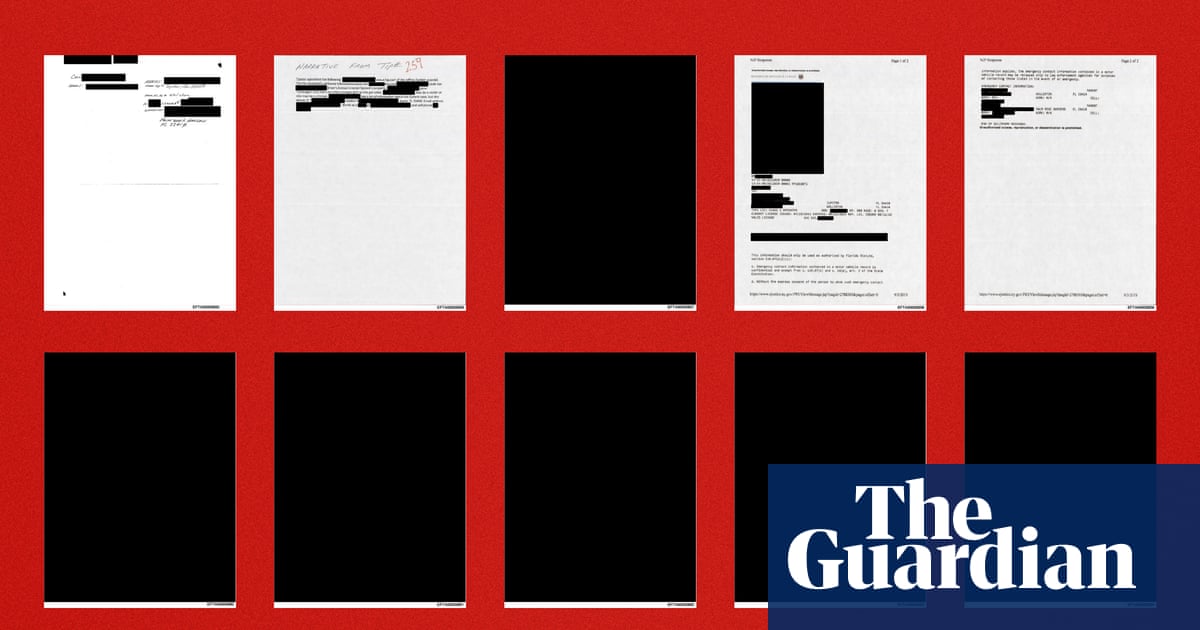
Some Epstein file redactions are being undone with hacks
Un-redacted text from released documents began circulating on social media on Monday evening
the Guardian
1029 points · by vinni2 · 11mo ago · 780 comments
- Paul Manafort court filing (U.S., 2019) Manafort’s lawyers filed a PDF where the “redacted” parts were basically black highlighting/boxes over live text. Reporters could recover the hidden text (e.g., via copy/paste).
- TSA “Standard Operating Procedures” manual (U.S., 2009) A publicly posted TSA screening document used black rectangles that did not remove the underlying text; the concealed content could be extracted. This led to extensive discussion and an Inspector General review.
- UK Ministry of Defence submarine security document (UK, 2011) A MoD report had “redacted” sections that could be revealed by copying/pasting the “blacked out” text—because the text was still present, just visually obscured.
- Apple v. Samsung ruling (U.S., 2011) A federal judge’s opinion attempted to redact passages, but the content was still recoverable due to the way the PDF was formatted; copying text out revealed the “redacted” parts.
- Associated Press + Facebook valuation estimate in court transcript (U.S., 2009) The AP reported it could read “redacted” portions of a court transcript by cut-and-paste (classic overlay-style failure). Secondary coverage notes the mechanism explicitly.
A broader “history of failures” compilation (multiple orgs / years) The PDF Association collected multiple incidents (including several above) and describes the common failure mode: black shapes drawn over text without deleting/sanitizing the underlying content. https://pdfa.org/wp-content/uploads/2020/06/High-Security-PD...
I've seen lawyers at major, high-priced law firms make this same mistake. Once it was a huge list of individuals names and bank account balances. Fortunately I was able to intervene just before the uploaded documents were made public.
Folks around here blame incompetence, but I say the frequency of this kind of cock-up is crystal clear telemetry telling you the software tools suck.
If the software is going to leverage the familiarity of using a blackout marker to give you a simple mechanism to redact text, it should honour that analogy and work the way any regular user would expect, by killing off the underlying text you're obscuring, and any other correponding, hidden bits. Or it should surface those hidden bits so you can see what could come back to bite you later. E.g. It wouldn't be hard to make the redact tool simultaneously act as a highlighter that temporarily turns proximate text in the OCR layer a vibrant yellow as you use it.
This was basically the only reason we were willing to cough up like $400 for each Acrobat license for a few hundred people. One redaction fuckup could cost you whatever you saved by buying something else.
I would like to believe that the DOJ lacking the proper software might have something to do with DOGE. That would be sweet irony.
Unfortunately the E in DOGE should have been for Effectiveness. That is, is the system shooting at the right target, and how close is it to hitting that target.
You can be very efficient but if you’re doing the wrong thing(s) you’re ultimately wasting resources.
The irony is, DOGE got the E wrong. It’s efficient but not effective
Now much more people will be aware of the issue.
Absolutely. They know this is confusing, and they're bound and determined not to fix it. At the least, they need a pop-up to let you know that it's not doing what you might think it's doing.
No surprise non-experts muck it up and I don’t see that changing until they move to special-purpose tools.
Any lawyer should be like "I don't know what I'm doing here I'll get an expert to help" just like as a software developer I'd ask a lawyer for their help with law stuff...because IANAL uwu
Placing a black rectangle on a PDF is easier than modifying an image or removing text from that same PDF.
https://www.adobe.com/acrobat/resources/how-to-redact-a-pdf....
That failed redactions happen over and over and over is kind of amazing.
If they get caught, they just take the document down and deny it ever got posted. Claim whatever people can show is a fake.
Since they control the levers of government, there's few with the resources and appetite for holding them accountable. So far, we haven't un-redacted anything too damning, so push hasn't come to shove yet.
The only might change if there's a "blue wave" in the midterms, but even then I wouldn't count on it.
there's white-out on my monitor.
> ...frequency of this kind of ...
sometimes I wonder if it is plausible deniability. Like people don't WANT to cover this up and do it in a certain way.
There is a lot of incompitence when it comes to file formats.
The most recent analogy I have is field techs in IT work. A company sends out "truck roll" tickets, and then complaints when there is a 40% failure/re-work rate on said truck rolls.
A single or handful of techs with said failure rate? Yep, perhaps incompetence.
A global failure rate across dozens of cities/countries and 40+ technicians total? No longer incompetence. At least at the field tech level. That's a documentation, process, and standards problem 100% guaranteed.
That some above average highly competent "hero" technicians are able to compensate for it is irrelevant.
If I have a sheet of paper and I color a section black. That's it. It's black. No going back.
So I can see people thinking the same for PDFs. I drew the black box. It's black. Done. They don't realize they aren't dealing with a 2D sheet of paper, but with effectively a 3D stack of papers. That they didn't draw a black box on the page, they drew a black box above the page over the area they wanted to obscure.
The fact that this happens a lot is an indication that the software is wrong in this case. It doesn't conform to user expectations.
I'm kinda surprised (and disappointed) nobody has done a Snowden on it though.
Hundreds of people might be involved, but the only key factor required for a single point of failure to propagate to the deliverable is lack of verification.
And God knows how the Trump administration is packed with inexperiente incompetents assigned to positions where they are way way over their head, and routinely commit the most basic mistakes.
https://www.psychologytoday.com/us/basics/weaponized-incompe...
They fired/drove away/reassigned most of those who are competent in the executive branch generally, it is pretty easy to believe that none of those managing the document release and few of those working on it are actually experienced or skilled in how you do omissions in a document release correctly. Those people are gone.
What happens in a court case when this occurs? Does the receiving party get to review and use the redacted information (assuming it’s not gagged by other means) or do they have to immediately report the error and clean room it?
Edit: after reading up on this it looks like attorneys have strict ethical standards to not use the information (for what little that may be worth), but the Associated Press was a third party who unredacted public court documents in a separate Facebook case.
Typically, two copies of a redacted document are submitted via ECF. One is an unredacted but sealed copy that is visible to the judge and all parties to the case. The other is a redacted copy that is visible to the general public.
So, to answer what I believe to be your question: the opposing party in a case would typically have an unredacted copy regardless of whether information is leaked to the general public via improper redaction, so the issue you raise is moot.
I know and am friends with a lot of lawyers. They're pretty ruthless when it comes to this kind of thing.
Legally, I would think both parties get copies of everything. I don't know if that was the case here.
If it's worth so little to your eyes/comprehension you will have no problem citing a huge count of cases where lawyers do not respect their obligations towards the courts and their clients...
That snide remark is used to discredit a profession in passing, but the reason you won't find a lot of examples of this happening is because the trust clients have to put in lawyers and the legal system in general is what makes it work, and betraying that trust is a literal professional suicide (suspension, disbarment, reputational ruin, and often civil liability) for any lawyer... that's why "strict" doesn't mean anything "little" in this case.
There are almost 2000 disbarments annually in the US.
The california bar recieves 1 compliant for every 10 law licenses in the state every year.
There's a wikipedia page on notable disbarments.
Legal malpractice suites are on the rise.
If you are going to assert that legal malpractice is not legitimate concern, I think the burden of evidence is on you.
Curious. I am not a litigator but this is surprising if you found support for it. My gut was that the general obligation to be a zealous advocate for your client would require a litigant to use inadvertently disclosed information unless it was somehow barred by the court. Confidentiality obligations would remain owed to the client, and there might be some tension there but it would be resolvable.
Of course if it's in the middle of an investigation it can spoil the investigation, allow criminals to cover their tracks, allow escape.
In such case the document should be vetted by competent and honest officials to judge whether it is timely to release it, or whether suppressing it just ensures that investigation is never concluded, extending a forever renewed cover to the criminals.
There was also a process on how to communicate top secret information, but these idiots prefered to use signal.
I'm completly lost on how you can be surprised by this at all? Trump is in there, tells some FBI faboon to black everything out, they collect a group of people they can find and start going through these files as fast as they can.
"When a clown moves into a palace, he doesn't become a king; the palace instead becomes a circus."
I'm not familiar with the term, and Urban Dictionary only has "fake babboon" which I suspect is not the intent here - what does it mean?
You can still open it with Illustrator if you want to see: https://obamawhitehouse.archives.gov/sites/default/files/rss...
The Trump 2.0 administration, in contrast, is staffed top to bottom with fools."
https://daringfireball.net/linked/2025/12/23/trump-doj-pdf-r...
That's not very competent.
> going analog is foolproof
Absolutely not. There are many way's to f this up. Just the smallest variation in places that have been inked twice will reveal the clear text.
Sure. But anyone can visually examine this. That means everyone with situational context can directly examine the quality of the redaction.
Contrast that with a digital redation. You have to trust the tool works. Or you have to separate the folks with context from the folks with techical competence. (There is the third option of training everyone in the DoJ how to examine the inner workings of a PDF. That seems wasteful.)
https://www.vice.com/en/article/russian-spies-chemical-weapo...
Anyone remember how the Trump I regime had staff who couldn't figure out the lighting in the White House, or mistitled Australia's Prime Minister as President?
However I'm 100% sure that that was not a real spy incident. But rather just a 'message' to be sent from the Russian govt. The same way they have infiltrated our airspace with TU-95 bombers nearly every month for decades. Just a message "Hey we are still watching you".
When you see how ridiculously incompetent they were, not just their phone history but also the gear they had with them. It amounts to nothing more than a scriptkiddy's pineapple. There's no way they would have been able to do any serious infiltration into any kind of even remotely competent organisation.
Also the visible fumbling about in a carpark with overly complex antennas instead of something more hidden (e.g. an apartment across the street, a cabling tent or something). IMO the objective here was to get caught and stir a fuss.
Please tell me they were saving them for expensing.
https://www.theverge.com/2023/6/28/23777298/sony-ftc-microso...
I may have disagreed with them on virtually every policy point, but they seemed to disagree with the most harmful Trump policies as well.
We would have never agreed on the right policy, but we definitely agreed that his policy was not the right one.
I disagree. It felt that way for the first few months, but the wheels are coming off. Trump is too old and unpopular to steal a 3rd term. Therefore everyone around him has to worry about what will happen in 3 years, and plan for post-Trump rather than forever-Trump.
They had a great playbook in Project 2025. I'm not convinced Trump ever had the smartest people executing it.
You mean the guy who covered up for Epstein's 'suicide' and expected us morons to believe it?
Let's assume that's true. How does it clash with him being "contemptible...but smart AF"?
This is a dumb way of doing that, exactly what "stupid" people do when their are somewhat aware of the limits of their competence or only as smart as the tech they grew up with. Also, this type of redaction eliminates the possibility to change text length, which is a very common leak when especially for various names/official positions. And it doesn't eliminate the risk of non-redaction since you can't simply search&replace with machine precision, but have to do the manual conversion step to printed position
Being aware of one's limitations is the strongest hallmark of intelligence I've come across...
> you can't simply search&replace with machine precision
Sure you can. Search and somehow mark the text (underline or similar) to make keywords hard to miss. Then proceed with the manual print, expunge, scan process.
No, this is an example of someone understanding the limits of the people they delegate to, and putting in a process so that delegation to even a very dumb person still has successful outcomes.
"Smart" people like to believe that knowing enough minutiae is enough to result in a successful outcome.
Actual smart people know that the process is more important than the minutiae, and proceed accordingly.
This is the only weakness of Barr's method.
> it doesn't eliminate the risk of non-redaction since you can't simply search&replace with machine precision
Anyong relying on automated tools to redact is doing so performatively. At the end of the day, you need people who understand the context to sit down and read through the documents and strike out anything that reveals–directly or indirectly, spelled correctly or incorrectly–too much.
Increasing the size of the redaction box to include enough of the surrounding text to make that very difficult.
https://www.minnpost.com/politics-policy/2007/11/you-can-swi...
IIRC there was a Slashdot discussion about it that went "Oh yeah, obviously you need to black out the face entirely, or use a randomized Gaussian blur." "Yeah, or just not molest kids."
Not that it matters much what the law says if the goal is to protect the man who hands out pardons...
The offices responsible for redactions are usually in-house legal shops (e.g., an Office of Chief Counsel inside an agency like CBP) and the agency’s FOIA office. They’re often doing redactions manually in Adobe, which is slow, tedious, and error-prone. Because the process is error prone, the federal government gets multiple layers of review, justified (as DOJ lawyers regularly tell courts) by the need to “protect the information of innocent U.S. citizens.”
But the “bad at redactions” part isn’t an accident. It functions as a litigation tactic. Makes production slow, make FOIA responses slow, and then point to that slow, manual process as the reason the timeline has to be slow. The government could easily buy the kind of redaction tools that most law firms have used for decades. Purpose built redaction tools speed the work up and reduce mistakes. But the government doesn't buy those tools because faster, cleaner production benefits the requester.
The downside for the government is that every so often a judge gets fed up and orders a normal timeline. Then agencies go into panic mode and initiate an “all hands on deck.” Then you end up with untrained, non-attorney staff doing rushed redactions by hand in Adobe. Some of them can barely use a mouse. That’s when you see the classic technical failures: someone draws a black rectangle that looks like a redaction, instead of applying a real redaction that actually removes the underlying text.
I didn't really know how they slept at night, but I don't know how a lot of people sleep at night. I only had to be involved because I had to do the actual trawling through the emails. They spent their time trying to narrow the keywords that I'd have to search, and trying to figure out new definitions of the words "related to."
In another episode they’re trying to find out the length of a stealth submarine for construction planning purposes of a port or something, and they have to go through endless layers of security checks with the military that lead nowhere. In the end a reporter filming a documentary episode on the government agency tells them the length because they were allowed to film the submarine on another program.
Definitely recommend the show and my friends in government say it’s scarily accurate.
No, there isn't an enormous cohort of bureaucrats going to work every day, collectively wringing their hands and saying "haha, we're going to be STUPID today!"
> Some of them can barely use a mouse.
How/why are they employed for that position then?
I always felt paranoid (without any real evidence, just a guess) that there would always be a chance that anything done in software could be reversed somehow.
If you don't know the provenance of images you are putting black box on (for example because of a rogue employee intentionally wanting to leak them, or if the image sensor of your target had been compromised to leak some info by another team), your redaction can be rendered ineffective, as some images can be made uncroppable by construction .
(Self-plug : https://github.com/unrealwill/uncroppable )
And also be aware that compression is hiding everywhere : https://en.wikipedia.org/wiki/Compressed_sensing
That is not cropping.
https://en.wikipedia.org/wiki/Cropping_(image)
>Cropping is the removal of unwanted _outer_ areas from a photographic or illustrated image.
Edit: I checked it out, nice, I like the lower res stenography approach, can work very nicely with good upscaling filters - gave it a star :)
So with this technique, you can definitively say "Redacted-file-A is definitely a redacted version of Origin-file-A". Super useful for identifying forgeries in a stack of otherwise legitimate files.
Also good for for saying "the date on origin-file-B is 1993, and the file you've presented as evidence is provable as origin-file-b, so you definitely know of [whatever event] in 1993".
If you compare an image to another image, you could guess by compression what is under the blocked part, that makes some sense to me conceptually, what I don't get is for the PDF specifically why does it compressing the black boxes I put have any risk? It's compressing the internal image which is just the black box part? Or are you saying the whole screenshot is an internal image?
(Note there's also other metadata in a PDF, which you may not want your recipient to know either.)
Image files usually have substantially less metadata by default, unless it's one taken by a camera.
how much lower can they go ?!
- Leave NATO
- Start openly supporting Russia and North Korea
- Arrest whole International Criminal Court
- Preventively invade China
Reintroduce death penalties on public squares.
Taking Greenland and Venezuela is given, as they took most of Latin America already. Just the new Mexican president looks like the next thorn in their eyes. Too competent, too social, too anti-corruption.
Already done.
I'm more concerned with them dragging everyone else down, and someone much worse taking their place.
When opening the file in my slow computer, I could see all the rendering of the watermark happening in slow motion until the white box would pop up on top of the text.
I could then open up the postscript, delete the commands that rendered the watermark, save it, then I converted it to PDF so it would be easy to print.
Randomly removing these by trial and error will usually quite easily allow you to find the watermark and nix it, with the advantage that even a sophisticated recipient will not be able to find out from the pdf file what the watermark was.
16 shades of grey (not 50) is plenty enough for text to still be smooth.
I do it for several reasons, one of them being I often take manual notes on official documents (which infuriates my wife btw) but then sometimes I need to then scan the documents and send them (local IRS / notary / bank / whatever). So I'll just scan then I'll fill rectangle with white where I took handnotes. Another reason is when there's paper printed on two sides, at scan times sometimes if the paper is thin / ink is thick, the other side shall show.
I wonder how that'd work vs adversarial inputs: never really thought about it.
Let all the files get released first.
Then show your hacks.
Keeping that secret would require sponaneous silence from everyone looking at these docs which is just not possible.
With how they have pushed out any career public servants who were good at their jobs in favor of sycophants and loyalists, I'm not sure government organizations are still capable of playing 4D chess, if they ever were.
The Trump team knows that nobody is gonna buy whatever they put out as being the full story. Isn't this just the perfect way to make people feel like they got something they weren't supposed to see? They can increase trust in the output without having to increase trust in the source of it
And as far as I've heard there hasn't been anything "unredacted" that's been of any consequence. It all just feels a little too perfect.
Whether breaking a law actually matters anymore is another question though, as crime is legal now.
Back in the day they had true masters of the Dark Arts. The forged letters about Bush's service were incredibly convenient in helping Bush beat Kerry. I am not alone in thinking it to be masterminded by Karl Rove.
And in terms of no big news in “unredacted”, it’s likely names that don’t mean anything to the average voter but damaging material for K Street.
And yes, I've heard of Hanlon's Razor haha
It's not like a few more stories of Trump raping $whomever are going to move the needle at all, especially with how the media is on board with burying negative coverage of the regime.
Also if you're wondering how this activity isn't some kind of abuse of government resources, keep in mind that thanks to the Supreme Council's embrace of the Unitary Executive Theory (ie Sparkling Autocracy), covering up evidence about Donald Trump raping under-aged sex trafficking victims is now an official priority of the United States Government.
Any major documents/files have been removed all together. Then the rest was farmed out to anyone they could find with basic instructions to redact anything embarrassing.
Since there's absolutely zero chance anyone in the administration will ever be held accountable for what's left, they're not overly concerned.
The thing that I've been waiting to see for years is the actual video recordings. There were supposedly cameras everywhere, for years. I'm not even talking about the disgusting stuff, I'm talking security for entrances, hallways, etc.
The FBI definitely has them, where are they?
What about Maxwell's media files? There was nothing found there? Did they subpoena security companies and cloud providers?
The documents are all deniable. Yes video evidence can now be easily faked, but real video will have details that are hard to invent. Regardless, videos are worth millions of words.
I'm leaning towards negligence though.
For context, lawyers deal with this all the time. In discovery, there is an extensive document ("doc") review process to determine if documents are responsive or non-responsive. For example, let's say I subpoenaed all communication between Bob and Alice between 1 Jan 2019 and 1 Jan 2020 in relation to the purchase of ABC Inc as part of litigation. Every email would be reviewed and if it's relevant to the subpoena, it's marked as responsive, given an identifier and handed over to the other side. Non-responsive communication might not be eg attorney-client communications.
It can go further and parts of documents can be viewed as non-responsive and otherwise be blacked out eg the minutes of a meeting that discussed 4 topics and only 1 of them was about the company purchase. That may be commercially sensitive and beyond the scope of the subpoena.
Every such redaction and exclusion has to be logged and a reason given for it being non-responsive where a judge can review that and decide if the reason is good or not, should it ever be an issue. Can lawyers find something damaging and not want to hand it over and just mark it non-responsive? Technically, yes. Kind of. It's a good way to get disbarred or even jailed.
My point with this is that lawyers, which the Department of Justice is full of, are no strangers to this process so should be able to do it adequately. If they reveal something damaging to their client this way, they themselves can get sued for whatever the damages are. So it's something they're careful about, for good reason.
So in my opinion, it's unlikely that this is an act of resistance. Lawyers won't generally commit overt illegal acts, particularly when the only incentive is keeping their job and the downside is losing their career. It could happen.
What I suspect is happening is all the good lawyers simply aren't engaging in this redaction process because they know better so the DoJ had the wheel out some bad and/or unethical ones who would.
What they're doing is in blatant violation to the law passed last month and good lawyers know it.
There's a lot of this going on at the DoJ currently. Take the recent political prosecutions of James Comey, Letitia James, etc. No good prosecutor is putting their name to those indictments so the administration was forced to bring in incompetent stooges who would. This included former Trump personal attorneys who got improerly appointed as US Attorneys. This got the Comey indictment thrown out.
The law that Ro Khanna and Thomas Massey co-sponsored was sweeping and clear about what needs to be released. The DoJ is trying to protect both members of the administration and powerful people, some of whom are likely big donors and/or foreign government officials or even heads of state.
That's also why this process is so slow I imagine. There are only so many ethically compromised lackeys they can find.
MAGA is a cult and every cult has a mission. MAGA's mission is to uncover the elite pedophile ring. A cult can only be sustained so long as the mission is incomplete. Epstein is core foundational mythology. It's going to be really difficult if not impossible to redirect this.
You'll notice that Mike Johnson once again has put Congress in recess to avoid it taking action, this time a day before the 30 day deadline. The last time was for 7 weeks to try and get Republicans to remove their names from the discharge petition to avoid all this. Republicans know what a core problem this is.
So it's politically damaging with his base for Trump to pardon attorneys involved in obstructing this. But even if he weathers that, it doesn't solve his problem.
For one, any attorneys despite any pardon are subject to disciplinary proceedings (including disbarment) as well as possible state charges.
For another, this stuff is simply going to get out. Where previously a DoJ attorney would be committing career suicide if they got caught leaking things like grand jury testimony and confidential non-prosecution agreements, now they're obligated to. So they're not leakers anymore, they're whistleblowers who are following the law.
Congress will eventually have to come back into session and Pam Bondi may actually face a real risk of impeachment. If that happens, who is going to want this job when the key requirement is being such a loyalist that you have to break the law?
Congress will also seek compliaance from DoJ and hold investigations as well as drip feed their own documents from,say, the House Oversight Committee.
And in the wings we still have Ghislaine Maxwell who is clearly operating under an implicit understanding that she will get a pardon or, more likely, a commutation. Her move to a lower security prison that isn't eligible for her type of offenses was (IMHO) clearly a move to buy her continued silence until it became politically possible to free her. I don't think that's ever going to be possible other than maybe a lame duck pardon when leaving office.
This story is only getting bigger.
> So in my opinion, it's unlikely that this is an act of resistance. Lawyers won't generally commit overt illegal acts,
Political redaction in this release under the Epstein Transparency Act is an overt, illegal act.
Does that reconfigure your estimation of whether DoJ attorneys that aren't the Trump inner-circle loyalists installed in leadership roles might engage in resistance against (or at least fail to point out methodological flaws in the inplmentation of) it?
I guess the big take-away is scrape everything ASAP when it comes out. I haven't found any meaningful differences yet, but file hashes are different in the published data set zip files available today versus when Archive.org took a snapshot a few days ago.
I did write a bit of a tool which will detect and log and dump the text of affected PDF's, since redacting via drawing black boxes as well as using dark-colored highlights are both programmatically detectable. Pretty trivial to do so. Happy Holidays for anyone else who has the day off!
Of course I'm probably the odd one out, wanting to apply that modifier to my own nitpick comments, so that idea probably wouldn't end up being very useful in general.
(There is also some irony in me commenting on your comment here where it's completely unrelated to the actual post...)
Please change the title.
You don't need to do some sophisticated thing for it to be considered hacking
Opening someone else’s laptop and guessing the password would absolutely fall under that definition, but I think it’s very much questionable if poking around a document that you have legitimately obtained would do so.
Hacking is unauthorised use of a system. Reading a document that was not adequately redacted can hardly be considered hacking.
I'm not a lawyer, so I don't know what the law has to say about this. But I do have at least a small handful of brain cells to rub together, so I know what the law _should_ say about this.
By serving up the PDF file I am being authorized to receive, view, process, etc etc the entire contents. Not just some limited subset. If I wasn't authorized to receive some portion of the file then that needed to be withheld to begin with.
That's entirely different from gaining unauthorized entry to a system and copying out files that were never publicly available to begin with.
To put it simply, I am not responsible for the other party's incompetence.
I'd say any technical or legal restrictions or possible means to enforce DRM ought to be disabled or absent from the media format used when disseminating content that must be disclosed.
Censorship (of necessary) should purge the data entirely,ie: replace by ###
> That's entirely different from gaining unauthorized entry to a system and copying out files that were never publicly available to begin with.
That's not the sum total of hacks, if you have publicly accessible password-protected PDF and guess the password as 1234, that's a hack. Copy& paste of black boxes is similarly a hack around content protection
> To put it simply, I am not responsible for the other party's incompetence.
To put it even simpler, this conversation is not about you and your responsibility, but about the different meanings of the word "hack "
HN discourages editorializing headlines.
While I wouldn't call it a "hack," common usage even here on HN isn't limited to "to gain illegal access to (a computer network, system, etc.)" [0]
Still technically a hack.
This isn't about knowledge or expectations. They didn't use colored boxes to jazz up the presentation, they _intended_ to prevent you from reading it, and now you can, with this, again incredibly _lame_ almost meaningless even-my-five-year-old-could-do this "hack."
That's also why a mafia extorts and doesn't run complex businesses in general.
Perhaps the US can survive this administration. But somewhere down the line it will become broken.
May it continue to work in the decades to come!
Two things come to mind:
* Some things Indyke did fall outside the scope of lawyer-client privilege. It would be bad for certain people to get him on a stand and force him to spill the beans. He was never interviewed re: Epstein [1]
* He's a very talented lawyer, insofar as a competent lawyer with, at least, extreme discretion, is talented.
[1] https://www.finance.senate.gov/imo/media/doc/letter_to_doj-f...
Yep. I think this sort of thing is actually their biggest concern with releasing the docs. They can redact or lose documents that say anything directly incriminating about Trump and his associates and dismiss everything Epstein and testimonies from the 2020s say about him as confabulation, but there are other people who might want to take the administration down with them if they get caught or even just get fed up of being doorstepped by the media, and some of them might have receipts.
It's why deleting documents outright is something we aren't really seeing. Those docs can still be floating around and, worse, there can be references to missing docs within the released docs.
And with just the sheer volume of documents that are being released, it's clear to me why the Trump admin didn't release anything sooner. There's simply too much and the effort to prune it down to a specific narrative is too much of a monumental undertaking. It'd involve too many people which ultimately means it's more likely to leak out.
From the Guardian UK https://archive.md/lO08a
> [Indyke] was hired by the Parlatore Law Group in 2022, before the justice department settled the Epstein case. That firm represents the defense secretary, Pete Hegseth, and previously represented Donald Trump in his defense against charges stemming from the discovery of classified government documents stored at Trump’s Florida estate.
So I don't know about "not a Washington person", but clearly connections exist to the current administration.
This is like putting a post-it on a printed document and circulating it as "redacted" -- and calling anyone who lifted the post-it a criminal/thief.
But on principle, what right does the government have to keep secrets from its own people? I don’t believe we had that button at the founding, it was added somewhere along the way. I’m asking what is the justification for this, and whether in the grand scheme of things that outweighs the principle of the government not being a separate entity from the people.
There are multiple ways to approach witness protection. For example if we have a problem with witnesses being harmed we could make being involved with witness harm at any layer of indirection a capital offense. We can probably think of other options besides the government being allowed to keep secrets from its own people.
Every government everywhere has and has always had state secrets e.g. names of spies.
>make being involved with witness harm at any layer of indirection a capital offense.
People still commit capital offenses. This just makes it much easier to get to that witness and get away. We also know from empirical evidence that the death penalty is not useful for deterring crime.
Witness protection is also getting to start over without everyone in your neighborhood knowing you were a criminal. It's part of the deal.
Pragmatically, I think it's easy to recognize that the government should be allowed to have some secrets from the public. I think the clearest and most extreme example is the details of our nuclear armaments.
But the question of where the line is is a tricky one. IMO, we definitely allow the government far more secrets than it should have.
As of February, it’s sensible to ask if there’s an OIG.
1: https://drive.google.com/drive/u/0/folders/1HFqpFLOJgYLiAgjT...
The only two reasons that redactions are allowed are a) to protect the privacy of victims and b) to protect the integrity on ongoing investigations.
- To protect victims
- Redact people that are currently under investigation
But here they are clearly blacking out potential co-conspirators, without them being under investigation or having been charged with anything.
Seems like they are just backing out powerful people not to embarrass or implicate them.
Still suspect that someone can undo this from data may have been accidentally steaganographed across non-deleted parts of the image.
However, I wonder whether heavily compressing the redacted image would help remove any unwanted artefacts. But the best solution is probably to render the original file from scratch, without compression, before redacting the image.
Redacting documents is hard for people who didn't learn how to properly do it, and don't have the right tools. But for courts, the FBI or the DOJ this shouldn't apply. They know how to do it right.
I can only imagine, that some people didn't redact the documents properly on purpose. Plausible deniability.
PDF is an absurdly complex file format. It's part of the reason there is no single "good" PDF reader, just a lot of mediocre PDF readers that are all terrible in their own way. Which is a topic for another day.
There are several ways to remove data in a PDF:
- Remove the data. This is much harder than it sounds. Many PDF tools won't let you change the content of a PDF, not because it isn't possible, but because you'll likely massively screw up the formatting, and the tools don't want to deal with that.
- Replace the data. This what what all the "blackout" tools do, find "A" and replace with "🮋". This is effective and doesn't break formatting since it's a 1-to-1 replacement. The problem with "replacing" is that not every PDF tool works the same way, and some, instead, just change the foreground and background color to black; it looks nearly the same, but the power of copy-and-paste still functions.
- Then you have the computer illiterate, who think changing the foreground and background color to black is good enough anyway.
> - Remove the data. This is much harder than it sounds. Many PDF tools won't let you change the content of a PDF, not because it isn't possible, but because you'll likely massively screw up the formatting, and the tools don't want to deal with that.
Compared to other formats this is actually relatively easy in a PDF since the way the text drawing operators work they don't influence the state for arbitrary other content. A lot of positioning in a PDF is absolute (or relative to an explicitly defined matrix which has hardcoded values). Usually this makes editing a PDF harder (since when changing text the related text does not adapt automatically), but when removing data it makes it much easier since you can mostly just delete it without affecting anything else. (There are exceptions for text immediately after the removed data, but that's limited and relatively easy to control.)
> - Replace the data. This what what all the "blackout" tools do, find "A" and replace with "🮋". This is effective and doesn't break formatting since it's a 1-to-1 replacement.
That's actually rather tricky in PDFs since they usually contain embedded subset fonts and these usually do not have "🮋" as part of the subset. Also doing this would break the layout since "🮋" has a different width than most letters in a typical font, so it would not lead to less formatting issues than the previous option. Unless the "🮋" is stretched for each letter to have the same dimensions, but then the stretched characters allow to recover the text.
> The problem with "replacing" is that not every PDF tool works the same way, and some, instead, just change the foreground and background color to black; it looks nearly the same, but the power of copy-and-paste still functions.
PDF does not have a concept of a background color. If it looks like a background color in PDF, you have a rectangle drawn in one color and something in the foreground color in front of it. What you usually see in badly redacted PDF files is exactly this, but in opposite color: Someone just draws a black box on top of the characters. You could argue that this is smarter since it would still work even if someone would chnage colors, but of course, PDF is a vector format. If you just add a rectangle, someone else can remove it again. (And also copy & paste doesn't care about your rectangle)
>- Replace the data. This what what all the "blackout" tools do, find "A" and replace with "🮋". This is effective and doesn't break formatting since it's a 1-to-1 replacement. The problem with "replacing" is that not every PDF tool works the same way, and some, instead, just change the foreground and background color to black; it looks nearly the same, but the power of copy-and-paste still functions.
You're making it sound way harder than it is, when both adobe acrobat and the built-in preview app on mac can both competently redact documents. I'm not aware of instances of either (or any other purpose-made redaction tools) failing. I wouldn't homebrew a python script to do my redaction either, but that doesn't mean doing redactions properly in some insurmountable task for some intern.
The most reliable way is to just screenshot the document or print and scan it, effectively burning it down and recreating it in a new format that has no concept of the past. This works across basically all formats, too, and against all tools.
To be fair, this works if you print out those copies and then re-scan them.
Should take... a weekend tops? ;) PDF is crazy and scary
Not kidding - it's a ~~~billion dollar market haha
Make an MVP/Show HN :-)
As far as I understand it, at its core, pdf is just a stream of instructions that is continually modifying the document. You can insert a thousand objects before you start the next word in a paragraph. And this is just the most basic stuff. Anything on a page can be anywhere in the stream. I don't know if you can go back and edit previous pages, you might have a shot at least trying to understand one page at a time.
Did you know you can have embedded XML in PDFs? You can have a paper form with all the data filled in and include an XML version of that for any computer systems that would like an easier way to read it.
The only safe way for journalists is to paraphrase what the document said and to say "an unnamed source claims that ..." and to guarantee with your reputation, and the reputation of your publisher, that you are being faithful to what the original source said. For even better results, combine multiple sources.
Unfortunately paraphrasing things and taking editorial responsibility have both been deprecated in favour of rereleasing press releases in the house style, so it's difficult to get the actual journalism these days.
Anyway, if you click on a "redaction", you're clicking on the box and can't select the text underneath, but if you just highlight the text around it, you can copy all the original text.
It's a bizarre oversight.
There would also be a mix of text documents, and image scans. The way to censor each is different.
Perfectly censoring documents, particularly digital ones is actually surprisingly difficult.
But the difficult part is easily repeatable once it's figured out, which is why it surprises me that it's not built into Acrobat as a tool already.
Firstly, calling this redaction implies that the data is missing, and calling what was done "unredacting" is akin to saying someone "decrypted" a cryptographic hash function.
Nobody unredacted anything here, they merely discovered that it hadn't been redacted, and simply looked like it was redacted.
Calling this a hack places responsibility on the people who discovered the information, rather than on the people were put in charge of handling the redaction and screwed it up.
To the journalist, it looks like "hackers at work" because the result looks like magic. Therefore their editor attaching "hacks" to the title for additional clickbait as well.
To us technical people, who understand the concept of layers in digital editing, it is no big deal at all (and is not surprising that some percentage of the PDF's have been processed this way).
It’s really not that hard; as someone else on this thread pointed out even my grandma knows this…
You can find out the technical details in one quick search.
How someone like this gets a paying job as a journalist is beyond me.
You seem highly confused on what a journalists job is in this era. Very few publishers are about correctness. It's about speed of getting the article out and getting as many eyeballs as possible to look at the ads in the article.
Or as the saying goes, A lie can travel halfway around the world before the truth can get its boots on.
My wife was a reporter with a top tier news agency in DC and I was shocked how they divvied up topics.
At best, it was "you're good with computers, go report on this hearing on cybersecurity" but more commonly, it was "who has this morning open? You do? Great. Go cover this 9am on the Israel-Palestine negotiations and what the implications are. We'll do a segment in the 11am hour."
It's people who are very good with words, and at talking to anyone and everyone about anything, both is a friendly and confrontation way.
They also have almost no understanding of math, science or technology. If they did, they'd get better paying jobs.
Journalism used to be a well paid prestigious career that attracted brilliant people. There is not enough money in what's left of that industry to do that anymore.
That's the first sentence of the article, and that's all there is to it.
The error is consumers believing journalist news is anything but uninformed, hot take heresy; spun in the most sensationalistic way.
They are hired to get eyeballs for advertisers. Not to be accurate, thorough truthful, or unbiased.
Some folks had to be taught on how folder structures work because they grew up with the appliance we called a "phone" as opposed to a real computer that also happened to be known as a "phone".
Their job is to write coherent articles that gather views, not truly understand what it is they are writing about. That's why the Gell-Mann Amnesia [1] aspect so often crops up for any technical article (hint, it also crops up for every article, but we don't recognize the mistakes the journalist makes in the articles where we don't have the underlying knowledge to recognize the mistakes).
When someone then shows them how to copy/paste out the original text, because the PDF was simply black stick-it notes above the text, it appears to them as if that someone is a magical wizard of infinite intelligence.
True story: one time I used that technique to ask for a higher credit card limit than the options the website presented. Interestingly enough, they handled it gracefully by sending me a rejection for a higher amount and an acceptance for the maximum offered amount (the one I edited). And I didn't get arrested for hacking!
*: disclaimer, I didn't attend MIT, but did hang out with greybeards on 90s IRC
Yes, but you see it says "view source" not "edit page live". Don't really see why it wouldn't be "omg" for them.
They had been asked for an assignment as part of the interview process, where they were supposed to make suggestions regarding the company's offers. They showed up on the (MS teams) interview having revamped what looked like the live website (www. official website was visible in the browser bar).
The interviewers gave them the job pretty much on the spot, but did timidly ask at the end "do you mind putting it back though, for now?", which we still laugh about 5 years later
A lot of people in the thread here are calling them a non-technical English major who doesn’t understand the technology. Word processors also happen to be the tools of their trade, I am sure they understand features of Word better than most of the computer science majors in this thread…
But I'd also bet the editors technical knowledge of how this "revelation" of the hidden material really works is low enough that it also appears to be magic to them as well. So they likely think it is a 'hack' as well.
You are supposing. The article doesn't read like that at all. Your post smells of exceptional tech elitism.
https://www.underhanded-c.org/_page_id_17.html
And the winner's solution is incredibly simple and clever.
(1) Considering it was a rush job (2) general ineptness of this administration and (3) the management wouldn't have defined the explicit job description ("completely black out, not use black highlighter"), the likeliness that there is any evidence that this was intentionally malicious is pretty low.
So I don’t think there will be jail time if that’s what you’re referring to.
If you are CIA / FBI / Court / Lawyer or professional full time redactor of documents you should know that the highlighter doesn't delete the text underneath it.
Unfortunately “hack” became a catch all word long ago. Just look at “life hacks”.
Also, in light of everything that is happening, is incredible that the top comment on this thread is about some minor semantic definitions.
(A better analogy might be the original physical document with redaction marks. If the text is printed using a laser printer or a type writer, and the marker used for redaction uses some other kind of ink - let's say one that doesn't dissolve the text's ink or toner in any way - then you can in principle distinguish between the two and thus recover visibility of the text.)
If you say “they failed to redact data” to a layperson looking at a visibly redacted document they’re going to be confused.
They are not. They are factually incorrect. Look up the various definitions of redacted. They fit perfect for the title. Arguing otherwise suggests you are making up definitions and words, in which case, I am still correct.
Special effects in movies? AI
Some edited photo? AI
Illustration for advertising? AI
That ship sailed a long time ago. The “phone hacking scandal” in ~2010¹ was mostly calling answering services that didn't have pins or other authorisation checks set.
These days any old trick gets called a hack, heck tying your shoelaces might get called a miraculous footwear securing hack.
--------
[1] https://en.wikipedia.org/wiki/News_International_phone_hacki...
Regardless, redaction does not imply that data is missing. The words were censored or obscured. That's it. Simply looking at the documents proves that. Interacting with them showed how easy they were to uncensor, but the simplicity of the method doesn't change facts.
By all means, complain about definitions and words, but get it right.
"The glitch appears to affect only a tiny number of the hundreds of thousands of documents that the Justice Department has posted online this past week because of a new Epstein-related transparency law. And it appears this redacting error wasn’t committed by the Justice Department – but rather by the Virgin Islands’ attorney general’s office when it first posted the original court filing onto a public docket in 2021."
Great contest. And a great entry, I had a big chuckle running it and unredacting my documents, even photos!
They are unredacted because either those in charge are not familiar with basic office tasks, or someone wanted this stuff to leak and nobody checked thier work. Either brand of incompetance should cause heads to roll. But, just like the signal fiasco, nothing will happen. When your brand is perfection, you cannot ever admit a mistake.
Yes, USDOJ is incompetent and dysfunctional, but this is not why. But sure, whatever, carry on...
It's the standard practice.
https://www.justice.gov/multimedia/Court Records/Matter of the Estate of Jeffrey E. Epstein, Deceased, No. ST-21-RV-00005 (V.I. Super. Ct. 2021)/2022.03.17-1 Exhibit 1.pdf
https://krebsonsecurity.com/2022/02/report-missouri-governor...
Luckily someone eventually talked sense into the governor, despite him ignoring the FBI originally when they told him it wasn't a hack
https://en.wikipedia.org/wiki/Donald_Trump_sexual_misconduct...
Look at the early quotes where Trump complains about Epstein being a creep. The main problem Trump had was that Epstein poached Trump’s favorite kids for prostitution years after they were hired by Trump.
1. Draw a black box over it in image editor, save a screenshot
2. Crop the info out
Are there other good ways?
You can't possibly know that!
(Sorry, watching Grinch, Jim Carrey spoke through me).
Victim?
The names of involved powerful people were NOT supposed to be censored. All those names except Bill Clinton name were redacted. To protect Trump and everybody else involved in the scandal except said Bill Clinton. But especially to protect Trump.
They had 30 days to process 10s of thousands of documents. The rumors floating around is they had to pull in people from other departments to work on the task.
It's pretty plausible that someone thought a black highlighter was good enough for redaction.
You think you uncovered the hidden layer but that was just a decoy.
You guys are too gullible.
Case ID #: 50D-NY-302757
Witness Information
First Name: Donald
Middle Name:
Last Name: Trump
Age: 70
DOB:
Additional Info: Again, just trying to find out the NYPD detective on the FBI sex trafficking task force that called me a couple of weeks ago and spoke to me about some of these issues.
How is Contact Known: He participated regularly in paying money to force me to ‐----- with him and he was present when my uncle murdered my newborn child and disposed of the body in Lake Michigan.
Type: Business
Address:
City: Washington DC
State: District of Columbia
Zip: 20500
Country: United States
At least it gives the US a better chance of doing a u-turn on the steep downhill path it recently took. Maybe it was intentional incompetence.
just wow.
The British media also attempted to bury this story several times but couldn't, because it was so big in the USA, and Americans don't take orders from them. The BBC royal coverage has never been anything but propaganda and flattery.
Anyway, the name should be Windsor-Mountbatten, not the other way round (or the string of German names they were anglicised from Saxe-Coburg-Gotha-Battenberg etc)
This would be comical if it weren’t so serious.
> It was unclear how property material complies with the redaction standard under the law.
In other words, who knows what else was redacted that is unrelated to either the victims or jeopardizing an active federal investigation (are there any related to Epstein? I thought those all got killed, except those ordered by Trump to investigate Democrats of course.)
When do we find out that the nuclear launch codes got changed to "YoureFired!".
We Just Unredacted the Epstein Files
https://news.ycombinator.com/item?id=46364121
I tried to ascertain, but am not certain, this is the original blog source. Maybe they made some prior X posts.
It seems that my novel "razor" is misunderstood. The article attributes bad redacting to gross incompetence. But what if the person having done this bad redacting is instead doing sabotage with plausible deniability "lol, those damn PDF tools, you never know how they work"?
It makes this story more interesting, and it allows one to see an outline of the future film scripts that will be written about this period. The courageous saboteurs at the dawn of american fascism.
I do still think incompetence is more likely to be the explanation. Incompetent redactions are a perennial problem even in much less controversial situations.
copy and paste people, the idiots have taken over
Username: admin
Password: password
More "info": https://en.wikipedia.org/wiki/Reptilian_conspiracy_theory#Da...
Every slide towards authoritarianism is gradual, there is no announcement.