Why is calling my asm function from Rust slower than calling it from C?
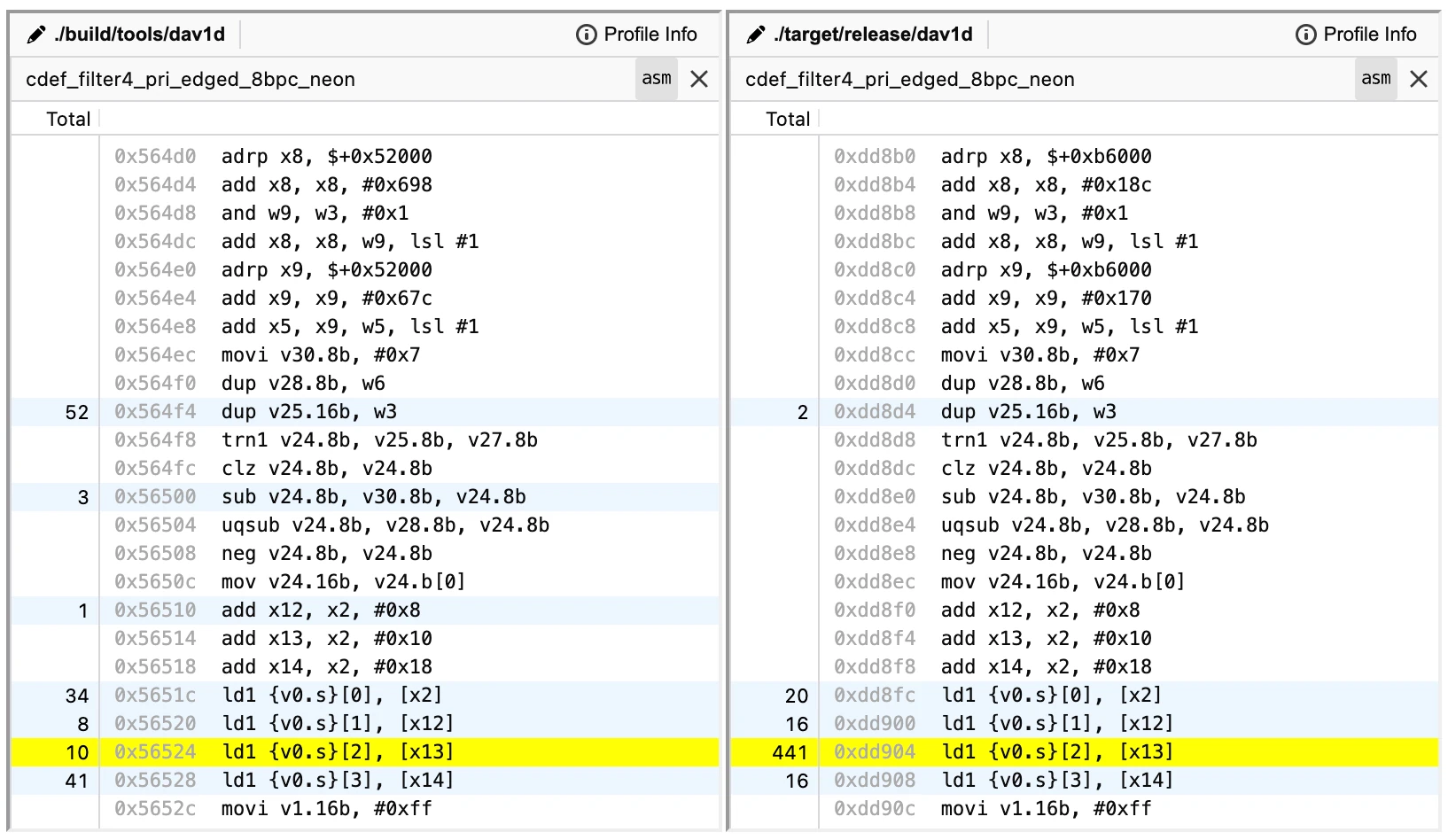
This is a follow-up to making the rav1d video decoder 1% faster, where we compared profiler snapshots of rav1d (the Rust implementation) and dav1d (the C …
ohadravid.github.io
121 points · by gavide · 11mo ago · 42 comments
FFI overhead is not to be neglected sometimes. I've seen cases where replacing a python or js lib with an in isolation much faster native Rust or C lib with bindings had the end result being a decrease in real-world performance due to it being in a hot path or loop and the overhead being more significant than the savings were. There is no substitute for real-world benchmarks.
https://ohadravid.github.io/posts/2023-03-rusty-python/#v2--...
As usual with Rust most of it is due to inherent complexity: for example, when you deal with raw pointers, you need to specify if they are const or mut, and you must have a syntax that’s not &, and not too wordy: so * is a good choice (might be changed to &raw in the future!). And if you want to say that something is generic and the generic parameter is a pointer… you just end up with a lot of syntax.
   For example, before we had something like:
     top: *const FFISafe<WithOffset<&'a u8>>
   We can change that to:
     top: WithOffset<*const FFISafe<&'a u8>>
So for all of the complaining about Rust abstractions and syntax in this thread, keep in mind that these particular abstractions that caused this problem are not standard. If you just want to call an extern "C" function you can do so directly in an unsafe block. The article should be read as the author debugging their Rust wrapper types, not as a generic article about calling C functions from Rust.
(To preempt any potential explanations about this: yes, I understand the reference being made with that quote. I just don't think it actually applies here at all)
(As an side someone whose spent a lot of time in the ecosystem might be able to infer this is likely a third-party library just from the fact that the capitalization is not in the typical format that official things use; if it were in std, I'd expect it to be FfiSafe, similar to how IoSlice[1], Arc[2], Shl[3], TypeId[4] etc. don't treat separate parts of an abbreviation/acronym/initialism as word breaks).
[1]: https://doc.rust-lang.org/std/io/struct.IoSlice.html [2]: https://doc.rust-lang.org/std/sync/struct.Arc.html [3]: https://doc.rust-lang.org/std/ops/trait.Shl.html [4]: https://doc.rust-lang.org/std/any/struct.TypeId.html
In general, and it applies to the referenced article, programming with a high level of control over the implementation is complex, and there's no way around it. This article explains the concept: https://matklad.github.io/2023/01/26/rusts-ugly-syntax.html.
1. You've come up with your own unique definition of "zero cost" which isn't what the term means, at least as popularized by C++ where the concept of "zero cost abstractions" comes from. It means zero runtime cost, not zero cognitive cost.
2. Rust generally has more "zero cost abstractions" than C++ in terms of shifting traditional runtime checks into compile-time checks (e.g. while unique_ptr exists in Rust as Box, it's far more rarely used because ownership is easier to transfer).
3. Rust generally has faster defaults in the standard library so the abstractions are lower-cost than equivalents in C++ (e.g. C++ took forever to add a hash table via unordered_map and then proceeded to really fuck up the definition to inhibit high performance designs despite this being raised during standardization & haven't since revisited the issue).
4. Rust offers far more opportunities for "zero cost abstractions" than C++. Notably it's ownership rules prevent aliasing which allows the compiler to do more aggressive optimizations that can't generally be done in C++. It provides abstractions like NonNullPointer and NonZero so that unused bit patterns can be leveraged for enums (e.g. Option<NonNullPointer> is the size of a raw pointer but in C++ it's harder to pull off). Functional style and iterators are implemented to be aggressively inlined and overheads like bounds checking elided by the compiler, whereas C++ can't elide as easily and various bounds checks have to be inserted. Could go on and on.
Anyway, Rust as the base language vs C++ has simpler cognitive abstractions, it has more zero cost abstractions, and it has more efficient abstractions overall, both in the language and the standard library.
The zero cost refers to the runtime cost, not the programming complexity.
> PSA: if you don’t see syntax highlighting, disable the 1Password extension.
This linked to the following discussion that's been ongoing for over a week (with acknowledgement from 1password that they're looking into it but as far as can tell no ETA on the fix or explanation for why it's happening in the first place):
https://www.1password.community/discussions/developers/1pass...
I know that browser extensions are in general a pretty terrible ecosystem in terms of security, but am I off-base for thinking this is not a great look for 1password? Maybe I'm just underestimating how hard this is to solve generally, but my expectation would be that it shouldn't be that hard to keep track of which circumstances you're loading entire external scripts to manipulate the DOM and not do it accidentally in places you have no need for it.
It looks [like the 1password extension] is using prism.js to try to add syntax highlighting to <code> blocks on the entire page.