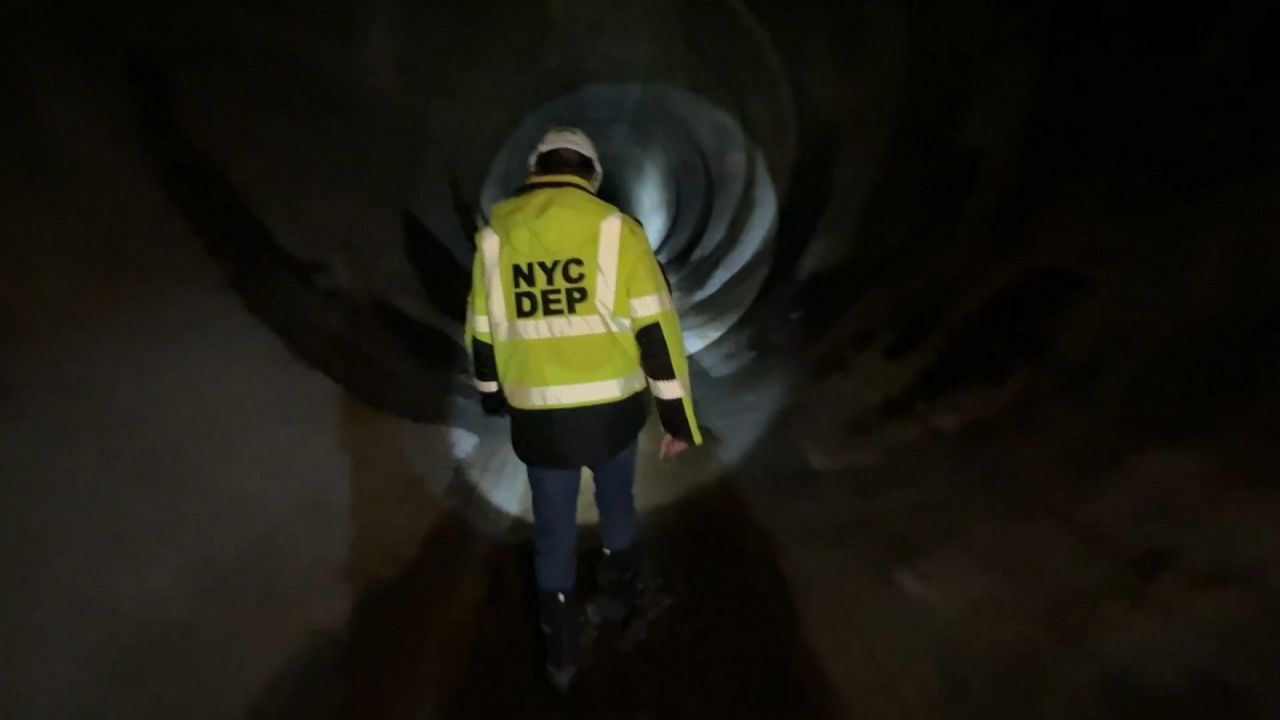
Inside NYC’s massive underground water project
NY1 visited a NYC water tunnel nearly 800 feet below ground.
ny1.com
147 points · by eatonphil · 11mo ago · 107 comments
There typically are no technical solutions to rhose.
It's not needed now, but we think that it will be needed in the future
It's needed now, but we don't know if we will use it in the future
How MUCH will it be needed in the future
Will there be a future technology that makes this investment unnecessary, or even obselete before the project ever completes
For the latter, a big argument of "No need to invest in commuter trains" argument was "self driving cars are 'just around the corner' and they will make mass transit a quaint thing of the past" was used to deny investment in trains.
People don’t want to invest in trains because Americans don’t like trains. We have only one real city, and that city’s population consistently has net domestic outmigration. The city’s population is kept stable by a steady supply of international migrants: https://www.cityandstateny.com/media/ckeditor-uploads/2025/0....
Most Americans don’t want to commute sitting next to strangers. It’s not complicated.
Not that they can't, but they won't.
The corruption and graft run so deep you would have to literally murder a lot of people to get that to happen.
It’s a big project, and it is tricky to patch it after release. The thing is supposed to last 300 years, and usually we use infrastructure well past it’s intended lifespan…
However, this is only the second phase of the plan, with two more phases broken out into separate projects. I've no idea if those were supposed to be a part of the original 50 year timeline or not.
These two questions are casually put next to each other in the same sentence but they're incredibly different. Personally, I don't think that corruption is a significant factor in how long it took. The second question is way too leading/framed - "necessary" doesn't exist past the physical limits.
For example, would the same project have taken the same time in China? No. Does that mean it should've taken as long as it would've in China, as clearly it took longer "than necessary"? Not by definition.
(The classic form of griping over NYC corruption is the MTA which is notable for not being administrated by the city.)
[1]: https://www.vitalcitynyc.org/articles/how-corrupt-is-new-yor...
Certainly NY's government and budget are larger than other US cities, for obvious reasons.
But as a few Germans have put it to me - sure, there's corruption here, but at least it still gets things built unlike _Italian_ corruption.
Which is an... ...interesting point of view.
[0]: https://en.wikipedia.org/wiki/Franz_Josef_Strauss
As for London, they built an entire industry around hiding money for oligarchs who stole it from their own countries. Maybe it's technically legal, but it's morally corrupt AF.
Building a train requires coordination. Building an autonomous vehicle requires technological innovation and convincing a few people at the top levels of government. The specifics matter (and the Abundance guys have done a great job summarizing them) but it's due to an entrenchment of certain styles of laws.
So the answer to "why do Americans build self-driving cars to ease transport when Europeans just built subway systems?" is "we do these things not because they are hard, but because they're actually much easier than the other thing you find easy".
https://www.nyc.gov/assets/dep/downloads/pdf/water/drinking-...
https://old.reddit.com/r/nyc/comments/in5lm7/cross_section_s...
Potentially related:
Discussing Waterworks, Stanley Greenberg's Photos of NY's Hidden Water System [video] - https://news.ycombinator.com/item?id=46416871 - December 2025
(Tunnel 3 will deliver 1B gallons/day and has a 200-300 year expected service life)
I went looking for an article I read a decade ago about the challenges of supplying water to NYC and maintaining the aging infrastructure. Part of the "race" to build new capacity is so they can actually turn off some of this supply for extended periods to repair it. Millions of gallons of water leaks or is just unaccounted for every day.
I didn't find it but this [1] kind of goes into it.
And since you can't turn the water off (generally), you need to do repairs in fairly extreme environments and use materials that don't corrode over very long periods of time. IIRC some pump or valve infrastructure was made out of manganese bronze for this purpose.
[1]: https://nysfocus.com/2024/11/27/new-york-water-leaks-drought
I'll never be a billionaire, but I'll also never spend $77 billion with so little to show for it.
> The Bronx and Manhattan already receive water from it, and the final phase — extending service to Brooklyn and Queens — is expected to be completed by 2032.
Tokyo Metropolitan Area Outer Underground Discharge Channe - https://news.ycombinator.com/item?id=43816183 - April 2025 (6 comments)
Tokyo's Underground Discharge Channel - https://news.ycombinator.com/item?id=19785044 - May 2019 (40 comments)
Tokyo Is Preparing for Floods ‘Beyond Anything We’ve Seen’ - https://news.ycombinator.com/item?id=15436943 - October 2017 (210 comments)
I wonder why 800 feet underground: Is that necessary to pass beneath all other infrastructure (to prevent flooding it?)? Remain beneath waterline to create negative pressure and reduce leaking? ?
Also, what is the general mathematical relationship between depth, rock pressure / weight, and energy required to drill? That is, what is the proportion of energy required to drill beneath 800 feet of material compared to drilling beneath 400 feet?
...
Here you do deep tunnels to avoid the surface, in ways another poster said; everything is easier when nothing is in the way.
For the mathematical difference, 400 feet below sea level and 800 feet below are almost exactly the same: difficulties are water getting in to your pit, but the machines that work on rock, work on rock at the same speed regardless of depth, so the difference between 400 feet and 800 feet is best described as 400 feet difference. A big issue here is that they do not drill; they hammer. Pounding base pylons into bedrock causes dramatic rhythms in the surrounding 500m, but that's to deal with the bedrock, not depth.
What? I've never heard this. Everything I've read says pylons go into drilled holes.
This thing will probably be operating hundreds of years from now. What a project.
I'd guess the reason for the 800 ft is because the reservoir it'll draw from is near sea level.
Maybe instead it needs to pass under the rivers [2: cross-section] surrounding New-York, which may be much deeper, especially when it comes closer to the bay passing Queens and Brooklyn [2: map]
1. https://en.wikipedia.org/wiki/Mississippi_River
2. https://gordonsurbanmorphology.wordpress.com/2014/10/26/wate...
(The Army Corps of Engineers has great detailed depth surveys for most of NY's waterways[1].)
Edit: There's also a higher-resolution render of the tunnel layout here[2].
[1]: https://www.nan.usace.army.mil/Missions/Navigation/Controlli...
[2]: https://extapps.dec.ny.gov/docs/water_pdf/nycsystem.pdf
I believe Tunnel #3 connects to the Catskill Aqueduct[1], which draws from the Schoharie and Ashokan reservoirs. Both are at least a few hundred feet above sea level (the Ashokan is about 600 feet above, since it was formed by flooding a valley in the Catskills).
But I have no idea why they dug it so deep, given that! Maybe to give themselves an (extremely) ample buffer for any future infrastructure in Manhattan.
One diagram I saw indicated 2 different layers of bedrock. I didn't find anything real clear, but it can be that the lower layer is a more suitable material for the tunnel.
There isn't any. It completely depends on the local geology.
Liquids are easy because there are no lateral load transfers, and the structures have to bear the weight of the entire water column above them. But with soil you get lateral load transfer, so the pressure on the tunnel is not easily relatable to its depth.
That's also why you can have mines that are kilometers deep, yet with tunnels held by wooden beams.
That depends on the rock type. In london, most things are clay, so not actually that solid (ie it needs shoring up immediately, and will collapse without supports, hence the travelling shield)
manhattan schist appears to be reasonably hard (not granite, but also no clay)
It feels like very soon, and coastal cities can stop relying on hinterland reservoirs for water.
There are Roman aqueducts in continuous operation for two millenia.
It's not entirely accurate to say that the West Coast doesn't have enough fresh water. Oregon and Washington have a lot of rain, and many groundwater resources.
California kneecaps itself with perpetual deeded water rights and mismanagement/closure/lack of improvement to reservoirs and related infrastructure. There's a long history of this kind of stuff in the state (see the watering LA desert, the Salton Sea experiment, and many others).
This was only a 60 year project because of politics.