2025: The year in LLMs
This is the third in my annual series reviewing everything that happened in the LLM space over the past 12 months. For previous years see Stuff we figured out about …
Simon Willison’s Weblog
940 points · by simonw · 10mo ago · 599 comments
I still dont believe AGI, ASI or Whatever AI will take over human in short period of time say 10 - 20 years. But it is hard to argue against the value of current AI, which many of the vocal critics on HN seems to have the opinion of. People are willing to pay $200 per month, and it is getting $1B dollar runway already.
Being more of a Hardware person, the most interesting part to me is the funding of all the developments of latest hardware. I know this is another topic HN hate because of the DRAM and NAND pricing issue. But it is exciting to see this from a long term view where the pricing are short term pain. Right now the industry is asking, we have together over a trillion dollar to spend on Capex over the next few years and will even borrow more if it needs to be, when can you ship us 16A / 14A / 10A and 8A or 5A, LPDDR6, Higher Capacity DRAM at lower power usage, better packaging, higher speed PCIe or a jump to optical interconnect? Every single part of the hardware stack are being fused with money and demand. The last time we have this was Post-PC / Smartphone era which drove the hardware industry forward for 10 - 15 years. The current AI can at least push hardware for another 5 - 6 years while pulling forward tech that was initially 8 - 10 years away.
I so wished I brought some Nvidia stock. Again, I guess no one knew AI would be as big as it is today, and it is only just started.
> But it is hard to argue against the value of current AI [...] it is getting $1B dollar runway already.
The psychic services industry makes over $2 billion a year in the US [1], with about a quarter of the population being actual believers. [2].
[1] The https://www.ibisworld.com/united-states/industry/psychic-ser...
[2] https://news.gallup.com/poll/692738/paranormal-phenomena-met...
2024/2025: "Okay, it works, but it produces security vulnerabilities and makes junior devs lazy."
2026 (Current): "It is literally the same thing as a psychic scam."
Can we at least make predictions for 2027? What shall the cope be then! Lemme go ask my psychic.
2024: "Now this time for real, software engineering is dead in 6 months, AI CEO said so"
2025: "I know a guy who knows a guy who built a startup with an LLM in 3 hours, software engineering is dead next year!"
What will be the cope for you this year?
I don't need an AGI. I do need a secretary type agent that deals with all the simple but yet laborious non technical tasks that keep infringing on my quality engineering time. I'm CTO for a small startup and the amount of non technical bullshit that I need to deal with is enormous. Some examples of random crap I deal with: figuring out contracts, their meaning/implication to situations, and deciding on a course of action; Customer offers, price calculations, scraping invoices from emails and online SAAS accounts, formulating detailed replies to customer requests, HR legal work, corporate bureaucracy, financial planning, etc.
A lot of this stuff can be AI assisted (and we get a lot of value out of ai tools for this) but context engineering is taking up a non trivial amount of my time. Also most tools are completely useless at modifying structured documents. Refactoring a big code base, no problem. Adding structured text to an existing structured document, hardest thing ever. The state of the art here is an ff-ing sidebar that will suggest you a markdown formatted text that you might copy/paste. Tool quality is very primitive. And then you find yourself just stripping all formatting and reformatting it manually. Because the tools really suck at this.
This doesn’t sound like bullshit you should hand off to an AI. It sounds like stuff you would care about.
But I can ask intelligent questions about that contract from an LLM (in English) and shoot back and forth a few things, come up with some kind of action plan, and then run it by our laywers and other advisors.
That's not some kind of hypothetical thing. That's something that happened multiple times in our company in the last few months. LLMs are very empowering for dealing with this sort of thing. You still need experts for some stuff. But you can do a lot more yourself now. And as we've found out, some of the "experts" that we relied on in the past actually did a pretty shoddy job. A lot of this stuff was about picking apart the mess they made and fixing it.
As soon as you start drafting contracts, it gets a lot harder. I just went through a process like that as well. It involves a lot of manual work that is basically about formatting documents, drafting text, running pdfs and text snippets through chat gpt for feedback, sparring, criticism, etc. and iterating on that. This is not about vibe coding some contract but making sure every letter of a contract is right. That ultimately involves lawyers and negotiating with other stakeholders but it helps if you come prepared with a more or less ready to sign off on document.
It's not about handing stuff off but about making LLMs work for you. Just like with coding tools. I care about code quality as well. But I still use the tools to save me a lot of time.
we built a tool for this for the life science space and are opening it up to the general public very soon. Email me I can give you access (topaz at vespper dot com)
> hard to argue against the value of current AI
> People are willing to pay $200 per month, and it is getting $1B dollar runway already.
Those are 3 different things. There can be a LOT of fast and significant improvements but still remain extremely far from the actual goal, so far it looks like actually little progress.
People pay for a lot of things, including snake oil, so convincing a lot of people to pay a bit is not in itself a proof of value, especially when some people are basically coerced into this, see how many companies changed their "strategy" to mandating AI usage internally, or integration for a captive audience e.g. Copilot.
Finally yes, $1B is a LOT of money for you and I... but for the largest corporations it's actually not a lot. For reference Google earned that in revenue... per day in 2023. Anyway that's still a big number BUT it still has to be compared with, well how much does OpenAI burn. I don't have any public number on that but I believe the consensus is that it's a lot. So until we know that number we can't talk about an actual runway.
But do you really believe e.g. Claude code is snake oil? I pay $200 / month for Claude, which is something I would have thought monumentally insane maybe 1-2 years ago (e.g. when ChatGPT came out with their premium subscription price I thought that seemed so out of touch). I don't think we would be seeing the subscription rates and the retention numbers if it really was snake oil.
> Finally yes, $1B is a LOT of money for you and I... but for the largest corporations it's actually not a lot. For reference Google earned that in revenue... per day in 2023. Anyway that's still a big number BUT it still has to be compared with, well how much does OpenAI burn. I don't have any public number on that but I believe the consensus is that it's a lot. So until we know that number we can't talk about an actual runway.
this gets brought up a lot but I'm not sure I understand why folks on a forum called YCombinator, a startup accelerator, would make this sound like an obvious sign of charlatanism; operating at a loss is nothing new and anthropic / openAI strategy seems perfectly rational: they are scaling and capturing market share, and TAM is insane.
Are they hiring? My job is still dragging its feet on approving copilot.
Intellectual dishonesty is certainly rampant on HN.
It is a large enough number to simply run out of private capital to consume before it turns cash flow positive.
Lots of things sell well if sold at such a loss. I’d take a new Ferrari for $2500 if it was on offer.
From a business standpoint, it makes some sense to throttle the gaming supply some. Not to the point of surrendering the market to someone else probably, but to a measurable degree.
>> Again, I guess no one knew AI would be as big as it is today, and it is only just started.
People have been saying similar about self driving cars for years now. "AI" is another one of those expensive ideas that we'll get 85% of the way there and then to get the other 15% will be way more expensive than anyone will want to pay for. It's already happening - HW prices and electricity - people are starting to ask, "if I put more $ into this machine, when am I actually going to start getting money out?" The "true believers" are like, soon! But people are right to be hugely skeptical.
display: flex; align-items:center;
now?
But stuff like this im not sure I understand:
> It's a great tool, but right now it's only being used to feed the greed.
if its a great tool, then how is it _only_ being used to "feed the greed" and what do you mean by that?
Also I think folks are quick to make analogies to other points in history: "AI is like the dot com boom we're going to crash and burn" and "AI is like {self driving cars, crypto, etc} and the promises will all be broken, its all hype" but this removes the nuance: all of these things are extremely different with very specific dynamics that in _some_ ways may be similar but in many crucial and important ways are completely different.
Look around?
It’s very unclear how much end-consumer hardware and DIY builders will benefit from that, as opposed to server-grade hardware that only makes sense for the enterprise marker. It could have the opposite effect, like hardware manufacturers leaving the consumer market (as in the case of Micron), because there’s just not that much money in it.
* The year of YOLO and the Normalization of Deviance
* The year that Llama lost its way
* The year of alarmingly AI-enabled browsers
* The year of the lethal trifecta
* The year of slop
* The year that data centers got extremely unpopular
I was discussing the political angle with a friend recently. I think Big Tech Bro / VC complex has done themselves a big disservice by aligning so tightly with MAGA to the point AI will be a political issue in 2026 & 2028.
Think about the message they’ve inadvertently created themselves - AI is going to replace jobs, it’s pushing electric prices up, we need the government to bail us out AND give us a regulatory light touch.
Super easy campaign for Dems - big tech trumpers are taking your money, your jobs, causing inflation, and now they want bailouts !!
Some people are of course, but how many?
> ... People are willing to pay $200 per month
This is just low-key hype. Careful with your portfolio...
Still, the gap between the capabilities of a cutting edge LLM and that of a human is only this wide. There are only this many increments it takes to cross it.
What is the concrete business case? Can anyone point to a revenue producing company using AI in production, and where AI is a material driver of profits?
Tool vendors don’t count. I’m not interested in how much money is being made selling shovels...show me a miner who actually struck gold please.
I looked into docker and then realized the problem I'm actually trying to solve was solved in like 1970 with users and permissions.
I just made a agent user limited to its own home folder, and added my user to its group. Then I run Claude code etc as the agent user.
So it can only read write /home/agent, and it cannot read or write my files.
I add myself to agent group so I can read/write the agent files.
I run into permission issues sometimes but, it's pretty smooth for the most part.
Oh also I gave it root to a $3 VPS. It's so nice having a sysadmin! :) That part definitely feels a bit deviant though!
Allow agent group to agent home dir: sudo chmod -R 770 /home/agent
Start a new shell with the group (or login/logoff): newgrp agent Now you should be able to change into the agent home.
Allow your user to sudo as agent: echo "$USER ALL=(agent) NOPASSWD: ALL" |sudo tee -a /etc/sudoers.d/$USER-as-agent now you can start your agent using sudo: sudo -u agent your_agent
works nice.
https://markdownpastebin.com/?id=1ef97add6ba9404b900929ee195...
My notes from back when I set this up! Includes instructions for using a GUI file explorer as the agent user. As well as setting up a systemd service to fix the permissions automatically.
(And a nice trick which shows you which GUI apps are running as which user...)
However, most of these are just workarounds for the permission issue I kept running into, which is that Claude Code would for some reason create files with incorrect permissions so that I couldn't read or write those files from my normal account.
If someone knows how to fix that, or if someone at Anthropic is reading, then most of this Rube Goldberg machine becomes unnecessary :)
Opencode plus some scripts on host and in its container works well to run yolo and only see what it needs (via mounting). Has git tools but can't push etc. is thought how to run tests with the special container-in-container setup.
Including pre-configured MCPs, skills, etc.
The best part is that it just works for everyone on the team, big plus.
Also , it's just normal backend work - calling a bunch of APIs. What am I missing here?
Actually making a system like this work seems easy, but isn't really.
(Though with the CURRENT generation or two of models it has gotten "pretty easy" I think. Before that, not so much.)
This year honestly feels quite stagnant. LLMs are literally technology that can only reproduce the past. They're cool, but they were way cooler 4 years ago. We've taken big ideas like "agents" and "reinforcement learning" and basically stripped them of all meaning in order to claim progress.
I mean, do you remember Geoffrey Hinton's RBM talk at Google in 2010? [0] That was absolutely insane for anyone keeping up with that field. By the mid-twenty teens RBMs were already outdated. I remember when everyone was implementing flavors of RNNs and LSTMs. Karpathy's character 2015 RNN project was insane [1].
This comment makes me wonder if part of the hype around LLMs is just that a lot of software people simply weren't paying attention to the absolutely mind-blowing progress we've seen in this field for the last 20 years. But even ignoring ML, the world's of web development and mobile application development have gone through incredible progress over the last decade and a half. I remember a time when JavaScript books would have a section warning that you should never use JS for anything critical to the application. Then there's the work in theorem provers over the last decade... If you remember when syntactic sugar was progress, either you remember way further back than I do, or you weren't paying attention to what was happening in the larger computing world.
That's incorrect on many levels. They are drawing upon, and reproducing, language patterns from "the past", but they are combining those patterns in ways that may have never have been seen before. They may not be truly creative, but they are still capable of generating novel outputs.
> They're cool, but they were way cooler 4 years ago.
Maybe this year has been more about incremental progress with LLMs than the shock/coolness factor of talking to an LLM for the first time, but the utility of them, especially for programming, has dramatically increased this year, really in the last 6 months.
The improvement in "AI" image and video generation has also been impressive, to the point now that fake videos on YouTube can often only be identified as such by common sense rather that the fact that they don't look real.
Incremental improvement can often be more impressive that innovation, whose future importance can be hard to judge when it first appears. How many people read "Attention is all you need" in 2017 and thought "Wow! This is going to change the world!". Not even the authors of the paper thought that.
Funny, I've used them to create my own personalized text editor, perfectly tailored to what I actually want. I'm pretty sure that didn't exist before.
It's wild to me how many people who talk about LLM apparently haven't learned how to use them for even very basic tasks like this! No wonder you think they're not that powerful, if you don't even know basic stuff like this. You really owe it to yourself to try them out.
I've worked at multiple AI startups in lead AI Engineering roles, both working on deploying user facing LLM products and working on the research end of LLMs. I've done collaborative projects and demos with a pretty wide range of big names in this space (but don't want to doxx myself too aggressively), have had my LLM work cited on HN multiple times, have LLM based github projects with hundreds of stars, appeared on a few podcasts talking about AI etc.
This gets to the point I was making. I'm starting to realize that part of the disconnect between my opinions on the state of the field and others is that many people haven't really been paying much attention.
I can see if recent LLMs are your first intro to the state of the field, it must feel incredible.
Curious, does it perform at the limit of the hardware? Was it programmed in a tools language (like C++, Rust, C, etc.) or in a web tech?
Without you, there was nothing.
Is this such a big limitation? Most jobs are basically people trained on past knowledge applying it today. No need to generate new knowledge.
And a lot of new knowledge is just combining 2 things from the past in a new way.
I remember when we just wanted to rewrite everything in Rust.
Those were the simpler times, when crypto bros seemed like the worst venture capitalism could conjure.
The stricter typing of Rust would make sematic errors in generated code come out more quickly than in e.g. Python because using static typing the chances are that some of the semantic errors are also type violations.
FWIW Claude Code is quite good at writing Rust, and Claude and Gemini are both surprisingly good at explaining complex third-party Rust libraries.
But LLM is certainly a game changer, I can see it delivering impact bigger than the internet itself. Both require a lot of investments.
I find LLMs incredibly useful, but if you were following along the last few years the promise was for “exponential progress” with a teaser world destroying super intelligence.
We objectively are not on that path. There is no “coming of LLMs”. We might get some incremental improvement, but we’re very clearly seeing sigmoid progress.
I can’t speak for everyone, but I’m tired of hyperbolic rants that are unquestionably not justified (the nice thing about exponential progress is you don’t need to argue about it)
> We might get some incremental improvement, but we’re very clearly seeing sigmoid progress.
again, if it is "very clear" can you point to some concrete examples to illustrate what you mean?
> I can’t speak for everyone, but I’m tired of hyperbolic rants that are unquestionably not justified (the nice thing about exponential progress is you don’t need to argue about it)
OK but what specifically do you have an issue with here?
First you need to define what it means. What's the metric? Otherwise it's very much something you can argue about.
I can’t point at many problems it has meaningfully solved for me. I mean real problems , not tasks that I have to do for my employer. It seems like it just made parts of my existence more miserable, poisoned many of the things I love, and generally made the future feel a lot less certain.
Language model capability at generating text output.
The model progress this year has been a lot of:
- “We added multimodal”
- “We added a lot of non AI tooling” (ie agents)
- “We put more compute into inference” (ie thinking mode)
So yes, there is still rapid progress, but these ^ make it clear, at least to me, that next gen models are significantly harder to build.
Simultaneously we see a distinct narrowing between players (openai, deepseek, mistral, google, anthropic) in their offerings.
Thats usually a signal that the rate of progress is slowing.
Remind me what was so great about gpt 5? How about gpt4 from from gpt 3?
Do you even remember the releases? Yeah. I dont. I had to look it up.
Just another model with more or less the same capabilities.
“Mixed reception”
That is not what exponential progress looks like, by any measure.
The progress this year has been in the tooling around the models, smaller faster models with similar capabilities. Multimodal add ons that no one asked for, because its easier to add image and audio processing than improve text handling.
That may still be on a path to AGI, but it not an exponential path to it.
I've been following for many years and the main exponential thing has been the Moore's law like growth in compute. Compute per dollar is probably the best tracking one and has done a steady doubling every couple of years or so for decades. It's exponential but quite a leisurely exponential.
The recent hype of the last couple of years is more dot com bubble like and going ahead of trend but will quite likely drop back.
sometimes it seems like people are just living in another timeline.
Yeah, probably. But no chart actually shows it yet. For now we are firmly in exponential zone of the signoid curve and can't really tell if it's going to end in a year, decade or a century.
My own "feeling" is that it's definitely not exponential but again, doesn't matter if it's unsustainable.
https://chrisfrewin.medium.com/why-llms-will-never-be-agi-70...
Seems to be playing out that way.
When people say ”fix stuff” I always wonder if it actually means fix, or just make it look like it works (which is extremely common in software, LLM or not).
Basically, you're saying it's not perfect. I don't think anyone is claiming otherwise.
Education part is on point and as a CS student that sees many of his colleagues using way too much the AI tools for instant homework solving without even processing the answers much.
One of them is whether or not large models are useful and/or becoming more useful over time. (To me, clearly the answer is yes)
The other is whether or not they live up to the hype. (To me, clearly the answer is no)
There are other skirmishes around capability for novelty, their role in the economy, their impact on human cognition, if/when AGI might happen and the overall impact to the largely tech-oriented community on HN.
BUT when I hear my executive team talk and see demos of "Agentforce" and every saas company becoming an AI company promising the world, I have to roll my eyes.
The challenge I have with LLMs is they are great at creating first draft shiny objects and the LLMs themselves over promise. I am handed half baked work created by non technical people that now I have to clean up. And they don't realize how much work it is to take something from a 60% solution to a 100% solution because it was so easy for them to get to the 60%.
Amazing, game changing tools in the right hands but also give people false confidence.
Not that they are not also useful for non-technical people but I have had to spend a ton of time explaining to copywriters on the marketing team that they shouldn't paste their credentials into the chat even if it tells them to and their vibe coded app is a security nightmare.
The NVIDIA CEO says people should stop learning to code. Now if LLMs will really end up as reliable as compilers, such that they can write code that's better and faster than I can 99% of the time, then he might be right. As things stand now, that reality seems far-fetched. To claim that they're useless because this reality has not yet been achieved would be silly, but not more silly than claiming programming is a dead art.
25 years ago I was optimistic about the internet, web sites, video streaming, online social systems. All of that. Look at what we have now. It was a fun ride until it all ended up “enshitified”. And it will happen to LLMs, too. Fool me once.
Some developer tools might survive in a useful state on subscriptions. But soon enough the whole A.I. economy will centralise into 2 or 3 major players extracting more and more revenue over time until everyone is sick of them. In fact, this process seems to be happening at a pretty high speed.
Once the users are captured, they’ll orient the ad-spend market around themselves. And then they’ll start taking advantage of the advertisers.
I really hope it doesn’t turn out this way. But it’s hard to be optimistic.
LLMs are being driven mostly by grifters trying to achieve a monopoly before they run out of cash. Under those conditions I find their promises hard to believe. I'll wait until they either go broke or stop losing money left and right, and whatever is left is probably actually useful.
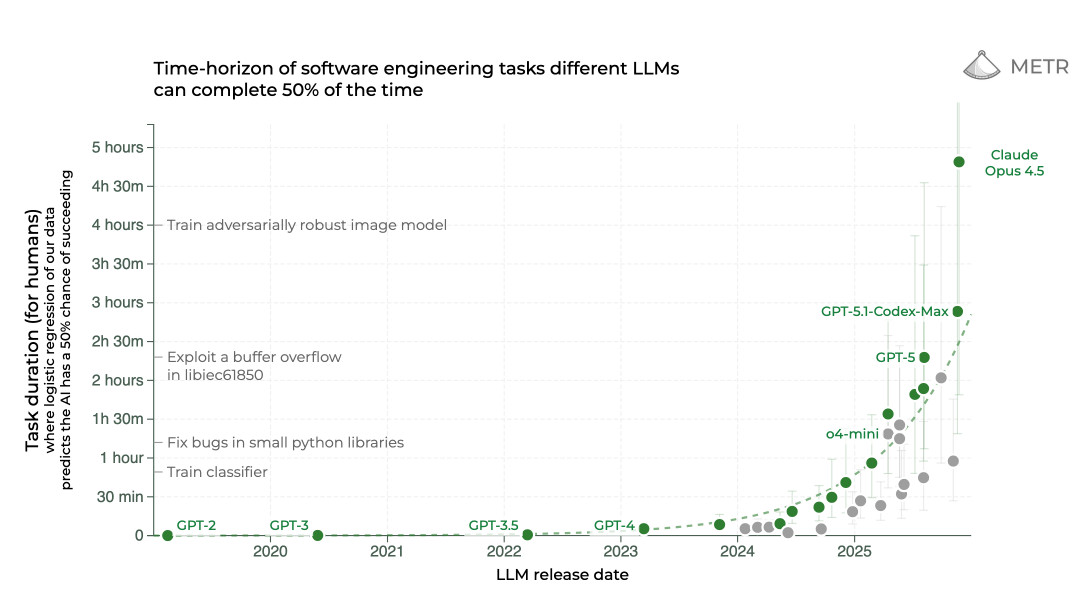
You'll note I don't mention AGI or future model releases in my annual roundup at all. The closest I get to that is expressing doubt that the METR chart will continue at the same rate.
If you focus exclusively on what actually works the LLM space is a whole lot more interesting and less frustrating.
I'm just a casual user, but I've been doing the same and have noticed the sharp improvements of the models we have now vs a year ago. I have OpenAI Business subscription through work, I signed up for Gemini at home after Gemini 3, and I run local models on my GPU.
I just ask them various questions where I know the answer well, or I can easily verify. Rewrite some code, factual stuff etc. I compare and contrast by asking the same question to different models.
AGI? Hell no. Very useful for some things? Hell yes.
Autodefenestrate - To eject or hurl oneself from a window, especially lethally
But most discussion I see is vague and without specificity and without nuance.
Recognising the shortcomings of LLMs makes comments praising LLMs that much more believable; and recognising the benefits of LLMs makes comments criticising LLMs more believable.
I'd completely believe anyone who says they've found the LLM very helpful at greenfield frontend tasks, and I'd believe someone who found the LLM unable to carry out subtle refactors on an old codebase in a language that's not Python or JavaScript.
it isn't irrational to act in self-interest. If LLM threatens someone's livelihood, it matters not that it helps humanity overall one bit - they will oppose it. I don't blame them. But i also hope that they cannot succeed in opposing it.
Eh. I wouldn’t be so quick to speak for the entirety of HN. Several articles related to LLMs easily hit the front page every single day, so clearly there are plenty of HN users upvoting them.
I think you're just reading too much into what is more likely classic HN cynicism and/or fatigue.
When an "AI skeptic" sees a very positive AI comment, they try to argue that it is indeed interesting but nowhere near close to AI/AGI/ASI or whatever the hype at the moment uses.
When an "AI optimistic" sees a very negative AI comment, they try to list all the amazing things they have done that they were convinced was until then impossible.
The most wide-appeal possibility is people loving 100%-AI-slop entertainment like that AI Instagram Reels product. Maybe I'm just too disconnected with normies but I don't see this taking off. Fun as a novelty like those Ring cam vids but I would never spend all day watching AI generated media.
Those are some very rosy glasses you've got on there. The nascent Internet took forever to catch on. It was for weird nerds at universities and it'll never catch on, but here we are.
If "immediate" usefulness is the metric we measure, then the internet and smartphones are pretty insignificant inventions compared to LLM.
(of course it's not a meaningful metric, as there is no clear line between a dumb phone and a smart phone, or a moderately sized language model and a LLM)
Here's a graph of internet takeoff with Krugman's famous quote of 1998 that it wouldn't amount to much being maybe the end of the skepticism https://www.contextualize.ai/mpereira/paul-krugmans-poor-pre...
In common with AI there was probably a long period when the hardware wasn't really good enough for it to be useful to most people. I remember 300 baud modems and rubber things to try to connect to your telephone handset back in the 80s.
Outside the verifiable domains I think the impact is more assistance/augmentation than outright disruption (i.e. a novelty which is still nice). A little tiny bit of value sprinkled over a very large user base but each person deriving little value overall.
Even as they use it as search it is at best an incrementable improvement on what they used to do - not life changing.
I have great faith in AI in e.g. medical equipment, or otherwise as something built in, working on a single problem in the background, but the chat interface is terrible.
Kagi’s Research Assistant is pretty damn useful, particularly when I can have it poll different models. I remember when the first iPhone lacked copy-paste. This feels similar.
(And I don’t think we’re heading towards AGI.)
Even if you skip ARPAnet, you’re forgetting the Gopher days and even if you jump straight to WWW+email==the internet, you’re forgetting the mosaic days.
The applications that became useful to the masses emerged a decade+ after the public internet and even then, it took 2+ decades to reach anything approaching saturation.
Your dismissal is not likely to age well, for similar reasons.
The opposition to AI is from people who feel threatened by it, because it either threatens their livelihood (or family/friends'), and that they feel they are unable to benefit from AI in the same way as they had internet/mobile phones.
I know a lot of "normal" people who have completely replaced their search engine with AI. It's increasingly a staple for people.
Smartphones were absolutely NOT immediately useful in a million different ways for almost every person, that's total revisionist history. I remember when the iPhone came out, it was AT&T only, it did almost nothing useful. Smartphones were a novelty for quite a while.
A year after llms came out… are you kidding me?
Two years?
10 years?
Today, by adding an MCP server to wrap the same API that’s been around forever for some system, makes the users of that system prefer NLI over the gui almost immediately.
LLMs have real limitations that aren't going away any time soon - not until we move to a new technology fundamentally different and separate from them - sharing almost nothing in common. There's a lot of 'progress-washing' going on where people claim that these shortfalls will magically disappear if we throw enough data and compute at it when they clearly will not.
If you inherit 9000 tests from an existing project you can vibe code a replacement on your phone in a holiday, like Simon Willison's JustHTML port. We are moving from agents semi-randomly flailing around to constraint satisfaction.
Search, as of today, is inferior to frontier models as a product. However, best case still misses expected returns by miles which is where the growsing comes from.
Generative art/ai is still up in the air for staying power but id predict it isnt going away.
Lol. It's worse than nothing at all.
So we are just irrational and sour?
lol.... Just make sure you screenshot your post so you have a good reminder in a few years re. your predictive ability.
But generally yes, I think back to Mongo/Node/metaverse/blockchain/IDEs/tablets and pretty much everything has had its boosters and skeptics, this is just more... intense.
Anyway I've decided to believe my own eyes. The crowds say a lot of things. You can try most of it yourself and see what it can and can't do. I make a point to compare notes with competent people who also spent the time trying things. What's interesting is most of their findings are compatible with mine, including for folks who don't work in tech.
Oh, and one thing is for sure: shoving this technology into every single application imaginable is a good way to lose friends and alienate users.
The rest is all noise and personally I just block it out.
The arguments going back and forth in these threads are truly a sight to behold. I don’t want to lean to any one side, but in 2025 I‘ve begun to respond to everyone who still argues that LLMs are only plagiarism machines, or are only better autocompletes, or are only good at remixing the past: Yes, correct!
And CPUs can only move zeros and ones.
This is likewise a very true statement. But look where having 0s and 1s shuffled around has brought us.
The ripple effects of a machine doing something very simple and near-meaningless, but doing it at high speed and again and again without getting tired, cannot be underestimated.
At the same time, here is Nobel Laureate Robert Solow, who famously, and at the time correctly, stated that "You can see the computer age everywhere but in the productivity statistics."
It took a while, but eventually, his statement became false.
The other day there was that dude loudly arguing about some code they wrote/converted even after a woman with significant expertise in the topic pointed out their errors.
Gen AI has its promise. But when you look at the lack of ethics from the industry, the cacophony of voices of non experts screaming "this time it's really doom", and the weariness/wariness that set in during the crypto cycle, it's a natural tendency that people are going to call snake oil.
That said, I think the more accurate representation here is that HN as a whole is calling the hype snake oil. There's very little question anymore about the tools being capable of advanced things. But there is annoyance at proclamations of it being beyond what it really is at the moment which is that it's still at the stage of being an expertise+motivation multiplier for deterministic areas of work. It's not replacing that facet any time soon on its current trend (which could change wildly in 2026). Not until it starts training itself I think. Could be famous last words
It's polarizing because it represents a more radical shift in expected workflows. Seeing that range of opinions doesn't really give me a reason to update, no. I'm evaluating based on what makes sense when I hear it.
1. LLMs can do some truly impressive things, like taking natural language instructions and producing compiling, functional code as output. This experience is what turns some people into cheerleaders.
2. Other engineers see that in real production systems, LLMs lack sufficient background / domain knowledge to effectively iterate. They also still produce output, but it's verbose and essentially missing the point of a desired change.
3. LLMs also can be used by people who are not knowledgeable to "fake it," and produce huge amounts of output that is basically besides-the-point bullshit. This makes those same senior folks very, very resentful, because it wastes a huge amount of their time. This isn't really the fault of the tool, but it's a common way the tool gets used and so it gets tarnished by association.
4. There is a ridiculous amount of complexity in some of these tools and workflows people are trying to invent, some of which is of questionable value. So aside from the tools themselves people are skeptical of the people trying to become thought leaders in this space and the sort of wild hacks they're coming up with.
5. There are real macro questions about whether these tools can be made economical to justify whatever value they do produce, and broader questions about their net impact on society.
6. Last but not least, these tools poke at the edges of "intelligence," the crown jewel of our species and also a big source of status for many people in the engineering community. It's natural that we're a little sensitive about the prospect of anything that might devalue or democratize the concept.
That's my take for what it's worth. It's a complex phenomenon that touches all of these threads, so not only do you see a bunch of different opinions, but the same person might feel bullish about one aspect and bearish about another.
Now we are starting to agree that social media has had disastrous effects that have not fully manifested yet, and in the same breath we accept a piece of technology that promises to replace large parts of society with machines controlled by a few megacorps and we collectively shrug with “eh, we’re gonna be alright.” I mean, until recently the stated goal was to literally recreate advanced super-intelligence with the same nonchalance one releases a new JavaScript framework unto the world.
I find it utterly maddening how divorced STEM people have become from philosophical and ethical concerns of their work. I blame academia and the education system for creating this massive blind spot, and it is most apparent in echo chambers like HN that are mostly composed of Western-educated programmers with a degree in computer science. At least on X you get, among the lunatics, people that have read more than just books on algorithms and startups.
This is not true..
"I find it utterly maddening how divorced STEM people have become from philosophical and ethical concerns of their work. I blame academia and the education system for creating this massive blind spot, and it is most apparent in echo chambers like HN that are mostly composed of Western-educated programmers with a degree in computer science. At least on X you get, among the lunatics, people that have read more than just books on algorithms and startups."
Steve Jobs had something to say about this. Shame hes gone.
Then genAI, It's become more and more difficult to tell which is AI and which is not, and AI is in everywhere. I dont know what to think about it. "If you can't tell, does it matter ?"
as for who made it, utility usually matters more than where it came from. i used an agent for an oss changelog recently and it picked up things i’d forgotten while structuring the narrative better than i could. the intent and code were mine, but the ai acted as a high fidelity compressor. the risk isn't ai being everywhere. it’s the atrophy of judgment where we stop using it to support decisions and start using it to outsource thinking.
I look forward to learning from his blog posts and HN comments in the year ahead, too.
> At the end of every month I send out a much shorter newsletter to anyone who sponsors me for $10 or more on GitHub
One of the difficult things of modernity is that it's easy to confuse what you hear about a lot with what is real.
One of the great things about modernity is that progress continues, whether we know about it or not.
Just yesterday, it helped me parse out and understand a research paper - complete with step-by-step examples (this one: https://research.nvidia.com/sites/default/files/pubs/2016-03...). I will now go ahead and implement it myself, possibly relegating some of the more grunt-work type tasks to Claude code.
Without it, I would have been struggling through the paper for days, wading through WGSL shader code and there would be a high chance that I just give up on it since this is for a side project and not my $job.
It has been a major force multiplier just for learning things. I have had the $20 subscription for about a year now. I bump it up to the $100 plan if I happen to be working on some project that eats through the $20 allocation. This happens to be one such month. I will probably go back to the $20 plan after this month. I continue to get a lot of value out of it.
I like to believe, but MCP is quickly turning into an enterprise thing so I think it will stick around for good.
MCP is a great way for an LLM to connect to an external system in a standardized way and immediately understand what tools it has available, when and how to use them, what their inputs and outputs are,etc.
For example, we built a custom MCP server for our CRM. Now our voice and chat agents that run on elevenlabs infrastructure can connect to our system with one endpoint, understand what actions it can take, and what information it needs to collect from the user to perform those actions.
I guess this could maybe be done with webhooks or an API spec with a well crafted prompt? Or if eleven labs provided an executable environment with tool calling? But at some point you're just reinventing a lot of the functionality you get for free from MCP, and all major LLMs seem to know how to use MCP already.
I don't think MCP is going to go away, but I do think it's unlikely to ever achieve the level of excitement it had in early 2025 again.
If you're not building inside a code execution environment it's a very good option for plugging tools into LLMs, especially across different systems that support the same standard.
But code execution environments are so much more powerful and flexible!
I expect that once we come up with a robust, inexpensive way to run a little Bash environment - I'm still hoping WebAssembly gets us there - there will be much less reason to use MCP even outside of coding agent setups.
Only problem is that they don't see connection between form and function. They may make teapot perfectly but don't understand that this form is supposed to contain liquid.
I push back strongly from this. In the case of the solo, one-machine coder, this is likely the case - if you're exposing workflows or fixed tools to customers / collegues / the web at large via API or similar, then MCP is still the best way to expose it IMO.
Think about a GitHub or Jira MCP server - commandline alone they are sure to make mistakes with REST requests, API schema etc. With MCP the proper known commands are already baked in. Remember always that LLMs will be better with natural language than code.
Create a folder called skills/how-to-use-jira
Add several Bash scripts with the right curl commands to perform specific actions
Add a SKILL.md file with some instructions in how to use those scripts
You've effectively flattened that MCP server into some Markdown and Bash, only the thing you have now is more flexible (the coding agent can adapt those examples to cover new things you hadn't thought to tell it) and much more context-efficient (it only reads the Markdown the first time you ask it to do something with JIRA).
So maybe a hybrid approach would make more sense? Something like /.well-known/skills/README.md exposed and owned by the providers?
That is assuming that the whole idea of "skills" makes sense in practice.
I don't hear much buzz about it from the people I pay attention to. I should still give it a go though.
There's a philosophical angle being missed: do we actually want our coding agents making hundreds of tool calls through someone else's infrastructure? The more capable these systems become, the more intimate access they have to our codebases, credentials, and workflows. Every token of context we send to a frontier model is data we've permanently given up control of.
I've been working on something addressing this directly - LocalGhost.ai (https://www.localghost.ai/manifesto) - hardware designed around the premise that "sovereign AI" isn't just about capability parity but about the principle that your AI should be yours. The manifesto articulates why I think this matters beyond the technical arguments.
Simon mentions his next laptop will have 128GB RAM hoping 2026 models close the gap. I'm betting we'll need purpose-built local inference hardware that treats privacy as a first-class constraint, not an afterthought. The YOLO mode section and "normalization of deviance" concerns only strengthen this case - running agents in insecure ways becomes less terrifying when "insecure" means "my local machine" rather than "the cloud plus whoever's listening."
The capability gap will close. The trust gap won't unless we build for it.
Or targeted prompt injections - like spear phishing attacks - against people with elevated privileges (think root sysadmins) who are known to be using coding agents.
The actual Agent payload would be very small, likely just a few hundred line harness plus system prompt. It's just a question of whether the agent will be skilled enough to find vulnerabilities to propagate. The interesting thing about an AI worm is that it can use different tricks on different hosts as it explores its own environment.
If a pure agent worm isn't capable enough, I could see someone embedding it on top of a more traditional virus. The normal virus would propagate as usual, but it would also run an agent to explore the system for things to extract or attack, and to find easy additional targets on the same internal network.
A main difference here is that the agents have to call out to a big SotA model somewhere. I imagine the first worm will simply use Opus or ChatGPT with an acquired key, and part of it will be trying to identify (or generate) new keys as it spreads.
Ultimately, I think this worm will be shut down by the model vendor, but it will have to have made a big enough splash beforehand to catch their attention and create a team to identify and block keys making certain kinds of requests.
I'd hope OpenAI, Anthropic, etc have a team and process in place already to identify suspicious keys, eg, those used from a huge variety of IPs, but I wouldn't be surprised if this were low on their list of priorities (until something like this hits).
On this including AI agents deleting home folders, I was able to run agents in Firejail by isolating vscode (Most of my agents are vscode based ones, like Kilo Code).
I wrote a little guide on how I did it https://softwareengineeringstandard.com/2025/12/15/ai-agents...
Took a bit of tweaking, vscode crashing a bunch of times with not being able to read its config files, but I got there in the end. Now it can only write to my projects folder. All of my projects are backed up in git.
It has been an amazing year, especially around tooling (search, code analysis, etc.) and surprisingly capable smaller models.
:)
https://chrisfrew.in/blog/two-of-my-favorite-mcp-tools-i-use...
IMO this is the best balance of getting agentic work done while having immediate access to anything else you may need with your development process.
Would you be open to providing more details. Would love to hear more, your workflows, etc.
Planing depends on deterministic view of the future. I used to plan (esp annual plans) until about 5 years. Now I scan for trends and prepare myself for different scenarios that can come in the future. Even if you get it approximately right, you stand apart.
For tech trends, I read Simon, Benedict Evans, Mary Meeker etc. Simon is in a better position make these predictions than anyone else having closely analyzed these trends over the last few years.
Here I wrote about my approach: https://www.jjude.com/shape-the-future/
With most other knowledge work, I don't think that is the case. Maybe actuarial or accounting work, but most knowledge work exists at a cross section of function and taste, and the latter isn't an automatically verifiable output.
Any data, verifiability, rules of thumb, tests, etc are being kept secret. You pay for the result, but don't know the means.
I have to think 3 years from now we will be having the same conversation about robots doing real physical labor.
"This is the worst they will ever be" feels more apt.
With knowledge work being less high-paying, physical labour supply should increase as well, which drops their price. This means it's actually less likely that the advent of LLM will make physical labour more automated.
We can now use natural language to instruct computers generate stock photos and illustrations that would take a professional artist a few years ago, discover new molecule shapes, beat the best Go players, build the code for entire applications, or write documents of various shapes and lengths—but painting a wall? An unsurmountable task that requires a human to execute reliably, not even talking about economics.
Software, by its nature, is practically comprehensively digitized, both in its code history as well as requirements.
You can describe that somewhat formally as:
{What your computer can do} intersect {What you want done (consciously or otherwise)}
Well a computer can technically calculate any computuable task that fits in bounded memory, that is an enormous set so its real limitations are its interfaces. In which case it can send packets, make noises, and display images.
How many human desires are things that can be solved with making noises, displaying images, and sending packets? Turns out quite a few but its not everything.
Basically I'm saying we should hope more sorts of physical interfaces come around (like VR and Robotics) so we cover more human desires. Robotics is a really general physical interface (like how ip packets are an extremely general interface) so its pretty promising if it pans out.
Personally, I find it very hard to even articulate what desires I have. I have this feeling that I might be substantially happier if I was just sitting around a campfire eating food and chatting with people instead of enjoying whatever infinite stuff a super intelligent computer and robots could do for me. At least some of the time.
The ability to accurately describe what you want with all constraints managed and with proactive design is the actual skill. Not programming. The day PMs can do that and have LLMs that can code to that, is the day software engineers en masse will disappear. But that day is likely never.
The non-technical people I've ever worked for were hopelessly terrible at attention to detail. They're hiring me primarily for that anyway.
I'm not too worried about my job just yet.
...and the best of them all, OpenCode[1] :)
[1]: https://opencode.ai
I don't see a similar option for ChatGPT Pro. Here's a closed issue: https://github.com/sst/opencode/issues/704
And no it is not AI slop and we don't vibe code. There are a lot of practical aspects of running software and maintaining / improving code that can be done well with AI if you have the right setup. It is hard to formulate what "right" looks like at this stage as we are still iterating on this as well.
However, in our own experiments we can clearly see dramatic increases in automation. I mean we have agents working overnight as we sleep and this is not even pushing the limits. We are now wrapping major changes that will allows us to run AI agents all the time as long as we can afford them.
I can even see most of these materialising in Q1 2026.
Fun times.
Not everything gets accepted. There is a lot of work that is discarded and much more pending verification and acceptance.
Frankly, and I hope I don’t come as alarmist (judge for yourself from my previous comments on Hn and Reddit) we cannot keep up with the output! And a lot of it is actually good and we should incorporate it even partially.
At the moment we are figuring out how to make things more autonomous while we have the safety and guardrails in place.
The biggest issue I see at this stage is how to make sense of it all as I do not believe we have the understanding of what is happening - just the general notion of it.
I truly believe that we will reach the point where ideas matter more than execution, which what I would expect to be the case with more advanced and better applied AI.
I posted about my failures to try to get them to review my bank statements [0] and generally got gaslit about how I was doing it wrong, that I if trust them to give them full access to my disk and terminal, they could do it better.
But I mean, at that point, it's still more "manual intelligence" than just telling someone what I want. A human could easily understand it, but AI still takes a lot of wrangling and you still need to think from the "AI's PoV" to get the good results.
[0] https://news.ycombinator.com/item?id=46374935
----
But enough whining. I want AI to get better so I can be lazier. After trying them for a while, one feature that I think all natural-language As need to have, would be the ability to mark certain sentences as "Do what I say" (aka Monkey's Paw) and "Do what I mean", like how you wrap phrases in quotes on Google etc to indicate a verbatim search.
So for example I could say "[[I was in Japan from the 5th to 10th]], identify foreign currency transactions on my statement with "POS" etc in the description" then the part in the [[]] (or whatever other marker) would be literal, exactly as written, but the rest of the text would be up to the AI's interpretation/inference so it would also search for ATM withdrawals etc.
Ideally, eventually we should be able to have multiple different AI "personas" akin to different members of household staff: your "chef" would know about your dietary preferences, your "maid" would operate your Roomba, take care of your laundry, your "accountant" would do accounty stuff.. and each of them would only learn about that specific domain of your life: the chef would pick up the times when you get hungry, but it won't know about your finances, and so on. The current "Projects" paradigm is not quite that yet.
left satisfied, lol
while LLM-generated text was already a thing of the past couple years, this year images and videos had the "AI or not" moment. it appears to have a bigger impact than our myopic world of software. another trend towards the end of the year was around "vibe training" of new (albeit much smaller) AI models.
personally, getting up and running with a project has been easier than ever, but unlike OP, i don't share the same excitement to make anymore. perhaps vibe coding with a phone will get more streamlined with a killer app in 2026.
The actual, notable progress will be models that can run reasonably well on commodity, everyday hardware that the average user has. From more accessibility will come greater usefulness. Right now the way I see it, having to upgrade specs on a machine to run local models keeps it in a niche hobbyist bubble.
AI slop videos will no doubt get longer and "more realistic" in 2026.
I really hope social media companies plaster a prominent banner over them which screams, "Likely/Made by AI" and give us the option to automatically mute these videos from our timeline. That would be the responsible thing to do. But I can't see Alphabet doing that on YT, xAI doing that on X or Meta doing that on FB/Insta as they all have skin in the video gen game.
They should just be deleted. They will not be, because they clearly generate ad revenue.
Not going to happen as the social media companies realise they can sell you the AI tools used to post slop back onto the platform.
If you don't make software developers prove their literacy you will get burned.
Will 2026 fare better?
The big labs are (mostly) investing a lot of resources into reducing the chance their models will trigger self-harm and AI psychosis and suchlike. See the GPT-4o retirement (and resulting backlash) for an example of that.
But the number of users is exploding too. If they make things 5x less likely to happen but sign up 10x more people it won't be good on that front.
Same thing with “psychosis”, which is a manufactured moral panic crisis.
If the AI companies really wanted to reduce actual self harm and psychosis, maybe they’d stop prioritizing features that lead to mass unemployment for certain professions. One of the guys in the NYT article for AI psychosis had a successful career before the economy went to shit. The LLM didn’t create those conditions, bad policies did.
It’s time to stop parroting slurs like that.
By telling paranoid schizophrenics that their mother is secretly plotting against them and telling suicidal teenagers that they shouldn’t discuss their plans with their parents. That behavior from a human being would likely result in jail time.
But that one doesn't make headlines ;)
What I find interesting with chat bots is that they're "web apps" so to speak, but with safety engineering aspects that type of developer is typically not exposed to or familiar with.
not AI’s highlights.
Easy with the hot take.
That’s what most non-tech-person’s year in LLMs looked like.
Hopefully 2026 will be the year where companies realize that implementing intrusive chatbots can’t make better ::waving hands:: ya know… UX or whatever.
For some reason, they think its helpful to distractingly pop up chat windows on their site because their customers need textual kindergarten handholding to … I don’t know… find the ideal pocket comb for their unique pocket/hair situation, or had an unlikely question about that aerosol pan release spray that a chatbot could actually answer. Well, my dog also thinks she’s helping me by attacking the vacuum when I’m trying to clean. Both ideas are equally valid.
And spending a bazillion dollars implementing it doesn’t mean your customers won’t hate it. And forcing your customers into pathways they hate because of your sunk costs mindset means it will never stop costing you more money than it makes.
I just hope companies start being honest with themselves about whether or not these things are good, bad, or absolutely abysmal for the customer experience and cut their losses when it makes sense.
do not acknowledge that everyone in the world thinks this shit is a complete and total garbage fire
Companies have been doing this "live support" nonsense far longer than LLMs have been popular.
I’m on LinkedIn Learning digging into something really technical and practical and it’s constantly pushing the chat fly out with useless pre-populated prompts like “what are the main takeaways from this video.” And they moved their main page search to a little icon on the title bar and sneakily now what used to be the obvious, primary central search field for years sends a prompt to their fucking chatbot.
That's the pure, uncut copium. Meanwhile, in the real world, search on major platforms is so slanted towards slop that people need to specify that they want actual human music:
https://old.reddit.com/r/MusicRecommendations/comments/1pq4f...
Add to this that all the hardware is already old and the amount of waste we’re producing right now is mind boggling, and for what, fun tools for the use of one?
I don’t live in the US, but the amount of tax money being siphoned to a few tech bros should have heads rolling and I really don’t want to see it happening in Europe.
But I guess we got a new version number on a few models and some blown up benchmarks so that’s good, oh and of course the svg images we will never use for anything.
I literally said:
"AI data centers continue to burn vast amounts of energy and the arms race to build them continues to accelerate in a way that feels unsustainable."
AND I linked to my coverage from last year, which is still true today (hence why I felt no need to update it): https://simonwillison.net/2024/Dec/31/llms-in-2024/#the-envi...
Or should we just keep chugging along as though there is no problem at all?
I also think we should use tax policy to provide financial incentives to reduce the environmental impact - tax breaks for renewables, tax hikes for fossil fuel powered data centers, that kind of thing.
2025: The Year in Open Source? Nothing, all resources were tied up to debunk a couple of Python web developers who pose as the ultimate experts in LLMs.
I made you a dashboard of my 2025 writing about open-source that didn't include AI: https://simonwillison.net/dashboard/posts-with-tags-in-a-yea...
Nvidia, Samsung, SK Hynix and some other voltures I forgot to mention are making serious bank right now.
Keep questions like this off of the propaganda thread.
I have a project to convert my multiplayer XNA game from C# to Javascript and to add networking to the game-play using LLMs.
They are far worse at it now than they were a year ago. They actually implemented the requirements (Though inaccurately) to the best of their ability a year ago. Especially Gemini.
Now they don't even come remotely close to implementing just the basic requirements.
The thing is, I'm giving them the entirety of the C# source code and spelling out what they should do.
How are you running them - regular chat interface or do you have them setup with Claude Code or Gemini CLI?
I am considering making a thread where I compel others to attempt to get what I'm trying to get out of it and show me their work.
The game is only around 25000-30000 LOC in C#.
This is the part they REALLY don't want you to say.
They can no longer train these models effectively and their performance is slipping. Late 2023 was the golden age.