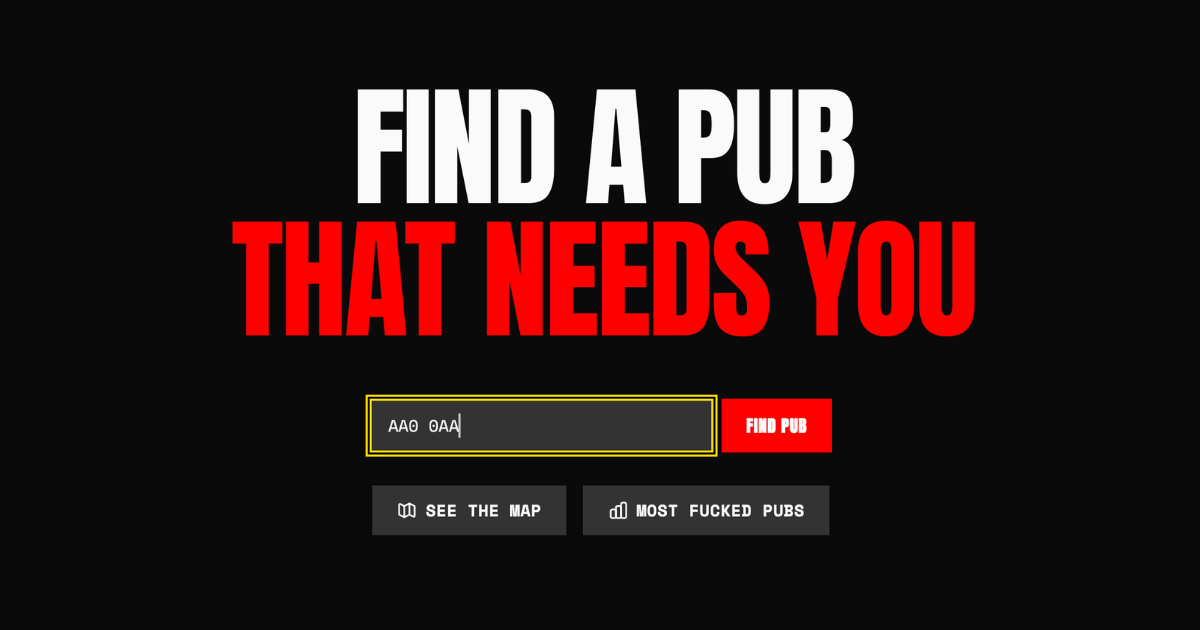
Is My Pub Fucked?
Pubs are under pressure from rising costs, taxes, and business rates. Find out how your local is affected and show up for them.
Is My Pub Fucked?
367 points · by thinkingemote · 10mo ago · 353 comments
For anyone not in the know, UK postcodes are made up of two parts: a general area (the outward code) and then a more specific one (the inward code.) Generally speaking a postcode + house number will be good enough to get a letter delivered to the right place, though the sorting office might not be too happy with you...
The format [0] is roughly: AB12 3CD, though the number of letters/numbers on the left side can vary a bit. As far as I know the second set of numbers is always 1 digit though, so that's how you can easily split the two sides of it to format it nicely. There's a couple of special ones that break the rules though.
[0] https://en.wikipedia.org/wiki/Postcodes_in_the_United_Kingdo...
A full postcode is often much less than a single street.
Picking something at random stick “SW15 6DZ” into Google maps and you’ll see it only covers 6 buildings (most are individual houses but some are split into flats). According to the Royal Mail address finder site there are only 12 unique delivery addresses that share that postcode. The Western half of that road has 12 or so full postcodes for only 100 houses.
A full postcode and one other bit of information can often be enough to uniquely identify someone.
If a US 5 digit zipcode is roughly equivalent to the “general area” part of a UK postcode (94107 <=> SW15) then the full UK postcode is like the 9 digit US Zip+4 format where the extra 4 digits narrow location down to a block, part of a block or even a specific building.
Details: election time. He went to the election folks and asked for his election papers. They said "sure, where do you live?" he said "the Bender, Eastville Park, Bristol", they said "that's not a valid address", he said "that's where I live, so that's where I'd like my registration to be, please". There was some back and forth. They caved, and duly entered his address on the electoral roll as such. Then he went to the Post Office and said "this is my address, as entered on the electoral roll, can I have my postcode please?". The Post Office kinda had no option, since this was now his official address. So they gave him a postcode and the postie had to walk through the park to drop off his mail.
There is guy living off grid in I believe Dorset on YouTube called "Maximus Ironthumper". The post office told him to try sending himself letters, eventually they started turning up. Then that became the address.
He has a whole series of videos about how he kinda managed to setup his off grid living situation, there is everything from how to avoid planning permission, to how he setup his solar power.
My business has its own unique postcode and so does next door! Between us we cover roughly three acres. Our place is one building with parking and a fair bit of greenery.
To be fair it's a 6-bedroom wing, but still a fun fact.
Each postcode would then have an optimum delivery route often devised by the postie's themselves.
A US Zip+4 usually identifies a specific delivery point. In some places this can mean it can even identify specific units within a building.
Presumably it helps a lot with validating the address is correct, kinda like a checksum, and also probably helps with how deliveries are organised by the local office before the postie is sent out with them all.
Now asking An Post to overhaul their system to work on postcodes only is a bit like asking a postal service which requires postcodes to make them optional. It's technically possible, sure, but they're not going to want to spend the money.
_That said_, An Post's last resort routing department is pretty famous for getting the right address from pretty fragmentary information like "Mary down by the church, formerly of Kilnowhere", so I'm sure if a letter with just a eircode arrived there they'd sort it, but I imagine that An Post don't want to encourage people doing things that increases load on the labour intensive sorting.
Often a single block of flats. Rurally perhaps even just a single residence?
https://en.wikipedia.org/wiki/SW_postcode_area
SW2 to SW9 are in alphabetical order: Brixton, Chelsea, Clapham, Earls Court, Fulham, South Ken, South Lambeth, Stockwell.
But then it starts again and you have to squint a bit for SW10-SW20: Brompton, Battersea, Balham, Barnes, Mortlake, Putney, Streatham, Tooting, Wandsworth, Wimbledon, West Wimbledon.
Looking at a few others (SE, etc) I see that the first chunk of them are in alphabetical order, but then they've added some extra ones later that break the ordering (e.g. SE19 onwards) but they have tried to add the extra ones in mostly alphabetical order too.
I’ve lived somewhere in SW18/SW15/SW19 for the last 30 years. Having not grown up in London I can’t imagine living anywhere else. Apparently many other bits of London (North, East, central, etc) are good too but I’m not ready for change.
It seems like the taxes only go up while the services get worse in the UK, although I’ve been away for 5 years now so maybe things improved.
Rateable value is based on what the market prices would be to rent that space. So, somebody is doing nicely apparently.
It doesn't benefit a town if rent is so expensive that their businesses shut down.
This could all simply be due to a devaluation of the currency, rather than due to increased desirability or productivity.
https://www.ismypubfucked.com/pub/11447801200
> the Inklings, a literary group including J. R. R. Tolkien and C. S. Lewis, started meeting at The Lamb and Flag.
It in fact closed temporarily in the pandemic due to UK law preventing their then owner / operator, St John’s College, a charity, subsidising a loss making business, despite having the wherewithal to do so.
https://www.bbc.com/news/uk-england-oxfordshire-55763746.amp
Same in the Netherlands
Overall the tax burden in the UK is middling for western democracies. It's actually on the low side for low earners - which is probably a problem because the distribution is such that the majority pay very little.
The other problem being cliff edges and complexities which distinctive chasing pay rises and working more for a lot of people.
There’s time for some party to sort themselves out before the next election is due (Aug 2029).
https://www.mirror.co.uk/money/personal-finance/finance-expe... shows how little pubs make per pint, very sad.
If anyone's curious about cask beer https://www.youtube.com/watch?v=_ud_eTwY4nc&list=PLyDTS7ZG3z... is a very interesting youtube video series by The Craft Beer Channel.
I knew java was good for something
What are the margins on a Codeacola?
You could buy a bottle of Teachers and serve yourself 25ml for 70p. You could buy a bottle of 30-year aged Macallan matured in sherry oak, and serve yourself 25ml for £160.
In a pub, you should be able to get a shot of blended whisky for about £4-6, and mass-market single malts (the kind you also find in supermarkets) for about £5-£10.
If you don't ask for a specific whisky, they should ask you which one you want, and/or say "is name alright?" and give you one of the cheap ones.
WTF.
The business is no longer viable, planning constraints (and often listed building constraints, which is protection for historical buildings, many pubs are very old) won't let them do anything else with the building so they sit empty until they spontaneously combust. Soon after they get demolished and regrow as a supermarket or apartments.
More profitable to convert the pub into a house and sell it that to actually run a pub.
_Not_ doing repairs and upkeep is free.
Arson is very difficult to prove.
So the listing process preserves a building exactly as it is, sometimes for decades past its usefulness, until it collapses or burns down.
Neither American nor from the UK, but I knew what this was about because it's possible to go online and seek out information. Neat.
What I didn't do was become some entitled see you next tuesday and complain that a .com should be reserved for the american audience and the site should use a .co.uk – As if american businesses don't utilise foreign TLDs to create cutesy URLs. Maybe now is a good time to note that the fashionable .AI TLD belongs to Anguilla, a British territory.
It's just basic communications skills, and honestly decency, to describe what a thing is and who it's for.
Maybe someone who isn't the target audience still wants to learn about the thing? Which this site provides no way of doing. That's the problem. Why choose to be inaccessible like that, when it's so easy to add a couple of works and links?
> or poke around out of curiosity
You mean like by following links that are supplied? Because that's my complaint: there are no links.
It's not until I get to checkout I realise they do not ship to my country or want to deal with me.
When I read stories I feel I can pick out US and UK instantly:
> Everyone is freaking out about ... - American
> ... has been Sacked from - British
> They negotiated a total sum of ... - British
> The ... is totally insane - American
Maybe it screams "not American", but the rest of the Commonwealth does exist, you know. Some of us are standing right here.
That's not true though, is it?
https://www.bbc.co.uk/news/articles/c8e57dexly1o
> In her November Budget, Chancellor Rachel Reeves scaled back business rate discounts that have been in force since the pandemic from 75% to 40% - and announced that there would be no discount at all from April. That, combined with big upward adjustments to rateable values of pub premises, left landlords with the prospect of much higher rates bills.
https://en.wikipedia.org/wiki/Business_rates_in_England
> Properties are assessed in a rating list with a rateable value, a valuation of their annual rental value on a fixed valuation date using assumptions fixed by statute. Rating lists are created and maintained by the Valuation Office Agency, a UK government executive agency.
You pay a percentage of the hypothetical rent as tax. There is a lower rate if you're a small business, and there are also tax reliefs for various reasons (charity, partial building occupation, etc.)
But pubs have been in trouble for quite some time: https://www.morningadvertiser.co.uk/Article/2025/05/27/numbe...
Pubs have high costs, small margins and customers are extremely price-sensitive. What pubs are generally asking for is more types of relief, because what we tend to see is pubs close, people in the area become more isolated, and the building remains empty for years thereafter. [] Pubs appreciated the post-COVID relief, but tax rates are about to shoot up.
[
] fun fact: if the building is vacant, its landlord must pay rates as if it's 100% occupied. Hence this brazen scheme where a man puts a snail farm in every room so you can pay the rates of an agricultural enterprise: https://www.theguardian.com/news/ng-interactive/2025/dec/04/...Many deaths were postponed because their taxes were reduced due to Covid. Those taxes are now returning to normal levels. This will result in a glut of deaths, as pubs that were just hanging on go under.
The policy question is, basically, do we want to subsidize pubs because they're part of our national culture, even though we don't use them nearly as much as we used to?
But pubs are a weird place to draw the line.
Without this more pubs could exist. So I don’t think it’s a case of subsidising as much as removing the disincentive.
Reducing taxes are not subsidizes. Subsidizes are when the government gives tax money to a business, not when they take a little less from a business.
People might think it's the same equation, but the difference in reality is enormous for the economy.
That, combined with big upward adjustments to rateable values of pub premises, left landlords with the prospect of much higher rates bills.
2023 Rateable Value £13,800
2026 Rateable Value £12,250
Change -£3,300(-23.9%)
I guess "no" would be the answer then.
Nearest town has 3 pubs where rates are going down significantly and 4 where they're going up. I wonder why, is it that the previous setup was unfair to those who are seeing their rates going down?
The pub I do go to each week is seeing rates going up +£3,300. That's not as big an impact from yet another inflation busting minimum wage increase.
However the much bigger concern is that people will be scared to drive there. Currently you can drive there, have a pint, and then go home, and be confident you're not triggering the limit. They're reducing this limit, which means no more trip to the pub.
I'm sure it's fine in big cities where people live in walking distance.
Pubs as social gathering places are critical to exist and keep alive.
Drinking neurotoxins that have a lot of destruction and damage, maybe not so much.
In the UK pubs are extremely different as well than the US. This site is for the UK, since it's asking for a postal code, among other signs. The UK also I believe has last call at 11 PM, which helps fuel the binge drinking before 11 PM and the wild public afterwards. In North America, last call for alcohol can be 1-3 AM, and people generally aren't in a rush to fuel up to blast off.
Most pubs now have much longer hours (some even 24/7) although they choose their opening hours based on how busy they are or think they will be. The local councils will take into account local considerations and limit individual pubs as they see fit.
Decades of hooliganism (mostly a thing of the past thankfully) has meant that you can't be in possession of alcohol within view of the pitch in the top 5 tiers in the UK. (And by the 5th tier you're looking at matches that have attendances anywhere down to 400 or so, although some clubs in the 5th tier still manage to attract 10000 fans to home games).
This spills out into the local community around stadiums too. Many pubs really close to the ground will have extra restrictions on matchdays, that's probably what you've experienced. But that's not just the UK, I remember going to a River Plate game in Buenos Aires 20 years ago and being amazed that on match days there was no alcohol served within a mile of the stadium or some such rule.
I've been to Champions League games in the UK sponsored by a variety of alcoholic drink companies and they weren't serving alcohol anywhere in the stadium (well, I guess they still do in the hospitality sections).
Even when the stadiums do serve alcohol they do strange things like stopping serving as the second half kicks off. As someone who wants to watch all of the football I've paid to go see it's a very odd thing getting a pint at half time and drinking it in under 10 minutes in order to be back to the stands in time for the second half to kick off. Us Brits just accept it and deal with it.
Compare that to watching rugby or cricket in the UK where you have no fan segregation and alcohol allowed at the seats.
It's also much more relaxed at the lower tiers of UK football. I've watched a few Dulwich Hamlet games with a friend and they allow to bring your own beers in (may have changed, haven't been for a few years), and sometimes have a "pay what you want" admission price.
Wherever I go in the UK I try and keep a look out for a local game, even if the football is terrible the people watching is often amazing and worth the admission price alone.
Hopefully they were able to see the negative effect, realise the mistake and reverse the decision.
But it's always busy even out of season, and absolutely heaving on match days. I'd be surprised if a single match day's profits weren't sufficient to cover the additional tax for the year.
Personally, I'll continue to offer my enthusiastic support to my much smaller, friendlier local even though it's facing only a tiny tax increase by comparison.
  Somehow Fine
  Feeling It
  Struggling
  Fucked
Absolutely FuckedWhen ordered by RV£ there are 43703 entries with data. Most negative RV£ change is -£137,500 for 33 Main Road
When ordered by RV% there are 43303 entries with data. Most negative RV% change is -87.0% for PAVILLION HOTEL
The third is listed under an old name, it changed hands and changed names years ago.
it is rated: "The (FPI) score of 22 means this pub is classified as “Feeling It”"
I wonder if there's an equivalent use case in the US.
If they had made this a .co.uk rather than a .com, there would be no confusion.
*Editting with a point: Perhaps everyone assumes a local audience.
Scotland, Northern Ireland & the rest of the world play by different rules.
Fighty customers, crap beer, odd opening hours, and half their food menu is off ("sorry mate, we've got no cheese"). Oh, and now their credit card terminal prompts customers for a tip!
I love a good pub, but most are crap.
I guess prepare for an acceleration of the same.
> Based on VOA data (Nov 2025) which is often inaccurate. Many pubs have also closed since then.
Sooooo yes happy with pubs closures.
Pubs are often the centre of a community, especially small ones. Not even small towns. Traditionally they have been centered around drinking, but this is changing. Much like libraries had to adapt to falling reading rates, pubs have had to adapt to falling alcohol consumption.
The hard part of this is that food and wage costs are often covered by alcohol costs, though where I'm from the government has exercised vice taxes to make this less tenable. More customers doesn't necessarily mean that much more profit, for a host of reasons.
I hope pubs find a way forward.
Source for my rambling: worked in and managed pubs for a decade. They're not just for heavy drinkers.
We need better social spaces which do not have the token cost of drinks to use.
(Yes I tried disabling all the dark settings, no difference)
Lots of Pubs in the UK are closing down in recent years. Pubs have traditionally been a big part of socialising in the UK. I don't drink anymore so I don't bother unless I am having a pub lunch on a Friday.
I know a lot of bars in my area also are places to play board games nowadays.
Being a .com as opposed to a .co.uk, you can't even tell from the domain.
There is a reason the prime meridian goes through Greenwich and it isn’t because we asked nicely.
Sometimes you need moments like this to remind you that your assumption is wrong
Give it a few months.
If you use a .com for something that is specific to a country/region that is not the US, the onus is on you to clarify. That's the problem here. If you're not going to make it ".uk", then you should be making that obvious on the homepage.
If you are from the US, the only nation who doesn't frequently use a national TLD, the onus is on you to judge if a site is commercial, US-specific, global, or something else entirely.
People outside the USA, i.e. the majority of the world, often experience the opposite to what you've described: the tiresome implicit assumption that everything on the internet is US-related by default. It's not.
The only big red letters are "THAT NEEDS YOU".
I do not drink. I am half Irish and half German.
Drinking is a _very_ weird cultural artifact from our past. It doesn't improve your life, it has been scientifically proven to not 'help you relax', and there may in fact be no safe amount of alcohol to drink; all the pop-sci headlines that say 'one glass of wine a week may improve your health' are really about studies that put the safe max at one glass per week.
From what I can tell, the UK is no longer subsidizing what is effectively a criminal enterprise that is centuries old.
Alcohol consumption follows a nasty curve. The average adult in the UK drinks about 11 liters of pure alcohol per year on average. Which is obviously a lot. But what's worse is, almost no one drinks 11 liters. The median is much lower, exactly how low is hard to find numbers on but as much as 1 in 5 Brits don't drink at all.
That means most of the alcohol is consumed by people who drink way too much by any sane definition.
If you own a pub, or an "off license", or arrange a music festival or pretty much any cultural venue, you know that in your bones. Staying afloat without selling alcohol, in particular without selling alcohol to people who drink far more than they should, is hopeless. You can't change things on your own. And even suggesting we should maybe work together to change will alienate your most profitable customers, who are understandably defensive about their drinking.
No, it's not a criminal enterprise, by definition. But you'll do better if you have a criminal's attitude - pick one: denial (consuming a lot yourself may help), rationalization ("if I didn't do it someone else would") or callousness. That's one reason pub chains do better.
None of them have ever explained why alcohol, or any drug use, needs to be part of third spaces.
Society is losing third spaces, largely due to unchecked capitalism eroding the society it serves... but 'pubs' are just another form of rent-seeking by landlords. It has been proven without a doubt that third spaces as a commercial venture is ultimately non-functional, yet that is what pubs and bars have always been, and now they are dying out.
Third places need to have some kind of draw, else nobody will show up. "If you build it, they will come" is for the movies. In the real world you need to have a compelling reason to have others come in your door. Space alone is not sufficient to establish a third space.
That draw doesn't necessarily have to be alcohol (or another drug), but it was the thing that many people used to want. Threatening use of a third space by fear of the wrath of a mighty deity only buys you one day out of the week, I'm afraid.
You're quite right that people no longer want alcohol like they used to. Why nurse a hangover when you can get the same dopamine rush scrolling through TikTok at home from the comfort of your couch? This means that many third spaces of yesteryear no longer serve a purpose, and as you call out, have closed as a result.
Which is all well and good, I guess, but some segment of the population still wish that there were third spaces for them to exist in. Trouble is that they've never been able to find anything as compelling as alcohol used to be across large swaths of the population, making a different kind of third space of the same scale a complete no-go. Trying to salvage the remaining alcohol-centric third places is the only path they can see to try and relive that glory.
Of course there are plenty of alcohol-free (or at least not alcohol focused) third spaces that revolve around niche interests, but these are generally not seen as a good fit for those who don't have that particular niche interest. Alcohol was historically so successful as the foundation for a third space because, once upon a time, nearly everyone was interested in it, bringing everyone in the door.
Commercial pubs have existed for hundreds of year. But drinking doesn’t have to be commercial. In Berlin where I live there’s a non-profit hacker space that has a bar with at-cost drinks. It’s also perfectly legal to buy a beer and sit in the park. And of course, nothing is better than having friends over for a wine tasting.
--------
Distilling what I remember about an entire book I read a couple years ago into a HN comment is difficult, but one of the more salient notes from it is this: Adult humans are naturally suspicious of others and slow to trust, particularly those they have no existing points of connection to. In contrast - children have much lower inhibitions in this sense and are much better at this.
Alcohol, in moderation, is one of the most effective tools in humanity's arsenal to more easily socialize with and create trust with total strangers.
The "reduction of inhibitions" we are all aware of in terms of being a risk of making negative choices, also serves to greatly reduce inhibition of the average adult to new interactions and experiences.
It is difficult to achieve this result in adults otherwise, especially in terms of a single activity with low investment required in time, money, facilities, and commitment.
--------
It is likely that as we transitioned from a society where adult encounters with total strangers were rare (tribal/village) to common (urban) that alcohol played a pretty significant role in creating the social cohesion for it.
It is not at all clear that we have found some successful alternative to this, and we may well find that even with all the documented downsides of it, we're worse off as a society for moving away from it.
-----
Again, this is my recollection of a book I read a couple years back - don't take this word for word. I will also note that it's not all rosy and has some thoughts on the types of consumption we should probably discourage as well and the general risk/reward of alcohol in society.
However, I am, as I said, an American, but also a Millennial. For many Millennials, drinking isn't a social activity, it is a form of quiet shame. We saw our parents and aunts and uncles and grandparents destroy their lives because of alcoholism, we lost friends and family because of being victims of drunk drivers, we saw people die of complications of a lifetime of drinking.
A lot of us simply chose not to repeat those mistakes as those mistakes effect the people around us in grave ways.
If anything, drinking is an anti-social activity, even if you do it entirely socially.
I just don't see the point in keeping it around.
So 'you do you' and continue not drinking, no need to preach your life choices. I'm also 'millenial' , I enjoy many alcoholic drinks both socially and because they go with my meal or simply are something not hot/dairy/sweet and other than water.
> [Millennials] saw our parents and aunts and uncles and grandparents destroy their lives because of alcoholism, we lost friends and family because of being victims of drunk drivers, we saw people die of complications of a lifetime of drinking.
Why do you think alcoholism - which is certain distinct from drinking - was new with the generation above 'millenials'?
Pubs won't question you if you ask for a lime and soda and they may even stop serving you if they think you've drunk enough.
Whilst this is definitely not what's it's like, this quaint video is all about the lineage of the pub in the UK, and explains the third-spaceness of them, which I'd argue still exists[1].
Pubs are so important for our communities in the UK, whether that's watching the game, seeing a friend's band, celebrating a birthday or just catching up after work.
Many of the parts of my life have been lived in a pub. If it's criminal, I'd happily be locked up. Or maybe lock me in, a sadly rarer occurrence these days.
If someone opened a social space with maybe a kitchen that let you pay by the hour to hang out, credit for kitchen orders. All the other bar/pub accoutrements gaming (darts, pool, shuffleboard, pinball, whatnot), sports on the tv, whatever .. I still don't think people will go for it.
I think the only non-boozy option that comes to mind is the small town diner but those are thin on the ground.
how so? I go to a climbing gym and it is a pretty social (and, of course, healthy) activity... crossfit is not my thing but apparently it is similar for more traditional workouts. to the extent you can consider a cycling or running club a "space" those are similar. dog parks for dog owners, playgrounds for parents, etc...
You thus aren’t “half Irish or “half German”. Stop with your cultural appropriation.
Unfortunately I haven't found any place that cracks that problem in america, especially into the later hours. There isn't really a place for people to hang out and socialize without it being a boozy bar. As someone who doesn't really enjoy drinking I don't even really want to go to boardgame/chess/trivia nights at bars because I feel like I'm freeloading. ( I imagine any given bar patron is having 1-3 drinks per hour and potentially ordering some food if that is an option. I might order some food and have a soda...)
I assume part of the problem being that alcohol has the helpful side effect of greasing the wheels socially. Coffee houses that are open late are generally library like affairs, a lot of people sitting around on laptops or with books, any attempt to start a more social night is, in my experience, refused because of this.
But again, now I know it's talking about that kind of pub, what is the actual issue? Some sort of rate being added to something? What rate? Is this related to a rating system? Taxes? Is it affecting the consumer? The owner?
So confused.
It's been in the news quite a bit over the years since the pandemic.
Not every site has to provide an ELI5.
For a generic ".com" domain that isn't American, it's generally a good idea to yes, have a kind of minimal hint that tells you at least which country it's about, and at least a single link you can follow to get the broader context.
I'm following a link to it on HN. When I get there, I have zero context. Visitors to your site can come from anywhere, so it's generally considered a good idea to provide basic context.
Maybe even a Union Jack in the corner as a background image, or something.