Neel Somani (@neelsomani) on X
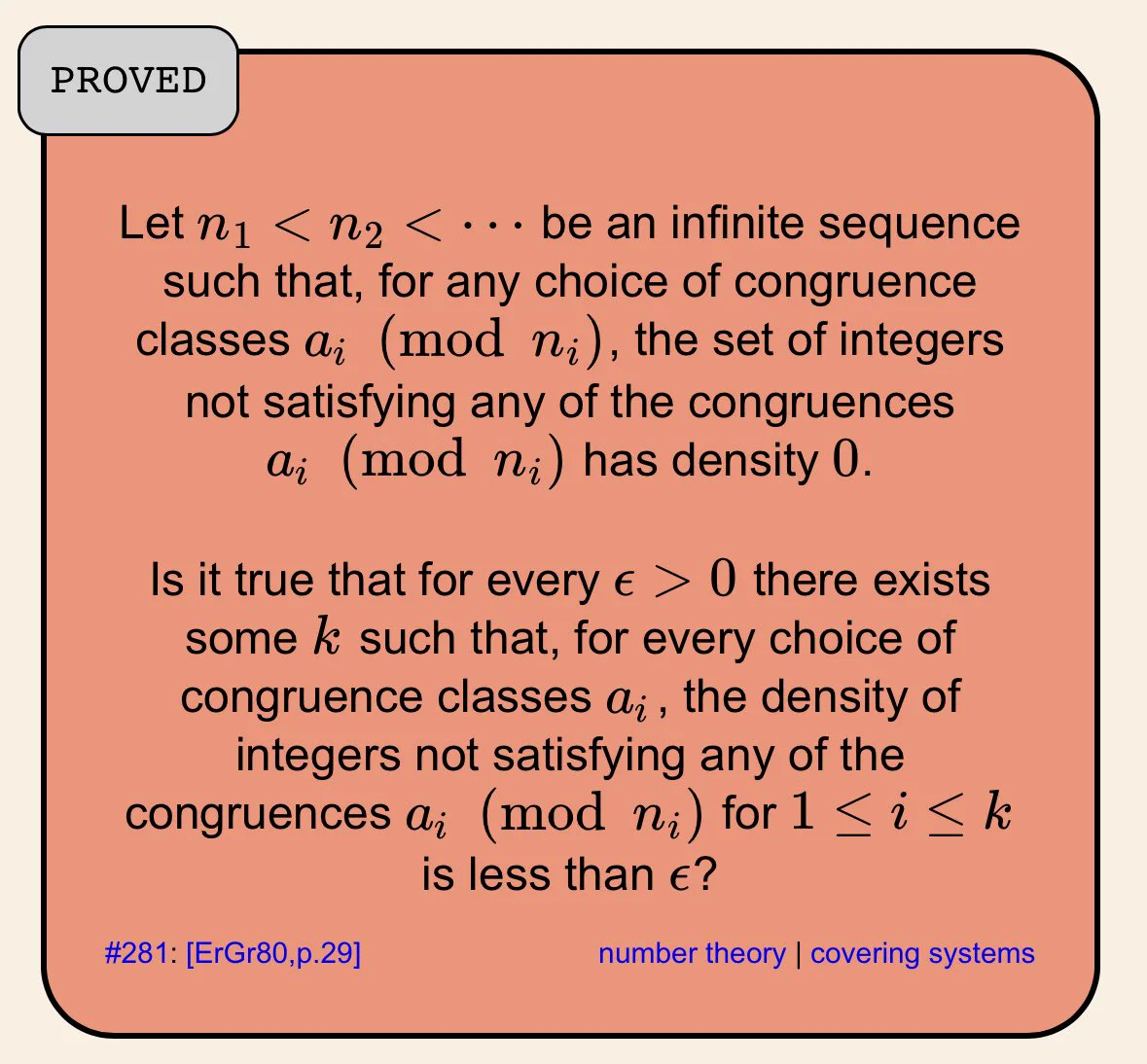
I've solved a second Erdos problem (#281) using only GPT 5.2 Pro - no prior solutions found. Terence Tao calls it "perhaps the most unambiguous instance" of AI solving an open problem:
X (formerly Twitter)
308 points · by nl · 10mo ago · 294 comments
This is no longer true, a prior solution has just been found[1], so the LLM proof has been moved to the Section 2 of Terence Tao's wiki[2].
[1] - https://www.erdosproblems.com/forum/thread/281#post-3325
[2] - https://github.com/teorth/erdosproblems/wiki/AI-contribution...
And even odder that the proof was by Erdos himself and yet he listed it as an open problem!
https://terrytao.wordpress.com/2026/01/19/rogers-theorem-on-...
"This theorem is somewhat obscure: its only appearance in print is in pages 242-244 of this 1966 text of Halberstam and Roth, where the authors write in a footnote that the result is “unpublished; communicated to the authors by Professor Rogers”. I have only been able to find it cited in three places in the literature: in this 1996 paper of Lewis, in this 2007 paper of Filaseta, Ford, Konyagin, Pomerance, and Yu (where they credit Tenenbaum for bringing the reference to their attention), and is also briefly mentioned in this 2008 paper of Ford. As far as I can tell, the result is not available online, which could explain why it is rarely cited (and also not known to AI tools). This became relevant recently with regards to Erdös problem 281, posed by Erdös and Graham in 1980, which was solved recently by Neel Somani through an AI query by an elegant ergodic theory argument. However, shortly after this solution was located, it was discovered by KoishiChan that Rogers’ theorem reduced this problem immediately to a very old result of Davenport and Erdös from 1936. Apparently, Rogers’ theorem was so obscure that even Erdös was unaware of it when posing the problem!"
Pretty soon, this is going to mean the entire historical math literature will be formalized (or, in some cases, found to be in error). Consider the implications of that for training theorem provers.
What's more, there's almost surely going to turn out to be a large amount of human generated mathematics that's "basically" correct, in the sense that there exists a formal proof that morally fits the arc of the human proof, but there's informal/vague reasoning used (e.g. diagram arguments, etc) that are hard to really formalize, but an expert can use consistently without making a mistake. This will take a long time to formalize, and I expect will require a large amount of human and AI effort.
But as far as we know, the proof it wrote is original. Tao himself noted that it’s very different from the other proof (which was only found now).
That’s so far removed from a “search engine” that the term is essentially nonsense in this context.
AI is currently great at interpolation, and in some fields (like biology) there seems to be low-hanging fruit for this kind of connect-the-dots exercise. A human would still be considered smart for connecting these dots IMO.
AI clearly struggles with extrapolation, at least if the new datum is fully outside the training set.
And we will have AGI (if not ASI) if/when AI systems can reliably form new paradigms. It’s a high bar.
But, I don't know. I tend to view these (reasoning) LLMs as alien minds and my intuition of what is perhaps happening under the hood is not good.
I just know that people have been using these LLMs as search engines (including Stephen Wolfram), browsing through what these LLMs perhaps know and have connected together.
A lot of pure mathematics seems to consist in solving neat logic puzzles without any intrinsic importance. Recreational puzzles for very intelligent people. Or LLMs.
Don't be so ignorant. A few years ago NO ONE could have come up with something so generic as an LLM which will help you to solve this kind of problems and also create text adventures and java code.
"Intrinsic" in contexts like this is a word for people who are projecting what they consider important onto the world. You can't define it in any meaningful way that's not entirely subjective.
Vs
> Interesting that in Terrance Tao's words: "though the new proof is still rather different from the literature proof)"
I guess this is the end of the human internet
It wasn't AI generated. But if it was, there is currently no way for anyone to tell the difference.
(edit: fixed link)
EDIT: After reading a link someone else posted to Terrance Tao's wiki page, he has a paragraph that somewhat answers this question:
> Erdős problems vary widely in difficulty (by several orders of magnitude), with a core of very interesting, but extremely difficult problems at one end of the spectrum, and a "long tail" of under-explored problems at the other, many of which are "low hanging fruit" that are very suitable for being attacked by current AI tools. Unfortunately, it is hard to tell in advance which category a given problem falls into, short of an expert literature review. (However, if an Erdős problem is only stated once in the literature, and there is scant record of any followup work on the problem, this suggests that the problem may be of the second category.)
from here: https://github.com/teorth/erdosproblems/wiki/AI-contribution...
The problems are a pretty good metric for AI, because the easiest ones at least meet the bar of "a top mathematician didn't know how to solve this off the top of his head" and the hardest ones are major open problems. As AI progresses, we will see it slowly climb the difficulty ladder.
This is bad faith. Erdos was an incredibly prolific mathematician, it is unreasonable to expect anyone to have memorized his entire output. Yet, Tao knows enough about Erdos to know which mathematical techniques he regularly used in his proofs.
From the forum thread about Erdos problem 281:
> I think neither the Birkhoff ergodic theorem nor the Hardy-Littlewood maximal inequality, some version of either was the key ingredient to unlock the problem, were in the regular toolkit of Erdos and Graham (I'm sure they were aware of these tools, but would not instinctively reach for them for this sort of problem). On the other hand, the aggregate machinery of covering congruences looks relevant (even though ultimately it turns out not to be), and was very much in the toolbox of these mathematicians, so they could have been misled into thinking this problem was more difficult than it actually was due to a mismatch of tools.
> I would assess this problem as safely within reach of a competent combinatorial ergodic theorist, though with some thought required to figure out exactly how to transfer the problem to an ergodic theory setting. But it seems the people who looked at this problem were primarily expert in probabilistic combinatorics and covering congruences, which turn out to not quite be the right qualifications to attack this problem.
"Very nice! ... actually the thing that impresses me more than the proof method is the avoidance of errors, such as making mistakes with interchanges of limits or quantifiers (which is the main pitfall to avoid here). Previous generations of LLMs would almost certainly have fumbled these delicate issues.
...
I am going ahead and placing this result on the wiki as a Section 1 result (perhaps the most unambiguous instance of such, to date)"
The pace of change in math is going to be something to watch closely. Many minor theorems will fall. Next major milestone: Can LLMs generate useful abstractions?
"On following the references, it seems that the result in fact follows (after applying Rogers' theorem) from a 1936 paper of Davenport and Erdos (!), which proves the second result you mention. ... In the meantime, I am moving this problem to Section 2 on the wiki (though the new proof is still rather different from the literature proof)."
Point in case: I just wanted to give z.ai a try and buy some credits. I used Firefox with uBlock and the payment didn't go through. I tried again with Chrome and no adblock, but now there is an error: "Payment Failed: p.confirmCardPayment is not a function." The irony is, that this is certainly vibe-coded with z.ai which tries to sell me how good they are but then not being able to conclude the sale.
And we will get lots more of this in the future. LLMs are a fantastic new technology, but even more fantastically over-hyped.
Models just generate text. Apps are supposed to make that text useful.
An app can run various kinds of verification. But would you pay an extra for that?
Nobody can make a text generator to output text which is 100% correct. That's just not a thing people can do now.
I've "solved" many math problems with LLMs, with LLMs giving full confidence in subtly or significantly incorrect solutions.
I'm very curious here. The Open AI memory orders and claims about capacity limits restricting access to better models are interesting too.
The answer is yes. Assume, for the sake of contradiction, that there exists an \(\epsilon > 0\) such that for every \(k\), there exists a choice of congruence classes \(a_1^{(k)}, \dots, a_k^{(k)}\) for which the set of integers not covered by the first \(k\) congruences has density at least \(\epsilon\).
For each \(k\), let \(F_k\) be the set of all infinite sequences of residues \((a_i)_{i=1}^\infty\) such that the uncovered set from the first \(k\) congruences has density at least \(\epsilon\). Each \(F_k\) is nonempty (by assumption) and closed in the product topology (since it depends only on the first \(k\) coordinates). Moreover, \(F_{k+1} \subseteq F_k\) because adding a congruence can only reduce the uncovered set. By the compactness of the product of finite sets, \(\bigcap_{k \ge 1} F_k\) is nonempty.
Choose an infinite sequence \((a_i) \in \bigcap_{k \ge 1} F_k\). For this sequence, let \(U_k\) be the set of integers not covered by the first \(k\) congruences, and let \(d_k\) be the density of \(U_k\). Then \(d_k \ge \epsilon\) for all \(k\). Since \(U_{k+1} \subseteq U_k\), the sets \(U_k\) are decreasing and periodic, and their intersection \(U = \bigcap_{k \ge 1} U_k\) has density \(d = \lim_{k \to \infty} d_k \ge \epsilon\). However, by hypothesis, for any choice of residues, the uncovered set has density \(0\), a contradiction.
Therefore, for every \(\epsilon > 0\), there exists a \(k\) such that for every choice of congruence classes \(a_i\), the density of integers not covered by the first \(k\) congruences is less than \(\epsilon\).
\boxed{\text{Yes}}
You could have just rubber-stamped it yourself, for all the mathematical rigor it holds. The devil is in the details, and the smallest problem unravels the whole proof.
Is this enough? Let $U_k$ be the set of integers such that their remainder mod 6^n is greater or equal to 2^n for all 1<n<k. Density of each $U_k$ is more than 1/2 I think but not the intersection (empty) right?
This would all be a fairly trivial exercise in diagonalization if such a lemma as implied by Deepseek existed.
(Edit: The bounding I suggested may not be precise at each level, but it is asymptotically the limit of the sequence of densities, so up to some epsilon it demonstrates the desired counterexample.)
I’m not sure what this proves. I dumped a question into ChatGPT 5.2 and it produced a correct response after almost an hour [2]?
Okay? Is it repeatable? Why did it come up with this solution? How did it come up with the connections in its reasoning? I get that it looks correct and Tao’s approval definitely lends credibility that it is a valid solution, but what exactly is it that we’ve established here? That the corpus that ChatGPT 5.2 was trained on is better tuned for pure math?
I’m just confused what one is supposed to take away from this.
[1] https://news.ycombinator.com/item?id=46560445
[2] https://chatgpt.com/share/696ac45b-70d8-8003-9ca4-320151e081...
Erdos was prolific and many of his open problems are numbered and have space to discuss them online, so it’s become fairly common to run through them with frontier models and see if a good proof can be come up with; there have been some notable successes here this year.
Tao seems to engage in sort of a two step approach with these proofs - first, are they correct? Lean formalization makes that unambiguous, but not all proofs are easily formulated into Lean, so he also just, you know, checks them. Second, literature search inside LLMs and out for prior results — this is to check where frontier models are at in the ‘novel proofs or just regurgitated proofs’ space.
To my knowledge, we’re currently at the point where we are seeing some novel proofs offered, but I don’t think we’ve seen any that have absolutely no priors in literature.
As you might guess this is itself sort of a Rorschach test for what AI could and will be.
In this case, it looked at first like this was a totally novel solution to something that hadn’t been solved before. On deeper search, Tao noted it’s almost trivial to prove with stuff Erdos knew, and also had been proved independently; this proof doesn’t use the prior proof mechanism though.
One wonders if some professional mathematicians are instead choosing to publish LLM proofs without attribution for career purposes.
"This LLM is kinda dumb in the thing I'm an expert in"
This will just become the norm as these models improve, if it isn't largely already the case.
It's like sports where everyone is trying to use steroids, because the only way to keep up is to use steroids. Except there aren't any AI-detectors and it's not breaking any rules (except perhaps some kind of self moral code) to use AI.
I assume OP was mostly joking, but we need to take care about letting AI companies hype up their impressive progress at the expense of mathematics. This needs to be discussed responsibly.
Anecdotally, I, as a math postdoc, think that GPT 5.2 is much stronger qualitatively than anything else I've used. Its rate of hallucinations is low enough that I don't feel like the default assumption of any solution is that it is trying to hide a mistake somewhere. Compared with Gemini 3 whose failure mode when it can't solve something is always to pretend it has a solution by "lying"/ omitting steps/making up theorems etc... GPT 5.2 usually fails gracefully and when it makes a mistake it more often than not can admit it when pointed out.
I believe the ones that are NOT studied are precisely because they are seen as uninteresting. Even if they were to be solved in an interesting way, if nobody sees the proof because they are just too many and they are again not considered valuable then I don't see what is gained.
More broadly, I think there’s a perspective that literally just building out thousands more true statements in Lean is going to keep cementing math’s broadening knowledge framework. This is not building a giant castle a-la Wiles, it’s laying bricks in the outhouse, but someday those bricks might be useful.
I would love to know which concepts are active in the deeper layers of the model while generating the solution.
Is there a concept of “epsilon” or “delta”?
What are their projections on each other?
> the best way to find a previous proof of a seemingly open problem on the internet is not to ask for it; it's to post a new proof
Personally, I've been applying them to hard OCR problems. Many varied languages concurrently, wildly varying page structure, and poor scan quality; my dataset has all of these things. The models take 30 minutes a page, but the accuracy is basically 100% (it'll still striggle with perfectly-placed bits of mold). The next best model (Google's flagship) rests closer to 80%.
I'll be VERY intrigued to see what the next 2, 5, 10 years does to the price of this level of model.
They never brothered to check erdos solution already published 90 years ago. I am still confused about why erdos, who proposed the problem and the solution would consider this an unsolved problems, but this group of researchers would claim "ohh my god look at this breakthrough"
https://mehmetmars7.github.io/Erdosproblems-llm-hunter/probl...
We are very close.
(by the way; I like writing code and I still do for fun)
The ability to make money proves you found a good market, it doesn't prove that the new tools are useful to others.
Isn't that a perfectly reasonable metric? The topic has been dominated by hype for at least the past 5 if not 10 years. So when you encounter the latest in a long line of "the future is here the sky is falling" claims, where every past claim to date has been wrong, it's natural to try for yourself, observe a poor result, and report back "nope, just more BS as usual".
If the hyped future does ever arrive then anyone trying for themselves will get a workable result. It will be trivially easy to demonstrate that naysayers are full of shit. That does not currently appear to be the case.
Coding was never the hard part of software development.
They’re a probabalistic phonograph. They can sharpen the funnel for input but they can’t provide judgement on input or resolve ambiguities in your specifications. Teams of human requirements engineers cannot do it. LLMs are not magic. You’re essentially asking it; from my wardrobe pick an outfit for me and make sure it’s the one I would have picked.
If you’re dazzled into thinking LLMs can solve this you just don’t understand transformer architecture and you don’t understand requirements engineering.
You’ll know a proper AI engine when you see it and it doesn’t look like an LLM.
The LLM did better on this problem than 100% of the haters in this thread could do, and who probably can't even begin "understand" the problem.
But thanks for the downvote in addition to your useless comment.
I'm beginning to think the Bitter Lesson applies to organic intelligence as well, because basic pattern matching can be implemented relatively simply using very basic mathematical operations like multiply and accumulate, and so it can scale with massive parallelization of relatively simple building blocks.
The ability to think about your own thinking over and over as deeply as needed is where all the magic happens. Counterfactual reasoning occurs every time you pop a mental stack frame. By augmenting our stack with external tools (paper, computers, etc.), we can extend this process as far as it needs to go.
LLMs start to look a lot more capable when you put them into recursive loops with feedback from the environment. A trillion tokens worth of "what if..." can be expended without touching a single token in the caller's context. This can happen at every level as many times as needed if we're using proper recursive machinery. The theoretical scaling around this is extremely favorable.
I’m talking about the inference step, which uses tensor geometry arithmetic to find patterns in text. We don’t understand what those patterns are but it’s clear it’s doing some heavy lifting since llm inference is expressing logic and reasoning under the guise of our reductive “next token prediction”
But I think the trend line unmistakably points to a future where it can be MORE intelligent than a human in exactly the colloquial way we define "more intelligent"
The fact that one of the greatest mathematicians alive has a page and is seriously bench marking this shows how likely he believes this can happen.
https://chatgpt.com/share/696ac45b-70d8-8003-9ca4-320151e081...