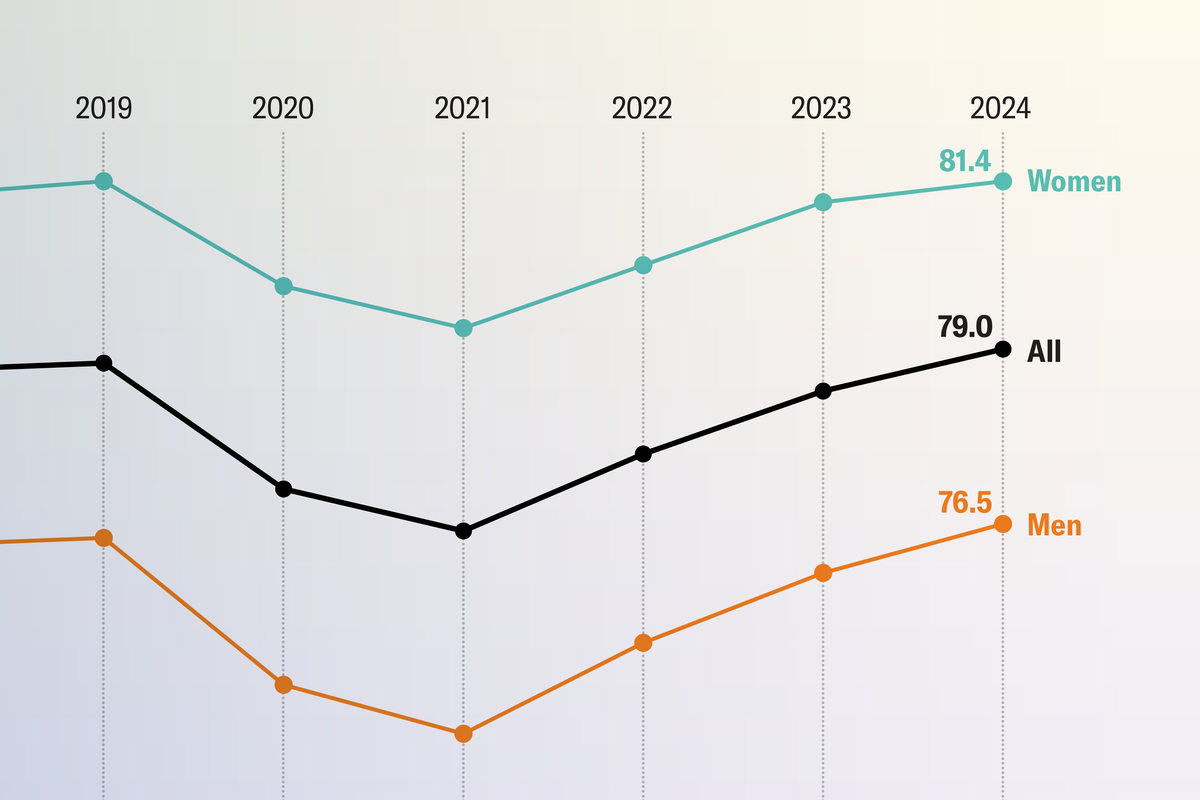
U.S. life expectancy hits all-time high
Americans are living longer than ever but still well behind the life expectancy of other developed countries
Scientific American
40 points · by brandonb · 9mo ago · 122 comments
If that was the case, you won't see death rates decrease across multiple groups and not just the weakest groups.
> Death rates declined across all racial and ethnic groups, and in both men and women.
https://www.medpagetoday.com/publichealthpolicy/publichealth...
> It's the result of not only the dissipation of the COVID-19 pandemicopens in a new tab or window, but also waning death rates from all the nation's top killers, including heart disease, cancer, and drug overdoses.
The linked quotes don’t seem to support your argument, unless I misunderstand? If the weakest people die, then the remaining people are expected to be more resilient to heart disease and cancer.
I think decreases in drug overdose and suicide are probably the most isolated from this effect, so I have higher confidence that those decreases are “real”. But I can imagine ways that even they might interact.
Obesity drugs are in the top 25 for 2025, but don't make up the largest plurality. That goes to oncology drugs at ~1/3rd. Obesity drugs are at ~14%.
I want to mention here that these oncology drugs are mostly antibody methods. Which, what the hell? We're making antibody drugs at scale now?! And that's like some of the highest selling drugs out there?
For comparison, though not in the linked article here, Acetaminophen (Tylenol) only comes in at ~$4.3B, which would put it way down in 13th place, out of the top 10.
Granted, this is sales numbers, and in the US, that's practically taking the savings of very sick people and turning it into stocks. Something that elicits no small reaction here on HN or just about anywhere.
Still, to the point of the main article, yes, we live in an age of medical miracles, and it arrived quite suddenly, only in the last 7 years or so, and we have a lot of gas in this tank.
Does the gap in obesity rates fully explain the difference in life expectancy? Or are there other factors at play?
I don't think it actually does, because UK has lower obesity rates than Australia (26-29% versus 32%), yet also lower life expectancy (Australia is 81.1 male, 85.1 female; UK is 78.8 male, 82.8 female)
The obesity rate in the US is 40%. The just-overweight rate is 33%. So unless we really ramp up on tackling obesity, the life expectancy is going be dragged down.
SubQ pen injections are something even most people afraid of needles can get used to quite quickly, so even if the pill forms never get to the same efficacy there's really no reason that they couldn't solve it for most everyone once they go generic and become affordable, or become otherwise subsidized. China already produces the APIs in huge quantities for insanely cheap for sale on the black market, so we know that they can be produced for extremely low costs.
Lifestyle seems to play a huge role in life expectancy. Mormons live 10 years longer than white Americans generally: https://www.deseret.com/2010/4/13/20375744/ucla-study-proves.... That’s a huge difference—it dwarfs the 2.5 years difference between men in the U.S. and men in the UK.
Diversity means diversity in health outcomes, which are vastly different between groups.
No it's not. White non Hispanic population in the U.S. has a life expectancy of 77.5, which is lower than the U.S. average life expectancy and comparable to Eastern Europe, but not Europe as a whole (life expectancy of 81.4).
There is a lot of evidence of a causal relationship between being non-white and having less access to healthcare, nutrition, and other things that affect health outcomes, and that evidence aligns well with being targets of racial discrimination.
When we just repeat baseless claims about race, we risk perpetuating it.
I've never seen evidence of a racial difference in accessing health care that is accessible. It's hard to believe skin color would affect that, while it's easy to believe (and witness) that it affects what you have access to.
Your argument about access to healthcare based on race doesn’t make sense either. Hispanics in the U.S. live longer than white people, despite having the highest rate of lacking health insurance.
This is laughably untrue.[1][2][3] They're lacked basic supplies for 30 years. Frequent blackouts also complicate or prevent many types of care.
[1] https://www.france24.com/en/live-news/20250709-bitter-pill-c...
[2] https://cuba.miami.edu/business-economy/a-close-look-at-cuba...
In one sense the Cuban healthcare system is mediocre, since it suffers from the shortages that plague the entire nation.
But that's like saying Cuban auto mechanics, who also suffer from shortages, are mediocre, despite their ability to keep the island's 70 year old American cars and Yugos in pristine condition.
Cuba has been under embargo for 66 years.
Genocide by denial for decades.
To give Trump credit, at least he's open about his intentions. Much like a certain Austrian painter from the 1930s; he too was open about his plans, and no one took him seriously until it was too late.
Alabama: 7.1
Mississippi: 9.7
Louisiana: 7.1
Arkansas: 8.2
There are a lot of other states that are bringing up the average, in many ways the US is a bunch of third world countries in a trenchcoat.
Statistics like these often overlay with demographic maps. In all of these states, there are swaths of geography that fall along color and income lines. If we want to change the numbers, taxing prosperous states to benefit these poorer ones would be beneficial.
Why is it useless? Any aggregate number can be broken down different ways into different groupings - region, age, education, income, wealth, smoking/not, weight, smartphone use, exercise, sleep, etc etc. By your argument, any aggregate number is useless because, no matter what the researcher chooses, it could be broken down differently.
So why choose race? I think the fact that so many in this discussion repeat the partisan trope - long used to oppose taxpayer-funded services such as healthcare, education, housing, food, etc. - of dividing people by race, is very telling.
That makes sense to me. Unhealthy people are less likely to make the (often) physically gruelling trip and take on the potentially gruelling lifestyle, and all the uncertainty. The same, I expect, applies to motivation - people thoughtlessly call immigrants 'lazy', but the lazy people don't give up their familiar lives and move - many crossing jungles and risking criminals - someplace where they have nothing, not even legal status, often not even the language, and start from scratch - with the goal that after a lifetime of hard work, your children will be comfortable.
* food standards for shops and franchises .. McDonalds here has better salads that in the US,
* sport and activity as a fundemental part of most lives,
* good health care for all, even for "bottom tier" unemployed, with hybrid public/private health insurance and literal walk in, fall over, free heart surgery and follow up (for those that cannot pay).
Stats wise, higher life expectancy and better cancer survival rates*
* Yes, better, but not by much .. just cheaper and across the demographics.
Obviously lots of other factors, but it does help explain part of why we see much of the most developed portions of Asia at the top of the list.
Switzerland is an interesting counterpoint, though - average height there is taller than most of Europe - though their obesity rates are about half of that of the European average.
Higher muscle mass tends to mean better insulin sensitivity, a higher general level of physical fitness, etc. etc. etc. These are all larger beneficial improvements than the problem with just being a larger person.
But if you look at two people of different heights, the same FFMI, etc., the larger person will have lower life expectancy, and it's not because their head is a few inches higher in the air, and despite having a similar body composition and more total muscle mass. (Obviously controlling for all other variables)
We know that blood flow demand increases put additional strain on the heart. We know this is one of the causes of things like LVH and other negative cardiac remodeling. We know that at rest, muscle and fat mass have essentially identical blood flow requirements. Even natural powerlifters when having their heart scans have found increased septum and posterior wall thickness without the increase in chamber size that endurance athletes have that keeps function optimal - they have diastolic function loss. In fact, in many of the negative imaging results, they found minimal difference between natural powerlifters and enhanced - https://pubmed.ncbi.nlm.nih.gov/4079743/
People get obstructive sleep apnea from too much muscle mass, even at low levels of body fat.
On the enhanced side, we see better health outcomes from people that both drop the AAS usage alongside letting them size go down vs. those that just come off the gear. (You can keep very significant portions of your enhanced gains while at physiological levels, as long as you maintain strict training, protein intake, etc. It's one of the reasons that many people argue that the 7-10 year bans in natural powerlifting federations is not actually effective.)
It's a u shaped curve. At some point all of the health benefits of muscle can't make up for the increased cardiovascular strain. The majority of people have more risk from their less-muscular body composition so building more will almost certainly benefit them, but that's not the same as the idea that body size, from any cause, doesn't have a negative correlation with longevity.
Wow, that’s a really biting criticism of US public health — and rightly so
The men vs women numbers otherwise are pretty useless for the reason you gave
> There are many different populations in the USA.
Are you saying only your 'population' matters to you?
What do you mean by it exactly? There are lots of populations everywhere, and every population can be broken down into more populations. Any aggregate number won't describe you as an individual, even if it's a number for your own family.
Is this just a repeat of the old racial trope here?: https://news.ycombinator.com/item?id=46843222
I don’t have much interest in adding years to my life if they are miserable years.
A wise man once said the goal is to live a long, healthy and vigorous life, then die suddenly.
Same with most diet or stress caused illnesses, like cardiovascular diseases or lung diseases.
You're only allowed to say "yea but it'd be way better if..."
But really, men do dumber shit and tend to have much worse diets than women.
> Researchers generally group explanations into (1) cause-of-death differences, (2) exposure/behavior differences, (3) healthcare-use differences, and (4) biological differences.
https://chatgpt.com/share/697ec925-3ab0-8000-9a09-d47d2fb33d...
There is no shortage of data on this. Here is one example: https://www.healthdata.org/news-events/newsroom/news-release...
>That 5 years difference between men and women keeps being biologically weird
The implication is that the "biological" expectation would be that men and women have the same life expectancy, absent medical intervention and societal standards and whatnot.
But it is possible that, due to having different biologies, men and women simply have different life expectancies. Similar to how men and women have different muscle mass and bone densities and height and yada yada.
Obviously, external factors could also be a factor, but my point is "internal" factors are also in play.
5 years life expectancy difference is a lot. As a man, it is frustrating and I want to make sure I get the most out of my life (which I enjoy)
It seems evident that the taller you are, the less life expectancy you have from the simple fact that the heart has to work harder.
Hence, since men are usually taller than women, it might also be expected for men to die younger.
I am making the following scenario up, but what if a difference in men and women's bodies causes men to process cholesterol differently, and increases the probability of atherosclerosis and/or arteriosclerosis. Perhaps it happens simply because men eat more than women, and this compounds over decades of life, eventually resulting in the difference in average age at death.
Some people shrug it off or claim that they’re higher status because they lost weight via diet and exercise, but I map that to people who think they’re better programmers because they don’t use llms for coding, when the real result is what matters. Similar to people thinking AI slop, there are news articles about what happens if you stop GLP-1s and gain the weight back. But the stories of people who either continue to microdose, or also learn the feelings of their body and how it differs have long term success. Similar to those who know how to work with llms get good results, but the news is about how smarter people don’t use it.
All very interesting subjects. What a world we’re in.
[0] https://www.derekthompson.org/p/why-does-it-seem-like-glp-1-...
Pretty much every man over 45 should get on TRT, because his health and QOL will improve more from that than perhaps anything else.
We already know women live longer than men on average, and also have less muscle-mass than men on average, so clearly it's not having too much of an impact on women.
Without looking into actual statistics here, Japan is known for having a high life expectancy, and stereotypically Japan's population is both relatively thin, and has relatively little muscle, so that also seems to defy that expectation.
What sort of mortality are you expecting here?
Every new generation deals with growing populations to one degree or a other. World population has doubled in my lifetime for example. But human society just isn't made to have so many long lived people hoarding wealth and power decades beyond what they historically have.
GenX finally outnumbers the Boomers, but that should have happened a decade ago. The damage they've inflicted on the younger generations is really incalculable.
I think as time goes by, we may have to decide that people over a certain age are to be legally treated the same as those under 18.
I suppose rooting for people to die doesn't sound barbarous, so long as you're not rooting for anyone in particular to die.
We can't stop our status symbol consumption and travel lifestyles. This is just more people to feed, which in our current broken system means more consumption and waste at insane scales.
> The world would be a demonstrably better place if the average life expectancy had remained around 70, like it was the year I was born.
> The damage they've inflicted on the younger generations is really incalculable.
imagine if we had to argue with 400 year old generals from colonial times.... or robber-barrons of 150+ years ago still trying to dominate everything.
1) keep BMI in the low 20s (yes, it's considered normal but difficult to maintain)
2) increase physical exercise: no cars and elevators, yes feet and bicycles
3) ban processed foods and promote cooked ones using local ingredients
4) tackle air pollution, car accidents, work safety and other forms of environmental hazard
5) improve healthcare in a free to all basis, which is of astonishing low importance
6) reduce life stress, which is a subject huge, complicated and subjective that whould need its own ministry, if you are dedicated enough