268 points · by PaulHoule · 9mo ago · 239 comments
I am still convinced the lava cheese insulator is there only to burn people's insides with boiling pineapple.
Although pineapple flavoured floor heating does sound delicious.
Physics does not apply to lasagna.
Also I suck at making lasagna.
(I also imagine using the circulation in a convection oven might help as well. Also, preheating your oven! Even if it's a toaster oven.)
Use the power button to select a lower power level, and cook the food for longer.
Cheese melting takes energy Cheese freezing, releases energy.
So you do actually get the temperature to remain at the melting point of the cheese for a longer period of time if you have enough % cheese to be significant.
So we already have an effective way to store heat which can work for decades without servicing and is also cheap to produce (in terms of money and energy consumption).
I live in Ireland where night/day temperature swings are small. To cool my attic on a hot summer day I'd need to move that heat into a large water tank that gets used for laundry, cleaning, showers etc and is refilled from cold mains water. But fitting an air to water heat exchanger inside my attic would be a big expense and I would have to make sure I didn't freeze the attic.
Regular air to water heat pump could be hooked into my existing tank I suppose?
But, as a result, Ecombi has a much lower system efficiency than a heat pump, since it's essentially just a space heater pointed at a rock. It only makes sense for jurisdictions with time-of-day variable pricing of electricity, and trades off simplicity and low initial purchase price for lifetime cost.
I actually don't know the answer. I'm just thinking that there must be more to it, if the answer was as simple as "just heat water".
With hot water tanks, they are unfortunately pretty badly insulated as well, with some of them loosing heat very quickly. Depending on how you plan on using that water, you also have to make sure the temperature never dips below ~60C to avoid legionella from spreading.
I actually think that heating your home slighly higher than you‘d usually do is the simplest and most effective approach, assuming it is properly insulated. Just rise the target temp for 1-2C when the energy is cheap and reset it once it isn‘t. Probably not as efficient, but extremely simple to implement.
They both are rated for annual kWH usage less than the US EPA yellow label can display (for their category of tanked water heaters, i.e. competing mostly with resistive heating models).
Annually water heating is about 3% of my energy consumption.
https://www.heatgeek.com/articles/legionella-and-water-tempe...
Sure, heat pump hot water tanks are a thing. Air-to-water heat pumps are less efficient than air-to-air as they need to reach higher target temperatures, but it will be more efficient that straight resistive heating by a factor of 2 at low input temperatures, and 3+-ish at high summer temps.
The primary concern would be the quality of the tank’s insulation. I would hope HPHWTs are good on that but if you’re looking into that you probably want to double check the heat loss of the tank.
https://sunamp.com/en-gb/hot-water-solutions-thermino-range/
The phase change stuff has positives like taking up less physical space but it's also a much less mature tech than storing hot water.
There's heat storage as discussed here.
Or you can store cold water in a reservoir as a giant battery, pumping it up high when you've got excess power, and letting it back down to generate hydroelectricity from it later.
Or you can boil water to make steam that spins a turbine and use it to convert anything that can heat water (coal, oil, nuclear...) to electricity.
It's gravity that does the generation. Water is convenient because it's weight per unit of volume is very high. Higher than most things we can get our hands on and it's also exceptionally safe.
Since water isn't perfectly clean the main problem you face is corrosion. Which can take a great system and turn it into a nightmare of buried leaks and sudden problems.
As far as our options go it _is_ really convenient.
In the UK there was a unfortunate trend of ripping out these energy storage devices and replacing hot water tanks with on demand electric hot water heating ( only heat the water you need ). And new builds often have no tanks ( as it saves space in the new tiny homes ).
Very short sighted in my view - a very simple way to store energy and everyone uses hot water directly.
Versus resistance, which is exactly as efficient at 0°C and 1000°C, and why those storage heaters used to make sense.
(And storage is directly proportional to temperature differential above interior ambient)
Hot water tank was in the basement, which was not insulated. So the mass of hot water contributed very little as a heat reserve for the house.
House was in a northern clime.
Earth's oceans and seas act as giant heat sinks.
And that means more trouble as global climate change impacts..
https://www.earth.com/news/ocean-warming-broke-records-for-4...
Many heat pumps are installed with a large insulated buffer of water (for ex. 300L), which stores heat pretty well?
And homes that use underfloor heating in concrete can store heat pretty well too. Many people use that to heat up the home when energy is cheap and disable the heat pump when it is expensive.
https://en.wikipedia.org/wiki/Pumped-storage_hydroelectricit...
The most optimistic hope is that the government mandate will force enough demand that manufacturers can enjoy some economies of scale and actually try to compete on price. I don't think this will happen anytime soon.
https://www.youtube.com/watch?v=uqyAWkXXt3A
https://www.neshw.com/residential/solar-heat-pump-water-heat...
Propane bill (no natural gas, town of 500) from Oct 24 to Feb 25 (installed the mini splits that month) was $1200, for just heating.
My mini-splits are on a dedicated sub panel with an Emporia Vue 3 energy monitor. $604 in electricity consumption, and that includes air conditioning over the summer months.
For what it’s worth, our winter weather averages 25-35F with the occasional few days dipping to tens, single digits, and the occasional -10 freak; but these units just BARELY have a HSPF4 rating to classify as “cold climate” models. Still going to pay for themselves in 6 years without any tax credits, and 4 or so since I still installed them when they were available.
I do miss my natural gas on-demand water heater from when I lived in the states though. Unlimited hot water was nice, and it took up almost zero space.
Isn't that what we call a combi boiler in the UK (and Europe?) I've recently moved from having a big hot water cylinder to a combi. The space saving is nice, but there are downsides.
Waiting for the hot water to come through is annoying and I'm often just wasting cold water waiting for it to come through hot. There is a "pre-heat" feature which would be nice, but then it would keep it warm 24 hours a day which is ridiculous. Maybe some better boilers can time the pre-heat. That would probably be close to perfect.
The other downside is it can only really supply one tap with hot water. So if someone is having a shower and someone else runs a hot tap it can be unpleasant. Requires some coordination between householders.
All in all I would definitely prefer a cylinder if I could afford the space it takes. Modern cylinders are incredibly efficient. I once turned the heating off for a week while away on holiday and when I came back the water from the cylinder was still tepid.
Yeah one of my colleagues has a preheat which can be triggered manually and via automation. They also have a preheat loop which cycles hot water through the entire piping as the boiler is on an edge, so it takes ages for hot water to reach the far bathroom.
Is it something from nefit by any chance?
https://www.pv-magazine.com/2026/01/29/samsung-releases-new-...
> The South Korean giant [Samsung] said its new EHS All-in-One provides air heating and cooling, floor heating, and hot water from a single outdoor unit. It can supply hot water up to 65 C in below-zero weather.
> Dubbed EHS All-in-One, the system provides air heating and cooling, floor heating, and hot water from a single outdoor unit. It is initially released for the European market, with a Korean rollout expected within a year. “It delivers stable performance across diverse weather conditions. It can supply hot water up to 65 C even in below-zero weather and is designed to operate heating even in severe cold down to -25 C,” the company said in a statement. “The system also uses the R32 refrigerant, which has a substantially lower impact on global warming compared with the older R410A refrigerant.”
So if I want to quickly scald myself in a 400 litre pool at fifty degrees I can’t. But if I had a gas heater that would be possible!
My heat pump is working great at 0F. It's 7 years old.
I've got a 1930s semi-detached house (UK, north of England) - heated solely by a ASHP for both heating and hot water.
Our Seasonal Coefficient of Performance is currently 3.47 (347% efficient) - even if limit that to just last month (coldest month of the winter so far in the UK) our COP was 3.25 (325% efficiency).
Roughly speaking if you can achieve a COP over 3.2x in the UK it should be roughly on a par with gas, assuming you go 'gas free' (i.e. you can make the saving on the gas standing charge).
Personally we're running at ~£200 annual saving vs. my estimate of what costs would be for equivalent gas boiler - that's thanks in part to being able to do all our hot-water heating at night rates.
House wise - we don't have cavity wall insulation, have 15+ year old double-glazing and probably should have more insulation in the loft (it fills the rafters but I think these days that's considered not enough).
Also with changes to ECO (energy company obligations) and RO (renewables obligations) the differential between gas and electric will reduce further
Anyhoo - added my example to show that ASHP can work perfectly fine in old, poorly insulated homes in (moderately) cold climates.
ECO/RO link - https://www.moneysavingexpert.com/news/2025/11/energy-bill-c...
If you have a poorly insulated house then the fix is to insulate it, which is what a lot of people are doing around here, with very hold houses. My house is less than 60 years old and very well insulated for the time, and it holds up even today - it's always warm, with the heat pump not even close to its max power.
At that price, resistive heating cost about as much as what I paid for gas at my old house.
I went with a heat pump to hedge the bet. (I was also pointed away from geothermal.)
If the insulation wasn't as good, or electricity more expensive, I would have used a different heat source. I was looking at pellet furnaces at the time, but never seriously got into the research before the solar proposal came in.
I have one of these: https://cta.ch/en/private/products/ah-i-eco-innen
I got it in October so most of the time I've had it has been <10C. It's produced 806.3 kWh of heating for hot water and 6587.2 kWh for the floor heating. It consumed 302.7 kWh and 1801.4 kWh respectively, for a COP of 2.66 and 3.66.
Personally, I prefer an air-source heat pump hot water tank. It significantly dehumidifies my basement.
We have been buying heat pump PTAC for the hotels for last 20 years, and price difference is usually 5% between with and without heat pump.
Seems like all companies are colluding with each other for marking up prices.
As an aside, HP dryers are really elegant tech, and it's a shame they're not more common. They use the heat pump not just to heat the air in the dryer, but also to condense the moisture back out of it, so just the water can be drained away instead of needing to exhaust the air outside. So you need much less energy overall, and you don't need a dryer vent. The only downside is they're a bit slower, but ours has a resistive backup option for when you need clothes dry asap, so really it's just price.
I've stopped needing to sort my clothes out as a result, I used to hate putting synthetics in a regular dryer because they get worn out so fast that way.
So you want the government to pick winners and you want to do business with a monopoly? This is the opposite of what you would want.
If the product saves me money, and it's _actually_ better, I will buy it in a heartbeat. If you're involving the government it's because one of those things isn't true.
Bus sized because that amount of thermal mass is bound to take up a lot of space, but capable of being buried so that it doesn’t actually take up property space.
A 100m3 (100,000 litres or 26,500 gallons) cylindrical water tank (approx 5x5m) buried and insulated with 50cm of XPS could provide around 4000kWh of deliverable heat throughout winter. Which would be more than enough for heating and domestic hot water for my house.
In the summer you'd use solar thermal to charge it to 85c. In the winter you'd run water through underfloor heating and discharge it to 35c (so you just need a mixer valve and pump).
The structural engineering part of it isn't actually that complicated (with a garden on top, not a house). You can buy plastic water tanks of that size, it just needs to be buried and have XPS foam placed around it.
Because it's volume, it scales up well. An extra one meter in each direction would increase the volume by around 60%, but you have a lower overall heat loss, so the heat capacity would more than double.
The important part of it is the XPS foam though, without this the loses are too great and you don't retain any heat. This is why insulating your foundation and slab is so effective.
• The centigrade is capitalized when used after a number. There is also a singular glyph for the entire degree-centigrade convention: ℃.
• There are also superscript numerical characters to use with volumes, without having to use formatting: m³.
UTF-8 is fun! As is automatic text replacement, once you have the appropriate triggers set up.See page 758 of the Chapter 22 for the Unicode 9.0 standard:
You can then use a heat pump that's optimized for the expected temperature range and you don't even need to insulate your water storage tank - you actually want the cold in winter to seep out into the surrounding soil, free energy.
In summer you have cold storage for your AC.
And being on an alluvial plain, if I filter out all the rocks larger than a pea, a good 90+% of what is dug out can immediately be trucked away.
edit: also on heating question - Moscow's electricity is provided by 40 or so big gas-fired steam turbine generator plants, about 10GWe total. District heating serves as cooling for all this power generation.
It says this is both a "heat pump" and also "storage" AND says that it will run when electricity is cheap or plentiful. Thus:
1: Where does it pump the heat from? (Or is this not really a "heat pump" and instead is using resistive heating?)
2: How long does it store heat? Is this something that will store heat on a 24-48 hour basis, or will this store heat during the spring / fall when longer days mean extra power from residential solar, and then use the heat in the winter?
3: Is the unit itself "warm" when storing heat? Or is the heat stored in a purely chemical way and needs to run through a catalyst or similar to get it back?
4: Can this be scaled up for general domestic heating?
---
Just an FYI: There are plenty of schemes with resistive electric water tanks to store heat when power is cheap.
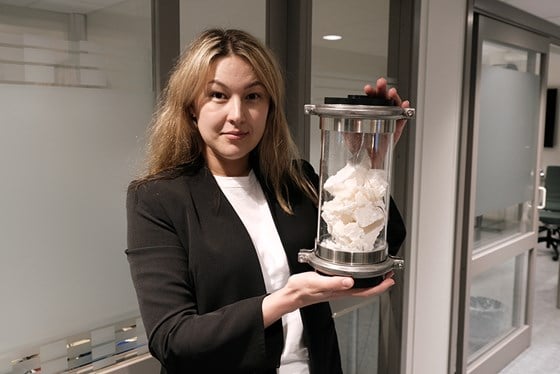
As it works on phase change (e.g. think of melting ice) heat is added (or removed) without changing the temperature of the store (which, I guess, might be hotter or colder than where the heat is extracted or used).
Depending on the needs, resistive heating can get hundreds of degrees hot, but the best heat pumps that I know of can only raise the temperature about 60 or 70° f.
So the way I see it, is that this material should be able to quickly store heat with the using the low temperatures that heat pumps provide, and be able to store it with minimal losses until it is needed.
2. With good insulation you can easily store heat for a day which is all you need. You're never going to get close to storing summer heat for the winter. That's not impossible but not feasible for something this scale (and not cost effective at any scale).
3. You just heat it up and cool it down. There are no fancy chemical processes happening other than the phase change. It's exactly like a phase change hot/cold pack you can buy on Amazon.
4. I'm pretty sure this is designed for domestic heating...
It's kind of an obvious idea tbh. I don't think they've done anything super innovative... They made an aluminium heat sink..
This is ground basically. How deep varies but few meters underground you basically have average yearly temperature. You could pump heat from house to the ground to take it out from the ground during winter.
my childhood public school took us to some big commercial building- I think it was Sears' HQ- and they proudly showed us the huge blocks of ice providing chill during the day.
Do you mean a heat pump dryer? Those aren't taking heat from the room; they work by sending the air inside the unit through a powerful dehumidifier. (I have one, it's very nice.)
So the temperature swing is smaller (almost zero) so heat losses due to non-infinite insulation are reduced.
Sometimes, in the winter, we get too much solar forcing, so if we don’t heat all, it can be 85F in the day in the house, but 60-65 at night. (We open the windows during the day, and don’t always close them at exactly the right time at night.)
unrelated: a simple technical solution to your window problem would be home assistant and a few sensors to notify you when the windows are open too long or open when too cold inside.
Come to think of it, if we had a big salt slurry that transitioned at 72F in the floors, that would probably do the right thing. It’d create a step function making it hard to heat above 72, or cool below it.
I wonder how much density changes as these things transition. Would a static pool (mixed by freezing) work, or would it need a pump?
GFL buying a simple resistive-heated clothes dryer, furnace, or tanked/tankless water heater in 2030.
It's a double edged sword. In my country everyone bought pellet stoves because of the subsidies, hundreds of companies popped up, now that the subsidies have been phased out, 90% of the companies went down, with their support and warranties of course. The 10% that managed to survive increased their prices, which is easy to do once 90% of your competitors went bust
People who thought they'd save money by having the government (their taxes really) pay the bill are waking up 5 years later with expensive maintenance, the first units are starting to fail and need to be replaced but they can't afford it without the 50%+ subsidies. Not to mention that the prices pellets goes up and down faster than your average shitcoin.
Energy property - Heat pumps and biomass stoves and boilers
Heat pumps that meet or exceed the CEE highest efficiency tier, not including any advanced tier, in effect at the beginning of the year when the property is installed, and biomass stoves and boilers with a thermal efficiency rating of at least 75% qualify for a credit up to $2,000 per year. Costs may include labor for installation.
Qualified property includes new:
Electric or natural gas heat pumps
Electric or natural gas heat pump water heaters
Biomass stoves and boilers
https://www.irs.gov/credits-deductions/energy-efficient-home...The only problem with resistance heaters is the large current draw to heat water for bathing. Central heating can be done at lower temperatures (as is the case with heat pumps), but bathing cannot.
There are some resistance heaters with built in (electrochemical) batteries aimed at reducing peak current, but I'm assuming the ban would affect those as well...
This kind of thing is why I don't like bans like this. The specifics matter a lot.
What an exceptionally moronic thing to ban, the market solves this naturally. Resistance heaters are 100% efficient whatever fraction of the year is heating days. So if that's 1/2 the year and the water heater can't last 16yr because of water quality the heat pump heater will never pay you back.
This reminds me a lot of the time some jerks in west coast desert states convinced the feds to regulate plumbing fixtures so that eastern "we take from the river and put back in the river" municipalities that have more water than they know what to do with have to suffer through low flow everything.
Running cost of heat pumps for heating is much much lower than resistive heating.
Storing cold during the night is probably more efficient
I thought about making ice blocks with a freezer on my balcony, probably not a good idea
Does seem like a lot of added complexity (and likely machinery cost) though.
I live in Switzerland where these are available. A Cowa 58 [0] costs CHF 4692 [1] and stores up to 13.5kWh. If you're heating the water with a heat pump, that's ~6kWh of electricity, so ~CHF 782/kWh.
I'm in the process of installing a 33kWh battery and the battery + inverter cost CHF 13600 in total for just the hardware, so ~CHF 482/kWh.
If you add solar panels, the inverter does double-duty producing AC from both the battery and the panels. The battery does double-duty producing both hot water and allowing you to use solar energy outside the times when the sun is shining.
That said, having ordered a heat pump recently and being in the process of having solar + batteries installed, the amount of electrical work needed for the solar/battery install is substantially higher than was needed for the heat pump and here, the labour costs quite a lot, pushing the upfront cost difference even higher.
I think that's where these heat storage things fit in: they have a much lower upfront cost. No matter how cheap the battery, for it to be useful in a Swiss residence, it needs to output a substantial amount of 3-phase power (3-phase is standard here, even in most apartments), which means you need to spend a couple thousand Francs on an inverter and electrical work. These heat storage devices are quite cheap and don't even need someone qualified to handle refrigerants, I imagine they could be installed by a normal plumber.
That reduced upfront cost makes them far more accessible than electrical batteries, at least for now.
[0]: https://www.cowa-ts.com/uploads/files/Dokumente/Datenblaette...
Similarly, in mild weather, it is more efficient to burn hydrocarbons and turn it into electricity to run a heat pump than use that hydrocarbon for it's heat energy directly.
Pumping heat is more efficient than making it.
https://www.youtube.com/watch?v=7J52mDjZzto
https://www.youtube.com/watch?v=7zrx-b2sLUs
Unless you live in a cold climate, they are worth it for a discounted energy bill =3
What's all this fuzz about ?