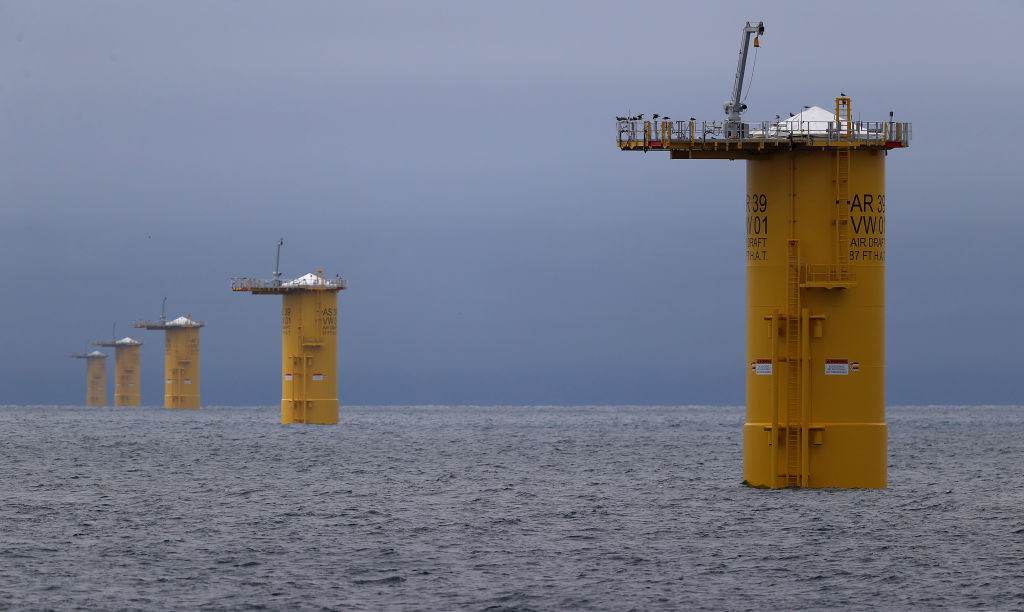
Court orders restart of all US offshore wind construction
Trump admin's "it's classified" ploy put on hold in five different cases.
Ars Technica
497 points · by ck2 · 9mo ago · 428 comments
And what of its negotiating credibility? How can the other side trust that an agreement will hold in the future?
This is not a critique, but a genuine curiosity, because there's an obvious drawback with a system with opposing world views.
Unless, of course, something still unites them in the first place, with acceptable disparity on each side turning it into an advantage of flexibility and adaptability while keeping the focus on long-term ideas and plans.
>...According to Suetonius, Caesar's assassination ultimately occurred primarily due to concerns that he wished to crown himself the king of Rome.[13] These concerns were exacerbated by the "three last straws" of 45 and 44 BC. In just a few months, Caesar had disrespected the Senate, removed People's Tribunes, and toyed with monarchy. By February, the conspiracy that caused his assassination was being born.
https://en.wikipedia.org/wiki/Assassination_of_Julius_Caesar
Congress 53/45 R; House 219/215 R
> creates the laws, the executive
Donald Trump (R)
> executes the laws, and the judiciary
SCOTUS (5-4 R)
> interprets the laws.
So Republicans create, execute, interpret, and enforce the laws. Congratulations on discovering how the party system works. Guess you're Big Poland (PiS) now. You can watch this on the news: Fox (R-Murdoch), CBS (R-Weiss), or read about it in the Washington Post (R-Bezos)
(snark aside, the situation where there's popular demand for authoritarianism is very dangerous, difficult to unravel, but like in Poland, it can be done once the public realize their mistake)
It's the Senate, not "Congress". Colloquially, "Congress" usually refers to the House of Representatives.
>SCOTUS (5-4 R)
> interprets the laws.
Actually, it's 6-3, not 5-4.
I get that you're not from or live in the US. Please understand, I'm not trying to insult or demean you. But you're making statements that are not true.
I believe the term is "FTFY." And you're welcome.
Lower courts. The track record of this administration at the SCOTUS is 90%.
They will simply have less goodwill when an American team is on the other side of the table, and give less benefit of the doubt. (as compared to say if a Swiss team is on the other side of the table)
Seeing what's possible in this position, I doubt future US presidents will hold back.
If, as an investor, I'm asked to throw billions at a multi-year project, political risk is going to be on the PowerPoint.
You may think this current administration is an aberration, but it serves to prove that aberrations can happen. That the levers supposed to prevent this (congress, courts) are creaking. Sure a judge ruled for now, but this is a long way from finished.)
And that's enough to create doubt. Lots of doubt. The impact of this on long-term future infrastructure projects cannot be over-stated.
(Let's leave aside that this project was 6 years in the planning, during his first term, before construction start in 2022... which just makes the current behavior worse, not better.)
I wonder if both parties see the need for that at this point. There still seems a lot of 'but we are the good guys' in both partys blocking deep reform. If I'm honest, it took 2 world wars to partially whack that attitude out of Europe, and it's slowly coming back.
No, it isn't. This administration is a rupture. It is the beginning of a new normal. Future presidents will try to emulate this guy.
You could say "outlier" when he lost in 2020. You can't say that after he came back. The American people wants this authoritarian populism. The SCOTUS enables it. And the world shouldn't trust both the American people and its crumbling institutions.
If you have two parties that have much the same policies you do not get necessary change and voting becomes meaningless.
Often when a new party takes power, no big real changes are seen as it is not so easy to implement considering the real world. They have to go down some kind of middle path.
If you have a jetski which changes direction every 5-10 years that's terrible for long term investment, and terrible from a personal point of view too. Legalise gay marriage, then 5 years later it's oh no, lets make that illegal again.
Best to move to a stable country which isn't run by the whims of a dementia-laden madman.
Political parties are mostly relatively small and under-funded huddles of second-rate individuals, who get told what to do by billionaire-owned media.
It's interesting how many and varied "minor parties" which are more genuinely grassroots have persisted in the UK despite the difficulty in scrounging up funding from the actual public, and despite FPTP being theoretically stacked against them. It's very different to the US, which despite all the talk of Federalism doesn't seem to have local parties at all?
Is it? What stops the next one being an outlier, or the one after that?
Its going to take decades to recover from the whims of the US population (the plurarity of whom voted for this)
What does "recover" even mean?
Are we supposed to back to the good ol' days when the <pick federal agency> could hold a press conference announcing some grand new plan with <pick industry group> key person and <pick billionaire> standing in the background smiling because they know their people ghost wrote it to their benefit and the press would unanimously gush about how good it is if not copypasta the press release entirely?
Institutions are basically bankrupt of trust in the eyes of the public. Between that and the modern information distribution landscape the status quo circa like 1930something-2010something where the administrative parts of the state could "just do things" without organized resistance by the parts of the public that were on the losing end is likely never coming back.
Whatever you, and everyone else, wants to use state power to accomplish will likely have to dial back their ambitions and prioritize in accordance with the new reality of how much you need to fight for each thing, basically realign policy targets to be closer to the fat part of the "what everyone wants" bell curve. Maybe from there there will be a decades long re-accumulation of trust, but we don't know what the world will look like in the future and that may bring us to a very different status quo than the one we're exiting.
I know we all like to whine and screech about billionares and moneyed interests, but I think the new status quo is probably a bigger problem for them and other "string pullers" than the median member of the public who's getting shafted by it. Remember, the "status quo" of the last 100yr is what created the problems we have to clean up today and in the future.
See for example the numerous wars against native Americans in the 19th century; even in some Washington US museum they admin the natives were not wrong when they had to assume any peace treaty was not worth the ink it was written with (and meant "we're only regrouping and will attack again in less than 5 years").
This is notably an area where the US is massively crippled. States can manage many year projects easier, but the federal government must conceal all such projects behind defense spending. Even that is wildly mismanaged (see: all the canceled naval purchases over the last two decades, and we still have an outdated, if large, navy)
We also have endemic corruption siphoning off funds all over the place, ESPECIALLY in the big projects that have the attention of the current administration.
Now, recently, they had a very good run. This must be admitted and even celebrated.
But the aforementioned flaw is still very much present.
Sure, but that's contingent on
1) the voters being well educated and not easily brainwashed by various types of propaganda pushing them to vote against their own interests (see the Germans being anti-nuclear and pro-Russian gas since the 80s) and >
2) the voters being trusted and having an actual ownership in the country so that their votes affect them directly and also having a say in how their country is run, because if whoever gets voted into power just does the opposite of what the voters want "for their own good", then you're not a democracy anymore, you're just a well functioning state (if that).
Other than Switzerland, and maybe Denmark, I don't know any democracies that constantly function well and aren't plagued with issues.
The answer is contract law. Pulling the plug out of a project costs money.
Obviously this still requires a level of sanity which may no longer exist in the US.
Either we live in a democracy or we do not. Democracy determines the correct path by wobbling between two incompatible options - implementation and repeal. That which is implemented by one side, but not repealed by the other survives as the appropriate path.
There is no alternative to this - without abandoning democracy and universal suffrage.
Remember that democracy is the worst way to run a country, except for all the other.
Dozens of new GW+ wind farms came online in the last four years. This concerns a few projects in a few particular locations that are exposed to federal interference. It has impacts on the market but the market is larger than these minor disturbances by an order of magnitude.
> while keeping the focus on long-term ideas and plans.
We have private business in this country. They're doing just fine.
Thats not that much is it given the size and energy demand of the country? And that's over the past 4 years, you'll only see the true impact of this in the next 6 years.
> This concerns a few projects in a few particular locations that are exposed to federal interference
Markets are driven by a lot of feelings too. If you're trying to build a wind farm now, why on earth would you do that in the US? There are just many better options.
Your private businesses will happily skip over the US if they understand markets. Don't row upstream, find a place where your investment is wanted
What is it relative to these 5 projects?
> you'll only see the true impact of this in the next 6 years.
Are these the _only_ new projects that could _possibly_ be built in that time frame?
> a lot of feelings too
The feelings of those with money not of the general population.
> If you're trying to build a wind farm now, why on earth would you do that in the US?
You just said. "The size and energy demand of the country." Or are you proposing that no one would build unless we remove absolutely all risk for them? I'm not sure you and I mean the same thing when saying "private business."
> happily skip over the US
I believe this is a worn out trope. Please show some evidence this has actually occurred.
> find a place where your investment is wanted
Ah.. the "amazonification" of America. "Businesses shouldn't compete or take risks!" You seem to say. We must bend over and make them happy before they can deign to take our dollars. Perfectly modern and utterly ridiculous.
If the Fed falls and monetary policy is subject to the political whims of a tyrant that only cares about himself, then we lost reserve currency stays and we are ducked so hard by simultaneous inability to continue the deficit and a need to pay back interest at far far higher rates. It would cause a spiral in the US economy like we have never seen. Or in the best case just a gradual switch from USD to other standin currencies causing a decade or two of recession in the US, best case.
So far most businesses have not jacked up prices from tariffs because they are hoping they can have the US Supreme Court overturn what look to be obviously illegal tariffs that should have been enacted by Congress rather than the king (we fought an entire revolutionary war over this!). If the Supreme Court doesn't overturn tariffs then we are at risk for inflation going up to 1970s levels.
The state of private business in the US is best represented by the meme of a dog sitting at a kitchen table saying "this is fine" while the house burns down around him. The firefighters may come, but they had better come soon.
Where are you deriving this from?
> is best represented by the meme
Ah.. well that offers a guess.
That's an abuse of the judicial system. Politicians are elected exactly because the voters perceive a need to change the execution of government's functions.
The thing is, you cannot beat human moral qualities with formalist means. People who come to power by raising hatred towards their political opponents will always find a way to subvert policies even if not cancel them.
Long-term policies should be established through consensus among all parties, not though legalistic bureaucracy.
Elected politicians can change laws and rules going forward, but there should be obstacles at changing past laws.
Congress certainly has the power to change this if they want to. But without something like the APA, private businesses exposed to federal regulation would struggle to make any plans beyond the current US Presidential term. So they do not want to.
That's the only way to work around Trump. According to the Constitution, no one can actually make the executive branch do anything it doesn't want to do.
the shape of how things actually work is what’s left when constant churn (and now budget blocking) is a fact of life
Obviously if you hate democracy you'll want to destroy this system, which is what they've been working at for the last 50ish years.
It is an interesting question of what changed in terms of ability to execute, but lack of funding isn't the answer. I suspect it is a combination of scope creep, application to intractable problems, and baumols cost disease at work.
Quite simply the US had founding fathers who were ahead of their time, and some uncharted waters ahead of it.
This set the example for the decent navigators who took the executive positions, but momentum can only last so long.
You need decent people to come along on a regular basis to refresh the progress.
The very system that allowed for a gifted individual to have an outsized positive outcome, has always posed a real vulnerability if the decency is compromised. Whether that is a "natural" lack of decency or if compromises escalate over time, that's a weakness which is magnified when it does show up.
Different presidents have had this problem from time to time.
When you start with a country where the big advantage is being ahead of its time with an emphasis on more decency than average, it doesn't take somebody completely behind the times or absolutely disgusting to do serious damage. Even dropping the ball one time can be a major setback.
Just ask every respectable President in history.
Sadly this is an inherent weakness of the US constitution. It's old and it was written at a time where we didn't have enough experience with democracies.
In a modern parliamentary democracy you vote parties which form coalitions and settle on one of the party leaders (in general the one with most votes) as prime minister.
This means that:
- other parties are still involved in the legislative process. In a presidential republic with the president holding executive power, other parties are not represented at all. Trump doesn't need approval on his actions neither by opposition nor his own party. In a parliament, many members will support continuity on many topics rather than change if it doesn't make sense. They still vote based on their conscience, not just on their affiliation.
- the executive depends on its effectiveness and for staying in power on the support of its parliament members. If some members of Giorgia Meloni's coalition don't like the direction she's taking they are not gonna vote her proposals and ultimately she may need to resign if she gets a vote of no confidence. Removing a president in countries like US is extremely difficult in comparison, and the executive has no checks, neither from opposition nor its own party to go in whatever direction a single individual decides to go.
Seriously, what Belarus, Turkey, Hungary, Russia, etc, all have in common? They are presidential republics. Single individuals hold too much power and have little checks from their own party members, let alone a parliament. It's no coincidence that the last parliamentary democracy to turn into authoritarian state has been Sri Lanka over 50 years ago: it's difficult for individuals to grab power, as there is a long checklist of things that need to happen. In a presidential one?
It's very simple: a single individual can claim popular mandate, building a personality cult is simple (you don't vote parties, you vote individuals), a single individual holds executive power and is very hard to remove.
Presidential republics are more effective than slow parliamentary ones, but we should ask ourselves if our focus in 2020s, in advanced economies where things are objectively fine, isn't slow refinement instead of sharp turns.
(I'm not even American and I know this)
The constitution was meant to be a living document, adjusted over the years as the world changes.
But the very opposite happened, it became Holy Scripture, unchanging and never evolving.
The whole American system was based on the idea that the ruling class cared for "reputation", "honor" or "legacy". It was wholy unprepared for people who just don't give a fuck about all that and actively wipe their asses on existing rules and conventions.
Like going in front of Congress and just ... lying. Provably, verifiably lying. Zero recourse, the shame of lying used to be enough. And because of ancient decorum rules, the congress can't even say "you're lying" and google the facts right there and then, they have to do this idiotic perfromatic dance of asking the same question repeatedly and getting a word salad non-answer back for hours.
Or just not going for the inquiry because, why would you? There's no penalty past "losing face" for not going. Why bother.
The system was flawed from the start, but the people were still in there for the best of everyone so it held together and mostly worked. Politicians respected one another as people and humans, even though they differed in opinion.
I personally can't see a way back for USA without a massive purge in the government followed by actual ironclad laws and processes set in stone to prevent anything like this from happening again. Let congress google basic facts, let them call people liars to their face, give them their own execuitve branch that can drag people for hearings by force if needed.
And copy the German Federal Constitutional Court[0] system, they have term limits and people are nominated through multiple channels.
So you end up talking with individuals where "the 2nd amendment says I can have guns, it's in the constitution" and "my favorite president should go for a third term, the 22nd amendment is just a technicality".
Of course, it never really worked out that way. We're simply at the end of that very long line.
Well, for one by ensuring that 'long-term' means it starts at the start of a term and ends before the end of that term. At most that only rules out nuclear, at least wrt long term energy projects. And it's not like recent dem administrations were unfriendly towards nuclear. Vogtle 3/4 were approved early in Obama's term, and finished under Biden's.
I’m a supporter of it regardless of the cost, but for a “long term” project look at the California HSR, which was directly approved by voters 19 years ago and we’re still debating how to fund the majority of it, let alone actually build what we voted to construct and open in its entirety within 10 years.
Simple. You begin constructing an offshore wind park when someone competent is president, pause the project for four years during Trump's term, and then resume work to complete it.
https://www.youtube.com/watch?v=Tq0LsX_fCm4
I'll believe it when it happens. Traditional 1GW nuclear like the AP1000 is just such a huge financial bite to make these days that the only orgs big enough to do it are large consortiums of large companies, or nation state.
It's a tough position because the AP1000 has a much better chance of reaching affordability than SMRs, but nobody wants to spend the $50B-$100B in capital to produce uneconomic nuclear reactors in order to maybe drive down the cost of construction so that future reactors will be economic.
It's a very different situation for funding than solar, because there's small scale use cases where expensive energy makes sense, in places that wires don't reach, etc. etc., on devices, etc., and that's what really drove a lot of the early development of solar manufacturing capacity. That got it to the point that Germany could do subsidies to really scale up the deployment of expensive energy, and since Germany spent that money, it's been smooth sailing for the rest of the world.
The path for nuclear is not as clear as it was for solar.
"corruption"
The Keystone XL pipeline had been partially constructed before President Biden revoked the permit on January 20, 2021 on his first day in office. About 300 miles had been completed when TC Energy officially abandoned the project.
And Putin. Two men, Trump, Putin and Farage.
Three men, Trump, Putin, Farage, and every far-right party in europe.
Among the people who are clearly involved in this conspiracy to deprive humanity of cheaper energy are...
But a windfall for the litigation financier that buys those claims off the U.S. government.
These leases are contracts. Sovereign immunity is curtailed when the U.S. contracts.
Wind farms produce electricity which pays for the investment when you finish but pays nothing when a stop early. This makes stopping early extremely economically harmful.
Glish supported networked remote procedure calls, made then almost transparent to the program. Otherwise, Glish was roughly similar to Tcl or Lua.
I don't know what other bits and pieces got salvaged from the SSC project.
US corruption.
Incompetence would've been a good news here.
https://old.reddit.com/r/politics/comments/1puwkpj/democrats...
https://old.reddit.com/r/politics/comments/1qu6vyu/trump_cal...
https://thehill.com/homenews/campaign/5716988-democrats-scor...
https://www.npr.org/2026/02/01/nx-s1-5695678/democrat-taylor...
Based on what I've read a lot of people who voted for him subsequent times thought that would continue.
> Several of these projects are near completion and are likely to be done before any government appeal can be heard.
Just gotta keep grinding towards success.
That's basically what the administration was trying to do here, under a legal system which (unlike Venezuela in the 70s) is very keen on protecting corporate investment. It seems like a classic "takings" case.
for Venezuelan oil leases to be comparable to wind farms you'd have to have the Venezuelan govt say "we are taking the leases away because we don't want any more offshore oil production", rather than "we are taking these leases away because you are rich and we want to pump the oil ourselves"
the cancelled Venezuelan oil leases were a taking, but that word is less useful in the case of wind farms. I would imagine firms with wind farm contracts would be made whole (i.e. get back lost investment, but not get back potential profit) but it's not a case of the wind farms being given to somebody else or those areas being put to some other use.
if you are "environmental" you might think it's a great loss not to pursue the wind approach, or that it's a great idea to shut down offshore drilling, but that's political not property ownership/taking.
That isn't a crazy interpretation of what actually happened. According to wiki [0] the industry basically collapsed to 50% of its former production after the nationalisation era and the overall trend since then has been downwards. If a major political contingent in the US sets themselves against wind energy it could easily play out similarly. That'd be in line with other battles in the War on Energy that played out with nuclear and fossil fuels.
[0] https://en.wikipedia.org/wiki/History_of_the_Venezuelan_oil_...
Wait..what? Made whole by whom? Has this happened before?
(I'm genuinely curious, I've not seen this brought up before...)
It's better to have your natural resources stolen than having your whole country wrecked by embargo, secret NSA plots, etc..
Steelmanning the risks, its the link to mainland as a weakness in supply chain of power, compared to onshore sources possibly. But, the construction is in close water, well inside the exclusive economic zone. You would think passage of a craft capable of causing a power shock with an anchor chain was raising hackles well before this, because it's hugely unusual for a warcraft of another nation to be that close without an explicit permit. Under the Jones act, all inshore commercial craft delivering goods to and from named ports have to be US badged, for international shipping it's clear from the baltic there's a concrete risk, but that's a matter of policing the boats, not banning the structures at risk.
A second steelman might be some belief about the intermittency. Thats easily knocked over because the system as a whole is building out storage and continuity systems, is adapting to a mix of technology with different power availability throughout the day, and of all the sources of power, wind is one of the most easily predicted to a useful window forward. You know roughly when a dunkelflaut is expected inside 48h, if you don't know exactly when, or for how long. Thats well north of the spin-up time for alternative (dirty) sources of power, if your storage capacity isn't there yet to handle it.
[1] https://www.nbcnews.com/business/energy/trump-offshore-wind-...
Gas generators can be spun up to provide megawatts in seconds btw. With less than a quarter of the grid being renewable, intermittency is not an issue. Grids are built with resilience in mind (or at least should be...).
Only if they're already spinning and everything is hot and ready.
Non-spinning reserves can take hours to bring online. Cold power plants cannot be brought up quickly. The simplest designs can ramp within a few minutes, but these are generally not intended for any kind of continuous operation due to efficiency concerns.
ie. They can nibble a bit at an array before you're onto them Vs everything gets thrown at a point source target.
I thought fields had 100s of square km of extent too. The exclusion zone after nordstream is now pretty big, albiet "temporary" according to the web its 5 to 7 nm so 9 to 13 km so close to 100 km^2
No it does not. Even if you'd manage to disable an entire wind farm, the impact on the grid as a whole is negligible. An attacker has to spend a whole lot of effort on such an attack for very little, if any at all, gain.
In contrast, shell a port or the right piece of infrastructure [1] and entire economies can get wrecked. And shell an oil rig... I mean, I seriously hope even the Russians don't sink that low but hey they did attack a goddamn NPP and a hydropower dam... anyway, taking out an oil rig risks an environmental disaster similar to Deepwater Horizon. That's a lot more effect for an opponent.
The actual threat to wind farms is software. We've seen that in the early days of the Russian invasion of Ukraine - the Russians took down satellite modems [2], causing about 6000 wind turbines to lose their command infrastructure and thus stop generating power.
[1] https://en.wikipedia.org/wiki/Francis_Scott_Key_Bridge_colla...
Its completely in-line with his personality to hold onto personal grievances for decades to the point that they become policy.
I feel like much of what he does today can be directly attributed to the epic roasting he got from Obama at the correspondents' dinner. Most of us would be absolutely honored by being roasted by the sitting president, but he seemed at the time to take it very personally.
Not just the fact that Scottish wind farms prevailed, also that he was relentlessly mocked, ridiculed, and protested against in unavoidably visible ways by the Scots.
https://www.youtube.com/watch?v=-NNWmZwObZc
( Note: while a recent youtube clip, the anti Trump protests in Scotland date back to well before his campaign for his first term as POTUS )
To speculate on what this risk is, the two obvious risk I can think of would be:
- Susceptibility to seabed warfare[0]. A rival nation can sabotage the infrastructure and maintain deniability, like we have seen with the Nord Stream sabotage[1].
- Potential interference with passive sonar systems, the turbines are likely to generate a fair bit of noise, which could potentially make it harder for SOSUS[2] to detect rival submarines.
[0]: https://en.wikipedia.org/wiki/Seabed_warfare
[1]: https://en.wikipedia.org/wiki/Nord_Stream_pipelines_sabotage
The former is a threat vector but one that can be priced into the ongoing maintenance costs.
We didn't see that with Nord stream. It was not a rival nation, but an allied one unfortunately. And Germany did nothing. Zero.
You don't always need to present the other cheek to do right. Neither do you always need to retaliate.
Nord Stream finally made it clear to Germany that "convenience" isn't a durable energy market strategy.
It's not correct though that Germany has done "nothing". The suspects are pursued by Germany, https://www.dw.com/en/nord-stream-poland-blocks-extradition-... so there's that.
If you mean though whether there's a will in Germany (nevermind a commitment or funding) to rebuild Nordstream ... you're right, nothing has happened
Convenience, and cheap gas, was definitely a good strategy. Up until the point where our ally, the USA, would try to get Ukraine to NATO, provoke Russia to invade, and then help the Ukrainians blow up the pipeline.
The world is moving away from the US and I really cannot wait. They have done much more damage globally than good.
The only way they can keep their jobs working on vastly inferior, dangerous technology is to ban new, safer, better technology.
Different as from a distance but still a lot of applicable skill and team work experience transfer for many workers.
https://www.uppermichiganssource.com/2026/01/29/tim-walz-say...
> MINNEAPOLIS (Gray News) - Minnesota Gov. Tim Walz said he will not run for elected office again.
> Walz touched on his political plans in a recent interview with cable news channel MS Now.
> “I will never run for an elected office again,” Walz said. “Never again.”
> The 2024 Democratic vice-presidential nominee said he plans to “do the work” while finding other ways to serve the country.
But I think Mark Kelly is likely to be a top-tier candidate from the jump. He's not my favorite of the bunch, necessarily, but I'd consider putting money on him being the Democratic nominee in 2028.
https://www.yahoo.com/news/articles/gavin-newsom-short-circu...
> “Republicans should say, ‘We want to take control of this. We need to take control of voting in at least 15 places.’ Republicans should nationalize voting,” [Trump] said on the podcast of former FBI deputy director Dan Bongino, which was relaunched on Monday.
It means Trump is sucking the oxygen out of the room. Again. I wish we would quit reacting to every stupid thing he says.
People are fed up. Assuming there will be free elections - as absurd as it is to even write this sentence referring to the US, but here we are [2] - it most probably will end in an utter wipeout for MAGA. They'll have the President, of course, but assuming the Democrat leadership finds some spine - again, an assumption, given Schumer - stuff has the potential to change.
On top of that are state and local level elections that are all the time. Stuff like school boards, sheriffs, whatever that is where MAGA and the Evangelicals built out their initial networks. All of that can be flipped around as well, if people actually bother to show up and vote.
[1] See https://en.wikipedia.org/wiki/List_of_shootings_by_U.S._immi... - it is notable that widespread outrage only followed after the execution of Renee Good and Alex Pretti
[2] https://www.theguardian.com/us-news/2026/feb/02/georgia-fult...
It's a shame that the US is being actively sabotaged by Republicans and Trumpists and people will continue on because saying that is apparently a capital-p Politics and not an objective fact.
the post i replied to didn't present any substance either
there's serious ecological problems with these turbines, the materials cant be recycled, and their uninstallation is incredibly costly
they just don't seem like a great source of energy
At least with Trump, there is no more pretending. It's gas, gas, gas and pollution.
Government lawyers: "Uh, well, we could tell you, but then we'd have to kill you."
Now, I would point out how the US is making itself into a joke, but I'm afraid the joke's on us, because carbon output is not decreasing dramatically like it must, and the effects of global warming will, slowly but surely, become worse with every passing year. I live in a region where warming is predicted to be near twice the global average, so I'm particularly worried about what it's going to be like when I'm old, or in the generation following mine.
1. Freedom — free markets, minimal regulation Early USA had both political and economic freedom. Modern China has only economic freedom (plus heavy protectionism).
2. Dictatorship of a certain group Modern USA and the Western world have a dictatorship of lawyers, regulators, and ideological enforcement. Communist China has straightforward political dictatorship. As you can see, it's not black and white. China struggled when they had both economic and political dictatorship, but thrived once they introduced economic freedom.
3. It's always a race, freedom of the past is not enough. What the West should do is focus on better planning, less politics, more economic freedom, and a dictatorship of data-driven decisions instead.
Wind also works better in some areas that don't have solar. UK has a lot of offshore wind, but less solar. The US Northeast has a lot of wind but lags behind on solar.
Wind has dropped significantly in price over the decades and is competitive in price with solar. I saw article about early Scottish wind farm being upgraded so that one new turbine equals the whole old farm.
The rich/old paticularly hate wind because they do not like looking at it. (The link to golf courses is not by accident. Wind farms and golf course tend to appear together due to them both gravitating towards areas with shallow waters.) We still here stories about blinking shadows interupting sleep cycles, even causing cancer. So perhaps we let them alone for another decade and allow solar+storage to take up the slack. Then, when the nimby people are no longer in power, we bring back wind.
(Shallow sea means no commercial traffic/ports. That means cheap land for non-industrial things like yacht clubs and big houses, which give rise to golf courses. So the rich/old dont like seeing the wind farms that, inevitably, want to live just offshore of their yacht/golf clubs. See Nantuket.)
In what way?
> Solar can be placed much closer to consumption, literally on the roof of the consumer. Wind exists in large farms away from cities.
You still need the grid to exist, so 100 miles one way or the other doesn't affect cost very much.
> Then, when the nimby people are no longer in power, we bring back wind.
NIMBY never goes away. There are some situations where you don't want to burn up your political capital fighting them, but in general if you can get a project through then do it.
With solar you get to overbuild it and charge you batteries once a day. Wind has way more peaks and bottoms, so you can sell your battery capacity several times most days.
But the GPs point is exactly that you need fewer batteries if you have both. Fewer batteries tends to be cheaper than more, and this pair is a very common case.
You are proposing something that sounds like killing the US wind industry and then simply bringing it back later. That probably would work well, especially when projects have development lead times of several to many years.
> Let them cancel the wind farms if that means a free hand to develop solar.
That's not actually a bargain anyone has the power to agree to in a binding way. The people protesting the appearance of wind farms are on the coasts, the people protesting solar are in the country's interior. There's no "deal" you can make to get the latter instead of the former. Just build all the power generation and then we'll have cheaper electricity and a more resilient grid.
multiple energy sources are what is important to make up for where solar falls short. sure solar is amazing, but it will never replace everything on its own
Solar + battery is just so good at staying stable and productive for decades with no moving parts, minimal maintenance, and unbeatable scalability
https://www.ercot.com/gridmktinfo/dashboards
And that's in Texas where there is tons of sun and wind. I would imagine markets where wind, and in particular off shore wind, could make a lot more sense compared to attempting 100% solar generation. If I had to wager, maybe where they are building offshore wind generation..
Solar PVC output directly and immediately correlates to sun landing on the panels.
Solar thermal runs well into the evening, and its output is not impacted by the occasional cloud.
Then there’s the cost, which has not been good for CSP’s market share.
Also, wind and solar have different production patterns, such as how they perform seasonally, how weather affects them, and how they perform at different times of day. You are much better off including a good mix of them in your system.