70 points · by bookofjoe · 9mo ago · 86 comments
Any additional fragments of Hipparchus' works is of great interest to the history of mathematics and astronomy.
Apparently the only pre-modern people (i.e. pre-Giordano Bruno) recorded as making the claim were Anaxagoras and Aristarchus of Samos [0], but their ideas were completely rejected by contemporaries.
In retrospect, it just seems so blindingly obvious that I'm tempted to believe that I too would have seen through the Aristotelean BS.
But surely there must be aspects of reality that will seem similarly obvious to future generations, and yet I don't feel any insights coming on.
I should say, Aristarchus is the ideal of maximizing information from minimal data:
>Aristarchus of Samos (Samos is a Greek island in the Aegean Sea) lived from about 310 to 230 BC, about 2250 years ago. He measured the size and distance of the Sun and, though his observations were inaccurate, found that the Sun is much larger than the Earth. Aristarchus then suggested that the small Earth orbits around the big Sun rather than the other way around, and he also suspected that stars were nothing but distant suns, but his ideas were rejected and later forgotten, and he, too, was threatened for suggesting such things
Sadly, Aristarchus's hunch was way ahead of his times and one could not convincingly explain the absence of screaming winds, absence of stellar paradox, could not convincingly explain why weights dropped from a height were not left behind as the Earth below spun away at fantastic speed.
In this duel of ideas I think the critics of Aristarchus's idea's were great scientists as measured by current standards, although they were wrong, they were wrong for the right reasons.
There were some minor discrepancies, that bothered experts in the late middle ages, which let to Copernicus. But even he could not convincingly solve them. (In his theory the Sun is not at the center, but the mean Sun, as is the center of Ptolemaios deferent not exactly the Earth.)
With Ptolemaios, however, cosmology had stabilised to such an extent that the fundamental questions had found their answers and astronomers turned their attention to practical issues and refinements, such as calendars and the related problem of the very odd movements of the moon. (You need Newton and gravitation to solves this, more or less.)
The Ptolemaic system is an adhoc form of Fourier analysis (circles upon circles). These are universal approximators (another universal class are the neural networks) of (preferably smooth) periodic functions. So with enough epicycles one can fit any complicated periodic motion. But it will not help extrapolate the motion of Pluto from the motion of Jupiter, it's a data fit description, not a causal description.
This is also why I worry about the recent trend of using DNNs in astronomy. We may go Ptolemaic with them.
That being said, I also believe that the ancients were well-aware that our Sun is a local star. And by extension, that stars are distant suns. I have been doing research on the Star of Bethlehem, and it is painfully, obviously clear that the Star sought by the Magi is the Sun itself, since when they met with Herod, they first described Springtime (late April through June) and then the Winter Solstice as they pursued the Sun to Bethlehem. Furthermore, anyone traveling for seven months, and only at night, in the ancient world, while bearing priceless treasures, would have been fools, unless they also carried torches, weapons, mercenaries, and medical supplies. Furthermore, any Hellenistic pagan reading the New Testament would've clearly discerned the identification of Jesus with the divine aspects of Phoebus Apollo (among other Olympians); the Sun metaphors continue to the present day. The Star of Bethlehem simply cannot be distant, dim, or anything but our own Sol.
Anyway, yeah, recently the descriptions of the large-scale copying at the Port of Alexandria has convinced me that the Library amassed a gigantic collection of knowledge and texts, and those were, for the most part, safely transferred "by angels" to Sinai when the time was right. And palimpsests notwithstanding, there are still tons of texts still unread, unindexed, and undiscovered in there.
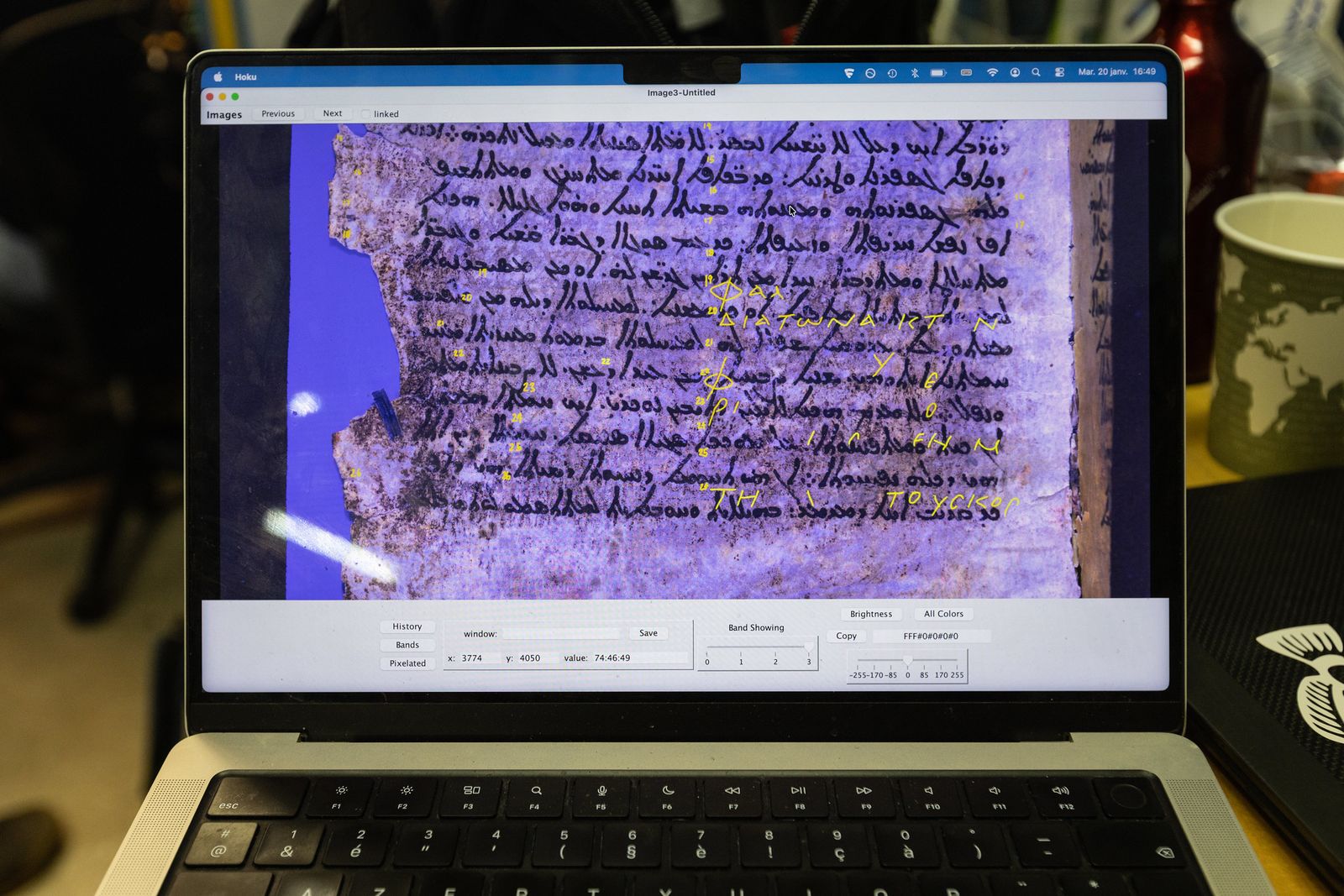
Maybe if the solar system had more than one star, or there were other stars very close, people would have caught on a lot quicker.
Pt 1: https://www.youtube.com/watch?v=YdOXS_9_P4U
Pt 2: https://www.youtube.com/watch?v=hFMaT9oRbs4
Commentary and Corrections: https://terrytao.wordpress.com/2025/02/13/cosmic-distance-la...
Apollo 13 astronauts used this method, works pretty well
The writings of St. John Climacus were also far more useful and interesting to people at the time since they dealt with what for them were practical matters of how to lead the life of their community. This isn’t because they were narrow-mindlessly religious. Monks also had to busy themselves with calendrical calculations — and therefore astronomy. These were works of what we would call practical philosophy or ethics, like the famous Meditations of Marcus Aurelius. It would also have been tragic to potentially lose those culturally significant writings in favor of astronomical or mathematical texts.
Also, the monks and scribes creating palimpsest were not thoughtless. In the West we enjoy a very wide collection of ancient texts specifically through the diligent work of making and distributing copies. They were remarkably literate and intentional in their work.
A lot of these palimpsest were not entire books, but fragments or loose pages that had built up over centuries and then bound and repurposed. They were not any more sentimental with them than you would be with a pile of old journals from a thrift shop. A collection of celestial observations done by the eye were certainly not of particular interest to them.
https://en.wikipedia.org/wiki/The_Ladder_of_Divine_Ascent
According to this article his writings pre-date the Islamic conquest (639).
Of course, there was also this: https://www.sinaimonastery.com/index.php/en/history/mohammed
And St Catherine's is a fortress in the middle of the desert so who knows what it's status was, it was an interesting time (beginning of Islamic conquests).
All of this is valuable, both the cultural knowledge and the scientific. I doubt the monks realized the gravity of their choice so long ago.
Okay just kidding, but also people stealing what they think are good ideas, discarding the rest, and passing off what is passed along as their own? Everyone does that. Anyone who says different is blind to their own behavior.
I mean, the star chart was probably something equivalent to a text book for us. Many texts were uniquely preserved at St. Catherine's since they had Mohammed's letter of protection not to mention being a fortress in the middle of a desert.
At the time the monks probably thought it was a common enough text to not worry about.
This is not to say that tons of material was not lost, or only preserved in other places (e.g., Islamic states in North Africa and the Middle East), but it ignores the learning and innovations of the medieval period (scientific, legal, theological, etc.), and of course the fact that so many classical texts were only preserved because of those monks copying them down.
Not all the Middle Ages were really Dark, but some of them were.
> It assumes people in very different places for 1,000+ years did the same thing and had the same views
But that was true, wasn't it? The Dark Ages started when Christianity spread through most of Europe. And really completely ended only when the Reformation fractured it.
And sure, the Reformation was made possible by internal forces within the religious institutions, slowly building ideological foundation for it.
> But that was true, wasn't it? The Dark Ages started when Christianity spread through most of Europe. And really completely ended only when the Reformation fractured it.
1. Political, economic, cultural, and even religious systems would vary drastically by place and time in Europe. The lifestyle and thoughts of an English peasent in 600CE would be drastically different from the lifestyle of a Spanish or Frankish one, and would differ even more so between 600CE and 900CE.
2. The "Dark Ages" traditionally started when Rome fell in 476CE, long before Christianity had spread outside of traditional Roman lands.
3. The Reformation didn't start until the 16th century, long after the Dark Ages are considered to have ended. Generously you could say it started with the Hussites in the 1400s but that's still skipping over the Renaissance entirely which is the absolute latest end for the Dark Ages since the whole point of it as a historical context is "rediscovering" the Classical works.
No, it is not. As Stryan noted in another response to your comment, the idea that medieval Europe was somehow one uniform culture is incorrect.
I would also add that the term "Dark Ages" is used in different ways by different people. People who don't know much about the Middle Ages often use that term to describe the whole of the Middle Ages, from roughly the fifth century to the end of the fifteenth (and Christianity had already spread around the Roman Empire by the fifth). Others just the early Medieval period (about 500 to 1000). Some limit the term to periods where we just don't have many sources, or it is perceived that we don't (e.g., I've heard it applied to Visigothic Spain).
Fourteenth-century Humanists (who lived at a time often considered to be part of those so called "Dark Ages"!) first used the term to contrast what they thought were the centuries between their lives and the classical period. They even went so far as to emulate the handwriting of the classical texts they favored, thinking they should because that's how the Romans wrote. They didn't realize they were copying eighth- and ninth-century Carolingian hands instead, texts copied by monks and clerics and court scribes because they valued them. (Lower case letters in modern languages that use the Latin characters, like English, are still based on Carolingian minuscule.)
1000-1400s AD was a period of extremely rapid (by historical standards) economic, societal and technological progress. Just compare with the highly stagnant (in relative terms) Roman Empire between 0 AD and 400 AD. It was the opposite of the dark ages…
500-800s AD were not great, but plague, climate change and extreme political instability likely had a bigger impact on that than Christianity…
Most cultural phenomena, be is classified as religious, philosophical, political, etc, are double-edged swords. The transition of the Western Roman empire to a succession of leaders from outside that tradition did lead to major losses in living standards of most Europeans. On the whole the root causes are certainly multi-factor such as large epidemics [1] and reflect significant susceptibilities in Roman culture. Many of the seeds for the Renaissance were held safe in the religious monasteries of the Medieval period and Cahill makes the case for the extremely remote Irish redoubts as making a critical contribution. If they made errors in which palimpsests to overwrite, well it is a pity that there wasn't a St. Linus of Torvalds there to save them with git.
0. https://en.wikipedia.org/wiki/How_the_Irish_Saved_Civilizati...
That’s not that clear, at least when it came to the median European. Amongst other things demographic collapse usually results in higher living standards in agricultural societies due to there being more land per capita.
I don't think it is right to say that population loss usually results in higher living standards due to more land per capita. For one, in a pre-industrial society agriculture is labor intensive and the amount of land that can be worked by a person does not scale with land availability. The Black Death [1] economic section works out some of the less than positive impacts.
For example, monasteries were the primary centers of literacy and education in Europe during the early middle ages, and they acted as the primary bridge for the survival of Greco-Roman intellectual heritage in the West. Not always intentionally, but they were the only sanctuary for books during those times.
Besides, this is not how history works. Civilizations come and go and times of transition always take a toll. An eye-opening recent book on these questions I can recommend is Tom Holland's "Doninion: The Making of the Modern World".
There might have been some hope that it could gradually transition to a somewhat more modern style of economic development, but this was hindered by the Barbarian invasions especially of the Huns, so this whole dynamic only really took hold much later, in the Middle Ages.
Not sure the Huns were the biggest direct threat either (unless we think that they are directly responsible for the Gothic migrations/invasions who were the ones who took over significant parts of the empire).
Of course there were significant regressions but the Roman world wasn’t exactly some pro-science utopia. Where do you think Christians got the idea of burning witches?
Climate change, the plague and extreme political instability (that already was ripping the Roman world apart for centuries) and the resulting societal, economic and demographic collapse pretty much made the dark ages inevitable (and the church was the only thing keeping the lights on however dim they were).
Witches and "cunning folk" are people who use metaphysical, occult means of spirituality to influence people and the environment. Witchcraft does not appear, to the dispassionate observer, to be scientific, evidence-based, or empirical at all.
Christendom was in the business of supporting many liberal arts and sciences, in terms of architecture, literacy, mathematics, chemistry/alchemy, exploration, R&D and building of war materiels and sea vessels.
It was the witches who were meddling and using occult means, such as divination, augury, psychological manipulation, and treachery to achieve their ends. It was witchcraft that was chaotic and working against orderly scientific inquiries about the natural world.
The witches were typically working clandestinely, stereotypically in a little hut in the woods, in the shadows. The scientists of Christendom were founding and running universities, seminaries, hospitals, and other institutional centers of learning. They were highly organized and orderly endeavors, and witchcraft threatened the natural and political order of things, which seems to be what science represents, even to the present day.
It's true that the collapse of the Western Roman Empire led to a regression in social order. To blame this complex collapse entirely on Christianity is overly simplistic. There's obviously some casualties during this period of upheaval (like the Palimpsest you mentioned), but if anything the early Christian monasteries deserve some credit for preserving knowledge during this period of tremendous upheaval.
Many have also pointed out how Eurocentric this view is. Mathematics and science continued to flourish in Arabic and Chinese places of learning as well. Algebra, modern astronomy, and the printing press did not pop out of the aether the moment Europeans decided to start printing Greek gods again.
How to do real research, when you have to align every insight with some old book or face the stake? Only very restricted, in secrecy and not in open exchange.
So also in non christian societies people were killed for having the wrong ideas, but comparing greece or early rome with the christian empires, it seems obvious to me why progress was slowed down for so long.
Rome's culture and traditional was fundamentally broken; it no longer served the needs of the Roman people, and if Christianity hadn't popped up, it would have been some other system of reform instead. The status quo was unstable, rapidly deteriorating. You may idealize the religious tolerance of their polytheism, but what that matter if it isn't actually serving the spiritual needs of the people?
I see you're one of today's lucky 10,000! https://en.wikipedia.org/wiki/Diocletianic_Persecution#Great...
I’m not sure there necessarily was that much progress before that, though? With some exceptions ancient societies were highly stagnant especially technologically in contrast to high-late medieval Europe.
Also plague, climate change and demographic collapse kind of directly kickstarted the dark ages.
This is a modern view with hindsight bias. In the ancient world, the existence of many gods did not imply peaceful co-existance, but very heated rivalry and politics.
Ironically pagan authors of late antiquity were the "conservatives" in our modern sense. Pagan literally means "farmer" - it might have similar implications to how we would call someone a "redneck" today. At the time, they were opposed to foreign gods and new influences on their traditional and respectable Pantheon.
St John Climacus' writings are some of the most interesting in the history of Christianity. Probably the most mystical of all Christian writings and give an amazing insight into the history of Christian monasticism. Also still held in high regard for sure in the Orthodox Churches.
We also need to consider that these sorts of texts did survive because of monks. They kept the embers alive. Without them, we would have nothing, not living among the stars.
As it is we have cabals of bankers and technocrats applying every mathematical and scientific advancement in attempting to construct their own version of global authoritarian priest classes. For now it stands they are only being held back by the other things learned from other humanist disciplines...
Darkly amusing is the Vatican. Reading about piety, service, generosity and kindness while beggars suffer at the entrance queue. The contrast between words and actions couldn’t be more striking.
Begging barefoot at zero degrees, poor health, dirty and miserable. I don’t see this as anything other than grinding poverty.
If I’m wrong, a sum that doesn’t matter to me was grifted.
Your explanation is convenient for the conscience.