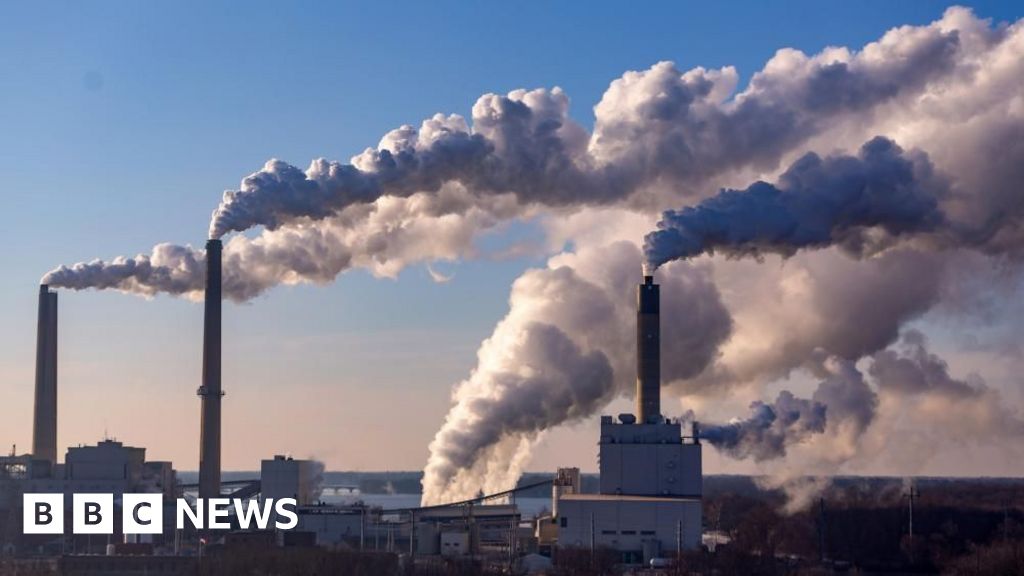
Trump revokes landmark EPA ruling that greenhouse gases endanger public health
The White House calls it the largest deregulation in US history, but environmentalists say it will prove costly for Americans.
bbc.com
116 points · by saikatsg · 9mo ago · 67 comments
So the executive branch has assumed a lot of functions that by right belong to the legislative branch. That's not great, but it has mostly worked out, because the executive branch is made up mostly of bureaucratic civil servants who really just want to do their jobs.
There were always appointed political functionaries at the top of the departments, who in theory had a ton of power but in practice frequently deferred to the subject matter experts within the department.
But that was always tenuous, and now that has broken. Which means that a single dimwit can override all of the experts. They always could, but were generally smart enough not to.
It honestly feels like we are adrift at sea, nobody sensible is in change, and there is little way to get back in control of our destiny. I suppose this is what it felt like for most sensible folks for most of history before liberal democracy took hold.
A lack of government functioning isn’t a dysfunction, it is an active plan perpetrated by the absolute worst kinds of people And if you feel disillusioned and like “government doesn’t work” - that’s by design by exactly one party. The democrats frequently don’t help themselves, likely because they know they still need money to win elections. But they aren’t actively trying to subvert democracy.
Ultimately we either overturn citizens united, and ban basically all lobbying, or the only way i see this ending is unfortunately through violence. Over the last two months I think a lot of Republican representatives are starting to feel the same way.
Global climate change is something that will be fixed by technology.
It's 2025... You'd think malthusian thinking does decades ago, but I guess not
I mean, presumably some future Democratic administration will reinstate the rule. But with this precedent set, this might become a switch that turns on and off every time the political winds change. When Republicans are in power, the US will do nothing at all to fight climate change. When Democrats are in power, they will belatedly try to undo the damage.
And of course there will be knock-on effects from other countries. Why should (for example) Mexico do anything at all to fight global warming, when the US (which is much richer, and a much larger polluter) declines to help?
Consider it a case study in governance failure. The US' failure is China's opportunity, and they appear to be taking it.
Ember Energy: China Cleantech Exports Data Explorer - https://ember-energy.org/data/china-cleantech-exports-data-e... - (updated monthly)
Our World In Data: Tracking global data on electric vehicles - https://ourworldindata.org/electric-car-sales (updated annually)
Bloomberg: China’s Four-Year Energy Spree Has Eclipsed Entire US Power Grid - https://www.bloomberg.com/news/articles/2026-01-28/china-s-f... | https://archive.today/H0oos - January 28th, 2026
Ember Energy: The EV leapfrog – how emerging markets are driving a global EV boom - https://ember-energy.org/latest-insights/the-ev-leapfrog-how... - December 16th, 2025
Ember Energy: Over a quarter of new cars sold so far this year are electric as emerging markets reshape the global EV race - https://ember-energy.org/latest-updates/over-a-quarter-of-ne... - December 16th, 2025
Ember Energy: Solar electricity every hour of every day is here and it changes everything - https://ember-energy.org/latest-insights/solar-electricity-e... - June 21st, 2025
Bloomberg: The World Hit ‘Peak’ Gas-Powered Vehicle Sales — in 2017 - https://www.bloomberg.com/news/articles/2024-01-30/world-hit... | https://archive.today/p2hl1 - January 30th, 2024
Bloomberg: Electric Cars Pass a Crucial Tipping Point in 23 Countries - https://www.bloomberg.com/news/articles/2023-08-28/electric-... | https://archive.today/e8XSt - August 27th, 2023
https://news.ycombinator.com/item?id=46544375 (citations)
https://news.ycombinator.com/item?id=46423660 (citations)
Global Trade Is Leaving the US Behind - https://www.bloomberg.com/opinion/articles/2026-02-12/on-tra... | https://archive.today/CFwlf - February 12th, 2026
(no dogs were harmed in the course of this comment)
In recent years the Supreme Court has turned against the use of regulatory agency rule making authority to stretch the meaning of older statutes and accomplish what Congress is too gridlocked to do. Most notably was the 2022 decision striking down Obama-era EPA power plant carbon emission limits (https://en.wikipedia.org/wiki/West_Virginia_v._EPA), but there are many other decisions in a similar vein (e.g. overturning Chevron), and more coming down the pipe (see https://www.scotusblog.com/2024/10/supreme-court-allows-epa-...).
Between SCOTUS decisions limiting how older statutes can be reinterpreted to encompass global warming on the one hand, and fundamental economic incentives on the other (the West Virginia decision didn't result in a rush back to coal), this move by the Trump administration is unlikely to change the course of things, except to perhaps spur Congress to involve itself more heavily one way or the other.
Rather than handwringing, the left needs to finally accept that relying on lawsuits and aggressive Federal regulatory agencies, rather than the ballot boxes (plural--not just the presidential election), to enact their social and environmental policies is no longer viable. But it's going to be a difficult change because the Democrats sacrificed a ton of grass roots support (real, substantive support, as opposed to professional class and social media popularity contests) as they came to rely almost exclusively on imaginative legalistic and technocratic solutions, an evolution that started decades before the courts took their sharp conservative turn.
I, for one, invite diminished environmental regulatory agencies. In so far as it concerns global warming, renewable energy, and land use (e.g. mass transit, housing, etc), they've become impediments much more than enablers of (net) environmentally friendly change. What does it matter if an agency favors one set of policies over another when it takes years if not decades for projects to make it through the thicket of red tape? For energy policy specifically, the economics favor renewables, so less regulation can only hasten the transition.
Do you really want Congress to use legislation to make decisions about day to day technical rules and regulations that they quite obviously have no chance of understanding?
The whole point of the administrative state is to put non-political experts in charge of hashing out the specifics of rules and regulations while Congress legislates the broad process of making those rules.
An analogy to “making Congress do it” would be like if you had to raise every pull request you wrote to the board of directors of your company and check if they were okay with it. That is insanely inefficient and your board of directors would make the wrong decision most of the time. Instead, your company’s board of directors hires competent people and sets the general goals of the company and directs everyone to work toward them, trusting them with the implementation details and putting in places systems that ensure good performance is rewarded.
In the past we just trusted presidents to operate at some bare minimum level of basic good faith that they were non-traitor citizens who actually wanted this country to succeed, rather than being completely apathetic to the future and viewing American society purely as an asset to exploit.
The idea of a president who would make the country worse on purpose, going as far as making it worse for the wealthy in addition to common people, was unheard of.
But then we elected the New York Russian mafia’s real estate guy. And now we have found out that it’s very likely that his best friend’s sex trafficking operation was potentially used to compile kompromat [1]. The probability that the Russian intelligence apparatus is directly instructing Trump to sabotage the geopolitical position of the USA is astronomical. Part of that sabotage is almost certainly the dismantling of the administrative state.
Call it a conspiracy theory if you want, but we’ve crossed this conspiracy theory bridge many times with Donald Trump and he has never really given any of us a good reason to not trust the idea that “oh, it’s actually worse than we thought…”
[1] https://www.aol.com/articles/exclusive-spy-jeffrey-epstein-p...
> With a divided Congress unable to agree on legislation to tackle rising global temperatures, the EPA finding became central to federal efforts to rein in emissions in the years that followed.
Trying to get the right outcome via (arguably) the wrong process has left these policy initiatives sitting on wobbly foundations and subject to reversal. Moreover, it provides ammunition for those who would rally their base with criticism of the "technocratic elite."
Easier said than done, but Americans need to fix their democracy. If the majority of Americans want action on climate change then Congress must reflect and enact the will of the people.
A magician makes you look where they want while the magic happens elsewhere.
I would be surprised if he was not in charge in 2030 still. It seems everybody else ate too much plastic too be able to think straight.
At this point I would be surprised if he wasn't still there in 2036.
Unrelated, but it reminds me that he captured maduro, and Chavez and maduro were able to stay in charge by destroying the Congress, support of lobbying companies and accusing other parties of corruption and frauding the elections. Because of that, like many others. He was able to push elections far from view and there was always a war to be fought or an enemy to defend against. At some point, I kid you not, those guys accursed every single immigrant living in Venezuela of being a conspirator. All those who questioned any of this were accused of treason and the army was right there to defend the president. Sorry I mean country. Maduro lost too much gas to keep it going
But who cares about science, or humanity for that matter, so long as big companies can increase their profits and keep greasing the wheels of corrupt politicians!
If this is true, that is a monstrous 5% of an average new vehicle. And it's not just the cost of the vehicle, emissions equipment also can make the vehicle slightly less reliable, especially diesel engines, so it's likely to reduce the cost of vehicles by more than the initial 5%.
----- edit since I am throttled -----
I know for a fact the prices are lower non-emission vs emission. I own a tractor that is detuned 0.1 HP under the emission limit and with zero emissions controls. They sell the exact same tractor with the exact same engine with a fuel screw turned up over the limit to increase hp, plus emissions controls, and it's about $4,000 more. Manufacturers absolutely will charge more for emissions models than non-emissions models.
(And Leavitt is hardly a reputable source.)
This is flawed logic.
BMW tried charging a subscription fee for heated seats (https://www.thedrive.com/news/bmw-commits-to-subscriptions-e...). All the cars had the seat heaters; "exact same [car] with the exact same [seats]". (I'd also note that you yourself acknowledge that people are paying for the extra horsepower, not the emissions controls.)
You're describing https://en.wikipedia.org/wiki/Price_discrimination, not necessarily an actual difference in the BOM.
If it was actually about "price discrimination" they would do something to stop you from tuning them back to the full horsepower other than "please definitely don't do this thing we made it super easy for you to do, hint at in your repair manual, and is plastered all over youtube probably indirectly by advice of our own mechanics."
To use your BMW analogy, it would be "we put a screw to turn on the heated seats, but please don't do that". That would not indicate someone actually seeking price discriminations, but rather providing people a way to save money getting around an expensive rule, but also they will charge you $4000 if you really want to comply with the law and add a big "save the environment" doohickey on to the seat heater.
----------- re: below due to throttling-----------
You cutoff my quote to change the context of what I was saying. Preponderance of the evidence is pretty clear what you're saying doesn't apply here, even if it applies to something else.
No, not necessarily. Plenty of price discrimination is the exact same thing sold to different crowds at different prices, like pink razors or "dude wipes".
https://en.wikipedia.org/wiki/Pink_tax / https://en.wikipedia.org/wiki/Dude_Wipes
Or how Teslas let you pay for more range in an existing car, with no physical difference, just some code. https://www.nytimes.com/2017/10/27/business/teslas-pricing-h...
CEOs want to maximize their golden parachutes and their stock value ... prices will be the same or go up. USA capitalism is about maximize profits not the buying power of their citizens.
Are you fantasizing that they'll reduce the price of cars because of this and somehow benefit people?
And they'd have to take the time to redesign. And Democrats will (hopefully) reinstate it in a few years, and carmakers probably recognize that. Along with the threat of legal challenges by environmental groups.
And, further, if we eventually do get these inefficient polluting cars - who's going to want to buy them? They certainly wouldn't be able to sell them in same countries. Seems pointless overall for carmakers, generally.
Just a gift to polluting corporations and billionaires who want profit at our expense.