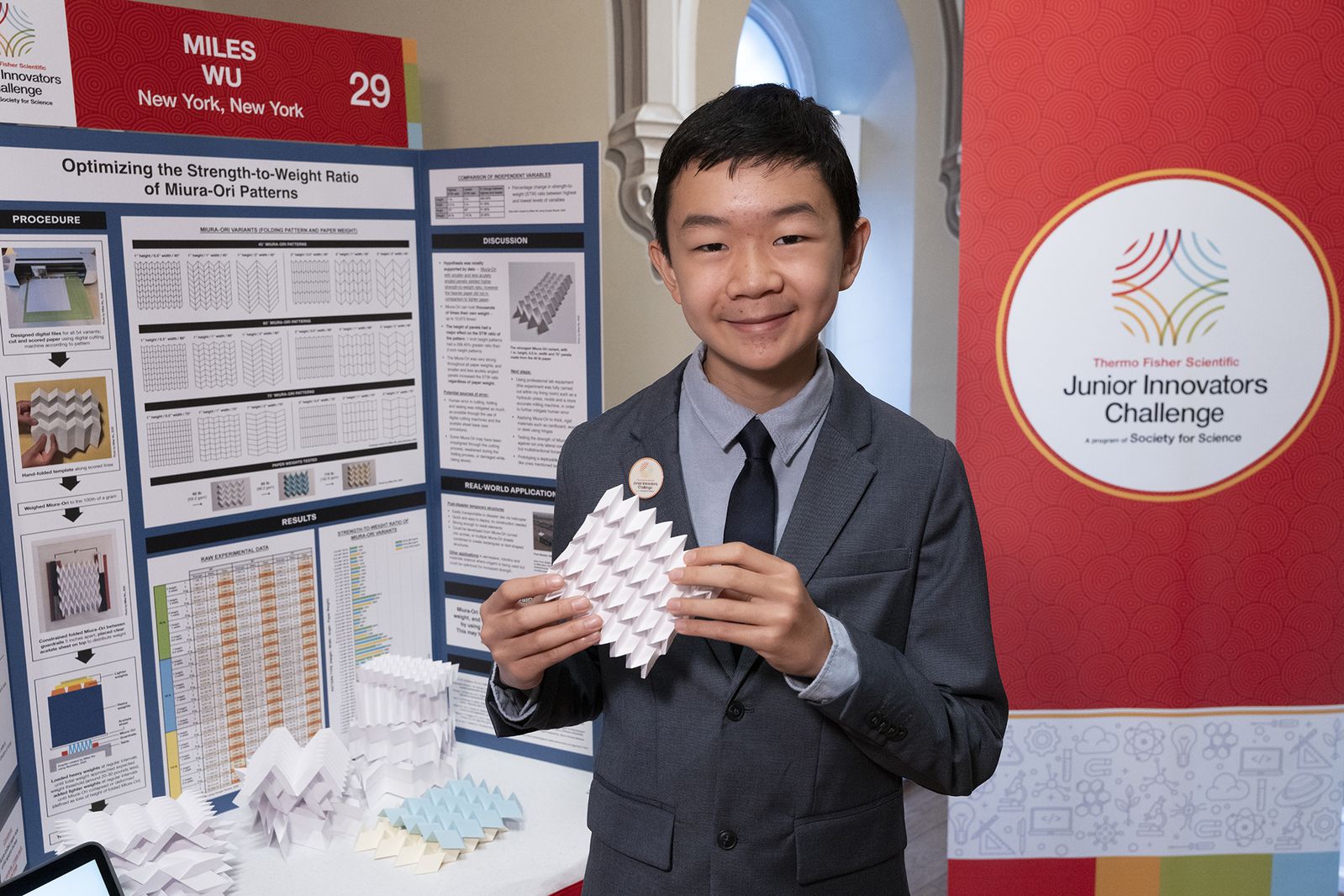
This 14-Year-Old Is Using Origami to Imagine Emergency Shelters That Are Sturdy, Cost-Efficient and Easy to Deploy
Miles Wu folded a variant of the Miura-ori pattern that can hold 10,000 times its own weight
Smithsonian Magazine
928 points · by bookofjoe · 9mo ago · 202 comments
I’m glad I learned OS in depth during high school via Gentoo linux. And engineering/physics/math in college. It’s very easy to assimilate any new knowledge which can be understood through those areas of first principles.
But learning more advanced math is quite a task now.
Same age and same experience. I am learning my third language, after acquiring my second to a fluent level in my early 30's (by living in a country where it's spoken). But it's an entirely different character set, and has nearly zero cognates. I'm sure some skills transferred from my second language learning but I'm massively enjoying it and don't feel bogged down.
I think a lot of it is managing my mental energy, I look at it as a finite per-day resource replenished by sleep. If I have a mentally heavy workday, or overly emotional day, I know my language skills will be sub-par and don't try too hard. I also approach my learning in the morning, when I have an excess of this energy, because my job will do a good job of getting it close to zero, regardless of the starting point.
I think we don't give enough credence to the mental toll of an adult life and corporate job, and how much that takes from us, versus when we were young.
Most of the folklore around "neuroplasticity" I've found pretty underwhelming. But yeah, if even he says it at that level of consistent practice, that seems like a good yardstick.
I have ;-) far too many times! Even going back and taking undergrad math coursework that my engineering curriculum didn't have like Discrete Math or Statistics got a lot harder than calculus / differential equations was when I was younger. I felt like I got less out of each hour, and also couldn't put in as many hours - not just because I have more responsibilities, but also because my brain just gets tired after fewer hours.
Though only in last few years did I realize I was a fast learner. I thought I was slow because I'd say I didn't understand unless I had a deep understanding. But found that where I would not feel comfortable claiming understanding was a different threshold than others.
Where I've found math and physics helpful is in depth and abstraction. The science builds a good framework to dive deep into understanding and tease out the critical components. Science is a search algorithm in some sense. The math helps abstract, or generalize. To see the patterns and extend and use in ways beyond what was taught. That's where the real compounding happens and where I personally start to feel I understand things. But it requires the depth. But that's my framework and I'm sure there's a million good ones and a million better ones
In my mid-30s, I'm definitely slower to pick up new things than in my college days, but I have much more mental discipline and patience, a broader base of knowledge to draw from, and maybe the biggest differentiator: a much more developed sense of priority and focus in order to get more benefit out of less time.
this was rather famously the technique of Jonas Salk to learn and master things, switch fields every so often, giving you a wide base of disciplines to apply to new fields.
someone like peter steinger can sit at home experimenting for hours and learn+create vastly more at the age of 48 than the average 30 year old
But, if you compare outright performance, the brain like any other part of the body is at its biological peak function in the late teens. Rachmaninov wrote most of his work as a teenager. mozart wrote first at age 8. zuckerberg create fb in undergrad. the youthful organism is full of vitality and ease
Never underestimate our motivation.
I know when I’m actually able to sit quietly to study something, I’m able to pick it up fairly quickly. (One thing going for me is I’m much better able to sit still as an adult than a kid, ha.) But yeah, having to juggle work responsibilities for 8-9 hours a day and then having to also manage a bunch of things I didn’t have to think as hard about when I was younger (bills, cleaning, pets), I definitely just don’t have as much time to dedicate towards focused studying like that.
I can believe there are some things that would take me longer as an adult to learn than if I were a child (a new language for instance) but origami folding wouldn't be one of them.
Whether it's something completely new and alien - in which case children might be better, or whether it's learning through association - ie I understand that because I can connect it to previously learnt concepts ( which would favour people with more previous knowledge ).
For example, something like maths is often seen as a young persons game, but at the same time you probably don't want a 14 yr old running your company.
Although I've had to restrict it to the 2 desktop machines. Maybe I should give it a shot again on the laptops, now that binary packages are universally available...
I don't think that's true. As an extreme example, it takes a newborn a couple of years before they can start speaking a language; an adult can learn a few basic phrases in an hour or so.
The origami is Miura-ori fold by the way and they are already used in plenty of fields. Fairly interesting stuff from the 60s. Would have made for a great article.
The kids tested some paper configurations and specific fold patterns. Really impressive stuff considering it was totally impossible to do with computer simulation and hasn't been studied to death in aerospace. Neat science fair project, awful headline.
Getting it via origami is art and a testimony to wonders of intuition and observational learning, but getting the shapes could be done by other methods.
I can’t tell if this is sarcasm.
The boy experimented to find the optimal parameters (height, width, angles) for load bearing of that earlier invention.
So, the result of his work would warrant a new patent, of course with reference to all earlier patents of which his work is an improvement.
I was more ready to accept the headline if it had been invented by the kid.
Are you telling me you can't roll up 10 origami papers and stand them on a reasonably stable origami pattern?
I'm trying to think of what I did when I was 14 that was as cool as that and I can't. I had an imagination and I created stuff all the time, but nothing I'd brag about today. The Space Pistol with Disintegrator Ray was only a prototype that I never managed to really put into production.
Is there anything useful about this? Maybe as an inexpensive(?) core for high strength skins?
Directly: no, the end of the article has a nice list of reasons why, somewhat hidden
(ex. "Actual shelters...need to respond to multidirectional loads" = these were tested with load in one direction)
Miles, if you're reading this, it's useful. You're already doing what .1% of people do. I call them journeys and emphasize they're a million steps without clear direction, and if you're lucky, maybe positive feedback along the way. You're just on step N < 1,000,000. This works out, in some way, you already know it's not literally "yes this is sooo useful that we should start autofolding it at 1000x scale". It will work out. maybe as exactly this, this with some tweaks, or the $25K helps you do $X, or the publicity helps you do $Y.
If I can make the shipping boxes less fragile with same amount of paper as current cardboard box designs, it is a win.
Does that mean we could increase the orders of magnitude if we made it smaller? Lots of tiny stuff needs mechanical support. And lots of folded small things agglomerated is another way to say biology.
Obviously not the same because the force isn't being applied perpendicular to the edges, but still, almost certainly will be not nearly linear.
Even if we include things like hydroxyapatite in teeth, or even lignin, those are more like byproducts of biology than active biology itself.
I was thinking microscopic versus nanoscale. Folding something out of a flat material is probably cheaper than machining it, and if it's stronger than additively manufacturing it you have applications in medical devices and aerospace for starters.
Tents don't need to be strong in compression - there's no weight on the roof. And obviously paper is not a material that scales up or would be practical for outdoor use.
Just a bit confused by the obvious mismatch here - maybe it's the journalist putting more weight on the disaster application than the kid did.
It's just an acknowledgement that the Miura pattern works and this kid kept his focus. To be perfectly honest, he just took something that was already done before (the fold) and applied it. Scientists do this all the time and win prizes--like cellophane tape to create graphene.
But there is on the floor, unless you expect the inhabitants to sleep more or less directly on the ground, including themselves, whatever is used as a mattress, belongings, small appliances, etc. Emergency habitation is not the same as a camping tent, it needs to be able to service populations that have difficulty with camping's limitations, like the elderly.
> Paper is not a material that scales up
Citation needed? It's made from a renewable resource (wood) and there's some 400+ million metric tons of paper production yearly (source: Gemini, so feel free to take with a grain of salt).
> Or would be practical for outdoor use
If exposed directly to the elements, sure. But what if the paper is laminated or otherwise enclosed within plastic, rubber, or other synthetic material well-recognized as hydrophobic?
> It's made from a renewable resource (wood) and there's some 400+ million metric tons of paper production yearly
They don’t mean production volume, they mean physically. You can’t increase the thickness of paper by 1000x to just make thicker, stronger, paper. It’s a different material entirely.
>Citation needed? It's made from a renewable resource (wood) and there's some 400+ million metric tons of paper production yearly (source: Gemini, so feel free to take with a grain of salt).
Sorry, I meant in the sense of physical scale - I wouldn't imagine the properties of paper at 50cm scale translate directly to say 5 or 10 metre scale.
While this probably does have incredible Z-axis strength, I can't imagine it being very strong with any kind of lateral loads.
Biggest downside is their lack of moisture resistance.
14yo won $25k for origami that holds 10k times its weight - https://news.ycombinator.com/item?id=46106871 - Dec 2025 (9 comments)
edit: What, they geoblocked a ~1min clip, wow.
https://en.wikipedia.org/wiki/Lego_Masters_(American_TV_seri...
I'm not sure that it's better than a dome; it might be for cases where you can't predict where on the top surface the load is going to be? I'm also not sure that a sheet of printed infill is sufficiently similar in its physical properties to a sheet of paper/card for this to transfer well, but it would be an interesting experiment to do.
The idea of origami steel sheets has stuck on my mind ever since I found out about laser welding. Cutting thin 2mm sheets of steel, stitching them back together in different shapes, and holding tons of weight? That sounds very compelling to me.
I know it's been used to build engines, which suggests they are strong, but there's also all this process around ancient swords around tempering, folding, etc that suggests that maybe just 3D-printing metals might result in weaker structures.
This, clearly very clever, young man is 14 years old. The article says: "Wu had always been fascinated with the ancient Japanese art of origami, but he really began indulging in it as a hobby about six years ago."
At eight. He was *indulging* in a hobby at eight years old. Indulging in a hobby should be a pre-retirement activity. What an incredible weight the attitude of the writer puts on kids.
Needs to? When did he sign up for it? It's not like he tried to patent a shelter design or bid for a government contract.
Who knows how ChatGPT made that suggestion [this time around]. Maybe 30% of the English-speaking population thinks it’s negative, or 60%, or perhaps someone simply wrote a high-profile negative op-ed that included the phrase in its title.
Anyways, not that you did this, but we need to be careful not to use LLMs as the deciding factor in how to feel about things. :) It gives too much power in swaying our thought to those who build the models.
I don't think indulge means what you think it means.
For anyone who hasn't understood my meaning:
Indulge is a word that implies that you're allowing yourself something that you might not ordinarily. The point being: it is (or should be) silly to suggest that a child can be said to indulge in a hobby. This is because the further implication is that an eight year old might show some restraint and focus on their book learning and networking.
You've got preconceived notions of what children "should be doing" in their free time to start with.
My point is that I believe you have probably misinterpreted the author and used that as a basis to critisize them, unfairly in my view.
We don't all need to indulge (hey look another one) your personal perspective of how that word should be used.
The real issue here is that there's not much point in it, as the very thing that makes this useful (the ability to fold it up) would also make it collapse easily in a pressurized environment. You'd also have to deal with preventing leaks if you wanted air inside, likely by adding an outer hull, which would then defeat the purpose.
The weak points then turn out to be joints, material defects (the famous Titan failure), windows and other piercing points, and any unexpected shear forces.
Adding 1 to _____ causes a doubling of resistance to pressure, adding 2 is a quadrupling, adding 3 is an octupling, what goes in the blank?
I think it would be fun to build a playhouse out of it.
It has a particularly cool region in its configuration space where it can be bistable: https://journals.aps.org/pre/abstract/10.1103/PhysRevE.93.03...
You won’t find a kid who’d say, “I want to be accountant when I grow up…” instead you’d find people want to be pilots or police officer….
> You won’t find a kid who’d say, “I want to be accountant when I grow up…”
When they realize that people with more money and more connections to powerful people get their way over people with less money and fewer connections to powerful people. The children of the former group also get a significantly better starting position in life compared to the children of the latter group. That is, if the latter manage to attract a suitable mate as poor people. If you choose dreams over money, you're not only failing your own potential desires and ambitions that will then probably never materialize, but also your future family and offspring. As the wealth inequality gap widens ever more, such pressures only intensify, and everything turns more and more into shit. Those kids' (from your post) desire to live a life with a fulfilling career is sacrificed at the altar to the dragons hoarding more and more wealth at all costs (billionaires).
I truely wish this kid continues to pursue his passion and not get side tracked with grim realities of the real world.
Agreed. But it doesn't go viral as much. Every cool robotics research goes with a comment that says "it could be useful for disaster response in a post-apocalyptic world where the conditions have changed in such a way that only my robot can save us".
In algorithmic design, we often struggle to balance form and physical function. But rigid foldability proves that finding the exact right geometric constraint actually creates the function. Respect to the 14-year-old.
The size and 10k amount here are impressive compared to the ant nonetheless
But the parents are doing lots of unappreciated work here.
/parent here
Parents or a teacher most likely guided this kid to empirically measure how much weight a known origami fold can hold. I mean I remember that we were guided to do similar experiments at school when I was the same age... I don't remember making the news for "14-year olds empirically confirm Newton's law" :-).
I don’t consider that the parent comment is seeking to “steal the spotlight”; just that it’d be a more realistic appraisal of how success is achieved.
1. He talked about them to people who were interested in listening.
2. He was able to apply the knowledge he gained for his specific task in a variety of team tasks at the event.
The web site is aggressively paywalled, to such a degree that I cannot determine the date of publication.
But they had a public access podcast and transcript here
https://www.nationalgeographic.com/podcasts/article/unfoldin...
[1] https://www.societyforscience.org/jic/2025-top-300-junior-in... [2] https://www.societyforscience.org/jic/2025-finalists/
https://www.societyforscience.org/jic/2025-project-showcase/
So how could he patent it?
I join the parent: it's a kid who empirically evaluated how much weight an existing fold can hold. It's not like he solved a hundred years old mathematical problem.