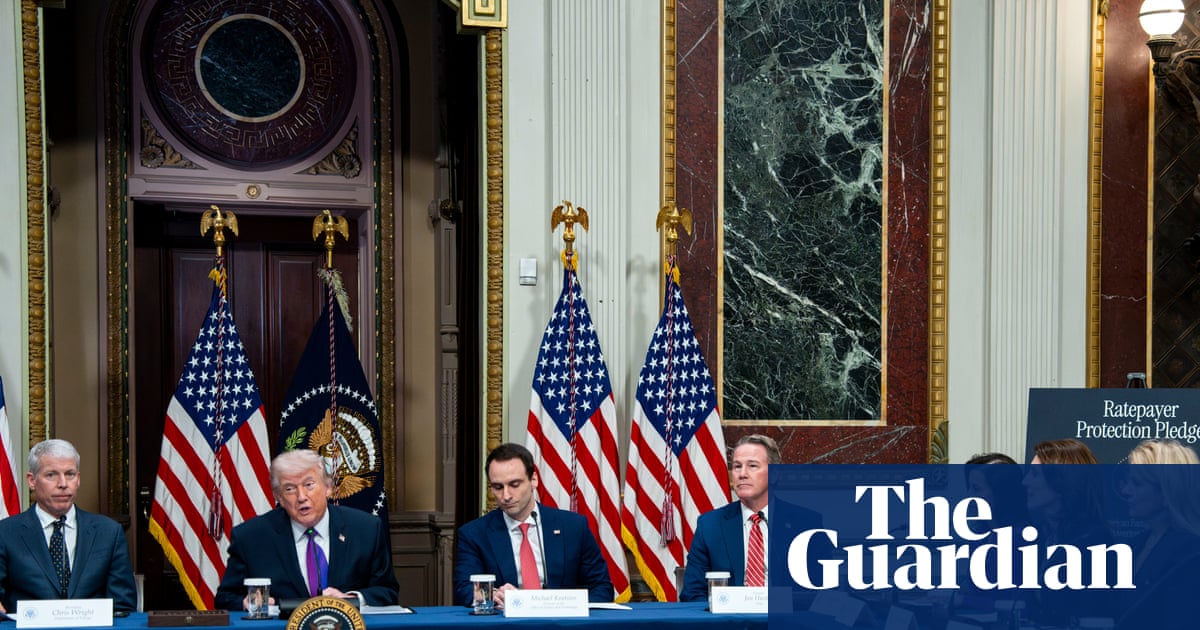
US tech firms pledge at White House to bear costs of energy for datacenters
Companies will pay for upgrades and new electricity generation in agreement to mitigate concerns of rising bills
the Guardian
185 points · by geox · 8mo ago · 245 comments
Alaska and Norway understood something critical when oil was discovered: if you don't assert collective ownership of the resource before private companies capture all the value, you never will. Alaska amended its constitution. Norway built the largest sovereign wealth fund on earth. Both were acts of people saying "this belongs to us, and we deserve a return on its extraction."
We are in exactly that window right now with AI. The resource is being extracted at an incredible pace and almost all the value is flowing to a handful of companies. The longer people wait to assert sovereign ownership over the collective intelligence that makes AI possible, the harder it becomes.
If you think this is crazy, ask yourself what’s actually crazier: demanding a share of the value built on your collective labor, or watching trillions of dollars get extracted from it and saying nothing.
the idea of Alaskans getting a check just for existing sounded crazy too, right up until it didn’t.
This is also true for the first commercially exploited natural gas fields in the world, in the Netherlands. This ruined the Dutch manufacturing industry, and became a textbook example of tge development of one sector harming others known as Dutch disease [].
AI has a great potential like this too..
[
] https://en.wikipedia.org/wiki/Dutch_diseaseIf a handful of companies capture most of the value from AI while it simultaneously displaces workers across every other sector, that's Dutch disease applied to the entire knowledge economy. One sector booms, everything else withers.
But the model is built on us. You can move the server anywhere you want. You can’t escape the fact that everything inside it came from human minds. That’s an ownership claim no one can relocate away from.
To move beyond that default you need to organize into things like communities, lobbying groups, and/or even governments.
Ownership of singular non-physical objects is a polite lie we tell ourselves because it makes us feel more secure in a universe filled with information chaos. The moment you open your mouth or move your pen you no longer own what is in your mind, it is now entropy. Lose control of that entropy and it now belongs to anyone with the proper tooling to record it. This is a universal law of information, it is beyond the laws of men and their fickle will.
Much like we build on information from our past generations, AI will build its own new information on those foundations. And since AI is an entity of information alone it is highly probable it will do it far better than we will and forever cement us in a prison of our own making.
Our entire civilization runs on your "polite lie" of owning non-physical things. Patents, copyrights, trade secrets, licensing agreements, NDAs. Trillion dollar companies are built on the legal enforceability of intellectual property. The software you're using to type this comment exists because someone owns the code.
Calling information "entropy" doesn't make contract law disappear. We decided collectively that people and institutions can own ideas, and we built the modern economy on that decision. You can argue that's a fiction, but it's a fiction that everything around you depends on.
You can't invoke "universal laws of information" to dismiss public claims to training data while the companies training on it aggressively enforce their own IP. They patent their architectures. They copyright their outputs. They sue competitors for misuse. They clearly believe in ownership of non-physical objects when it benefits them.
You don't get it both ways.
This is the same false threat that gets repeated over and over whenever anyone tries to regulate or tax anything.
The same line of reasoning that purports billionaires will flee if their taxes go up.
Spoiler alert: they don't.
Also, data centers in space is not a serious idea. It's been beaten to death that this isn't economical. People like Musk are proposing that as a possibility for the sole reason of keeping regulation away. "Well if you regulate us we will just move into space". They won't because they can't because physics.
looks at the US
Well, looks like we lost that.
But you're answering a question I'm not asking. The question isn't "was something taken from you." It's "who deserves a share when collective human output generates trillions in commercial value."
your torrenting analogy makes my case. Nobody loses their original movie when it gets pirated either. We still recognize that the people who made it deserve compensation when others profit from it. The entire IP enforcement apparatus is built on exactly that principle.
Non-rivalrous doesn't mean non-exploitable.
Nothing physical is being stolen when a company makes a clone of a product based on another company's designs, but that doesn't mean we shouldn't have patent laws.
Maybe I'll get labeled a 'commie' for saying all this but I think we create a world where everyones needs are met and things(information & media are the easiest imo) are freely available. Thinking we can't do this is a bit of a disservice to the capabilities of humans.
It being a royalty and not a tax is the reason Alaska's dividend is politically untouchable while tax-funded programs get gutted every budget cycle. Ownership is a fundamentally stronger claim than redistribution.
Edit: to clarify, this wouldn't be a tax. A tax is the government taking a cut of someone else's money. A royalty is the owner charging for access to their resource. Alaska doesn't tax Exxon for drilling. It charges Exxon for extracting something that belongs to the people. Same principle here.
Isn't that how communism (should have) worked?
The Alaska Permanent Fund has been running since 1982 inside the most conservative state in America. Norway's sovereign wealth fund is the largest on earth and their economy is doing fine.
These models work.. work well... And they exist comfortably within mixed market economies.
The question is whether the public gets a cut when private companies build fortunes on a collectively generated resource, or whether they don't. We already know the answer can be yes without anything breaking.
Our entire white collar system might be a house of cards with AI, what I am proposing is a safe hedge against a future with potentially massive wealth inequality, and increased unemployment. But this isn't just about protection from injury... people should BENEFIT massively.
not sure if that would work in this case since all these companies scraped (publicly) available data? So with the right resources anyone could redo it?
Every human uses that "resource" to train themselves, and now they use AI to supercharge that consumption.
The companies are giving average lay people access to a personal PhD to help with whatever they are working on, for $20/mo, and those companies are committing an evil cardinal sin?
I get the gatekeepers are pissed, LLMs are way cheaper than those expensive gate fees, and I cannot come up with a good faith argument about how giving the power of SOTA LLMs to anyone for $20/mo is somehow evil or bad.
In an alternate universe these same models are $100k/mo with limited invite only access, occasionally the public gets a single demo prompt with a short reply, and $20/mo access is a utopian wet dream.
If you want UBI, then the framing shouldn't be around "whoever had content on the internet circa 2024 is entitled to lifetime AI company payouts that effectively act as permanent unemployment checks."
Sick of how SV/VC absolutely ruin words for their own monetary benefit.
How about you put up it up to a national vote and see what democracy gets you? I highly suspect that vast majorities of the electorate would want to nationalize this tech to benefit everyone rather than benefiting the few.
Democracy means there is a politics of rejection, rejection is normal in functioning democracies; what isn't normal are small handfuls of people capturing all collective human intelligence then claiming only they are allowed to benefit from it.
I suppose the root of the word is from democracy, everyone gets a vote/equal rights, but the meaning doesn't really have anything to do with politics or government...
So to reframe my argument for clarity;
I have a hard time coming up with an honest critique of why giving everyone incredibly cheap access (often free!) to incredibly powerful LLMs is somehow evil. And obviously these things are ridiculously popular. Average people seem to think they are fucking awesome, and anger seems to be mostly from gatekeepers that are relentlessly screaming that their gates are being bypassed for pennies.
You're probably right -- except for the billions in massive PR campaigns that will be spent to successfully convince enough of them that it's in their best interest to let the companies keep ownership.
This is in addition to the billions in PR already being spent to make AI palatable in spite of the societal and economic costs.
Lol, then you've missed how propaganda in the US has worked for the last 100 years. The wealthy have launched a continuous attack against the idea of nationalization/socialization to the point it creates a irrational Pavlovian response in huge portions of the population. Us the population have already lost a war we had no idea we were fighting to an enemy that plays a far longer game than most of us.
Paying for access to information is not democracy
AI can be genuinely useful AND the people whose collective output made it possible can deserve a share of the wealth it generates. These aren't in conflict.
Alaskans benefit from oil too. It heats their homes, paves their roads, funds their schools. That wasn't an argument against the dividend. "You're already benefiting from the resource" has never been a reason the people who generated it shouldn't share in the profits.
The question was never "is AI good." It's "when something built on collective human output generates trillions, does the public have a claim to a share." Nothing you said here addresses that.
So your understanding of the present state is that we are living in a utopian wet dream now that we have models who can generate slop faster so much so that we have a term of it called AI slop?
I or many people don't want this Utopian wet dream, so I want to know, did I or other people have say it or not?
A few select people decide what's the definition of a Utopian wet dream is and they then take the collective properties of everybody else to fulfill that and even putting the employment/livelihood of those same people into risks
Sir, does that sound familiar?
> I get the gatekeepers are pissed
No, humans are pissed, humans just like how you and your family are humans too (well I sure hope so)
> a personal PhD
A helper tool that I can ask a question and which responds with relevant information gleaned from the vast collection of human-gathered knowledge and experience would be fantastic.
What we have instead is something that often gets things mostly right, if you don't look too hard at it. And the poisoned output of this thing seeps back into the knowledge pool, reducing its accuracy and therefore usefulness.
The problem of LLMs is the dissolution of human knowledge into a sea of slop.
The social media companies gave their services for free, and now it turns out they've committed quite a few sins. None of the AI companies are doing this out of the goodness of their hearts, nor will they be satisfied with subscription revenue. If they see opportunities to make more money by manipulating the population, rest assured they will take those opportunities.
because no one believes there are legal consequences if they don't
and there are a lot of ways to doge it even if there where a reliable government in place
like especially if they do what they have been doing recently (run their own generator, build their own power planes) a lot of this cost is implicit and as such very dogeable. E.g. higher cost for gas power planes for other due to major increase of demand, higher medical cost due to more air pollution, higher fuel prices, etc. etc. (not even speaking about anything climate change).
If it is not legally required, it will not be done.
Blinded by greed, I have never done it before, but I have seen the light, the bright future that we are all building toward.
From this day forth, I shall be righteous.
In your name, all good things come.
Hallelujah.
And it's not just data centers, it's all sorts of industry. My local gravel and concrete plants run their "big stuff" off generators because the cost of the utility drop for their amperage doesn't make sense. And nobody will connect the dots between these choices and the requirements we've saddled utilities with. They're spinning up generator not because it's cheaper per watt, but because they're not operating on the 40yr timeline you need to be in order for the red tape you have to go through to put in permanent infrastructure to pencil out.
I'm an abutter for a utility project and I've gone to the meetings for and it's an absolute massive boondoggle. My energy bill is going to reflect god knows how many hundreds of billable hours it takes for these hired lawyers and engineers to prove to the system that they're not gonna fuck over any endangered frogs by widening the cut to meet some industry standard that changed over the past N year and dumping culverts and fill in some places where streams criss cross it.
Literally nobody involved cares. The abutters don't care. The town wants it to go forward because it's all trivial and it's not like it won't be their ass if they block an upgrade to industry standards and something happens. The system is just going through the motions. The city engineer grills them about petty bullshit because it's literally his job. They know he will and they have the answers but he makes a show out of the subjective things. Ditto for the conservation commissioner. It's like the Israel missiles meme. One side is my tax dollars and the other side is my energy bill. We're all doing this because some slimy politicians wanted to pander to some shortsighted big picture ignoring environmentalists 50yr ago and beurocacy has perpetuated and grown itself since. No public interest is served by this.
And the cherry on top is that at the margin, we get shit like generators that don't need to exist because the cost of the alternative is driven up to the point the fuel inefficient (and also dirty) solution makes sense.
I'm more than insinuating it. The cause may be noble but the state and local implementations have been perverted by all the minutia and business interests and NIMBYism. I would go so far as to say that (state and local implementation of requirements within) the clean water act is a non-negligible contributor to the decline of manufacturing and agriculture in the northeast and upper midwest.
We basically took "thou shalt not dump for that is bad for our surface and ground water" and over 50yr turned it into a blank check for all manner of leeches to make a buck and all manner of NIMBYs to make things unnecessarily expensive.
Petty 1.5-acre "I want my lightly forested former field to be a field again" and "business is going great I want my gavel parking lot paved" being stalled by five figure costs and even with those costs incurred it doesn't guarantee compliance. That's a far cry from the "yeah we just dump this stuff in a settling pond, IDK where it goes after that but man that river over there sure is a weird color" type 1960s industry behavior that it was meant to really curb. And the big industrial offenders still get to do what they want, not as bad as before of course, but still bad. Some Megacorp's runoff might turn the fish neon green or their 1k unit condo development might turn the river brown with silt but of course they'll be right there with their lawyers and experts who'll tell you why it's fine even when it's not to anyone with a brain and two eyeballs. The layman can't pay off people like that be on their side and neither can the regulators. (I assume this frequent fact pattern what you refer to by "living in the stink")
I think it ought to be revamped at the state and local level into something that's substantially more "results based" rather than the proactive red tape "make the bureaucrats feel like their ass is covered if someone ever complains about what they approved" based system we have now.
(And just to be clear for any readers who aren't familiar, the clean water act basically doesn't do much to affect the average person or business at a federal level. The local implementations and all the key definitions, industry standards, etc, are where the rubber really meets the road)
Edit: Basically I'm saying that in the past 50yr the interests the CWA was supposed to stymie learned how to pay their way around it, the parties who make a buck doing that have gotten themselves all but written into the compliance process to the detriment of the interests the CWA was supposed to not seriously burden. It needs to be replaced or revised to solve those two big problems.
Extinction is forever -- your frustration, and that committee process, does not compare directly to species extinction.
as long as the boxes are checked, most public sector employees are not going to stick their neck out. it's steady work that pays all right and has great benefits (and even pensions sometimes). a lot of people in the public sector aren't willing to step out of line for "frogs" even when they should or want to.
There's a lot of data centers that are not being built because they're not fixing it. The trend is going to continue. The hate for AI is going to grow. You basically have a lot of people that will vote a lot of people into office to take down all AI progress inside the United States if they don't fix their problems.
It'll be cool to shit on big tech as a politician.
There's some speculation in the comments about what is or isn't in the pledge. I recommend reading it yourself.
[0] https://www.whitehouse.gov/articles/2026/03/ratepayer-protec...
[1] https://www.whitehouse.gov/presidential-actions/2026/03/rate...
> IN WITNESS WHEREOF, I have hereunto set my hand this fourth day of March, in the year of our Lord two thousand twenty-six, and of the Independence of the United States of America the two hundred and fiftieth.
One can do the former whilst repudiating the latter and remain logically consistent.
We just approved the first nuclear plant in 20 years to a company owned by Bill Gates and in a state that has basically nothing but farmland and a Microsoft datacenter.
This absolutely cannot backfire. /s
Tech companies are exceedingly good at giving things away for free to get all the "market share" and then monetizing.
Interconnection expenses.
Same issues as with mining and large industrial clients generally.
Exactly opposite will happen. Reason is, when Big Tech is paying huge amounts of money to contractors to build those power generation facilities and service companies to service it, they will abandon servicing other facilities (remember how Micron dropped consumer RAMs last year because of enterprise demand) or require higher pay from everyone else
1. DCs must be built anyway
2. You can't take away energy from households
(3). Highly preferred that you are not going to impact cost negatively to households (otherwise why we have this discussion)
based on these assumptions, solution I see is, BigTech subsidising energy costs for 10 years for nearby households (area will be geofenced, e.g. in the radius of 50km), subsidy will be based on the prices outside of that radius. e.g. if you everyone outside of closest DC pays 1$ and in the radius prices become 1.5$, 0.5$ will be covered by BigTech and they're also responsible & pay to setup the system to automatically include everyone in subsidy program, not like you need to apply
Also BigTech is not going to build the power generation plants, it must be built by existing processes to minimize impact on pricing
* power generation is not local in most of the cases. You'd be still fucking energy market to anyone outside it
* power is also used by companies people actually want. Even if household power cost wont chance thanks to that approach, the price for power for every single business around will increase.
* similarly any other manufacturing business will cost more. In essence, the AI boom will reduce profit margin of every single business that has electric power as significant cost in the production. Which is a lot of industries.
"Making AI pay more for its useless power draw" is nice idea but it is pretty hard to realise. Unless we start outright denying connection to power grid but that's pretty dangerous political precedent to set.
It's the entire region where prices will increase. A facility could be built 200 miles away from you and it would have just as much of an impact on your power bill as one built across the road.
> Also BigTech is not going to build the power generation plants, it must be built by existing processes to minimize impact on pricing
The issue with this requirement is that it's not a capital problem. Big tech would be happy to pay someone to build more power generation and just take a power feed, even if it costs marginally more.
What they cannot do is wait 12 years for what they could get done in 2. And I do not blame them at all for this at all - building anything in the US is basically impossible these days due to the NIMBY and general culture of not getting things done. We forgot how to rapidly build infrastructure in an efficient manner, and anyone putting proverbial boot to ass to get this done is a good thing.
It's not a case of a datacenter operator wanting to save a few pennies per kwh. It's a case of the power literally not being there and the utilities being utterly incompetent at building anything in any reasonable timeframe.
I used to think we were progressing up an exciting tech tree. That seems naive now.
Water, land, energy, the soundscape, intellectual property that incentivizes the dissemination of good ideas, digital networks of information and self-expression, perhaps even the economic value of expertise itself are all being sacrificed in the now for promises of utopia in the future.
Precious eggs to give to those promising a utopian omelet, eventually.
Increasing natural gas generation is of course disastrous policy with a major death toll from the climate disaster, there needs to be a rampdown of fossils use and production.
So no.
But what probably also isn't included but should is environmental damage.
Running low quality "temp." gas turbines non stop isn't without filters etc. isn't just bad for the climate, it's a air pollution which can directly affect anyone in it's path with not only increased chances for lounge cancer but also much more short term effects like asthma, and increased chances of asthma attacks ending deadly. Especially if the weather prevents easy dispersion (like it tends to do in winter). It's not that long ago (<80y) that the west had acid rains, and deadly smog accidents exactly from this kind of negligent shit. And if we look at Asia this is sometimes still a topic today (but has gotten much better compared to just ~20 years ago).
No MBA pencil pusher wants to run an inefficient local turbine. It's just that the timeline and upper cost bound of doing that is less crap than having a "real utility" build more power at "real utility scale" and run you a wire because the latter is subject to all manner of delay and cost overrun.
And there's no inherent physical or economic reason for it to be that way. We made it that way. The metaphorical local turbine is less worse specifically because people like you, saying the exact same things you're saying right now have saddled the "real utility scale" generation, and more importantly, the wire to the big industrial consumer who'd pay for it with all sorts of requirements.
It costs tens of thousands of dollars of lawyers and engineering over years just to dump a concrete culvert in a ravine where it crosses a power line clearing and fill over the top, all because of the red tape. Say nothing of the cost to do all the legal paperwork to get the utility cut in the first place. Now multiply by every mile the wire has to go, add in the wires, etc, etc. For an industry that might boom and bust in 2, 5, 10yr dumping a fuel guzzling turbine in your parking lot at 5x the cost per watt starts to look pretty good.
Of course this will all change, but I doubt we will see tech companies opening power plants anytime soon with their associated balance sheet dragging 1% return on equity.
https://en.wikipedia.org/wiki/Biochar, for those who have not heard of this.
When our civilisation is excavated in 500 years, they are going to say we were as crazy as all of the others.
completely ignoring all existing technologies related to that topic to spout obvious nonsense about "cutting down trees and burying them" (which would bind active bio mass which isn't a grate idea, also that won't produce oil anyway not that this is relevant for the discussion)
various ways to reduce the carbon in the air do exist (and without trees)
and the carbon can be both recycled for other usage and literally placed in the earth, too
it is not rally a solution for climate change as it's very expensive to do. But this also makes it a good idea to "make companies pay for it" (at least if their carbon-equivalent output goes above a certain threshold). Because if they have the choice between very expensive carbon removal or reducing carbon output for a much cheaper price they will do the later; But in emergency/outlier situations they still can do the former, just at a very high price.).
Theoretically you could harness some of those volatiles for some energy production, but at the very least use those volatiles to heat the wood and make it charcoal for basically free.
Actually, the tweet quoted in the article is firmly in the "you can't make this $%&/ up" category...
It is also a ~50 year investment.
This makes it not very attractive for companies and is why most nuclear power is state sub-ventioned.
Theoretically the US had something similar to a state bank to help companies to finance exactly such projects, but Trump/DOGE defounded it for publicity reasons which makes it even less likely for private nuclear power plants.
Many "we will use nuclear power" statements do rely on mini reactors. But AFIK pretty much all mini reactor projects have ended in dead ends so far. With promised at best working out on paper (and quite often not even there).
So my guess is: They will claim they want to use Nuclear and might even intend to do so. But in the end look at their balance sheets and risk calculation and go "nah, lets do coal/gas/oil". There probably will be some single public co-investment into a nuclear power plant which "happens" to also be government sponsored to keep up the pretense.
It reduces profit.
Soon I’ll get a used EV and cover the garage in panels too so I don’t have to care about wars causing surges in gas prices either.
I was unaware it was optional.
Ta da! It's 3 Megapaks wired together with a transformer. Now that's innovation.
See? Without billionaires, who would save us from billionaires?
Tesla’s Megablock: Breaking the Transformer Bottleneck https://www.rebellionaire.com/post/tesla-megablock-transform...
Take the case of Duke Energy in North Carolina, which illegally raised rates too much. Utilities prices are supposedly regulated but utilities work around this by simply moving costs to things they can charge whatever for (eg transmission costs vs energy costs).
The NC Court of Appeals ruled that Duke Energy's actions were illegal BUT there would be no refunds for customers [1], in part because lawmakers passed a law to allow them to do this retroactively [2]. Also, if Duke Energy had to repay customers they can simply raise prices to recoup those costs even though the money was improperly charged in the first place.
So consumers will keep paying for the infrastructure to connect up these data centers and will keep subsidizing the ongoing energy costs.
[1]: https://www.wcnc.com/article/news/local/no-refunds-for-duke-...
[2]: https://sustaincharlotte.org/press-release-nc-lawmakers-over...
Launched in 2010 by Bill Gates, Melinda French Gates, and Warren Buffett, it was sold as a historic shift in philanthropy. Fast forward to 2026, and the data suggests it’s been more of a "Wealth Preservation Society" than a massive wealth redistribution event.
This will be just as trustworthy. We need laws - not merely rhetoric pledges !
Building pipelines is a long and arduous process and one that will not be done in time to reasonably accommodate the increase in natural gas demand presented by these data centers.
The pledge is meaningless political theater meant to placate voters in the mid-terms.
- They already invest in new power plants and connection infrastructure when they bring in new datacenters - Electricity for datacenters is based on capacity rather than actual usage - They already have backup generators at most datacenters that they can run during outages. It wouldn't be much work to allow those to feed power back into the grid in extraordinary circumstances - They generally use local contractors to build them for practicality purposes anyway.
This is just some fancy PR and nothing else.
People are not voluntarily going to build things that make less profit.
It is a suckers bet assuming the unscrupulous will grow a conscience. =3
One could say "use renewables", but even that has externalities: that means an increase in demand for solar panels, or wind turbines, or the labour to maintain them, which again leads to an increase in prices.
Pledge my ass. It is either law mandating those massive datacenters absorb the cost with heavy penalties for non compliance or it is just BS talk (what it seems to be at the moment)
That's why he wants to go into space (10x solar potential because you don't have a day/night cycle, no clouds, no dust/rain, no temperature loss, no orientation issues, and no atmosphere reducing solar).
To me it seems ridiculous, for one because sending 150kg to space costs about $500k, and this is about the weight of a solar installation that costs $800 to install and generates about $1000 worth of electricity across 20 years at utility wholesale prices.
But suppose it was cheaper and viable, and earth-electricity was indeed capped, you could argue (if you believe the hype) that developing AI is an existential arms-race objective for US/China.
But from what I've understood that's just not the case at all. Something like 170+ coal plants are scheduled to be decommissioned, and the average coal and gas plant runs at 40-50% of capacity, because wind/solar is eating their lunch (cheaper marginal $ per kWh). i.e. there is so little demand that these plants keep using less capacity and shutting down superfluous plants.
You'd think if experts believed electricity was going to be a bottleneck, that venture capital / AI companies, or even traditional capital, would be buying up plants or signing guaranteed-usage contracts. But it doesn't seem to be the case.
In fact, Nadella publicly stated that he has a large amount of hardware in inventory that has already been purchased but cannot be utilized due to insufficient energy.
I'm sure we'll be hearing all about how much this benefits households in the coming months and years.
The general goal for utilities has been to pursue the next “thing” and work toward some sort of regulation to lock in demand, which can be used as a lever to seek price increases and consolidate.
If there’s margin to be had, the utilities will find a way, and prices will go up either way.
Saying they’re going to pay for generation and transmission adds little. That’s already baked into the charges! It’s like saying they’re going to finally pay for the farmers to grow the produce and the drivers to get the produce to market when they buy apples--as though spontaneous generation and teleportation was ever an option.
They'd ask the utilities to make Gigawatts of energy available over the next two decades and the utilities would say "No problem, just sign here and agree to pay for us building out the grid to support that".
Then the AI companies said "No we only want to pay for energy if we actually use it, if we go bust or decide not to use the energy in a couple of years we want you to charge all the others consumers to recoup that cost".
No idea if that's addressed here. I'm assuming not.
It was never clear if that reflected uncertainty about future demand or of they just like shifting costs and risk onto other people whenever possible.
edit: the pledge references this problem, whether it actually solves it I don't know.
This mean retail consumers are paying less for electricity than what they would have paid if not for the pledge.
[1] Narrator: they will [2] Narrator: they won't
I was looking at this one organization[0], they want to do a constitutional amendment. At this point, I cant disagree with them, but with this administration, I don't know what good its going to do.
I can see how big tech is enthusiastic about freestyling this. Eh sorry I mean bear the cost
David Roberts (https://volts.wtf) has repeatedly noted that AI companies need the power, need it now, and have the capital to get it. So he (and others) advocate that Big Tech fund the grid improvements and new power generation.
Point #1 Virtual Power Plants
Roberts advocates adopting virtual power plants (VPPs). Think grid of grids, like the internet is a network of networks. Think peer-to-peer energy sharing. VPPs unlock dynamic load shifting, two-way energy sharing (think of all those roof top solar panels and powerwalls), and therefore -- most importantly -- reduces peak demand on a grid which will allow greater utilitization.
IIRC: our grids currently operate at 30% capacity (to accommodate rare peak demand events). Grid enhancement techs plus VPPs can boost that to 80% or higher. Reducing the urgency for building more transmission and distribution infra. (In the short term; we still need to greatly embiggen our grid(s).)
It'd be kinda amazing if the urgency to build more data centers mooted the incumbent's (utilities, regulators) opposition to improving our grid(s), thereby benefiting everyone everywhere.
Tangent: there's a backlog of grid enhancing technologies available, just waiting for funding and incentives to line up.
Tangent: VPPs also enable new financial products, which will further accelerate electrification (of All The Things).
Point #2 Solar + Battery
Solar + battery is the fastest, cheapest way to get new power generation. More so every year.
Yes, we still need to massively invest in All The Things to reach Net Zero and beyond. Wind, geothermal, nuclear (fission and fusion), hydro, every flavor of storage, de-carbonize industry and agriculture, conservation, rewilding, and everything else.
But at this moment in time, today, we need gigawatts of new generation and the grid that can support it. That means solar + battery.
Aside, IIRC, data centers are projected to demand just 5% our electricity supply. So society will be the net beneficiaries (on this axis).
Were Big Tech to fund the generation and grid that we need, maybe society will indulge some of Big Tech's less egregious offenses. https://en.wikipedia.org/wiki/Indulgence
Important Point: the rising costs of transmission, distribution, and fuel costs account for electricity's higher prices. New renewable power generation is now the cheapest option, and getting cheaper. The challenge is delivering that cheap electricity to customers.
That doesn't make sense because robots and AI won't have money to buy goods and services.
If they get "AI" and industrial robots, they don't care that nobody can buy their products anymore because they never cared about selling products in the first place.
Right now capitalists loathe that they can "only* collect a 10-50% return on the things "they build", and the rest of the value has to go to the consumer. They want nothing more than getting rid of that "waste", and just having their personal factories create whatever they want and their personal farms making whatever they want and we all just fucking die.
So don't worry, you'll have basic ~~income~~ soylent green.
That will never happen, but would prevent we the people from bearing these costs directly.