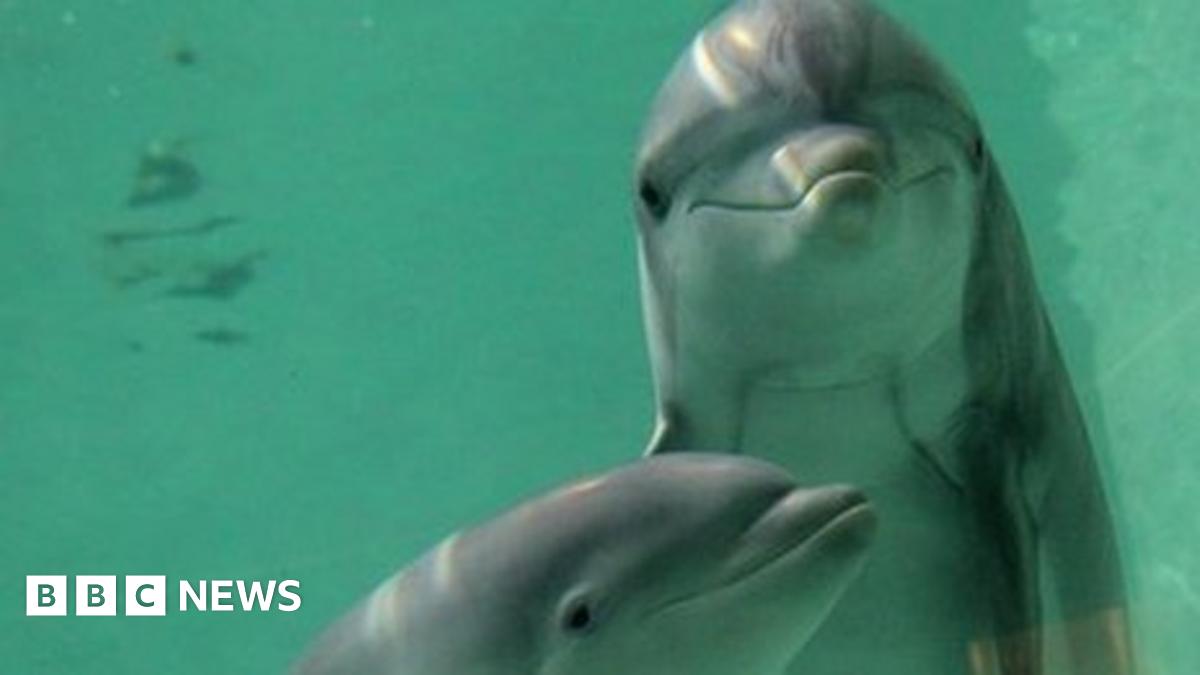
Dolphins deserve same rights as humans, say scientists
Dolphins should be treated as non-human "persons" and their rights to life and liberty respected, the world's biggest science meeting is told.
BBC News
126 points · by zosimus · 14y ago · 189 comments
I don't have a problem with extending legal protection to dolphins, but I do think that "intelligence" as the criteria is morally problematic, at least if it's the sole criteria.
For instance, could a person with Down's Syndrome be denied protection from murder?
The Christian worldview holds that human life has value intrinsically because God values it. Whether you agree with this or not, I hope you'd want to avoid drawing moral conclusions such as "my life is more valuable than my neighbor's because I'm obviously smarter."
Especially considering how slippery the definition of "intelligence" is.
I think 'intelligence' represents how slippery all concepts are. Think about the definition of intelligence. According to the most common scientific definition, it's basically the ability to see patterns. The funny thing about that is that the ability to see patterns is basically what makes someone a good scientist, so scientists have defined 'intelligence' to mean having the potential to be good at science. Similarly, if you look at the CIA, intelligence means having information about enemy countries, because that's what makes a good CIA officer. If you were to ask a painter about the definition of intelligence, they'd probably tell you that it has something to do with being good at painting.
All words are defined by the types of people who are most likely to spend time thinking about the definition of that word, which means that essentially every concept in the every language is fundamentally biased by the worldview of the sort of person who would spend time thinking about that concept. And since science, logic, and knowledge are fundamentally based on these concepts in terms of looking for what to talk about and measure, I think this may be a serious epistemological problem that leaves humans capped at a certain level in terms of what we can know.
This is also why I'm generally skeptical of sites like Less Wrong, as I think the real limits of rationality and human knowledge have almost nothing to do with the 'official' list of logical fallacies that these sites tend to focus on.
I took Latin in high school because I liked etymology (and because greek letters were really too weird):
From Latin intellegentia ("the act of choosing between, intelligence"), from intellegō ("understand"), from inter ("between") + legō ("choose, pick out, read"). [taken from wiktionnary]
So intelligence is the ability to understand, that's all (the etymologic link with dichotomy is beautiful).
Now how we understand (and please don't confuse yourself again with "oh yeah but what does 'understand' really mean") is the hard part.
Note the focus on a species, rather than individuals.
Until then, I don't want to see such beautiful intelligent creatures harmed -- but murder/manslaughter charges would be inappropriate if one were inadvertently killed.
The current animal protection/endangered species protection rules are sufficient.
This is of course a really bad requirement. A lot of people in the world do not know English, and would thus be unable to let anyone know that they will mutually honor some sort of Interspecies Protective Treaty. Mostly, they would be unable to read any such treaty, or reply with the word "yes".
First create a requirement that all human being will pass. Then see if cetaceans do pass it.
The recently and soon to be extinct species would disagree with you.
Also, if homo sapiens had the same levels of "protection" I'd be able to cull yuppies when too many of them moved into my neighborhood.
The things that I have been thinking a lot about lately are --
What happens when natural death is reduced by 99% and human levels of intelligence are extended to countless genetically customized biological lifeforms?
Do sentient computers that consume non-renewable resources have the right to reproduce and live? Who would enforce either option?
I think we are at the early stages of experiencing a paradigm change in human philosophy. In some part, because much of traditional human beliefs simply hold no foundation with reality (religious and otherwise.) Secondly, the things that were distant science fiction now exist or is within reach. The Star Wars/Star Trek view of the future and space travel mere decades later has become archaic.
I happened to read "The Age of Spiritual Machines" by Ray Kurzweil over a decade ago. It completely changed my thought process in regards to much of life. (I doubt without it I would have been as strongly convicted about dropping out of college and starting an internet business.) As technology has advanced since then, I believe it has kept my thinking a step beyond where it would have been otherwise.
The average person, even equipped with the latest smartphone, is unequipped to deal with these radical changes. Children can no longer look to their parents for patterns on how to live their lives, because their parents lives will not remotely resemble their own.
These are very good opportunities for start ups.
This stands for at least a century when the big shift from the village to the city occured. I'd say it wasn't any less radical than the shifts ahead us. Maybe a bit more radical even.
Protecting helpless/non-contributing life was happening long before Christianity.
Protecting helpless/non-contributing life is seen in almost all vertebrate+ life forms and seems to be a requirement for species advancement. The alligator mother allows its spawn to swim in and out of its mouth for protection, it doesn't eat them even though it could.
For instance, could a person with Down's Syndrome be denied protection from murder?
As thinking, social beings, we've extended the umbrella of protecting life to members of our species that are functionally disabled, even to the point where they can't take care of themselves.
It would be a significantly slippery slope hole in our Social Contract if we started trying to define who can and can't be murdered based upon genetic mutations.
Protecting offspring, and relatives more generally, is an expected consequence of natural selection. It doesn't require any kind of intelligence, compassion, or even consciousness. Witness the many ways plants invest in protecting their seeds, for example.
What's interesting in this context is caring for the elderly, disabled or injured. The article mentions a case where a killer whale with a broken jaw was fed by other members of its pod. As far as I know, this kind of behaviour is only known in a few large mammal species.
Wolves lick each others wounds, for example.
Although the behavior evidenced by cetaceans is fascinating, it just isn't societally important enough to justify the push by the AAS to recognize them as fundamentally equivalent to people.
You say that as though the matter has been completely and definitively decided. In fact, humans often disregard that protection and hurt harmless people. Which is why moral debates are still being had, and why it's worth asking about the philosophical underpinnings of a moral position.
I suggested that Christianity offers such underpinnings. You may suggest alternate ones, but I think it would be naive to say that no such moral arguments are necessary because Nature Takes Care Of It.
I understand your sentiment, but 1) you're making an "ad hominem" against Christianity, which I could argue is not justified but in any case is not pertinent, and 2) what you're asking ultimately doesn't make sense.
We're having a discussion about what is or is not moral. Any answer you can give necessarily depends on views which can only be classified as religious, even if you are a purely a materialist; they involve the purpose of existence, what it means to be human, etc.
Consider this exchange:
A: "We should not commit genocide." B: "Why?" A: "Because protecting life is a universal human value." B: "It's not universal if I don't agree with it. Why should I care?" A: "Because we can't survive as a species unless we protect one another." B: "What if I don't care about the species, but only about myself?" A: "Genocide is still wrong. You shouldn't do it." B: "Says who?"
Ultimately A has to answer "there is a larger moral principle outside of you which, whether you agree with it or not, you are obligated to obey", which is a religious statement.
The only other option is "many of us prefer that you don't do this and we will use force to stop you." That's pragmatic, but it's not about morality at all; it could just as well be applied to playing the bagpipes.
You can't exclude religion from moral debates because morality is inherently about religion.
Existence doesn't have a purpose. Existence simply "is". Purpose (in general) is the goals of pre-planned actions taken by intelligent agents acting to achieve specific ends through whatever agencies they believe themselves to control.
My answer to what is moral is to undertake actions that work to achieve those ends, as opposed to random junk and hoping for the best. Moral is to think, not accept dogma. For me, that is the exact opposite of religion.
I don't know precisely where we get morals from without religion. Clearly it can't be as simple as what the majority prefers: the phrase the tyranny of the majority refers to the problem with that.
We have a deep seated sense of fairness, even without religion. A recent experiment put two monkeys within sight of each other. One did a task and was given a piece of food, then the other did the same task and got a much tastier piece of food. The first does the task again, and again gets the low-value food, but this time he threw it back at the experimenter and beat the bars of the cage, trying to reach the high-value food. That sense seems likely to be where our concept of morality comes from.
Any relevant principles can be talked about without a religious carrier signal; including it only serves to alienate those who do not share the same beliefs.
Person B is not fundamentally immoral, only by the standards of a society and if his moral framework is incompatible with his society then they will leave or be terminated.
Since nobody seems to have given a straight answer to this, I will. Someone with Down's Syndrome easily counts as an intelligent being, and is not even close to any borderline.
I suppose your question assumes that, since intelligence comes in degrees, any value based on it must also come in degrees. But instead, most people who see personhood this way believe in some sort of threshold above which everyone deserves equal protection.
The medical establishment, at least where I live, tends to take the view that there's no intrinsic value in trying to prolong the life of such a body.
Now, are dolphins at the same level as vegetable humans? Clearly not. Is the bar to which we hold them higher than that, since we lack the same emotional connections? I suspect, in reality, yes.
Rather than saying certain categories of animals should have the same rights as humans, maybe we'd be better off saying certain categories of animals deserve a higher level of ethical and legal consideration.
We punish those who are cruel to animals, not because we attribute personhood to them, but because of the impact animal cruelty has upon persons collectively (society at large). Criminalization of animal cruelty is no more based on the rights of animals than the criminalization of throwing litter from a car is based on the rights of curbs.
On the other hand, ethical considerations are not dependent upon legislation. One may choose to forgo killing a cockroach based upon inherent respect for it as a living creature.
Are you sure this is correct? I'm fairly sure cruelty to animals is punished purely because of ethical considerations for the animal's well being.
The well being of an animal is no better after a slow cruel death than a quick painless one. When well being comes into play we tend to prohibit killing specifically and instrumental uses in general, as is the case with humans.
The free range chicken on your plate is no less dead than one raised under factory conditions which make us feel better about ourselves. Neither has any more being to which degrees of wellness may be applied.
It isn't the general presence of animal suffering in the world that is a problem, it is the intentional infliction of suffering that is the problem, because it means the one doing the infliction is skirting close to the outer edge of empathy.
Perhaps this is the best way to legally consider dolphins. They have approximately the same rights as human children, until any one of them decides to ask for more.
Rules of thumb regarding treatment of immature or disabled humans is not at all appropriate.
"I'd like to share a revelation that I've had during my time here. It came to me when I tried to classify your species and I realized that you're not actually mammals. Every mammal on this planet instinctively develops a natural equilibrium with the surrounding environment but you humans do not. You move to an area and you multiply and multiply until every natural resource is consumed and the only way you can survive is to spread to another area. There is another organism on this planet that follows the same pattern. Do you know what it is? A virus. Human beings are a disease, a cancer of this planet. You're a plague and we are the cure." [1]
There is no chance any animal/fish is going to survive the brunt of us 9 billion in next fifty years.
I won't be so sure considering that unlike a Virus we are aware of the damage we are causing and are already trying to mitigate it.
I'll take that bet.
It has nothing to do with how capable she is of accepting responsibilities in her current state.
Non-humans have no such implicit acceptance of responsibilities and inclusion within the framework of human society by humans.
Ethicists use the term animal welfare (as opposed to animal rights) for this reason. No one at least at this point thinks that animals should be allowed to vote, which is what equal rights for animals would imply.
I am reminded of people who scoff at giving money to bums on the grounds that it is an inefficient form of charity. In most cases, here is what happens:
1. Bum asks X for spare change.
2. X thinks "That's not an efficient way to give. I would be better off donating the couple bucks in my pocket to a charity that I have researched carefully."
3. "Sorry I don't have anything on me."
4. X goes and spends the money on a cup of coffee and completely forgets about the incident.
Now, obviously that's not what always happens. But it's what usually happens, and it's ridiculous. I've had people tell me that instead of giving money to homeless people, I should go buy fast food and hand it out. Of course, when asked if they have ever done this themselves, the answer is invariably "no". It's so easy to do nothing instead of something if you can convince yourself that the something is not the absolute ideal.
Finally, affording dolphins human rights is not in conflict with affording humans human rights. We will not delay the process of preventing human rights abuses by also preventing the abuse of dolphins. To ask the question "How can we think about giving dolphins basic rights when so many humans don't have basic rights?" may feel righteous, but it certainly doesn't actually do anything to help either cause. All it does is to reassure yourself that you don't need to worry about the dolphin situation.
People have a kind of mental 'karma quota', where once they've done so much good deeds, they don't feel a need to do more. It's a problem for environmental awareness, because people get daft advice like 'unplug your phone charger' (which achieves almost nothing), and then feel they've done their bit.
So the person walking past a homeless man probably won't go and give the same money to charity (hands up, I've done that). But the accumulated guilt might eventually make them go and donate money to something.
On the other hand, self-image plays a pretty big role in determining behavior. Robert Cialdini discusses this at length in Influence: Science and Practice. He discusses several studies that demonstrate that getting someone to take an action that affects their self-image makes them more likely to make decisions corresponding to that self-image in the future.
For example, researchers divided home owners into two groups. Those in Group A were initially approached and asked to place three-inch signs in their yards saying "be a safe driver", and most of them complied. Group B was not approached initially.
A few weeks after that, the researchers went back to everyone in both groups and asked them if they would be willing to place a large billboard in their yard saying "drive carefully". They were shown a picture example showing a poorly designed billboard so large that it almost entirely obscured the view of the house. Almost everyone in Group B declined. The majority in Group A accepted.
The conclusion of this, and many other experiments is fascinating: people have a powerful drive to behave consistently. We are strongly repulsed by the possibility of hypocrisy. So if you change someone's view of themselves to fit a certain pattern, they will tend to continue to conform to that pattern in the future. So to some degree at least, giving money to a homeless person will create in you an internal psychological pressure to be more altruistic in the future.
And choosing not to give money because you think giving it to charity would be more effective may inadvertently cause you to incorporate "cautious about donating" into your self-image, and cause you to have more difficulty with future altruism. After all, what if you gave money to the Red Cross instead of the homeless person, and then found out that they weren't such a great charity after all? You'd look like a hypocrite for being cautious with the bum, but not with the Red Cross. Your brain is very good at anticipating "I'll look like a hypocrite" and avoiding it, even when the end result is worse for everyone.
Incidentally, if you find this stuff fascinating (or terrifying), I highly recommend Cialdini's book. But it might make you a little paranoid about salespeople and marketers.
Philosophically, placing human rights first is inherently inconsistent with the foundation of extending "equal" rights to other species.
1) http://www.slate.com/blogs/xx_factor/2009/05/13/dolphins_are...
Japanese harvest ships slaughter thousands of dolphins each year, in a certain bay. Some escape. Next year, more olphins return to the bay and are caught, seemingly by surprise?
SO either, the escaped dolphins did not communicate the danger, were unable to communicate, or just didn't care what happened to other dolphins.
In any of those cases, do we have the duty to protect the lives of dolphins? Either they are not intelligent, not communicative, or have no racial ethic that values dolphin life. Why would we?
So this argument isn't 'considering the issue at all'? Then what's it about? Some other issue? Would a personal attack have been more on-point? (sarcasm)
It's the height of arrogance to assume the humans are the only species on this planet that deserve these rights. And it's not helped by animal rights organisations, that preach that all animals deserve equal rights to humans, which is an absurdity that doesn't help their cause, since it drives more reasonable people away from the idea that some animals really do deserve these rights.
Saying "X has a right to live" means "you shouldn't kill X." That's a completely different statement from "you will not be able to kill X."
Morality is concerned with what you are obligated to do or not do, apart from your preferences or abilities.
This has been hashed out before. Doesn't go well for "rights" in the sense you mean.
Furthermore, you could've made the same comment about us [humans] just a few thousand years ago. And considering the rate of evolution compared to the length of time this planet is going to be around for, it's probably a bad idea to extrapolate the fate of dolphins in the future based on their current capabilities.
This wasn't always the case, and may not be true in a million years.
Someone that is brain-dead can't self-sustain, are there no legal/ethical qualms if I pull the plug?
Are disabled people open season for abuse because they are 'lesser' than the rest of us?
How did they conclude dolphins and whales are self-aware comparatively to humans? That seems like quite a large claim to make and the argument significantly hinges on this.
I wasn't aware of any scientific method to prove self awareness.
Note that such tests, especially the mirror test, aren't bijective. If you pass the mirror test, we can be reasonably sure you're self-aware. However, if you don't pass the mirror test (which I didn't as a toddler), that doesn't mean you can't be self-aware.
This only applies to one (quite narrow and literal) definition of self-awareness, mind you, but it's something you only see in apes and dolphins.
The article does allude to a couple of experiments in the article ("pass" option if they can't answer a question, self-recognition in a mirror). I agree it needs to be studied in more depth to make these assumptions and certainly to confer new rights.
Can any non-human species do that?
A great question, and the answer is yes. Here's a clear example:
http://www.youtube.com/watch?v=aAFQ5kUHPkY Monkeys cooperate to solve a problem, and one of them clearly shows a sense of social contract when he gives a reward to his partner, even though he could easily keep it for himself.
Studies have shown that animals definitely have an innate sense of fair play: http://twentytwowords.com/2012/10/08/monkey-hilariously-reac...
The above study has been replicated on a variety of animals.
Sorry, my question was rhetorical in reference to existing species, not a search for prior art.
If Neanderthal and Cro-Magnon did recognize each other with special status, that would be more of an example of the level of equality that would need to functionally exist between two species in order for there to be a real "understanding".
That level of relative equality in no way exists between humans and cetaceans, so proposals to pretend that they deserve equal status seems illogical to me. What's next, chickens have eyes like humans so we can't eat them? Green beans react to stimulii, humans do too, no eating green beans?
Slippery slopes, thy name is PETA.
    Man has always assumed that he was more intelligent than
    dolphins because he had achieved so much... the wheel,
    New York, wars and so on... while all the dolphins had
    ever done was muck about in the water having a good time.
    But conversely, the dolphins had always believed that
    they were far more intelligent than man... for precisely
the same reason.A more general idea that the more "conscious" (variously defined) an entity is, the more it should be treated humanely. That makes sense to me, and to most people I would think. But we need to figure out how to do this with getting into ethical quandaries like the ones outlined.
Would you call the cannibalistic tribes who hunt neighbouring tribes and eat them in holy rituals murderers?
It contains a well reasoned critique of Peter Singer's approach to animal rights which has become mainstream.
http://philosophybites.com/2012/10/gary-l-francione-on-anima...
Would internet access be a basic dolphin right? They didn't build it...
“Each state should thus develop a concrete and effective policy to make the Internet widely available, accessible, and affordable to all segments of population.”
This can imply more than negative rights, in certain cases, but certainly not "free internet for everyone".
aquatic jerks?