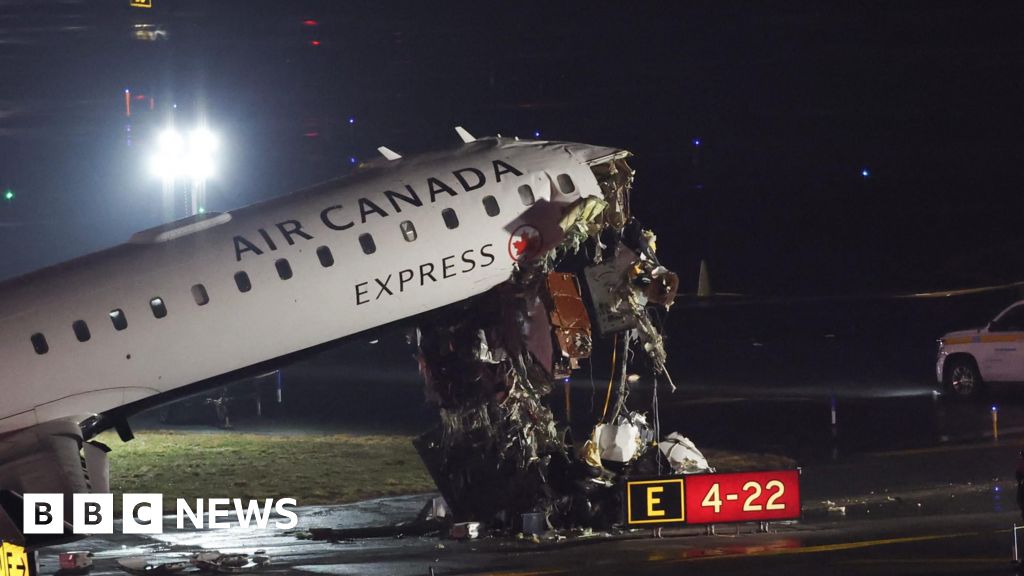
Two pilots dead after plane and ground vehicle collide at New York's LaGuardia Airport
The plane, arriving from Montreal, collided with a firefighting vehicle responding to a separate incident.
bbc.com
429 points · by mememememememo · 8mo ago · 687 comments
That ATC still takes place over radio just seems insane at this point. And there's pretty much no way to make ATC's job not stressful, its inherently stressful. Taking out how much of their job is held in the current operators mind versus being 'committed' seems like low hanging fruit 30 years ago.
The whole system's just begging for human error to occur. There's 1700+ runway incursions a year in the US alone, each one should be investigated as if an accident occurred and fixes proposed. Like when an accident occurs.
My father works ATC and his schedule has him working overtime, 6 shifts a week, including overnight shifts, meaning that there is literally not a day of the week where he doesn't spend at least some time in the tower.
If that's the reality for even half of the controllers, it's no surprise that we've been seeing more and more traffic accidents lately.
I'm Australian. In Australia, if you are forced to work overtime the rate of pay goes up, by 50% or if it's extreme, double. As a consequence "underpaid" isn't a common complaint of people working lots of overtime.
This has some negative consequences of course. If labour is plentiful you can have lots of people on hand and pay them on an hours-worked basis. The same deal applies - if you go beyond 40 hours a week their rate of pay goes up, but that shouldn't happen if labour is plentiful and management is on the ball.
But if, as in this case labour isn't plentiful, then they are going to have to fix it some other way - like paying to train more staff. What the employers can't do is offload the problem entirely onto their employees, so there are forces compelling them to get their act together.
The OP makes it sound like the dynamic is very different in the US.
It’s analogous to this hypothetical conversation:
“XYZ Politician is a corrupt official who needs to be investigated”
“Well actually, corruption is everywhere.”
See how that downplays and changes the subject at hand?
Not everyone is overworked and underpaid like ATC workers. The US government needs to implement real reforms to rectify that situation.
Instead, you find that this critcal mass is happy being boiled with their eyes wide shut.
I wrote this 12 years ago and it's even more true today: https://magarshak.com/blog/stop-wasting-our-time/
https://www.tracingwoodgrains.com/p/the-faas-hiring-scandal-...
https://www.pbs.org/newshour/politics/trump-begins-firings-o...
The real issue is just insufficient slots.
Hard disagree. The ATC initially cleared them to cross the runway. The truck started moving, and just then the ATC realised that they made a mistake and tried to fix it. Even their first attempt at that was unclear, and they only clarified who should stop on the second attempt.
People can’t react in zero second, trucks don’t stop immediately. The ATC mistake was clearing them to cross the runway, whatever happened after was out of their hands.
There have been many attempts to change phraseology, teach pilots and controllers to always readback runways, etc. but nothing that actually prevents the issue from occurring entirely via automation.
The pilot was given the clearance to land before the fire engine was dispatched. Apparently there was not even enough time for the crew to max out the thrust and try to lift off the strip even if they managed to notice the lights of the incoming fire engine.
If so, doesn't the understaffing (lower # of employees) result in each employee being overpaid (paid a higher hourly rate)?
EDIT: And it seems like air traffic controllers can retire after just 20 years and draw a defined benefit pension: https://www.faa.gov/nyc-atc
You can still do contract ATC work after 56.
You can’t account for overtime in pensions because the employees will conspire to force overtime for retiring employees to bounce the pension up. Just a natural risk with an entity that can’t go bankrupt hiring people.
The money doesn't somehow make it sustainable for the people burning out their lives. Working 7 days a week, including overnight shifts, for 20 years to collect a pension seems like WELL earned compensation.
That's seems unrelated to "we have so few" and "we enmiserate the one's we do have".
If the ATC is under staffed they’d charge a far higher premium since the risk of accidents is higher.
I’m not sure who would be liable for this accident, I’m guessing ATC is a government provided industry, and I understand governments don’t insure.
In my job we work 40h a week + oncall rotating. It works.
My suggestion is to restrict the use of smaller jets like crj and turboprops. I know airports like LaGuardia can't handle the big jets either, but they could reduce the slots and require a jet that holds, say, 150 people or more. This would result in fewer flights per day to some airports, but reduce overall congestion while still serving the same number of passengers.
You're left with a bunch of planes in the sky that can't stay there forever, and not enough humans on the ground to manually land them.
Now image the outage is also happening at all airports nearby, preventing planes from diverting.
How do you get the planes out of the sky? Not enough humans to do it manually.
Now imagine the system comes back online. Does it know how to handle a crisis scenario where you have dozens of planes overhead, each about to run out of fuel? Hopefully someone thought of that edge case.
> In audio from the air traffic control tower at LaGuardia, a staff member can be heard saying: "'Truck One, stop, stop, stop!" in the seconds before the crash.
It sounds to me like either the Cop or the Firefighter (whichever was driving) wasn't listening to ATC and this whole incident was probably completely avoidable.
EDIT: a video of the crash seems to have warning lights that the emergency vehicle ignored.
One controller working tower duties, ground movement duties, coordinating with other ATC functions off the radio, an active emergency request, and giving clearance amendments all within 2 minutes. It's insane understaffing. On top of it, there was nobody there to take over after the crash. He worked the whole cleanup for the next 30 minutes.
This is an Olympian level elite Air Traffic Controller who was setup to fail.
I've visited towers, center facilities, and have flying (and some instructing) in the San Francisco airspace for 10 years. That kind of failure is systemic way above an individual.
It does, the Runway Status Lights System uses radar to identify when the runway is in use and shows a solid bright red bar at every entrance to the runway. I'm curious what the NTSB has to say about it for this incident. From the charts LGA does have RWSLs. I didn't check NOTAM to see if they were out of service though.
Just to add…
The vehicle in question got clearance from ATC to cross the runway. ATC revoked it shortly afterwards (by radioing "Tower, Truck 1. Stop truck 1. Stop! Stop Truck 1, STOP!" (followed by the incident; the next transmission is go-arounds.)); presumably, ATC realized the impending danger. I am assuming that requesting permission from ATC to enter a runway in an emergency is a permitted action, so RWSL aren't going to prevent this type of incident.
I don't think we know why Truck 1 did not heed the stop warning (e.g., if it came too later, got lost, etc.), but I am thinking that if they understood the indication from the RWSL, they overrode it by getting clearance, because they needed to cross the runway due to the (first) emergency.
So, same. Will be curious to see what NTSB says. I suspect something about resource management: there seems to be too much happening, too quickly, for that one ATC controller. While perhaps the controller makes mistakes, the mistakes appear to my untrained ear as "reasonable", and I'd like the system to be such that reasonable mistakes don't cost lives.
I read a theory that there's only one radio in the truck that needs to be switched between frequencies.
Presumably the truck driver got clearance from the tower then immediately switched away to the frequency that the firefighters use to coordinate.
In the audio released by the BBC, the fire truck DID get permission from the tower to cross something, I can't tell if it was the runway in question. However, to cross the red runway lights if lit, you normally need that spelled out too something like "truck one, cross four delta, cross red lights". This did not happen on the BBC audio, which could mean one of many things.
> If an Air Traffic Control clearance is in conflict with the Runway Entrance Lights, do not cross over the red lights. Contact Air Traffic Control and advise that you are stopped due to red lights. (ex.: "Orlando Ground, Ops 2 is holding short of runway 36 Left at Echo due to red lights").
Airports are highly controlled environments unlike typical motor vehicle roadways and generally the same rules apply for aircraft, vehicles, and equipment on airport surface movement areas. From all sources I can find, if the RWSLs were working they should have been red and nobody should have entered the runway without further clarification from ATC.
In this case, from the available information, the drivers of the fire truck thought they were cleared, and proceeded to cross while a plane was cleared to land. I'm not familiar with ATC ground radio to know if they were actually cleared or not, but it seems clear that that the drivers thought they were cleared.
Investigation reports will give us more details.
However that is not permissible here. Airplanes are similar to trains, you have to stop and wait and there are no exceptions.
Tweet showing the video of the collision:
https://x.com/MCCCANM/status/2036131991792550351?s=20
Here is a diagram showing their locations.
https://www.faa.gov/air_traffic/technology/rwsl/media/LGA.pd...
Digital comms is available in the US:
* https://www.faa.gov/air_traffic/technology/DataComm
The issue is that the final approach and landing (and taxiing?) environments are probably too dynamic for that: in this particular situation one of the vehicles was responding to an emergency (fire).
In addition to huge planes, there is baggage transportation, passenger buses (to mid-field terminals), fuel pumpers, emergency vehicles, snow plows, deicers, and general maintenance vehicles (clear debris off runways).
Literally the crash here was caused by a fire truck entering the runway.
I would settle for a good digital system with an ability to issue emergency/priority calls to specific receivers. Oh, and full-duplex communication.
I'm practicing for a sports pilot license, and I really have problems with understanding other pilots and the ATC.
Software routinely solves database coordination problems with millions of users per second.
A naive view that confuses the map with the territory.
While in a database state you write a row and reality updates atomically....for aircraft they exist in a physical world where your model lives with lag, noise, and lossy sensors, and that world keeps moving whether your software is watching or not. Failed database transactions roll back, a landing clearance issued against stale state does not. The hard problem in ATC is not coordination logic but physical objects with momentum, human agency, and failure modes that do not respect your consistency model.
CPDLC is already being deployed domestically. It's currently available to all operators in en route segments.
All runway incursions at towered airports are reported, classified according to risk, and investigated.
I wouldn't be so quick to rule out that there's some kind of relatively easy technological double check that could greatly reduce incidents. The fact that we've not gotten there despite years of effort to reduce runway incursions doesn't mean that it's not possible.
This is a REALLY hard problem that the US cannot solve alone. It would require extensive global coordination.
Not insurmountable, but this is not something you can easily roll out piecemeal. If even a single aircraft lacks the compatible equipment you're back to the existing system.
But calling a replacement of major ATC functions with software a "simple fix" is a perfect illustration of why this is a bad idea. Nothing about human-rated safety-critical software is simple, and coming at it with the attitude that it is? In my view, as an experienced pilot, flight instructor, spacecraft operator, and software engineer, that thinking is utterly disqualifying.
Besides, there already are a lot of "simple" fixes in place for this problem, e.g. RWSL, which didn't prevent this accident.
Ok, let's not try improving systems, how's that working out?
I feel the same way about close calls on the road, especially ones involving a vehicle and a vulnerable road user like a pedestrian or cyclist. Way too many lives being saved by a person jumping out of the way at the last minute who shouldn't have had to do so, and then cops and bureaucrats shrugging with "well what do you want us to do, the numbers don't show enough fatalities here for it to be worth fixing" and later when someone actually does die it becomes "this is a horrible tragedy that no one could have seen coming, let's focus on thoughts and prayers rather than accountability that could lead to structural change."
Which has always seemed a little nuts, like in case of hit and run it would definitely be possible to take action based on a plate alone, both for police and insurance purposes. Unless the registered owner can point to the not-them person who was driving their car at that time, then it was them. Or it was stolen, but either way there will be a clear paper trail.
In the end the air traffic system is a highly complex but also a highly reliable system, especially when you compare accident rates.
I am sure the working conditions of ATC staff might be improved - but being both a pilot and a programmer, I know that there is no easy digitalization magic wand for aviation.
I'm sure the NTSB report will cover why this didn't stop the accident. Presumably either the system wasn't working as-expected, or the fire truck proceeded despite the warning lights since they had clearance from the controller.
The system is only advisory at present, so if the truck did see a warning light and proceeded anyway, they were technically permitted to do so.
1700 incursions a year, and other articles mentioning multiple near misses a week at a single airport [1]. It is safe in practice, likely largely due to the pilots here also being heavily trained and looking for mistakes, but it seems a lot like rolling the dice for a bad day.
>I am sure the working conditions of ATC staff might be improved - but being both a pilot and a programmer, I know that there is no easy digitalization magic wand for aviation.
I didn't say it'd be free. Just hard to believe radio voice communication is the best way to go.
[1] https://www.nytimes.com/interactive/2023/08/21/business/airl...
Traffic lights instead of mad max intersections are better.
Then there's subway Automatic Train Control.
I don't know that Air Traffic Control staff don't have computer systems for establishing which plane owns what airspace. They at least did do it manually already following specific processes, so it can be at least augmented and a computer can check for conflicts automatically (if it isn't already). And, sure, ATC could still use radio, but there could be a digital standard for ensuring everybody has access to all local airspace data. Or maybe that wouldn't help.
Your ground vehicle wanting to cross a runway could have the driver punch "cross runway 5" button (cross-referenced with GPS) and try to grab an immediate 30 second mutex on it. The computer can check that the runway is not allocated in that time (i.e. it could be allocated 2 minutes in the future, and that would be fine).
But, as pointed out elsewhere, obviously some of this is already present: stop lights are supposed to be present at this intersection.
I remember a debate a year or two ago about a plane ignoring instructions (IIRC it had changed frequencies) and had taxiied onto a runway when a plane was landing. Luckily the landing plane saw this and do a go around so nobody was harmed.
In the aftermath, there were similar complaints to yours. "Why can't they just have lights to block planes when a departing or landing plane was using the runway?" without thinking through how any of that works. For a start:
- How do you allocate that a runway is "in use"?
- If ATC does it, what if they fail to turn the system on?
- What if turning it on or off fails?
- What if it gets stuck on or off? How do you fix it? Are there procedures for ATC to override it anyway?
- There are multiple entry points to a runway. What if they're in different states?
- What company si going to sell such a system and accept liability?
- What training requirements will be needed for ATC and the pilots?
- What do you do if a pilot goes ahead and ignores it?
I think people can't think beyond cars. Cars have had unimaginable effort put into them so they can only operate within a certain window. Even then they require maintenance.
But as soon as you scale up to industrial safety and control systems, a power plant, the engine on a ship, etc you will end up with a bunch of controls where the people using them need to be skilled operators and it is essentially impossible to eliminate mistakes with automation and IT systems. You will need overrides. You will need redundancies. You will need to end up doing things nobody has ever considered before and have to rely upon training, education and experience to go beyond the envelope. That's just how it works.
I'm gonna guess that code never went into production. The problem seems easy until you start looking under the hood.
Money isn't the only reason it's so old. The coordination problems are huge. https://www.theregister.com/2024/09/24/us_air_traffic_contro...
Voice communication is insane? I suspect you are ignorant of what it is like to actually fly a large aircraft into a busy airport. Fault-tolerant and highly available hardware must facilitate low-latency, single-threaded communication with high semantic density in order to achieve multi-dimensional consensus in a safety-critical, heterogeneous, adversarial environment.
There is some interesting research that captures this sentiment and shows how complex a solution might need to be (replace "faulty agent" with "human error"): https://www.sciencedirect.com/science/article/abs/pii/S00051...
Almost all voice transmissions are routine instructions/clearances from ground to air, with the pilots reading them back to reduce the chance of errors. In fact, this already exists and is in wide use in (at least) the US, EU, and in transoceanic airspace.
Of course, now you have two systems that can fail, and reducing reliance on the older one can easily cause automation complacency (which is a well-researched source of errors) and require more frequent refresher courses if the skill is not practiced on a continuos basis.
I suspect that that these are the reasons it's not commonly used for approach and tower operations: There's a lot more spontaneous and/or nonstandard stuff happening in those flight phases, and as you say you don't want a pilot's eyes on a tiny screen/keyboard instead of on their instruments or out the window.
I don't doubt that it's a very safe system with enough slack allowing for intentional redundancy. But as it is, some of these controllers seem to be limited by their ability to pronounce instructions, leaving absolutely no margin for error and presumably very little room for conscious thought.
There is digital comms with ATC without voice:
* https://en.wikipedia.org/wiki/Controller–pilot_data_link_com...
* https://www.faa.gov/air_traffic/technology/DataComm
But in the highly dynamic environment of final approach, landing, and taxiing, I doubt it would be practical. Unless we want to try autonomous 'driving' on taxiways and runways?
We use AM simplex radio. That means everyone hears everyone else and that helps everyone build a situational awareness picture. Secondly we use AM because if someone transmits over someone else it makes a squealing noise so you know it happened. Also AM propagates pretty well.
Most people on HN could design a pretty good digital replacement in a few minutes - and no doubt some have been suggested in these comments. But its instructive to understand a bit about aviation history. The liability risk carried by aircraft and avionics manufacturers at one point go so bad that we stopped making general aviation planes in the USA. Then that liability was limited to a very small extent by GARA, and we had what we call the 'restart' of manufacturing.
So the idea of introducing a new mandatory replacement (not addition like ADS-B) for AM comms has a lot of resistance from quite a few areas: Manufacturers don't want to have to make the capex to reinvent and recertify new equipment. The US has a lot of old planes due to the lack of innovation because of the liability issue - and so those old planes all need a retrofit and pilots don't want to spend that money. Avionics for certified aircraft is already horrifically expensive. Legislators don't want to take on the risk of an incident attached to a bill they sponsored. And then there's the practical matter of now having two systems - the legacy AM comms, and the modern one that some have and some don't and the split in situational awareness between those populations.
So while full-duplex is seductive, and digital is seductive, and satellite seems like the obvious endgame - the reality of transitioning is very difficult.
Vehicles are listening to the same audio the pilots are, so they have the same mental picture of what's going on. Last week I talked to a maintenance vehicle at KBLI directly from the air because he was on a runway I needed to land on, at an untowered field. He cleared it, I landed, and he went about his business. So the system works pretty well most of the time.
I think the root of the issue here is actually something else. Firstly there is a lot of dissatisfaction among NATCA members (ATC union) towards their union, and the view seems to be that the union could be doing a lot better job of lobbying for their workers. You can visit /r/atc or /r/atc2 on reddit to learn more.
Secondly, the USA has fallen into a nasty trap where our government has positive incentives to choreograph shutdowns to get our congress members and senate members the face time that they crave. So there is a negative incentive to resolve a shutdown. Rather let it get hot, let it play out, and maybe you'll be the one to appear to save the day to your constituents. The trouble with this is that the department that creates one of the highest risks for civilians in a very visible way, is the FAA and the controllers in particular. So they have become a political football. And they're in an extremely stressful job without pay. And that's a very big problem.
You're seeing this play out in a growing adversarial relationship between the NTSB (e.g. DCA) and FAA, with NTSB tearing FAA a new one recently for DCA - and rightly so. I think that's led to more demotivation at FAA which hasn't helped.
So the situation is spiraling out of control. We have controllers who are overworked, who regularly don't get paid, and a union not doing the greatest job at advocating for them. Along with the recent cuts in government funding across the board.
It's frustrating for pilots. The best we've been able to do is bring our local TRACON folks stacks of free pizza, both in Colorado and Seattle. But that's obviously a token gesture. I don't see a way out of it. To be perfectly honest. And it's very frustrating because the amount of good work that FAA does, is quite startling. You'd be amazed how much data they produce including real-time feeds that are freely available to devs like us. Once you get into the IFR world and start looking not just at approach plates, but the review and updating process of each, the other maps that are produced, the real-time sitrep data that they're producing - it's really quite something what they've accomplished. And the world looks to FAA for its lead in aviation. We were the first to pioneer powered fixed wing flight, after all. I can only hope there's a way out of this.
but it's still "don't fix what ain't broken" situation - the system works surprisingly well, if you think of it, and nobody has balls (nor political power) to truly reform it.
How many runways crossings are there in a year? How much is "1700+" a percentage of that total?
FAA defines it as "Any occurrence at an aerodrome involving the incorrect presence of an aircraft, vehicle or person on the protected area of a surface designated for the landing and take off of aircraft." [0]
Many runway incursions run no risk of any accident, but are still flagged as issues, investigated, and punished if appropriate.
[0] https://www.faa.gov/airports/runway_safety/resources/runway_...
And the cost of investigating 1,700 should be within the budget.
How would you do it, then?
The technology existed to at least help automate this decades ago.
Should they be combined at LGA when both (crossing) runways are in use, and there's an incident on the field? (The fire trucks were on their way to investigate a smell on the flight deck of another airplane that had to abort takeoff twice.)
I'd say hell no.
The obvious problem is what happens when operations become abnormal. ATC shouldn't be staffed for normal operations, because then abnormal operations lead to catastrophe. Welcome to last night: the weather is bad, which causes a plane to abort two takeoffs, which causes that plane to need emergency services. This increases the controller's workload beyond his capacity, so he accidentally clears the emergency vehicle to cross in front of a landing airplane, and they can't see the airplane because the weather is bad, so they follow the instruction and promptly get hit with an airplane.
When some bad weather can be the difference between "this is fine, one controller can handle it" and two dead pilots, you need to be staffed for bad weather.
https://www.nytimes.com/2026/03/23/nyregion/faa-air-traffic-...
The emergency vehicle was told to stop and did not. Even a dozen ATC wouldn't have helped in that case.
Understaffing is absolutely a factor. Had tower and ground not been combined, the erroneous clearance probably wouldn't have been issued.
The ARFF truck not complying with the stop instruction is absolutely a factor. Had they heard and complied, the accident wouldn't have happened.
And there are likely additional factors that will come out in the investigation.
I recommend reading some final aviation accident reports from the NTSB to learn more about how these investigations proceed and what kinds of conclusions and recommendations they include.
- Another plane was out of position, grabbing some attention of the controller
- Stop communication was ambiguous about whether talking to previous plane or firetruck
- The colliding plane didn't have "explicit" landing clearance, but a "follow previous plane and land the same way unless told otherwise" implicit landing clearance. In Europe, planes need an explicit landing clearance, the act of granting it may have brought attention to the runway contention. US implicit system (arguably) is a bit more efficient, debate will now be is it worth it (pilots are now required to read back instructions because of past blood... will this result in same thing?)
- This was around midnight and apparently a little foggy, making visual contacts harder
Remember folks, disasters like this are rarely caused by a single factor. NTSB reports are excellent post-mortems that look at all contributing factors and analyze how they compounded into failure. Be human here.
"Jazz 646, number 2, cleared to land 4."
"stop stop stop, truck 1 stop stop stop" I mean maybe it was ambiguous for half a second but he pretty quickly said "truck 1 stop". I guess we'll have to wait for the sync up to see if it was too late to stop by then
The controller said “truck 1 stop” that is not ambiguous.
I remember late last year, couple of months ago, US ATC controllers were without pay but forced to work anyways (similar to TSA I suppose, although I don't think they were forced, but volunteered to work without salary), is that still the situation? Couldn't find any updates about that the situation been resolved, nor any updates that it's ongoing, if so though it feels like it'd be related to the amount of available controllers.
But no, AIUI only things that were somehow deemed part of "Homeland Security" are frozen, the TSA are part of Homeland Security but the ATC are under the FAA. So this particular partial government funding lapse wasn't causal, at least directly.
So why the fuck would any talented individual choose to go work for the "Get an example made out of you" department, on top of the horrific stress of the actual job!?
The idea of a union that "isn't allowed" to strike is a joke. Next will be a union that has a max membership of 1!
It's a mess.
Sharp contrast with Europeans
From pilot friends, in best case I would say a big “depends” in some countries are very unprofessional, in others very professional (anyway total unfair generalization). There were already accidents because of that, for example because the twr communicated with locals in non english, so not everybody was at the same page.
ATC audio
make a mistake, recognize it, and then have to continue on your job, knowing you likely just killed people, because if you don't others will die.
The weight of some jobs is immense, and our civilization relies upon workers to shoulder the burden everyday.
Our civilization? Nah. Just that one shithole country. Greatest country in the world and they schedule a single guy to work both tower and ground frequencies at a major airport, it's almost like they're asking for this shit to happen.
And before anyone mentions understaffing, this literally one of the plethora of problems that the rest of the world figured out while the U.S. continues to act special.
I read elsewhere that the plane was only going 24mph when it hit the truck, and I didn't understand how the collision could have been that damaging, but I wasn't taking into account how much momentum a plane would have at that speed. From the video, it seems like a plane moving on the ground acts less like a car or truck and more like a very delicate freight train when it hits something.
I'm not completely sure but it seems like the runway entry lights are red which very clearly indicates the runway is in use. They should have known better.
https://www.faa.gov/airports/airport_safety/certalerts/part_...
They do at CYYZ (Toronto Pearson):
* https://www.flightradar24.com/43.68,-79.63/13 (zoomed in)
* https://www.flightradar24.com/airport/yyz
Also at CYUL (Montreal Trudeau) and CYVR (Vancouver International).
Truck declared it was crossing. ATC told it to stop. Truck didn't stop.
This wasn't a communication issue.
Timestamps from the video:
2:46 Truck requests crossing
2:51 ATC allows it to cross
2:53 Truck confirms
2:58 ATC: "Frontier 4195 stop there please"
3:02 ATC: "stop stop stop stop truck one stop stop stop"
3:15 ATC: "tower, truck one, stop, ..."
Crash probably a couple seconds later, wouldn't rely on the video for the exact timing.
So it seems that ATC made an error by allowing the truck to cross, and then the order to stop wasn't communicated clearly enough. I wouldn't place much blame on the truck.
Edit: Looking at some other videos with that audio, I'm also not sure if the video I linked represents the time between communications correctly, transmission at 3:15 may have been right after the one at 3:02. Anyway, the best thing is to wait for the investigation.
The only negative I can think of is that it will generally involve accepting and responding to clearances on short final. I think adding more tasks to that critical stage of flight probably increases danger a little. Especially for low time student pilots like myself. That's particularly relevant in the U.S. because we have a higher percentage of student and private pilots than most of the world.
Overall, though, I'm fully convinced this would be safer.
Us lot have more people doing SRE ensuring p99 10ms for something frankly way less important. It is a nuts world.
I'd bet a lot of money that however the system is implemented the police and fire get special treatment when it comes to process (i.e. asking permission before they go somewhere planes might be) and that is part of what lead to this.
I highly doubt that any system would intentionally give ground vehicles of any kind special treatment on an active runway.
The truck asks permission to cross. It is given. The truck declares it is going to cross, but the ATC replies "just stop there please".
Also, those runway entry lights look red to me. If so, that should have been a HUGE warning sign to the driver.
I can almost guarantee you the airplane was visible from taxiway D.
Still, I'm always hesitant to cross an active runway.
Source: Mentour Pilot. https://www.youtube.com/live/Bb4CcoK0KLM
> Captain and first officer are reported to have died in the accident, two fire fighters on board of the truck received serious injuries, 13 passengers received injuries.
The margins are thin enough that certain planes will sometimes have people in the back get off first, before the people on the front, to avoid tipping onto the tail like this.
https://www.iata.org/en/pressroom/2026-releases/2026-03-09-0...
On average, it was slightly worse globally, especially if you count fatalities (which were much worse).
Looks like more flights in 2025 than previous years and less accidents. 2025 does have more fatalities, which are more memorable than emergency landings where everything was alright. So that is likely what skewed my view.
- Jan 2025 mid air collision with helicopter near Reagan National, Washington, D.C.
- April 2025 China Eastern Airlines Flight runway overrun at Chongqing Jiangbei
- June 2025 Air India crashed after departure from Ahmedabad
- August 2025 incident at London Stansted where a DHL A330 landed long and struck the runway end
- September 2025 Tokyo Haneda: Inflight engine fire
There was one where the plane ended up on side or back. But I don't remember enough details to find the event
Not making light of this, but I imagine there is another story of the person who had some strange scented product that led the flight attendants to play it safe and phone it in. There may very be someone whose strong cologne or forgetfulness to leave a chemical at home resulted in 2 deaths :(
> A fume event occurs when bleed air used for cabin pressurisation and air conditioning in a pressurised aircraft is contaminated by fluids such as engine oil, hydraulic fluid, anti-icing fluid, and other potentially hazardous chemicals.
RTOs throw off a ton of energy: https://www.youtube.com/shorts/S6nZDGBPsak
Anyone else think that if you're going on an airplane, you shouldn't be wearing cologne or perfume? Antiperspirant/deodorant, absolutely. But giving yourself a strong scent when you're going to spend a few hours tightly-packed with other people feels rude.
Also, did the pilots die in the collision or in some sort of aftermath? The cockpit looks absolutely smashed.
https://en.wikipedia.org/wiki/Aviation_accidents_and_inciden...
The 2025 crash near DCA, of course, absolutely spiked the number of recent commercial aviation deaths, but we haven't had any other aviation tragedies of that magnitude in more than a decade.
This can be a preventable tragedy without there needing to be a conspiracy behind it.
Your link is global not American which wouldn’t really show the effect if it was a change in US policy. But Googling you’re right, the premise is wrong.
If Tower had some help, maybe an AI or maybe another set of ears, the tragedy could have been avoided.
An LLM monitoring instructions could easily have identified the mistake and alerted the ATC in time to save the situation. There was plenty of time to correct the mistake.
Probably good here instead of seperate submission.
More air traffic? Busier airports? More travelers? More flights in general? Overworked/understaffed positions?
Air Traffic Control staffing shortages. This has led to long shifts and intensive workloads for controllers, increasing the risk of errors.
Government shutdowns have exacerbated these shortages, causing delays and heightening safety risks as critical personnel, including TSA and safety technicians, were furloughed or worked without pay.
Then there’s the outdated infrastructure. The U.S. National Airspace System relies on aging radar and communication technology.
IMO is a combination of events. I think Covid stopping all flights for so long caused some permanent loss of institutional system knowledge, and we've never recovered from it since.
On top of that, the US has been having more and more shutdowns - and regardless of whether you like him or not, Trump's been responsible for some of the longest ones.
The impact of extra mental stress on people who're already in one of the most stressful jobs in the world cannot be good in any way I can think of.
I think the fact that we're not seeing so many issues in Germany or Singapore or Dubai makes me suspect that this is a bit more US specific than global. Some issues (eg Covid) are common, but an alert pilots can overcome eg a mistaken ATC. But the more things/conditions that go wrong, the likelier it is that the Swiss cheesehole misses and causes an error.
Richard Cook's How Complex Systems Fail is an interesting read if you're curious for more.
To clarify - I'm not minimising the fucked up nature of the event. I'm just saying it's still thankfully a rare occurrence.
Nowhere else in the world you would hear such statements. Boeings simply disappeared from Europe, those few that were here before. I am sure they are still used somewhere but I haven't flown any in past 7-8 years. Heck, I haven't seen any in South east Asia neither (but that may be due to luck).
I check this with all bookings, no way I am flying that piece of shit if I can anyhow avoid that, not alone and quadruple that with family.
That is just simply false. There are many boeings flying in europe. Just by randomly clicking around on flightradar24 I found multiple right now in the air.
Grok timed out but here is perplexity
Per 100 million miles traveled
    Car driving: ~0.57 deaths per 100 million miles (recent U.S. data).

    Commercial air travel: ~0.003 deaths per 100 million miles.
umm u should never drive again. in fact never leave your apartment/house.
You're going to die of heart disease caused by your poor diet.
You should never eat again. No, wait, stop, I mean...
This is one of many examples of why capitalism needs to be kept in check with democratic government oversight. Sometimes the financial incentives are not high enough to warrant changing the system.
Per the ADSBx track the plane was at 101kts (115 mph / 185kph) just before crossing taxiway D, which would be where it hit the firetruck. It still had enough energy afterwards to reach taxiway E, 600ft away.
A plane is basically a flimsy tube. A firetruck is a solid brick comparatively. The plane out weighs the fire truck by a lot and out speeds it by a lot. So yeah, destroying the whole front of the plane to punt the truck it sounds about right for a 25 on 5 or 35 on 10/15 type rear ending to me. Flipping doesn't really sound that unreasonable considering that the plane made contact with the top of the truck (just by virtue of comparative height) and contact may not have been straight on. Even if it left the pavement on it's wheels airport firefighters aren't exactly who I'd bet on (they're middle of the pack) to keep the truck on it's wheels if they got surprise kicked off the road especially if there's an embankment involved.
An Oshkosh 1500 4x4 is 62000 lbs GVWR (wiki says kerb weight but it’s incorrect).
The plane was landing and the truck was heading to an intervention, so they were likely close to empty and to GVWR respectively.
And again, 25mph is the final ground speed, after the plane punted the truck and kept on going for 600ft.
I think you'd be surprised. The cab is quite solid because it has to conform to certain vehicle design and safety criteria (at least here in Europe).
The rest of it is made of fairly squashy aluminium box section with panels TIG welded on. There's not a lot left if one of them gets rolled, for example.
The speed was much higher per sibling comment, but also remember that kinetic energy also involves mass (planes are heavy) and the square of the velocity.
* https://en.wikipedia.org/wiki/Kinetic_energy
The latter is why (e.g.) going 100 units/hour has twice the KE of going 70 units/hour in a car.
edit: Looking into this a bit more it looks like the plane came to a stop around crossing E while the emergency vehicle was crossing at D(based on ATC recordings). Using the following map as reference[2], the 58kts point was around E, while the previous recorded point which was just before D was 114kts.
[1] https://www.flightradar24.com/data/flights/ac8646#3ede6c39
[2] https://www.flightaware.com/resources/airport/LGA/APD/AIRPOR...
People into boats need to understand this. Even a boat that travels no more than 4mph can crush you easily. This is why you never get on to moving boat from the front. Many people have made a mistake because speed is not high.
Speed, kinetic energy and acceleration are all interrelated and at the end of the day it's all forces (to some extent) and no amount of hand wringing commentary is going to replace genuine understanding of them.
(Though some of the major damage may have happened while deplaning the passengers)
You seem confident and well-informed. Can you tell us about the time of day, visibility conditions, and what it’s like driving a fire truck at an airport? We should really get this judgment to the driver ASAP.
> It would have prevented this.
Wow.
Let's get the important parts out of the way first: We in charge have taken care of optics, with regard to our offices.
Oh, and we're going to contact families eventually.
How would the ICE thing cause more ground traffic collisions. Are you thinking ATC controllers are illegal immigrants and they’re going to run away during their shift? I just don’t see a connection there…
https://www.reddit.com/r/aviation/comments/1s16x61/comment/o...
CNN, CNBC, NYPost, Guardian all had stories up quickly, or around an hour. There are others too.
UPDATED:
Down-votes happen but disappointing since I'm stating facts. Heres some backup:
The user haunter said media started reporting around ~4 AM EST (based on timestamps).
The accident happened at 11:40 PM EST. Story publish times across a sample of various legacy/mainstream media orgs:
  CNN - 12:47 AM
  NYPost - 12:47 AM
  The Guardian - 12:50 AM
  Associated Press (AP) - 1:31 AM
  Fox News - 1:47 AM
  Newsweek - 2:24 AM
This is a good overview so far:
ATC audio is https://archive.liveatc.net/klga/KLGA-Twr-Mar-23-2026-0330Z....
The clearance for AC8646 to land on runway 4 is given in a sequence starting at 4:58. "Vehicle needs to cross the runway" at 6:43. Truck 1 and company asks for clearance to cross 4 at 6:53. Clearance is granted at 7:00. Then ATC asks both a Frontier and Truck 1 to stop, voice is hurried and it's confusing.
You should provide sources for a claim like that. For example, what in the BBC article is wrong?
> Video footage on social media showed the aircraft, which is operated by Air Canada's regional partner Jazz aviation, coming to a rest with its nose upturned.
This just isn’t true. There’s no video of the plane coming to a rest with its nose upturned (which implies motion). The upturned nose happened only after passengers deplaned and the balance shifted.
> It had slowed to about 24mph when it collided with a vehicle from the Port Authority of New York and New Jersey, which runs the airport.
This is the next part that will change. Just because some of the last broadcast data said 24mph doesn’t mean that’s the speed it was when it collided with the truck. The truck is on its side and those passengers are in hospital. The pilots are dead. The plane sustained enough structural damage to have the entire nose collapse. If the sentence is based on that broadcast data, SAY THAT instead of printing it as fact.
And with all the quotes from social media posts from key groups, link to them instead of just vaguely quoting.
EDIT:
As expected, they got rid of the above paragraph claiming the speed. It now says:
“The plane was arriving from Montreal and had landed, before colliding with the vehicle from the Port Authority of New York and New Jersey, which runs the airport.”
Everyone can write a comment on Reddit / make a podcast / video / whatever claiming whatever they want. Unless you already know and trust them (which requires you to be able to cross-check their information), it's potentially as useful as a random LLM hallucination. Could be brilliantly spot on, or could be completely nonsense. No way of knowing unless you already know enough. (Because even cross-checking won't necessarily save you, if you cross-check multiple bullshit sources).
Media with standards (like the BBC, Guardian, Liberation, etc.) will do their best to report truthfully (even if sometimes with some bias), and will fix their mistakes if they're caught later on or the story evolves. Independent media checking organisations have shown time and time again that there is trustworthy media, you just need to know which it is, and always take a pinch of salt. It's wild to me that people will just dismiss rags such as Fox News and relatively quality media like Guardian in the same breath.
The NYT is biased, but it’s still basically the most official newspaper of the American ruling class.
It wouldn't surprise me in the slightest if the truck has a single radio (airplanes always have two) and was constantly switching between ATC and fire house frequencies. The probably never heard the "stop, stop, stop stop.."
It would also not surprise me if airports previously had dedicated fire services, which have since been outsourced for cost reasons.
Yes they are.