1072 points · by jipumarino · 14y ago · 637 comments
I mean, why on earth would you tamper with a voting machine so that it stuffs the ballot, but have it update the UI so that the user can see and report the error? This should fall to the way side of failing basic logic, but it doesn't because people want a sensationalist article to argue over. Changing votes would be much easier to do on the back end, and would have the additional benefit of never being detected by the user
Having no knowledge of this machine in particular, I can't say much more, but it's certainly feasible that this is the easiest or only method to modify the outcome of a vote.
Based on the description and assuming it's accurate, we could conclude that there is some sort of mapping of the display to vote selection that is configurable locally. This makes sense, as every locality has different ballots - school districts, etc.
We do know that these things tend to be pretty poorly written, so you also can't assume even reasonable or typical component design.
I don't think your logic is valid.
Doing it at the front end won't flip as many votes because many people will see the incorrect registration and stab at the touch screen a few more times until they find the right spot. But some will not notice, and in a close race that could be good enough.
:)
It seems ridiculous to be unable to comprehend something that would be as familiar as using a hand calculator to people like me and you, but there are people out there who are afraid to touch the power button on their computers because they think they'll burn their house down or get a virus or something.
Imagine people like that trying to learn a brand new user interface in the span of 5 minutes while people are waiting in line for them to finish. It's a small population of people but it could conceivably make a difference given the right conditions.
edit: I forgot to add that this would be a good way to commit voter fraud and still have plausible deniability. Also, it would probably be more cost efficient to bribe someone for this small bug that gives a 0.5% advantage than it would be to pay for the campaigning that makes a 0.5% difference.
In any case, I'm skeptical of the tampering hypothesis because only one person reported and filmed it.
Or it could be an attempt at plausible deniability. If all the machines need calibrating, but an uncalibrated machine just so happens to mis-register votes in the direction you want, that would give you an edge because you can guarantee that some machines won't be deployed correctly.
Further to this, why aren't the names randomized?!
Do you know how many millions of lines of code they would need to add to do this?
Voting machine manufactures have repeatedly proven themselves the most incompetent people in technology.
Unfortunately, when politics are involved, people default to assuming malice far more than they perhaps should.
It's simply because of the stakes. The cost of ignoring a positive is much greater than the cost of freaking out over a false positive.
Not hard enough to knock the whole machine over, but way harder than "touch."
It doesn't even need to be malicious. Maybe someone really liked Obama.
This exact thing happened last election. Why does it only happen to the advantage of Republican candidates?
There was also this, a few weeks ago: http://www.nationalmemo.com/man-connected-to-virginia-gop-ar...
The fact is that there is a concerted, coordinated effort to tamper with the vote every single election. I have no way of knowing whether this specific incident was malicious, but I sure wouldn't be surprised if it was.
Exactly my experience as well. It was excruciatingly well behaved.
At the polling place, there were quiet conversations and line chatter, yet was very professional and well, British.
Even when I was a poll worker during the 2000 election, it still was decent and honorable proceedings, even if the campaigning was not.
http://www.washingtonpost.com/local/va-politics/fairfax-democrats-sue-over-polling-place-observers/2012/11/01/2fb64b20-2451-11e2-9313-3c7f59038d93_story.html
There was also a NYT article suggesting that fairfax co. could end up being this election's Florida. We'll see.All this nonsense about voter IDs, altering votes, making it difficult for people to vote in contentious areas (e.g., the Florida districts who have already filed suits in the last couple days) and the like should really be handled by applying the 14th Amendment. Or at least by the executive making a clear statement that it will do so.
Any attempt to disenfranchise people should be met with Section 2.
Besides, it is hard to convince a government to apply section 2 if the party in power is the one that was doing the disenfranchising.
If Florida is a state of party 2 voters then party 1 gains by preventing voting, not only do party 2 voters get removed from consideration in the state but the state gets weakened and so support of party 2's ends in congress is reduced?
Or am I misunderstanding? It's the first time I've heard of this part of the 14th amendment.
http://www.breitbart.com/Big-Government/2012/11/03/Dozens-of...
If enough people cry foul to rule out a large group collectively lying or forgetting their confirmation numbers, fraud would be much easier to establish and localize. Moreover, requiring each independent database of votes to match to within some margin would also decrease the likelihood of fraud by requiring collusion between both organizations.
EDIT: Note that the confirmation number would be issued to you anonymously and sans receipt - there would be no way to prove your vote - you could have found some random confirmation number, and no recourse for a single citizen crying foul. The point, rather, is that if several hundred or thousand individuals noticed that their vote seemed to have changed, the likelihood that they were all making it up or forgetting their confirmation numbers would decrease substantially.
As an example, I worked with Michael Clarkson on an implementation of Civitas: http://www.cs.cornell.edu/andru/papers/civitas-tr.pdf
The problem is they are far too complicated to explain to voters which makes them unlikely to be adopted and unlikely to be trusted. Having a secure vote is obviously the primary goal, but having a vote that people trust is pretty important too.
The trick to these systems is there's some one-way hash done. This requires a lot of ballots, with enough hash collisions to ensure one's ballot gets lost within the herd.
Alas, elections in the USA are precinct-based, typically 1 to 1,000 voters in size. And our ballots are complicated. My ballot this election had 20 issues.
So combinatorially, it's very likely my ballot will be utterly unique within my precinct. Meaning my ballot is not secret.
Edit: Clarification at end.
I dropped off my wife's ballot. It is totally normal for one person to drop off multiple ballots at the box. It would even be hard for you to notice multiple ballots being dropped. I did our two with one gesture.
The vote buying cow has already left the barn.
So it's far more important to let citizens verify that their vote was counted accurately, with some sort of anonymizing hash.
I did the same thing with my wife's ballot this morning, and I saw multiple other people dropping more than one ballot as well.
a) the secret ballot was introduced into the US (originally as the "Australian ballot") many years after the ratification of the Constitution b) no amendment has prescribed it
I find it hard to quarrel with the judge. I do consider the secret ballot an excellent idea, but I don't see it as constitutionally mandated.
Then stick all the votes up on a server somewhere. Let us go and check our votes are in the list. We could then have informal verification and audits of the counts.
What happens when I stuff the ballot box with a million non-existent votes?
Oh, so you voted correctly and you can prove it. Whoopy do!
> Let us go and check our votes are in the list. We could then have informal verification and audits of the counts.
You have the square root of bugger all - the integrity of the total count is what counts - not the individual votes.
Vote stealing and ballot rigging is a well understood human phenomenon - it is a solved problem.
Sprinkling some poorly thought out computer pixie dust on it is not even the beginning of an answer.
I think this verification may already be a reality. The alternative is to disallow any form of verification, as with the Reddit poster, but then we lose the ability to perform checks on the voting procedure, and would never have known about this current anomaly.
What's missing, though, is the proof that who you voted for is who the vote was internally counted for.
Due to anonymity you can't individually prove a confirmation number belongs to you - you could have found one on the street or made up some random number, but if 10000 people claim that their initial vote does not match the confirmed vote, it's worth looking into more carefully.
That'd be a felony in Wisconsin, presumably for that sort of reason. http://www.nbc15.com/home/headlines/Wisconsin_GAB_Is_Felony_...
So that people can't bribe or blackmail you into voting a particular way.
The voter must retain her vote (A or B) in human memory, which cannot be externally verified, except by brain scan, etc... but that detail is rather unsolvable.
Punchscan is a bit impractical for verifying large ballots, but large contested ballots are rare.
I wonder what (if any) pitfalls it has, other than the increased complexity and less obvious correctness (i.e. it would be hard to convince a non-mathematically inclined person that it works properly).
It's possible that I'm getting a bleaker picture than reality, I suppose, since I only read about the broken stuff and not the instances where everything just works.
There are several "wards" in the city, and each contains a school that is the voting location. Outside of each location will be people holding signs of all candidates, but all they said this morning are things like "Happy voting" and "Thank you for voting."
Inside the location there will be about 8 lines with last name letters. A-D and E-H, I-M, etc. If your last name was Dorette you would get into the A-D line. This is one bottleneck, but it resolves very quickly. You say your name, they find your name and cross it off, and you are handed a paper ballot.
With the paper ballot you then wait in a second line until a booth (containing nothing but a marker pen and writing surface) is free. There are about 16 of these booths, with privacy screens behind them.
If all the booths are filled you will have to wait, BUT if you do not mind people being able to possibly see your vote you are welcome to go to a temporary booth, that is just a series of lunch tables with cardboard dividers. Less privacy, far more seats. Maybe 30-40 people can fill out ballots at once at the ward I was in.
You fill out your ballot with a black marker and bring it to the end of the room where there is a single machine. This machine does nothing but take your ballot and scan it, so the line here processes near instantly. The ballots are kept to be recounted by hand if need be, and most importantly, the machine portion of voting is not a bottleneck.
It went very smoothly today.
It sounds very similar to the last time I voted (also in a school building), except I never experienced a line longer than, say, 2 persons -- I guess we have more, smaller locations/voter --, and of course there was no computer at the end, you just put your ballot in the box. And there were no people picketing near the location, and nobody thanked me for voting. Well, that's not true, the people inside said thanks (and so did I).
Representatives of all parties are present when the votes are counted (and recounted). We get the results in the evening, 2 or 3 hours after the elections close.
It's not entirely comparable since our ballot is quite simple, two pages with large letters, it takes about a minutes to fill out with two crosses in the right place. From what I understand you often vote on loads of things at the same time and it takes a while to fill out correctly.
isn't it illegal to campaign within a certain radius of a polling place?
If you never hear about these things in your own country that means that apparently no one there cares.
- Voter ID to discourage minorities, students, elderly [1]
- "True the Vote", invoking a problem that doesn't exist [2]
- Another article on "True the Vote" [3]
- Blocking voting on the weekend before election [4]
- You don't see lines like this in other developed countries. It's not that they're not reported on because "no one cares", they're not reported on because there aren't any lines. [5]
- Again, you don't see stuff like this on election day outside of the US: [6]
- Thankfully, there are honorable republicans who also call this out, like Conor Friedersdorf: [7]
- And this, it's just... Baffling to people in the rest of the world. [8]
Again, this is unheard of where I live, not because people don't care but because we're not (completely) bamboozled!
[1] http://www.youtube.com/watch?v=EuOT1bRYdK8
[2] http://www.theatlantic.com/magazine/archive/2012/10/the-ball...
[3] http://www.nytimes.com/2012/09/17/us/politics/groups-like-tr...
[4] http://www.nybooks.com/blogs/nyrblog/2012/sep/21/voting-wron...
[5] http://news.yahoo.com/voting-already-mess-florida-041641182....
[6] http://www.theatlantic.com/politics/archive/2012/11/no-one-i...
[7] http://www.theatlantic.com/politics/archive/2012/11/shame-on...
[8] http://www.esquire.com/blogs/politics/doral-florida-early-vo...
Why would that discourage anyone? In slovenia, you are required by law to carry an ID when you turn 18/get voting rights. So there's really no excuse for anyone to not have an id (or driver's licence).
Well, that's not strictly true. I recall waiting about half an hour on the election day for one of the elections I voted in in Ontario.
Several hours' wait during early voting seems a little bush league though.
Or that they don't happen...
Yah, somehow I doubt that, unless you managed to hire god to run your elections. Humans make mistakes, and machines and systems that humans build mess up.
If you never hear about problems that's quite worrying - that means no one is even checking.
*(Scotland 64%, Germany 68%, US 55%)
In many other countries these things are banned because people care.
(2) We are OK publicizing it.
(3) Probability would indicate that we'll have a certain error, and it'll be shouted about.
---
But it's very strange that it was "miscalibrated" to not select one particular candidate, no? :)
The internet loves Obama. There are many stories of people that support Obama cheating the system (right now there's a popular story of someone admitting on Facebook to voting for Obama 4 times...) and that isn't on the front page of HN, when that is absolutely confirmed to be a misuse of the system.
Everything that is a disadvantage for Obama is naturally going to get more attention, because most of the internet age that use sites like reddit and HN are the sort that want progress.
I'll bet there are machines that have this problem (assuming this is not an isolated incident and his a software/hardware issue) that vote for Obama when Romney is clicked, but that won't be big news in this circle of news because who cares about Romney here?
Edit: here you go, same problem that affects Romney votes on another machine http://www.cbs42.com/content/localnews/story/Voting-machines...
To be fair it is a claim of a problem affecting Romney by some person which is then refuted by another person (some sort of voting official?). The problem affecting Obama was captured first hand and confirmed as voting machine problem by second source per the Gawker article.
[ Note : I have no dog in this hunt - just pointing out something that I noticed. ]
I think the difference here is that there is absolute proof that it wasn't end user error whereas with the story you linked to there were no videos or any other demonstrations.
Being that none of these machines are open-source, that's really the important factor, the political persuasion of the companies manufacturing the machines.
The essence of democracy is an essential distrust of power, so yes, I'm concerned.
In Germany voting machines have been banned completely with good reasons, because they're unsafe and easy to to hack. And still we can pull off a purely paper-based votes with 82 million people completely without any lines in front of the voting booths and results within two hours after the election.
> "verification of the result must be possible by the citizen reliably and without any specialist knowledge of the subject."
Unless you're trying to bribe the counters/interfere with the counting ;).
It's hilarious when Americans use that as an excuse for things being sub-par in their country. I see it all the time for health care, roads, schools etc.
Yes, your country has lots of people in it, but it also takes in an enormous amount of tax, and has enormous government agencies to organize this kind of thing. Everything should scale up appropriately, but you guys have no figured that out yet.
I am simply providing an explanation that statistics indicates that there will be an absolute greater # of issues.
I would also suggest that governing at scale is hard and doesn't seem to scale linearly; much worse, as far as I can guess, based upon my news reading. Things like population density, diversity of industry, diversity of cultures start to play out in a very loud and complicated way. The only person I've met (who I talked about this with) who appreciated the scale of the US immediately was from Russia, which has similar scale issues.
See: the disparity between road quality in Maryland (good density) and Pennsylvania (poor density). (or, to correct for climate, compare Pennsylvania with New York).
OP: When has this been used as an excuse for anything that you are apparently deeming as 'sub-standard' here in America? Cite a source please? Gotta be honest, I've never heard that excuse once.
I also had no idea the rest of the world had solved the problem of civics and effective government. Why are you guys keeping it a secret? Care to share?
Um, unless you're talking to India which manages to pull off votes with 1.2 Billion People. You are like 25% their population.
Of course, again, there is media acting as a watchdog, and a hope that the manipulation is statistically insignificant.
Note that this doesn't mean it's counted right: it just means you have no way to worry about it. Maybe election officials are debating whether that line for Joe is a mistake or not. Now the problems are seen immediately instead of unseen, which was one of the driving forces for people who didn't want to ever go through the hanging chad issue again.
I'm certainly not saying computer voting is better than paper voting -- they each have their trade-offs. (I'd prefer paper ballots that voters can "self-scan" by a machine that is very conservative in what it accepts, but that's a whole separate discussion.)
this is a lot of people. I am sure that if we investigate the details of elections in India, Indonesia, and Brazil, we will find an array of fudged votes and issues.
In other words, I am pretty sure that the error rate for the mix of remote/paper/electronic voting will hold pretty constant regardless of population size.
You only hear about the ballots that crash, not the millions that land safely every election.
I have no idea why other states don't do this.
In any case, what am I supposed to do besides vote (at the polls - I'm all but convinced this is pointless), spend my money wisely (this is the best method I've come up with to enact some kind of change, but it's hardly effective since I'm not a billionaire), and write my "representatives" (who invariably respond with some boilerplate bullshit and go on doing whatever the folks paying for them (global business) want)?
David Frum weighing in: http://www.cnn.com/2012/11/05/opinion/frum-election-chaos/in...
In fact there was a case in my home state of New Hampshire a few years ago, where a state worker was investigated for not using funds that had been made available by the federal government for each state to use for elections. The state worker's defense was that the money had strings attached; basically there were some restrictions on how the federal money could be used during the election. The investigation was dropped immediately, in favor of the worker. Basically my state would rather spend millions of extra dollars to run the elections than allow the federal government to put restrictions on the way they run elections.
Do you feel it's beneficial for New Hampshire to be in a federal union where it doesn't control its economic policy, central bank issues, or foreign policy, but can ensure it has its way on such issues on who can get married and how you vote in the federal elections, where your votes are ultimately largely meaningless? That seems a bit neither here nor there to me.
That's also one reason we're so hesitant to get rid of the thing: at the same time, we'd need to nationalize election administration. If we didn't, it would be much easier for states to "cheat" and exaggerate their voting power by claiming higher voter turnout than what actually happened.
Think of it like a badly-designed old dataflow that you would love fix, but there are so many dependencies now that it's become a major project.
That being said, I'm taking a two hour drive later today to vote because my vote-by-mail ballot never arrived, so...
What I've found is that it roughly correlates with education, and not in the inverse sense. More educated and accomplished Americans usually scoff at any and all hint of real not-an-isolated-incident systemic corruption as "conspiracy theory," grouping it in the same category as David Icke's tales of shape-shifting reptiles. There is no organized crime in America, no systemic corruption. Everyone is just doing their job.
To me it would seem like an easy win to push for it and push it through. "We need to preserve our democracy!" "Any one who doesn't vote for this bill, is unamerican!" "We cannot let our ability to vote be assaulted!" etc.
This makes a bit less sense when you look at how it ends up that a very few districts end up deciding the race - but I think the idea itself is sound. Those battlegrounds will shift, likely more rapidly than endemic corruption can take hold.
It would probably cause a small dent and shift by people who don't notice or are confused (elderly).
Looks like a bug, actually swings a close election?
I've used that exact type of machine to vote in North Carolina (but this ballot is not from North Carolina). You have all sorts of people pounding on the screen all day.
Remember the reason we all wanted electronic voting after the year 2000: because it gives absolutely clear answers, not necessarily better answers. (Even the best systems have errors because there are humans involved.) You don't have to debate whether that smudge counts or does not count as a vote.
The lack of a receipt is deliberate and prevents vote-buying. A carbon copy of your vote will open as many avenues to fraud as it will close.
It's not perfect, and not my preferred system, but it's pretty decent.
Assuming it's miscalibration, how many people used this machine before the video? how many afterward?
>I then called over a volunteer to have a look at it. She him hawed for a bit then calmly said “It’s nothing to worry about, everything will be OK.” and went back to what she was doing. I then recorded this video.
That sounds like they were very likely the first person to complain. What did the rest do?
I think you mean if the machine was intentionally designed to alter votes, it wouldn't do it in this fashion. The article doesn't even hint that this might be done on purpose.
Altering is an action, not something passive. If a machine is altering votes then it must be doing that intentionally. What is happening here is the person interacting with this machine is interacting in such a way that makes the machine believe he is pressing elsewhere on the screen.
The title reads as if the machine is doing something, the reality is the user is doing something in such a way that the machine believes they're doing something else, due to poor calibration.
http://www.reddit.com/r/politics/comments/12q6wu/2012_voting...
> I initially selected Obama but Romney was highlighted. I assumed it was being picky so I deselected Romney and tried Obama again, this time more carefully, and still got Romney. Being a software developer, I immediately went into troubleshoot mode. I first thought the calibration was off and tried selecting Jill Stein to actually highlight Obama. Nope. Jill Stein was selected just fine. Next I deselected her and started at the top of Romney's name and started tapping very closely together to find the 'active areas'. From the top of Romney's button down to the bottom of the black checkbox beside Obama's name was all active for Romney. From the bottom of that same checkbox to the bottom of the Obama button (basically a small white sliver) is what let me choose Obama. Stein's button was fine. All other buttons worked fine.
I disagree. If this person decided to walk away because of confusion/frustration/etc, then it would've been one less vote cast and would have altered that individuals vote. It wasn't intentional, but a software/hardware bug.
Cause it won't be spun like that at all.
[1] Joseph Hall comments here, also provides a link to further commentary by him: http://gawker.com/5958114/an-expert-weighs-in-on-that-viral-...
[2] http://www.theawl.com/2012/11/the-truth-about-voting-machine...
Being a software developer, I immediately went into troubleshoot mode. I first thought the calibration was off and tried selecting Jill Stein to actually highlight Obama. Nope. Jill Stein was selected just fine. Next I deselected her and started at the top of Romney's name and started tapping very closely together to find the 'active areas'. From the top of Romney's button down to the bottom of the black checkbox beside Obama's name was all active for Romney. From the bottom of that same checkbox to the bottom of the Obama button (basically a small white sliver) is what let me choose Obama. Stein's button was fine. All other buttons worked fine.
Edit: Just watched the video again. The video suspiciously freezes from 11s to 18s. Probably, something inconvenient being edited out amateurishly?
I used to work on kiosk software for restaurants. At the start of every day we had to go through all of the touchscreens in the restaurant and calibrate them. Sometimes they would lose their calibration halfway through the day and need to be recalibrated multiple times.
I remember the old Nintendo DS touch screen, which was resistive, required user calibration where you would press on the corners of the screen. If you missed the corners (which, with the relatively thick stylus and the relatively thick bezel on the original DS, wasn't uncommon), the accuracy of your touch positions would be very notably off, to the point that using touch-screen keyboards in some games would be difficult.
Obviously I don't know for sure if this was the exact case with this voting machine, but the point being, some touch screens do require calibration and there is a chance for error. Or, of course, it could simply have been a factory mistake.
Either way, I doubt there's any malice behind this error.
Multi-touch screens as used in smart phones use capacitive touch sensing technology, they do not require calibration.
Cheaper, older touch screen systems (such as those used with ATMs or voting machines) use resistive touch technology, they absolutely require calibration.
2. Because these machines are open to the general public who are hitting the screens with their meaty fingers all day.
I have used a ton of touch screen devices in public. I've encountered quite a few that were miscalibrated.
Public devices put up with abuse that your private devices do not.
My kids abuse my iPad pretty heavily but generally smacking on the screen with their hands and fingers a lot but I still have never seen it mis-calculate a touch.
If you've ever interacted with a touchscreen at an ATM, mall kiosk, or airport kiosk, it's likely that they were resistive or infrared based, and more susceptible to calibration errors.
[1] http://www.chieftain.com/politics/pueblo-county-voting-machi...
Because the person who wishes to tamper with the outcome of the election only has access to (or, very likely, skillz to modify) the calibration template (which has to be reconfigured each election, hence is modified by more people), not to the entire source code and tool chain of the voting machine. Most attacks are not gigantic conspiracies with unlimited resources.
That being said, the only conceivable way to have a secure electronic voting process is to use a completely open source system. Open source hardware and software, with publicly viewable results.
Paper ballots have issues, too. They are different issues, and largely unseen by the general public until you have a really close election and have to use human judgment to decide whether that mark counts as a vote or not.
No magic can make the halting problem decidable.
[edit PS] Of course, this is purely academic. You might as well fantasise about a voting system made of Babbage-esque clockwork.
1. Allowing people with disabilities to vote. For example, headphone voice prompts for blind people, large print/high contrast for the elderly etc.
2. Making sure voters understand the voting procedure - particularly if there are multiple offices and issues on the ballot, multiple ballot papers and so on.
3. Ensuring voters' intent is recorded unambiguously. For example, you can't put marks in multiple boxes (intentionally or accidentally) and you can't leave a dimpled or hanging chad.
4. Perfect counting (assuming the data is entered correctly and the software works right) as opposed to manual counts where papers sometimes end up in the wrong pile.
5. You can offer voting in multiple languages.
6. You can randomise the order of candidates on the ballot, to evenly distribute any impact being at the top might have.
7. Ability to take backups for transit or deliver results electronically, avoiding boxes of ballots going missing.
8. Reduced counting costs and faster results, allowing more polling stations to be operated and allowing the polls to stay open later for the same result delivery deadline.
Whether it succeeds at offering these benefits, and whether they're worth the obvious cost in trust is debatable.
The machines used on Brazillian elections are simpler but much better thought out, since it's impossible to input the wrong candidate. You have to input the number of the candidate, review his information and photo, then press "confirm" button. It doesn't present a list of candidates to choose from, so there are no biases. The US should adopt a similar machine. [1]
[1] http://en.wikipedia.org/wiki/Elections_in_Brazil#The_Brazili...
"I first thought the calibration was off and tried selecting Jill Stein to actually highlight Obama. Nope. Jill Stein was selected just fine. Next I deselected her and started at the top of Romney’s name and started tapping very closely together to find the ‘active areas’. From the top of Romney’s button down to the bottom of the black checkbox beside Obama’s name was all active for Romney. From the bottom of that same checkbox to the bottom of the Obama button (basically a small white sliver) is what let me choose Obama. Stein’s button was fine. All other buttons worked fine."
Based on the reddit story, I think this was Central PA, which definitely falls into the "not allowed to take video" category.
http://www.citmedialaw.org/state-law-documenting-vote-2012#P...
And although I think this is overblown, in general I think this seems a legit reason to sneak a recording.
I wonder what the trade-offs are for randomizing each ballot.
http://tv.msnbc.com/2012/11/06/machine-turns-vote-for-obama-...
But even at that, when a state has a razor-thin margin in an election, it can be maddening to figure out what happened.
http://latimesblogs.latimes.com/washington/2008/11/franken-c...
http://www.factcheck.org/elections/mining_the_minnesota_reco...
The election to the United States Senate from Minnesota in 2008 was too close to call before the election, and even after millions of Minnesotans voted for one of three major party candidates, the margin between the top two candidates, Democrat Al Franken and Republican Norm Coleman, was so close that the margin was only one-hundredth of 1 percent of the votes cast in the election. That election really underscored the slogan "every vote counts."
It's quite indefensible to use a voting system that doesn't leave a literal paper trail. The technology is well proven. But what really gives most election results legitimacy and staying power is a wide enough margin among votes cast by people who show up to vote that the old saying "Vox populi, vox Dei" can apply to the result. The people speak, and even the voters who didn't agree with the plurality have to listen. It's appalling that any state would have a voting system that could obscure what the consensus of the voters is.
AFTER EDIT: Thanks for the several replies to this comment. Reading other replies posted to this thread since I first wrote this comment, I see several mentions of the systems in the Pacific Northwest states of having mail ballots mailed to voters. When I lived in Taiwan, more than a decade ago, I had a post office box there. Sometimes I would receive postal mail from the United States for the previous holders of that post office box, including State of Oregon ballots for two different Oregon voters (who were presumably each other's roommates while living in Taiwan). I always wondered, without giving into the temptation, whether I could have successfully filled out one (or both?) of those ballots and mailed them back from Taiwan to cast votes in an Oregon election. By contrast, I was never able to cast a Minnesota absentee ballot from Taiwan, even the time when I should have been regarded as having a stable permanent residence address here in the United States. So I missed out on voting in both the 1984 election and the ever-so-controversial election of 2000. I have no clear awareness of how mail ballots are authenticated as having been mailed by the voter to whom they belong (a signature on the envelope?) and hope that someone is checking to prevent those ballots from being misused.
Computer systems are trying to bring forward all the hidden problems that aren't found until we have to fight about the result and put them right in front of the user. By design, they are going to show more errors, instead of hiding them from the voter.
(I shouldn't need to say this, but I'm not saying computer voting systems are better. I tend to prefer pure paper. But each system has trade-offs.)
Paper ballots as the canonical record can always be: a) recounted on demand while being able to verify original voter intent (to a greater extent than digital or mechanical systems) and b) digitized for redundant storage and securely encrypted.
Therefore, IMHO, if you want to ensure democracy, ballots must: show tampering, be easy to complete, easy to count (and re-count) and quickly deployable/scalable. Scannable paper is the only option that really does all of that well.
From an operations perspective (MBA/Designer here), the bottleneck in the process is the filling out of the ballot, not the scanning/recording (with any electronic/scanning system), so why not make that part scale/parallelize really easily without requiring thousands of dollars of heavy, breakable hardware? Paper is better, all around.
Lots of people really don't like the fact that the senator is chosen based on how 3 people sit down and decide what that means, or whether this chad was punched out "enough."
Computer touch-screen voting systems, like all other voting, have flaws, but one thing they don't have is any ambiguity how you count each ballot.
(There are, of course, other ways to handle this. For example, you could fill out a paper ballot and have it read by a test machine that is very conservative in what it accepts, and alerts you to errors. I'm sure this has trade-offs, too.)
Instead of going to all the expense of flipping a coin, though, you could just take the person who seemed to get the most votes (after you've counted them all really hard to make sure you're within the margin of error). Just an arbitrary rule, no biggie.
Or have a runoff election, or have instant-runoff voting. Having elections determined by real or statistical coin-flips undermines the (important) story of self-rule.
"The greatest value of free elections is in all of the out-of-equilibrium outcomes that, because of the regularity of free elections, never come close to happening."
That's a very positive way to look at it. The problem of reduced legitimacy persists, though. The disgruntled Coleman supporters will probably always have a sneaking suspicion that the election was stolen from them, which tends to poison actual discourse.
Are you expecting the vote to be a proxy for the entire population of the country/state/whatever? Perhaps the entire population of eligible voters? Or, do you view it as simply the preference of those who took the time to vote?
Personally, I see little harm in disregarding the intentions of those who could vote but choose to not vote.
Issues of systemic inequalities in access to voting aside, I have little problem with viewing an election the task of accurately counting the votes of those who actually made it to the poling place. If you accept that concept, then the margin of error is extremely low – especially with electronic voting systems.
And to partly answer your question: Oregon makes it a felony to sign someone else's name to the identifying envelope.
I think you'll be less enthusiastic once you understand how it works.
In my jurisdiction, ballots are stuffed into an image scanner (like a high speed fax) as they arrive, the votes are detected, any ambiguous votes are "electronically adjudicated" meaning workers alter the database to correct for voter intent or write ins. There's a nightly summary report, allowing people to peek at early results.
Add the problems with USPS losing 1% of all first class mail, and the lower end demographics being more mobile (changes of address), you get some real disenfranchisement issues.
It's true that vote by mail increases turnout, mostly with primary and special elections.
It's also true that vote by mail silently disenfranchises about the same number of people it enfranchises.
The correct solution is postal ballots for people who need them, poll sites for every one else. Thereby maximizing the number of people enfranchised and minimizing the number disenfranchised.
[edit] In addition, we have locked dropboxes in many locations so you can avoid the USPS and the elections office entirely.
That's a numerical statement. Can you provide the numbers behind it? How much is turnout increased, and where did you get the 1% figure for the USPS losing first class mail from? I would assume that mail going to central locations are more likely to be delivered than to individuals. Same with issues related to change of address.
Is this different than how the count works in states whose ballots are delivered via volunteers with ballot boxes?
http://www.krdo.com/news/Pueblo-GOP-Machines-switched-Romney...
covered by the Washington Post
http://www.washingtonpost.com/blogs/election-2012/wp/2012/11...
Virginia has both right now and a lot of people prefer to wait for the machine. I would love for them to switch completely to the paper marked ballots.
Las Vegas slot machines seem like a perfect archetype (to me, anyway). In trying to look up the security measures I remember from an episode of Modern Marvels I instead ended up with an NY Times opinion piece from 2004 [2] drawing the same conclusion as I. Probably (based on admittedly nothing) the measures cited have become more sophisticated and rigorous in the past 8 years.
Here are some highlights on slot machine security (as of June 2004):
* All machine software past and present are kept on file by the state
* Spot checks, spot checks, spot checks. Random and often.
* State gaming commissions are constantly looking for new ways to manipulate their machines; the article mentions firing a stun gun at a slot machine (best job ever?)
* Six month vetting process for companies and employees wanting produce gambling hardware/software
* User disputing the machine's actions has the right to an immediate investigation
Note: I am absolutely in favor of maintaining a paper trail for decades regardless of the state of digital solutions.
[2]http://www.nytimes.com/2004/06/13/opinion/gambling-on-voting...
If you don't vote for the Lizard People, the wrong Lizard Person might get in.
In my area (northern MA), voters are given a ballot with a bubble next to each of the candidates' names. You use a marker to fill in the bubble next to the candidate you want to vote for, like 6-year-olds manage to do all the time on multiple choice tests in school. Then it gets read in by a machine, leaving a paper trail just in case.
How are these electronic voting machines any better than that? With all the technical/fraud issues surrounding them, wouldn't it make sense to just use paper?
If we do have to use electronic voting machines, I like your idea of it printing a paper ballot rather than tabulating the vote inside the machine.
Just because you never see this issue doesn't mean it doesn't exist. It's just that the ambiguous ballots don't matter in the vast majority of elections so no one cares.
I'm not saying computers are better than paper. They each have trade-offs.
There's never been any real discussion about it being complicated, confusing or needing any other kind of design change. (Which isn't to say that you couldn't make arguments in that vein.)
EDIT: Out of 1000 people, how many will get confused by this design? http://www.umsl.edu/~kimballd/polk.pdf
SECOND EDIT: misaligned arrows were also a problem in Florida in the 2000 election
The system can work like this:
- Voter is assigned a unique ID, on his voting card issued upon verifying his identity. He can pick a security pin for added security.
- Voter is given a device thumb drive, RFID with some RAM, whatever storage device.
- Voter goes to a machine to vote. The machine cryptographically signs the voting result with his id. The machine writes the result to his storage device, emails him a copy, and/or puts the result on a public website. The machine also sends the result to a central server for compilation.
- Voter can go to any other machine on any other sites, plug in his result, his id, and his pin to see the voting result for verification. Voter can confirm by sending the result to central server. Or submit the signed result to third party website to display it for verification.
- If there's any mismatch, voter raises hell and demands to invalidate old vote (after verifying his identity, id, and pin), revote, and burn the tampering machine.
Edit: Id obviously means a public/private key pair.
It's not some conspiracy, just a calibration error.
Source: http://www.breitbart.com/Big-Government/2012/11/03/Electroni...
http://webcache.googleusercontent.com/search?q=cache%3Awww.b...
They are great if you are looking for biased, unfounded, or fraudulent "facts" to support an extractive wealth policy that exploits "undesirables"
More troubling, exit polls and voting results have routinely disagreed with each other since 2000. In most countries that would be taken as proof that the election was not fair. But not in the USA!
http://www.ukprogressive.co.uk/breaking-retired-nsa-analyst-... claims evidence of systemic manipulation of the vote, with the trend strongly being in the GOP's favor. I have not personally verified, but it would not surprise me.
Anyone who has been paying attention this election cycle knows about the attempts by both sides to manipulate rules about who can vote, when, in ways that advantage themselves and disadvantage each other. That happens in a lot of elections but not to the extent of this one. With weird results such as, because of a recent law in Ohio, polling workers have to ASK for ID, but due to a court decision, they can't stop you from voting if you DON'T have that ID. (Confused polling workers are sure to get this wrong.)
The general trend is that Republicans want as many barriers to voting in person as possible, while Democrats want as many to be able to vote as possible. That is because more marginal voters are much more likely to be Democrat than the general population. The stated reason is "to prevent fraud" even though there is very little evidence of such fraud in practice. On mail-in ballots this reverses, since the GOP expects a large portion of mail-in ballots to be from military people who are likely to vote Republican. Fraud has been more of an issue with mail-in ballots, but obviously people are not as worried about that.
Laws get broken as well. For instance the 2000 election was decided in Florida, in part due to a voter purge that the courts decided was illegal. See http://en.wikipedia.org/wiki/Florida_Central_Voter_File for verification of that. The lesson learned is that voter purges work, which is why Florida was trying to do a purge this year at the last minute despite being warned that it was illegal. Because flipping the choice for President was easily worth the slap on the wrist they got afterwards.
There already have been laws broken this year (see http://www.cbsnews.com/8301-250_162-57535950/man-charged-aft... and http://www.tampabay.com/news/politics/national/fbi-launches-... for example), and everyone expects the lawyers to be gainfully employed as a result.
In short, get out your popcorn. When we exercise our right to vote, the vested interests exercise what they see as their right to manipulate the vote, and this time there is a decent chance of fireworks.
It's absolutely not proof. It's, at the least, evidence. Exit polls are statistical -- in my dozens of times voting, I've never hit an exit pollster.
But if you say "the exit polls disagree with the official numbers, so let's go with the exit polls" you have substituted your official election mechanism with the exit polls.
Given how successful exit polling was until 2000 in the USA, and given how successful it is in elections around the world, I do not believe that this is a plausible explanation of recent discrepancies.
But, as is common in this sort of situation, I have no way to prove it.
Statistics is highly valuable despite not being proof. For example, it's a foregone conclusion that Obama will win today, based on earlier polls. It's not certain that he'll win, but the odds of him losing are nil, the stats show.
Normally I wouldn't worry about this, but if you want to give them power to invalidate an election (or force an "investigation," whatever that means), then you shouldn't just let them run around doing whatever they think is best.
but the odds of him losing are nil, the stats show.
I don't even know what mindset produces this thought. While Nate Silver doesn't think Romney will win, he gives changes that are a hell of a lot bigger than "nil."
Since when have Democrats been passing laws to prevent old white people from voting?
They do this because they know that people who might or might not vote are much more likely than not to vote Democratic. Thus adding these people to the vote advantages themselves and disadvantages Republicans.
It is not as nasty as voter suppression, but it is no less a form of vote manipulation.
Besides the responses nearby taking you to task for the sophistry of your last sentence, I feel like it's worth highlighting the very real history of vote suppression in the South under Jim Crow. That's decades of violence, physical intimidation, bogus literacy tests, and a host of other tactics, directed at suppressing the vote of blacks and the poor. At every step of the way, these shameful tactics were justified as some kind of proxy for "intelligence" (and some other "wise" comments here repeat that justification).
Working to increase access to the vote is, in a very real sense, a continuing rejection of these disgusting tactics.
This is why I used the term "ignorant" above. It is as if you do not understand and appreciate the significance of this history. This is not a simple Democrat/Republican issue. Increasing access to the vote is an attempt to remedy, in an imperfect way, the biggest failing of American democracy.
More people voting == voter manipulation??!??
I would call that a MORE REPRESENTATIVE democracy.
Just what we need? Definitely.
I cannot think of a scenario where having more people in a representative sample would be worse than having less.
"As" nasty? Nice wording. There isn't a shred of nastiness in it at all.
Complaining that it's dishonest and wrong is like the joke about "reality having a well known liberal bias"
http://www.forbes.com/sites/rickungar/2012/09/26/obama-accus...
/sarcasm
The only positive thing is that such an easy to demonstrate failure might open the eyes of the less technically educated parts of the public to how bad an idea it is to use electronic voting machines.
Any suggested replacement of paper ballots comes with such a huge bag of problems (sometimes inherent in the method, and not merely problems of the implementation), and so few advantages that it puzzles me why anyone would want to introduce them.
Ideally, every voter would be able to verify their own vote after the fact via some cryptographic mechanism. But on the other hand, this mechanism should be such that the government (or another individual trying to coerce our voter) would not be able to verify the vote -- an almost contradictory, difficult requirement. I am not aware of such a method being employed in any large-scale election.
In the absence of such a method, you have a heap of problems:
1) How do you make it verifiable for the general public? Even if you accept that the general public will not be able to verify it (bad!), how would you make it verifiable even for experts? It's almost impossible to ensure that the code being run is the one you verified beforehand, especially on such a large scale, so this way is out of the question. (Remember, this is a high-stakes game, so you'd better know that your CPU in fact executes your opcodes correctly...)
2) Electronic voting & tallying opens the door for large-scale manipulation without leaving traces. If you want to remove 10000 paper ballots, you have to somehow get rid of them (with people watching). 10000 votes vanishing in a computer? No problem, just a memory operation, a bystander would never notice it.
Some of this can be dealt with by having the machine print out a paper ballot immediately after voting, and keeping those ballots. Then you're in fact using the relative safety of paper ballot voting to double check the electronic record.
1) The software is exactly the same for the whole country (138m voters). All software that runs on it is encrypted and signed, and the box is physically sealed to detect intrusion.
2) You verify your vote before it's committed to disk on the voting machine. See next point.
3) Every ballot box records votes to a flash card that is physically taken to the nearest court house, where a judge is responsible for the equipment that can decrypt, compile and transfer results to the federal system, using a private network. At no point a ballot box is connected to any network or external devices.
4) The equipment is programmed to only function during official voting times, and only after running a test suite and integrity verification
5) At the end of the day each ballot box prints it own vote report, archived locally, and keeps a copy of the results in it's internal flash memory
If you remove 10k votes from one machine, the numbers won't match: every voter is registered, and you have to sign a small declaration if you don't vote - the number of voters is always known beforehand. Voluntary elections like in the US pose an interesting problem, maybe you could require pre-registration?
I think bypassing all the security measures undetected would be one hell of an achievement.
In our country (Brazil), the electronic voting machine is strongly marketed by the government and big media as a model for the entire world to copy.
You put a man on the moon, flew the space shuttle, have a rover sending holiday pics from mars, not to mention, your entire computer industrie....
But you can not make or agree a voting machine that actually works beyond reasonable doubt?!
They're just not what certain states bought. Were these bought for nefarious reasons? Perhaps. Are they bad even if they were just purchased due to incompetence/graft? Yes.
Anyway, a similar mechanism to say "hey, this voting machine might be screwed up, somebody check it out ASAP!" would make a lot of sense.
Oregon worker altering ballots in the GOP's favor: http://www.rawstory.com/rs/2012/11/06/oregon-election-worker...
At least one worker taking votes and putting them under the voting box: https://twitter.com/danicamckellar/status/265907196372594688 https://twitter.com/danicamckellar/status/26590774867435110
... What the hell is going on over there?
A group set out to ensure that the election process in the Netherlands would become as fraud resistant as it was before the advent of paperless voting computers. They demonstrated that the voting machines could be hacked. It wass also a risk because of the small group involved in getting the results out of these computers, with no real possibility to check if they are real (because the source code is not open). Committing fraud would only have to involve a few people.
On May 16, 2008 the Dutch government decided that elections in the Netherlands will be held using paper ballots and red pencil only. A proposal to develop a new generation of voting computers was rejected.
More info at http://wijvertrouwenstemcomputersniet.nl/English
I'm sure there is probably mountains of state law on the issue but I would have to wager any guarantee of secrecy would be just that, provided for on a state-by-state basis. I would appreciate it if anybody could correct my misunderstanding with citations.
I think its much more important for an election result to be trusted than for it to be secret. Having both is optimal but not necessary for a valid result under the law with which I am familiar.
If he'd hit Mitt Romney, it probably wouldn't have selected Romney but the blank region above his name.
Wrong:
> Being a software developer, I immediately went into troubleshoot mode. I first thought the calibration was off and tried selecting Jill Stein to actually highlight Obama. Nope. Jill Stein was selected just fine. Next I deselected her and started at the top of Romney's name and started tapping very closely together to find the 'active areas'. From the top of Romney's button down to the bottom of the black checkbox beside Obama's name was all active for Romney. From the bottom of that same checkbox to the bottom of the Obama button (basically a small white sliver) is what let me choose Obama. Stein's button was fine. All other buttons worked fine.
Let's hope whomever gets elected spends money on education so that people start reading again and not just consuming the 5 second Reader's Digest version.
Don't troll. You are bad at it.
It's pretty clear that you didn't read (or understand) my comment. Don't comment, you're bad at it. Dumbass!
That makes it not sound like a calibration error to me.
Or just operate under the assumption that some of the machines are compromised and make sure you have ways of recognizing faults after-the-fact.
Easy explanation- the voter was lying.
Senate - http://aec.gov.au/Voting/How_to_Vote/Voting_Senate.htm#paper...
This is how we vote in Australia. I have real trouble seeing any system of computerized voting or punch-card voting as superior having followed the United States' experiences.
What do you guys think? We use preferential-voting, so it's a little different but the idea is solid.
I was surprised to see how similar it was.
All these machines should do, presuming you need machines at all, is print out a receipt with the vote clearly indicated so that it can be deposited in a traditional ballot box. Leaving the tabulation a "trade secret" is really not a good idea.
If you were reprogramming the machine, wouldn't you be better off changing it to show Obama had been selected on the screen, but then print Romney onto the paper ballot? There's a better chance a voter won't bother scrutinizing the printout.
A lot of people are dismissing the calibration issue because of the "calibration test" the user described performing:
"Being a software developer, I immediately went into troubleshoot mode. I first thought the calibration was off and tried selecting Jill Stein to actually highlight Obama. Nope. Jill Stein was selected just fine. Next I deselected her and started at the top of Romney's name and started tapping very closely together to find the 'active areas'. From the top of Romney's button down to the bottom of the black checkbox beside Obama's name was all active for Romney. From the bottom of that same checkbox to the bottom of the Obama button (basically a small white sliver) is what let me choose Obama. Stein's button was fine. All other buttons worked fine."
However, this test does does not actually demonstrate anything. With resistive and infrared touchscreens, which are commonly used in kiosks, it is entirely possible to have some subsections of the screen work incorrectly, while the rest works correctly. Therefore the fact that some buttons work fine does not prove that the touchscreen is, in fact, correctly calibrated.
I've done a lot of work with kiosk touchscreens, and the first culprit I thought of when seeing that video was that the touchscreen was miscalibrated. The second culprit I thought of was that the touchscreen itself was faulty.
Resistive and infrared touchscreens are very prone to these types of problems, and I've seen many scenarios similar to this across hundreds of different touchscreens. (Often, just one corner of the screen will go out of wack, while the rest of it works perfectly. I've seen this happen many times.)
The only way to know if the screen was actually correctly calibrated is to re-calibrate the screen and see if the issue persists, and if it does, to replace the touchscreen itself (as it could be faulty, not uncommon among cheap touchscreens either). Neither of these steps was performed by the user, therefore he has no way of concluding that the screen was correctly calibrated. I suspect that once these tests are performed, it will be obvious that the touchscreen is to blame.
There's a lot of outrage here at the idea of the voting machine altering votes, but I think the following quote applies: never attribute to malice that which can be explained by incompetence.
The real outrage should be that these voting machines were deployed with such crappy touchscreens built into them (probably to cut costs for the manufacturer).
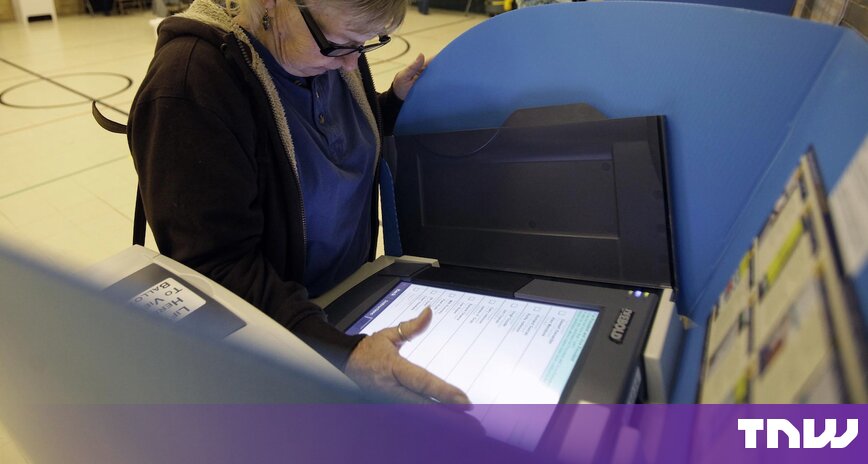
In my opinion the risks and downsides of moving away from pen and paper clearly outweigh any of the laughable advantages - unless of course you profit from a system that is in-transparent and manipulatable.
They have such a system in place for over a decade, it works perfectly. Just buy that and use it instead of reinventing the wheel poorly.
If only the specifications of the hardware and source for the software for the machine in question were available for us to analyze....
I think the title is link bait. The voting machine isn't altering the vote. It's just off kilter. Besides, it's not like the user didn't know what box was being checked!
Too confusing. I'm staying home.
Microsoft must be behind it.
Some systems have a "recount" button that returns the same result as before. Others have an actual paper trail that can be recounted by hand.
Edit: Also, it's been verified and taken offline. http://tv.msnbc.com/2012/11/06/machine-turns-vote-for-obama-...
All the commenter was saying was that whoever shot the video didn't share it before first splicing two different shots together.
http://articles.baltimoresun.com/2012-11-02/entertainment/ba...
Call me when they verifiably lie, ala Fox, and then we'll talk.