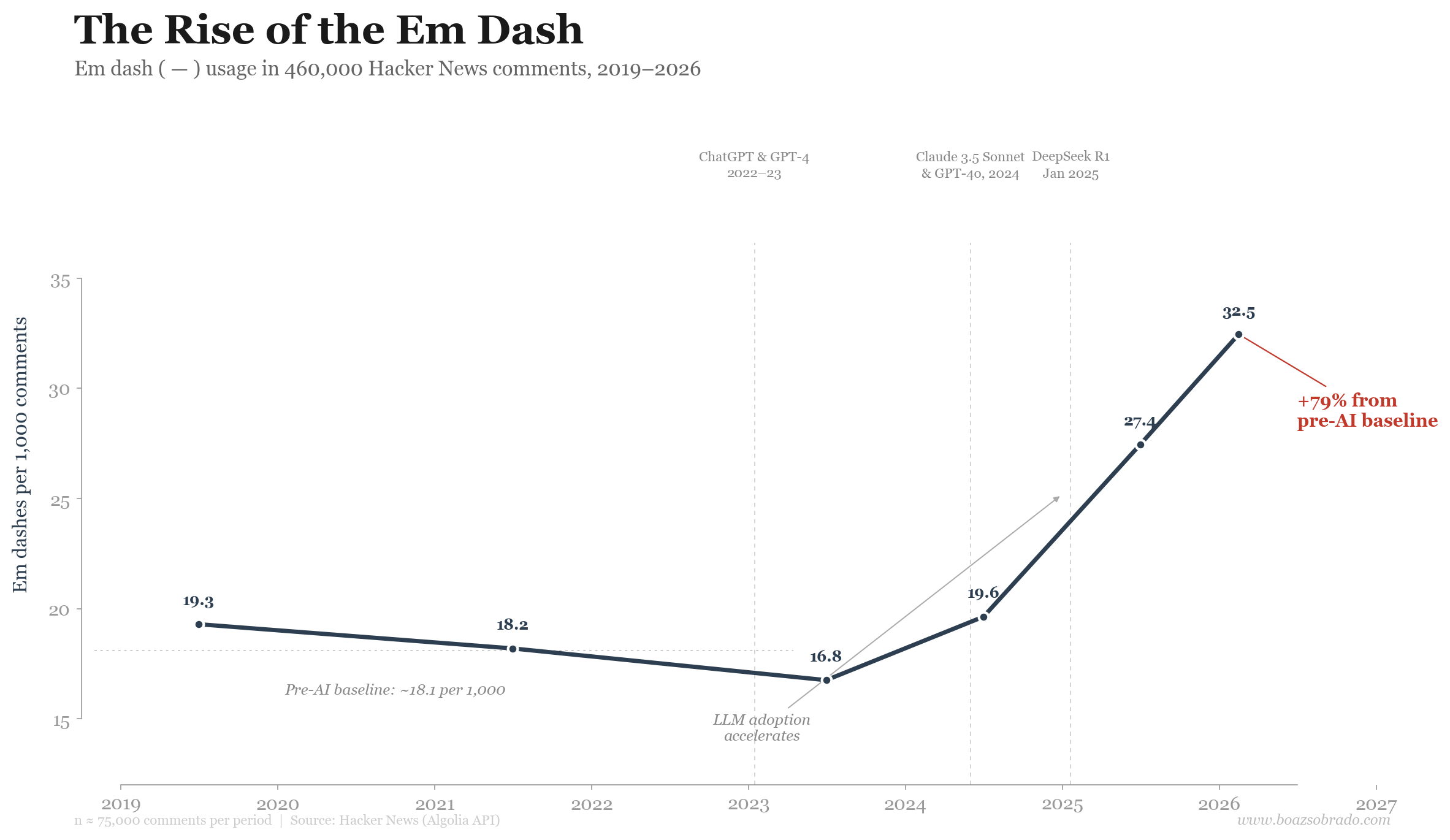
The Rise of the Em-Dash in Hacker News Comments
Tracking em-dash usage across 460,000 Hacker News comments reveals a striking post-AI inflection point.
Boaz Sobrado
44 points · by sobradob · 7mo ago · 96 comments
Like, I could see some people noticing that the book they're reading has dashes that are a bit longer than normal, but what made you think "That must be it's own thing, separate from a normal dash" as opposed to something like "In this font the dashes are very long"?
Also, it's called em dash because it's as long as the letter m (as a rule of thumb), so it's usually an easy visual comparison. Finally, a typeface with hyphens as long as em dashes would be terrible and quite noticeably wrong!
The em-dash is indicative of AI usage when it shows up in contexts where it doesn't belong. Like informal context like forum comments and emails (though "smart" substitutions do complicate the picture a bit).
I'd only be funny if they argued it indicated AI usage in context where it does belong, like formal writing.
I have known people that personally used em-dashes in all the wrong places way before AI... entire emails would just be paragraphs-long run-on sentences filled with dashes.
It went from 19.3 to 32.5. It did not even double. Which means that if you see a comment with an em-dash, it's more likely to be human than LLM.
For example, take a look at just about any stock chart (try https://www.google.com/finance/beta/quote/GOOG:NASDAQ?hl=en). There's actual money on the line, but no baseline. Why do you think that is?
Visually, this is vastly exaggerating the variation. Actual usage did not even double.
No, it is literally showing the exact variation of interest. If you think it's exaggerating the variation, you are not reading the chart. You are glancing at the chart, ignoring what it actually says in multiple ways, and imagining it has a baseline of zero, when it clearly does not.
Read the chart. What does it actually say?
Honestly, I hate that about stock charts. They adjust the axes and scales so that the graph itself provides no information. Did it go up 1 point? 200 points? 5%? 50%? You can’t tell, because the graph is just a scale free squiggle.
If a stock chart "provides no information," why do you believe the financial world uses them to communicate the movement of a stock over a period of interest? Do you believe that financial analysts do not understand how to communicate stock movements to each other?
> Did it go up 1 point? 200 points? 5%? 50%? You can’t tell, because the graph is just a scale free squiggle.
I don't know what stock charts you've been looking at, but all the common ones list the stock's price on the y axis, making it easy to answer all of the questions you pose. For example, consider what a Bloomberg Terminal gives you [1] or what you get from Google Finance [2] or from Yahoo! Finance [3].
Take a look at the y axes. See those labels? What do you think they mean?
[1] See page 15 of https://data.bloomberglp.com/professional/sites/10/Getting-S...
Now she's been accused of using AI for her pieces.
Oh well.
Read the observation that AI was (presumably) trained on the 'best' (or at least 'quality') writing, and so if good writers tended to use em-dashes, it should not be surprising that AI generates text with it.
But, if one's personal style included using them, you should continue to do so because why should you dial down your own voice just because someone else may be mimicking it?
You can do small succinct sentences, but style-wise it sucks for longer passages.
This gets corrected to an emdash.
I get annoyed and put the double dash back in.
Sometimes swearing a little or grumbling “HEY. I typed what I typed” at it helps a little.
I don’t even know how many times in 20-30+ years I’ve checked some box in system or program preferences begging it to knock that off.
This is the real reason I already loathe and avoid the emdash (nitpicking over a personal stylistic preference I won’t relent on even if I’m wrong) but I can’t be the only one this happens to.
Getting piled on and called “AI” really doesn’t ease my distaste for it, but .. do people.. not write enough to understand that it brute forces its way into human copy as well?
and yes. phone posting on HN. will insert them. to my dismay.
The other one that ticks me off endlessly but I’ve finally said to hell with it and just let it go?
Turning " into “.
(Writer. Not a very good one and I’m not here to steer anyone to that drivel. But at least I’m a human one.)
Although I still prefer the traditional ASCII double-dash -- easier to type, and less potential for character encoding issues. Also, LLMs don't seem to use it at all.
(Incidentally, I love that backlash against LLM writing has more people developing as much of an allergy to emojis and content-marketing- and personal-branding-style writing as I've long had)
Depending on the text area you are typing into, if you type two hyphens/minuses right after each other (no spaces), Apple systems often translate them to an em-dash (kind of mimicking (La)TeX).
(If you don't want the em-dash, hit <cmd-z> with macOS to undo that auto-conversion.)
Show HN: Hacker News em dash user leaderboard pre-ChatGPT
https://en.wikipedia.org/wiki/Caedite_eos._Novit_enim_Dominu....
Maybe if you are looking at it in a monospaced environment like the HN edit window; rendered in a proportional font, hyphens, en-dashes, and em-dashes are quite distinct from eachother.
> It's no surprise humans barely use them. Then why did it get picked up so much by AIs?
It got picked up by AIs because their training corpus includes plenty of professionally published work, not just informal, off-the-cuff communication, and professionally published work uses typographic dashes (em-dashes, en-dashes, and even 2-em- and 3-em-dashes) extensively. (3-em less so in newer works, it having, e.g., dropped out of the recommendations of the Chicago Manual of Style as of 2024.)
I've never heard of a "level 3 shift key"; I'll have to look that up.
Within months I was convinced that every default English keyboard I'd ever seen except the Mac one is strictly worse. It bothers me now how hard it is to get a consistent Mac-style keymap on Linux. This is one thing others should for-sure just rip off entirely. It's so much better.
If it's all comments, including flagged/dead/downvoted/etc., then it's not reflective of the actual filtering HN does.
But if it's weighting comments by their likelihood of being read -- e.g. mostly top comments on popular stories -- then I'd be a lot more curious.
I'm not surprised AI spam has increased substantially. But I'd be surprised if it's affected the comments most people actually read to anywhere close to the degree shown in this graph.
key insight - https://trends.google.com/explore?q=key%2520insight&date=all...
etc.
Is HN more botted, or less? And are banned accounts excluded?