248 points · by tobr · 7mo ago · 138 comments
Unlike other consensus "bests", it's relatively unknown to the public (which is understandable for many reasons). It's very likely that if you're a puzzle game devotee, you will fall in love with SSR; but at the same time, if you don't have experience with puzzle games, you'll very likely hate it.
As a result, I've always thought it's an interesting window into how we value "taste" and "mastery", how too much mastery can actually distance us from one another, and what meaning there is in designing games for an ideal world shaped around ourselves, versus the world we actually live in.
It's well-known that puzzle games sell badly on Steam, and I think part of that is that difficulty and struggle is an acquired taste. Most try to paper over that gap with nice soundtracks and graphics, "hooky" mechanics, and narrative. SSR is so interesting because it contrasts so violently: it's ascetic, has no obvious hook, and offers nothing but difficulty and struggle, and the best feeling in the world if you decide to push through it anyway.
After reading the linked article, and the comments here I still have zero clue about the game. It's a puzzle game involving sausages and a large fork does nothing to describe what kind of puzzles they might be.
A video is worth a thousand words, and there's a video at the very beginning of the article. Did you watch the video?
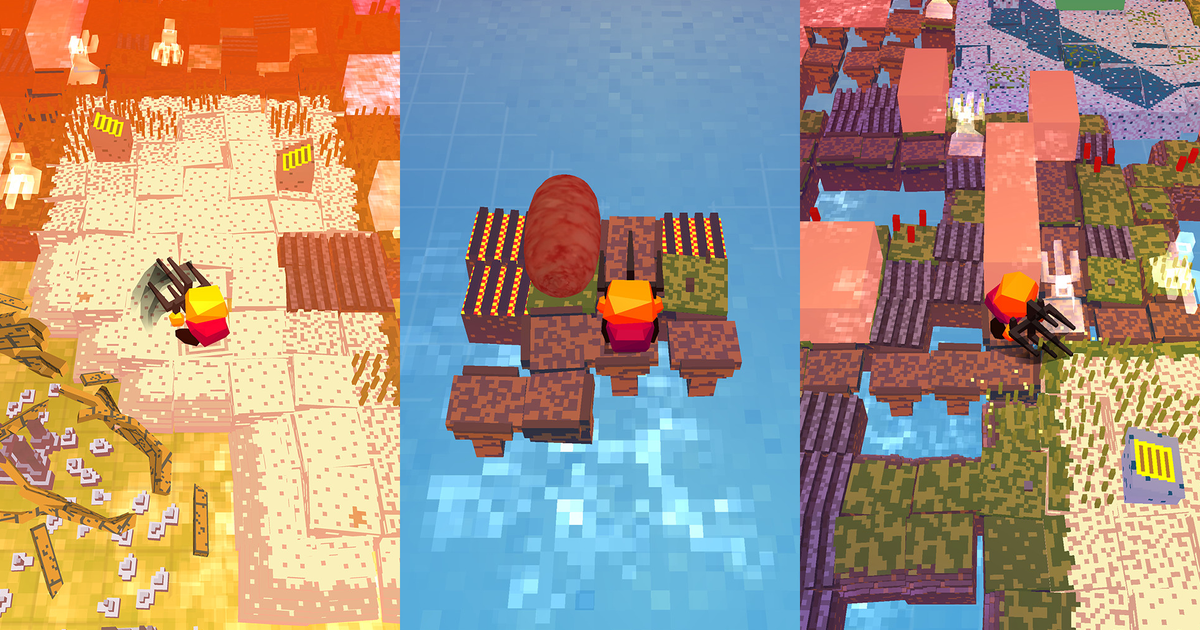
You control a character on a grid and you have to push sausages around the grid in order to grill them (some of the floor tiles are grill tiles). That's the core game. But the sausages roll and you can't let a given side touch a grill more than once. And the grid is space constrained - you can accidentally push a sausage off the grid and it will fall into an abyss and you have to start over. The puzzles are very difficult because there is so much complexity that stacks:
- Your character can strafe and push things, but your character is also 2 tiles wide and can pivot and swing a fork (and the swing action can push things)
- sausages only roll along one axis, otherwise they slide
- sausages can be stacked into the 3rd dimension which means there's also gravity
- if a sausage falls on your character's head you can move it around and rotate it
- etc.
This game introduces a very small set of controls and mechanics (you basically only have the arrow keys, and initially can just move around), and combines it with minimally small, yet surprisingly hard puzzles. Every puzzles is distilled to its smallest form, and involves a genuinely satisfying eureka moment.
The game then explores every possible hidden way to use the minimal set of mechanics introduced, before introducing a new mechanic (e.g. early on you'll be able to suddenly 'stab' you sausages which allows you to move them around differently. So you become a master of the game as you progress.
The problem for new players is that it's deceptively difficult to solve even the simplest puzzles + it encourages you to explore and learn how things work instead of giving you hints. This makes inexperienced players abandon it way before it fully reveals itself (which takes many hours into the game).
What I suggest is if you are new and are frustrated, find a Youtuber that solved it so that you can look at what they did. This way you won't get stuck to the point of leaving it, while still allowing you to fully enjoy it.
Sure, sure. Here's the annotated second paragraph from TFA:
When game designer <Stephen Lavelle> [0] (Increpare Games) released Stephen's Sausage Roll back in April 2016, it was accompanied by <a trailer> [1] that showed almost nothing about the game, yet word still spread quickly. Puzzle developers and fans praised the game for its impeccable design, teasing out layers of deep puzzling and mind-expanding discoveries from so few puzzle elements. It was also renowned for its uncompromising, yet always fair, difficulty curve, with immensely challenging puzzles from the very start. These sentiments are still held to this day, as this beloved sausage-pushing sokoban continues to influence new generations of puzzle developers, <inspiring some of the best sokoban games> [3] ever made and introducing "Sausage-likes” to the puzzle vernacular.
Clicking link [3] leads us to a page that has this as its first paragraph: Sokoban games, also known as block-pushing or box-pushing games, are turn-based puzzle games in which you control a character pushing or moving objects around on a grid. The genre has origins in the 1982 game Sokoban, designed by Hiroyuki Imabayashi, in which you have to push boxes around a warehouse onto designated targets. The japanese word 倉庫番 (“sōkoban”) translates to “warehouse keeper”.
Incidentally, link [3] is repeated in the final paragraph of TFA, which I will also copy and annotate: Learn more about Stephen's Sausage Roll in <our database of thinky games> [4], where you can also find <similar games> [5] and some of the <best sokoban games ever made>. [3]
Link [4] is pretty clear about what the game is. Did you bother to click it in order to "[l]earn more about Stephen's Sausage Roll", as it invites you to do?[0] <https://increpare.com/>
[1] <https://www.youtube.com/watch?v=lCNqYLGwqxU>
[3] <https://thinkygames.com/lists/best-sokoban-games/>
[4] <https://thinkygames.com/games/stephens-sausage-roll/>
[5] <https://thinkygames.com/games/stephens-sausage-roll/similar/>
And even more if figuring out how to buy it wasn't a challenging puzzle in its own right.
https://store.steampowered.com/app/353540/Stephens_Sausage_R...
On sale for 6$ at 80% off.
Baba is You ramps up as you go to, but the ramping up is mostly done by the game giving you new tools to work with. Plus, the amount of interesting puzzles you can do with the mechanics of Baba is You is virtually endless, whereas SSG makes you feel like the game squeezed all the possible gameplay out of moving sausages around.
In favor of SSR: The design is more vertical than Baba, it explores fewer mechanics but with greater depth. And it's entirely spatial, whereas Baba's solutions are sometimes a matter of wordplay, with the sokoban just a formality.
I like Baba better, but I'm not sure if it's the better game.
rolled, surely
It's a fantastic game, one of the all-time greats, and there are tricky parts to execute, but it's not particularly challenging in terms of puzzling.
Simple turn-based eight-direction grid movement, where one of your adjacent squares contains your "sword" and you can rotate your sword around yourself one square per-turn. Kill (deterministic and 1hp) monsters by moving your sword on to all the monsters move after your move, and "complete" a room by killing all monsters.
There's quite an active community (at least there was when I was in to it) but I've rarely heard it mentioned outside of the community.
Edit: I'm happy to see some other references to DroD in this thread.
Wouldn't really agree considering:
Antichamber, The Witness, Talos Principle, Manifold Garden, Portal, Zachtronics, Tunic, Blue Prince, Return of the Obra Dinn, Seance of Blake Manor, a bunch more I could list.
The puzzle game that reaped all the rewards this year is Blue Prince, it has its sokoban moment, but as a whole it is definitely not a sokoban game.
By "critically acclaimed games" I should clarify I mean games acclaimed for their mechanics and general mind blowingness. For whatever reason sokoban enables some crazy logic stuff that is harder to find in other puzzle games.
thinking about how calvin's dad would explain every video game is either sokoban, or chess
The game is hard. I only kinda got the hang of it, and I didn't quite get to that ah-ha moment. You have to be willing to sit with it and think. I think with sokoban games, you can often just almost random walk your way to a solution, because the state space and its transitions is easy enough to wander into. But I didn't find that to be the case with SSR. You have to be able to reason about the state space changes, I think because the state space isn't exactly euclidean, so it's harder to wander into the solution.
Imo it's better to approach Demon's Souls as an exploration puzzle game with RPG stuff and combat, not as an action RPG (such as Dark Souls 3).
Haven't played Taiji, I'll give it a shot.
That said, The Witness isn't a bad game as such, though the puzzles do get a bit repetitive in my opinion. I prefer more variety rather than hyper focus on one type of puzzles.
And you don't have the time element of Outer Wilds (Outer Wilds is brilliant though, and it kinda needs that time element to work properly).
I mean technically it does in that you only have so many steps in a day, but you only spend a step moving from one room to another, so you can take your time in any given room, and you have ways to increase those steps.
Also you're more likely to block yourself off with your room layout for the day than you are to run out of steps, at least once you start getting better at the game (it can happen though).
I guess Zelda, Metroid and Half-Life also count as puzzle games then. :)
I suppose the new Breath of the Wild / Tears of the Kingdom titles are more action-oriented, but everything in the mold of Ocarina of Time is a puzzle game with some light combat sprinkled on top.
Sorry Mario, but your princess is another castle!
This one? It looks interesting but definitely a lot less visible than SSR and not on storefronts or etc, right?
My list:
1. Antichamber
2. Fish Fillets 2
3. Baba is You
4. Ittle Dew (esp. the Master Dungeon)
5. An Architect's Adventure
6. Cosmic Express
7. Talos Principle
8. Stephen's Sausage Roll
9. Portal
10. Cocoon
Fish Fillets 2 looks simple, but it's one of the toughest puzzle games out there. Especially getting the stars on each level. I love it because the rules are simple, everything's there on one screen, but figuring it out requires a lot of out of the box thinking.- Patrick's Parabox
- Blue Prince
I'd take Void Stranger or probably even Deadly Rooms of Death: The Second Sky over Stephen's Sausage Roll any day, I imagine.
de•li•cious saus•ag•es
I’m good with zero-story puzzle games. I’ve spent many hours in Simon Tathem’s Puzzles [1] on my iPhone, just for the 100% pure logic goodness that they are.
[1] https://apps.apple.com/us/app/simon-tathams-puzzles/id622220...
[0]http://itunes.apple.com/us/app/english-country-tune/id476962...
I've seen this game recommended many times but I've never played it because I feel like I would get bored very fast. Same with Zachtronics games.
Deadly Rooms of Death has same movement style as SSR. It is amazing series of games each with unique mechanics. It often evokes that feeling of being in active communication with puzzle author through evolving level design.
I've also enjoyed Rhell: Warped Worlds & Troubled Times, a recently released gem. It is completely opposite of SSR, with how broadly you can approach the puzzles depending on which spells you have available (with many parts becoming too easy if you postpone them). Many games design their puzzles with a single solution. Rhell takes approach of "you cannot pass here, let's see you try" which is a fun spin on the genre. I also enjoyed how you gain abilities through game. In many modern games you unlock higher jumping by collecting skill points and spending them on skill tree. Here the same ability is emergently and organically incorporated into game mechanics. Over the playthrough the player collects new spell runes; at one point you gain rune to apply the spells to yourself. By assigning a combo strong-raise-on-self to a hotkey, you empower the character with the higher jump ability and stop using the normal jump. There's all kind of crazy and innovative ideas in there and the entire game is delightful.
Put another way, it's been years since I played Baba and I can still remember the key insights to some of the sneakier puzzles. I couldn't even begin to do that for SSR.
Huh, I've seen both games (though both are very fringe to my overall experience) and didn't make that connection.
https://youtu.be/85mAmP4k1Co?si=yuxpJ2xhkH7r_eo3
The video has lots of helpful information for puzzle game design. I have started to incorporate some of that knowledge into my own puzzle game https://qcgeneral29.itch.io/lets-learn
From this post by one of the original devs: https://bsky.app/profile/draknek.bsky.social/post/3m7qybidq7...
Never heard of it.