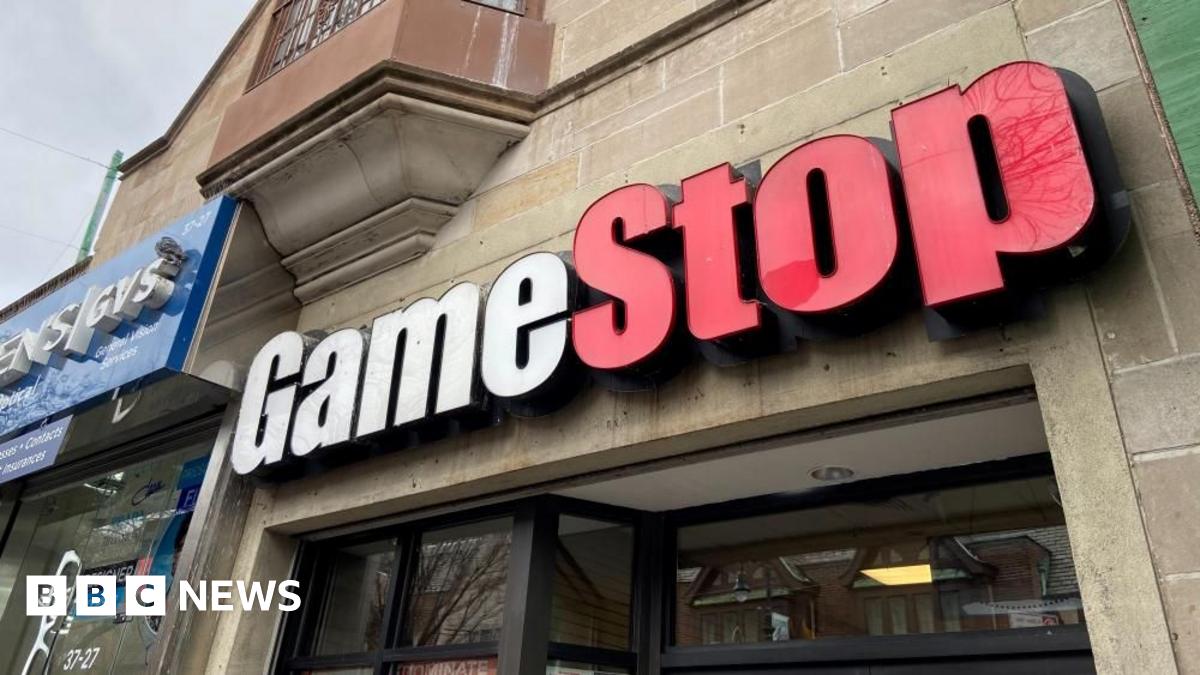
GameStop makes $55.5bn takeover offer for eBay
GameStop's boss Ryan Cohen says he sees potential to make eBay a much bigger rival to Amazon.
BBC News
712 points · by n1b0m · 6mo ago · 695 comments
A friend of mine also pointed out and this made it click for me that it makes 100% sense, GameStop is setup as a legal pawnshop in every state. So a pawnshop buying out eBay makes insane sense.
This merger in theory could be good for both eBay and GameStop if they don't mess it up. Imagine being able to list your eBay items locally without having to have people needing to come to your house, or better yet, getting a cut of what you wanted up front since they're basically a pawn shop, and then they list it on eBay and turn a bit of a profit with a local pickup option available.
I could see this working out decently, assuming the CEO of GameStop doesn't mess it up completely.
It raised over a billion dollars of capital (i.e. issued shares in return for cash). It did not make a billion dollars in profit (and has never had a year when it did).
    Net Income: $418.4 million
    Gross Profit: $1.196 billion
    Total Revenue: $3.63 billion
Operating Income: $285.9 millionhttps://investor.gamestop.com/news-releases/news-details/202...
That total revenue also declined 5% YoY
Yes, in 2021 GameStop did sell shares to raise cash in a dilutive way. [1]
No, that is not being treated as profit or revenue.
Gamestop had ~418 million in profit in 2025. [2] A fraction of that profit does come from interest income. Ignoring that (say to value the business separate from the cash) they still made ~110 million in profit.
In my personal opinion (not financial advice) Gamestop with the cash it has today is a much more attractive investment than without. If you have worries about an economic downturn, it's a hedge. If you worry about GameStop being able to maintain it's current revenue/profit or volatility, it's runway. There's a variety of ways it reduces the risk of an investment.
[1] https://investor.gamestop.com/news-releases/news-details/202...
[2] https://www.sec.gov/Archives/edgar/data/1326380/000132638026... page 27 has the consolidated results.
It doesn't though. eBay could easily set itself up as a legal pawnshop in every state if it wanted to. It doesn't because there's no advantage to doing so.
There are already third-party sellers in many areas who will take your physical merchandise and sell it on eBay in exchange for a cut. eBay doesn't need to enter that market, it's simply not profitable enough.
The barrier to listing huge amounts of merchandise is not the commission, but rather the amount of labor it takes to list and price everything and pack and ship it and deal with refunds and returns for items that turn out to have problems. And how a lot of items are only economical to sell locally, because when you add in shipping costs it approaches the value of buying something new.
Buying eBay doesn't provide any kind of easy way to help offload inventory at all. The way inventory is offloaded in bulk is in bulk pallets sold at auction, where people bid on them and then do all of the grunt work involved in photographing and listing and packing and shipping. Which is a significant proportion of sales on eBay today. GameStop can easily auction off pallets of their merchandise if they want, today. In fact, there's a good chance they already do.
They seemed to be doing really well esp with all the pokemon and MTG card crazes going on.
If you list an item, it strongly "suggests" a price. Sounds innocuous, right? However, when every seller knows they would be stupid to list a product for less than the suggested price, that means that eBay is enacting a collusion process on their sellers to regulate prices for products sold on their platform.
I don't think this is illegal in any way, but it is bad for the buyers as it decreases the chance that they will get lucky with a purchase and ensures that all purchasers on the platform spend as much as they can afford to spend.
Next, as a seller, eBay presents you with an option to "promote" your product, for a fairly significant percentage of eBay's suggested sell price. (Last time I tried to sell something, they wanted $9.99 to promote an item expected to sell for ~$150, for instance). If you do not "promote" your item, then it is thrown to the bottom of the listing and may be filtered out when purchasers sort by "price low to high" as they often do.
I chose not to promote my item as I was just getting rid of it, (brand new OEM toner for a printer that normally sells for $200) and it got almost no views and ended up selling for $40, of which ebay took $7.50 for their cut.
I checked the other solds for the same product and mine was the lowest sold by almost $100 all seemingly because I didn't pay the racketeer price upfront.
I didn't care about the money, I was just getting rid of it, and ebay punished me for not playing ball their way while also losing out on their profits just to make a point with me.
If you don't eBay the ebay way you will suffer for it.
Speaking of which, eBay has started changing the number of results based on your search filtering, preventing purchasers from finding the specific thing they are looking for in exchange for something that is often more expensive and not quite right.
Try it yourself. Search for something very specific and then change your filters and see the number of available items increases and decreases based on how you search. I honestly would not be surprised if they were hiding the unpromoted less expensive more accurate item you are searching for from you in the expectation of inducing you to buy the more expensive item in the process.
Why would eBay do this? They make more money. It's pure enshittification. They charge the sellers to promote. They set the prices. They charge an insane percentage, something like 15-20% of the final sell price to the sellers, and they have made the platform hostile to its original purpose of being a bazaar for ordinary people to sell their old stuff to people that might want them.
Of course, they are still seller hostile, they protect fraudsters who buy expensive items and claim they are fakes or broken and return bricks, and they have strongarmed their customers into arbitration agreements in an attempt to prevent anyone from suing them to stop their anti-consumer practices.
The only thing I can think of is Gamestop positioning to become a clearing house for fan swag or gaming items the way Woot is for Amazon overstock.
It didn't add enough value back then, but IMHO it does now. Selling on eBay is a massive hassle these days for a variety of reasons, and much less profitable for onesy-twosy transactions than it used to be.
If I could just drop off a bunch of stuff at my local GameStop and forget about it until the checks arrive in the mail... yeah, there's definitely a business model there.
Umm, that’s been around since 1938, which is a few years before the era you’re talking about…
There's also the synergy that GameStop now has access to more used gaming inventory, a category that I'm led to believe is high margin for the stores.
Gamestop closed 2,400 stores from 2020 to present, and operates just 2,200 stores currently. They'll continue to close stores as their revenue continues to shrink (down 60% in the last decade).
>used gaming inventory
physical used game inventory is a fraction of what it was a decade ago, and continues to shrink as a category, digital sales continue to climb and exclude Gamestop
So far he's failed to improve Gamestop's core business, which is still in decline, even with the memestock cash gusher.
No one goes into Gamestop anymore, and they won't start because of eBay.
Must be why it's revenue is declining to it's historic 2006 level, because it's just too busy.
net sales 2016 $8.6b, 2025 $3.5b and still in decline
Any possible 'synergy' is wiped out by.
- Having to pay a premium on the public market.
- Organisational complexities/moving slowly.
- Culture clashes and bad vibes between teams.
GameStop would probably be gone by now despite the meme stock if it wasn’t for trading card games and other similar collectibles, and eBay is very involved in that market.
Sort of wondering why nobody did this already. I know that the better charity shops do this with rare and unusual books/records. The UK equivalent CeX has an online offering through webuy.com, which appears to be a Chinese owned multinational.
I'm surprised nobody has really mentioned this in the thread. Does anybody remember the "trade in anything" day GameStop just had? https://www.usatoday.com/story/money/2025/12/08/gamestop-tra...
Obviously they're going to need to liquidate a lot of this stuff. It can be quite lucrative if done right. You're basically getting inventory for free.
If you read online employees have talked about how they donated it or threw it all out, presumably there is very little of that stuff left at this point (and probably nothing left of any real value).
Ex: https://www.reddit.com/r/GameStop/comments/1qceolz/what_did_...
EDIT: regarding the CEO, you should find the interview where he’s challenged about funding.
Instant classic.
I kind of assumed there were already local businesses that already did this? Seems like a decent side-line for any drop-shippers out there. In any event, moving that activity into a local strip-mall would be super convenient for everyone.
IIRC, the short (borrowing stock, selling high, waiting for a downtrend, then buying low to pay back the borrowed stock buy an agreed date) was accelerating the fall of GameStop's stock price.
Then some Reddit knuckleheads noticed the hedge fund shorting GameStop was over-leveraged. They also found the deadline the hedge fund had to repay those shares to the bank.
The knuckleheads pumped the stock. Technical term: I like the stonk.
The knuckleheads then bought and held GameStop stonks. Institutional investors joined in. The hedge fund was legally obligated to pay any price to buy back the shares necessary to pay back the loan by the deadline. So the longer everyone else held on to the stonk, the more the hedge fund would be forced to pay. Squeezing the hedge fund in this way caused the stonks' price to temporarily skyrocket. Technical terms: hodl and rocket emoji
The original Reddit knuckleheads eventually stopped hodl'ing and sold high.
IIRC the hedge fund eventually went under.
Unfortunately, like all things, the knuckliest of Reddit heads would keep hodl'ing all the way back to the ground[1], hoping to cargo cult another squeeze by building wooden towers and dirt tarmacs to entice the sky rockets back. I'm not a stonk hodl'er, but I'd guess they are predominantly the ones who provided capital for Gamestop to buy Ebay. It's probably the most expensive and baroque way to fund a new consignment shop in your home town.
1: is there an emoji for a rocket crashing toward the ground? If not, there should be.
But here's the fun part. All of those issuances were made during periods of weirdly high prices. The biggest one was this time 2 years ago. The price jumped to $80. Doesn't seem like much, but there was a share split in 2022, 4:1. Between that and the offerings, buying the same proportion of Gamestop The Company as one share did in late January 2021 would have cost about... $350? The intraday high from 2021? Weird. Oh, but it happened in after-hours. When non-institutional traders usually aren't active...
I don't think anyone truly knows exactly what's going on with Gamestop's stock price.
More than 10 years ago eBay tried to launch a program where they would buy your stuff and then list it themselves, but it didn't work out.
They later raised new special types of debt instruments tied to crypto much like Micro Focus did that are at 0% interest rates.
The company also went from years of consistent net losses to consecutive years of consistent profits.
Deadbeat dad selling their kids videogames to buy meth.
The pawnshop industry is incredibly depressing but it has been around for millennia and they will always be around.
eBay isn’t the same individuals selling one off things like it used to be. Sellers are established businesses.
“Shares are fungible, how would it matter if one share is borrowed by 10 people or by none?” Lets hedge funds create disproportionate downward pressure
Maybe eBay survives as an international site but even at that point, with $20B in debt this will just follow the regular PE playbook of shutting down after many layoffs and pivots
The entire concept of, "I have $1,000 in the bank, im going to buy a $10,000 company, but the debt will be on the companies name, not mine" needs to pass. Can you imagine if the mortgage was owned by our home, not ourselves. And we could stop paying it without any personal consequences
If you want to buy a $50B company, you should pay $50B (loans are fine, but not putting the new company in debt)
I don't really know what alternative there is to eBay as an 'everything shop'. I can get specific screws there, or diff fluid, or a customised motorhome name sticker, or an old baseball cap for an airshow I attended in 2008.
And if I bought the wrong diff fluid I can sell it.
The main value over Amazon, though, is that the search works.
Super true. You can actually search for the exact brand you want and not get a search result page full of brands XIAOLE, LLKAPOO, JEMROK, QPPNSS, VRINHH.
Also, I don't really know why, but I have much greater confidence on eBay that I'm not going to get something counterfeit or unsafe.
Having physical locations that you have to come to pick up your Thneed protects both buyer and seller. Buyer can verify that what was described is delivered and seller can verify actual pickup with ID.
If they apply a bit of logistics for shipping between stores, Gamestop could crush it.
Fraud is forcing the pendulum to swing from everything-online back to everything-in-person.
The last few times I've used EBay is to get parts for old garden tractors, and even for that I've found cheaper options with small retailers that specialize in that stuff. Most ebay shipping pushes the cost up too much, and with the small retailers usually I can get a bunch of things I need at the same shipping price.
To a large degree you can just stop paying your mortgage.
The biggest personal consequence is you will be evicted and lose both your place to live and any equity you built up.
The other main consequence is it will show up on your credit report for 7 years. Maybe some specific forms ask "have you ever been foreclosed on" in the future.
In most places, you can only get recourse mortgages. You will be liable for the rest of the mortgage, if the value of the house drops so much that selling it doesn't cover the remaining debt.
House values dropping a lot is something that happens fairly rarely, but it tends to happen exactly during the times when you are most likely to be unable to pay your mortgage (recessions, industry downturns, etc.)
It's not experience massive growth but that's because it's a pretty mature market by this point. People who want to sell their stuff already use eBay. It works. It's mature.
Markets are built on eBay and then leave.
Kinda weird for an online shopping site to… miss the absolutely massive growth in platforms that let 3rd parties sell their stuff online.
Others grew out of their niche, best eBay can do is acquire a handful of their new competitors to keep up.
Same for FAANG BS, ZIRP BS writing made by millions of bots online. Even before llms
This guy? https://x.com/i/status/2051303211668021478
Surely, he's a safe bet, no chance he will mess up this deal!
/s
It almost seemed like he was incredibly hung over and didn’t sleep last night.
But I got the feeling he was being a jerk on purpose. Still don’t understand why though.
CEO gets paid "only if GameStop achieves a market capitalization of $20 billion." Buying a $55bn company would certainly achieve that quickly. I'm not sure how they'd manage that (buy with what? Memes?), other than the should-be-illegal process of putting debt on the acquired company's balance sheet.
This is a basically a leveraged buyout (LBO). All private equity works this way. Yes, it should be illegal, or at least heavily limited.
I highly recommend this book: "Plunder: Private Equity’s Plan to Pillage America"
In fact, coming from a finance background, I didn't find the book in general to be particularly insightful, and much more ragebait / policy oriented (which makes sense given the author was a DOJ Antitrust prosecutor)
Because you already knew that stuff, or because it's wrong?
It's how they destroy companies while making billions in private profit. They over leverage them. Accrue debts. Sell of equity. Wash, rinse, repeat until bankrupt.
But vast majority of the time it’s bad?
This says that private equity effect on employment is neutral and efficiency is positive.
So what gives?
People just want someone to blame.
eBay had $2B of net income in the last year. That might get them half-way to paying their annual interest payment if this deal closes. Get ready for the inevitable layoffs to cover that interest payment.
If there is iffy interest coverage for the debt and assets might be a stretch to cover (principal + interest), why will someone sponsor the debt here ?
Also, rates seems to be high, at least compared to recent history, to be favorable for this kind of LBO.
There are various proposals to deal with this, but the most effective are probably imposing joint and several liability on certain kinds of litigation (breaking the "investor veil" and allowing rights of action against PE funds for the actions of their portcos) and limiting business judgment rule protection for directors and senior managers who approve LBO sales that are reasonably foreseeable to end in bankruptcy, which creates personal liability for fiduciaries. In other words, align the financial and personal interests of the individuals and companies involved with those of the acquired entity.
For example, Joanne's Fabrics was a profitable business with a fair amount of real estate. After PE bought them and was saddled with unreasonable debt they were in the red and had to sell all their stores. This removed useful and profitable business from the economy and sold off the assets in a fire sale. Where as me losing a house just means a bank now owns it and someone else can buy it. But if someone were to buy Joanne's they'd have to pay off the debt Joanne's owed for being bought and run into the ground
Then once you realize why private equity firms do this, how their leaders have extreme monetary incentives to squeeze value out of companies in ways not limited to this, you realize why it’s insane how we have basically zero regulation on it.
For these PE loans, its the new company that takes on the debt, not the buyer. Essentially any broke person can "afford" any trillion dollar company this way
In an LBO, a private equity buyer often buys a company using a large amount of debt, but the debt is typically placed on the acquired company’s balance sheet or serviced from that company’s cash flows. In effect, the target company helps pay for its own acquisition. That is the key difference.
In a lot of LBO schemas, the acquirer loads the target with, abusing leverage to maximize its returns, but this leaves the company with very little margin errors, any hiccup in the economy, and Kabum! The company goes under, an once viable company closes its doors, employees lose their jobs and local economies suffer. Meanwhile, the PE entity walks with as much cash as it could extract from the acquired company and debt-free.
Some PEs also go one step ahead, make the acquired company borrow more money, not to invest in the business, or restructure debt, but to pay a dividend to them.
In other cases, PE companies acquire a controlling block and then use it to make the company sell their assets to them, to be immediatelly leased back to the company. Then, there is also the practice of extracting all kins of "monitoring fees", "advisory fees", "consulting fees", etc. for services that are vague and frequently of questionable value.
PE companies also frequently engage in overly agressive cost-cutting to manipulate the EBITDA in the short run to sell the company at a appreaciated valuation, but hurting the long term value creation potential of the company and the quality of their services.
For PE, sometimes even bankruptcy is a business strategy.
Update: Numbers still don’t add to $55b - I think there’s a $14b shortfall. Not sure about how they are planning to fund that.
Is that really an advantage? Fulfilment is always handled by a lot of places for the big e-retailers for returns, which is similar to what eBay needs for sellers.
How much does Staples charge for its Amazon return fulfillment where you don't even need to wrap up the item?
It is really popular: https://www.staples.ca/a/learn/amazon-returns-now-available-...
I question whether it is advantageous to use GameStop stores for this or just to piggy back on what Staples is already offering to Amazon and others for their returns? Fulfilling returns for Amazon isn't significantly different to shipping eBay orders.
Now, dropping off items you're selling? That probably removes a decent hurdle for many first-time/one-time users who aren't familiar with shipping (what box/label/insurance/padding/...).
I think the advantage is going to be "bring your junk to GameStop and an employee will put it up for sale and handle shipping"
You'd get considerably more trust buying something on ebay that at least some teenager looked at and verified was real and powered on, etc.
So GME dilutes by 20%, stock price immediately goes down by 20%. its not some infinite money hack
They threw him a hardball today in his cnbc interview on this topic. $GME stock value would plummet short term, but the combined company would revalue much higher.
Current Gamestop shareholders would be diluted. They would own, proportionally, a much small slice of the combined company, but at a higher price point.
The framing of this as, "Ryan Cohen is diluting Gamestop shareholders in order to meet the terms of his enormous pay package" is disingenuous though, as his pay package is all stock. He's diluting himself too. He obviously has faith that, long term, the value of the combined company can substantially grow.
Depends how much of them he has before and he will after, it might still be worth diluting if difference is vast.
Also, why long term if short term could also do?
How is the framing wrong?
And "Attempting" is doing the heavy lifting here.
Otherwise take out a $20b loan and put it in the bank. Assets increase $20b, job done.
For example, Honeywell acquired Garrett AiResearch, a well known manufacturer of turbochargers for combustion engines, through a series of mergers.
Later on, it loaded them up with debt (over $1.5 billion, mostly asbestos related indemnity obligations from other parts of the business), before spinning them out as an independent entity again. Two years later, Garrett filed for bankruptcy claiming it was succumbing to the unsustainable debt burden placed upon it by its former owner.
GME is ~12B, EBAY is ~46B (58 total) with net income of 0.4B and 2B (2.4 total). If he boosts profit by 1.2B then it's nearly a 50% increase and probably going to result in a more valuable combined company despite the debt.
The most beneficial thing is how even proposing this shifts peoples' perception of Gamestop from a beloved but struggling brick and mortar chain to a successful business
GameStop had revenues of $3bn last year and eBay was $10-12bn, so combined it's $13-15bn. A net income increase of 1.2bn on that gross is a tall order for M&A efficiencies. Especially difficult when the two companies have essentially zero operational crossover, besides business admin. It doesn't seem likely to me that merging eBay's accounting/legal departments into GME's (and similar efficiency gains) is going to save anything close to a billion across the two entities.
Sigh. The synergy argument, once again.
While historically most mergers don't work out particularly well, I'm absolutely sure this time will be different.
Its good for GameStock management who will end up running a much bigger business. https://investor.gamestop.com/news-releases/news-details/202...
Game Stock management is essentially claiming that they can run Ebay better than the current management so Ebay shareholders will end up better off by selling to Game Stock: they get some cash and shares in a business that will be mostly a better run Ebay. Very possible bad for GameStock shareholders who will end up with a smaller stake in a bigger business.
Suffice it to say, the Gamestop's price floor has gone up each time it's been diluted in the past few years. Perhaps lower highs, but higher lows. And a company that can afford to try a stunt like this.
That said: conceptually it’s not an awful fit for GameStop. In so far as video games discs and cartridges were the main disposable belonging i had as a kid and the main target for new purchases, Funcoland was (later to become GameStop), if you squint your eyes, a brick & mortar eBay scoped to only video games. If you’d been an SV startup at the time pitching the eBay concept you could have said “it’s like funcoland, but online and for anything and also lets people sell peer to peer “
I agree it's weird but ultimately the check against dumb lending is natural consequences for the lender, right? If you ask me for billions in loans for your zero revenue company and I give it to you, whose problem is that but my own?
Banks go bankrupt all the time. Community Bank and Trust of West Georgia went bankrupt just 3 days ago. The Metropolitan Capital Bank & Trust that went bankrupt back in January. 99% of the time the investors are completely wiped out. Bailouts almost never happen, which is precisely why it's such big news when it happens.
They have no say in the matter, and given that the lender can probably absorb the loss without, you know, missing mortgage payments or losing health insurance, I would absolutely argue it's not just their problem.
You can certainly hold the opinion that "it's just business" but it feels like an unnecessary part of business that very often has real disruptive and detrimental effects on average working people, for the sole benefit of rich people getting richer.
And yes I get that it's not just a PE problem, but PE is a big one of these kinds of problems.
Regulations designed to ensure businesses never take risky bets lest they have to lay people off would be a nightmare of unintended consequences and surely in aggregate hurt employment.
Making debt of that form illegal would kill any company that needed money to stay afloat, such as during some emergency, or war, or COVID, or tons of events that companies regularly survive.
Say company B wants to buy company A. Company A is worth $20B, but the buyer doesn't have that much, and the original owners/shareholders want to get paid. So Company A takes out a $20B loan, paying out the original owners, making that company worth $zero. Now Company B gets it - it's still worth zero because of the fat loan, but now Company B is the owner. I don't feel like anybody got taken advantage of in this financing model.
In fact, this is pretty close to what happens in the US real estate market. When I buy a house I take out a loan against that house. It's non-recourse, so it's very much like the house borrowed the money, not me. In any case, I got the house with a lot less money than the purchase price. Sometimes nearly zero from me in fact.
I do understand why people get angry about what often happens next - layoffs and such - but I think that's very independent of the financing used to purchase the company. The acquirer could pay all cash using money from it's own bank account, and then still lay a bunch of people off - and in fact that often happens.
Of course the market may move the price up or down based on how much they like the merger. If they think there is some synergy here, they may move things higher. If they think the debt is too burdensome or have other issues with it, they will move the price lower. But all things being equal, any market cap increase of a buyout should be offset by the dilution that was incurred to finance the deal.
What looks like a "hack" here though, is that Cohen tied his incentive structure to market cap and not share price. The fact that his award is in the form of options and not RSU's does add some incentive for a higher share price, but at the end of the day, it looks like he can get 100% of his award by simply buying companies using dilutive stock issuance. Not sure how much the GME faithful appreciated that at the time of the vote. I think Elon did something similar in his incentive package.
I'm just not sure his rationale is completely objective given such a structure...
Which is why the board would have to approve the deal and he can’t act alone on it. He was hired to create and execute the strategy including finding the target. The real question is, why did he get hired to do something anyone could have done?
“ The award is divided into nine tranches that are eligible to vest only if the Company achieves both a “Market Capitalization Hurdle” and a corresponding “Cumulative Performance EBITDA Hurdle”.”
This changes basically everything. He can’t just buy any bigger company. The company has to earn way more cash flow, cumulatively, as well.
“ The award is divided into nine tranches that are eligible to vest only if the Company achieves both a “Market Capitalization Hurdle” and a corresponding “Cumulative Performance EBITDA Hurdle”.”
This changes basically everything. He can’t just buy any bigger company. The company has to earn way more cash flow as well.
This is silly. No different than buying a house w/ borrowed money based on using that house as collateral.
Banks aren't stupid. If it's very likely to fail and the interest doesn't cover the risk, banks won't risk. There's typically no upside to banks. At best they get their interest and at worst they lose everything.
Even a cursory familiarity with the history of the industry shows both that this is untrue but also that it’s leaving out many of the core reasons why finance is regulated. Bankers do make mistakes, but also their focus is on what makes them a profit now rather than what’s good for their client or the country long term. The bank does not care if GameStop goes bust as long as that happens after the loans are repaid or, most likely, sold. None of the guys who sold incredibly dodgy mortgages—if you weren’t in the market in the late-2000s, they would literally let applicants pencil in their income and not check it—went to jail for packaging those mortgages up so many times removed that they couldn’t reliably prove the loan even existed and reselling them with inflated ratings, and absolutely none of them had to repay their bonuses. Once they found a buyer for an “AAA” derivative, foreclosure was a problem for the retirement fund left holding it after a couple of sales.
That’s what I’d expect here, too: they’ll make some flashy announcements to juice share prices (“AI powered auctions paid in crypto!”) and sell that debt, spin whatever’s left into a subsidiary which splits off, and then profess complete surprise when that goes bankrupt.
The modern trend of believing that “history” is made up of one or two things that everyone saw on the news is actually really entertaining. Definition of “cursory understanding” tbh.
The banking industry, historically is far from stupid.
This particular story is just basic PR driven market manipulation and has nothing to do with the banking system.
If they can gamble with other people’s money then why won’t they.
If they can get rid of those liabilities by offloading them in a hidden way why wouldn’t they.
If it all collapses and the government bails Them out, oh well.
I think this argument is much stronger in the opposite direction: if his motivations were not focused on accumulating wealth, he’d be retired or running some kind of charity once he was that far past the point where he had to work. The fact that he’s not suggests that he derives his self-identity from wealth and the guys who do that are rarely satisfied at mid-tier rich.
I also can’t name a single CEO who had the mentality of “I’m rich enough to make personal/financial sacrifices for the good of the company.” That’s simply not how things work. I’m sure an example exists but it would clearly be an exception to the rule.
https://www.cnbc.com/2024/02/13/nintendo-ceo-once-halved-sal...
Thing is, GameStop is, well, for videogames and videogame paraphernalia. It's not a general store. Doing this would turn them into a thrift shop, not a pawn shop, as people are trying to offload their carpets, desks, etc - bulky stuff.
I don't think this makes sense.
This does make sense when you consider the collectable market, another domain I'm involved in. Trading card games, specifically pokemon, have exploded over the last 5 years. GameStop is making a killing off of buying, selling, and grading these cards. Ebay is the primary marketplace to buy and sell those cards. There's also tax free havens ("Vaults") offered by multiple companies, grading service passthroughs, and scalping offered through ebay too.
Viewed through the above lens, that's what's prompting this offer, I think.
FY2024: $718 million
FY2025: $1.06 billion
I guess wallstreetbets can giveth (given they're probably the primary reason Gamestock even still exists as an independent company today) and taketh away.
Just find it difficult to imagine anything outside of market manipulation: either an eBay pump and dump scheme, or collusion to get investors to sell as the inflation comes down so activists can pick up more.
He’s already rich and GameStop is falling apart, so really what’s the risk to him if it all goes under? May as well try a moonshot and move on. It’s not like anyone will hold him accountable for failing to turn around a ship that was already deemed sinking many years ago.
One has to wonder if there's an unstated interested party ready to back the deal.
> Our offer is $125.00 per share, comprising 50% cash and 50% GameStop common stock
Even if you magically included all existing GameStop stock in the offer, it still would not comprise 50% of $55.5B.
EDIT: looks like it's not impossible and I misunderstood. It's a proposed change of leadership with a $25B injection of cash to sweeten the deal. GameStop would issue shares which would capture the original eBay value (since GameStop would own eBay after the trade), making that part a wash. At least assuming people owning eBay stock currently would value the combined company at at least the sum of their parts, which is a big if.
When the merger concludes, the former shareholders of eBay will have $27.5bn of GameStop-eBay stock and $27.5bn of cash. (“Cohen said GameStop has a commitment letter from TD Bank to provide up to $20 billion in debt financing” and “GameStop has around $9 billion in cash on its balance sheet to put toward a deal” [1].)
[1] https://www.wsj.com/business/deals/gamestop-is-offering-to-b...
The whole thing seems incredibly dubious and fishy. The eBay board should vote this down which is why the CEO of GME has already realised that and said he’ll appeal to the shareholders directly. If eBay wanted to load themselves with twenty billion dollars of unnecessary debt and extra complications which would kill the company then they could do it themselves. They’re not in that kind of business.
When the SEC filing is made, we'll get to see how the deal is structured. The $20 billion from TD Securities becomes a debt obligation of the combined company. There's a tax break in equity to debt conversion, and a second tax break for carried interest. [2] There may be a preferred stock deal or debt refinancing so that TD gets their $20 billion back. Usually, the private equity firm exits within a few years.
[1] https://pubs.aeaweb.org/doi/pdfplus/10.1257/jep.23.1.121
[2] https://www.pgpf.org/article/what-is-the-carried-interest-lo...
A third of the deal is financed with debt. A fifth is financed with cash. The bulk—fifty percent—is being financed with equity. An LBO would see debt and a thin tranche of cash finance the bulk of the acquisition.
The one I was most familiar with was the Discovery “acquisition” of Warner Brothers. Though apparently that’s a little complicated because AT&T was divesting itself of Warner.
In practice the price paid for the company being acquired is usually a bit higher than the market value (so the shareholders take the deal), and the market usually punishes the acquirer a bit and the resulting entity’s stock will fall a bit. (This is most definitely not investing advice.)
The issue is the non-cash portion of the offer. They claim that the remaining 27.5B is covered by GameStop stock. But that's more than double the market cap of GameStop.
I would guess that this information will bother you.
If it helps, because many public company executives are compensated on earnings per share, most C level teams are incentivized to buy back shares, thus decreasing the denominator for the EPS calculation without changing fundamental economics of the company.
If this also bothers you, you should guess what Buffet says and thinks about those two dynamics, and then read up on it, and you will learn something interesting about public markets!
So you're just outright accusing GameStop of fraud?
https://www.sec.gov/ix?doc=/Archives/edgar/data/1326380/0001... page 36 of their filing with the SEC lists the cash and marketable equities.
The non-cash (stock) portion of the offer needs to be valued against the resulting entity, which will own eBay. This will likely result in current eBay shareholders owning half or more of the resulting entity. (Though we don't know specific numbers yet). That's normal for a M&A where the smaller company is doing the buying.
A quick search for how leveraged acquisitions, stock-for-stock deals, financing commitments, or tender offers work would answer most of the objections.
Is it too much to ask the Hacker News commentariat to do one quick search before collectively declaring that something they don’t understand is impossible?
> It is implicit in many comments.
> It is implied in many comments.
You’re picking one single metric that’s not even consistent for 2 years to assess the health of the company. It feels rather cherry-picked. The whole story is very rough for them right now, they’re in trouble.
https://www.nytimes.com/2022/05/25/business/media/thomas-s-m...
A quick review of the comments here would have demonstrated that it is.
I don't see how such leveraged acquisitions should be legal.
Before I started paying attention to such things I wouldn't have known a single one of those terms to even begin googling.
And let's be honest here. A smaller company saddled with big debt buying out an even larger company really doesn't make logical sense. It makes financial sense, which is subject to different laws of mathematics, probably involving the waiter's check pad in an Italian bistro.
I propose this would make sense in the animal kingdom though; large, lumbering fatty walks along. It has big claws, but … it doesn’t look like it can be bothered to be dangerous anymore. Meanwhile a pack of hungry successful hunters walk alongside. To take this down, they will risk pretty much everything..
It’s the same story. The shareholders provide a sort of bet on if the big guy has still got it, or the risk-on hunters do.
That’s why the operational results got attention in Cohen’s letter — he’s telling Shareholders: “I turned around GameStop. I can turn this ship around, too.”
Are you new here?
Isn’t the assumption that it’s impossible intuitively justified if you have no background in finances? A small fish usually can’t devour a bigger fish either.
Also, all those terms you mentioned mean nothing to me. You can’t search for what you don’t know exists.
(https://en.wikipedia.org/wiki/Barbarians_at_the_Gate)
This sort of acquisition is typically called an LBO or Leveraged Buy Out. The story gets into the details of key figures involved, including Henry Kravis who people today would better know for his private equity firm KKR.
Basic formula is raise cash using junk bonds, buy company, fix up company or kill off costs, use money company earns to pay debt, sell company. Since you have leveraged, your payout can be large.
It's a similar style financing activity to a house flipper. example: buy house for 1M, but pay $200K + 800K debt (mortgage). Fix up house, sell for $1.2M. Pay off $800K debt. You're left with $400K, or 100% return!
LBOs can have other formats. Take Debt, assign debt to part of the company, auction off arms, legs, kidneys of company to pay off debt... you're left with a shell of your former company but a boatload of cash to pay off the debt and everyone gets their bonuses.
Unfortunately a lot of LBOs tend to result in job cuts. The Twitter deal was a bit of that sort of thing, and we all see where that went.
The CEO has a very specific deal where he gets paid significant compensation for specific valuations, which this is likely to achieve. That is value extraction at the cost of shareholders who will be on the hook for the leveraged loan and which will likely wipe them all out over time.
https://investor.gamestop.com/news-releases/news-details/202...
He has to hit both the market cap and EBITDA for each tranche of his compensation plan to vest. He could do this by growing the core business, or by doing a merger like the proposed eBay one. Even if such a merger was very dilutive, even value destroying, it could help him vest a tranche he otherwise would not, for more value than the dilution reduces his position.
To be absolutely clear, I hope+think in practice that he is aligned with shareholders, especially given that the market cap restrictions appear much easier to hit than the EBITDA ones, but it's important to be precise because there's so much misinformation going around.
I'm not saying that that isn't his aim, and I've definitely considered that a Vader Imposition is in play. But it seems like there are easier ways to make that kind of money without becoming Public Enemy #1, smack-dab in the middle of the "eat the rich" zeitgeist.
If Gamestop is the king, then reddit was the king-maker.
May 2020: $570.3 million
Jan 2026: $9.013 billion
Investors gave them this money; they sold additional stock to raise $3.47B in 2024, and another $4.2B of convertible debt in 2025.
---- henlow, fellow regards ----
Any questions for muh'smoothest'brain?
[$]: 4710BTC, to be exact
Can people here really not keep their emotions in check enough to admit clearly obvious facts?
Bed Bath & Beyond (BBBY) being one of the worst / most hilarious ones.
[0]: https://www.businessinsider.com/gamestop-ceos-awkward-interv...
They're offering 50% cash and 50% stock. At an eBay valuation of 56B: 20B of cash will come from their creditor, TD Bank. 8B will come from GameStop itself. 28B will come in the form of stock from the resulting entity, which will own eBay and presumably have a valuation north of 56B.
The resulting entity may end up having 50% or more of it's equity allocated to the existing eBay shareholders. This is normal for a M&A where a smaller company buys a larger one.
The real economy seems to be burning but Wallstreet acts as if it didn't matter.
I am so painfully sick of this.
I didn't think so.
I wish them well!
GameStop has physical stores so could be a place to send, collect from or even verify high value eBay items.
"Weird" is the wrong word for Allbirds. "Fraud" is far more fitting. They obviously have no intention running an AI-datacenter business and are doing it for the stock-price rush. A small number of people will be laughing all the way to the bank, and everyone will forget Allbirds in short order.
Ebay has a history of being legit, though they have had a long list of uncanny acquisitions themselves (including Skype, which they later sold for a stiff loss). It's a pity they couldn't just execute on their core business and are now being acquired themselves by an entity using sketchy financial shenanigans.
Who's going to stop a few rich people with a pile of money and a stated intent of doing something they have no intention of doing? No one, I guess. I mean, there's plenty of examples. Supermicro is still listed on NASDAQ even though one of their founders was caught smuggling export-controlled GPU's in Supermicro servers to the tune of 2.5 billion dollars a couple months ago.
These are just public sales. Private deals are done with agents on both sides routinely and without any reportage. There's an element of gambling to most transactions but on the origination side, mostly because Topps, who owns licenses to the major sports leagues, are neither timely nor accurate in posting pack configuration odds, and seems to somehow have nobody competent enough to properly ensure that the same cards don't all get clustered in the same box. On multiple occasions I've bought cases where 3 out of 10 cards of a player were pulled, and multiple 2/10s. The checklist is only 100 cards. The case had 384 cards total. It's downright negligent, but screw the consumers, right? Thanks, Lina Khan, for making it all happen.
There's money to be made but it's a lot of dumb money mixed in with some very sharp acquisitions. Who knows how it'll play out. The market is inefficient largely because USPS is effectively a crapshoot in a time-sensitive market. The likes of Courtyard.io have only partially caught on, and ArenaClub, their competitor, ran for 2 years where a bookmarkelet allowed the user to turn what was supposed to be a random draw into a completely predictable purchase at way below market. Upon reporting, they just added a line in their ToS that put users in theory on notice. They did not fix the bug. They don't even have a SECURITY.md. The company served so much unnecessary data on their API that I now have Steve Nash's personal cell number, among others, before they designed their front page.
There's a gold rush going on but this really should be a hedge. At some point the market correction will screw over a ton of people.
It is a multi billion dollar market with Ebay being key secondary market with Gamestop angling for same.
This logic should apply to all corporate acquisitions. You want to buy another company? Use your own cash and equity. No need for us to be exposed to your risk.
This will also reduce the predatory private equity takeovers.
This debt will carried by company resulting from merge. It might be not classic leveraged buyout but if they have any trouble with repaying it, it will end in asset liquidation all the same.
Along the way he says some ridiculous Trump stuff and wasted a bunch of time on NFTs but the eBay play seems interesting at least. It's one of the best internet soap operas to follow. For comparison AMC was put in the same "meme stock" bag at the time and you can see how they managed to ride the hype. So it's not just memes.
The revenue for Gamestop continues to decline, even if they are "profitable". The annual decrease in revenue continues. It's a dying business, it hasn't been turned around. The most charitable comment you can make about the company is that they've shrunk the business to align with their revenue decline.
How the hell can GameStop buy eBay, this is insane.
Here local eBay "clones" aren't in a good place and have been left as ghost towns after Facebook Marketplace.
Yay.
Is this offer on a timer?
The best part is eBay works exactly the same as 10 years ago, as far as I can tell.
It’s the only place someone can give you a fake tracking number (somehow people get these from UPS) get caught and other than a refund after weeks and a negative reputation ding, they get to keep on doing it. The fake tracking number scam has been going on for years too, it’s still happening. Permanently ban for people caught doing this, preferred shippers with eBay as a managed tracker or something like that.
If this goes through, that will be the final straw that gets me to stop using eBay entirely. That would probably be for the best.