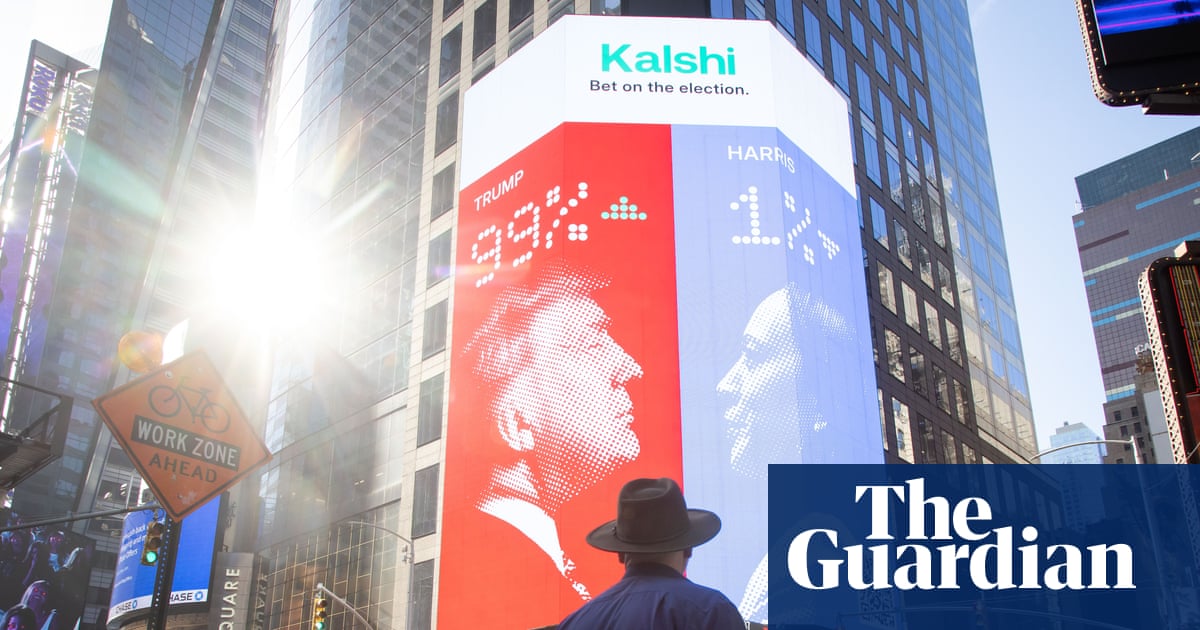
‘You can bet on it’: Utah lawmakers form united front in push to ban prediction markets
Utah’s heavily Mormon population is largely opposed to all gambling, even on financial exchange platforms
the Guardian
106 points · by thm · 6mo ago · 102 comments
I don't love casinos or lotteries, but at least there's the friction of having to travel to a physical location to feed your addiction.
And then there's the whole "insider trading" and "gambling on war" angles that come into play with prediction markets.
> it is clear from studies and from what we see with our eyes that ubiquitous sports gambling [...] is mostly predation on people who suffer from addictive behaviors.
> This is not a minor issue. This is so bad that you can pick up the impacts in overall economic distress data.
> the financial consequences of legalized sports betting [...] include a 28% overall increase in bankruptcies (!). [...] a 28% increase in bankruptcies is far more than I would have predicted. The typical adult bankruptcy rate is about 0.16%, so this would mean about 4bps (0.04%)/year of additional bankruptcies, or an over 1% additional chance a typical person goes bankrupt during their lifetime. [...] A bankruptcy is extremely socially expensive, on the order of $200k. That alone is almost triple the profits, and clearly wipes out all the social gains. Legalized online sports betting is currently a deeply, deeply horrible deal.
> [...] there might be a 3% overall increase in domestic violence as the result of legalized sports betting [...] This is a huge direct cost to bear. Domestic violence ruins lives. It also is a huge indicator that this is causing large amounts of distress in various forms, and that those gambling on sports are not making rational or wise consumption decisions.
OTOH allowing those kind of activities WILL end up with people opting in for the greater evil and thus some kind of limits should be enforced by governments.
I have no idea what would be the right approach, but outright banning prediction markets and casinos is definitely not the right one.
America is the land of the free, but I think there have been and will continue to be reasonable disagreements on the question of, free to do what? It's evident that "freedom" isn't a pure, unrestricted thing in the anarchist sense. We all agree that through the democratic process, laws can be made to declare some things not free to be done.
And to the degree that various taxpayer-funded social programs exist, the cost of grown consenting adults destroying their own lives are directly borne by the rest of us.
> but outright banning prediction markets and casinos is definitely not the right one
In general, I think a gradual "ban" in the form of taxation is often times better, especially for things that society is trying to discourage out of its sinful or destructive nature; think cigarettes.
We intentionally put a lot of roadblocks in the way of the democratic process. The constitution, and amendments place limits on what the democratic process can do - they can be changed but that takes a lot of time/effort which in turn slows things (for both good and bad). Even that we are a representative democracy vs a pure democracy slows things down.
The above is a slightly US perspective, but most others reading this have similar things in their process to slow down "fad" laws.
I don't think it is freedom. But. If someone destroys their own life the rest of us who share the same society pay a price, be that government money supporting their rehabilitation, incarceration, or the non-financial impact of people being homeless on our streets etc.
So as much as I favor freedom I also think there should be limits. I think "freedom always without exception" is a pithy statement that doesn't lead to positive outcomes in reality.
Part of living in a society is giving up some of your freedom to make the system work. I can't choose to kill myself of my own free will by smoking in an airplane anymore, no matter how happy it would make me, because it might not only hurt me, but everyone around me.
I think that's the line for me: When your self-destructive behavior causes harm to others, not just your self, it's fair for society to ban it.
If a bunch of people are going to end up a burden to society in the aftermath of their self destruction through gambling, it's fair for society to say "no".
This tradeoff has been debated my philosophers for millennia. We still haven't quite figured out a universal answer. Laws of nature vs laws of man and all that.
I'm not sure why we think this works.
Gambling is considered bad, and banned in many states, but many of those states run a lottery. This is just a straight up theft from the poor who are least well equipped to understand they are playing a rigged game, and not rigged in their favor.
I think gambling is almost a natural instinct in humans, and a state-run lottery may be a relief valve for that itch to be scratched in a controlled manner.
It's depressing to be poor, and have no perceivable path to fix that. Continual lottery participation is an action they can constantly take to have a chance to change that. It doesn't matter that their chances are incredibly low, it's still something they can do to have things not be entirely hopeless.
That rationale gets undermined if the state lottery is widely advertised in a predatory manner though.
Is there some actual evidence that poor people are under the impression that they have a meaningful chance of winning significant money the lottery?
I see this line a lot and it’s extremely patronizing. I’m not even pro lottery but this “poor people are too dumb to understand” does not strike me as a sound argument.
I fail to understand how this is someone's business. As I see it, in the US a person is free to be as dumb as possible. And have as much freedom as possible. I don't get it why anyone would patronize poor people (or any people) from making bad decisions.
However, I will ask you to consider that under discussion are very specific bans. Call these something else if it makes you feel better. I think these are normally called "regulation." But, what's being discussed is still completely compatible with "freedom", especially with added context of the elected lawmakers enjoying the support of their constituency for their actions. This also leaves the door open for a future electorate to legislate something else.
Nations have established middle grounds for gambling. To gamble, drive a couple of hours down to an exempt casino and set fire to your money if you so wish. Bootleg operations are permitted as long as they stay low. Prostitution has similar regulations. Sports betting, Onlyfans & Prediction markets remove those necessary frictions from each vice, preying on men (it's mostly men) at their most vulnerable.
Prediction markets : gambling :: weed : cigarettes
What is _Freedom_?
Should I have freedom to enjoy a movie or conversation uninterrupted? Should I have the freedom to modify a motorcycle or car to be excessively loud that it shakes windows while driving by and interrupting people so they have to pause their movie or conversation?
Freedom for the movie viewer or conversationalist goes against the freedom of the loud motorcycle or car driver? They both cannot have freedom because each will impeded on the others. So who is gets their version of _Freedom_?
Perhaps. But almost universally, most societies consider it a crime to encourage or facilitate another’s self-destruction.
Freedom itself is itself a nebulous concept. Are my freedoms restricted when I can’t drive 80mph through my neighborhood? Yes. On the flip side I enjoy the “freedom” of living in a more controlled, safer environment. Is a corporation’s freedoms restricted by the laws that prevent them from dumping toxic sludge into the river upstream from me? Yes, but my freedom from living downstream of that pollution is preserved. Are my freedoms preserved when we allow broad access to firearms in this country? Yes, at the cost of my kids freedoms to attend a public school without the risk of being shot by a mentally ill psychopath.
Here we are considering the freedom to destroy your life via gambling vs the freedom from being targeted by corporations with much greater resources than you trying to get you to do so, and the freedoms of your family who may choose to not gamble and still have their lives destroyed as a result.
An “pure” worldview of maximizing personal freedoms over-simplifies the trade-offs and is doomed to fail in the real-world as a result. Realistically maximizing societal well-being requires a more moderate approach.
If you bet randomly on the winner of NFL games on DraftKings you'd expect to lose 4-5% of your money per bet over time. I'm not sure the people here with a cultivated disinterest in professional sports know this but it is much more entertaining to watch a game when you have money on the line. We know that all but 1-2 percent of people are able to control themselves and not become problem gamblers. The UK fines casinos for not doing enough to stop problem gambling, the US can do the same. You can do income checks, have a national self exclusion system, and ban advertising.
Lastly, prediction markets are the only way for Americans to bet on sports and not be banned for winning too much (short of using sketchy agents for Betfair and Asian books that can randomly steal all your money)
That says absolutely nothing about the blast radius of damage from the 1-2% who do become problem gamblers and end up leaving their families impoverished and destitute, robbing their children of chances for education, etc. This cascades into issues and expenses for society in terms of more dependent and fewer productive members.
Similarly only a small percentage of people also are problem drinkers enough to drink and drive, and the small percentage of trips while impaired result in accidents. Yet the blast radius of the damage by that small percent is such that we decided long ago that serious laws and enforcement is a good idea.
Just because only a small percentage of people
Would be interesting to see how a new prohibition amendment on gambling on games of chance would work.
The line isn't all the clear, is it? Is poker skill or chance? What about betting on a horse? Or buying a stock option?
Or if you allow it put a warning like the surgeon generals warning on tobacco. Clearly state that most people lose money.
Smoking is legal but advertising cigarettes is illegal. I grew up in the 1980's where smoking was everywhere. We even had a smoking area at school. Today I don't know anyone that smokes. Obviously people still do but it is much less common
* researchers found that prediction markets are actually good for your wellbeing
* lobby group is lobbying to fight against Utah lawmakers who are working against the wellbeing of people in Utah
These markets are a straightforward way to cut through all the noise of the current media conglomerates. Rather than getting bombarded by inflated headlines a glance at polymarket or kalshi is often enough to know whether something is actually happening or it's just the media corporations trying to get your attention.
Of course there should be limits with regards to what kind of markets are allowed on these platforms. But in a lot of areas there's genuine price discovery happening that's not available anywhere else.
2. I think the existence of prediction markets can change the outcome of events. See the Super Bowl Streaker as an example.
3. I don’t have a strong use for prediction market odds. In the few areas of my life that require forecasting I have sources of information i understand and trust more, sometimes with private data not available to the general public.
100%. I have no earthly idea what the value of these markets is for things I'm not an expert in (I assume they're roughly equivalent to asking the bots and teenagers on Reddit and pretending that's crowd-sourcing, given what they show in things I understand well), and I have no use for them in things I am an expert in.
But hey, at least government employees/soldiers can cash in on secret operations before they happen? That's fun, or whatever.
A market that only works as long as participants in the market also pretend that they aren't in a market is nonfunctional.
Let all reasoning be silent when experience gainsays its conclusion. The beautiful libertarian theories have failed.
The much more popular method of making bets in a variety of ways to skew the system, use all the power of financialization to manipulate values of contracts independently of the underlying measurement, and everything that we're already seeing in quantity and abundance ruins the utility of the market as a prediction market.
You say it's really hard and can be neglected... I say it's already happening so much that the putative value of the markets is ruined. I wave at all the news already written about it and the ongoing flood of news that will continue. The system is fundamentally broken, does not work, and will never work. The theory only works if the value of the prediction market is somehow completely isolated from the value of the things under prediction, but the prediction market itself is the engine for destroying that assumption.
Perhaps a solution instead of banning them would be to create a class similar to accredited investors that are allowed to participate. And stuff like market manipulation should just be prosecuted in old fashioned ways like we prosecute any crime.
It's like you make something legal, and some group of people try as hard as possible to push the limit as far as they can, and in turn ruin for everyone.
You could just force the biggest entities in this space to comply and people wouldn't care enough about secretly betting on wars so it would all work out.
* if you make it so that everyone sees what their neighbor betted on then overall predictions will become less accurate due to social signaling
Obviously, insider trading, but as a society we have long decided that this is evil.
And if we compare markets where I am ready to put my money where my mouth is, then this actually is called gambling. Just not a game of chance but rather game of skill.
It becomes problematic when we make a game of it and add financial stakes. Gambling is a lot like drugs in its ability to hijack the brain's reward circuits. I stopped investing in cryptocurrencies because seeing +400% profits was like crack. I never gambled any money I couldn't afford to lose but there are people out there who were leveraging their entire lives to FOMO into markets.
https://en.wikipedia.org/wiki/Depository_Trust_%26_Clearing_...
You actually participate meaningfully in the outcome via investing instead of just price discovery and the successes are derived from the valuation or income of the venture instead of the losers. The participation is not only in impact on their credit rating and sales but also concrete choices in government of it.
Not to mention in principle there is an actual activity being backed by the investment to produce non-zero sum gains. While there may be risks involved in say, running a turnip farm or sending a ship across the ocean, you are still supporting a useful activity for its own end. Crucially as well there is motivation to do the task even without the market, even though it may enable it.
If you can manipulate the outcome of the turnip farm (as opposed to the market) to make it succeed that is doing useful work and not just cheating a bet. A guideline of the distinction would be - would charging somebody for making the outcome successful in a not otherwise criminal way be a Kafkaesque injustice?
You can in fact use the market to gamble via options intended for credit or insurance but stopping those by stopping the market entirely would be throwing out the baby with the bathwater.
Investing takes x capital, put it into a machine, and x + (yield * x) comes out. In gambling, x is put in, x always comes out, but on the way out x is simply distributed among a different population.
Investing literally creates net value (or loss, technically) that didn't exist before. Gambling cannot do either: x is always constant, however x is divided up differently.
There's many videos about this: https://www.youtube.com/watch?v=HnRslDPlkg4
So, I guess the answer is, regulatory control.
Christianity has some good stuff (love thy neighbor, etc), but I'd rather we not lean too heavily on it for public policy, for obvious reasons