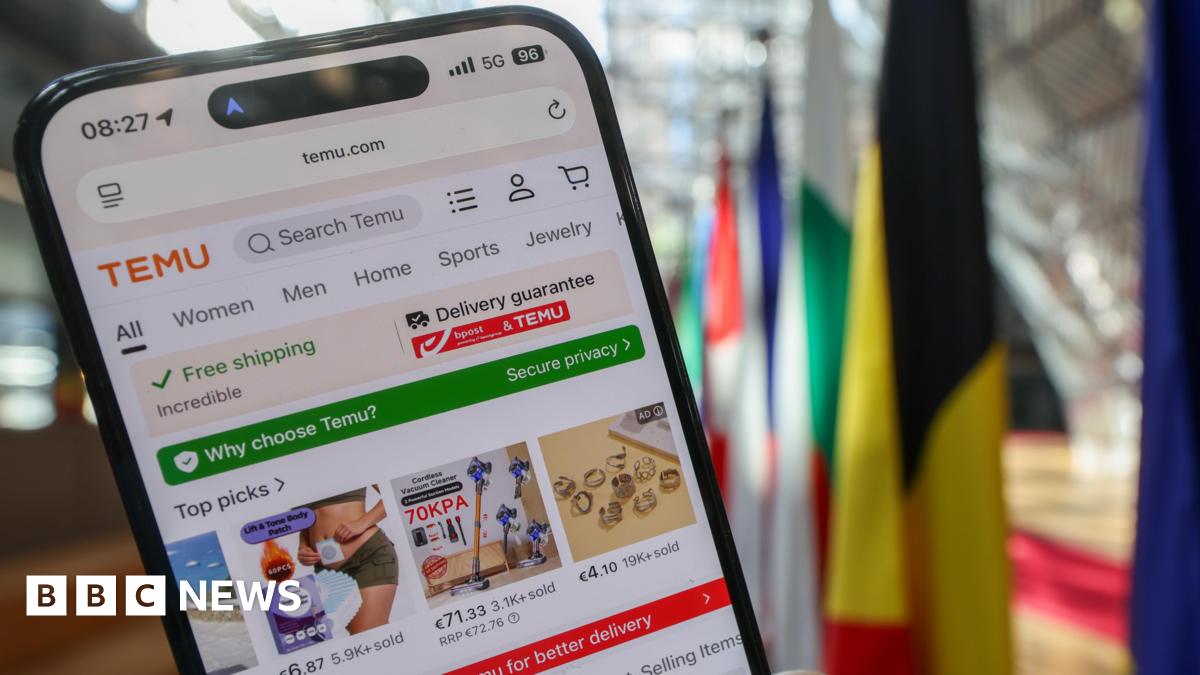
EU fines Temu €200m for allowing sale of illegal products
The European Commission says the Chinese-owned online retailer failed to take account of risks from baby toys and faulty chargers sold on its platform.
BBC News
352 points · by jjp · 6mo ago · 401 comments
There's something unpleasantly snobbish with the way business is done here, a spirit of "if you have to ask the price, our business is not for you". For example, in Instagram, "Local offerings" pop up all the time in the feed. The ones which are truly local end up in a "call us to know more" button, no pricing info disclosed. The ones that show actual prices tend to be shell companies with no employees, no doubt a thin wrapper around an importer from Asia.
Don't get me wrong. I think companies should be held to higher standards: i just don't understand why only Temu is being held responsible of the entire broken capitalist system.
The first is liability. If they're selling chargers that burn down houses, they get sued, and they don't want to get sued, so they don't want to sell chargers that burn down houses.
The second is regulatory requirements. This one is generally worse. The incumbents capture the regulators to e.g. have the law require their technology or raise costs to exclude new entrants. The rules are often inefficient or poorly conceived with bad cost/benefit ratios. And companies making products that are dangerous but nevertheless comply with the rules will point to their checkbox compliance to dodge liability.
The problem with the first one is that it doesn't work well against companies outside the jurisdiction, because then you can't sue them, and the importer will be a small entity that just files for bankruptcy if you try to sue them. But the second one has the exact same problem. They sell products that don't comply with the rules; if you try to fine them they're outside the jurisdiction and the only thing in the jurisdiction is a fungible importer that will dissolve if you try to go after them.
In that environment the thing that actually works is the third thing. Customers expect some products to be dangerous and rely on product reviews to determine which ones. But this is the thing the second one inhibits, because then overpriced incumbents use their influence over the laws to target any new supplier that tries to establish a trusted brand, which causes the foreign suppliers to have to sell through dozens of unknown labels so they can continue to dissolve them if any of them get prosecuted. And then customers are stuck choosing between the overpriced incumbents and the far cheaper foreign suppliers that may or may not be safe, with many people risking the latter because they have so much lower margins.
They are not really. If one of the big brand shop is found importing stuff with fake certificate, they’ll experience the same thing. One of the advantage of the stores you mention is that they have a procedure for recalls, and their responsibility is on the line if they sell faulty goods. Good luck getting anything from Temu or AliExpress in the same situation (at least Amazon is very good with this).
Can your family? How about your neibhbors? Does anyone you know have this ability?
There is no common sense to be had here. There are people with more specialized information that I have that look into this. There are laws to address this - and I'm pretty sure these laws were written with the blood of folks killed by faulty products.
Edit: Reply to Scroll_Swe as I am rate-limited to posting new comments. The chargers in budget stores are identical to Temu chargers are are frequently recalled.
The line should be drawn by parents.
The paternalism really has gone too far,
and people are (incorrectly and dangerously) expecting to be protected now.
Consumer standards are a net benefit to society.
> and people are (incorrectly and dangerously) expecting to be protected now.
The general public hasn’t the faintest idea how to differentiate between a safe product and an unsafe one, and they shouldn’t have to
And I think that sentiment is significantly more representative of the populace outside of some edge cases around speech and vices. The vast majority of people do not want to have to investigate if their food has too much rat shit in it. They want the rat shit out of the meat or the meat not to be on the shelves.
That is not a good reason to fudge certifications and sell dangerous goods. I sympathise with your use case, but the solution is not "let’s just import whatever, as long as it’s cheap".
I can buy 3 from the local store or a BAG OF ONE HUNDRED from Aliexpress.
Not a hard decision tbh.
Now I gladly pay Home Depot or friends to maintain stock for me so my house isn’t filled with bags of shit I’ll never practically use.
I cannot speak for the specific part of Europe that you are in, but in the professional Photography community, it is common practice to not list prices and instead have a "contact us" option. The reason isn't a, "Look at us, we're so exclusive and fancy!" Rather, if you list a price for various packages, people get scared off or think they are a master negotiator and can essentially get the work done for free. All of the professionals I've spoken to are happy to work with customers to find a package at an affordable price for them, or at least recommend other professionals in whatever price range they have in mind. The issue is that its exceptionally hard to convey that in a sincere, real way because if someone only sees a price of say $10 000 or whatever, they are naturally going to assume that you cannot possibly get anything for $100-$1 000.
In truth though, many are glad to try and accommodate and get people something that they will be happy with. Perhaps it ends up being 1 or 2 photos instead of an album of photos or whatever, or perhaps the photoshoot is a little bit more "low budget" than a standard one, but there is still lots of opportunity to get the client something they will be happy with. People tend to get wrapped up in the bottom line though, and just assume that they can't afford to capture a happy memory because of the cost - that's something that photographers really want to avoid because (aside from scaring off paying customers! :) ) it means less photos existing, or making it feel impossibly hard to ever show an interest in photography, which is very sad for people who live and breath it.
Yet somehow other businesses manage to convey tiered pricing without scaring customers.
Imagine trying to book a hotel room but were told to contact them because they have a range of rooms from single bed to honeymoon suite. "We couldn't possibly list all the packages, it would confuse you!"
Or try to buy a car, but the dealer refused to list a base price because "we have so many options it's meaningless".
Withholding guideline or indicative pricing is a deliberate obfuscation designed to increase friction and reduce choice.
There are some that are genuinely dangerous and bad for society, but there are tons of goods that are "the same thing but half the price because it lasts a quarter the time" that have genuine utility.
Harbor Freight has basically made a drop-shipping business out of it. I often have tools that I need but will probably use 4 times in my life, and the Harbor Freight stuff is crap but will probably work 4 times.
Copy that over a bunch of verticals and it starts to make sense. Clothing for a costume I'll wear maybe twice, niche cooking gadgets for very specific things, tools to do a one-time repair on a car, a flash drive to turn over photos to family members, yada yada.
It's not all of it. Some things are seriously worse quality. But really a ton of the "better quality" is just better marketing.
There was a time where society didn't buy clothes to only wear once or twice but would instead rent them for those occasions.
Forehead hit hood, but I caught myself so it was a "gentle" reminder instead of a concussion. I should have splurged that time I broke a socket tightening an axle bolt. 150 ft-lbs + 180 degrees is a fair bit of torque.
Europe has historically had pretty strict consumer protection laws, and ever since the end of the Cold War these consumer protection laws have been slowly chipped away. When I was a kid for example companies were not allowed to target children in their marketing material. When American media became predominant in the continent, instead of enforcing our own consumer protection laws against American advertisers, regulators just ignored it and allowed it to proliferate, effectively making ads targeting children legal in the continent. Regulators have been showing the exact same inaction towards Chinese retailers breaking our own laws as they did towards American advertisers three decades ago. I foresee that consumer safety laws getting the same fate as the ban on ads targeting children.
https://www.connexionfrance.com/news/amazon-is-wrong-to-use-...
Small businesses that do the work of curating a niche item, doing QA work that's absent on the shipments from china, and then offering much stronger aftermarket support/replacement/repair? That is often worth a (substantial) premium over wondering if the item showing up in a month is going to work as intended.
Aka like Amazon but with much smaller margins.
The savings would come from the fact sea freight is so much cheaper than air freight.
There’s a reason the likes of Aldi and Lidl have limited product choice.
I downvote comments like this, since they make the comment useless. No-one can vouch for or argue against the comment when it's some "part" of a continent of over 40 countries.
The clothes are all 100% plastic polyester shit with extra chemicals. If you have proof of otherwise, show me.
Yes I make enough to buy good clothes. If I REALLY need cheap clothes H&M basics are always there.
Same with anything else, IT and tech parts I shop in Sweden.
What else?
Like, what is so needed now that you did not need before but you need to buy plastic China crap from Temu now?
> Under the DSA, designated Very Large Online Platforms are required to diligently assess systemic risks linked to their services and adopt corresponding mitigation measures.
It's good to know that someone's actually checking this stuff. Self-reported compliance like CE always makes me wonder if I'm a mug for trying to comply honestly with the rules when it would be easy not to.
They tested play sand for asbestos, and four of these positive tested play sands were ordered on Temu. The play sand is for kids!
https://www.test.de/Deko-Spiel-und-Bastelsand-Asbest-Alarm-i...
Are you US-american? (Walmart is a good hint that you are.) There's some widespread misconceptions/prejudice there, e.g. the Kinder egg thing. The EU has no problem with selling those.
The US seems burdensome because some US Entrepreneur already tried not caring and something happened. A good comparison is China cars which don't pass US standards for import. It's also a reason US Makes can't iterate as quickly as they aren't allowed to do the same things that China Makes can to iterate fast.
Whether or not it needs to stay that way is really the only question. I think most reasonably intelligent people read things like suffocation warnings and go, "well obviously don't do that." But the regs are written for the people who aren't that bright who will do it anyway.
Not sure there is anything one couldn’t find on Amazon the exact same wares, though with the additional margin for a USA bigtech company in the middle.
Whether they're dangerous I don't know, I've not tried them.
Temus comments about this being for their 2024 store are probably accurate. I honestly wish they were more dodgy tbh.
Otherwise why fine out of the blue when this had been going for years.
And what about western countries violate those laws, lobbied or deliberately turning a blind eye.
Can European companies demand equal treatment? Wait, no, I know the answer to that.
But it will eventually get better because in addition to DSA there are other steps; the importers have to declare a responsible person in the EU, the packages will get more expensive etc.
As a general principle, the EU commission handles all international trade and member states are not allowed to impose tariffs or rules on what has been imported into other member states.
I say general principle because in many cases pre-existing legislation was allowed to continue, however anything new and any changes went through the EU commission (meaning the executive branch has full control, not parliament as generally was the case, even against the wishes of both the EU parliament and member state parliaments)
So no, the EU commission was stopping member states from doing this. So yes, it is very much the EU's fault it took so long.
Oh and, look up the history of the EU commission. If you think the EU commission will help anyone against big business, well, look up their history until you find "European Coal and Steel Community" and look up some of the scandals they were accused of. And yes, they're better than they were in 1951, but that's coming from a pretty damn bad start.
No it wasn't. I wrote 'prosecuting', that is a term from criminal law, and that still is in the agenda of the member states. If Temu is breaking law, which it probably is when they were fined for selling "illegal products", then the states should have acted, but they didn't.
> If you think the EU commission will help anyone against big business
The difference is the seat of the said business.
If they don't fix it, it'll eventually continue to the "20% of worldwide revenue" kind of fine everyone on HN was so afraid of when the GDPR was introduced. But that's not what it starts with.
I find this incredibly, incredibly hard to believe.
GDPR has been a farce in terms of enforcement.
We also have laws making the store selling the thing that burnt down your house liable for what they sold, which make them think twice about selling a random off-brand fire-starter with unknown manufacturer. This worked great until Temu, Amazon, and Alibaba entered the market claiming to be "marketplaces" connecting "importers to suppliers" while clearly behaving like a store.
The core issue is that, if the producer cannot be sued, the seller cannot be sued, then there is no reason to follow any safety what-so-ever. So fine the distributor until they put some quality control or standards on the producers they give market to, may solve the issue.
The US has this issue as well, though more focus on individuals suing for each case rather than broad-spectrum compliance regulation. The outcome is the same; with nobody to sue, there is no reason to make things safe for human use.
From my perspective (as a non-resident EU citizen), it seems the EU is addicted to cheap products from PRoC which do not comply with a variety of EU regulations, because actually enforcing compliance would drive up consumer prices, which is politically unacceptable. This also seems like the reason of the lackadaisical enforcement of regulations.
Essentially, allowing in PRoC products, then complaining is an easy way to keep prices low while continuing to introduce regulations which are expensive to comply with.
Put another way: why does the EU manufacture a declining share of its consumer products, at a time when automation makes mass-production less labor dependent than ever for many industries.
So what else are you going to do? Paperwork up front for every single product?
That's basically how drugs won the war on drugs, yes.
This is also part of the EU's larger tariffs against China [3].
[0] - https://www.globaltimes.cn/page/202605/1361926.shtml
[1] - https://www.globaltimes.cn/page/202605/1362200.shtml
[2] - https://www.globaltimes.cn/page/202605/1362161.shtml
[3] - https://www.ft.com/content/e28fe696-ac30-4543-a105-febc82789...
Ahah, China going Adam Smith on the EU.
Peacefully, so far. Let's hope they don't go "opium war" on free trade.
[0] - https://www.telegraph.co.uk/world-news/2026/01/30/china-traf...
[1] - https://www.reuters.com/business/aerospace-defense/russians-...
> A major source of this latest wave of the so-called "China shock" narrative is the claim that the EU's trade deficit with China reached 360 billion euros in 2025.
These are the same people whose collective knickers are getting in a twist over Trump, mind you.
The average EU salary is €39,808. It's equivalent to a €636 fine. Though this is based on income, not net profit so it's actually more impactful to the average person than to Temu.
https://themorningnews.com/news/2025/10/13/temu-doubles-eu-p...
… which found that a high percentage of chargers purchased through Temu failed basic electrical safety tests. It also found that a high proportion of baby toys posed safety risks, containing chemicals above legal limits or featuring small detachable parts that presented suffocation hazards…
https://www.nytimes.com/2026/05/26/climate/plutonium-nuclear...
Let's do more of that.
bigclivedotcom takes apart some of the Temu stuff on YouTube and some of the electronics is atrocious.
So Temu should be sued if a house burns down from a generic-brand e-bike that they imported and took money for.
If you sell something on your site, or allow users to post something on your site, you should have some liability for the consequences.
But this is an internet store.
Just image having a mandatory political party inside every American corporation which the board has no control over.
1. https://www.washingtonpost.com/national-security/2024/05/01/...
America is not China, but how close is it getting?
> Failure to comply with the non-compliance decision may lead to periodic penalty payments.
So they're just threatening a fine at this stage? It's not clear to me
An exemple what how in the old microsoft case they ended up puttin a daily fine for non compliance until microsoft balked back and fixed it (after they tried to act tough and pretended to ignore them).
The end goal ultimately is to get it fixed.
1.1 These Terms are between you and Whaleco Technology Limited, an Irish company.
But the EU got some headlines and people believed they came down with an iron first so that's really the most important thing here
In my world finest are served when they're actually paid, not threatened
There were several such cases in my country before we joined EU, most high profile one was against Optimus SA (predecessor to CD Projekt), where they just took people's money, without cause as they courts later found. Never again.
So the middle ground is, Temu can choose to play hardball all the way to ECJ, but if they are wrong (they are and they know it), the cost will be substantial (200 M€ + interest + daily fines + interest). So I think they'll enter talks, pay 200 M€ and pinky promise to delist offending items.
But I guess if Temu was running government infrastructure they would be off the hook too.
In Australia, the product selection is often limited, and a lot of local stores are just reselling Chinese-made products with huge markups anyway. At that point, you may as well order directly from China and save money.
It also saves 10% GST.
For now.
Your local companies hate the competition, and will be lobbying hard to remove de minimis exemptions on imports.
https://www.ato.gov.au/businesses-and-organisations/internat...
> If you are a non-resident business and you sell goods into Australia with a customs value of A$1,000 or less, GST applies and you will have to collect this from your customer and send the GST to us.
Generally speaking, international direct-to-consumer e-commerce is a problem for trying to enforce these kinds of rules. The whole model of checks at the border works well for massive bulk shipments, which not only are few enough in number that customs have a chance of doing a proper job on them, but there's also a commercial importer taking a large financial risk on the shipment and therefore 1) having an incentive to ensure they import something safe to begin with, 2) they can be practically fined/sued by authorities if they screw up. But when you have myriad tiny operations selling direct to consumers, the consumer is the importer, and there's no local representative for the manufacturer that you can actually sue. It's effectively a quite lawless area. Being able to do direct imports is an important freedom, and this kind of laxity is inevitable, but it's understandable the EU wants to do something about the flood of poor-quality goods that are terrible for fair competition, the environment, and health and safety.
In the old days, when an importer purchased Chinese goods in bulk and resold them, import checks were commonplace.... AND the importer was legally responsible for paying import duties and selling goods to the public that were legal and met safety standards.
Now that any individual can order direct from China (with cheap subsidised postage!), the floodgates of untaxed and dangerous shite are open.
One solution is to address the subsidised postage that makes this state of affairs possible.
In my country the government is pushing those companies to have local warehouses. So if items are bulk imported by the marketplace, in theory it should be easier to inspect.
Or is the intention of the law to allow for an unlimited number of supposedly illegal goods to circulate freely within the EU, just fined appropriately?
https://cemarkingassociation.co.uk/latest-news/ce-marking-an...
The policemen controlling imports don't have the competency to check for faults, so we get this situation where specialists regularly sample the products, and heavy fines are issued to the importer.
Unless I’m missing something obvious, enforcing regulatory compliance from the army of hustlers that is their vendor market would be expensive or impossible.
I try to a avoid Temu, but they have some good traits, too, like quick and convinient shipping.
Seems fine
The EU began enforcing a small parcel tax directly against Temu last May [0] and France has been strongly lobbying against Shein and Temu [1]. The EU has also made Chinese overproduction a critical topic of discussion for EU-China relations [2][3], and barring Temu and Shein is backed by both unions and industrial groups within Europe [4].
All of this is linking to the EU's strategy of playing hardball against Chinese support of Russia's invasion of Ukraine [5][6], as well as pushing back against the Chinese perception that the EU is a has-been [7] as well as conducting an active info-war against a European state [8].
[0] - https://www.ft.com/content/102e18d7-d06b-4405-a347-97bb3c373...
[1] - https://www.ft.com/content/b1fdbad1-2793-4975-a10b-74bb928d3...
[2] - https://www.reuters.com/sustainability/society-equity/eu-law...
[3] - https://www.europarl.europa.eu/news/en/press-room/20260326IP...
[4] - https://www.lemonde.fr/economie/article/2025/09/15/les-indus...
[5] - https://www.bruegel.org/podcast/how-war-ukraine-reshaping-eu...
[6] - https://www.osw.waw.pl/en/publikacje/osw-commentary/2025-01-...
[7] - https://fddi.fudan.edu.cn/_t2515/57/f8/c21257a743416/page.ht...
[8] - https://www.defense.gouv.fr/desinformation/nos-analyses-froi...
Ah of course, I do want the state regulating what I can and cannot buy when it comes to junk. Only approved goods should be allowed.
If you don't build nor buy European, you become a vassal of either the US or China.
Competition, innovation, etc. Progress, you know.
TEMO will more than likely just pass the cost of this onto EU consumers.
I take it you don't?
† If you lived in the German Democratic Republic (aka "East Germany") in 1950 you could literally just walk to West Germany, by 1961 all other borders are closed and fenced and in Berlin the Wall is up and people who try to escape are being executed routinely. This didn't happen instantly over night, but it took about a decade to go from routine to "Vast majority of people who attempt it are killed".
Good. I want to know my AIEONUS phone charger isn't going to burn my house down and I'm more than happy pay a premium for that knowledge.
The best way to fight Temu would be to maintain a society where young people are not so desperate that the only comfort they can afford is to order the cheapest crap online.