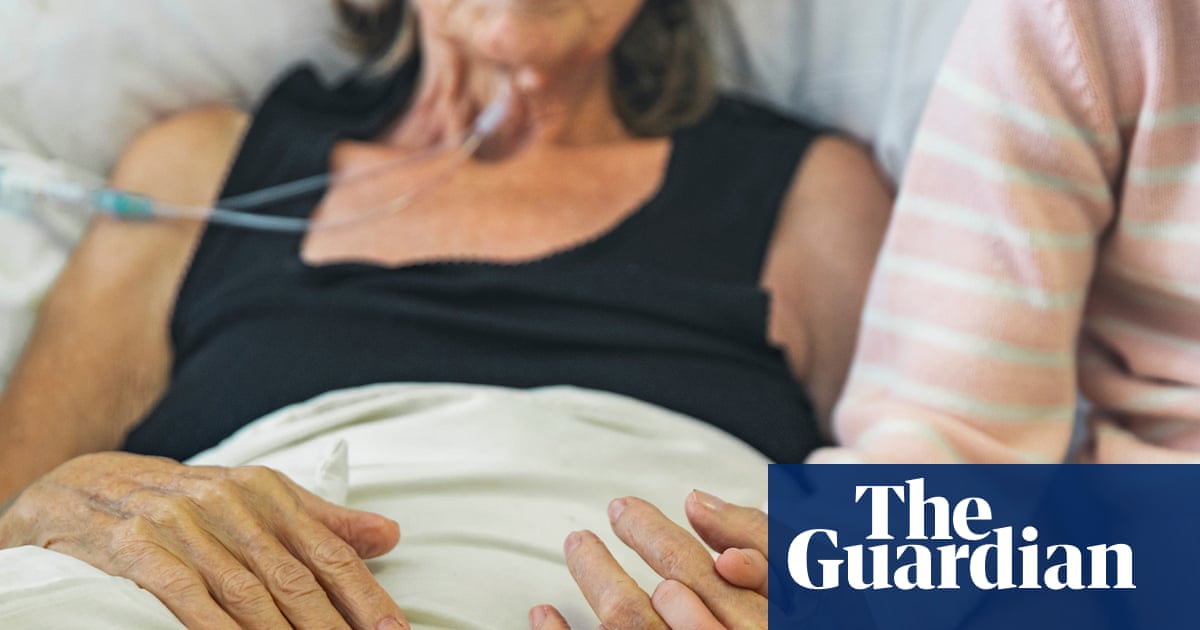
Daily pill can double survival time for world’s deadliest cancer, trial shows
Experts hail daraxonrasib as ‘gamechanger’ for patients with advanced pancreatic cancer
the Guardian
172 points · by c-oreills · 5mo ago · 58 comments
> ...
> He’s been on daraxonrasib since early this year, and describes it this way: “. . .it’s a nasty drug. It causes crazy stuff like my body can’t grow skin and so I bleed all out of a whole bunch of parts of me that shouldn’t be bleeding” If you go to that link above, be prepared, because he also looks like he’s had aqua regia thrown all over him (and apparently feels a bit like that, too). But his tumor volume has gone down by about 75%, and there’s a very strong chance that he wouldn’t still be alive at all without having gone on the drug.
But to me, that doesn’t sound like a life worth living. Obviously different people will have different thresholds for when to throw in the towel, and I’m glad that we are finding medicines to allow people to make the choices that align with their own drives.
Still, I can’t help but think that this is the sort of life virtually none of us would choose to inflict on our pets, even if cost was no option. We give them a far more graceful exit from this world than we give ourselves, and I think that’s worth considering.
I am truly terrified of death. I wish I wasn’t, but an infinity of nonexistence somehow seems unbearable (though, obviously, it will be trivial to bear in practice). I still hope that when my time comes, I will find the strength to exit gracefully if my life ever gets to the point where each day is filled with pain and discomfort, and where I can’t actually take part in any of the things I enjoy about life.
I hope that this is only a temporary treatment for this guy to get the tumor to a point where it can be operated on or treated with other therapies. Because his life sounds like a living hell and that breaks my heart.
BUT ... this is not a binary situation, where suddenly life becomes unbearable. There's so much worth living for. And not just the obvious big things in life (kids, family, friends), but also many many small things. Man, that first cup of cappuchino once the effects of chemo wear off alone is almost worth all the puking beforehand :) Or having a nice piece of cheese. Seeing my small herb garden grow. Etc. etc.
The trick is to live a peaceful, content life. Be grateful for what you have. Enjoy your short time on earth.
I am in a position to be intimately familiar with illness. I will say that health is a spectrum and the mind is incredibly resilient. You will surprise yourself as you inevitably age how much your mind will adapt to always hurting. There is more to life than body discomfort. This patient sounds like he has his faculties and is making an informed decision to continue living, because his life is worth the discomfort he is going through. I am reminded of a line along the lines of every day you experience, no matter how terrible, is very likely a day that someone else yesterday would have desperately wanted.
There is a targeted therapy that applies to many melanomas, but hers did not have the mutation that made it an option. Perhaps this treatment will be tweaked and developed to be less awful and offer that gift of time that my wife didn’t have.
Cancer and other diseases are insidious. While she didn’t make it, she had hope. And the reality is her hope was built on the shoulders of countless others who faced certain death and whose experiences led us to the 60/40 odds that melanoma patients have today.
I often think about this, wondering how many of those animals would have chosen death if given the choice, and how often it is simply a way to spare the owner from seeing something that upsets them.
There are so many different situations I could not imagine happily living in even when I try to, but then I try to think about how I would feel if I was born into the situation from day one. I wouldn't really know any other life, and so it would just be my life. With that in mind, the most troubling thing mostly seems to be what I have perceived to have lost, rather than what I currently have. That helps me understand how you can keep on living. Even when you lose something, you still have what you still have.
Insensitive comment in general. "Throw in the towel" really pissed me off.
I think he looks better than every 90 year old. But he also mentions that it still is terminal.
[0] https://www.nytimes.com/video/opinion/100000010826256/what-d...
<https://en.wikipedia.org/wiki/Chemotherapy-induced_acral_ery...>
I'd first run across this decades ago in the context of FDA drugs trials, in which adverse incidents were noted. My understanding at the time was that certain chemotherapies tended to interfere with skin regeneration, particularly in areas subject to high wearing (hands, feet, elbows), or rapid replacement (particularly mucous membranes, lips and mouth especially).
Not all chemotherapies are brutal, but some can be quite fiendish, and quality of life is a legitimate consideration when considering whether to proceed with treatment. Informed decisionmaking and consent in a context where expertise is rare and clinicians don't directly experience the adverse effects is difficult at best.
We can’t know ahead of time which medicine works so you need to fund many teams at the beginning.
<https://hardmanandco.com/research/corporate-research/2025-ph...>
Total VC tech investment in 2025 was $425 billion.
<https://news.crunchbase.com/venture/funding-data-third-large...>
VC funding includes firms inside of the medical industry, but also companies operating across most of the economy. It’s not just IT, but food, solar, EV’s, rockets, etc.
So, IMO these numbers are pretty reasonable.
The recently-read-out trial is in the 'second line' - meaning patients will have received one 'line' of treatment before this - typically chemotherapy +/- surgery. The chemotherapy regimes used for pancreatic cancer can be pretty brutal, and patients can usually tolerate one, max two lines overall. As such, this trial administering only daraxonrasib monotherapy made sense.
The first line trial of daraxonrasib is already underway, and includes both darax monotherapy and darax + chemo arms. (They are combining with a slightly less brutal chemotherapy called GnP, with an eye to the overall side effect burden considering the non-trial side effects that darax also brings.)
It'll be very interesting to see the outcome of this trial; there are some examples elsewhere in oncology where a treatment is recommended by guidelines without chemotherapy over a combination with chemotherapy, as the small survival benefit the addition of chemotherapy brings is seen as outweighed by the additional toxicity.
Of course this is better than nothing, but it is not a cure.
Moreover, the link provided by another poster to an article that discusses the side effects, shows that they are unpleasant.
Still, an extra year of life may provide a chance to survive until the appearance of a better solution.
Therefore those well above the median might have reached an extra year of life.
I agree however that because almost all of them (96%) had severe side effects, many people would prefer to not choose this kind of life extension.
My own parents were such people.
So pancreatic cancer is basically a genetic disease for most patients instead of environmental?
DNA is unstable. Lots of stuff cause mutations: background radiation, chemicals, viruses, even our own normal metabolism [1].
[1] https://en.wikipedia.org/wiki/Reactive_oxygen_species#Oxidat...
https://www.nejm.org/doi/full/10.1056/NEJMoa2505783
Paywalled but has a free access option if you make an account.
It's also meaningful insofar as extended survival time suggests progress against the disease mechanism. This may not mean long-term survival for present sufferers of this particular disease, but may suggest future research which is more promising, or if this route hits a wall on any additional outcomes improvements, limitations to this approach. The advance of knowledge is a benefit, regardless of ultimate patient outcomes.
(Where the trade-off in knowledge gains vs. patient outcomes lies is yet another realm of medical ethics.)
Language-lawyering the term is however specious. If you want to comment on quality of life or other matters, those are separate and meritorious discussions. You're embarking on them in a manner that's not likely to be especially conducive however.
No one actually knows that one way or the other since some patients were still taking it after the study ended according to the article.
One group had median values of 8.5 months for progression-free survival and 13.1 months for overall survival.
The other group had median values of 8.1 months for progression-free survival and 15.6 months for overall survival.
Overall Survival (OS) measures the time until death from any cause.
Progression-Free Survival (PFS) evaluates how long a treatment can delay disease progression or death.
So at least most of the patients from the study have died, because otherwise median values could not have been computed.
Thus the treatment had provided them a median life extension of about 3/4 years. The lucky ones probably have got more than an extra year.
RAS G12 population mOS: daraxonrasib 13.2 months / chemotherapy 6.6 months Overall population mOS: daraxonrasib 13.2 months / chemotherapy 6.7 months
RAS G12 population mPFS: daraxonrasib 7.3 months / chemotherapy 3.5 months Overall population PFS: daraxonrasib 7.2 months / chemotherapy 3.6 months
> Thus the treatment had provided them a median life extension of about 3/4 years. The lucky ones probably have got more than an extra year.
The 'median' patient in this trial lived ~6.6m longer if they received daraxonrasib. It's worth noting that the performance of the chemotherapy arms was stronger in this trial than previous trials of second-line chemotherapy; whether this reflects better care or a prognostically-superior trial population remains to be seen.