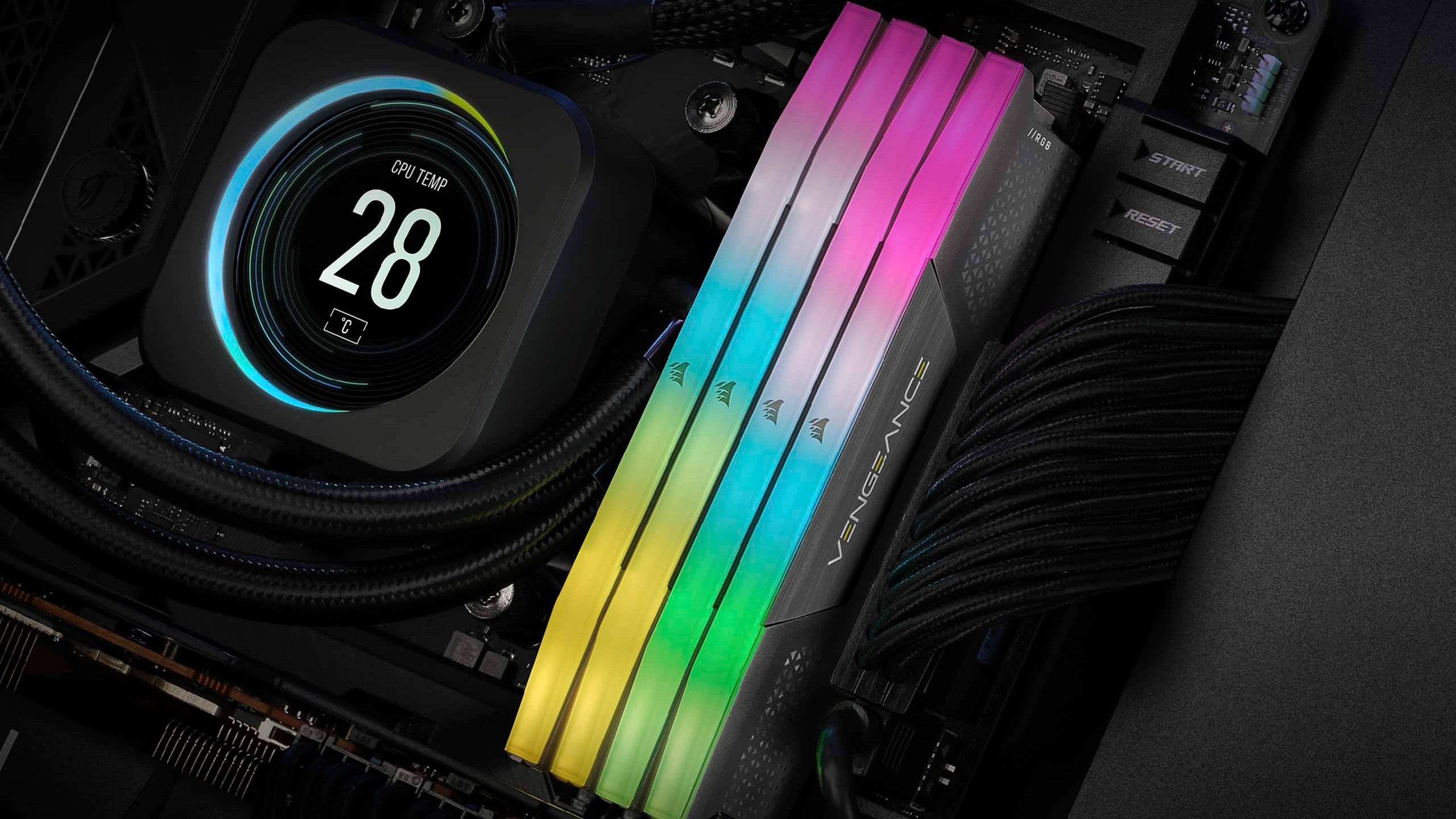
32GB of DDR5 now costs $375 minimum — AI shortage continues to squeeze PC building
Lower-priced kits are disappearing by the day
Tom
436 points · by papersail · 5mo ago · 393 comments
It's gotten to the point where nvidia doesn't even bother to report their gaming revenue anymore. It's a clear sign that we're back to the bad old days of pc gaming being a 'prosumer' hobby, but don't worry I'm sure nvidia and their ilk are salivating at the idea of making pc gaming into a streaming stadia like solution that you pay for monthly
I think I paid a total of around $5,500 for the current components of my PC. Hard to say for sure since my PC has been a Ship of Theseus for over 30 years and started as a 486. The link merely reflects its current state.
At one point, PCPartPicker was showing my PC as worth $11,000. It's now at $7,200 without including the RAM or PSU. That would put it at $9,000.
> It's a clear sign that we're back to the bad old days of pc gaming being a 'prosumer' hobby
Yup.
I think it's especially bad since the gap between budget-grade and mid-grade feels like it's gotten wide. If you wanna play the latest AAA games and not feel like you need to upgrade in 3 years, you can't settle for the budget grade unless you're still gaming at 1080p.
I wouldn't recommend spending under $3,000 for a gaming PC these days, and that's just an absurd price.
As much as I hate to say it, the move at this point is GeForce Now, at least for the time being... I just subscribed to the 200 USD/year Ultimate plan with a free 007 game. My ping to the datacenter is a mere 5ms, with 5080, RTX, 4k@60Hz (which my projector can drive) I am getting way more performance and similar latency than I would if I were using my own, semi-affordable rig or even a PS5. It's mind-blowing, really, and I recommend anyone to at least give it a try.
If I take out the cost of that 007 game, that plan i 140 USD a year. If you consider the cost of the electricity, it alone would likely cover it. In the past one would typically include hardware depreciation cost in such calculations to drive the point home...but the 3-4k USD I am not spending spending on a similar rig alone can generate me some 100-150 USD in bank over a year – not to mention the inflation! So, all in all, it's basically free, comparatively speaking.
Ten years from now I'll get to watch inception in 4K.
Very lucky me!
I was thinking of upgrading the video card to something better, but looking at the cost of replacing that Quadro? I might just stay put for now. Costs on those have also pretty much doubled.
I had it all priced out, but a bunch of birthdays in my family were coming up and I felt like I shouldn't buy something for myself if it's really their time.
My old laptop will have to cut it for a while. :-)
Spec-ing and buying servers has become quite the pain in the past year, at least at the relatively-small scale we operate at. It's "dynamic pricing" with most quotes being valid for 24 hours :(
That's about 50% higher than you'd pay for retail, small quantity, off the shelf alternatives in the US.
Many vendors have limited allocation so they're sending out extremely high quotes to see who will take it. They know everyone is seeing news about high RAM prices and getting new vendors approved can be hard, so they raise prices and see who takes it.
I would recommend getting quotes from multiple vendors. Don't be afraid to push back. They might come back immediately with a lower price in this market. Also check the retail suppliers you can access in your country.
> Quotes came back to about €200k for 48 x 96GB DDR5-5600 RDIMMs.
That's around EUR 40 per GB? That seems quite high compared to what consumer DDR5 RAM is selling for, though it being RDIMM may account for some of the difference.
Quotes are 7 days max, lead times fluctuating out months, and often now have language they can choose to not honor the quote for any reason due to price fluctuations.
When it comes to server RAM, I got quoted double a previous quote within the span of a week.
Buying servers is basically quote roulette now.
I sell used RAM in trays of 50 sticks (I physically know how much that is, I've held that many). I've had some trays sell for a few thousand dollars. Six figures for just one tray is absurd, but I've never collected enough DDR5 to make a full tray.
The only hope here is China floods the market which would be a good or bad thing however you look at it.
Is supply actively constrained, or is this mostly in anticipation of future shortages? How much of this is a mix of panic buying and price gouging on bad news?
I care more about the secondhand market. Prices are nuts for old used gear, but that also tracks with patterns I've been seeing since roughly the pandemic where more and more secondhand sellers on the usual platforms setting pricing patterns are small businesses, not hobbyists.
It is hard to overstate the damage that the infinite money being poured into AI is doing to the wider economy. Anything involved in datacenters is going to experience shortages/price rises. A pre-existing problem is power transformers: https://www.reuters.com/business/energy/us-power-transformer...
The impact on domestic electricity prices in a year just after high oil prices is not going to be popular either.
I get what you're saying but medium term this is an extremely funny sentiment. This money being poured is likely to end up being a huge boon for a lot of economic sectors, including in the US. Most commodity shortages like this end in a glut, with a medium term win for consumers, even if we have 1-2 (more) years of pricing pain. Meanwhile expensive RAM has so far left stock for people that really need it. Calling this kind of demand economic damage is odd.
The 3 RAM manufactures know this too, from painful experience. There won't be a glut this cycle because there are no capacity build-outs. Instead of increasing capacity, some OEMs left the consumer segment to focus on enterprise AI.
> Calling this kind of demand economic damage is odd.
It's not odd at all because the complementary industries are being damaged - possibly permanently: manufacturers of motherboard, cases, fans, and the entire consumer PC supply chain are being negatively impacted. Expect bankruptcies and consolidation if this lasts for 2 more years.
Sentiment is the right word here. None of us really know, and go by feeling. If you perceive the AI boom as approaching tulip craze levels of irrationality, it feels pretty dire.
The RAM is a commodity and may be repurposed afterward. This kind of thing is a bit like a debt jubilee when the dust clears and survivors scavenge the dead. But a lot of other build-out may essentially be waste. To me, apologists for this boom seem to be harboring a variant of the broken windows fallacy. Not all economic activity is productive.
The other kind of damage is opportunity cost. How many players in other industries are being strategically harmed by this situation? We can't all just live on AI token output if these other industries retract too far.
No such thing as a free lunch. Whilst a lot of industries are doing extremely well right now (i.e. everything involved in datacenter construction), everyone else has to actually pay for it.
Therein also lies the damage; The economy wasn't doing so great to begin with, and now this massive multi-trillion-dollar expense has been added.
The direct expenses come out of the pockets of Big Tech, but all the indirect stuff like the DRAM crisis affect the wider economy directly.
Smaller businesses in particular - not so long past the COVID disruption and already facing significant challenges in areas like logistics and energy supply costs - will not necessarily have the reserves that older and larger businesses often do to withstand another multi-year price shock.
There's smaller businesses that I know _need_ data capacity (hard drives) that can't afford them and are facing serious CAPEX challenges.
I work for a start up that helps folks move off of existing on-prem virtualization solutions and every small to medium company across every sector you can think of aren't just able to not afford additional storage and memory, they can't find them either.
There isn't as much stock as you think. I can't wait for this AI bubble to pop. It's been absolutely terrible for 90% of the industry.
The evidence coming out is saying otherwise.
I know it's an unpopular opinion on Hacker News but I think most people are overstating the damage to the economy. Increased demand starts to pull more advancements forward and increase spending on production, which benefits everyone.
Transformer demand is real, but what percentage of your electricity bill do you think goes to spending on those transformers? The number is so small that it's a rounding error. Many examples like this where we see headlines about some part going up in price and forget that it's such a negligible piece of our bill that it barely matters.
The cost of fuel inputs for base generation and peak supply are a bigger factor.
It's not just about the price of transformers (which have gone up!), lead times have gone up too - any infrastructure project involving transformers will be delayed by varying amounts - including grid-connected solar, at a time when energy prices are going insane.
Let's say you're an alchemist living in ancient China. You discover some kind of strange material made out of melted sand and want to sell some of it as a drinking vessel. One problem: everyone already uses porcelain for that purpose, which holds hot drinks without cracking like your strange sand ones do. So you toss that in the trash and move onto the next attempt at making an elixir of life.
Problem is, what you invented was a kind of glass; which has no economic niche in the society you live in. Some funny other places in the far west might invent it, though - hell, they might even figure out that you can grind this material down into lenses and discover an entire field of magic - optics - that you discarded because nobody needed tea cups that crack when you put tea in them.
Now, let's say you live in a society that has access to some kind of artificial intelligence. You are going to chuck the AI at absolutely everything, because on average, it tends to be better at all the problems you throw at it. Even simple things like spell-checkers get turned into AI invocations because, well, the Bitter Lesson dictates that having enough compute and learning to throw at the problem will always yield a better result than hard-coded nonsense logic that demos well. And even if you want to, well, you couldn't afford the RAM to run modern vibe-coded slop software anyway. Porcelain crowds out investment in glass, and as a result, we are limited to only having technologies that can be made by or from a pile of stolen books tied together with a bunch of matrix multiplies.
There are two issues... one being that an economy needs people to buy things to work, and people only can buy things if they have money, and people only have money when they have work - but everyone is laying off people left and right due to "AI".
The other issue is that there's trillions of dollars floating around between all the companies. It is likely that a significant chunk of these will fail and give us another 2007.
Both. AI datacenters create immense demand on DRAM, NAND storage, even HDD storage.
Then Sam Altman went ahead and "bought" 40% of the world's DRAM production, by way of secretly approaching both Samsung and SK Hynix (each unaware of the other getting a similar deal), which sent the entire market into a panic and everyone rushed to buy ahead of the anticipated supply shortage.
The kicker is that it wasn't even a proper purchase agreement. Just a non-binding promise of "By 2030 I will have infinite dollars and buy your DRAM".
When I bought the same ECC DDR4 16gb ram stick in 2016 (when DDR4 was rather new) it cost $85 (cant remember if it was new or used)
$86.30 for my 32gb DDR4 3200 stick Oct 2022. So glad I bought that. I have a mini-itx board and one of the ram slots died so i was forced to upgrade to a single stick. the historic trend of price deflation in computer components has always had me leaning toward not upgrading my set up.
fortunately all i play now are "premium" web browser games like narrow.one and eggball, ha! going to be hurting when GTA 6 launches with my 3050/1070 gpus...
Right now the biggest threat to their IPO's is that people realize that local models are good enough for whatever they're peddling, what's the most important factor to even running good enough models? RAM since you want the models in memory to not be total slogs.
Except, Chinese firms have entered the market now to capture the public market while the "top tier" firms supply AI firms. If the AI firms stops buying everything the toptier firms will come back into a market that has begun to be overrun by cheaper Chinese alternatives. It could get damn bloody (but good for consumers).
Surely it is a more efficient use of DRAM to run inference on shared hardware with large batch sizes and more utilization.
Demand will only go down if people reduce their use of these AI tools. Given how much folks here complain about quotas, I'm very skeptical that will happen willingly.
Because what to do with power-consuming outdated hardware ? let's say 5 years from now ?
They will need new RAM.
I wonder.
I’d even get a house with a garage or something just for that.
Right now the biggest threat to their IPO's is that people realize that local models are good enough for whatever they're peddling...
...plus the recent price increases by AI companies, made me actually think the opposite: that there might be another additional "run" for memory and/or GPUs.
Therefore, yesterday I decided to order an additional RTX 5060 with 16 GiB VRAM for the ~500$ that I saved during the last months (to be added to the RTX 5070 12 GiB that I bought last year to play games in 4k + my old RTX 3060 12 GiB which I recycled a few months ago after noticing how nice it is to run llama.cpp locally without having to worry about subscription costs).
The original 24 GiB VRAM were actually quite enough for some of the stuff that I do (e.g. transcribe text of image scans of old magazines, coding with Aider, etc - I usually use Q5_K_M quantizations of Qwen & Gemma by Bartowski as lower ones delivered sometimes weird results and/or looped forever in "thinking"-mode), but I guess that with 40 GiB I should be bullet-proof for my pessimistic view of our future :o)
they are not. Unless you are satisfied with plausible, but mostly garbage output.
For non-coding work, they are more than good enough. A lot of the ways my non-technical family members have interacted with AI would be perfectly served by using a local model.
After all, people were more than satisfied with the results from GPT 3. That has long since been surpassed by open weight models.
I'd say local models are fairly capable of even somewhat complex coding execution. For complex non-coding work (research, in-depth analysis, assembly of complex info-dense documents) I'd rather do it by hand than switch from Opus 4.7 to anything I could even theoretically run locally.
Steam Deck had a huge price increase (~40-50%) but it still sold out in 24 hours.
All it would take is for everyone not to pull the trigger on buying things for a little bit and prices would fall but instead enough people are buying things at a crazy markup. If anything that's a signal to sell things at higher prices. Of course AI is amplifying this problem but realistically people are still buying consumer hardware at these prices which lets businesses know people will pay this price.
I'm on a machine built from parts in 2014 and it's all very good for me to do every day development so I'm not posting this from a machine I won't have to touch for another 10 years.
I pulled the trigger on an early Ayn Thor because it was obvious this was going to happen. Something I didn't really want to fit into my budget but knew that if I didn't I would regret it later.
Implicitly, but that's blaming the consumer who has no or few equivalent choices. Purchasing RAM is not like choosing between Coke and Pepsi. A better analogy is that when a hurricane is coming or a natural disaster has already hit, it doesn't help that people will purchase food and fuel at any price.
- Altman, a.k.a. Dory from Finding Nemo and/or Dario, a.k.a. Carl from Jimmy Neutron.
I wanted to upgrade my SSD but prices are more than at the end of 2025. I refuse to pay 500 euro for a 4TB SSD. I rather go outside and play with my bike like when I was 5.
And if you're wondering, who's throwing out DDR5 systems? A local healthcare company. The boxes for some units are crushed and have water stains on them, and I imagine others don't meet their exacting requirements in some minor way (though they look and work OK to me, regardless of scratches and dings on the case).
Some people need to buy at these inflated prices anyway, and are ultimately willing to spend. Maybe it differs in your area but there's no risk in listing these on Facebook Marketplace or similar platforms and see the interest.
i5-13500E, 32GB DDR5, 512 GB NVMe, scratched and dinged a bit for $500 is practically a steal! Hardly anyone's biting or clicking, I don't get it...
New open box models (not scratched and dinged), if anyone's interested: https://www.ebay.com/itm/188355326179
Edit: they're intended to be retail POS PCs, like cash registers. (The motherboard literally has a header for a cash drawer!) So unless you're a particular kind of retailer, you're not asking your distributor for them. If distributors aren't looking for them, our B2B buyers aren't buying them. If they were Elite/Prodesks, Optiplexes, or Thinkcenters, they'd probably be gone by now.
The only thing I've found that's annoying with these POS/Office builds across various brands and models from 2013-2017 is the PSUs are less reliable and end up failing if you're doing more than just running excel and outlook. The OEM PSUs are often priced at ~25-70% of the value of the entire machine. I've seen some people end up cutting a hole in the case and bolt an ATX PSU to the exterior.
Edit: Pittsburgh
I have no idea why a weather forecast site needs tens of megabytes of resources, and gig+ of ram for my browser, since i get no more info from it, than i did back then. Same for chat programs (how is discord different than irc? and why does it need so much ram to do so? same for slack), mail clients, etc.
Maybe it's time to kick developers to start optimizing stuff a bit, since neither they nor the users can't afford "unlimited" ram anymore.
edit: i'm not saying we need to get back to literally 32 megs of ram, just to make developers performance test their stuff on a laptop that was on sale 3 years ago in their local supermarket, i.e. stuff their users use at home.
Anyway, I just can't find a reason to build an AM4 PC even though the RAM is "free". It's just not worth it. If you need 64GB+ of RAM and the DDR4 vs DDR5 difference isn't significant to you then maybe it's worth it. Otherwise, you can still buy a 32GB DDR5 PC for similar prices to last year sometimes. It's not worth buying any AM4 CPU then the 7500X3D/7600X3D/7800X3D are so much better for the same price.
The 5800X3D re-release is kinda funny. AMD claims they had to do significant re-engineering but it is my understanding they stopped selling it in the US but were still selling it overseas. So did production really stop? Anyway, the price seems to be $349. If so, that's completely not worth it. It's the same price as the 7800X#D, which is significantly better.
As an example, here's a 7800X3D + motherboard + 32GB DDR5 bundle you can buy today for $629 if you happen to live near a Micro Center [1]. No AM4 option is going to compete with that, particularly not with a $349 CPU.
[1]: https://www.microcenter.com/product/5007391/amd-ryzen-7-7800...
The 5700X3D has been the smarter pick back then, it fits to the current latent user hostility of AMD to focus on the more expensive processor.
It's also quite nice to actually hit 165 fps in some less demanding games on my 165 hz monitor.
When I was trying to upgrade to Windows 11 from Windows 10 I got the same warning. It is the reason why I'm now happily running Xubuntu on the same machine.
I did end up installing a Windows 11 VM (VirtualBox) which works perfectly fine running as a guest under Xubuntu on a 4790k (screw you Microsoft). But I otherwise never want go back to Windows as a daily driver. The enshittification just got too much for me.
AI bros are building something fantastic, but let's not forget that value isn't necessarily brought by sheer prices
weather forecast wasn't more rainy on a 2005 windows PC or an early smartphone in 2G to save battery
FHD streaming has worked for decades now
The plot of animes was still enjoyable on DVD
Progress is important, but some companies don't realise how customers don't need it when it's twice their pay
A 2x32GB DDR5 kit I paid $150 for 11 months ago costs $910 today from the same retailer. A 2x16GB DRR4 kit that was $105 last year is now $230.
The RAM alone in my newest machine would sell for over double what I paid for the entire machine one year ago.
It will happen, but yeah it takes time and money
This is similar situation to housing market. Prices are going up and supply is being restricted by whatever means.
It will be a bit of Catch 22.
Using red tape as some kind of prophylactic is ridiculous. If the state doesn't have the monitoring in place, you have to just trust the company, which is naive if not negligent. If you do have the monitoring, why require the extremely expensive song & dance? To protect corporations from negligently wasting money?
Answer: because the song & dance is primarily about extracting concessions, like union labor or even cash (e.g. promises to pay to fix someone else's pollution, or contributions to various interest groups). The friction and expense involved in today's development review processes are many times more costly to all involved than the social benefit.
https://www.amazon.com/dp/B0BJ7X9P1W
Consumers need to start playing legal warfare against the companies for openly distorting the market. The ramifications will only hurt us and there needs to be a true comeuppance.
I am annoyed that the new handhelds are all crazy so sticking with my Legion Go for now.
The one I am annoyed with is storage. I desperately need to get a couple new drives for my NAS (one to replace one that its bad sectors are growing and one to add more storage) and I am not looking forward to spending $600-$700 each for 20TB drives.
Been solid so far for 6-ish months.
https://www.amazon.com/Crucial-6000MHz-Overclocking-Desktop-...
Well... I guess William Gibson laughs last, after all!
Usually these bottlenecks lead to a price crash later. Of course that’s also part of what fuels the bottleneck. Companies are afraid of over investing in production and being left with underwater capital later.
https://www.bloomberg.com/news/articles/2026-06-02/sk-hynix-...
I bought it for 82 EUR, before the whole ongoing situation.
Now the same spec costs upwards of 290 EUR, about 3.5x the original price and even on Amazon the best prices I can find are upwards of like 210 EUR (2.5x).
If you're building your own PC, your best bet is to buy a bundle. If you happen to be lucky enough to live near a Micro Center (they don't deliver), then you have good options [2]. Newegg does too.
Prebuilts get a bad rep and it's not really justified. That Walmart PC is ABS. That's Newegg, basically. I'm sorry but you just can't buy that parts list for $!900. The idea that there is a $1000 premium for a prebuilt is just not true. Alos, I hear people say "it only takes an hour to build a PC". No, it doesn't. Maybe if you've built 20 PCs it does but if you don't do it regularly, it's a massive pain. Years ago I used to do this. I'm too old and the novelty has worn off. I don't want to diagnose if I've gotten my motherboard headers right or why my fans aren't spinning up or why my PC isn't POSTing or even just getting the cabling right, etc etc etc.
But yes, if you're just buying RAM by itself the situation is horrific. If you can live with a 32GB gaming PC, there are options that are relatively comparable to what you could get a year ago. If you want 64GB+ of RAM, that's going to bite.
[1]: https://www.walmart.com/ip/ABS-Eurus-Ruby-Gaming-PC-Windows-...
[2]: https://www.microcenter.com/site/content/bundle-and-save.asp...
[1] https://tweakers.net/pricewatch/1419292/corsair-vengeance-lp...
Looking at it from that frame, it seems reasonable.
I thought 128MB of SDRAM was a good deal at $100.
I also thought $479 for 32GB of DDR4 was nuts back in 2016/2017.
But then again I remember spending hundreds of dollars as a high school student to upgrade my family's 8Mb desktop to 40 Mb.
It's not that bad, at least by recent standards, but the problem is that there's no such thing as "price per Gb." If you need 512 Gb you will not be buying 16 Gb DIMMs to get it. More likely you'll be buying 64 Gb ECC sticks, and those are much pricier.
I'm at least happy I went for DDR4 RAM when I was building this server.
I built in February 2025, and my two 48GB DIMMs were $440. Last month I checked and they were $1800 if you could even find them still in stock.
For my workloads it was like getting 2 - 2.5 more CPU cores worth of performance, so it was worth it, since the CPU was already as beefy as it could be. It was a reasonable premium then. Today? I’m not sure the math would still math.
Same thing with GPUs, is kind of insane having so much processing power and yet requiring more and more. What purpose for? What's the limit? Does it really really pay off such investments?
For me as a non-AI developer (I don't use any models of any kind, nor I train LLMs at all), a system with 16Gb seems to be more than enough for a vast number of applications.
I have a 48GB development machine which is nice if you are running IDEs, backend stuff via docker, etc. And even just having a bunch of RAM there for file caching helps keep things fast.
I think people who need more than 16GB of RAM are power users with higher memory requirements, such as those using local LLMs, those who frequently use virtualization, and people doing tasks such as video editing.
Now some will bill Taiwan and Korea the same way they bill consumers and industries when they need RAM, should they need us.
Chinese companies were at least producing more and more to brace for restrictions from western manufacturers
There certainly is lots and lots of potential.
Now they're worth over half as much as the whole machine.
"Price tracking courtesy of PCPartPicker now reveals the cheapest 32GB DDR5 RAM you can buy is $375. Specifically, four XPOWER kits from Silicon Power will set you back $374.97 thanks to a promo code."
its paired to a 5950x so im sure it will be fine for a few more years
That said, getting hold of them was hard and needed a special order.
The question is to buy or wait.
This is the stupidest freaking timeline...
Boy do I ever regret that. Every time I compile some code and the VM I use goes OOM, I die a little bit inside knowing that less than 100 bucks or so would have fixed this if I just went for it.
Like clockwork, people naturally want to have their cake and to eat it too, so there will be the incessant complaining about the externalities. Half the people lack the brainpower to see the good and bad are intrinsically linked, and the other half just like complaining.
But at least for now, both halves aren't pulling back (in fact it's increasing), and money, not complaining, steers the ship.
For the record I'm leading the AI program at my company and am very vested in the positive side. But one can also be aware there are downsides, more so than complaining.
It's impossible to avoid using AI multiple times a day, just because it's forced into every product under the sun.
That is NOT demand. None of those users WANT this.
Can you elaborate? Leaded gasoline is estimated to have contributed to the deaths of like tens (hundreds?) of millions of people. Asbestos probably millions.
Why would high RAM prices be remembered alongside these events?
This is insane. We've built our apps and websites to require ungodly amounts of memory and now AI scrapes away said websites while pricing us out.
Fast apps and websites need to make a comeback.
The exact same sticks/model #’s of RAM cost $200 last year, now costs $950. I don’t remember existing CPU’s ever going up in price by 5x (300-400% increases).