192 points · by rbanffy · 5mo ago · 186 comments
This naming-proposal couldn't possibly cause any problems down the line...
> They had worked out a way of running software on a classical computer that would mimic a quantum task.
When it comes to using a regular computer to mimic (read: fake) the execution of an exotic program/API for nonexistnet future hardware, I highly recommend the humorously titled talk: "Temporally Quaquaversal Virtual Nanomachine Programming In Multiple Topologically Connected Quantum-Relativistic Parallel Timespaces... Made Easy!" [0][1]
Which. Yeah, has been a pretty bad thing for people in understanding those. :(
You're a little late here, "magic" is already a fairly well known term in quantum computing literature. There's "magic states" and protocols for "magic state distillation" and "magic state injection", there's "shallow magic depth circuits", etc.
which is fine, but the point is still valid. who looked at the state of science education in today's world and though that "magic" was a word that belonged anywhere near legitimate discourse? and more importantly WHY?
Your worries are a bit late, there's already a huge amount of new age conspiracy bull about quantum healing with wave function collapse, microtubule alignment and biophotons - quality all-you-can-eat word salad buffet.
Also as far as I know, Penrose’s main argument is that consciousness can not be computational. If you can’t argue against an idea with reason and resort to name calling, you’re not being rational you’re just being dogmatic and censoring ideas.
Would gravity or spacetime under these definitions behave differently and yield something we can observe?
Or is this fancy math modeling that looks nice on paper, but that we won't be able to test until we become a Kardashev type III civilization?
Without tests it’s just pretty math that can be coaxed into agreeing with reality but that proves nothing.
Physicists try to indirectly test all the time via cosmological observations but that is extremely hard and limited to what you can infer and how well you can eliminate other explanations or sources of error.
If it is competing against another model that does both that and offers new testable hypothesis (which experiments match), the other model is the clear winner. But lacking that, if no other model explains all existing data, is new testability really necessary when it is the only model that currently explains all existing tests?
That said, aren't most of theoretical models only contenders for such, as in they haven't been expanded to actually explain all testing results, only that, as far as they have been expanded, there are no contradictions yet? So they need physicists to expand them, but if the model is wrong, the effort might largely be wasted, and we have some models that there is disdain for not because they contradict existing experiments, but because they have eaten too many careers without showing value in return?
"The best kind of science is magic, and the best kind of magic is science."
Who has ever used that phrase?
In this analogy, a planet is like a smaller ball. If it rolls close enough to the bowling ball, its path will be altered by the dimple in the mattress — space-time tells matter how to move."
This analogy is wrong in a way that even people who've studied physics often don't realize.
On an everyday scale like the Earth orbiting the Sun, almost none of that gravitational interaction is from the bending of space. Far beyond 99% (actually, about 99.999999%) of it is from the bending of time.
Now just add massive scale and distances.
Other than that, thank you for a very clear explanation.
It may help your intuition to consider the extreme case of a black hole. The event horizon is where time is so warped that no possible future trajectories lead outside of the black hole, and you need a magical time machine to escape. (Of course, the best way to gain intuition is to work through the mathematics, either symbolically or with diagrams, rather than reading English-language descriptions.)
There is a sense in which an orbit is a straight line. Obviously, an orbit is not a straight line through space (unless you count the perfect and unobtainable orbit of a beam of light around a black hole, some distance from the event horizon), but we often think of them as spirals through spacetime: there's an argument that really we should think of them as straight lines through spacetime, much like how a great circle is a straight line along the earth's surface.
https://www.youtube.com/watch?v=8yhk1EZq9tY
fortunately that video is more gentle but the math in that youtube channel absolutely melts my brain some days, I can keep up for the first minute but then all bets are off as he dives in and I realize there are some insanely brilliant people out there
I always hated the ball and sheet example simply because it was describing gravity with gravity. It felt fundamentally wrong.
Imagine spacetime as a field of local clocks. Far from the Sun, clocks tick faster. Near the Sun, clocks tick slower. A freely moving object tries to follow the straightest possible path through spacetime. But because the “time axis” changes from place to place, what counts as “straight ahead into the future” tilts slightly inward near the Sun. So the Earth’s path through spacetime curves toward the Sun.
Earth’s spatial speed around the Sun is about 30 km/s. But through spacetime, its “timeward” motion is basically c, 300,000 km/s. So even a tiny tilt in the time direction creates a significant spatial acceleration. That is why the time-warping term dominates for slow massive bodies.
If you view gravity as a mattress, you're stuck. There's nothing to do with it that you couldn't already do, because it's fundamentally wrong. Another way to say this is that it's actually an analogy for Newtonian gravity, not for GR, despite apparently including something curved.
If you view gravity as a field of local clocks that tick at different rates, you can make many correct predictions:
- Clocks at different heights will tick at different rates.
- GPS needs gravity corrections.
- Light climbing out of a gravitational field is redshifted.
- Radar signals passing near the Sun should be delayed (the Shapiro time delay).
- You can have no gravitational pull but still have time dilation (inside a perfectly spherical shell, Newtonian gravity seems to cancel out).
- From the outside, it appears to take an infinite amount of time for something to fall into a black hole's horizon.
- Aging can be path-dependent.
- Gravity affects every physical process: chemical reactions, radioactive decays, biological aging, atomic transitions, molecular vibrations, computer processors, pendulums, pulsars.
- A sufficiently precise clock can measure height.
- Objects in eccentric orbits should have periodic clock-rate changes.
- Quantum matter waves should accumulate gravitational phase shifts.
- Spectral lines from compact stars should reveal compactness.
- Thermal equilibrium in gravity should involve a temperature gradient.
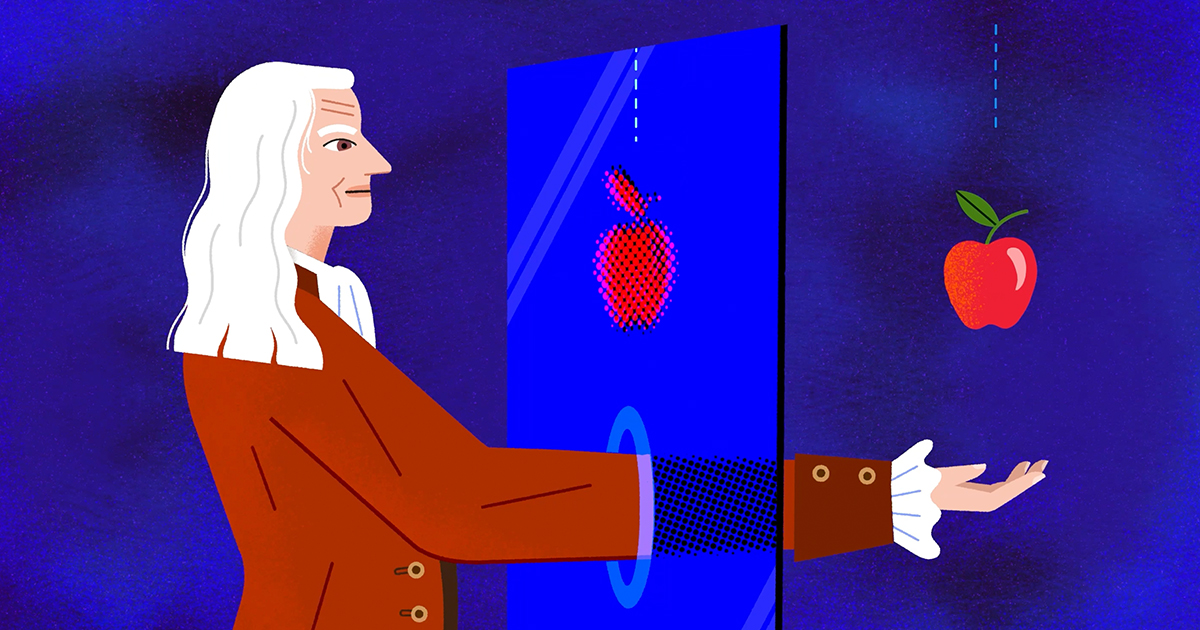
The main take away for a lay person is that _like_ the mattress space is being deformed. That's where the analogy stops. Taking it further, like with all analogies, breaks the analogy.
If the analogy was a perfect one, then it would just be the reason and not an analogy.
My main gripe is how hard for most people it is to extrapolate that deformed mattress into a 3d space.
They use that to explain why you don't feel acceleration when you jump off a building or out of a plane.
They say you DO feel it when you are standing, because the earth is impeding you and pushing you away from the geodesic you naturally want to follow.
So it is counterintuitive. the standing still person is being accelerated/pushed. The freefall person is free.
John wheeler said "Spacetime tells matter how to move; matter tells spacetime how to curve". I think it explains the circular nature.
Mass curves spacetime, that changes how mass moves , mass moving to a new position changes the curvature, that changes how the mass will move next. The dimple in the mattress staying with the mass.
The only plausible example I can think of that isn't purely theoretical / speculative would be gravitational waves.
time and gravity are the same thing, the history of understanding physics is basically of the same nature, understanding that two things are actually one thing, which is more like philosophy but with physical confirmation
> The more non-Clifford gates you need to produce a quantum state, the more magical that state is. The group found that the particles were highly magical. ..They showed that magic gave space its springiness. Magic, in other words, is connected to space’s ability to bend.
At some point these physicists crossed over into a very specialized form of poetry, a game of language.
> In quantum information theory, magic is a property that quantifies the computational resources needed to describe quantum states beyond stabilizer states.
> In 2024–2025, quantum magic was detected in top quark pairs produced at the Large Hadron Collider; it is the first observation of this property in fundamental particle collisions.
https://en.wikipedia.org/wiki/Magic_(quantum_information)
And "second stabilizer Rényi entropy" is even better, it's exactly the kind of technical term I'd prefer, that describes what it means.
> One measure of quantum magic is the stabilizer Rényi entropy of order α such that..
https://en.wikipedia.org/wiki/R%C3%A9nyi_entropy#Stabilizer_...
Physicists get a failing grade for naming things.
Perhaps Magic is even so ridiculous that it’s immune to co-option by charlatans. After all, they choose sciency words to lend an air of credibility. OTOH the perceived ridiculousness could also change rather quickly. It’s just the nature of language use…
There's also other areas where a current of picking simple names instead of greek/latin terms was popular for a while at least - Shannon named the smallest unit of information a "bit" after all.
It's not just a bad idea because of that BS, but even within the field it's just asking for trouble. We may all wish we were perfect Vulcans who have perfect mental separation between all concepts and emotions, but we aren't. It's going to have a small, but extremely persistent and long-term effect on the field if you seriously name a major part of it "magic". The emotional connotations simply can not help but smear into the putatively mathematical term. It's a high price to pay for what isn't really all that funny of a joke even the first time.
And of course the BS will crank up even higher. People get hurt by that, but I don't know how much to lay at the foot of people who are all but taunting them by naming something "magic", because most of the hurt was going to come anyhow and what particular guise it is wearing is of minimal importance. Still, why even sign up to be in the line of fire of responsibility for that sort of thing?
It's bad enough all the corporations trying to steal perfectly active words for their brand names or products.
Analogies aid understanding, even if on an abstract level.
Why am I trying to find a name for this? Otoh, why are so many physicists trying so hard to popularize their projects for the last 40 or 50 years? Oh .. I think I just answered my own question.
But magic is related to non-Cliffordness, not mixing.
Also, the term "magic" is pretty well used in quantum computing, it really doesn't need to be popularized. The concept is quite important already and would be talked about regardless of its name.
One of the most boring and yet egregious examples imo is "Random Variable". So named because
- they aren't random and
- they aren't variables.[1]
A "random variable" is actually a measurable deterministic function from the set of possible outcomes of some experiment to the real numbers. But you can see why the name "random variable" is confusing to people.
[1] https://cyril9227.github.io/random-variables/ and elsewhere.
I don't think that this was the formalization that was used when the term was coined, given how late set and measure theory were formalized.
As the old saying goes, better to stay silent and look like a fool than to speak and remove all doubt.
How does gravity work? Magic!
Gravity is the force created by a mesh of entanglements. Entanglement is not the "connective tissue". Entanglement is the whole universe. Only our minds disentangle the universe out of necessity.
In other words, there are no particles, only waves. A planet is not a chunk of matter, it is a wave. a planet has no real boundary, that is a product of human consciousness.
Anyone else get Game of Life vibes?
I’m so sorry. Couldn’t help myself.
We can do better than "magic".
if only there were some kind of magical universal summarizer you could use..
Does using words that are more of a mouthful make scientist more credible?
When trying to understand the reality and then convey that understanding, "mouthfulness" seems like not a concern at all.
Obviously. Because the fact that they use this word for something modernly scientific means that its meaning is as far from the commonfolk meaning of the word as possible. Magic doesn't mean anything sensible yet. So it's basically free real estate for something physical, especially something very foundational.
Please no.
...ah yes holography again. Not to say that all these insights from it are completely worthless, but unless we actually find a holographic dual of our universe instead of AdS spaces (which are the opposite of our universe if anything), this whole field is starting to feel more like a jobs program for mathematicians out of new ideas.
They’re promoting their preferred frame to ontological status when you can’t use a dual model to assert more than equivalence between frames.
Obviously I don’t understand this, and probably won’t but what limits the dimension reduction?
Going the other way, would our 3d space not be the “surface” of a deeper 4d space, and that of a 5d space, etc?
So sick of seeing phrases like this.
Science is not business. It is not about producing results that you personally think are important. It is understanding the nature of the universe for the sake of it.
That is, the concern is that instead of studying the real world, theoretical physicists are spending more and more time studying mathematical constructs and their properties.
Is this actually stated somewhere by the institutions that take taxpayer money for this research, or just your opinion?