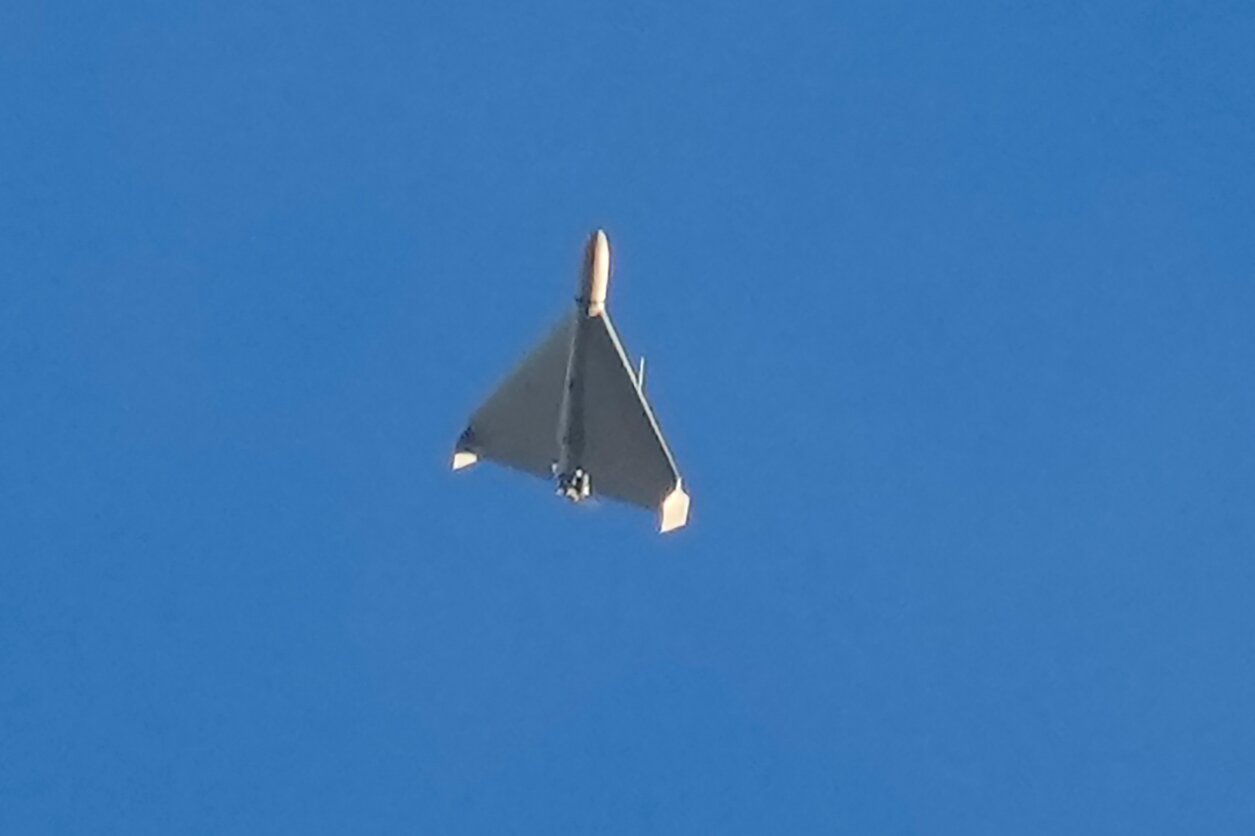
Lithuanian startup launches crowrd-source network to detect Shahed-type drones
A startup, together with activists, has launched an crowd-source drone detection system that links data from participati...
lrt.lt
128 points · by giuliomagnifico · 5mo ago · 91 comments
The latest versions of Shahed can reach 5000m in altitude, which would largely be inaudible on the ground.
I suspect the Shaheds are going higher to mitigate AA ground fire. Higher up you have to send a missile or interceptor up.
It’s a trade off.
Sending up a plane that costs $500/hour to operate to take down a few Shaheds an hour works out really well.
YouTube has plenty of videos of these guys going up and just shooting them out of the air.
Interceptor economics makes more sense when you reason about the bigger picture. The point is to buy you time to remove the supply chain and the stocks so that you're not trading 1:1 forever. It's a stop-gap, or at least it's supposed to be.
However that only works in a war where you have air and informational superiority. In a peer-like conflict with information asymmetries and air parity (no way to remove the opponent's industrial base), such as Ukraine-Russia, the intercept economics are less appealing.
Anyone interested in cooperation? I am hardware and math guy.
What's with that "vs" trade-off?
You're saying avoiding detection requires high altitudes.
What do interceptors have to do with that?
Detection is facilitated by radar, low altitude means flying under the radar (due to curvature of the Earth) - except radar network is now so dense, it in practice can't work anymore. So they can fly low or high they will be detected anyway - but flying high reduces interceptor's reach and makes intercept geometry harder, giving them better chances to slip through.
Radiative power drops by the square of the distance? Does anyone with a real physics background start demanding authority on a soapbox like this?
Edit: as others say, plain radar will suffice.
A cheap radar takes an order of magnitude less power to run on hardware that is cheaper than an LLM and can see way farther than a camera.
The solution is going to be multi-modal (optical + audio) and imperfect. The above poster is correct that an ordinary camera with computer vision (not an LLM, of course) is going to be part of the multimodal defense in depth.
Shahed-type one-way attack drones are important to defend against, but not as impactful in terms of frontline body count, given they just slam into a pre-programmed target.
There are extremely sensitive differential pressure sensors (like SDP600-25Pa) available from Sensirion that aren't overly expensive.
Use one differential side and connect it to a kitchen funnel for directional listening the other one to a plastic bottle with a tiny hole in it. This way the sensor will "Null" out the environmental pressure (which the bottle follows very very slowly) from both inputs. It then only will pick up everything high frequency which is left over (and the bottle cannot follow because of its small hole).
This way I was able to detect washing machines that have a physical link to a house from many hundred meters (machine spinning -> house wall shaking -> pressure waves) away. The speed pattern of washing machines when spinning is very unique (several steps over many seconds).
Add this with some GPS PPS frame timestamping and you should have a nice tracking network that doesn't require a lot of bandwidth. But maybe the setup must switch to analog differential pressure sensors as these Senirion-I2C sensors do not have a Sync ping for super precise timestamping.
Nevermind drones, and war, that's all fine; but I need to know more about this. Is there a phrase or name for this I could use to find more information, maybe example schematics?
I'm 99.5% sure if you throw Claude with a datasheet on it will Slop out working code for a ESP32 with ESP-IDF.
Somehow there has been little VC interest in this idea.
Curmudgeon Ai?
Sensirion is using a thermal flow-sensing principle method which is basically a heated plate that cools/heats up when air passes it - making it extremely sensitive in this range.
That being said, most microphones are intended for audio and their amplifiers and readout circuitry are not optimized for very low frequencies. And the physical measurement devices don’t work down to DC. (If they did then the microphone wouldn’t work — the DC pressure is around 1 atm, which is some 12 orders of magnitude above the more quiet sounds the microphone is trying to detect.)
A device sold as a pressure sensor will be intended for use at or near 0 Hz and will work fine.
I assume the actual practical crossover is something like 0.1 - 10 Hz depending on the microphone. There’s an additional practical issue, though: the pressure sensor comes from the factory already calibrated for DC, whereas you may be on your own trying to get physical units out of a microphone much below 20Hz.
If you use a high end microphone intended for professional use with phantom power, you will also be fighting the power circuit and lower frequencies.
My experiments never had a dependency on linearity.
The SDP600-25Pa speaks I2C and only has a handful of commands.
Just read it out with a microcontroller you love (like ESP32) and send the samples to a host for analysis. The ESP32 has limited I2C time stretching capabilities limiting it in the highest resolution modes of the sensor - but often that's not a big factor.
To not overwhelm the poor processor and Wifi maybe better a bunch of frames (like 512 or more).
Only pressure waves coming into all holes at the same time will reach sensor.
Never tested it. Only a Gedankenexperiment as Einstein would say.
I may have even discovered it from hacker news, I forget now.
The files [1], [2], [3] on Github (once featured on README and on some articles) depict what I presume is a Chinese built radar which you can see here [4], [5]. I also suspect this might be a honeypot since Instagram - of all places - is full of accounts offering these radars [6], [7]. Some of the contributors on that projects are heavily leaning into AI. Git project history is suspicious. Discussions on the issues seem very artificial. I remember having bunch of notes on this project, but can't find it now. Just looking at it from outside, nothing about it seems real.
[1] https://github.com/NawfalMotii79/PLFM_RADAR/blob/main/docs/a...
[2] https://github.com/NawfalMotii79/PLFM_RADAR/blob/main/docs/a...
[3] https://github.com/NawfalMotii79/PLFM_RADAR/blob/main/docs/a...
[4] https://www.cloudwalkerfpv.com/product/CW-t20.html
[5] https://www.militarysignaljammer.com/supplier-4701497-survei...
You are correct, that today, we (USA) lack the capability to defend against this threat in a meaningful way.
> Multi billion dollar spend to “see” $2,000 aircraft
Look at how we deploy SOCOM assets today: smaller teams in the field far from fixed detection, a satellite to do this job, allows it to be tasked rather than having to deploy more, fixed detection equipment.
As part of a larger system it would be integrated by software: see the "Lattice" project from Anduril.
> and try to shoot it down with multi million dollar equipment.
DAWG, (Defense Autonomous Warfare Group ) has requested a billion dollar base budget and 54 billion of flexible spending (More than the USMC per year) for 2027.
There is also the "Replicator" program (I think headed for phase two) to get unit costs back down, and volume up. Facets of this are bleeding into other spend. Andurill openly talks about unit costs, and how few tools are needed to put together their low cost missiles (still more expensive than drones but... headed in the right direction).
As for the astronomical size of that budget: it's cheap to build an idea, what is hard is testing. The Ukrainians have a massive advantage here, in that they ship these things to the front line. It's much cheaper to trial things when you don't have to buy something to blow up, repeatedly.
The US military has been falling behind for 25 years now (especially the navy: if you want to understand why it has become schrodinger's straight read this https://en.wikipedia.org/wiki/Millennium_Challenge_2002 ) and I think what is going on in Ukraine has been eye opening for them.