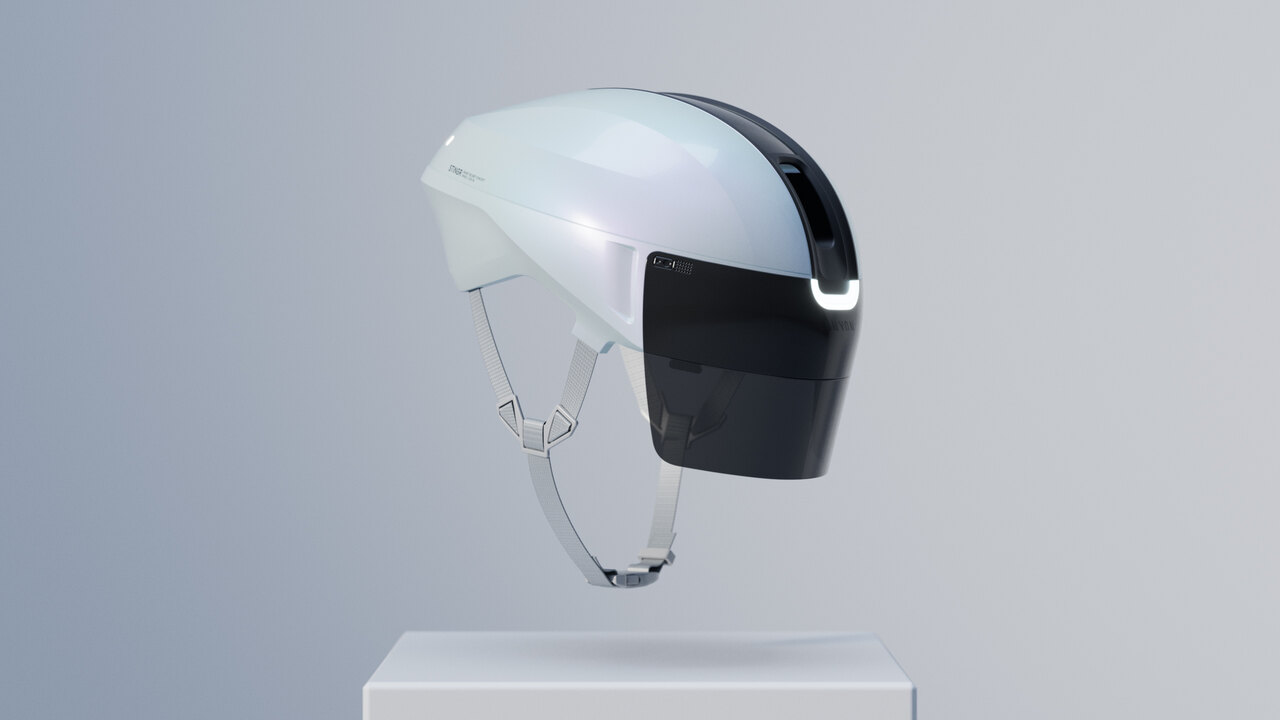
NEW CANYON HEADS-UP DISPLAY HELMET COULD BE A SAFETY GAMECHANGER FOR ROAD RIDING
Performance and safety information with an audio and haptic communication system allows you to receive warnings before you see them.
Canyon newsroom
109 points · by zh3 · 5mo ago · 137 comments
And turns out Virgina Tech does a bunch of helmet impact testing and maintains a ranking list https://www.helmet.beam.vt.edu/. The latest helmets have a releasable layer that absorbs (converts rotational energy?) more impact.
This HUD is pretty slick. In a way, it's more preventative (avoiding accidents) vs. reactive (absorbing impact in an accident) safety which sounds nice.
That is important and useful, and is best used in combination with other testing: Bicycling also has many other and more serious risks to cyclist head, including skull fractures, brain damage, and death.
Consumer Reports is another great source (better one IMHO); in their labs they do empirical testing for other outcomes of ~150 helmets, and provide a comprehensive guide to buying helmets:
https://www.consumerreports.org/health/bike-helmets/
In Consumer Reports’ tests, we strap helmets onto “head forms” that simulate the size of a human head, then drop them 14 mph onto a flat anvil to find out how well they withstand impact. An electronic sensor inside the head form monitors the force that would be transmitted to a rider’s skull in an accident.
To ensure the helmet will stay in place during an accident, we test the strength of the chinstraps, attachment points, and buckles by dropping a weight that’s 8¾ pounds and 2 feet so that it yanks on the straps to simulate the force of a crash.
Our testers also evaluate each helmet for ventilation, fit adjustments, ease of use, and other features.
To my knowledge, the only group that tried to test bike helmets against a car is Volvo -- and all helmets failed.
I guess one reason people are so focused on that is because it's easy to quantify.
Helmets reduce the risk of head injury by 48%, traumatic brain injury by 53%, facial injury by 23%, and fatal injury by 34%.2 Pediatric non-helmeted bikers have a 3-fold higher risk of serious head injury compared to helmeted bikers;3 one study suggests that helmet use may reduce the risk of head injury by 83%.4
Bicycle-related head injuries and deaths have decreased in states that have enacted bicycle helmet laws.5
Larger effects are found when legislation applies to all cyclists than when it applies to children only. 6
That one study has been thoroughly debunked...yet decades later it still gets cited.
https://www.seattlebikeblog.com/2013/06/04/feds-no-longer-ba...
US or globally? Got any stats to link to on that?
Here are 2017 numbers (ok...only 96% that year). https://crashstats.nhtsa.dot.gov/Api/Public/ViewPublication/...
There is a grain of truth to the anecdotal claims. But, even then, this is very much an imagined grain of truth. What makes it fun is if you work for a specialist bicycle shop or up the chain, distributing thousands of helmets. With customer interaction at the showroom level, fitting hundreds of helmets, then selling gazillions at B2B, the question has to be asked, where are the broken ones, the one sent back for money off, as a replacement discount?
Indoctrination into the polystyrene club is also very easy. Customer buys new bicycle, customer gets upsold a helmet, as an easy win. The far more practical high vis jacket costs $5 and you make no profit on that, whereas the $50+ polystyrene is just money for the taking.
The testing was originally to a SNELL standard, but the helmets were too heavy. So manufacturers switched to the lame self-test consumer testing, 'trust us bro'. This became the new benchmark, anything aiming at SNELL or other meaningful test just did not survive the market.
Hence I keep it simple. If cycling for conspicuous leisure purposes (fitness, racing, stunts) then get the helmet and make sure the straps are tight. You will need it for organised events so you might as well get used to wearing it.
If not cycling for conspicuous leisure purposes, but merely for transport, whether that be the commute or errands, then you don't need a helmet. Get the lights, mudguards and high vis instead.
I am learning the counter-logical-fallacies, so I can counter the life saved anecdote with quality nonsense that has the same logical fallacies. For example, "I know a true Scotsman that has been cycling every day for fifty years without a helmet. Once he got hit by a car and his life was saved because he was not wearing an ill-fitting helmet, he would have been strangled by the straps had he been wearing a helmet, plus the driver would have given him less room, so the accident would have been far worse."
I digress, as for the article, the helmet is excellent for conspicuous leisure cycling. Now give me your money!
Thanks for sharing. Interesting to see my Giro (with MIPS) has... 3 stars. Hmmm.
Too many helmets hit the old five star threshold, so to differentiate it's now based on relative performance (the x% best helmets get 5 stars) instead of static thresholds.
A crappy helmet with MIPS is a slightly less crappy helmet that may still be worse than a great non-MIPS helmet.
Like upgrading a 1960 motor vehicle death trap’s 2 point seat belts to 3 point. It’ll help, but it’s still a death trap.
VA Tech (and others, IIRC) has years of empirical tests that show otherwise. What is your comment based on?
Edit: In fact, if I understand your analysis, humans won't get concussions at all.
> The latest helmets have a releasable layer that absorbs (converts rotational energy?) more impact.
MIPS? Or is there something newer
I'm anti MIPS
If you have only tried first-gen MIPS, I recommend giving it another shot.
I ride on the streets of Oakland every single day and situational awareness is critical. The single biggest thing you can do for safety is watch each car as it approaches behind you for its speed and trajectory. Anyone approaching too close or too fast is a bad sign and with a mirror you can more easily avoid them.
These are also available on Amazon and I am not in any way affiliated I just think they’re good life saving technology:
I tend to prefer helmet mounted and I glue them on which isn’t my favorite thing to do on a new helmet. It’s also a bit frustrating when you find yourself cycling in a country that drives on the opposite side.
I do find that on very long tours the week following I’m looking where I’d expect the mirror to be when I want to look behind me.
Also, helmets are meant to be replaced every couple of years as the materials deteriorate (UV/heat) and the protection dissipates.
As we like to say, dentist helmet.
Not necessarily:
But if you really like your old helmet—and it’s in good condition—one scientific study tested older helmets and showed that holding on to one for longer won’t necessarily put you at significant risk. Randy Swart, executive director of the nonprofit Bicycle Helmet Safety Institute and former vice chair of the helmet and headgear subcommittee for ASTM International, a nonprofit, voluntary standards-setting organization, says that his own helmet is “much older than that,” though he adds that there may be other good reasons to get a new helmet, such as more protective technology included in some newer models.
How can I get people to stop laughing at me for tinfoiling my helmet?
It's not needed on everything but I really appreciate the extra options on my recumbent and touring bike.
I see the point of it being a potential e-waste in 10 years, but I'm not sure the mechanical route was much better in that respect (looking at you, shimano shifter-derailleur-brake compatibility table that currently runs a few pages long even before adding all the Di2 stuff)
BTW - "what" do You need a 48-spoke hub for? Are You building cargo bikes in Your spare time? I'm not trying to be snarky - the "all our bikes load limit is 120kg bicycle included" has long been bothering me as well (100kg rider), so... kinda curious about Your side projects
[1]: https://www.canyon.com/en-de/clothing/helmets/canyon-cfr/can...
maybe there will be some engineer on the project who learns something useful while working on this that can be applied to some actual project, but this is pretty clearly not an actual product that they intend to sell in anything more than single-digit quantities
Don't apologize for being a human being. The world needs more of them.
Pogies are great but don’t do you any good off of your bike.
Just what I need, when a car nearby me crashes into a physical object, my vizor helmet is shouting "Bonzai!!!" with lighting bolts everywhere.
We're closer to having lidar in all new cars than this mesh network, so "There's a bike behind you travelling approximately X speed" is something the car already knows. "The cyclist requested you not to turn in front of him" - why would anyone ever send anything else?
Perhaps the car can send you a message instead "I'm going to cut you off and there's nothing you can do about it" but even if that might actually improve safety I don't think it's the change you'd want to see.
Even if the network was there, it's a difficult physical/technological problem to figure out everyone's relative position and velocity to suitable precision with something like GPS, or GPS + accelerometers. But mostly solved with lidar.
Funny how garmin varia gives the exact same information but on cars. "There's a car behind you travelling approximately X speed" (which is most often over the speed limit anyway)
I really just want a basic, simple HUD that can display speed, distance, pace, HR from other sources. I don’t care about it being standalone, I already have a bike computer, phone, and watch.
- [0] - https://www.formswim.com/products/smart-swim-2-lt-goggles
At first glance the visor seems large enough to cover the face, but based on the HUD simulation I guess it only covers the eyes.
That works well enough for most road riding. I wonder if having a reverse view mapped onto my glasses would be an improvement or take away from my focus.
- if a car is behind me
- how many cars( I think up to 8) are behind me
- what speed they are coming up on me by way of animation
To answer your question about what to do, mostly yes, yield the road if I'm on a country road and get over to the shoulder if there is a good paved one.
It's a valid question if you've never ridden on a country road with cars. You want all the notification you can get if someone is coming up behind you so you can plan what to do
Do my fellow hacker news readers recommend some useful tech for bikes?
Recumbent bikes might be fun to watch in time trial races but would be ridiculously dangerous in a peloton. Visibility is bad enough on a regular bike when you're at the back of a group, and the lower perspective on a recumbent would make mass crashes even more likely. Yikes.
I can see a HUD (not this one) for non-pro club riders, though. It might be nice to be able to see your stats while holding a wheel at 20+ MPH, without having to look away.
And improve education all around for road users, including pedestrians, to widen the understanding of how individual decisions affect the community. For example, starting to cross the road at the end of the crosswalk signal leads to fewer cars able to turn right, which leads to more congestion, etc. Trying to make it across the intersection when traffic is moving slowly and blocking crosswalks and cross traffic. Opening the driver's side door with your opposite hand to look in the side view mirror or blind spot for cyclists.