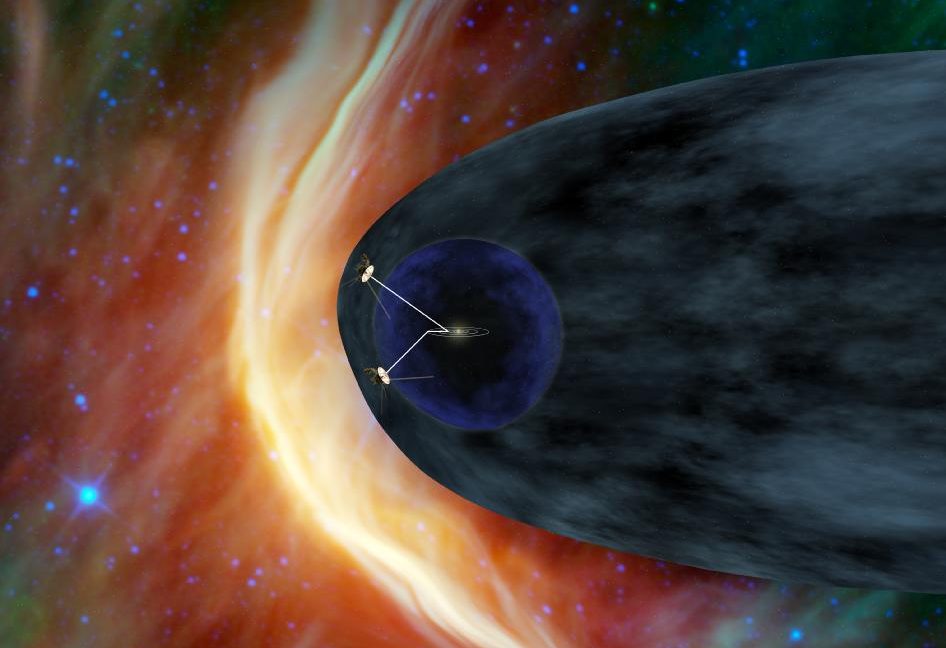
Voyager 1 spots new region at the edge of the Solar System
Area surprises researchers as it wasn't predicted by models of the region.
Ars Technica
167 points · by Reltair · 13y ago · 67 comments
The RTGs in Voyager 1 are only good until about 2025 iirc, ~12-13 more years. Here's hoping it makes it through in time.
NASA's timeline for the Voyager lifetimes: http://voyager.jpl.nasa.gov/spacecraft/spacecraftlife.html
Also, the RTG might be powering instrument heaters, keeping them at warm enough temperatures to prevent failure. If that's the case, once those are shut off, there's no turning those instruments back on.
EDIT: It appears that Voyager 1's ultraviolet spectrometer instrument, at least, is pretty tough: as of January 2012, it has survived having its heater shut off for power conservation: http://www.nasa.gov/mission_pages/voyager/voyager20120117.ht...
That's one hardy spacecraft! =)
What an amazing achievement to do what those guys did back in the 1970s.
(there was a shift right overall, but it was mostly just a shift down in space funding, I think)
http://phys.org/news/2012-12-voyager-encounters-region-deep-...
How transient is transient? 30 days is not a large fraction of an 11 year solar cycle.
If you give yourself 10 years to design the probe and something to get it going that fast, then the speed you actually need jumps up to 19.5 AU/year. The longer it takes you to design your fast rocket, the faster it has to go in order to catch Voyager 1 in the same amount of time.
Realistically, unless something exotic happens in space propulsion technology, we will never catch Voyager 1 within our lifetime. If we launched today at twice the speed of Voyager 1, then we could catch it in around 50 years, but that's not going to happen.
The question you're asking is hard to answer: When do you want to catch up? If we send a new object to space today, which travels 5% faster, is that good enough? It won't pass Voyager 1 for a looooong time, but will eventually.
Is that what you're aiming for? Why? Or are you asking for a magical way to cross that distance (35 years of traveling) 'instantly'?
1: http://www.wolframalpha.com/input/?i=3.595+AU+per+year&d...
http://en.wikipedia.org/wiki/Helios_probes (70 km/s)
http://en.wikipedia.org/wiki/Solar_Probe%2B (theoretical 200 km/s)
Accelerating to ludicrous speed on the way out of the solar system is much more difficult.
My understanding (though I'm no astrophysicist) is that gravity boost from a planet works because of the relative velocities between the planet and the sun, whereas trying to use the sun's gravity to boost your solar system escape velocity would fail since gravity would be fighting you on the way out just as much as it was helping you on the way in.
(Feel free to correct me, physicists!)
The bigger issue is convincing someone to hand you millions of dollars to literally throw away faster than anything in prior human history.
No. The gravity assist is because of the motion of the planets around the sun. The sun isn't moving relative to itself. There are some other things you can do where the sun can help, but not a slingshot.
Provided it survives that far out, New Horizons is likely to follow the Voyager probes in exploring the outer heliosphere and mapping the heliosheath and heliopause. Even though it was launched far faster than any outward probe before it, New Horizons will never overtake Voyager 1 as the most distant man-made object from Earth. Close fly-bys of Saturn and Titan gave Voyager 1 an advantage with its extra gravity assist. When New Horizons reaches the distance of 100 AU, it will be travelling at about 13 km/s (29,000 mph), around 4 km/s (8,900 mph) slower than Voyager 1 at that distance.
The expensive part would be operating it indefinitely, right? I assume you could outsource to a satellite TT&C facility.
Why aren't we sending more of these, in every direction?
A good question would be "Why are the space sciences so under funded?" and that policy question is best addressed with your legislators. Lately I've been positioning space as a 'back up plan' [1] for the Global Warming crisis.
[1] Motivating politicians is hard, especially if they can't point at what they've done and say "See how impressive is that!" Space sounds like a 'waste' to a lot of voters, so I've been taking the tack, "Global Warming is a crisis, and we don't yet know how to control the climate on our planet, we may get to a point where we are seriously thinking about moving off planet and this information will be invaluable, there is also the asteroid threat which space craft "out there" where the most likely earth killing asteroids are hiding (the Ooort cloud) would be a tremendous early warning, you might be saving the entire human RACE by funding these projects at NASA, how cool is that?!"
I have no idea how favorable this was, i.e. whether you could get the same effect today with more propulsion, but it's quite possible that we don't have the technology to do this in any reasonable timeframe today.
The Voyagers did pretty well, but if your only aim was getting away from Sol it's not too difficult a target. See also: http://en.wikipedia.org/wiki/Interplanetary_Transport_Networ....
I remember reading a story when I was a kid, about a future society that moved underground to get away from unfavorable planet conditions. The description was remarkably like what I'd picture as a large scale off-planet settlement -- everyone living in a rather confined space, and kids only knowing about what Earth was like from reading books and watching old movies.
It's an interesting hypothesis with a fair bit of research ("daisyworld" simulation of global temperature stabilisation via albedo effects, the methyl iodide cycle, etc.)
I believe his current position is that we're all doomed and the "flip" is underway.
(New Horizons is set to flyby Pluto, because orbiting it wasn't feasible as the dwarf planet doesn't have nearly enough mass to capture a fast incoming spacecraft. New Horizons would have had to fly to Pluto much slower if it wanted to orbit it.)
I hope I'm wrong…
LOL