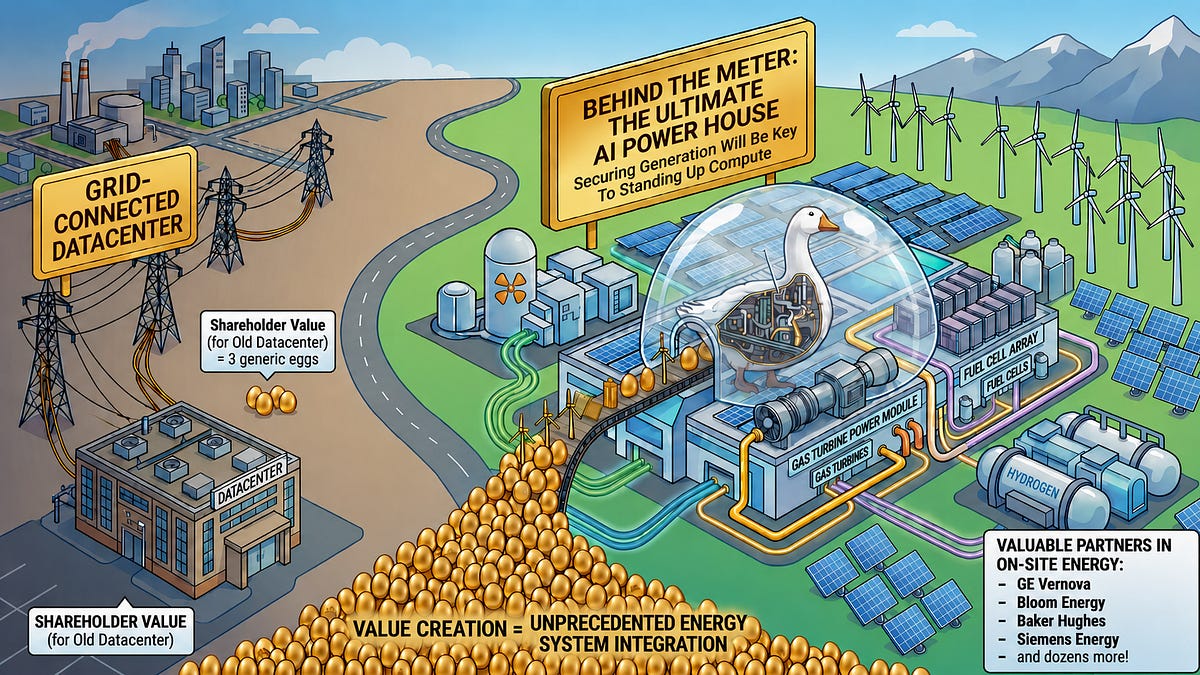
US Grid Constraints: Towards 40GW+ of Behind-The-Meter Datacenter by 2028?
Why the Grid Can't Keep Up, and Why that Drives Behind-The-Meter 50%+ of DCs/Year By 2028
newsletter.semianalysis.com
36 points · by felixdoerp · 4mo ago · 79 comments
Worse, the burden [generating energy] increasingly falls on the buyer [data center developers]
It's as if trucking companies flooded the highways with so many trucks that people couldn't commute to work anymore.
This seems to further confirm that, though now the data centers are being portrayed as the victims in this.
The sentence immediately following your quote:
> securing grid-connected power now often requires developers to post substantial letters of credit, security deposits, or sign take-or-pay commitments to fund the generation built to serve their load.
The question is, if they couldn't commit to paying the utility, how can they finance building their own independant grid equivalent? Did they find some other sucker to take on the risk?
For example:
PS5 Combined Cycle Power Plant for Aluminium Bahrain (ALBA)
https://www.idom.com/en/project/ps5-combined-cycle-power-pla...
India
https://nalcoindia.com/business/operation/captive-power-plan...
Tiwai Point Aluminium Smelter, New Zealand
Funnily, that's precisely what happened to America's rail network. Enterprise demanded unlimited right of way to the point that it's laughable to even consider transit by rail these days.
It's going exactly as well as you'd imagine. I expect our power infrastructure is going to be treated exactly the same as our rail infrastructure: legacy public assets to be exploited indefinitely[0] for free[1] profit, and never invested in until failure becomes an existential threat[2]
[0] until next quarter
[1] losses are the public's problem
[2] unless the government bails you out
But holy shit is something broken if that sort of approach is more economically effective (middle of nowhere Alaska not withstanding) than having the people who not only specialize in pipes for jiggling electrons, but have all sorts of preferable treatment from regulators and expertise in financing these sorts of things, just enlarge the size of the pipe to your door.
Furthermore, the grid wants to be as big as it can for basically all the same inflow/outflow smoothy reasons a bank or an insurer wants to be. Something is very, very broken here if big, highly financed corporate interests are saying "no I'm not gonna get all my power from the grid" and the grid is saying "actually this is fine". They should be jumping at the chance to essentially have someone else at least partly subsidize their improvements.
Everyone wants to whine about future volatility, will the data centers be around to pay for what they ordered, etc, etc. But the energy industry has a long, long, long track record of financing this risk away. Oil and related energy infra has been boom and busting for over a century.
30yr ago it would have been unfathomable that anyone without an extremely niche case would go where the energy is rather than just ordering up power from the grid.
Every DC I've visited - probably ten - has on-site generators, for redundancy. To a certain type of mind, that's capital going to waste. I can imagine a bean-counter desire to sweat that plant.
I agree that today's economics is very broken, but co-siting generation and consumption is probably not a symptom.
Aside: Language is whatever people use, but, "per se" is Latin for "in itself". "Per-say" is an eggcorn.
IDK about Britain, especially historically when you would have been building aluminum smelters. It's not normal in the US more or less since the advent of the grid. I'm sure people will be along shortly to construe exceptions or special cases where the fossil fuels were extra cheap as the norm or heat was what they also needed and it was cheaper to capture that locally and make some electricity too.
>Every DC I've visited - probably ten - has on-site generators, for redundancy. To a certain type of mind, that's capital going to waste. I can imagine a bean-counter desire to sweat that plant.
But they don't use those for any semblance of "normal" load. Those are strictly for redundancy not "ah it's 3pm, power's getting expensive better fire up the genset for 4hr". At least that's normally how it is. It's not normal for it to be possible to out compete the utility even after fixed costs are amortized in. Bigger generation is more efficient, if you're buying fossil fuels then buying them in bulk is more efficient. Etc. etc. It should be cheaper to have the people who benefit from all that string you a wire.
That makes sense up until you realize that the data centers aren't just burning watts for fun. They're providing a service that is in extremely high demand to a very high amount of those other electricity customers.
> It's as if trucking companies flooded the highways with so many trucks that people couldn't commute to work anymore.
And those trucks are delivering products to the stores those commuters shop at.
Utilities requiring ten year of prepayment from the DCs makes sense.
So, we're talking 40GW. Lets see what China does:
https://energyandcleanair.org/china-energy-and-emissions-tre...
"In the first two months of 2026, China added:
32.5 gigawatts (GW) of solar power capacity, down 18% from last year. 11 GW of wind power capacity, up 19% from last year. 20 GW of thermal power capacity, up 414% from last year. 1.2 GW of hydro power capacity, down 36% from last year. 1.2 GW of nuclear power capacity. "
Edit: to the proponents of nuclear - i think nuclear is very damaging to society as it promotes corrupt crony-government capitalism instead of market forces.
2.2-2.5 GWdc solar capacity which at 600W/panel amounts to 14-17sq mi plus additional 8-12GWh of storage to deal with nighttime, two-three days of cloud cover is not going to work with these numbers.
Ballpark 5-7BN$
Nuclear otoh, 1GW continuous - gives constant power, badly managed first of a kind (or first one after decades) build will be at around 10-15BN and that’ll cover two 500MW data centres.
There’s also the second/third degree order effects nuclear power stations have of creating jobs and industrial manufacturing demand. To run a nuclear power station you need to employ 1000 people (engineers plus support staff) - that’s a small town’s worth of adults. So you’ll need a town with a school, hospitals, stores - those need staffing as well.
Unfortunately building nuclear is not something that’s currently a feasible path as it requires patient capital and long term vision and planning.
So gas turbines it is at around ~1BN$
HN arguing in favour of a planned economy - see, we aren't free-market cultists!
In Europe, we approach energy generation as a political, or climate problem. We are building solar and wind power sources, not to make energy cheaper, or to make grid more resilient, but to fulfill an ideological goal.
The results are, not great, to be honest. The energy prices have increased substantially, and are now driving our chemical industry bankrupt.
Edit: I do not dispute the climate change. I am only highlighting impacts of current policy.
Europe's generation is roughly flat during the same period.
It doesn't make sense to build a lot of everything in a system without growth in generation. Replacing decommisioned generators would be enough. Growth in solar and wind generation (for ideological or economic reasons) means there's less reason to build new capacity of other types. There's complications there with firm vs intermittent capacity, but that's a different discussion.
US electrical generation was also flat from 2000 to 2020, but seems to be growing again since then, but not anywhere near China's growth rate.
yes, they don't seem to fall for the "solar is unstable" trap and recognize new reality - the solar + wind smoothed by nuclear/gas is the new baseline
To the comment on the coal below : not really. You don't need that much as a smoothing capacity.
Sometimes they ignore the transportation costs, as for example: capital costs for transporting 1 GW of electricity over 1,000 km using High Voltage Direct Current (HVDC) technology costs more then the 1 GW peak solar power plant attached to the power line.
China builds everything solar, coal, wind, hydro, nuclear. So if you want follow the example of China, then you have to, like China, build everything and don't just pick one part of Chinas energy strategy.
Also I would not present China as an example of market capitalism, they have a very strong government capitalism. Probably the strongest government capitalism in the world.
And grid battery works and is cheap enough now.
But I haven't looked into where these datacenter are being placed, I'm assuming that although solar is cheap now, the surface needed would make the purchase of nearby land probably not worth it. These new categories of datacenters are becoming very energy dense...
- battery storage
- and in the article
"However, AI labs and some hyperscalers have relaxed those requirements as there is now a lower uptime tolerance applied to both inference and training, not just training. Many of Meta’s self-built AI datacenters, for example, target just two nines of uptime and forgo backup generators entirely, as detailed in our Industrials Model."
Without enforcement it will happen continuously with snail pace
I find that it's just a shame to be so close to energy abundance - through renewables - to only be set back by the installation of "temporary" gas turbines. The economic incentive is so great that delaying the datacenters in order to power them cleanly isn't even considered: there's no incentive to do so. This may sound a little alarmist, but if it's GW of capacity in 2028, it's TW in the mid 30s.
I'd much rather live in a heavily compute-constrained world for the next 5 years or so than in a world that keeps increasing its gas consumption.
There's just no way to force our incentive to align with preserving our climate, and it's making me extremely depressed.
By your logic we shouldn't question any development, at any cost, including if it contributes to making our world uninhabitable for billions of people within our life's timescale?
Putin only has a certain amount of the resource on tap and sells it to someone eventually. Meanwhile data centers will eat up whatever you throw at them at any price, especially that in principle they don't need to be connected to the grid, so I imagine setting up their power supply must take months at the longest.
When the price is right all kinds of contracts and agreements are usually thrown out the window - especially if the penalties are small enough to make it worth it.
But fuck them, they are poor people so we don't care about them /s .
Additionally, people against data centers are accused of being paid by China [2]
[1] https://www.theguardian.com/environment/2026/feb/13/elon-mus... [2] https://fortune.com/2026/06/10/kevin-oleary-trump-administra...
Additionally, you proved my point that the majority really doesn't care about the folks whose quality of life worsen because someone built a datacenter close to their homes. Or the fact that turbines still pollute the air with NOx emissions (which cause lung cancer and other respiratory problems).
You are basically saying that it is not so bad, but (I guess) it is because you aren't close to a datacenter not depending on the grid. And I trust more hearing about live accounts of people being affected, than a "trust me bro, it is not as bad". Are the accounts cherry-picked? Maybe, but they are also supported by videos that substantiate what they are saying.
Sacrificing it all for making tech bros richer seems like a ridiculously bad play.
There is money now for a huge investment boom, which is what is happening in the US and China. With EU failing completely.
Not in western Europe, because they spent almost all their excess economic output over the past few decades on welfare/transfer payments.
At some point, probably in the 80s, the prophets of Mammon convinced policymakers that the liquidity of capital markets was the highest good, that no liquidity was enough, and that the financial class is inherently productive.
When we bailed out the banks in 2008, it amounted to a wealth transfer from the public purse to Jamie Dimon. That's your counterproductive welfare spending.
Texas had blackouts last year because free-market fundamentalism. Perhaps Texans should run their fridges on investment boom.
https://www.oxfordeconomics.com/resource/the-rising-challeng...
Many kinds of renewables are day/night, weather dependent, you don't get this level of reliability without a fossil fuel backup. If you already need to build a dedicated gas power plant to power your data center, then the decision to invest in an additional renewables power plant depends on the costs of the natural gas. (Additional capital expenses of the renewables power plant vs reduction in consumption of the natural gas).