What's wrong with EU age verification?
Nothing really, to be honest.
blog.vrypan.net
3 points · by Zababa · 5mo ago · 8 comments
I find it also sad (and maybe a bit suspicious) to see someone that has blogged since 2003 use AI to generate blog articles, especially for a controversial law that has been pushed again and again in undemocratic ways.
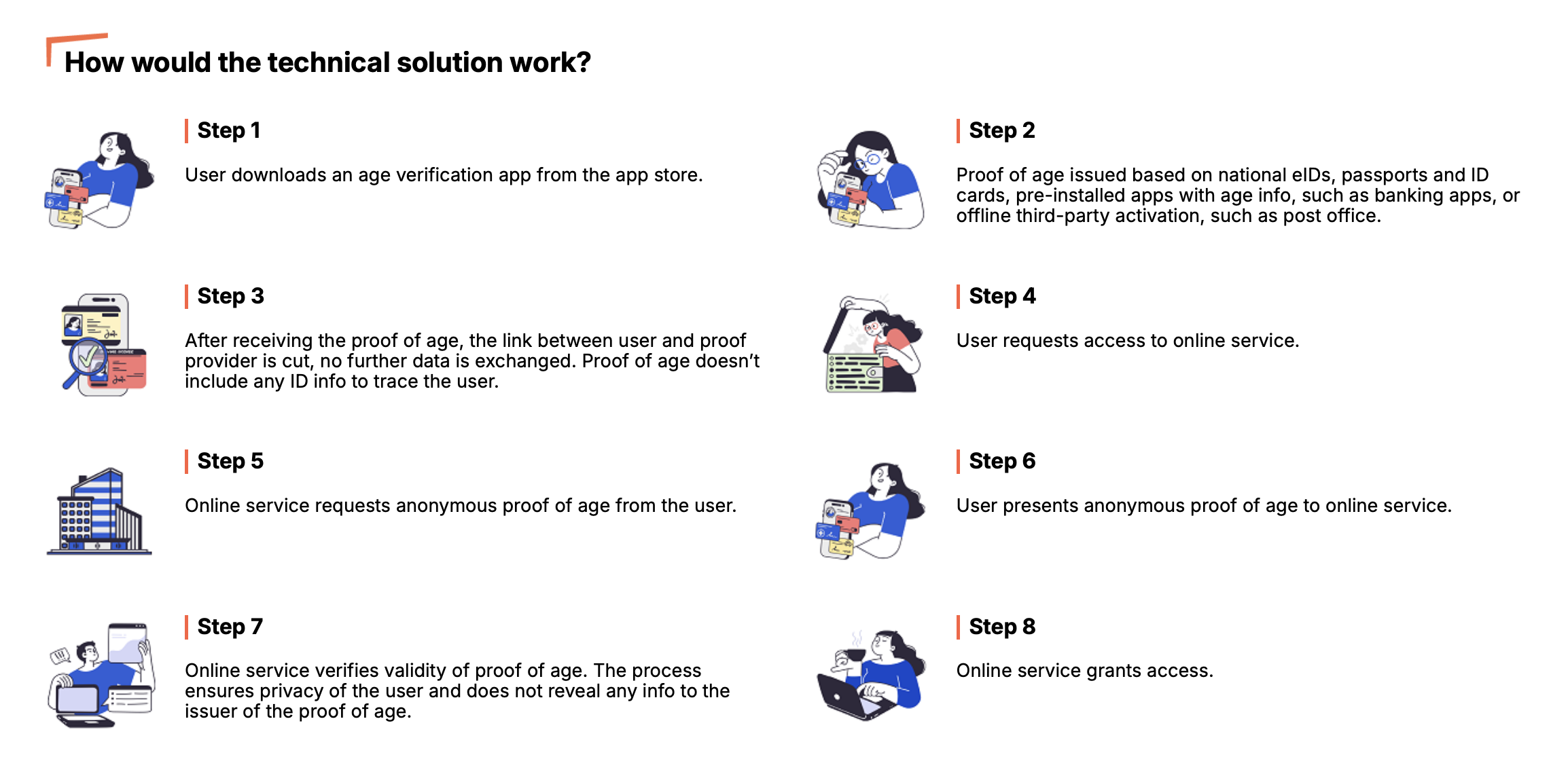
The real concern about age verification is that I don't want any party (the one that requires it or the authority that provides it) to track my identity or my usage of it. As outlined the system seems to work fine.
- the author claims the website doesn't need to know the date of birth, but as said it is easy to derive it. Therefore the author was wrong on that point, which makes me wonder if he's wrong about the rest too
- the author list 10 "Things that would break the promise", saying we should fight for them to be respected. That seem to imply, to me, that as is they may not be respected, and even if the implementation he imagines is possible in theory, it might not be in practice. The author also hasn't considered that maybe people are against age verification precisely because the promise of a well implemented, privacy-preserving age verification is easy to break.
- the author hasn't considered adversarial use, for example using the identity verification from someone else, and what other checks could be added to ensure those. There is a slippery slope of "first we check your age in a privacy-respecting way, then we realize we can't really enforce it like that but you already agreed to age verification so we can reduce the privacy respect to better enforce it"
- the author is using a possible implementation at one point in time to transform a political/ideological issue into a technical issue, while not considering all aspects of said policital/ideological and technical issues; as explained above.
Yeah, I didn't understand the reasoning here. Is it because you assume that every newly created account must be of someone who has just turned 18? Or because multiple accounts on different age-restricted websites tied to the same email would all be created in a short time as soon as one becomes 18? This could indeed give an approximate hint as to the age if one could cross-reference the same email across several accounts, but it doesn't seem to be high risk.
For the rest, I understand the objections, but they are either ideological or slippery-slope ones. I.e., they're not about the thing per se for how it's presented and implemented now. As the author notes, nobody objects to age verification in real life, so the problem is not with verifying people age per se. It's about how this can be either leaky now or modified in the future for abuse.