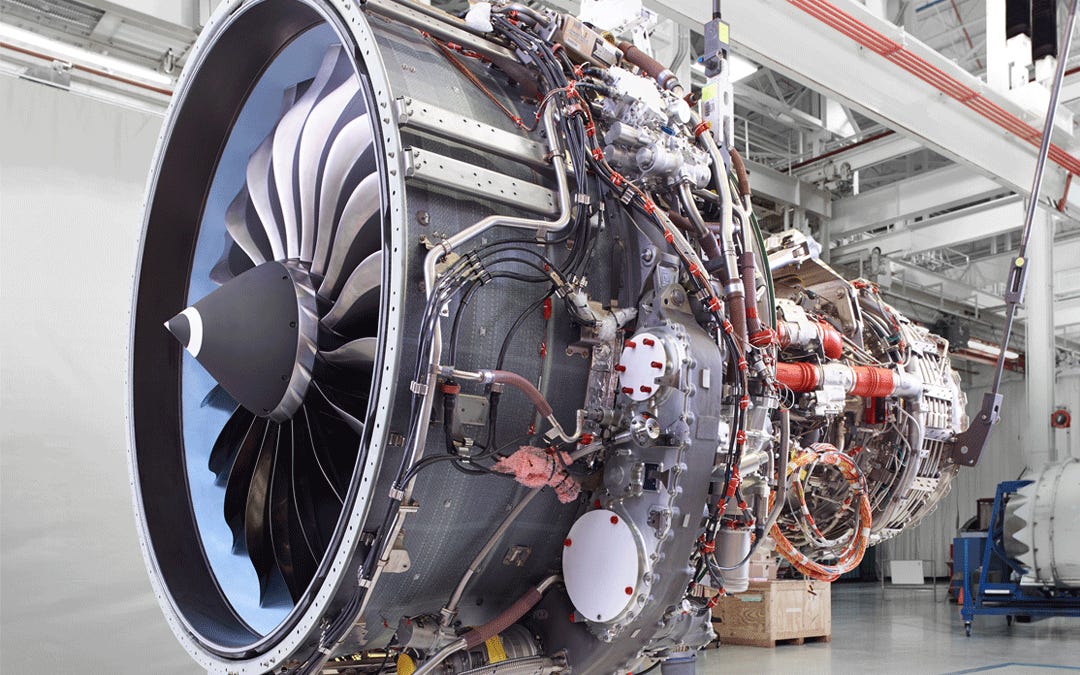
Why Jet Engines Aren’t “Made In China”
What China’s jet engine program tells us about the limits of industrial policy
aakash.substack.com
314 points · by paulpauper · 4mo ago · 315 comments
I'd argue the opposite that jet engines have a market structure that's uniquely terrible for traditional free market societies. There's a few industries where structurally, companies can only exit the market but it's almost impossible for a new company to enter. Airframes, jet engines, CPU manufacturing, lithography etc.
What this dynamic doesn't make any company immune from though is corporate rot. You've seen the rot take down Boeing and Intel from the inside as a slow moving car wreck. There's no reason the rot can't take down ASML, TSMC or Airbus as well. The free market fundamentally doesn't have a good response to this problem, excess capital is taken out of these companies during good times and then they run to governments seeking bailouts during bad times but governments don't know how to mandate good corporate governance.
I think a lot of the jet engine manufacturers are seeing this same corporate rot process, the number of high profile scandals across the industry and reports of insiders on how the number crunchers are taking over the business are strangely reminiscent of what we heard out of Boeing and Intel.
The market may not for the most capital-intensive businesses, but US laws at least attempt to address the situation. In Boeing's case, for example, the McDonnell-Douglas merger likely could have been blocked under existing anticompetitive laws.
The US's longstanding refusal to apply antiticompetition law causes a number of harms to consumers, entrepreneurs, and the stability of our economy.
Not letting Boeing grab McDonnell-Douglas military projects might have stopped some of that, but it might have also accelerated it.
It's worse than this.
The US Government had an actual goal to reduce the number of defense suppliers. And they succeeded at it.
Yeah, talk about an own goal ...
I don't think you need to entrain market arguments or whatnot to this, when it's only in the last decade China was a strong advanced manufacture player, and turbines are the kind of project that you probably wouldn't expect to go much faster than that regardless of the demand.
And don't think it doesn't matter for jet engines. This article gets into how the open acknowledgment and dissection of engine failure in the West promotes quality and that China has clearly not adopted this culture. Of course not.
They'll catch up in the same way the Soviet Union used to - at unsustainable cost and on the way to falling behind yet again.
Sounds like the free market hasn't been tried, a key plank of the free market on the supply side is that incompetent managers have to go bankrupt and lose their capital or otherwise get squeezed out. If the government is going to bail people out then obviously the companies will take adopt a ridiculously risky management strategy because they get the upside and dodge the downside, so they just have to maximise the potential upside at any cost. No surprise if after getting a bailout people do exactly what they did that led to the bailout until they need another bailout. Why change?
The trick to "mandating" of good corporate governance is not to bail them out. Then at least the corporations will be governed in a way that they aren't likely to go bankrupt. Maybe even make things people want and sell them at a profit.
> here's a few industries where structurally, companies can only exit the market but it's almost impossible for a new company to enter. Airframes, jet engines, CPU manufacturing, lithography etc.
Is there actual evidence for this, or are the companies involved just doing a good enough job that the market doesn't see a need for new entrants? Because it actually seems a bit implausible that these technologies could just disappear or even become less available under a free market. What we actually see is the likes of NVidia or ASML, where other players can't catch up because the market leader is just pushing the cutting edge forward too quickly (spare a thought for Intel, who was the unbeatable colossus once).
Put differently: if the population of the earth were 50 Billion people instead of 8 Billion - then we'd have markets with enough competition to allow free market dynamics.
In that context, then we'd have 'Space companies' being subsidized.
We'd have a hotel on the Moon and we'd easily be on Mars already.
Those aircraft are on the 'edge of our resource capabilities' - huge companies at the top of the pyramid.
If we had a massively bigger economic pyramid, they would be more like car companies.
Outside of general aviation (hobbyists/business jets), the potential buyers for jet aircraft are going to trend towards natural oligopoly.
Military craft, there's basically one buyer per country, at most a handful of different decision makers behind the same basic chequebook.
Civilian craft, does the number of airlines scale with population? There are a finite number of viable routes, airport slots, and market segments, so would it actually support a hundred new airlines, or would we just end up with a Big Southwest buying 1,000 737s instead of 100?
Even if you had more airlines, would they want to diversify their fleets? Running the same few types of planes, especially if they're the same types of planes as their competitors, unlocks efficiencies. How much would it cost a random American or European airline to retrain their pilots to fly the Comac C919, and how much would they spend extra on adaptations (stocking new spares, retraining maintenance staff, retooling processes for different floorplans)? I also suspect there's a very strong CYA/risk aversion mindset that would make it very hard to sell a new player into the market.
Regional flag carriers have political excuses to support a buy-local policy at some cost, but that still only justifies a handful of manufacturers per economic hegemon.
It's a pretty strong claim and I would like to see some theoretical justification, other than belief in the magical free market.
In my country, IIRC, we let Aero Vodochody to crash and be bought by Boeing. We are not better at making airplanes, honestly probably the worst than at any other point in history.
For a very brief moment, under the existential crisis condition of total war in WW2, the US government was somehow able to corral corporate governance towards a semblance of common purpose (survival). As I understand it from historians malfeasance was still widespread, but we arguably maybe got a good enough outcome?
This is the corporate equivalent of the shirtsleeves to shirtsleeves in three generations problem. And if that corollary is true, then I suspect the remedy is similarly not entirely amenable to deterministic antiseptic metrics and processes; they're necessary but not sufficient conditions.
You can see it in ukraine right now - they are making drones in their basements in ways that no other country is.
These are hard things to factor into economics just as they are very real.
Undoubtedly some competition would help.
I think if you zoom out on a society, you have to have a war regime and a peace regime.
There are going to be coordinating aspects that a war regime can achieve that a peace regime simply can not because the stakes involved fundamentally can't be the same by definition.
Basically, China excellence in EVs and Solar was driven by the market being new. It's hard (almost impossible?) to outrank an incumbent very entrenched in a big market. You need a paradigm shift (ie: iphone vs nokia) to make the change.
I imagine the manufacturing breakthrough for high temperature jet turbine blades could be additive manufacturing where you grow the crystalline structure layer by layer instead of casting and carefully nurturing it. Mature markets with few incumbents focus on local maxima and have difficulty to move from one maxima to another, while a new manufacturer can start from a different position and search for other maxima.
So yes, that does happen.
https://www.bbc.com/news/world-europe-32542140
(it's particularly hilarious (in the bad way), that German secret services were participating in spying as well)
Thankfully some countries (here: Brazil) have some spine to react to it: https://www.reuters.com/article/business/saab-wins-brazil-je...
A lot of the theoretical concepts behind this... They need updating to account for the last generation of experience. For the most part, the concepts were developed in the context of the industrial revolution(s) and manufacturing.
We are talking about manufacturing here, but the US economy in the last generation is a story about software, services, non-manufacturing firms and manufacturing firms the side step (as best they can) the core paradigm of manufacturing economics.
Competitive pricing, substitutes and alternatives, a strategic paradigm governed by market prices, marginal costs, and manufacturing quality... This is relatively marginal paradigm in the US economy, certainly in terms of market cap. In china, it is their bread and butter.
Low margin, highly competitive components manufacturing... Is that really a forte a free market societies in 2026? We outsource the "commodity value add" parts of the process. We certainly do not put them at the center of corporate strategy.
I agree about "corporate rot." I don't think anyone has a good answer to this either. China included. In practice, the best solution appears to be young vibrant companies. VW or Ford vs Tesla & BYD. VW and Ford exist because of history. Tesla & BYD exist because they perform well.
Schumpeter's free market solution was creative destruction... But, we've never really had a system for promoting this.
Part of the problem is that in a global market, allowing a company to fail creates room in the market for renewal, but there's no guarantee that your country will fill it. If Germany had come down hard on VW after the turbo diesel scandal... They probably would have just ceded market share to Korea or China or the US or something.
https://en.wikipedia.org/wiki/Alcoa_50,000-ton_forging_press
(which has made parts for pretty much every U.S. produced jet aircraft since the '60s)
Interestingly, Tesla has invested in some largish presses:
https://en.wikipedia.org/wiki/Giga_Press
which makes for a large reduction in the quantity of parts (but also complicates repairs https://www.northwestautocollision.com/the-most-common-tesla...)
https://aviationweek.com/air-transport/aircraft-propulsion/b...
And there's the opening for China. The 90s and early 2000s saw alot of innovation by engine manufacturers. Boeing and Airbus built their planes around the next generation of engines coming out. But over the past 10 or so years all the major engine manufacturers decided to stop investing in new civilian engines and maximize their dividends on existing models. That's what killed the A380--the A380 engines are 90's tech, and all the engine manufacturers declined to build a new engine for an upgraded A380, not even one that utilized the current tech, and not even if Airbus backstopped potential losses.
So now is probably the best time since the 1980s for China to play catch-up. But the biggest problem is as you pointed out--engines and airframes are developed together, and both Airbus and Boeing also decided to stop new aircraft development and instead coast and reap dividends for the next decade or two, so there's no market for China to break into. There's still development happening in the defense space, but that's not a market open to China, either. Their only potential market is primarily domestic, and it's not capable of incentivizing and demanding dogged innovation in the same way the international market could.
Even if all constraints were relaxed, the absolute limit might be another halving of fuel consumption. (with trillions of R&D)
And beyond that, there literally can never be jet engines significantly more efficient, until the end of the universe.
https://www.geaerospace.com/news/articles/shape-things-come-...
And for short flights, battery electric or hybrid power could boost efficiency even further. Although that will depend on developing batteries with better safety and power density characteristics.
In addition even if had been engine-centric there is no way there was enough market to dedicate R&D for a new engine for this limited market.
Both Airbus and Emirates were willing to keep the A380 alive. Emirates was making money on it, and Airbus believed the market would eventually turn as airports reached takeoff/landing capacity. But Emirates wanted upgraded engines, so for several years there were negotiations between Emirates & Airbus on the one hand, and the big 3 engine makers on the other. IIRC, circa 2018 Emirates & Airbus were very close to a binding agreement with Rolls-Royce for an upgraded engine, but then Rolls-Royce faced costly issues with its existing programs. At the same time, prospective investment in the engine industry had already started winding down, and Rolls-Royce didn't want to be spending cash on a new program while GE and Pratt & Whitney were passing through profits to shareholders. So in 2019 Rolls-Royce walked away, and shortly thereafter (weeks if not days), Airbus and Emirates agreed to terminate the A380.
It's difficult to find non-paywalled sources, but see, e.g., https://www.forbes.com/sites/michaelgoldstein/2018/10/16/is-...
This isn't a free market problem. Companies move money out to avoid corporation tax, and government bailouts are what stop the free market from operating as it should.
For jet engines, the only thing that comes to mind is electric aircraft. No single-crystal turbine blades needed at all.
I may have picked a bad example, but the principle stands.
EDIT: China has an extensive high-speed rail network. While those don't quite cover intercontinental flight, it is the sort of paradigm shift I mean.
(Now sure, you can substitute electric aircraft with open rotor jet engines which require different institutional knowledge to modern high bypass turbofans, but they're still really sensitive to how the blades are manufactured)
I know electric aircraft are not quite feasible on the same scale as airlines.
On the other hand, China has an extensive high-speed rail network for inland travel. OI have no idea how often the Chine fly inside the country vs how often they use aircraft, but this is the sort of different technology for the same purpose I mean.
I understand the idea you wanted to convey and that commenting on the technical detail is not something we're supposed to do, but the technical side of your example is just too glaring to ignore. A people-carrying aircraft, be it of electric propulsion, or of other type, is heavy. Like, several tons (at minimum) heavy. To acquire the necessary portance, the aircraft has to be accelerated (on its inert wheels) on the runway up to the take-off speed and then to be able to hold the cruising speed, using engines capable of generating such thrust by only moving the air. That's a lot of force right there, and the engine that has to do this, will have to be pretty tough. Regardless of the fact that the source of the on-board energy is electric or not, that same air will have to be moved, somehow, at the needed speeds, and it will be by an engine that will look and work pretty much the same way the current jet engines do, since the shape is dictated by the aerodynamics and the internal design is given by the (air) fluid dynamics it has to work with. The single-crystal turbine blades are just an optimization. Weaker (regular fine-grained casting) materials can be used, but that will mean limiting the performance to lower tolerance levels (and most likely be heavier as well, to compensate for the lower mechanical strength).
It's even worse. Nowadays, in order to land, the aircraft needs to be almost empty, otherwise the mechanical structure that supports the stress of impact with the runway may break. So, heavier (as with batteries included) aircraft landing will mean the need to design sturdier landing gear, and stronger landing gear will most likely mean heavier materials as well.
One nitpick, all the money in the world would be able to achieve the goal by simply giving rides away for free.
Overall, I agree that any industry that is extremely optimized requiring ultra high precision+knowledge in multiple verticals makes the barrier to entry beyond difficult. It just requires too much up front cash.
General Motors?
Could also try not giving them the money.
Forcing others to do better - or not exist.
Free markets don't exist.
The problem isn't what you think it is. It's Dunning-Kruger effect and 99% of the population is living it loud and proud.
The correct answer to this is to break up consolidated markets with antitrust. Are there only two airframe manufacturers left? Then chop them into smaller pieces so there are more. Reduce vertical integration so that it gets easier for new entrants to compete at any given part of the supply chain without needing to duplicate the entire thing themselves. Let each of the spin offs start with a non-exclusive license to the no longer existent parent company's technology so they all have the chance to iterate on it and compete for providing it.
And don't let them buy each other again.
Airframers really aren't that vertically integrated as companies go. But it turns out the business of designing, certifying and selling an aircraft (and managing complex multinational supply chains) is hard, and airlines don't want 6 competing types of narrowbody in their fleet, they want one type of narrowbody in their fleet with an abundance of type-rated pilots, multiple maintenance options and a robust aftermarket.
Which is in itself a regulatory problem. Why is the government certifying only a specific company's design, granting them a lock on the market for everything to do with it?
Certifications should work in one of two ways. Either the industry comes together to submit a royalty-free design IETF style and then anybody can make it, or they certify a specific company's patented design and that company is prohibited from making it themselves and can only license it in exchange for a fixed fee per-plane, no license restrictions other than the payment of the fee, and a requirement to publish the uniform fee and charge the same amount to all producers. Then you get a company that designs planes but a competitive market for producing and maintaining them. And a requirement that Airbus do the same thing, because why should foreign companies be exempt from antitrust laws when they want to sell to the domestic market?
Notice also that the traditional 737, 757 and 777 are all over 20 years old, which is the term of a patent. In the absence of some chicanery that means they should all correspondingly be available for anyone to produce by now or design variants of which share parts and should only need partial rather than full recertification.
There is no reason it needs to work the way it does other than regulatory capture.
That's assuming the regulations are competent. But if you let the market consolidate then the incumbent has enough money to buy off the government. Or it happens the other way around and the government is kind enough to set out regulations that only a megacorp can satisfy, thereby destroying the competition and awarding the last company standing the vaunted "too big to fail" get out of jail free card.
Which in turn gets you the 737 MAX sort of problems where the regulations both cause a problem (recertification is prohibitively expensive) and then fail to impede the incumbent's efforts to shirk it because you can't be damaging the business of your only domestic producer.
I know your comment was likely made as a knee jerk reaction to the above comment but I implore the reader to actually consider the process and incentives by which rules and regulations are created and how an assumption of good faith negatively affects the rules and laws we get.
A plane built for resilience against defective engine components would be very different from the airliners we fly today. I would assume more engines for redundancy, better protection against catastrophic failure, different designs to allow engines to function even if parts flew out, and so on. It’s an interesting design exercise to build from radically different expectations from the fundamental parts.
Alternatively, a far less radical redesign would be turbines running at a much more forgiving regime feeding electric motors.
Aerospace RND has been looking into hybrid propulsion systems for a long time. If there's one thing they aren't shy about pushing, it's the ability to go higher, faster, more efficiently. Such systems aren't used because they aren't yet good enough.
Do you think todays aircraft are not designed with the idea that the engine can fail?
And if you have unreliable components do you think redundancy is going to save you?
And lets be real - there already exist a aerospace arena where you have a higher number of CAT-events - it's called the military. And they deal with it by having a parachute for each passenger..
No - in effect building jet-engines (that are commercially viable i.e. fuel and efficeny) is not a easy to disrupt business. And the cost of entering it would be - high. And the benefit, well less obvious.
Also for aerospace the patents are more legitimate. Software is encumbered by stupid patents <obvious idea> but on a computer! whereas aerospace patents are more legitimately about hardware that indeed took years and millions to develop and optimize.
Something that leaps out at me reading through semiconductor and aerospace patents is a noticeable fraction of them are basically saying, "hey, <non-obvious process understanding that pushes our limits of comprehension of physics required> to achieve some desired effect was found to be useful, but it consumed <years and millions to develop and optimize> because it was such a convoluted journey filled with zillions of dead ends, so we want a patent on that because the end result only looks obvious in hindsight". I don't see as much of this in software at this time, though I suspect it may change in the future.
https://precisionam.com/articles/precision-machining/itar-re...
https://aircraft.zone/navigating-the-rules-a-guide-to-u-s-ex...
Will jet engines never be made in China? Don't bet against them. There's no guarantee that the legacy of the Cold War technology race will continue to subsidize western jet engine development.
There are reasons to think this subsidized moat will hold for a while: geared turbofan engines will deliver another increment in efficiency that passenger airlines can't ignore. Until that technology step is commoditized, the incumbent jet engine makers are relatively safe.
Lot technological development in China in the last two decades was result of US and European companies outsourcing manufacturing to China and most importantly, sharing know-how with Chinese companies.
I recommend the book "How China Captured Apple" by Patrick McGee
https://www.thewirechina.com/2025/05/25/patrick-mcgee-on-how...
This outsourcing development path for jet engines in China is not possible because ITAR.
If China can master nuclear, space, chips, it seems a bit stretch to say they it is the Jer engines where they fail.
China hasn’t mastered chips either yet in the same way it hasn’t mastered jet turbines: they can do cheap (high yields, low maintenance costs per hour of use), they can do high performance, they can’t do both yet at the same time.
Once China figures out how to have both at the same time, they will basically take over the worldwide market, let alone their domestic market.
Bollocks. Russia does that as well, single crystal turbine blades in particular so the west is not the sole gatekeeper here. Given the circumstances Russia might as well share the tech for some things in return
You’re joking. These have been put on network drives since early 2000s and CCP has hacked and exfil them
you don't exactly need to hack a network drive when you can just hire the guy who came up with it
Sure, automobiles aren’t as complex as a jet engine, but they’re still complex, especially the internal combustion variants.
Something like 10 years ago we were laughing at videos of Chinese cars spectacularly failing crash tests, and now China is selling to very heavily regulated markets.
Same deal with things like high speed rail.
Say what you will, but I don't consider eminent domain to be some kind of mystical technology that only wizards possess.
For automobiles, China didn't compete with the West on its own turf in heavily regulated markets. They embraced EVs from the beginning. Complex auto regulations can't save Europe because EVs are an end-run around all of the complexity of building an economical, low-polluting engine.
Indeed, Europe is talking about relaxing some of its environmental regulations for petrol cars, now that those regulations are more of a barrier to home companies than foreign ones.
I will point out, the #3 top selling vehicle in the UK is a Chinese SUV with a gasoline engine (Jaecoo 7).
I think the idea that China just can’t make a reasonably competitive ICE vehicle is another outdated notion about China.
Don't need eminent domain to do that.
Also, eminent domain is used routinely in the US, like for Texas' most recent highway expansions. And highways require a lot more land than rails. I don't buy that eminent domain is the real reason here.
They are often made of superalloys, yet regular cars, down to econoboxes costing 20-30k or less have them, and are made by the millions.
I'm not sure China is known for their ICE designs. Like Korea, I suspect China partially pushed hard for EV specifically because the complexity in a battery + motor system is meaningfully simpler than the ICE equivalent and there's relatively little overlap in many facets outside of some first principles.
Jet engines are like ICE, but with a very reliability threshold. ICE is already complicated, but OEMs will accept a certain deviation on reliability if they need to because occurence might be low and severity is manageable. Not so in jet engine design. A single failure is a big deal.
I suspect it's wouldn't have been good strategy to try to build those cars for the US, CA or EU markets. An ICE engine is relatively straightforward, but hitting emissions and fuel efficiency targets is complex. [1] And the future of ICE cars, especially in those markets, is limited... why build out emissions expertise, when you can get your foot in the door with EVs?
[1] I recently bought a 1981 VW Vanagon which I try to maintain. That's a perfect time period to see how emissions control forces engine design. My engine has fuel injection and EGR, but a few years back has the same engine block with a carburetor; california emissions uses the same engine, but adds electronic ignition and an o2 sensor in the exhaust for closed loop injection control. A couple years later and they added water cooling. Every so often emissions and efficiency standards got harder to meet and you have to do more stuff.
Low reliability and safety issues kills car brands. Consumers really don’t like it.
Sure, jet engines are on a very different level of reliability standards, but it seems to me that the concepts are all the same: highly regulated market of low-margin complex heavy machinery where it’s difficult to be a new entrant in the market.
1. Geopolitical risk of oil dependence. Domestic Chinese EVs are not dependent on imported oil. Oil imports would be at risk in case of a Taiwan conflict.
2. China already had established battery manufacturing. EVs are essentially batteries on wheels. For example the BYD Company (formerly named Shenzhen BYD Battery Company Limited) manufactured batteries long before manufacturing cars.
It doesn’t even take a lot to understand that. It’s the same tried method they’ve been applying for decades now; information gathering, rapid prototyping cycles, quality threshold goals, led by overcapacity dominance. It’s really not much different than agile and “hyperscaling”, accepting massive losses for a long period because the objective is shifting core dynamics.
Ironically, in the US it was used to crush competition and innovation and parasitize the society while on the global scale, China is increasing competition and/or breaking up the monopoly of the parasitic cabal that controls the West and long the world.
It also treats EV motors as "commodity brushless motors" completely glossing over the actual engineering behind modern EV motors.
Twenty five years ago a Chinese supercomputer was laughable. Today they build them. Ten years ago Chinese cars were laughable, now they're sold worldwide. Ten years ago people laughed at the "metro to nowhere," now it's the core of a new central business district.
The fact that domestic Chinese engines have entered military service, to me, is a pretty strong indicator that given another decade or two, they'll be building some of the most competitive jet engines on earth.
For example the monocrystalline blades, which are touted as some holy grain, were in production engines on both sides of the iron curtain by the 70s. China has mastered this technology by the 2010s at the latest.
As for airliner engines, I looked up both the LEAP and the PW1000 and their 'hot' part - the turbines - have fairly conservative specs, roughly on par with these aforementioned 70s US/Soviet fighter engines. This is the technology tha's more or less shared between military and civilian engines.
The big Western advantage comes from manufacturing the bypass fan - the composite blades and the high-speed gearbox connecting them to the jet 'core' are technologies that the West has a huge lead on and that's why the reason comparable Russian and Chinese engines don't exist.
But strictly speaking, that's not really directly related to the tech in the turbine 'cores' which most people refer to when speaking about jets and not a peep is made about this in the article.
Fun story: it is not just jet engines - it is only recently that china was able to actually make indigenous ballpoint pens https://www.bbc.com/news/business-38566114
Source from al-Arabiya: https://english.alarabiya.net/variety/2017/01/14/At-last-Chi...
The point (no pun intended) is that China was beginning to crack the processes for making the precision machine tools that make machine tools.
" China's inability to produce a complete, high-quality ballpoint pen came to widespread attention in 2015, when Prime Minister Li Keqiang singled out the products at a seminar in Beijing, noting that his writing was "rough" when he used Chinese-made ballpoint pens. For Li, China's failure to manufacture a complete ballpoint pen was indicative of the Chinese economy's weaknesses. "That's the real situation facing us," Li said at the time. "We cannot make ballpoint pens with a smooth writing function." "
https://www.smh.com.au/world/finally-china-manufactures-a-ba...
its a clear prioritzation choice from the government, and that prioritization is itself a technology
notably this same prioritization mode resulted in the soviet union failing to produce quality of life improvements for its citizens.
the failure is that the CCP is unable to prioritize making simple useful stuff
We already know this was an issue with the soviets, back when they had the plans for us jet engines (for fighter planes), but couldn't replicate them. Same for stealth, hell even some of their rocketry. And the soviets had plenty of auxiliary systems already in place, during the cold war. As someone said above, they could do quantity, they could do limited high-quality, but couldn't do both at the same time.
There are things that work with 5-year plans: railroads, road infra, buildings, etc. And there are things that are not that easy, and take multiple decades from when the order comes to having it realised. Something that's not immediately obvious for western folks is that when you mix central planning with authoritarian governments, you will get a huge number of pain points along the way, where orders come downwards towards the ones executing them, and overreporting/missrepresentations/lies go upwards. It's like the longest game of telephone, where you start from the top, demanding x y z, get reports that you're on your way of getting 3x, 3y, 3z and in reality you have some of x, none of y, and z looks like z but it's actually three x's in a trench coat.
[0] https://scholars-stage.org/china-and-the-future-of-science/
for example: - until the end of ww1 the haber bosch process was confined to germany
- jet engine turbine blades today
- most historically: https://en.wikipedia.org/wiki/Greek_fire , medieval napalm that nobody has been able to replicate even now
> DD6 is a second-generation nickel-based single-crystal superalloy developed by the institute with fully independent intellectual property. Its chief engineer, Li Jiarong, said the alloy’s performance matches or exceeds that of comparable second-generation superalloys used in Europe and the United States, at a lower production cost.
US manufacturers have already developed sixth-generation SC superalloys and most Western airlines are on engines with third- and fourth-generation materials.
The technology behind single crystal superalloys is relatively well understood, the problem is getting the process reliable enough to be economical in an industry that requires tens if not hundreds of billions of dollars to develop through trial and error. The TFA's point is that unlike EVs or semiconductors, the turbofan industry is between a rock and a hard place that China's other successful industries weren't.
I've watched their manufacturing video recently and shocked how much of it was hand labour - it's not something I'd associate with precision. My partner said they must know better tho lol.
But those companies have no commercial interest in supporting a Chinese manufacturer that just wants the blades even without export controls, when they can make much higher margins selling whole engines that must be maintained using their parts (in practice variants of the engines destined for COMAC also omit some of the IP that finds its way onto Airbus and Boeing because you can help a customer too much...)
Do they need to be at the same level as the West?
For civilian aircraft a decade or two behind seems like it would be good enough.
For military aircraft that could be a significant disadvantage, but from what the net is telling me they have excellent air defenses so it seems unlikely someone with superior planes is going to be able to go in and bomb them into submission. And they have a lot of nuclear missiles to further discourage anyone from trying.
The difference isn’t huge (I think it’s 10-20% or something), but when fuel is your main cost that’s enough to make older engines undesirable
China may or may not be much more than a decade behind in their engine technology, but there's no commercial case for designing a new aircraft with engine variants so outdated they wipe >$100m off the sticker price of the aircraft....
Also, the domestic commercial jet market is still sizable, so excluding the domestic market from analyses is kinda weird.
Finally, lots of countries are spooked by arbitrary US sanctions and want to diversify.
With petrol/diesel engines they just gave up and went straight to electric, but there's no viable alternative to jet engines for planes, so they'll put in the work (plus the military incentive running in parallel)
A 10-20% reduction in fuel burn is actually considered pretty huge...
(This applies a bit less to military engines though, where performance is a more important factor. Fuel efficiency is still important though)
You seem to believe that China's military ambitions are purely defensive, but that is not the case. They have grandiose expansionist ambitions which include basically the entire South China Sea - which in spite of its name is shared by many countries. Not to mention their explicit goal of eventually conquering Taiwan. Their military doctrine is fundamentally offensive and does require air power.
In other words, let's says the Chinese military jet engine is 15 years behind is say fuel economy. Which reduces range. If the conflict is local that doesn't matter overmuch.
Equally operating from land, not carriers, reduces reach, but if what you want to reach is local then that doesn't matter.
If China has military ambitions (and despite the sabre rattling there's no overt indication of that), they are all in a specific area.
By contrast the US likes to participate in, or instigate, actions far from home. Moving planes means long open-ocean ferry flights. Single-engine reliability, range, effeciency and so on is paramout.
Equally the US relies on friendly local countries to provide support bases, logistics, fuel and so on. As evidenced just this year, that support can be withdrawn. Will Japan or Korea want to be dragged into a US / China conflict over Taiwan?
So if the Chinese are operating engines later than the first gulf War, and on par with the second, I'm not sure that's a defining difference.
The US doctrine of air-defence suppression followed by air superiority may not be possible in a space near the Chinese mainland.
The only use case is modern day AI workloads, but that's used more in planning than in the field. I can imagine a use case for e.g. image recognition, but again, that tech or the level required is not new at all and doesn't need state of the art chip tech.
That's also why they're so damned expensive, and why it's difficult for upstarts to break into the market with cheaper alternatives. Like any tech company, once they get the customer locked into a platform they're constantly pushing upgrades to both stay technologically competitive and, more importantly, keep their margins high.
That’s one of the reasons drones are so disruptive. The development cycle is tuned by state of the art missile and stuff, and isn’t tooled for some dude strapping a mortar round to a little drone.
But unless you massively subsidize a company "cough Rolls Royce cough" then you can't compete at all with a generation or two behind commercial jet engine tech.
in which conflicts have those air defenses proven themselves?
A desired task that requires the most skilled makes those skilled people in demand. If a power has significantly more resources then they have more to offer those most skilled people.
It isn't at all disputed that there are a huge number of scientific discoveries that have occurred in The USA by people born outside the USA. That shows the draw of that power, but it is a relative draw. As the ratio becomes smaller the draw is less.
Advances like this are a feedback mechanism, being ahead gives you more resources to stay ahead.
If you consider the average contribution of advances to be a relatively steady force advancing a nation, yet a nation is in decline, it stands to reason that the decline is in another area and is being mitigated by the advances.
If the force propping things up goes somewhere else the change can be quite swift because the force of the decline becomes suddenly much more apparent.
I don't see the world going full Mad Max, but I can certainly see a sudden shift to the USA being considered no different to the UK,Japan, or Germany.
They actually do. The segment of small jet-powered (military) drones is rapidly growing and isn't served by the big jet engine manufacturers.
Getting a handle on how nations are doing for jet powered drone is a bit tricky because of limited data available for what is primarily a military application. But, if we take model aircraft applications as proxy, then my understanding is that the Chinese company Swiwin (est. 2013) is already undercutting everyone else.
"Technological sovereignty" sounds like something smart and glorious ... well, in the 6th grade history classes it was called "natural economy" of the feudalism.
China is 10x of Russia, and thus can build higher technological pyramid - the modern technology in my view is like a pyramid where the complexity of achievable technology at the top is defined by how broad is your foundation. The base of China's pyramid is growing by including more and more of its society into modern technological economy, yet it is still smaller than the Western world's pyramid. The original article exactly describes that the China's pyramid is still of not sufficient height/width for such a complex product like modern jet engine.
There is a section about its engines: https://en.wikipedia.org/wiki/Shenyang_J-35#Engines
The first engine they used for the J-35 was the RD-33 (designed/built in Russia): https://en.wikipedia.org/wiki/Klimov_RD-33#RD-93 - It was not efficient enough for the J-35 and generated black smoke trails. China decided to design & build a China-based engine.
This is the engine for the early J-35 prototype, WS-13 built in China: https://en.wikipedia.org/wiki/Guizhou_WS-13
This is the production engine for J-35, the WS-19: https://en.wikipedia.org/wiki/Guizhou_WS-19
China has built 50+ J-35 aircraft, and is scaling up production to support their domestic military, and also export orders to other militaries (including Pakistan, and possibly Russia).
Interesting: This is China's latest aircraft carrier, which has electromagnetic catapults, instead of steam-based: https://en.wikipedia.org/wiki/Chinese_aircraft_carrier_Fujia...
You can see videos of the J-35 aircraft here: https://www.youtube.com/watch?v=oLdCNAUjuRI
They are narrowing a gap measured in decades. The article explains the difficulty well, but it doesn't convince me that China can't eventually (again, given enough time) build good engines, especially for domestic military use.
Same for semi-conductors, IMHO.
But there are obvious counterarguments if you cherry-pick technologies where the US currently leads — Google Search, AI, and so on.
So I would be really careful extracting any kind of simple "truth" from examples like these. Different countries have different advantages, and those advantages shift over time. That's it.
IDK if the WS-15 failed or is "two decades" behind. I think we just don't know, but we do know that it is that they have achieved the ability to deliver, in mass, third-generation single-crystal nickel-based superalloys. That's a strong proof point.
As for commercial, China can/has grant a sizable portion of the C919 to domestic engine producers ( I think AECC has this contract ) that allows for a lot of capital and practice.
I would not be shocked if China demonstrates highly competitive engines in the late 2020, maybe with a few setbacks and iterations. I would also not be shocked if they started demonstrating engines with some characteristics slightly better than the Western manufactures in that time period (or maybe a little later).
Well, that's not true. I've worked in engine testing, in all countries, and the Chinese shared more than anyone else. We had a huge wiki, and Chinese shared the most, the Koreans and Japanese the least. It might be that they were the worst in speaking English, but the culture was also much stricter. The only ones who worked by shouting. I've not heard much about much shouting in China, just African-style delays. Which is gone by now for sure
This is somewhat similar to the camera industry. It is a shrinking market, while iterative improvements in smartphone cameras are where the real economic returns are. This is why the traditional camera industry remains dominated by Japan, while China has gradually captured adjacent markets such as smartphones and products like DJI. Of course, the barriers to entry in traditional cameras are not as deep.
As the article suggests, China is mainly “late” in certain areas. The industries are not always large, the profit pools are limited, and compliance requirements can be cumbersome. In this sense, the Chinese government does not seem to have made any major strategic mistake here. The current pattern of catching up and lagging behind is largely predictable. Unlike in high-end semiconductors, I do think China has made significant mistakes here. In state-led industrial programs of this kind, a lack of market discipline and episodes of corruption scandals have repeatedly slowed progress and led the government to become more cautious. However, given that China already holds a dominant position in mid-to-low-end semiconductors, the overall outlook may still be optimistic.
Since it is currently World Cup season, Chinese football is another example of a similar structural issue. The system is simply deeply broken and incapable of properly identifying and cultivating top talent.
Distances over 1000 km are already favorable for passenger jets. Even in today's Western Europe, there just aren't that many really long distance trains (by which I mean something like Amsterdam-Barcelona or Copenhagen-Milan).
The only real reason you would fly this route would be as a connecting flight. But if you just want to travel from Beijing to Shanghai, HSR is the obvious choice. It probably takes less time overall, and it's way more comfortable. You can even order takeout from restaurants along the way, delivered to your seat.
Like everyday US wastes on healthcare over OECD basline = enough $$$ for PRC to build like 300km of HSR, stations hardware and all. 1 week of US healthcare waste can build out entire Beijing to Shanghai route. Chinese HSR is best demonstration of why developmental dictatorship works.
I don't know where they're at in terms of civil engines, but each new generation of engines eeks out less and less additional performance. If China comes out with something like the CFM LEAP at a good price, I'd imagine they could sell that for many years to come.
First, the certification process in aviation absolutely is a massive issue. This was in large part the undoing of Bombardier. Well, that and Boeing successfully getting the US government to put 300% tariffs on them. But one of their go-to-market delays was that they simply weren't set up for FAA's processes and that was a mistake.
Second, I think there's a difference between the China of now and the China of the 1970s. It seems like Deng Xiaoping did kind of throw money at problems. I don't think that's true anymore. Or at least it's far more integrated and thoughtful that it might've once been. The example I'm thinking of is EUV. Go back 2-3 years and you'll probably find a lot of people who would say China won't replicate EUV for similar reasons about the supply chain, interdependence and vertical integration. But we're only a few years away from that now. The author is correct to raise an important factor: local demand. This was the mistake (IMHO) of US bans on exporting the best chips to China: it created a captive local market for Huawei chips.
Third, if I was in charge of bootstrapping a jet engine ecosystem (that's really what it is) given all the very real problems the author raised, how would I do it? I'd to bootstrap the materials side and manufacturing in other industries that don't have the stringent testing and regulation requirements of commercial aviation. Gas turbines, medical equipment, orthopedics, that sort of thing.
Note that this was to be done without Weingarten and other German presses, which were the EUV machines of the era. This was also to be done without the 'Black Country', which was the British industrial heartland centred around Birmingham.
A big problem turned out to be the British blueprints, which were ill-suited to precision mass manufacturing, where fettling is not allowed. Everything had to be redesigned for mass manufacturing.
This redesign for mass manufacturing was evidently outside of the competencies of the Brits but an easy task for the guys at Ford.
Until 2014, China and Russia have genuinely sought trade and cooperation with the West. The deal was hydrocarbons and labour in exchange for luxury goodies, specialist machine tools, avionics and much else, including jet engines. It was win-win, mostly.
However, in 2022 the gloves truly came off. Economic cooperation between Russia and China became necessary. Thus far, there is no evidence of Chinese war material on the front line, other than dual use items seen on both sides such as the ubiquitous DJI Mavic drones. However, there is a deeper partnership going on between the two nations, with aerospace being extremely important.
Already Rolls Royce are making gas turbines in China, for non-plane things. Naturally they hold back the true trade secrets, and the US government absolutely makes sure that is the case. However, you know it is only a matter of time before there are several Shenzhens for aerospace growing like mushrooms in China, blueprints from Russia, re-engineered for mass production.
Aaaaand the author just lost any credibility with me whatsoever. This is someone who knows big words, maybe did some research and ChatGPTing, and doesn't actually know shit about aircraft or their engines.
On passenger aircraft because passengers sit directly inline with the path a blade with insane levels of kinetic energy will probably go, the nacelle is designed to contain it.
The engine must be able to contain a "blade off" event where a blade snaps during full rated thrust. Two videos:
https://www.youtube.com/watch?v=j973645y5AA
https://www.youtube.com/watch?v=wcALjMJbAvU
The aircraft will not be "destroyed."
The blade could fail during takeoff climb and the plane would still be able to climb because all twin engine passenger jet aircraft must be able to conduct all phases of flight on one engine.
SWA 1380 had a passenger fatality not because of the blade hitting them, but because part of the cowling disintegrated, broke the window, and she was partially sucked out of the aircraft, which killed her.
If she'd been wearing her seatbelt, she would likely be alive today. As would several other passengers who, over the years, have been killed by debris breaking the window and them being sucked out.
The blade itself did not leave the engine.
https://en.wikipedia.org/wiki/Southwest_Airlines_Flight_1380
That article lists a number of incidents, in roughly half of which the blade was contained. All the flights made it back to an airport...
The passenger's seatbelt was buckled.
https://libraryonline.erau.edu/online-full-text/ntsb/aircraf...
"When flight attendant C reached row 14, she saw that the head, upper torso, and arms of the passenger seated in 14A had been pulled outside the airplane through the window. The passenger’s seat belt was buckled. Flight attendant C grabbed onto the passenger and, with assistance from flight attendant A, tried to bring the passenger back into the airplane, but flight attendant A reported that they could not get the passenger back into the airplane by themselves because of the pressure and the altitude. Two male passengers (in seats 8D and 13D) offered to help; they were able to pull the passenger back into the airplane and laid the injured passenger across seats 14ABC."
RIP Jennifer Riordan.
Losing a fan blade, as demonstrated in your two youtube links, is both a more likely event to occur and low enough energy to be able to contain with a reasonable structure.
However consider the situation in [0] where a turbine disk became detached from its shaft. The disk is still taking power from the exhaust gas, but rather using the energy to power the compressor or rotate the fan it is now just increasing its own kinetic energy. This continues until the incredibly strong turbine disk rotates itself apart. From the linked article:
> For engineering purposes, disk fragments are assumed to have infinite energy at the moment of release; they will cut through any reasonable material and cannot be contained
You can see from photographs of the aftermath, the nacelle is missing where this happened
[0] https://admiralcloudberg.medium.com/a-matter-of-millimeters-...
if you develop everything anew there will be mismatches in tolerances and thousands of potential individual failure risks that can be combined in interesting, unexpected and fatal ways.
Take this incident for example:
https://admiralcloudberg.medium.com/a-matter-of-millimeters-...
Interesting reading. Sadly, once I encountered this, I realized the article was extremely biased. The USSR successfully achieved this several times.
I suspect this article will age badly after WS-15 goes live. China has significantly narrowed the gap.
Scale doesn't help them much in getting the engines up to quality but it does give them the ability to run dozens of experiments and companies at the same time. And they only need to have a handful of breakthroughs once.
That's a pattern that's already repeated it a few times, China has had trouble catching up in the car market for a long time, on semiconductors. On the first they're now on their way to capture the market, on chips they're catching up, and on military engines you can already see the gap closing. I predict the title of the post will age badly, within 5-10 years there'll be competitive commercial planes in China.
Turbojet/fan core programs bottle neck isn't technical, its political / organizational, assuming some base pop scale, i.e. need to sustain specialized aerospace workforce of a few 100k which most countries can not - and EU has to as bloc - but trivial for PRC. What's hard is building the entire process / development pipeline etcs. Tremendously expensive and takes political will to sustain, with little expectation of returns, over 10-20 years. This was last piece PRC was building out post 00s, which basically caught up ~50 years in ~10 years for military hot section... aka one should expect rapid catchup in civil aviation if PRC serious. As if PRC not good at parallel iterations and tacit knowledge buildup at PRC scale. But IMO civil aviation not PRC serious/priority, nothing that increase reliance on fossil is.
The other caveat is commercial aviation is deeply geopolitical, PRC can very well have competitive engines and still have difficulty commercializing because west currently has chokehold on regulatory/certification. Half the reason COMAC went with western components is due to ease of certification, really if PRC wanted right now, they can plug Y20 avionics / components into domestic narrow/wide body (turbojet not 1:1 price/perf swamp with turbofan) but the point is PRC at point where if they wanted completely indigenize domestic civil aviation with eye on medium/long term global expansion, they could.
Other thing to consider is "commercial" viability of jet engines is pegged to oil price, i.e. aviation fuel opex at current prices means marginally more performant engines (5-10% better fuel efficiency) will economically pay themselves off over lifespan at recent fuel prices. If aviation fuels dips to historically precedented lows, PRC ability to involute component prices to commodity levels can become competitive, i.e. the economics of spares/maintenance of having lower priced hulls > fuel price.
But ultimately, formula for frontier capabilities is basically having industrial policy that can eat a lot of losses during incubation while generating/coordinating the required talent.
If you're a small country, sure, that kind of strategy might make sense. Pick your battles, run the country like a startup (i.e. bet on one or two industries). China's strategy is the opposite of that: just make production costs low across the board (transport, energy, housing, etc.) and let everything else follow. With 1.4 billion people, something somewhere is bound to pop off.
People are reading way too much into the 5-year plans. It basically boils down to "do science across the board, but lean a bit more into these areas."
So yeah their five year plans are indeed often “Invest in science/engineering”, they are an interesting country.
Rote learning, no democracy. Proper jet engines WILL come out of China soon. lol. Just watch this space.
https://qz.com/1146259/mercedes-got-caught-trashing-a-rental...
In the near term, it is highly unlikely that Chinese-made engines would be adopted by Boeing or Airbus, given certification barriers, supply chain integration challenges, and broader geopolitical considerations. As a result, the primary initial market would be China’s domestic commercial aircraft programs.
However, the scale and timing of that demand remain uncertain. Early production volumes for programs such as the C919 are relatively limited, and initial fleet sizes alone may not be sufficient to amortize the substantial research and development costs associated with modern turbofan engines. This raises questions about the commercial viability of such programs in the absence of broader international adoption.
China’s civil aviation industry is still in a relatively early stage of development. The C919, its first domestically developed narrow-body jet, has completed test flights and entered initial service with Chinese airlines. At present, it relies on engines supplied by GE. A critical milestone for the program is obtaining international airworthiness certification, particularly from U.S. and European regulators, which would enable broader global operations and improve export prospects.
If such certifications are achieved, potential demand may emerge from developing markets, including Southeast Asia and parts of Africa. Nevertheless, penetration into North American and European airline fleets would likely remain limited for the foreseeable future, even if existing Western-supplied engines continue to be used.
Recent export control measures—such as U.S. restrictions on the sale of certain engine technologies—highlight the extent to which geopolitical factors can influence supply chains in the aerospace sector. These constraints have, at times, affected delivery schedules for aircraft programs like the C919.
In this context, China’s push to develop indigenous engine capabilities can be understood as a strategic response to external dependencies. Similar dynamics have been observed in other high-technology sectors, including semiconductors and advanced computing hardware, where supply chain resilience and technological self-sufficiency have become increasingly important policy objectives.
Isn’t this by design? ie each country customer has an important stage in the supply chain so that if the primary country fails to deliver, a supply countries can choke global orders
Going from near zero 40 years ago to being just 10 years behind the state of the art now is actually pretty rapid convergence. Calling that a "failure" is strange.
The author does not notice that the F-35 is a single engine jet rated for VSTOL flight characteristics. The F135 is required to produce that much thrust by itself to support that profile. The J-20 is a twin-engine fighter. Why, pray tell, does the engine designed for a twin engine, land based fighter designed for carrying large payloads of air to air munitions need to beat the thrust of the F135? The comparison is worse than stupid.
The Chinese Flanker fleet is being built out and maintained at scale with WS-10s, it's industries churn out 100-120 J-20s per year, all with twin WS-15s. This is a mature jet engine capability, at massive scale. "Not made in China"???
The author makes a passing comment that the WS-15 is "outdated" compared to NATO forces. They are clearly blissfully unaware that the F-18 Super Hornet standard runs the F414 powerplant, as old as the WS-15, itself an upgrade on the F404 powerplant, 50 years old now. The F-18F is the USN's mainline pacific theatre fighter.
I honestly believe anyone who considers the Chinese jet engine program to have been a failure to have perhaps lost some marbles along the way. It demonstrably is not, unless you think the PLAAF is about to collapse midair, a notion their daily ADIZ violations and interceptions over the SCS and the Taiwan straits should thoroughly disabuse. My prediction is by 2037 the entirety of Chinese domestic civil aviation will be running the C919 and they'll be a serious competitive threat to Airbus and Boeing.
On technical complexity, China _has_ a more technically complex engine, totally domestic! The WS-15 is a _more_ difficult engine to make. It runs hotter, has an afterburner and variable nozzle... and it is made virtually entirely domestically; yes, including the turbine blades that the author wastes two pages reassuring you only the West can make.
On thin margins... this is laughable. The CCP loves to subsidize strategically industries in six million ways and it is _really_ good at it. Way better than any Western government. Talk about efficient use of gov't money, the CCP will get you high quality engineers, raw materials, a captive market, whatever you need. Negative margins do not bother them one iota.
On strong regulatory requirements... China has a massive domestic market, a physically large country and several strong allies / client states. International requirements are irrelevant to start and once they have proven performance in their markets they can get them anyway.
On opportunity costs... this is the least weak of the arguments. I would argue that 1) China has enough top talent to go around, 2) even in a post-AI world jet engines are useful, and 3) it's clearly a priority of Xi Jinping and thus this whole discussion is irrelevant. That said, there is something to this argument and I would be interested to read a political/strategic analysis on this topic.
Overall, this and Aakash's other articles seem like starting with a conclusion then grasping at random factoids to defend it. If I might give advice to the author: try writing with a strong central thesis.
For civil applications, fuel efficiency is non-negotiable if China is to sell engines outside its domestic market.
when you don't have an environment where truthful valid opinions or facts are allowed to freely be tested and communicated you simply can't build anything complex that requires strong individual integrity and honesty.
jets aren't the only stuff that China cannot make. Semiconductors are also a great example.
To imply they lack “individual integrity and honesty” is misinformed, deluded, and likely racist.
if China has such incredible engineering culture where are the jet engines? semiconductors ?
Maybe I shouldn’t have used the word racist. But in the same way that stupidity and evil look very similar, so do racism and ignorance.
... and implied by that is that no one who holds that knowledge is going to be braindead enough and go and help China to destroy their industry just like they did with everyone else.
This article is full of laymen's inaccuracy that indicates the author is not anywhere close to the depth of the field.
> China’s first fifth-generation fighter, the Chengdu J-20B, relied on a thirty-year old Russian AL-31 for a full decade until its domestic WS-15 program, which was started in the 1990s, was deemed ready for production.
There is no J-20B J-20 has been using WS-10C for at least 3-5 years
> China has excelled in industries with legible technological targets, well-known manufacturing processes, and fast iteration cycles.
I cannot believe people still think an advancing manufacturing economy just stops at certain threshold. That's plainly illogical.
Jet engine has legible technology targets. Well-known manufacturing processes. Not-so-fast-in-common-sense iteration cycles.
If I am poor, of cuz I am not have time to make a beautiful suit for myself. I need to first make the house, a shabby one as well. Until one day I started make the suit. That has nothing to do with the suit being less clear targets, processes, or whatever.
> Additionally, there was existing synergy China could exploit. Chinese EV success was predicated on earlier successes in battery manufacturing.
Yes, of cuz, battery manufacturing was considered beyond China's capability before ...
I hate these terms. They always seem so meaningless. Normally those kind of terms grow out of some kind of useful analogy that helps you picture what they mean. I don't find that at all. MBA speak
it's well known that the way China dominated in solar panels was by "transferring" (aka stealing) the IP from US solar panel makers who had foolishly set up shop in China to reduce costs, and ended up going out of business once Chinese companies got the IP and was able to use their resources or gov subsidies to undercut on price.
I'm not saying that this is always been the reason for China's ability to quickly catch up but it is definitely a factor. Anyone who has worked in China (as I did for a number of years) knows that IP is not safe there (it's not just foreign companies who experience this, Chinese companies find their IP copied by other Chinese companies), and the courts provide almost no help to foreign companies (this may have changed as of 2017, when I left China, up until that point no foreign company had won a significant court case against a Chinese company in a Chinese court).