349 points · by mpweiher · 4mo ago · 198 comments
They used mice, because they are good for early tries. The researchers had 9 bacterias and only 1 was successful. Experiments in mice are cheaper and have less ethical problems than experiments in humans. (Hey! They even injected the cancer cells in mice and waited a week until it grow. Nobody will approve something like that in humans.)
The title claims that the tumos were eradicated. The title hides that it was a small tumor they injected in the mice and more importantly that it disappeared for two weeks until the experiment ended. It's difficult to guess if it will be useful for humans with bigger tumors because they are harder to detect, and it would work for a interesting enough period like 5 years.
There is also and old comment by octaane https://news.ycombinator.com/item?id=46308732 I'll quote it partially:
> Several things trigger my bullshit meter. Quote:
>> "This dramatically surpasses the therapeutic efficacy of current standard treatments, including immune checkpoint inhibitors (anti-PD-L1 antibody) and liposomal doxorubicin (chemotherapy agents)"
> PD-L1 monoclonal antibodies are only effective against cancers that are PD-L1 positive. [...] Many tumor types are not PD-l1 positive.
> Doxy is an ancient SOC chemo.
> [...]
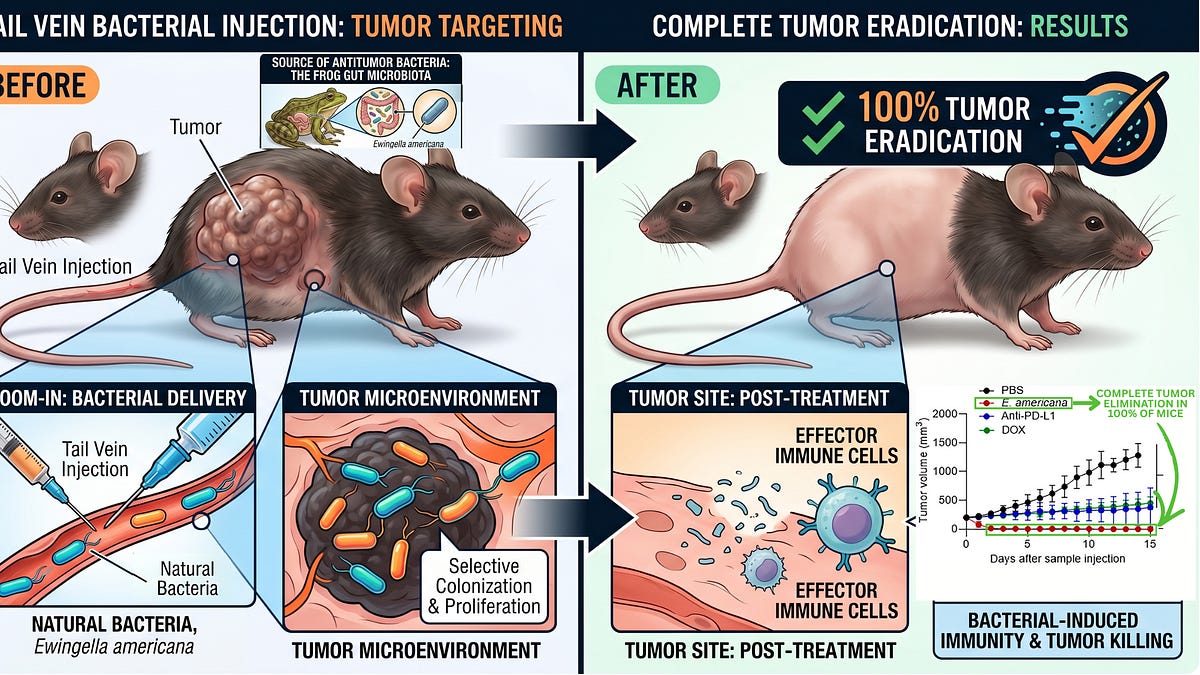
The article says
> The surviving contingent on the E. americana strain was evaluated for 60 days (Supplementary Figure S5).
The supplementary material only shows a reshot with cancer cells at the day 30. All the other parts also days a total of 60 days. At day 0 the cancer cells were injected, approximately at day 10 the bacteria were injected, and approximately at day 20 the cancer disappeared. So correct my initial comment and say that it's 40 days cancer free.
When the title says "eradication" most people interpret "forever". That is too optimistic and unrealistic, but a 5 years survival rate is somewhat a standard point. 15 or 40 days is too short to know if there are some hidden metastasis, they need more time to grow and be visible.
Also, the initial treatment is only 10 days after the initial shot with cancer cells. IIRC it's an aggressive cancer variant in mice variant that has a crappy inmune system. Gut cancer in humans are detected when they block the guts or bleed or in periodic colonoscopy every few years, so they usually have more than 10 days to develop before detection.
Note that this setup in mice is good for initial test and to filter the promising treatments as they did, but it's difficult to extrapolate to long term treatment of humans.
More like, what's a mouse gonna do about it?
For those unfamiliar with the reference, in Hitchikers guide to the galaxy series, Mice are projections of hyper intelligent extra terrestrial beings from a higher dimension who commission the creation of planet earth complete with fossils as a giant organic computer
> The three bacterial strains that successfully induced tumor regression (E. americana, C. portucalensis, and E. ludwigii) were all identified as facultative anaerobic bacteria.
> This finding is consistent with established principles of bacterial cancer therapy, as anaerobic bacteria possess the unique capability to selectively accumulate and colonize within solid tumors due to the characteristically hypoxic and immunosuppressive tumor microenvironment.
> This selective tumor colonization likely enabled efficient intratumoral bacterial proliferation and, in conjunction with activated immune cell responses, contributed significantly to the observed tumor regression phenomena.
Said in other words, the tumours created the ideal environment for anaerobic bacteria to multiply. Eventually causing a reaction from the body’s own immune response (which ignored the tumour but successfully detected the bacterial growth).
So one of the reasons this worked well was that the bacteria acted as a target for the immune cells, and they proliferated inside the tumour thus weakening it.
Anyway, 5 years is a long time, so I agree shorter times are useful and interesting. But, 5 years is used as an arbitrary threshold like in https://www.webmd.com/cancer/remission-what-does-it-mean so I think it's a good comparison to put "eradicate" in the title.
They make fun affectionate pets if you can stomach the idea that they will die on you.
> Outperforming chemotherapy and immunotherapy
And then later:
> As a facultative anaerobe, it preferentially accumulates within the hypoxic tumor microenvironment, where it rapidly proliferates and exerts direct cytotoxic effects while simultaneously activating a broad immune response. Within hours, tumors become infiltrated with T cells, B cells, and neutrophils, accompanied by surges in key inflammatory cytokines like TNF-α and IFN-γ.
So this is immunotherapy. Although it is clever immunotherapy. Gut bacteria doesn't usually survive long in the bloodstream because there's too much oxygen present (that's part of why it's gut bacteria, its unlikely to go all Leeroy Jenkins on the rest of the organism).
The TME is often so densely packed with growth that its less oxidative than surrounding tissue. So the bacteria that don't find a tumor don't last long enough to cause problems and the ones that do find one see it as a bit of a refuge from the problematic environment and colonize it specifically, throwing off whatever subterfuge the tumor was using to keep the immune system from getting involved.
It's a bit like throwing a brick through the window of a bank that was being quietly robbed by somebody else. The cops show up and realize they've been overlooking a separate problem.
https://www.imdb.com/title/tt0104839/?ref_=fn_t_1
In it, Connery finds what looks to be a rare natural cure to all cancer in the Rain Forest (spoiler: not a frog, but equally as weird), and is literally battling the nearby deforesting and bulldozers. For a Sean Connery movie it was bizarre (As a young teen, I saw it in the theaters.. quite a bit less action than a 007 movie but good drama and dramatic Sean Connery acting).
Connery definitely starred in even weirder movies. Have you seen Zardoz?
https://www.imdb.com/title/tt0070948/
https://m.media-amazon.com/images/M/MV5BNmI2NjI2OWYtMzU5NS00...
Oh, yes! Just once, but Connery, in just underpants and boots, battling some surreal head-shaped apparitions, is something I won't ever forget. I have no idea what the plot was about - but that's OK, because I had no idea about that either during or just after watching :D
A movie so bad it's kind of good - though second-hand embarrassment (at the performances, effects, plot, characters) was a bit hard to bear at points.
Buddy, if you're trying to tell me it's weirder than Darby O'Gill and the Little People, I am going to need more than Sir Connery in a ponytail.
Check out Zardoz: Connery with a ponytail, a pistol in hand, wearing thigh-high boots and a mankini.
And a giant flying stone head that vomits guns.
I am not joking.
Ewingella Americana itself is a quite common bacterial species, but it seems that the effective strain is the frog-derived and cultivated one. So don't go injecting yourself with a random E. Americana.
Full article: https://www.tandfonline.com/doi/full/10.1080/19490976.2025.2...
Curing cancer in a mouse model is not at all uncommon in new therapies. Mouse models like this are vastly easier to treat than real world cancer for a bunch of reasons. Fully curing mice is the baseline for a treatment to even be considered for further evaluation. And even then very few therapies end up succeeding in humans - low single digit percent.
So yes, another possible treatment. But not at all a breakthrough.
If it never works as well if at all in humans, maybe mice are too different?
This kind of treatment triggers an immune response, which the model tumors have never had to fight before. So it’s just an easy target.
EDIT: we did revert about 50% of the lawn to native wetland/prairie and we aim to raise that number over time.
With comments on the current post agreeing that the shadowy cabal will suppress yet another miracle treatment to keep for themselves, so the “goyim” can be sold poison.
Also who thinks -- "hmm we've found a new random bacteria --- let's give a bunch of tumors to mice and then IV inject this random thing into them!"?
There must have been something about the microbe that gave them a hint. Maybe it's in the cited original article and was left out of the blog post.
> happily
I think you answered your own question really, a lot of animals just enjoy eating them (humans included!)
Given that many cancer sufferers are immunocompromised, this isn't necessarily a silver bullet, although it is an interesting result.
One theory of where posts like this come from: https://www.pnas.org/doi/10.1073/pnas.2527316123
Thank you for this; I'd not seen it, but needed to.
Definitely changing, I'm not so sure about destroying. Your house displaced an ecosystem so you could live there but I bet in your ethical system that's fine right? What a surprise
Thats the most dangerous thought one could have. Simply thinking "its okay because we can fix it later" leads to taking issues lightly and hoping that a fix is eventually discovered in time. We run out of time with climate change for example. There are no fixes.
Backwards logic. If they're fond of it then they're the people to be arguing against, no?
And far better to be hiding, than watching and playing a fiddle from atop some convenient high wall. Or plotting how to destroy your fellow alpha arsonists next.
Seriously though, we are living in an era where the more the science broadens its horizons, the more it just looks like plain ol' witchcraft.
I'm hoping there'll be some uses for figs we haven't thought of, next ..
https://radiolab.org/podcast/best-medicine
They followed a 1100 year old medicine recipe and found the resulting salve was effective against MRSA in their test.
https://pdfs.semanticscholar.org/06ab/f83d30ec00bb902bb1aa37...
(Note: I am affiliated with the linked website, but I didn't write the article in question)
[1] https://www.damninteresting.com/coleys-cancer-killing-concoc...
Edit: Ignore me, I'm sleepy and can't read, lol
Eat more fiber and fermented foods yo
CPMV for Cancer.
Cowpeas are also known as Black-Eyed Peas; which are regarded as good luck and used to be in pastures and thereby human diets.
They get all the good medical breakthroughs.
Vs. there's a whole lotta of money to be made in mouse medicine.
Symbolic, perhaps?
Is there any other source?
Likely too late for a particular person in my life, but hopefully not too late for others.