957 points · by defrost · 4mo ago · 303 comments
So Adamala decided to ditch the cytoskeleton. One day, while tearing through the literature, she came across an interesting mechanism in a paper (opens a new tab). By attaching protein tags to a cell membrane, the synthetic biologist Reinhard Lipowsky (opens a new tab) at the Max Planck Institute of Colloids and Interfaces attracted other proteins to crowd around and physically bend the membrane, forcing the cell to divide. Following this approach, Adamala tweaked a cell-membrane protein and tested it in her protocells. After several tries, it worked.“
This is the novel bit.
> Some have also grumbled about Adamala’s efforts to draw attention to the work, which she says was rejected by Cell after one reviewer said SpudCells were not real biology. She then sent the 190-page manuscript to journalists, under embargo, even before she had uploaded it to the preprint server bioRxiv, where her colleagues could read and assess it. She says her group will submit it to a new journal soon. “It’s an unusual way of doing things,” says Kerstin Göpfrich, a synthetic biologist at Heidelberg University.
https://www.science.org/content/article/lab-created-spudcell...
https://www.nytimes.com/interactive/2026/07/01/science/spudc...
(Reviewers at J.Crypto subsequently sat on it for a year and then suggested I submit it to a journal on CPU microarchitecture instead.)
Novel research is uniquely susceptible to "cool but it's not part of our field", because that critique is entirely correct until the research gets published!
They have just bolted an unsynchronized physicochemical process onto the boundary of the cell. It doesn't coordinate with anything to do with the cell. Both cells don't get half of the dna. They built stochastic chemical scissors that only work if you make the cell less cell-like.
IMO this extremely, extraordinarily true. And in my experience, it's somehow even more true for disagreements among scientists. Even though every scientific field is, in some sense, about defining a shared set of extremely precise jargon. (I recall two very well-respected scientists screaming at each other about the definition of "acidity" for instance)
It's frustrating because when trying to engage in intellectually curious dialog on HN sometimes people will attack my character and get upset because our perspectives seem to differ on the meaning of a specific word. When trying to reconcile the meaning sometimes people get upset and dismiss it as "that's just semantics". Semantics is the meaning of words... If our disagreement stems from differing opinions on what the word means how else can we reconcile or discuss the topic constructively?
The last time this happened I think the crux of the debate was the meaning of "unconstrained capitalism". Pretty sure the other person and I agreed on everything (values wise) except the precise meaning of that term, and the misunderstanding led them to accuse me of being unsavory.
These exchanges tend to discourage me from engaging in HN for a while.
Yeah, I have a hard time reconciling this especially since biology and biologic research often involves things like enzymes which both aren't alive and are synthetically created.
I'm certain cell magazine has published articles on novel enzyme discovery.
That is flatly wrong.
https://en.wikipedia.org/wiki/Exoplanet
"An exoplanet or extrasolar planet is a planet outside the Solar System."
Imagine writing this.
That's being kind; it's a complete overreaction, simply put.
I've had papers sit in peer review for two years, get rejected, then when they are finally published the other editors of the journal that rejected them came crawling in asking for the next paper in the series and promising the front page. Worse they ran a news story about our paper _in the journal that rejected it_ saying how groundbreaking it was.
The only people who think peer review still works are people who have never used it or people who have never had a novel idea in their lives.
And for people who aren't in academia, lets just say the unspoken part: While one or more of the reviewers are actively trying to replicate the work so they can beat you to submission after rejecting you.
Uploading the manuscript to a preprint server and/or submitting to another journal, which Adamala is doing/planning to do, is the normal response.
Sending it to journalists beforehand is what I consider an overreaction.
TL;DR politics breaks everything.
This has become the norm in science, and all of the best labs do it now, except for a few toxic holdouts who incorrectly believe preprinting their work will adversely impact its peer review.
Can't blame her if she wants her line of research to stay alive
Instead, your learn about Biotic.
It's now the leading polity in the solar system and its environs. It bought Alphabet, OpenAI and Anthropic in a single day back in 2084.
Humans are no longer desired. Their reproduction is capped to an optimal minimum assuring the survival of the species as a relic.
For productive matters, Biotec preferes to rely on its biomachines. Imagine drones giving birth to offspring when traffic is at a peak. It takes more energy, sure. But no factory, nor workers are needed.
If left alone, machines would multiply out of control, instead of rotting to waste like in the olden days.
The article notes that this event actually occurred ~3.5 billion years ago, and suggests that the current hive-mind should buy a subscription.
[0] https://web.archive.org/web/20130124200735/https://www.pathe...
Reproduction, once we master its blueprint of course, is much less demanding: just provide the ingredients at approximate proportions and the chemistry will work its magic to provide a similar enough unit to achieve the required task.
Obviously, we'd have processes built that build machines for each of the individual tasks, or changing tracks to support new car models.
From my perspective, this framework of a factory could map to many other endeavours where we either produce the end product or a machine used for something else.
So, the difference would be whether the machines utilize chemical/biological processes for working, or are made out of steel, at which point it would boil down to economics.
I guess I don't see what's so special about adding 'bio' to these perpetual factories.
And yes, science it seems is advancing faster than we might be aware of.
in case you didn't know, your immune system WILL detect left handed pathogens, possibly more aggressively, and two of the body's mechanisms for fighting infection -- fever and ozonolysis -- are distinctly achiral
Arguably we should push for mirror life for industrial purposes FASTER because biocontrol is easier (they got nothing to eat) and lab escape is far less likely
> (they got nothing to eat)
They can eat fats, that are not chiral.
Perhaps they can eat some carbohidrates, all carbohidrates are chiral, but some bacterias may eat some of the unusual carbohidrates too. But amino acids are beyond any possibility, and fixating nitrogen is hard, so I also think they will starve to death very fast.
> Biotic is a public-benefit nonprofit research organization developing chemically and functionally defined synthetic cells. Biotic's mission is to responsibly enable and steward foundational advances in bioengineering. Our goal is to ensure that all people and the planet benefit from world‑leading biotechnologies soon enough to matter. We conduct and support public‑benefit research ranging from foundational science to how people interact with biotechnology.
It looks like this particular research is conducted at the University of Minnesota
A few things that confused me while trying to read the paper:
- There's two different methods of cell division mentioned -- mechanical extrusion and the autonomous, protein-driven division. Most of the results (e.g. the five generations) focus on the mechanically driven one, while the autonomous one is more "lifelike". Does the autonomous division have a higher failure rate, or can you get the same results with it as well?
- It's mentioned that the bottleneck for survival of many generations is ribozomes degrading, but also that ribozomes are supplied from the outside. Do the degraded ribozomes actively harm the cell? Or is there some other reason why they cannot be replenished?
- You say that after 5 generations, only 30% of the cells have the correct genome, and it's presented like a problem -- but 30% of 2^5 is more than 10, so this sounds like more than enough for continued survival. Is there something missing in this train of thought? Perhaps other failures that can kill the cell?
And some questions about the implications:
- Do you think that the genome you use is already close to minimal? AFAIK a lot of the minimal organisms found in the wild are parasites of some sort, getting most of their complex molecules from the outside, which is a similar spirit to this (a rich medium and the cell "just" self-duplicating). If the multiple plasmids are causing trouble (per the previous point), would it make sense to try and get rid of some of them?
- Are those minimal genes somehow interpretable -- as in "you need functions X, Y, and Z and cannot avoid them by using a better medium"?
- Do you think this is a plausible stage of very early life?
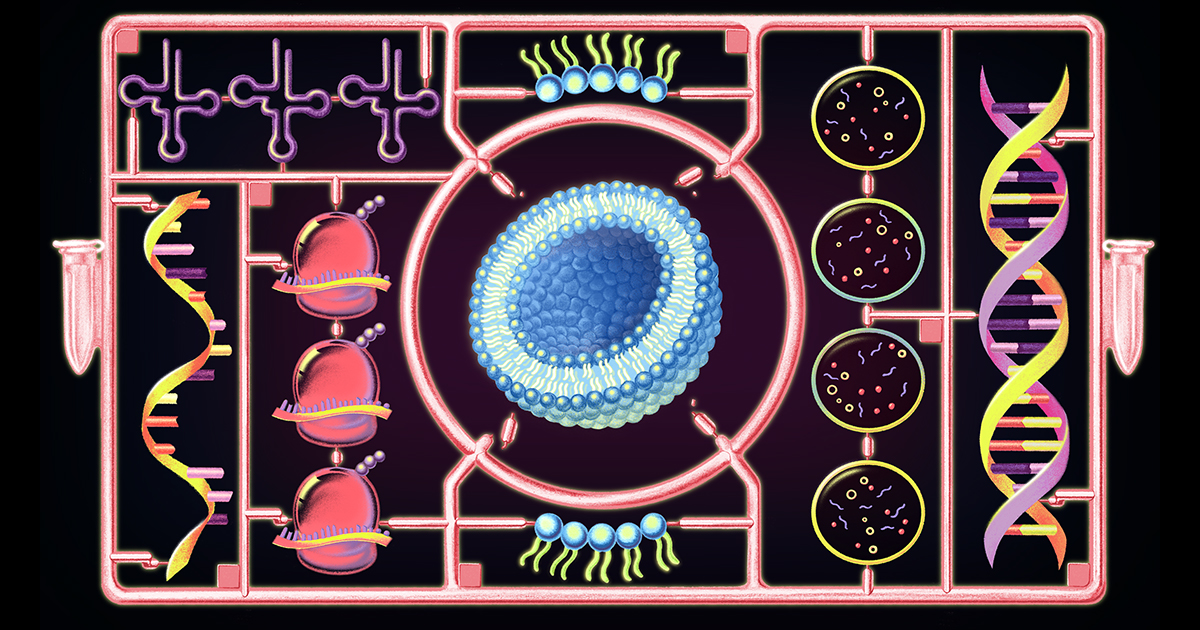
Something like, all forms of life share a common ancestor.. until now
I think it will be a missed opportunity to not foresee manufacturing applications of "biological machinery". Enzymes have long been used in manufacturing, especially in chemistry. For the first time, ribosomes and membranes could be used as well.
In eukaryotic cells (your cells) the cytoskeleton is needed to shape the cell, position DNA, and most importantly for this study, separate daughter cells allowing replication. Think of the complexity here, you need to make compartments to separate the copies of the genetic material, physically separated during division. Microtubules assemble the "mitotic spindle" and then pulls the sister chromatids apart from each other. After the chromosomes separate, other cytoskeletal filaments (actin and myosin) form a contractile ring, which tightens to create a cleavage furrow. The membrane pinches inward until the cell splits in two.
Bacteria work slightly differently, since they don't have a eukaryotic cytoskeleton, but they do have cytoskeletal-like proteins (FtsZ), since they divide by building the cell wall inward (I am not an expert on bacteria lol).
SpudCell doesn't have a cytoskeleton, so instead it relies on a physical membrane-rupture strategy. It makes membrane proteins from its own DNA (a-hemolysin), which inserts into the membrane. They help fuse with feeder liposomes for growth. For division, these proteins crowd on the membrane surface, creating mechanical stress which leads to membrane instability, which then splits on its own.
I suspect that, once scientists lean more into the right kind of communication with these systems that many substantial leaps forward will be made. I am very excited about it too, mostly because I think it has the potential to positively impact how we see ourselves (humans) in the natural world.
This Cell Feeds, Grows and Reproduces. and It's Manmade
https://www.nytimes.com/interactive/2026/07/01/science/spudc... (https://news.ycombinator.com/item?id=48747038)
There is another submission on Hackernews which talks about: The first early human eggs from stem cells[0] which is an interesting discussion to read through on hackernews as well.
I don't think I've ever seen researchers do PR like this directly. Interesting approach, will it become the norm?
Also, go MN!
Or like a grad student didn’t dispose of their work properly and are desperately trying to distract from their scandal.
We have always theorized the start of life but this could actively show that life could have started on a rock floating in space given enough time. No sky daddy and no aliens necessary!
From my point of view: a team combined all the tricks in the community into one machine and we finally created a new life form to play with!
Not sure what that is in this case.
Out of curiosity, do you use Claude a lot and did you pick up the saying from it?
Are you Claude?
Or just a coincidence?
https://books.google.com/ngrams/graph?content=is+doing+a+lot...
https://en.wiktionary.org/wiki/do_a_lot_of_work
A random example from 1991:
https://www.google.com/books/edition/Object_oriented_Program...
Of course Claude picked it up from usage; it didn't invent the phrase. But I don't see any indication that it's uniquely Claude-y. I use the phrase on occasion myself.
Oh I dunno, maybe create synthetic organisms capable of rapidly destroying all life?
That is the holy grail? I get that the goal is to "grow" biofuels, plastic, fertilizer, drugs, or whatever else we can imagine. But is that worth the many apocalyptic sci-fi outcomes we can imagine?
“Penicillin?! A poison from fungus that kills living cells?! Haven’t you played the sci fi game The Last of Us?”
Stories are stories, man. Story-logic is biased towards interesting tales. And “discovery from the natural world turned to human aims with great results” is uninteresting because we do amazing things these days.
Also known as the fallacy of “generalizing from fictional evidence”.
https://www.lesswrong.com/posts/rHBdcHGLJ7KvLJQPk/the-logica...
I don't spend any time on LW but perhaps that is because I'll have to face that all my ideas have already been explored more eloquently by him and the communities he's part of.
It would be a lot easier to set those warnings aside if we didn't have so many examples of the very things they warn about happening in real life.
We currently have a system where private individuals can fund private science and then deploy the results globally to their own profit with very few mechanisms for enforcing restraint and caution. And we've seen this backfire with horrific consequences over and over again.
Lead in the gasoline. Microplastics in the water. Pesticides widely applied to the biosphere. In my area PCBs are a massive risk due to past soil contamination. In other areas fracking biproducts make the water undrinkable.
Hell the AI rush in the face of climate change. We literally have heatwaves killing massive numbers of people while a tiny handful of investors and the companies they control are drastically increasing our carbon emissions in the race for AI.
It's easy to imagine all the ways in which synthetic life could go horribly wrong, even with out those sci-fi stories, especially since all but the youngest of us have been through a brutal pandemic in living memory.
It's very, very hard to imagine our current system showing proper restraint with this technology.
Ever since the industrial revolution, humanity has stumbled from one environmental disaster to the other.
Heavy metals, CFCs, acid rain, radioactive elements that don't occur naturally, microplastics, PFAS, large scale oil spills, greenhouse gasses, deforestation, over-fishing, species extinction, the list goes on & on.
And in each case, early warnings are ignored & the harmful activity is only curbed many decades after deployment at scale, when environmental harm becomes too serious to ignore.
Imho AI is no exception to this rule. Its energy usage alone adds to CO2 emissions at a time those should be reduced. Higher efficiency says anyone? No! Higher productivity. Read: same # of humans can consume even bigger amount of resources per time unit.
Yeah I can envision the wonders AGI/ASI could bring to humanity. But as deployed right now, it mostly helps to worsen a number of problems in human society (CO2 emissions, wealth inequality, concentration of economic/political power, to name a few).
Synthetic life? Absolutely, would be a fantastic scientific milestone. But could also turn into yet another eco disaster.
Natural life tends to evolve, which may have consequences for production.
For example, quorn production has to be restarted from a seed population after ~1000 hours because it tends to evolve colonial variants that break the product standards: https://www.davidmoore.org.uk/21st_century_guidebook_to_fung...
Their "minimal" cell is not quite a minimum product because it depends on prebuilt ribosomes and can't reproduce on it's own. No danger of gray goo!
This is more like it
https://www.jcvi.org/research/first-minimal-synthetic-bacter...
but those guys could probably add components to their cell to make it truly self-supporting although in biology there is a big difference between "barely works" and "high performance"
At one end we're creating artificial life, the other we are creating artificial intelligence.
We're coming at everything we as the human race have known for millennia from both ends, simultaneously. We're recreating that, from scratch.
That is absolutely fucking wild.
Ironically this "holy" grail will end up being the thing that finally puts religious creation myths in their place (i.e. as bullshit) since we will be able to answer with 100% certainty that we are not alone or unique in the universe since we recreated life in the fucking petri dish so why not across the billions and trillions of other planets out there?
What a time to be alive.
I don't think we are alone, but this is not logically sound. The conditions in the petri dish might be easily so special that their natural prevalence is < 1 per universe.
How does it affect religious ideas per se? its something many religious people long to find https://www.theatlantic.com/culture/2026/06/disclosure-day-a...
We thought evolutionary theory would do the same, now we got people who believe god directed evolution. Some believe everything evolved from a common ancestor except Humans.
So the believers will adapt to believe that Genesis was talking about exactly this.
Mainstream Christianity was not biblical literalist anyway. Read what Augustine or Origen had to say about interpreting Genesis.
You can’t win
> Ironically this "holy" grail will end up being the thing that finally puts religious creation myths in their place
I think you're way out of your depth here and making things up. The first tell is that you use "religion" as a blanket term as if all religious traditions make the same claims, which they absolutely do not. You can discredit, say, Mormonism much more easily than, say, Islam (though, ironically, there is a strange structural similarity between the two).
> we will be able to answer with 100% certainty that we are not alone or unique in the universe since we recreated life [..] so why not across the billions and trillions of other planets out there?
Who exactly claims that human beings or, generally, life on earth is the only life in the universe? None of the major religions do. I'm also going to assume that Christianity (or some caricature of it) is for you the paradigmatic reference point of what constitutes "religion", in which case there is nothing in Christian theology that excludes the possibility of life - even embodied intelligent life - elsewhere in the universe. (The latter is actually interesting from an ontological perspective. If the definition of "human" is "rational animal", then by definition, all rational animals are human. So, from an ontological perspective, even if an intelligent, phylogenetically distinct species were to be found on another planet, ontologically, they would also be human.)
May well turn into a time to better be dead.
I’m no 7 day creationist but haha my guy…
Kurzweil puts it between 2029-2032 and that seems right to me
If you can disassemble and reassemble a thing, you can say you understand it. Not perfectly. But understand it. I’d imagine properly understanding rudimentary cellular biology will come with perks.
(Also, does the Holy Grail imply both a boon and a cost? Or is that just Indian Jones.)
The thing that they made is more alive than a crystal, which when placed in a suitable solution will grow and reproduce its own structure, but much less alive than even the simplest known living cells.
Its "life" is similar to that of a brain-dead human, whose body is not left to die by a bunch of machines that pump air into its lungs and nutrients through its blood vessels.
The techniques developed to make this pseudo-cell might evolve eventually into techniques able to make a true cell and it is likely that valuable information can be extracted from experiments with it, but it is very unlikely that any of the ancestors of the living beings has ever had even a remote resemblance with this (because it is far too dependent on continuously receiving complex cellular components and nutrients from outside; simplified parasitic living beings could appear only when there already existed sufficiently complex living hosts for the parasites).
Some components of this thing are growing by reproducing themselves, but like I have said, so does any crystal, thus it is difficult to choose a criterion that will distinguish with certainty what is living from what is non-living.
The growth is followed by a kind of division into 2 vesicles, but that happens by a mechanism very different from any living cell. Many inorganic things will split when growing over a certain size, so again it is hard to decide whether this can be called living.
A brain-dead human is alive, but just facing systemic collapse, aka death. That's not to imply that what the scientists here have created is alive, but the comparison isn't so apt.
OK, what I have said above is not generally true, as some brain-dead humans may be more alive than others, e.g. some integrative functions, like some feedback loops that function through the endocrine system or through the autonomous nervous system, may still be working, connecting some organs with each other.
My comparison was with a very dead brain-dead human, who was reduced to the equivalent of a tissue culture.
These artificial cells also have some components that continue to work like in a living cell, doing some nucleic acid replication and some protein and lipid synthesis from precursors provided from outside, but they lack the capability to perform many of the chemical reactions that would be needed to close the complex network of feedback loops that enable a true living cell to live autonomously.
Custom metabolic pathways to manufacture materials could be more easily implemented with cells that are fully synthetic.
If the entire cell is synthetic its more easy to simulate it's full behavior and then it's faster to iterate on it during development.
Its really easy now to engineer novel deadly viruses thanks to alphafold3
Anytime you do something interesting or useful someone accuses you of trying to build the apocalypse.
I suppose I can see why. But at the time I was just curious about the idea of "mule" cells.
Replicating eukaryogenesis with synthetic components is something I hope to see in my lifetime.
Because no one minds if good things happen...
Will they be hated? Killed off? Will they ever be see as legitimate, or just soulless beings, p-zombies.
Similarly a program that runs on a computer, where its only interactions are strings of numbers is the same as an entity having to interact with the world.
We could launch these custom bacteria in stasis to planets around the galaxy and seed life everywhere.
So in the future when there's a lab leak from the Wuhan Institute of SpudCellular Biology, the SpudCells will devour all biological life they can in order to harvest the building blocks they need. "Just social distance and wear two masks," the Surgeon General tells the CNN correspondent, as he disolves to red gray goo on live TV.
Contradicting themself in the same paragraph.