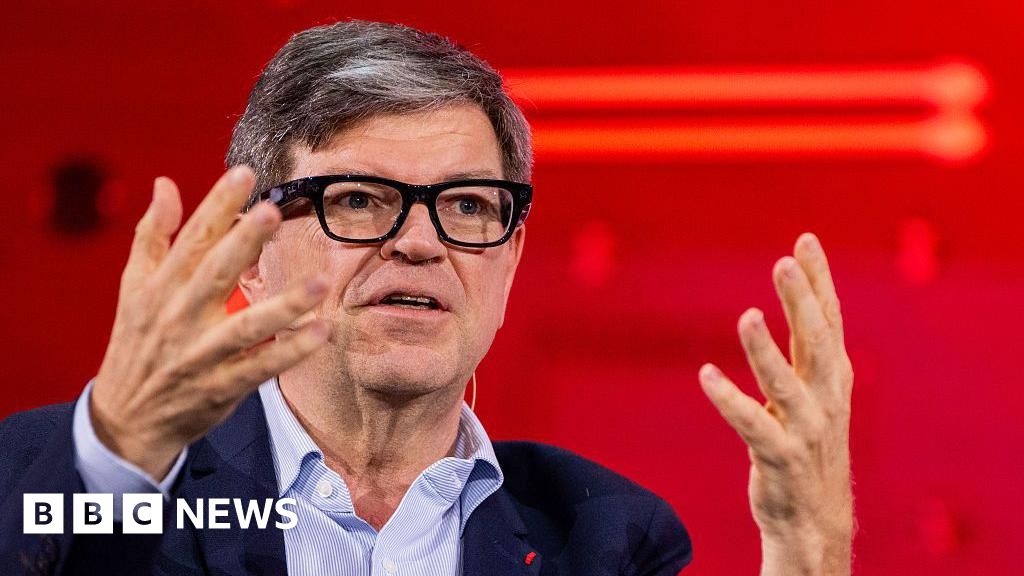
Artificial intelligence: Yann LeCun works on more flexible AI
Leading AI researcher Yan LeCun has a start-up which is developing a more flexible AI system.
bbc.com
44 points · by 1vuio0pswjnm7 · 4mo ago · 75 comments
and then models learned that they can back track and error correct
so much for "mathematically impossible..."
You mean "Human developers learned ...", yes? Or was there really an all AI-driven, self-improving aspect to this?
I doubt that this was AI self-improvement.
I suppose it's additionally trying to imply something else, like "due to a pattern of researchers being unable to discover discoveries before they discover them, AGI is just around the corner".
I very commonly see someone make some small mistake and end up going in the wrong direction, “accumulating stupid” as they go, sometimes for years.
AI can not.
For those disagreeing: please explain how a static hardware can learn.
Not only that... AI is NOT only learning during the training phase... LLMs learn in real time the minute you talk to it. It learns something and saves those learnings in a context window or somewhere else if you want it to exist beyond the context window.
All of the above runs on static hardware. Don't understand how someone can say a profoundly wrong statement and get voted up.
I never ask Opus or Fable a question and think "what a stupid response".
Quite the opposite. It has actually raised the bar of what I consider an intelligent response to my inquiry. So much so that most responses from humans on most subjects to most forms of inquiry seem stupid and not really thought out.
This isn’t exactly saying how stupid anyone is but I’d definitely have been concerned about a human’s reasoning ability and understanding of logic if they’d given me similar answers.
That's the first time in my life I hear this definition. Until now, the word "smart" has meant doing exactly the things LLMs do, and mice don't.
I guess it is a sign we are re-evaluating what makes humans special.
Always has been: https://en.wikipedia.org/wiki/AI_effect
Tangentially: https://en.wikipedia.org/wiki/Moravec%27s_paradox
For example, initially, a "planet" was just a big body in space. Then when people started to see more and more nuances, the definition just refined, and some objects stopped being called "planet".
I would not be surprised if there is a bias that pushes some people to redefine "intelligence" away from machine, but I would not be surprised if there is a bias that pushes some people to ignore newly discovered nuance and put into the same "intelligence" bag things that are in fact very different. I personally can see how LLM are not really "intelligent", and I don't think it is a good idea to say: well, yesterday we said the minimum criteria is X, now that we noticed that X can be reached without really doing the real thing, let's just ignore that and pretend it is the same thing.
(
: the biggest clue for me is to use an early model, and see that it sometimes looks very intelligent, and then sometimes you can see that it gets it wrong in a way that shows that it never "understood" it at all. Newer models are better, but because it is an iteration on the same bases, the increase of performances cannot really due to replacing the things that "looked smart by aren't" by "real smart", but more replacing the things that "don't look smart" by "look smart by aren't")I don't think we even need to go into tech and AI for an example. The intelligence or lack thereof of pets surprise us. Sometimes a cat is surprisingly smart when it is able to open a door to get food it wasn't supposed to. But then same cat gets bamboozled by walls and simple optical illusions. We generally expect that if something/a human is smart enough to do the former, then it shouldn't be dumb enough to fall for the latter.
Coming back to AI, this dissonance is how AI-generated images are detected for example. If a human can render something so well, you wouldn't expect them to make small but nonetheless elementary line art mistakes.
Every time this comes up, people pick on any kind of flaws or inconsistencies of AI models, while at the same time giving a huge pass to the extreme variation in intelligence and stupidness displayed in human behaviour.
Creativity is the same. Human artists are "inspired" by earlier arts, perhaps following and slightly changing "trends" they participate in -- which is somehow seen as totally different from what AIs are doing.
This isn't a great analogy, because part of the challenge would be preventing myself from picturing the spelling in my head. But my point is, the AI is not getting the words as letters. The correct solution is tool use.
Fine, that describes theorizing.
But then a contradictory ending statement: "We're still going to need humans to figure out what questions to ask, what to build, what to create".
So that's moral theorizing. I don't think you can have one without the other. Then there's two more suggestions before the end of the article:
> smarter than us
> staff of assistants
Both of which are completely gratuitous assumptions. Why should its theories be better than established ones? Is it supposed to be a maverick hermit genius and come up with everything from first principles, or does it in fact participate in the existing world of ideas like a normal person? Then, being a normal person with moral theories, why would it take on the role of assistant rather than theorizing "I don't want to do that for you"?
For me, "smart" means doing things less based on instinct. Things humans can do but mice cannot, things mathematicians can do but normal people cannot, etc.
Considering the unit distance conjecture was disproved by OAI's model last month, I think maybe LLMs should count as "smart".
I hope not but your observation on YouTube is spot-on. It's really frustrating. I've managed to keep good hygiene for my shorts feed. I practice zero-tolerance for braindead content; one strike is all it takes for the "never recommend" button.
But with the World Cup, the situation is just pandemonium. Football has always been breeding ground for low-effort content on the platform: unofficial highlights, cropped to death to avoid copyright, and always, for some reason, with a blaring background music. But now it's reached peak slop chaos: AI voiceovers, dubious anecdotes ("...and that kid, was Ronaldo"), and STILL the horribly blaring background music. The algorithm makes no distinction between quality and slop content of a topic. It's all just about the topic. So all it takes is for me to view a short related to football (even one of thoughtful commentary) for the slop to come in hordes.
At least I can now share in this forum's disdain for shorts. Kill that shit with fire man.
The models work remarkably well for several classes of problem that seemed impossible a few years ago. They're not going away. There will still absolutely be a lot of ups and down and crazy stuff that happens in AI, but it won't be that AI almost completely stops being developed/funded for a decade or more. The biggest risk, I think, is regulatory capture; it's what Anthropic and OpenAI seem to be aiming for with their scaremongering about how capable and dangerous their models are. That'll put a damper on the industry for everyone except the companies that bribe the right people.
Which, judging by the terrible PR optics AI has nowadays, could unfortunately seep into academia too. Fund grants wouldn't want their names associated with anything with "AI" in its name even if it's a return to expert systems.