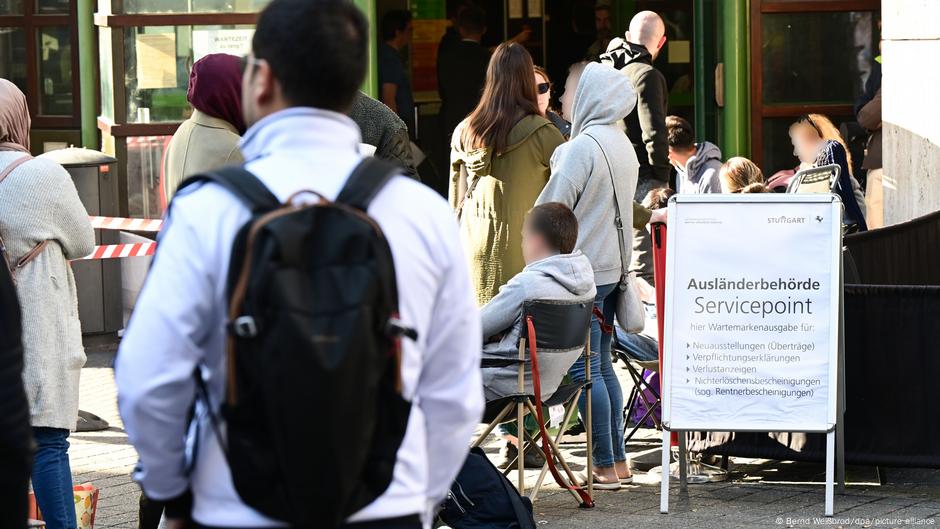
Why migrants come to Germany for work and then leave again
Germany has long attracted skilled workers to its labor market. The country has been much less successful at retaining them. So what is Germany doing wrong?
dw.com
290 points · by theanonymousone · 4mo ago · 849 comments
I don’t usually comment on topics like this because there are so many biases and different perspectives involved. In the end, I believe only the person who has actually gone through the experience can truly understand it; otherwise, it often becomes just another judgment.
We are an ASEAN family earning more than €200k gross annually (sorry for mentioning the TC, but there is a reason for it—please keep reading before judging). We have lived here for more than six years, and you know what? I still haven’t obtained either permanent residence or German citizenship simply because I don’t have a B1 certificate. So first things first: regardless of how much you contribute to the country, German is a must today if you want to obtain residency and stabilize your life here.
I was honestly devastated when the officer told me that I was not eligible for permanent residence. That was also the moment when I started to feel that maybe I don’t actually need permanent residence in this country after all.
Story 2: In an international working environment, German may not matter much at the IC level. But I’ve seen countless situations where Germans exchange a glance with each other, and suddenly the final decision is not what was agreed upon in the meeting. Over time, I’ve learned that there are many unwritten rules behind the scenes, and when you speak their language, you start to understand them.
One bright thing is that maybe we’re still lucky. We bought our first home without fully understanding the laws, the government system, or the tax rules. We simply worked hard and played the game in a way that we believed would be sustainable in the long run. Whatever happens, we know there are still many other places we could go.
Our children speak German natively, but they are also willing to go the extra mile to speak our mother tongue at home.
If you ask me for one piece of advice for immigrants and emigrants in Germany, I’d say: life is short—play naked!
- understand the main points of clear standard speech on familiar topics such as work, school, or leisure - manage most situations that occur while traveling in German-speaking areas - produce simple, connected text on familiar subjects - describe experiences, events, dreams, hopes, and ambitions, and briefly explain your opinions or plans
That seems like a reasonable standard of native language proficiency to ask of people who want to make the county with said language their permanent home.
[1] https://www.sprachenatelier-berlin.de/en/topic/3736.german-p...
It's also the kind of requirement that's made explicit on government information about residency. So it shouldn't have been a surprise.
What the article is covering are the skilled workers, and for them B1 isn't nearly enough to function in any profesional capacity. I'd put B2 as a bare minimum for that. So if it's impossible for someone to find employment in the language they already know (for skilled workers it's usually English), they are understandably not eager to stay.
For those who are quick to judge, try mastering a foreign language (and German is noticeably more difficult than English, French or Spanish) in another country where you don't have any support system yet, and with likely some suboptimal job (as you need this foreign language to find a decent one). Getting to B2 takes about 750 class hours (not including homework) for an average English speaker. That's an enormous investment (of both time and money). One will have to sacrifice entertainment, socializing, hobbies, sleep, and work-related educational opportunities for several years in a row, depending on abilities (and the language).
And just a reminder- most people tend to overestimate how well they know a foreign language. Telling you know [insert your flavor of Chinese] and actually passing an exam are two different things.
Again, I am not saying it is unfair for country officials to expect whatever language level they want. It is their country and their rules. As far as I understand nobody's talking about giving away passports.
It's just when it's relatively more difficult for skilled immigrants to find employment and interact with said officials without high level (at least B2) German, some of these immigrants will chose in favor of the countries- with easier/more widely used languages and/or more jobs in English or just lower taxes and higher pay.
If a country's government wants to attract these kinds of immigrants, some of these variables will have to change
english is the best language for business and everything else.
I don't really see what a good salary has to do with it either. When it's hard for me to communicate with a neighbor or coworker I don't care whether they have a high or low salary.
This person lives in a very international city where they speak English at work. For some people it’s not as easy to get to B1-B2 levels while working full time, having children and using English to communicate daily without issues.
In many EU countries requirement for a permanent resident status is just 4-6 years of residency, plus sometimes certain income/language level. And there is always EU permanent residence permit that just requires you to reside for 5 years.
These people typically call themselves "expatriates"
If you want to learn a language, the absolute best thing you can do is to be completely immersed in it.
I know lots of English speaking people who have settled in non-English speaking countries (or at least countries in which most people do not speak English as a first language) with little knowledge of the main language(s).
I cannot imagine living in a country for over a year and not taking the effort to lesrn the language.
The joke is on them, though, because I happen to speak impeccable Spanish with 40 years' experience, and I've successfully intervened when the app inevitably misdirects the driver.
I also happily greet drivers in Arabic, Hebrew, Hindi, or at least try to understand what country/dictatorship/failed state that they've emigrated/fled from, to be driving in the United States.
But that’s really a bit nitpicky, and the actual point I wanted to make is as follows: B1 is something like five uninterrupted years[1] of consistent lessons. Somewhat less for closer language pairs like maybe French to Spanish, potentially a lot more if the language is foreign enough that you need to build your vocabulary from zero; and keep in mind that the typical foreign-language class in middle or high school tends to go a lot slower so isn’t a good reference.
Uninterrupted is never going to happen for an immigrant who needs to find their footing for basic survival and, for the first year or two, also juggle the multitude of individually small demands of an unfamilliar environment (do I want a broker to help me rent an apartment? how do I deal with the healthcare system? where can I find a decent plumber? what’s the public transport situation? nobody writes this shit down). As an immigrant, you’re on the hard setting by default regardless of salary, and then you add an extra 2–3 hours per week of language classes and perhaps double that in homework.
None of this is to say it’s unfair to demand B1 if you want people to integrate. It is to say that the, realistically, seven to ten years of effort are in no way a small deal, and if you want people to integrate then you need to make the incidental stuff, i.e. everything else, as straightforward[2] as you can. At the moment, the incidental stuff is about as convoluted as possible more or less everywhere[3] and feels like it’s designed to make you lose at every step, partly because it is. That’s the natural state of affairs (like prison inmates, immigrants don’t have anyone to advocate for them so the system just drifts where it would), but not the one you need if integration is your actual goal.
(Israel is probably the only place to get a pass on planning because they took the extraordinary step of writing fucking manuals, in six foreign languages, for a lot of the implicit knowledge—at least to the extent that a government-endorsed document can be honest about things.)
[1] The estimate of 350–400 class hours that I see in some places feels wildly optimistic to me. That of 1000 hours for C2 feels like downright mockery.
[2] Straightforward to understand, not necessarily to pass.
[3] No specific experience with Germany, for the record.
> B1 is something like five uninterrupted years[1] of consistent lessons.
If you go to lessons twice a week and dont do much else, yes. Or, if you go duolingo 15 min a day way. Otherwise no, it does not require 5 years. And what you need the most are not so much lessons (tho you need some for grammar) as watching and reading of basic media - and german has tons of those.
Personally I've gotten to B2 (not Germany) which is enough for most purposes, but it would have been very possible to get stuck in a rut.
It's very common for couples that move here for one to have a job, and the other to spend some months unemployed looking for a job. It's generally observed that those that have the job learn the job much slower and get stuck, and the ones that spend time at home and looking have much better outcomes longer term
I still can’t pronounce about a third of the Vietnamese sounds. I’ve had three private in person tutors, no luck.
Should I just like pack up my bags and leave?
> The requirements [to possess sufficient knowledge of the German language] shall be waived if the foreigner is unable to fulfill them due to a physical, mental, or psychological illness or disability, or due to age.
Though I would recommend setting yourself a target of some small (≈10) number of new words to learn every day and practice them during your commute or so. B1 is achievable in under a year with consistent practice. The official word list has 2400 entries: https://www.goethe.de/pro/relaunch/prf/de/Goethe-Zertifikat_...
I am very certain this is not true. The "just learn the language" people are typically rather people who are very talented in learning new languages (and often indeed to this as adults as a personal hobby - often even with languages from very different families), and thus are often not easy to convince that not everybody is as talented in language learning as they are.
Believe me, I know this kind of people:
I just want to quote some polyglot person who very casually said: "Being fluent in five languages is not something to be proud of - this is rather minimum standard." (she had the opinion that rather keeping fluent in 10 [!] languages is something that takes steady learning efforts to retain the obtained level in all of the 10 languages).
Having learned czech, I only had 1h30 a week and it took me 5 years to get to B1. I agree that the steps to A2 are much simpler because it focuses more on simple phrases and vocabulary, so you also learn it outside of the classes by reading descriptions, signs, menus. For B1 and up, you definitely need to practice by having deeper discussions with people or reading articles.
It's honestly absurd to make the case that you don't have time to learn the language of a country you're spending 100% of your day in.
What are you doing all day? The people who are struggling to learn a language tend to be the people who have zero pressure to learn a language.
The most time consuming part of language learning is immersion, meaning that you just listen to or speak the language, without going out of your way to do any language lessons at all.
It just requires turning your rational mind off, immersing yourself in the language and trusting things will work out, something which more rational/analytic people tend to struggle with. It's telling that children from non-English countries naturally become completely fluent in English by just playing video games and watching YouTube videos, while adults will struggle for years to reach conversational fluency in their second language.
Citizenship? Absolutely, you must speak the language. Residency? Not nearly as common.
Hmm, is that really the case? Or perhaps you're confusing work visas with permanent residency? Most attractive destinations for immigrants usually require a language test for PR. Ignoring the United States and its dysfunctional immigration system, a language test is required or practically required almost anywhere there is a points-based system to obtain PR. The UK requires a language exam to be granted leave to remain. Canadian federal programs for PR require a language test result to even be considered for the Express Entry program. In Europe, Germany, Austria, Denmark, Norway, Sweden, Italy also require it, and I'm sure there are more I'm not aware of.
Also, B1 is honestly a very basic level of proficiency with the language. It is really hard to be a productive member of society and interact with locals if you cannot speak at a B1 level.
________________________
Footnotes:
[1]: As long as at least one parent is a permanent resident and has in Germany for at least 5 years (the same duration that's usually required to become a permanent resident anyway)
This statement is clearly false, off the top of my head only USA and Spain come to mind. There are some countries like Japan where there it isn't a hard requirement, but you'd need a very good reason to justify why
For example: 1) Low birth rates and high ageing population percentage, this can be offset with immigration. Then PR status can be granted, as a kind of carrot and better tax revenue generation "filter". 2) Labor market manipulation and facilitating international business, where immigration is used to fill holes in various industries.
Why a country would want to grant PR, usually has different purposes from citizenship. There is overlap, but they aren't the same.
It's quite audacious to want to be part of a country, but also to be so quarantined from them as to not even want to learn their language.
I doubt that Germans see it that way.
That’s how deals work, both sides state their position and either they find a middle ground or they don’t.
To be fair, I have continued learning German—not because I want to pass the B1 examination and obtain permanent residence, but because I feel my children need to be protected and guided, and I want to teach them the same things they learn at school. Every moment I spend learning the language is a moment I invest out of love, so that I can be a better and more supportive parent.
Simply making higher-than-median income should not make you eligible for permanent residency. Cultural immersion and assimilation is important to maintain social stability and language is just the first step. From what I found (and as another commenter pointed out) the bar is not even that high.
Edit: For context I am not a right winger and am an immigrant myself. But I am seeing the social fabric of my host country (Canada) degrade because of immigrants' refusal to assimilate.
BUUUUT, even with B2, it's just not enough for avoiding "the look", as you put it. I think you need flawless C1 or something, idk. Don't care anymore lol.
B2 should mean one is confident in most conversational situations. I’m at this level and have no issues conversing at all but make a lot of small mistakes.
With that being said, being in a meeting with a group of natives from the same region is brutal.
And learning that dialect is just something you can only do through exposure which you won’t get because nobody is going to hire someone who takes a few months to a year to be able to understand and speak like you (which is completely understandable).
Any specific examples?
I'm a bit surprised because I thought that the German certifications were quite standardized. So I would expect B1 certified people to be able to speak in everyday situations.
One of those is an honest attempt, the other one is pure hostility.
For me it doesn't really matter how well you speak the language.
Residency is purely about taxes, health insurance and right to work. You e.g. don't get voting rights in national elections.
EU citizens automatically get permanent residency in any EU country regardless of language.
E.g. I'm a permanent resident in Germany as a Dutchie.
(However I did end up picking up German and speak it now. But never had to do a language test)
Yea free movement and choice of residency is one of the main points of the EU
First of all, if you want to become a resident somewhere you must learn the language. Not should.
Second, no country owes any foreign citizen residency there.
I honestly can't image planning to live in any country for the long term without learning the local language to at least this level.
My partner, an American, is fluent with the language so it helps. My plan is to make a good amount of savings, take a year or so of sabbatical and finally learn the language. Until that, we go with bar Deutsch.
Honestly, you brought up a valuable point that I didn’t cover in my original comment. Living in Germany has been one of the best ways to strengthen our relationship, especially when one of us couldn’t speak German and the other stepped in to help. Some people may see this as a fragile vulnerabilitye, but I see it as part of our growth.
Just need to say stop one day, take a year off and go to language school.
P.S. I don't think it's the same company: the other devs are either in Paris or in Scandinavia.
That said, personally I'm thankful for Quebec having been the forcing function to learn French.
With no prior formation to reach "intermédiaire avancé" took me about 20 months of studying on the side with one lesson per week for most of that time; usually before or during work hours (partially was a group setting there).
I'm a German native speaker so I'm probably biased / ignorant about some major language hurdles but to me German must be the easier language to pick up for most as it's way more regular.
I think the trick is to make a deliberate choice / opening up to love language and people, speaking with as many native speakers as possible etc. It also really helped me to almost exclusively switch to consuming French news and most of other media.
I'm not a fan of dubbing in general but for learning, Hollywood movies in French have been mostly great same as with German translations. Maybe watch older movies, they used to put in an unreasonable amount of work into those especially.
Computer games I'm personally still playing mostly in French to this day and I know that German translations are usually done with a lot of heart as well.
Edit: do check out https://www.arte.tv/de/ if you haven't - one of our favourites for both French and German of course; probably one of, if not the best TV worldwide. Always especially palpable after having been on youtube for a while too long; just the opposite of engagement bait, wholesome and good journalism and more.
Your situation makes me think of Japan. Starting about 10 years ago, they introduced a special "fast path" to permanent residence for high income people. I am surprised that it has not triggered more debate in Japanese society. I think the numbers are so small that most people (and politicians) don't really care. The goal was to attract high income people to work and live in Japan... and pay taxes! Germany could consider a similar programme. However, for normies, I am still strongly in favour of language requirements in any nation when applying for permanent residence.
Last:
> If you ask me for one piece of advice for immigrants and emigrants in Germany, I’d say: life is short—play naked!
What's the issue here? Is it me or is it absurd for someone to permanently move to a country and expect to integrate without knowing how how to speak the language?
I've met people who have lived over 20y in a country while working, having and raising kids there and still can't have a half decent basic conversation in the local language.
There is always an excuse: too much work, too little time, too tired or you name it, but the end result is that they are inconveniencing themselves.
Not saying it is OP's case, just some anecdotal obserevations.
The utmost basics, A1, you could learn very quickly and those will get you through basic interactions (buying groceries, greeting neighbors, etc.)
At work, doctors, apartment search etc. you can use English.
For contracts you can use translate, since B1 wouldn't get you far there anyway.
But to get to B1, you would have to make language learning your hobby for at least a year... and that is not for everyone. Especially given that there aren't interesting media to immerse yourself into in German, compared to other languages like Japanese or Korean.
The only thing that I find puzzling is that OP didn't learn it, when they plan to stay in the country and obtain permanent residency. I would understand not learning the language if they planned to move out in 1 year.
There's nothing interesting to read im Land der Dichter & Denker? Perhaps following is to your taste? https://editionfaust.de/produkt/faust/
Did I say otherwise? How do you live 6 years in a country without putting in the effort to learn the language? You're there, watch TV, talk to people, read books, take a class here or there. Come on, how do you put yourself, for 6 years, in a situation where you don't learn the language?
Because that's what the post seems to boil down to, but you haven't opined on it (other than refusing to learn B1, which implies the answer somewhat).
B1 by the way is considered doable for a consistent parttime learner in 9 months, and 1-2 years for someone doing weekend studying. That's an average.
For a studious family with higher educational background making 200k a year (this is significantly above average in Germany), you've got both the IQ and the capital for tutoring to do better than average.
Seems like a sensible, useful, necessary and practical bar to set for permanent residence, to me.
eg Chinese both Manderin and Cantonese, Indonesian and Chinese, some Chinese and Vietnamese, Korean and Chinese, these are combinations I have met at work here in Australia aside from "and english"
I've had lifts from Uber drivers who speak 4 tongues fluently.
Well yeah, learning the local language is a requirement for a lot of countries on the path to citizenship.
This doesn't apply to higher end jobs though, which are almost always international to begin with.
I am basing this off my personal experience of going from A1 -> A2 -> half-way through B1 (I dropped after I decided against studying in Germany, but my classmates continued the course). Given that German companies are known for excellent work-life balance, there should be enough spare time to learn German by the 5 year point.
All that being said, I imagine it's harder to learn a language when you have kids and family responsibilities.
As an Ausländer (who reached C1), I am surprised that you are not talking about the other actual and terrible problems the german society is facing: an aging population relying on immigrants to fill in the gaps, taxes everywhere without the advantages of a strong social system, a very expensive health system but with doctors almost prescribing you tea to fight cancer, crippling solitude inherent to the german culture which even spreads to immigrants -more than half of Berlin lives alone-, a housing market held by boomers and huge corporations (literally no houses below 200k€ in the whole country) which leaves you to rent your whole life to shelter your family, a pro-russia, pro-Afd east Germany vastly undevelopped and uneducated compared to the west. And also food, love, conversations. Germany often feels like the bad sides of northern Europe have been mixed with the bad sides of southern Europe.
And then the glass ceiling does not come at B1, but when you start to notice the difference in behaviour the Germans make between C1 and C2. If you want to pursue your whole career in this country, given how strong the german identity is, you will have to know every single subtlties of the language and culture if you are willing to compete for the next step in your career, for instance a management position.
Really, this country has been in a bad shape for at least five years now. Germany lived until now on its bounce after the reunification, the money poured by the Americans after the war and cheap russian gas. Now it feels like the bill other european countries always had to pay in the last decades has been finally handed to Germany.
Wut? Germany is socialism personified.
There are some below 100k but it's in Marxloh. In Berlin, there are still some below 250k in the outskirt
Sorry to say, but the rule is fair. If you want to be a permanent resident, put in a little bit of effort to integrate into the country that you would like to call home.
AFAiK, in most European countries obtaining permanent residence requires at least 5 years of continued residence in the country so it is also a bad look in term of effort to integrate if a person still can't speak the language (maybe not perfectly but at least "good enough") after all that time.
That is true of every country.
Have you even tried to learn German, and if so what is so hard that you can't even get B1, although you stayed long enough to have kids speaking natively the language?
Are you sure you're not reading too much into that? I've witnessed plenty of times (in the USA) that agreements of a meeting were later 'forgotten' (no doubt often indeed due to poor memory). To the point that it was best to insist on a written record of a meeting.
The point is that immigration can never really become a true meritocracy and even I recognised the privileges I had to reach to US in the first place. The country's ethos, ideas are grandfathered into the law alongwith numerous loopholes or sneaky ways. There is never a social compact where I did X , I deserve Y coming true. I suspect globally we are at the tail end of this type of immigration from Global South to Global North as well
That's bizarre. In Germany about half the population rents their primary dwelling; many life-long. There's really no rush to buy real estate here.
(not that anybody would fully understand the tax rules)
You should look the other way around. The country is contributing to YOU. You are profitting from Germany.
I get the whole “speak the native language” but seems like the appealing countries speak a language most of the world doesn’t care about.
The number of countries with English as the main/official language that are desirable and open to immigrants seems really small.
Most people don't care that the current US, or UK governments are a mess, because grass isn't exactly greener back at home.
And there are quite a few more English speaking countries that have their own issues, but don't get so much negative press online. (Ireland and Canada have housing crisis, but sound fine otherwise. Singapore, Australia, and New Zealand surely have their own issues that I don't know about)
sorry to nitpick on this, but the story did not expand on this despite the pronouncement that there is a reason. Maybe it was subtle, but then let it be subtle.
Such a concise way of saying what I've been thinking for a long time.
The way this manifests is different in each country, but the fundamental reason is the same. In the german case, take the words of Messut Ozil, the former footballer - when the German team wins, he is German. Lose, and he is the immigrant. He is ethnically Turkish, i.e. not ethnically German.
The same will apply to your kids as well.
I want to be clear, not every German person is a frothing racist, i would argue that the racists are a minority. It is, however, important to note that the reactions of the individual and the reactions of society can be different, sometimes polar opposites.
In sharp contrast to this are the US and Canada, where there is no shared definition of "white" even though the majority of their populations are ethnically European. In that case, "European" spans everything from Irish and Greek, to French and Austrian. Less than a hundred years back, Irish people were not seen as white. Today, that idea is laughable. The fundamental difference between the US and Canada on one side and German or european society on the other is that the old world is built around exclusion, while the new world is built around inclusion.
This is one important reason why skilled immigrants leave europe, and is also why i left.
I think you've got this turned around. In the US and Canada "white" is all you have. In Germany you have Germans, in France you have French, in the US, you have "white," which usually means "untraceable white mutt, at least one grandparent didn't speak English, don't be surprised if they're a bit Lebanese, Indian or Mexican."
The difference between Europe and the US is that in the US, the only important thing is not to be black. Europe's hostility is more finely tuned because they have more culture and community to protect (more continuity, more history, etc.)
Once that's gone, it's gone. Greece can't get back its Greekness by importing more Greeks, whereas the US (and the other Anglosphere colonies) can get more white by taking in anyone who isn't black. The colonies are places that often started by being filled with British prisoners; i.e. standards were nil. The standard was that you were white, could kill natives, and in the US, catch slaves.
The lack of an overarching culture in the US is probably why slave and ex-slave culture had such an outsized influence. It's uniquely American.
What do you mean by it being the bedrock of society? I haven't found ethnicity to be an important part about being a citizen here at all.
See also: https://en.wikipedia.org/wiki/Nation_state
The traditional view taught in history books is as follows:
> Before the french revolution, states extended as far as their kings' military power allowed them to, and the king derived his claim to power from god.
> After the french revolution, states formed around the concept of a common shared ethnicity, language, and culture (nation), with the claim to power deriving from the people.
> This shared national identity was instrumental to the unification of many separate kingdoms into the German confederation.
EDIT: That view is not necessarily correct (see the comments below), but it is what most people will have learnt in school
Of course not every German has fallen into the abyss of such insanity, but sorry to inform you (for those that have never been), way too many have. There are also levels to it as well, where various people may not be so open about it, but very much embrace and practice it. This then is reflected in housing, jobs, or even nightclubs.
> The way this manifests is different in each country, but the fundamental reason is the same...
While in agreement with this argument, the levels of hostility can be very different, depending on the European country. Views and treatment of other people in regards to color or xenophobia in the Netherlands, Germany, or the Czech Republic can be wildly different.
The US and Canada should not be viewed as better, but how things manifest themselves are different, which can result in different experiences and outcomes. Maybe better or maybe even worse.
I mean, how many CEOs of major German companies are non-German? The country does seem much more insular than the Anglosphere.
A quick headcount says Mercedes, Adidas, Bayer,...
https://www.consultancy.eu/news/1605/one-third-of-executives...
It pays off to do the actual research before passing judgment.
Now let's do the top 5 companies in the US (by market cap). CEO of NVidia was born in Taiwan to Chinese parents and immigrated to the United States as a child. CEO of Google was born in India to Indian parents, came to the US after college. ditto CEO of Microsoft. CEOs of Apple and Amazon are a white men who grew up in the US.
How dare they require you speak the local savages' hard language after you've already been working for a multinational corporation for six years.
The reason is sadly, the culture is very reserved and cautious, so as an "outsider" it's going to take A LONG time before you can be trusted in a senior/leadership position (no matter how good your German language skills are).
The good part, from my experience the people here are great, friendly, and yeh it takes time to get to know them but it pays off in the long run. But professionally... it's complicated.
So while people come here, work and stay for a few years, they're going to leave when they realise that despite their best efforts, they need to do 10x more than someone who is simply "a native" to the country (or... you'll stay in a position and just rot until you move on).
And this sadly affects applications for jobs (a photo is pretty much required which would be considered illegal in other countries like the UK), apply for apartments (which country is your last name from... automatic rejection), just to mention a few key cases that really affect immigration.
i've lived+worked in 4 different countries on 3 continents and i think you always have to expect to adjust to the culture, it's not going to change for you, nor should it. But if you want to progress professionally (and Germany NEEDS tech-imports, the tech culture here is a disaster, it's embarrassing) you're going to have to promote these people into high positions, not just view them as "cheaper labour".
Staying in a position for a long part of one's life is a very common situation for many Germans, too. The whole concept of that you must have a career seems to be deeply ingrained in US mentality.
So, I have a strong feeling that a lot of immigrants who feel they hit a glass ceiling are rather used to the USA understanding how a career works, and think because they are not promoted, they are discriminated against, when in reality it's rather that a promotion to a completely new role/title is much more uncommon in Germany than in the USA.
But it makes more sense. If you're a normal human being, the longer you work with something the better you become at it. That's just natural. And then you should have your compensation increased to reflect that, or move to other ventures where your skills have better use.
Switching the job too often is a red flag for many companies in Germany.
The system in Germany is based on the idea that it should both not be so easy to quit your position at the company and for the company to fire you (cancellation periods hold for both sides).
I was born in Germany and have a German passport. When I was a teen my family moved to the US and and have since also gotten my American citizenship. I have been considering moving back. I talked to my aunt who lives in Switzerland who told me not to bother trying to open a Swiss account it’s virtually impossible as long as you have a US passport. Germany is slightly better but at most there are 2-3 (mainly online only) banks where you might be able to get a basic (ie bare bones) account.
The IRS has the ability to compel foreign banks to freeze assets of US citizens living abroad or at least to make it a paperwork nightmare for them. I can understand why a company might not want to promote an individual to senior positions if banks are weary of dealing with them.
If you move to CH on your German EU passport, register at the local authorities and get your residency card, most traditional Swiss banks will open an account for you. You just won’t be able to do it online or with the Neo-banks. But an actual physical UBS office or Kantonbank will eventually be able to handle the paperwork for you.
And with the offer of DE citizenship where you're not giving up your birth citizenship, most people will take it, and move somewhere else in EU with a shiney new DE passport.
Just curious how well does that work? I assume it’s being able to have a job, have a place to live, travel once a year. Medical care not tied to employment but hopefully easily accessible?
So for most middle-class families, the work grind will continue for the rest of their life, until retirement (if it even exists by then), without anything to show for it (owning the place you live in). How are people even going to be able to pay for their rent between retirement (67 years old) and assisted living (+75 years old)?
Don't worry, wealthy people manage fine in Germany and multiply their capital.
It's just a glass ceiling on a middle class.
A small town where I've lived was very much like its neighbours, but one particular neigbour was different in two clearly visible ways: ① there were (still are) more rich people in that neighbour and ② it was much easier to get financing for starting and growing companies in that neighbour.
It's a serious question because in an ideal (IMHO) society, people can have full and satisfying lives with security and family without becoming a CEO. In the US, for example, there's an obsession with "getting ahead" but, by definition, only so many people can get ahead. And why do they want to? Because, at least in part, a basic job in insufficient to make ends meet in most cases now. This is a form of coercion.
This is orthogonal to the issue of German social inclusion and forms of xenophobia (eg in the housing applications you mention).
Personally I'd rather in a society where everyone's needs are met and it's not a race against a rising tide where only 20% of the population are above it.
That's the core of the great lie which so massively limits people.
Everybody can get ahead. It's not about comparing yourself with others - and has never been about that. That's school boy logic, to think in limited terms like that.
Can all members of an orchestra become better musicians, even though some will still be better than others? Can all members of a football team become better players?
You can always become better at what you do, no matter what other people are doing. You are almost guaranteed to become better at what you do, if you're doing it everyday. The purpose of a business is to deliver productivity to the purchaser. The purpose of employing workers is for them to do work. As they become better at their work, they will produce more and should be paid more and given more responsibilities. Internal company hierarchy has little to do with it. It's not about getting in front of the other guy.
No - why do you do it? For upward mobility in a job market that is screaming out for foreign skilled workers.
When that upward mobility is no longer there, why should they stay?
All of this to say that your observation in Germany doesn't sound that different from mine in the US (been here for over 20+ years; been in a manager/director role in data for almost a decade).
Try going to Singapore, Japan, the UK, Netherlands, god forbid France, Germany, Latin America. Try going into engineering in major US companies - you know how hiring works and who is prioritized over whom.
If you are not local or you are not part of the inner circle of management the glass ceiling is there.
Some would say that it's just empirical evidence and they never had this problem. I would call them lucky.
Overall that comment sounds quite true based on my experience. I had a way better time contracting for foreign companies from Germany
I work since over 15 years as SWE and have been job hopping most of the time. Only during one job hunt I put a (professional) photo on my CV. While a photo on the CV is obviously not illegal, employers aren't allowed to demand it since 2 decades. But I agree there is a bias.
While I'm fully German so to say, I have a foreign last name literally from centuries ago. For most of the time this was never an issue, at best a conversation starter. But companies where the daily language is German (hint: these companies usually suck) I definitely had weird situations before. Also with some recruiters, especially from the UK.
While an engineer can usually get by with good English, a manager in a German company with German clients and German bosses also requires excellent command of German. I would think that this would equally apply to any other country and their native language.
Perhaps Germany is a bit unusual in that it fosters a strong small-company culture, with few levels of management. There is no "engineering ladder" in a company with only a single layer of management between engineers and CEO.
Can someone explain what the "strongest plausible interpretation of this" is in this context? It sounds like straightforward xenophobia from the Germans but the other guy who said so got flagged by the moderator. That implies that the strong interpretation is entirely obvious but I don't know what it is, and I can't get it out of an LLM. If it were that anyone takes a long time before they're trusted, that's institutional slowness. If the slowness is reserved for an "outsider" and not for a "native" then that feels like the natural interpretation is xenophobia.
I can understand why a foreigner in Germany (the outsider here) would be hesitant to say anything so I understand that part.
First, things are bad: trains are getting worse every year, the highways are in disrepair (ask me about Bonn!), overloaded doctors, impossibly slow bureaucracy, economic crisis, growing inequality, housing crisis, and so on. If you're a fresh immigrant who cannot find a job in an economic crisis (aka "most of them") you may very well wonder why staying here alone when you could be just as unemployed near your family.
Second: I won't say that Germany is xenophobic (not even all AfD voters) but I will say it's unfriendly. Work example: I've worked in multiple places in German without language issues, and yet many jobs automatically disqualify me because they ask for "minimum C2", a rank I don't have and one that many native Germans wouldn't achieve either. Add less chances to make a social circle, inflexibility, not great weather, and a government that's constantly calling you lazy and entitled, and that's how you get depressed.
The sad part is, Germany has all the pieces to be a great place to live that, for some reason, has decided to dismantle them all one by one.
I sometimes wonder if the digestion of East-Germany hasn't somehow hurt a post-war rejuvenated Western&Southern German spirit.
Maybe it's just post-traumatic-stress from the Russian occupation still lingering: 1989 is not that far, generations-wise.
There is hope still... https://www.youtube.com/channel/UCT7MCko43YqeZ1x55O1DRtw
If you want more information about this I highly recommend Katja Hoyer's book, "Beyond the Wall" about life in the east and the problems of reunifcation.
The saddest part is that there are even many East Germans who don't see this at all, but instead attribute the economic stagnation of many regions in eastern Germany to the mindset of the people living there.
Any minute now those millions of doctors, lawyers, and engineers from the MENA countries that flooded Germany the past decade will fix all that! Any minute!
The healthcare workers are overwhelmingly people who migrated legally through the proper channels.
and for the downvoters: these are facts. this is what the politician in Europe campaigned with, built platforms on and said for everything. "We'll get engineers, and doctors! Lots of workers!" Fast forward 5 years... How's the Willkommenkultur going you ask? Look at AfD. Look recently at the 10 million Switzerland votes.
And I'm writing this as an immigrant myself... It's sad.
Refugees is a completely different topic.
One would expect you would follow that sentence with some facts...
But if European elites (including UK) are smart they should be able to avoid the worst outcomes, most people don't really want trouble.
Issue is, there's no sign of smartness so far
I would assume this would take a generation. Y'all don't understand how lucky you have it, tbh.
I assume.thats your point here, but to bystanders: C2 is nearly native speaker language proficiency, nuanced, precise, eloquent.
if language production is the job, or impeccable understanding is a must have, like as a psychotherapist, then C2 is a reasonable requirement.
in contrast you can study in german language at a German university with C1 proficiency already.
A C2 speaker is comparable to a highly educated native speaker with a master degree who reads regularly.
Any native speaker will still be far beyond C2 when it comes to intuitively understanding a language and using it. No native speaker will ever fail the oral part of a C2 exam, unless they have to talk about a topic they don't know, which would be a case of a lack of knowledge, not a lack of language proficiency.
C1 is high school level indeed and C2 is academics. this has been studied on native speakers:
me> I'm looking for studies which examine citizens language proficiency in their native tongue in the European language reference framework i.e. b2 C1 C2
Gemini> https://share.google/aimode/bImgIsAl5VfAcuoFl
has links to studies
also here is the "self assessment" on the CEFR home page:
Self-assessment grid - Table 2 (CEFR 3.3) : Common Reference levels - Common European Framework of Reference for Languages (CEFR) https://share.google/E6POb6UYC53cUkxXg
I had a friend rejected from a job (she was not German but lived in Germany, and spoke the language), as the recruiter told her they are looking only for people from DACH countries becase of some 'data protection laws' that can be enforced there. Since the job was remote, they argued, she could move out of the country at any point in time so she would not be eligible.
(I know this because I had another acquaintance who worked there)
A subtle hint they want born-and-raised German rather than immigrant.
I did not argue that this is a outcome that can only happen to conservative governments. In fact I am convinced it is a fundamental problem of how politics work: you elect politicians to government for a limited period, so they often try to push off costs for which the ultimate prize will be paid to the next period, in which they may not be in government anymore.
But of course conservative governments tend to be more often part of that dynamic since austerity politics and conservatism often (although, not always) go hand in hand. Often the austerity has a smidgen of corruption as well, where government contracts that then need to be made (urgently! since maintenance was deferred!) often go to the politicians private friends. Free market for thee and not for me.
Another classic is to starve some working government/public institutions budget, only to then point at the mess and explain why this needs to privatized (coincidentally you know exactly the right guy to step in, what a surprise).
I am not saying that it is only conservative polticians that do that, but it tends to be a bit harder to do while e.g. demanding democratic socialist policy and strong public institutions.
It's going to be interesting to see the long term consequences of the choices different nations made along the way.
/s
I've worked in German institutions for a long time now, I've published in German, I have no problems understanding people and, leaving my accent aside, people can understand me. I read books in German and understand German movies. My German is fine.
I could take time away from learning what's new in tech and science (a lot, apparently) to get a C2 but, and I may be wrong here, I don't think someone asking for "minimum C2" (which, again, disqualifies even native Germans) is engaging with the process in good faith.
I have no objections to learning the language, which is why I've done it. What I do object to is chasing a pointless certificate when I could be doing the thing I was brought here to do.
I doubt he could pass a C2 level test, there's simply a hard limit in language learning for most people without academic instruction. It's also pointless, he's had a long career in a professional field where clear communication is mission critical. Furthermore even if another foreigner with a shiny Spanish C2 certificate appeared they would fare worse, because they wouldn't know the local social minutia.
Aside from jobs in the Literature department or something, a C2 requirement is a "foreigners need not apply" sign.
When a company sets C2 as a requirement, it can be interpreted as "must have a degree from German University".
That's not true, but it is a commonly shared myth. I've taken and passed C2 with the highest mark in every category (I moved here when I was a young teen, wanted to know if I would pass it after hearing years of people saying things like you're saying).
Most Germans would easily pass C2, although I think they'd have to be well-read/possibly university educated to get high scores (mostly need to be able to read quickly, give a semi-structured presentation and write a persuasive essay).
For what it's worth, I could run linguistic laps around all the other test takers there that day, and I assume at least some of them passed.
As a native German, I actually have difficulties with concepts like "identifying as [nationality]", "feeling like [nationality]" or "naturalization". I really would say these are concepts that US-Americans (or people who were "shaped" by US mentality) seem to deeply care about, but Germans very typically don't.
So, my opinion/advice is: she should simply abandon such concepts ("identifying as [nationality]", "feeling like [nationality]", "naturalization") that, as a native German, are simply far away from the mentality that I observe in daily life.
Don't forget that a unified Germany was a concept that only involved in the 19th century, so "Germany" is more of a somewhat "synthetic" unification of various historical, and very different, federal states where the unifying element is rather what is now considered to be a shared language, ethicity, culture and history.
With this in mind, the advice should be obvious:
This woman should concentrate on getting really good in German, and learn about the more than 1000 years of (what is now German) culture and history, and additionally learn about the laws and rules to survive daily life. Otherwise, she should live her life.
What she should not do, is caring about what "identifying as" or "feeling like a" German means - she should put this out of her mind, since modern Germany is a very synthetic unification of what were historically very different sovereign nations that share what is now considered to be a common language, ethicity, culture and history.
Btw most Europeans are like this - but some are more polite about this than others.
Americans are the incredibly weird outlier (in a good way!). If you speak decent enough English, then basically if you get along, they forget about where you come from. At least it felt like it - Americans basically don't make headspace for this kind of stuff.
Thanks for your interesting point.
Nevertheless, I think the situation is a little bit different:
Many Germans indeed also have the feeling "that [they] are not one of them", but I would say it is part of the German mentality to worry much less about that than in other countries.
A lot of connections at work are rather "communities of purpose" [English translation of "Zweckgemeinschaft(en)"], i.e. you work together because of a common goal/hobby/... which makes collaborations a really good idea.
I read somewhere that in the USA a lot more of the social life is centered around the work/company than in Germany. So, it is not untypical to get social connections at work, but this is only one way among many. I would even claim that the social connections from work are often not the most important ones.
Immigrants who are used to the US mentality that work is much more important for social connections than in Germany thus feel that "[they] are not one of them", when in reality this is not the case.
I am very certain that typically German colleagues treat immigrants colleagues as they would treat their German work colleagues (as far as possible). The misunderstanding is rather that many people from other cultures want to be treated quite differently.
> So your friend group (if you decide to have one, rather than concentrate on family), will consist of other expats/immigrants.
In my observation the reason for this is rather because many migrants have very different wishes on their surrounding group than what is common in Germany (also and in particular for Germans).
This has been my exact experience in Germany though.
This experience is usually invisible to the people who are part of the in-group, in this case Germans, but if someone lives in a foreign country for an extended period of time and tries to make it their home, I think they understand what that woman was saying.
I wrote something about a related point in my parallel post: https://news.ycombinator.com/item?id=48824800
With this in mind, I think that
> This experience is usually invisible to the people who are part of the in-group, in this case Germans, but if someone lives in a foreign country for an extended period of time and tries to make it their home, I think they understand what that woman was saying.
is not a feeling that is felt as strongly by people from Germany as for people from other countries.
1. As I have hinted in my original post, there simply is not that much of a feeling of "belonging" also for Germans who live in Germany.
2. I wrote in the linked post
"I would really say that a lot of life in Germany is organized around 'if you don't have anybody to do something specific together (and be it because of different interests), you simply do things alone on your own'. There is simply not a feeling of urgency/necessity to socialize if not both sides profit from it."
So, people from Germany are often much more used to the situation that they do things alone on their own, and thus in my opinion indeed have much more internal tolerance to the situation what people from other cultures would call "a feeling of not belonging".
This is exactly why I wrote further above:
"This woman should [...] learn about the laws and rules to survive daily life. Otherwise, she should live her life."
The reason is not knowing the laws and rules can get her into trouble, but living your life on your own (without a sense of "belonging") is something that is easily doable (as I hinted: quite some Germans feel this about their life in Germany) - if you don't "belong" or have few contacts, you can still live.
Concerning "part of the in-group": It is very usual that in Germany, you don't become a "friend" fast (the German translation of "friend", [der] Freund, has a much deeper meaning than the US-American understanding of the English word). Friendship is much deeper and takes much longer to establish, but is also there to stay.
The same is said about Nordic countries.
If you come from a country where you become a friend much faster, but in a much more shallow sense, you will indeed likely be disappointed.
My advice based on my feelings/observations:
- If you do shallow smalltalk (as it is very common in the USA), you signal that you only want a shallow relationship. If you want a deep friendship, better bring something deep to the table.
- In particular referring to the point "people they know throwing parties and not inviting them": I would really say that life in Germany is much more "live your own life" (which is also what I wrote in my post above: "Otherwise, she should live her life."), i.e. you do much more things on your own. For me, for example, a very common evening is filled with learning (which I do on my own).
I would really say that a lot of life in Germany is organized around "if you don't have anybody to do something specific together (and be it because of different interests), you simply do things alone on your own". There is simply not a feeling of urgency/necessity to socialize if not both sides profit from it.
With this in mind, I think that "people they know throwing parties and not inviting them" is not something that you will commonly experience (and people likely would consider this to be unfair), it's rather "people not throwing parties, so you are not invited to a (non-existing :-) ) party".
This is fairly revisionist. Germany is no more synthetic than most other modern European countries in that regard. The lands of modern Germany were more culturally and linguistically unified than say, France or Spain (which had more diverse minority languages that were suppressed, e.g. Catalan, Basque, Occitan, Breton).
Virtually everything that is now Germany (and lots that isn't) was part of the same polity, the Holy Roman Empire, for roughly 1000 years before being dissolved by Napoleon in 1806. Yes, it was highly decentralized even for the time, but the fact that there was a common language in the core lands was not lost on people at the time, and a gradual informal standardization of the written language was already taking place during this time.
So Germany's unification in 1871 was essentially re-unifying lands that had been part of the same state for centuries before, only this time they did it under the justification of the then-fashionable concept of the nation state and with a centralized power in control of the whole thing.
Unfortunately for everyone, that centralized power was Prussia.
I'm German. Very rarely is the issue that people will in principle treat her as foreign, there's sometimes still the stereotype that you "can never be German" but in most places in the country that's not my experience.
However what is important is that you need to elbow your way in. There's a saying "nur sprechenden Menschen kann geholfen werden*. (only people who speak up can be helped). If you think someone's gonna carry you in that's not gonna happen. That's the biggest mistake I see immigrants make. It's a private and personal culture but people respect someone from the outside who shows initiative, and nobody is easily offended by someone being assertive, that's seen as a good thing.
It's not the kind of place where you can just wait and people will read what you want off your face. Doesn't even work for Germans, if you feel left out, you'll have to stand up and say you want to be in.
Those who say stuff like "nobody makes me feel integrated" would also very much struggle to befriend people in their own country if they got dropped anywhere else other than their home cities away from friends and family.
Making new friends after school is hard, no matter where in the world.
I say this as someone who myself emigrated from America. Nobody calls me "that American guy." I'm just "that guy".
This may be how you perceive or feel about it, and of course you're not alone, but many other Americans feel differently. Those of us with Colonial ancestors maintained much the same culture and mores for generations; it's evident in the manners and the literature; it's something distinct that we certainly feel as close to an ethnicity. Granted, we comprise multiple European heritages, but those heritages did not define any of us after a few generations. The concept I am trying to outline her is also a very old one: e.g., first Speaker of the House Frederick Muhlenberg, referring to some of his own constituents, said, "The faster the Germans become Americans, the better it will be."
I've had ancestors in North America since 1650, including a vice president and a union admiral, but I also have friends whose parents arrived from Somalia or Vietnam in the eighties and nineties who grew up in largely the same cultural soup I did, speak with the same accent, have the same humor, drink the same beer and eat the same food. Some have served in the US military. In my eyes, they're just as American as I am.
But even that is too broad. It might be more accurate to get even more granular. For example, you might identify someone like Tim Walz as belonging to a synthetic Scandinavian-Midwestern ethnicity: although he has no actual Scandinavian ancestry, he grew up in Minnesota in what’s a recognizably distinct ethnocultural subgroup.
A far more useful analogy might be that “American” is a college football team.
Europe the Germanic people have existed way before , a country is not tied to the ethnicity.
There are many different distinct cultures in the US. Cowboys from north Dakota and Texas are both cowboys but have little cultural connection, and the hill billies Tennessee are very different from each.
There just is not the kind of immigration culture as in America. Some people don’t even have a notion why anyone would want to come to Europe.
My point being, everyone in America is more or less an "immigrant" if you go back enough on their family tree, but the Native Americans.
In the end Prussia ate Germany
And by that logic even many native Americans are immigrants. The Apache and Sioux people were living up in canada by the Great lakes near the time Spaniards were on the continent and then started migrating south westward. Not to even mention all of the natives who were forcibly moved out of their original places or fled due to war/famine/etc
well, because she isn't one. had she moved to China, she wouldn't magically become Chinese.
I don't even have to go far back in the history of Germany and the defunct states that preceded it to find a patchwork of languages and cultures all of which would only be colloquially called "German" but many of which would be in fact mutually unintelligible from a linguistic POV and often quite apart culturally too.
I've also always found it more than a bit absurd that I as a second generation son of a German immigrant to Canada could -- because of blood descent -- claim a German passport and citizenship despite never having lived there.
Then again with the way North America is going, if I wasn't tied down here, I'd be tempted to do that and spend my retirement there, instead.
it's not controversial, for example, to say that Ukrainians and Russians are different people. the intent behind equating our superficial similarities to us being "one people" is obviously malicious. likewise, it shouldn't be controversial to say that Europeans and South Americans/Asians/Africans/etc are different people. the notion that Hassan ibn Hassan from Mogadishu magically becomes a German if he moves to Frankfurt is as absurd as the notion that Hans Hanssen from Frankfurt would magically become a Somali if he moved to Mogadishu.
Probably because there's no such thing as an US-American ethnicity, but there definitely is at least one or more unique and very distinct ethnicities and cultures for every European country, and simply getting the passport as a foreign adult, does not also buy you into those clubs, you just got a piece of paper, not the culture and belonging the locals with ancestry there have.
It's not something you can learn as an adult living in a big international city with lots of expats and international companies, it's something you get from growing up there surrounded by that culture and ethnic ingroup created by your ancestors.
The equivalent for americans would probably be those whose ancestors were there before the civil war but that's a smaller % of the population today vs the more recent immigrants compared to Europe. Sure, there's as much immigration to Europe as well, per-capita as in the US, but a lot of it is undesired and the native Europeans have various cultural and bureaucratic glass ceilings to keep working class immigrants in the least desirable jobs, while they kept the more desirable governmental, academic and managerial jobs.
Not knocking them for it, they're free to run their societies the way they see fit, but then they also shouldn't be surprised when, unlike in the US, the second or third generation migrants growing up in the ghettos who are full citizens now, decide to blow themselves up, shoot up a cafe or drive a truck through a crowd, because of how unaccepted and held down they feel by the native European society.
The issue I see seems to be on how US and EU treat integration of migrants. In the US you ge equal opportunities and freedom to do whatever you want as long as you don't hurt anyone, while in the EU you get endless strict rules and welfare which not only don't compensate the glass ceilings and isolation, it also pisses off the locals to see their high taxes going to foreigners who don't integrate. The other reason might be that migration to the US is more from Canada and latin america which is culturally similar to the US, while EU migration is mostly from africa and middle east which are very different culturally.
Your last point is largely wrong. The primary difference between immigrants to the US and to Europe is in qualifications. The majority of US immigrants are skilled. The majority of immigrants to Europe are not skilled. It is then no surprise that immigrants to the US tend to integrate better than immigrants to Europe.
The idea that there is a single European society is laughable to anyone who has visited more than one European country.
It's not xenofobia, it's just a rigid caste system with little to no upward mobility for immigrants, setup for the economic benefit of the locals at the expense of most immigrants. Sweden and others for example has no inheritance taxes so locals inheriting property and assets get a massive leg up at advancing in society with little effort, over even the hardest working immigrants making the system feel unfair and rigged against you if you're a high earning immigrant paying high taxes. Something less of an issue for immigrants in the US.
Xenofobia implies discrimination based on skin color or ethnicity, but that's not the case here, as white european immigrants also fall under this trap because they don't have the citizenship, language, bureaucratic system knowledge, connections, inheritance to get the chill lives the locals do, and get stuck in less desirable jobs with little to no upward mobility even if they learn the language. I'm EU native living and working in another EU country and feel this regularly across all society along with the other immigrants I know here.
> The majority of US immigrants are skilled.
Maybe in SV tech companies, but most illegals to US are not skilled, but they're tolerated as long as they don't break any major laws because they do the tough and dirty jobs for low pay the natives don't want to do otherwise they risk deportation.
The difference is EU doesn't do deportations and instead showers illegals with welfare, meaning they're not forced to integrate and become self sufficient ASAP like in US, and it's easier to stay a perpetual victim in need of state assistance.
Canada, England, France, and the US, to name a few, seem to have done it wrong considering how immigration is a constant complaint and weaponized topic in their politics, but likewise Japan has too, just on the other end of the spectrum.
I'm unsure who does it well.
I can't speak for the other countries, but in the US it's almost entirely an agenda being pushed. When I hear people say this, it's not because of any experience they've had, but just a repetition of talking points. Virtually none of them had a negative story to tell. I've heard far, far worse stories in some European countries.
PS The US does it well in general but there were periods of madness recently. The political discourse of many still shows extreme madness is still possible.
PPS The very wealthy are normally the main beneficiaries of immigration and undocumented immigration just creates an underclass with few to no legal protections.
I think a big part of the issue is a certain German presumptuousness.
There’s a general sense that Germany is a prosperous, influential country. The reason for that must be that things are done correctly in Germany.
I think this is an inherited attitude that doesn’t really correspond to reality anymore as systems are crumbling and a trip to many other European countries (including those Germans grew up to view as a barbaric hinterland or as holiday destinations) shows them that even small towns can have fast mobile internet, that you can pay by card at market vendors, and that the government can use computers.
I'm not gonna say the claims used to be true, but at least they used to be much closer to truth then than today. And I've long felt that having these kind of national beliefs can cause people/voters to neglect those things - e.g. all the bad claims about education can be just brushed off with "well we have the best education here so no worries!" - and few decades later they're not even close to true anymore.
Reminds me of a saying in poker, when many good players changed their style radically when playing against worse players and started playing way too bad starting hands (thinking they can just outplay them on the later betting rounds), something to the effect "It isn't enough that you know how to play better than your opponents, you have to actually do it"
I've heard it said that the idea that Germans are efficient is a myth. (The new Berlin airport is one example.)
Germans are, rather, *rule followers*.
I wouldn't say this either. Many people in Germany do care about efficiency, but they have nearly completely resignated about systemic problems where they can change nothing.
When I (German) was on vacation in the Netherlands, I found it dystopic that you could often not pay cash, but had to use card. This "I don't want to be tracked" mentality is deeply ingrained into the feeling of many Germans.
So, I would rather call this not a bug, but a feature.
“Privacy” is a straw man argument.
I'm from the Netherlands(also not living there anymore) and I recognize this arrogance there, too.
And at the same time, almost paradoxically, the Netherlands has an inferiority complex.
Overall sentiment is that the juice ain't worth the squeeze any more.
Back when my country became a full member of Schengen(2008) the ratio of GDP per capita between Germany and us was around 3.3x - salaries were roughly proportionally higher, so just about any job was worth moving there and potentially going through the hoops required to establish a permanent residence.
Earlier, especially throughout the 90s that ratio didn't go below 5, so a sizeable number of people attempted to move to Germany by any means possible.
Currently it hovers at around 2.1x and most of the discrepancy in salaries is focused on the trades.
A specialist from Poland typically doesn't have access to higher tier salaries, so they don't really enjoy a different quality of life than at home, so they have no reason to move.
Net migration of Polish citizens to Germany has been consistently negative for the past year:
https://www.destatis.de/EN/Themes/Society-Environment/Popula...
[0] https://stat.gov.pl/en/topics/population/internationa-migrat...
I had a hard time with German work expectations and management style. Also, their engineering approach is thorough but incredibly slow and over-built. The environment is hierarchy and credential based with little room for individual initiative or creative problem solving. I was used to improvising, experimenting, and thinking outside the box. It was not a good fit.
Nice disconnect from reality.
90k is more than twice the median income in Germany, and by extension, more than twice the median income of most European countries.
Currently the market for software developers is very complicated in Germany.
Basically, the answer is: if you have a job, you stay there (at least until hopefully in a few years the job market situation for software developers in Germany improves).
How do I know? I've met them there. My project of close to 40 people was over 80% German. Contractors overall were mainly German as well.
And it makes huge sense - in the German part language is largely the same where it matters and salaries are much better. Also there aren't nearly enough Swiss programmers to fill all the positions.
If I were German, I would be in Zürich right now, admiring its hideous bare concrete 20-21st century architecture.
But even as an Englishman, it was very different to home. I remember the supermarket was shut all Sunday and was only open until 12 on the Saturday, and it shut early in the week too (at like 5pm or 6pm or something?) so by the time I'd got the train back home from work it was already closed. I had to get up early every Saturday just to make sure I could get the shopping done.
I remember once I waved at my neighbours who were sitting eating in a common garden area and they acted super confused that I would wave to them.
It didn't seem like an especially friendly place and there were so many rules about everything too, like just being able to take the rubbish or recycling out you had specific days and times.
I think things have improved a little bit over the past few years – one large retail park near us advertises "late opening" (7 pm! ha!) on Thursdays — but it's still difficult to run errands during the week. I don't understand why it makes sense economically to only have your store open when no one with a 9-5 job can shop there.
Really, it's just what you are accustomed with.
Stores closing on Sunday is a good thing I think, it makes it easier for families to have a day together and kind of resets the week. On Saturdays they are also open until 8pm, some even until 10pm or so.
>I remember once I waved at my neighbours who were sitting eating in a common garden area and they acted super confused that I would wave to them.
You need to yell "Moin" very loudly. If you are in Southern Germany, you need to yell "MOIN" twice as loud to establish dominance.
I don't mind closed on Sunday but I wish we had a bit more stores open until a bit later. My parents were in health care so for me people working late or nights was always normal.
Music and video calls without headphones on all transport all the time. Shoes and socks off on train seats. Zombies barging into you constantly. Nobody letting people off the train.
Throwing rubbish on the ground. Leaving it on trains and buses.
Vaping on the tube
Pushing through the barriers at stations is normalised
Everyone does whatever the hell they like everywhere all the time. Constant antisocial behaviour. It's hell. An absolute epicenter of selfishness
I dream of a rule based society like Germany or UK of years ago
Edit: am a Brit but wouldn't live in London for love nor money. Obviously a lot of those issues aren't just in London. This isn't "foreigner repeating right wing talking points" people love trying here
I've never felt as unwelcome in London as I do almost every time I leave it. Constant suspicious looks, questions about who I am and what the purpose of me being there is, the occasional downright xenophobia.
To give you a recent example, just a couple of weeks ago I was in a supermarket in Bangor stocking up on some water ahead of a hike in the Lake District. My train was delayed, and I am now about to miss the last bus for the next two hours (still needed the water). I explain this to the guy ahead of me in the queue, asking if I could maybe jump ahead of him. He looks at me, says "No", laughs, and then proceeds to scan his items as slowly as he can. Not everyone is like that, but this kind of thing happens all the time.
I definitely believe that you'll feel more of a sense of belonging outside London if you're a local, but as a non-local, it is not friendly at all. And the further away from Britain you are from (geographically and culturally), the worse you are treated. I noticed the difference in reaction when I told people I am Moldovan compared with my ex-partner telling them she is Dutch, and my non-white friends tell me stories that are even worse. London can be unfriendly and isolating, but I'd never live outside London and a few of the other cosmopolitan cities.
I'm treated with suspicion too. A lot of it is 'not from here [the village/town/county]' (and not sounding like you're from here) rather than 'not white' or 'not from the UK' so I can't hard agree it's strictly xenophobia/racism etc.
And your anecdote about that guy: exactly what I'm saying. Everyone out for themselves. Selfish. Unrelated to racism or xenophobia etc
But are you saying in London everyone falls over themselves to hold open doors, let you skip queues, always waits for people to get off the train first, nobody barges past anyone, every single shop worker says "hello good morning" "thank you" "have a great day"...? What acts of making you feel welcome exist in London that doesn't elsewhere in the country?
edit: And you started "I agree...but not with the unfriendliness" then ended with "London can be unfriendly" so I'm a bit confused :D
Guess we both need to redirect our fantasies of civility to Japan or something.
Yes, almost everything you mentioned happens. You're probably going to come across some of it if you spend a bit more time here, and in some areas more than others. But you are exaggerating it all significantly - in reality these things are sporadic nuisances and it is SO far away from "everybody does what the hell they like" (implying lawlessness). Shameful really that you participate in this spread of bullshit about an amazing city.
Are you even British? If not, who the hell do /you/ think you are to accuse me of propaganda? I can tell you're not a native English speaker
> in reality these things are sporadic nuisances
THIS is the real propaganda
I have and did not experience any of that. Not all that different from when I last lived there in the last 90s.
If it were the Anglosphere that had very restrictive laws about store hours/days of operation, and Germany/Austria with pretty much unlimited hours, this would be the #1 topic brought up in any online discussion whatsoever about the US/UK/etc. But because of DACH's smaller cultural visibility, it isn't brought up nearly so often in actuality.
I kind of get it. I found my German grandparents baffling at some level. Simultaneously extremely warm and generous but at the same time intensely critical and harsh at times. My Oma was perhaps warmer on account of being Alsatian, but we had a language barrier.
Visiting Germany for the first time when I was 19 was a bit of a brain-melting experience. Like a bunch of things about my father finally made sense.
When I moved back to Italy I had forgotten that shops close between 13 and 15:30. Every country has their own little quirks
If you are not an engineer you must have an almost excellent level of local language --> an excellent level of a language is only possible if you are immersed daily over a long time and have the time to study --> to live there you need a job --> back to start
Different counties have different tolerances regarding how quick you pick up the local language. For Germany and France this tolerance is almost 0, for Netherlands it's much higher.
My theory is that in areas with lower densities of foreign nationals, you'd benefit more socially form learning the local language.
I disagree: for many jobs, it is expected that you have a decent level of English, but at least in Germany, you are often not immersed a lot in English. So you have to get decent in English with barely any immersion.
I thus have a feeling that because many Germans had to learn hard to get somewhat decent in English on their own, they have the same expectation on immigrants to learn really hard on their own to get good in German fast (without demanding immersion).
English is the global lingua franca, hence the incentive to learn English is incredibly strong. Outside of Germany, what exact benefit does the German language get you?
German is also official language in Austria, Switzerland and Luxembourg. In many neighbouring countries it is also often well-understood and/or there exist language minorities.
> English is the global lingua franca
From my professional experience I can tell that depending on the countries or persons from countries that you deal with, Spanish, French, Russian or Chinese can be much more important than English.
So, calling English the global lingua franca is in my opinion rather based on a selection bias on specific countries.
Try to lean polish, or chinese. Or german as a Japanese native. Won't be that easy.
I never had English lessons in primary school (Germany), and as far as I am aware, English lessons in primary school are still not that common.
> You are exposed to english a lot.
This is not my experience.
> And on top of that it's a simple lanuge.
Getting some elementary, broken knowledge of English is not very hard (English is more forgiving here than German or Russian). Getting good in English is insanely hard (much harder than for many other languages like French).
> Try to lean polish, or chinese. [...] Won't be that easy.
For me, finding a (near-)native speaker for widespread languages would be rather easy:
Option 1: I work for an international company. Thus finding someone who is either native speaker or at least very good in the respective language would not be hard.
Option 2: You are aware of "superconnectors", i.e. the persons who know "everybody"? Well, I know a few of these people. Just give one of them a call: "Hey, do you know someone cool who speaks language X well and is willing to serve as a teacher for Y hours/week? For this, I am willing, for example, to teach this person programming or whatever this person wants."
The non-easy part is just finding the necessary time for learning the respective language.
Let me start with the wonderful things: Public transportation is nice, at least compared to the U.S. I like the shared sense of responsibility that Germans have with things like recycling. The directness is quite nice, in the U.S I often had to question if someone was being genuine or not, and that is not really a problem here. If you're into various hobbies, clubs, etc., Germany has really incredible communities and clubs for so many things, and they're very organized about this, it's quite nice. The nature is great, and I've really enjoyed exploring different areas.
As for the negatives, it's clear in Germany that you're looking at buying into their system, for life so to speak. You don't find yourself getting equity, trading stocks, buying a home, etc. You generally are expected to work, keep your head down, and hopefully acquire an apartment where the rent won't increase while you support the social system (for the record, I am more than okay with paying my share, but I was shocked at the difference in take home pay, and particularly how it feels compared to the U.S). Buying a home is likely not going to be in the cards for most, and there is so much paperwork, painful and expensive driving courses, and strange decisions as well with starting your own business. I have for instance a few projects where I could be taking revenue, but I specifically am not as it would make my visa situation more complicated, and am instead waiting for a year or two.
Germany is really not a convenience culture, I consistently find myself exhausted. This might sound stupid, but in the U.S, I can simply hop in a car and grab a reasonably healthy Chipotle bowl or similar, get enough protein and vegetables, etc. In Germany, there really are not so many places for quick food to grab, in general the food is actually quite poor, I don't find myself eating out at all.
Additionally, the language is brutal, it's hard to explain just how exhausting it is to learn while you're working full time. I have probably spent ~600 hours practicing yet I am still only about an A2 speaking level, with my understanding generally being a bit higher.
All in all, I'm happy I made the switch, it's been incredibly rewarding, but it truly is exhausting. I can see how this would add up, and I often think about how easy my life might be in the United States, and I miss this easy, casual life that's been replaced for something that really expects and demands so much from me, every single day and interaction.
But I'd argue for most people getting into the car to get takeout is not very common.
That being said, I've noticed that these takeout meals tend to be pretty low quality and unhealthy and I miss this middle ground that I could lean on once or twice a week.
Side remark: In Germany "drive" (in this case: to get ice cream) can often also mean "go by bike" (in Germany, the word "fahren" is both used for cars (Auto fahren) and bicycles (Rad/Fahrrad fahren), leaving it open which vehicle is meant, because both choices are plausible, even though I would claim that for getting ice cream, a bicycle is the more natural choice.
As one example, Tokyo has 160,000 restaurants. NYC has 21k. Divided by population that's 5x more in Tokyo.
Other example would be most major Asian cities. Taipei for example has 20-30 night markets each with 50 to 500 stalls. Kuala Lumpur has mamak food stand areas all over, often open till 4am.
That is wildly false. First of all the availability of eating out options is directly influenced by where you are (e.g. in Berlin there is incredible variety of cuisines, price ranges and healthiness), and secondly almost every food or grocery you buy in Germany is of higher quality than the US equivalent.
I remember my shock when every single food item I bought in the US had sugar in it.
There also seems to be this general perception of food in the U.S being so bad, this is true for areas that are strongly lacking access, i.e inner cities, rural areas (much of the country to be fair!), but if you're in an agricultural hub in the U.S you can have absolutely incredible access to farmers markets and fresh produce. A lot of regional grocery stores have fresh sourdough and other breads similar in quality to the stuff you can find at Lidl/Aldi/Edeka.
Of course I haven't scoured the states (not even Germany for that matter), so.. :)
And with Alternative für Deutschland / AfD rising rapidly, this is only going to get much, much worse.
https://www.infomigrants.net/en/post/70478/study-finds-racis...
https://www.business-humanrights.org/en/latest-news/germany-...
Last year we decided to move to my home country because of "too many things" but also fed up of feeling an immigrant.
Few months ago I met a German family living around here in a coastal area. I asked them why they moved here and they answered me straight to my face "Because in Germany there are too many immigrants". I think the joke tells itself.
In general, you can totally be against the way immigration is handled in one place while being an immigrant elsewhere.
The family you mentioned likely considered themselves different from the immigrants that they complained about.
I'm not agreeing/disagreeing with these people I don't know, but the general point is fair.
This reminds me of those UK elderly living out their pensions in Spain voting for Brexit to reduce immigration. Thanks to outrage media, I think this public perception of immigration ruining everything is almost everywhere now.
Here in DK we have a law with my family name in it .. which the fuckers spelled wrong. I asked them to correct it but they refused. This is the story about how I became a citizen.
Nevertheless, all that ugly history doesn't seem like it's put a damper on their ambitions or status through the 21st century.
The ambition of keeping that country, however, is something that many people would rather deny that specific etnoreligious community.
There existed no "Germany" before the second half of the 19th century, only a list of various sovereign states.
So it feel a bit more complicated than "germans are racist, BAD". Anecdotally I've heard that it's hard for any other nationality to do business in germany, simply because they prefer to do business with other germans. It's their country, we just need to accept those cultural differences, and their right to do as they please in their own country.
There's plenty of countries whose laws or attitudes I don't agree with, and that I just don't visit or have any ambition of staying in. China, Burkina Faso, Somalia and Chad are a few examples.
The question is, is any country “perfect” in this regard, showing zero degree of self-selecting and internal favoritism? I suspect not, because it’s not really possible to have a country without focusing on, well, itself, first and foremost. Of course integrated immigrants ARE part of “the country”. But if immigrations swells too fast and/or immigrants are not well integrated, then of course that can present obvious non-racism-based problems for the county’s finances, infrastructure, economy, and culture.
Is anyone outside the west throwing the word “racist” around so liberally? It seems to west thinks it’s somehow evolved beyond the natural constraints of state/tribe. But, of course, it can’t.
I don't think it's just the Germans and there's definitely an additional factor at play.
At work we speak English, everybody speak English all the time, all docs are in English, all meetings are in English. There's an occasional German email every now and then but people will switch.
When we go to a "team building" retreat, all the same teammates that happily chatted with us expats in English just switch to German 100%, full stop. You can come and stand at the edge of a group chatting in German and they will look at you and continue, knowing you stand there not understanding, without batting an eye.
I'm an English native speaker, new in Germany, and learning German. I personally find it really annoying and awkward when other foreigners come into German social situations and expect or push them to speak English.
- What right do I have as the foreigner to intrude and get them to speak English?
- Social life in another language has it's own shared culture, jokes, and social cues. It's not fair or realistic to make people give that all up because some foreigner walked near the circle.
- It's my problem that I'm not yet fluent. It's not their problem that they're not speaking English.
- Some people are shy about their English skills, and they do not want to be pushed to speak English in front of others, in a group social setting.
- If you want exposure and practice, these are the golden opportunities! Take a humble learners position. Be quiet, understand as much as you can, and say what little bits you can, in German, not in English. Then study, study, study as much as you can in your time alone.
I hear fellow foreigners bemoaning the fact that they can't speak German yet, but these same people will inadvertently push English into every social situation they walk into. This just doesn't work. If you want to learn the language of the land, you have to let them speak it.
I find Germans are incredibly friendly and welcoming, especially when you come in humbly, trying to learn, and don't push everyone to speak English.
> understand as much as you can, and say what little bits you can, in German, not in English. Then study, study, study as much as you can in your time alone
That's the whole point to add to "why people leave Germany". It's a difficult language and not everyone have time to "study, study, study". It leads to isolation, expat bubble, and leaving.
No such thing has happened to me in Germany.
Germany is in deep demographic and economic crisis, mostly due to talent shortage. If it has any ambition to maintain being #3 economy (by GDP), while simultaneously paying cushy pensions to a growing pool of retirees, it must either very quickly build talent (but it has a very limited pool due to demographic), or accept high levels of immigration. The US is in better position because, let's face it, English is the widest spoken language professionally. If Germany's pitch is just "please come here to work for less money, speak German day #1, and enjoy batshit crazy bureaucracy with years to process residency", it's just not going to work. Something has to give.
In Austria I've always made an effort to stay inclusively in English in these settings but it's probably normal to fall back to default language in most countries and cultures especially when the context is not about the work per se.
After my tenure of 11 years in the country, my impression is that there is a deeper sense of "us" v/s "them"; the language is the most PC way to express it.
If you're in the category of "us" you don't complain about the taxes or things being closed on Sundays, because you're supposed to "understand" that there's a welfare state (which has been a myth for a while now and cracks are showing up since covid). If you're in the "us", you don't claim bureaucracy is treacherous, because the language should have equipped you to fight it. You might be in the "us", if you believe with every bit of your being that rules and regulations is the best way to ensure everyone behaves properly and everything works efficiently.
If you dare challenge (m)any of these and you don't speak German good enough, it's the language. If you speak the language, then you're not "integrated". Maybe that's immigration everywhere, but I feel in Germany, there is a rather narrow band you get to be in "acceptably".
1. Defensiveness; one could describe it as "Stockholm syndrome"
2. What outsiders don't understand about the language thing is that it's not about how much German you need to get along in daily life. That's a similar challenge everywhere in the world.
The crux is that in Germany, correct use of the language is a social status thing, more so than in other places. Any person, whether German or foreigner, who appears to have difficulty with the language, is easily looked down upon.
Recently I saw a discussion on Reddit where the author made a minor mistake in the title, that sounds perfectly fine and understandable to me, as a non-native speaker. They used "Mit was" instead of "womit". And more than half the comments were people pointing out the mistake and making fun of the person due to it, rather than engage in the topic that was raised in the first place.
The same is true for speaking English, which is considered very high status in Germany. If someone has a strong German accent, they’ll be made fun of. I always find this ironic because the people laughing usually don’t speak much better. (Not that I would care; I love people’s accents.)
The taxes seem largely fine relative to the cost of living there, with people living in poorer regions at an advantage even due to the Freibetrag.
Taxes are fine till Herr Merz isn't busy proposing a rug-pull on half of the things you learnt were supported here. Many of our "expat" friends faced this first hand when they lost their Kindergeld unplanned. There was a sudden hue and cry about dependents' insurance being scrapped, not sure of what's latest on it. And the English speaking, tech and finance working expats are not in poorer regions.
I don't know all Germans and maybe it is my circle, but in general I felt if I didn't mirror their hobbies, opinions, and preferences, I wasn't going to have a chance to be on the same table as them or have a heart to heart conversation with them. It's almost like it's too inefficient use of their social time and I'm pretty sure I ain't alone.
It seems the world is turning hostile to immigration in general - or maybe it is just the impression I get from the media? I don't know for sure.
Despite the whirlwind of media to the contrary, the US is very welcoming to foreigners who follow the laws (that is, don't enter illegally) and make an effort to integrate by learning the language and customs.
Much more than any other country on Earth.
What about Canada?
Not the concept itself, but the insane numbers. Even South Africa is having "anti-migrant" protests (by the _black_ population; important detail, due to history).
Having 1-2% of your population come in as migrants* is pretty nuts; no negative migration afterwards; number only goes up. I cannot see how this is going to end well in the long run.
*: This is for the Netherlands, for the last 5 years since 2024 (that's the latest numbers I got from our Central Bureau of Statistics (CBS)). That is _just_ economic migration. It's insane. I made some visualizations: https://tbataafschebroederschap.nl/projects/autochtoonse-ned...
As for including the locals lives, how? You might be bringing skills they need, or money. Do you mean purely socially? That is very subjective.
I think the media exaggerate the hostility. IMO most of the hostility here in the UK is aimed at 1) illegal immigrants and asylum seekers and 2) Muslims. There is also rising hostility to Jews, but usually from an entirely different group to those hostile to Muslims.
True. I remember walking the streets of NYC with a friend. We played a game, if we hear anyone talking, we'd try and identify the language. In less than 20 minutes, I think we counted like 10, and they were only the ones we were sure of. That level of diversity is possible only with immigration.
Some people might be good with diversity. Some people might hate it. Immigration is a complex, nuanced topic. Personally, I am in the camp of letting people move around freely (as long as they are not doing crime and are being respectful to locals). This is 2026, we can fly from one corner of the world to another in 24 hours. We are more dependent on each other than ever - so why not let people move freely too?
But I also realize some people might not want immigrants, there are people who don't even want tourists (and tourist money)
The United States.
> It seems the world is turning hostile to immigration in general - or maybe it is just the impression I get from the media?
The world is turning hostile to immigration because the media (and social media sites) highlight and repeat the bad anecdotes, while barely mentioning the actual data showing positive outcomes.
And even you know it; I saw your other comment before you deleted it. You are well aware that there is a tipping point, and expressed disappointment that natives are resistant to the path that leads to it. It's like you want there to be ethnic violence.
Your argument seems weird, where exactly will the civil war happen, US, Europe, EU, both?
I tried two countries so far (>5 year in both) and there were pluses and minuses in each. Which are different to the pluses and minuses in my home country.
I think that one will (generally) evolve and adopt some habits of the country you immigrated too, while giving up some habits you had before. The result? You might be a more complete person (because you become aware of the habits, and can choose to some extent) but on the other hand you will not belong anywhere any-more (you will not adopt some stupid habits of the new country, but you did gave up some stupid habits that you had).
Get born outside the western world and migrate to Europe as a skilled worker and your live increases significantly as well as that it your family. Same goes for the society you live in.
I view it as growing pains. We inhabit a highly interdependent and interconnected world now, the economy is extremely global. Nation states as the primary governance model simply don't make sense anymore, and the world needs to adjust and find a new political organizing principle. The modern concept of nation state is itself a historical concept, it really arose approx. 18th cen. has worked ok for a while and now we need some new governance concept that is a better fit for our highly interconnected and global world.
What we are seeing now are reactions against what in my view is the inevitable decline of nation based organization and the formation of something else. The "old system" is acting out in an attempt to save itself, in a refusal to evolve. People don't like change. The writing is on the wall though. The degree to which every nation is now completely entangled with every other makes nations themselves as an operational concept inefficient and untenable.
There is a big problem with mass migration and people entering a country with antithetical values and beliefs.
It's a lot of misinformation and funding from too many countries, for a long time.
What's impressive is how much this tension had actually been holding on, which goes to show that education actually plays an important role when dealing with misinformation.
Sadly it was successful in the UK.
Not really anymore. All the good ponds have all been fished out by now.
Housing is in short supply in every livable city in the western world and the job market is tight right now, so if you move there now, you're one, increasing labor competition for the locals, and two, rising housing prices for the locals. THe only locals happy with this arrangement are the corporation hiring you and the landlord taking your money.
The world has min-maxed itself into oblivion that it's already reached saturation point. We're way passed the balance point, everything is fucked, there's no magic place on the planet where things are nice for everyone.
If you're going to lie to people, at least come up with more-plausible propaganda than the talking points you people came up with in the 1920s.
The only WASPs anybody's going to find on a construction site in 2026 are the ones with wings and stingers.
1. A "meta-problem": While many Germans agree that things are bad, people favour completely opposite solutions.
My meta-solution to that would be decentralisation and letting more things be decided locally, but unfortunately Germans are united in favouring centralisation these days.
2. There's a strong superposition of "things are bad" and "we are still the best"; a high degree of defensiveness and stubbornness. This was accurately described as "presumptuousness" in another comment.
These can be reconciled by good old xenophobia: "Yes, things are horrible, but the way they do it is worse because it is not the way we do it"
This sounds like a personal issue. Is Germany at fault here?
Sounds more like systemic prejudice than "OP lacks social skills".
I know two languages and for me learning English was a terrible experience,it took so many years and so much effort, if I could get by with just one, I would.
I had read Kafka's The Castle before dealing with the German immigration office but that experience gave me a new perspective.
What I hear about it is that it can feel closed and lonely. Germans are not necesarily mean, but they won't fully assimilate you into their circles easily, especially if you're not European. I also hear dating can be tough if you're not German or European. It's an important factor for choosing to stay somewhere permanently if you move there in your early 20s, like my friend did.
So how many emigrants stay in Germany?
Emigrants are those that left the country... so by definition, no emigrants stay in Germany.
That being said, German is not an easy language to learn. In my experience, native German speakers are quite patient and help you with practice compared to let's say French, still it would take ages to be fluent in German unless you're studying the language full time. However, if you're a skilled worker you would be working in an environment where English is used and the amount of time you'd get to learn German would be way less.
In that aspect I think Anglosphere is way more attractive for migrants to settle down and it's natural people would come to Germany, work, save some money, travel around Europe and move on to US, UK, Australia, etc. to settle down.
My partner and I lived together in Czech Republic for 7 years where I was working as a scientist (EU to EU, pretty much no paperwork involved). She is american and obtained a "partner of EU citizen" long stay permit. We decided to move back to France and now we have to deal with bureaucracy and it is exhausting.
There are many paths by which an non-EU citizen can get residency in europe and it includes:
- Student visa (9 months, needs to apply long in advance) - Entrepreneur (need to pitch a business, needs 30k€ of savings) - Refugee - Married (the easiest one) - Family member of EU citizen (only applies when the EU citizen is not native to the country you apply to) - Family member of native citizen
We had to apply to the last one, because we only have a civil union (it's a french thing called PACS and it's not recognized as a "proper" union for permits).
We also needed to prove that we had lived together for more than a year (which we also had to do in Czech Republic) so that she could get her one year permit. The fees are opaque (the website says 350€ of tax + 100 € of processing fee but the final bill was 650€). Any document must be translated (cost us around 1000€) and official documents must be verified by apostille (which we learned when we celebrated our civil union in at the french embassy in Czech Republic).
At the end of her permit, she will need to validate an A2 level of profciency in french to apply for a multi year permit (2 to 4 years). Once she has lived 5 years here, she can apply for a permanent residency if she has a B2 level, pass a civil exam and show proofs of involvement in civic life.
All of this to say that the requirements to immigrate in Europe require either a lot of money or a lot of dedication. This really changed my view on the whole "Europe has free border, anybody can get in to steal our job" rhetoric.
Learning german is not easy, but it is absolutely essential if you want to call it home; Id suggest anyone planning a move to start learning beforehand - the idea that you will "wing it by talking to people" is not enough.
I'm surprised that despite its claim to openness and tolerance, cities like Hamburg, Bremen or Hannover are not capitalising on this.
The company culture was clashing with the Danish culture that I was used to and also I didn't give a fuck.
Small companies are usually flat, but my experience is that larger companies turn into departments/teams until someone realizes that more leadership on paper doesn't add any value.
So what the Germans did is right, not wrong!
if you retire abroad you spend the pension abroad. that's a net loss for the nation.
Whether it's fair or not is trumped by how _easy_ it is. You can get a B1 German certification in a matter of months with SRS and cheap tutors online.
This is a B1 English question:
“This is a nice bathroom.” “Yes. It’s the one _ we’ve just redecorated.” a) when b) who c) which
Hell, I doubt you'll make it past the restaurant's door before it becomes clear.
Treated that immigration wave like shit. They left.
Germans worked really hard for every single nasty thing which is about to happen to them.
The only reason to push language requirements for PR, is to make it harder to obtain it, its politically driven
Which certification language test is most transferrable? I'm most interested in testing for Latam Spanish if possible. SIELE or DELE?
Emigrating is a generational project, you will forever be a foreigner, your children will be immanent children and only your grandchildren will be true locals.
This is not a government issue, right wing issue, racism, or what not its just a fact of life. Be prepared for it when making the decision.
Racism here isn’t so severe that it leaves you with bruises, but you notice it in the little things. For example, this year I was looking for a new apartment with my partner, and when I first made contact, I used her German last name instead of my foreign one—just to be on the safe side. Whenever I do have to deal with the police—for example, because of a traffic accident or something similar—it seems like who gets blamed depends on skin color. If some guy named Hans Müller cuts me off, the police are still on his side. If I cut off someone named Achmed, strangely enough, they’re on my side. The last startup I worked for as a developer really played up its left-liberal, progressive image. Even so, the bosses were blond and blue-eyed, and the janitors were Black Africans. I could fill an entire book with impressions like these.
All the bureaucratic hurdles mentioned in the article are probably intentional. The aim is to make it difficult for foreigners to come here and stay, because these people are not wanted here. In recent years, even politicians deep within the left-liberal spectrum have touted the fact that the so-called migration problem has been brought under control. In other words, they have adopted the right-wing premise that migration itself is a problem, rather than the way migrants are treated and integrated.
The tragedy is that we’re running out of people of working age. We’re having too few children and are turning into an aging society. Over the next twenty years, this will hit us like a bus driving toward a cliff, while none of the passengers see the impending disaster. Immigration could be our salvation, but we just don’t want brown people.
At the same time, German society is tearing itself apart through policies that lack solidarity. Life is meant to be made as difficult and harsh as possible for people with average incomes. The last remnants of the welfare state are being gradually dismantled over successive legislative terms. Everything is being ruined by austerity measures. There is no longer any awareness that collective investments in education and public infrastructure are, in fact, investments that will yield a real return later on—for example, in the form of well-educated people, transportation networks that allow goods to be transported smoothly, or nationwide internet access when you need it. Instead, everything must be milked dry by the private sector, or it’s simply left to rot (or both).
Another comment here mentions that sclerotic forces are at work in Germany. I think that’s an apt description. It frustrates me immensely that society can’t pull itself together to take bold steps toward shaping a positive future. Instead, we have to watch as the country slowly withers away, while one idiot after another takes the reins of government to orchestrate the next round of bloodletting.
It's gotten to the point where I've now lost faith in democracy. Things aren't getting better—they're just getting worse and worse. And all I can do is try to position myself in my personal life in such a way that I can hopefully protect myself and a few people around me from the worst damage caused by this decline.
At that point, it barely makes sense to call that a minority, it's just normalcy. If you find yourself in a pocket of unusual backwardness where it feels otherwise, you should probably leave.
I pass as German based on looks, but my name is weird and my wife doesn't look or sound German at all. I don't think her or I have ever noticed any adverse consequences from that.
If your German is good, you can just act and feel like you belong here and no one will challenge that.
The people saying they're having trouble getting by with just English though are weird to me. What did they expect? Different countries are different, that's sort of the point.
I do actually agree that Germany isn't the best country when you're looking for economic opportunity, but that isn't really what people are optimizing for here. You might disagree with this, but it's mostly not directed against immigrants.
Regarding your political points: Ironically, they sound very German to me. Yours is a standard left of center critique in German politics. The countries that have a long history of being targets for immigration largely don't work that way, probably because extensive social safety nets are bad for the acceptance of recent immigrants by locals.
"it has been said that democracy is the worst form of Government except all those other forms that have been tried from time to time" - unknown, often attributed to Churchill
Rah-rah democracy advocates, and patriots of countries which imagine themselves democratic, often attribute all sort of mythical virtues to democracy.
But the reality is no more than "statistically less bad than the alternatives".
These days, the by-far worst problem for most supposed democracies is the excessive financialization of wealth. A century ago, the personal fortunes of most better-off people were tied to the overall fortunes of the country, the province, the city, and the neighborhood in which they lived - giving them huge incentives to care about those collective fortunes. Vs. now, the prevailing attitude seems far closer to "when this place goes to shit, I'll just pack up and leave".
For me the best thing in a democracy is the fact that is supposed to have some dynamics. I am more afraid of a fixed set of people taking continuously worse and worse decisions. Many dictatorships started with the dictators managing fine the country, and people being fine to give them more and more power. Then, in something like 10 or 20 years things go to shit, but there is no "mechanism" to replace them.
Bureaucracy is an annoyance in this country. But the flip side is that if you persist, you'll manage. It's also not something that's necessarily a lot better in other big countries. But Germany could do a lot better by just moving a lot of the key processes online, cutting down on asking for the same information over and over again via paper forms, and speeding up decision processes. That's slowly happening.
With AI translations, doing things in German (or any language) is a lot easier these days for foreigners. Also making sense of the complex processes with AI is helpful. Insistence that everybody should learn German is understandable from a nationalistic point of view. But you get quite far without that. Easier than ever now. Germany could be a bit more accommodating for this.
And the reality in factories, on construction sites, etc. is that you hear a lot of other languages being spoken. Lots of eastern Europeans active in the construction industry, for example. And lots of nurses and doctors from abroad are active in their hospitals. Packages are being delivered by people from India and Pakistan. And of course German companies that sell to foreign companies have to deal with the notion that their customers mostly won't be speaking German. Germany is already a lot more international than it might like to admit.
But it's undeniably true that you need to speak German in order to interact with especially older Germans and their companies. They simply don't speak anything else. Kind of weird because many of them are super dependent on import/export markets and yet they are mortally afraid of having to be in a meeting with non German speakers. I've experienced this several times. However, the baby boom generation is retiring and younger generations are already much more internationally focused. Most younger college educated people here speak English at this point. It's not that much of a problem as it used to be.
And even talking to people is getting easier now that we have AI translations and transcriptions. I've worked my way through a few meetings in Denglish. Ugly, but it works and if you have a shared business goal, people get more flexible.
Germany has been in and out of a recession for several years now and it's working population is on track to shrink and things like its pension and healthcare system are becoming a problem financially. It will need to work smarter to get out of that and that probably is going to require working with people that won't be speaking German from outside of Germany. Easy fix for that recession is just embracing the future. Many of Germany's problems are of its own making and very fixable.
Regarding the DW article, yes language is a constraint and does cause issues with finding/keeping a job and integrating into one's area. Believe it or not, this can also affect us locals too [1]. The bureaucracy is often _difficult_ and people behind the counter can be unhelpful.
We definitely suffer from institutional inflexibility, leading to absurd situations, for example with our population of economically active refugees who will probably be forced to leave, which will lead to an even bigger job market deficit and possible economic decline [2], or how we blunder large scale projects like Stuttgart 21 (or 35 or 70?!?!)[3]. The German concept of identity and unity is also very complex [4,5], and sadly this reflects somewhat on our interaction with migrants. Couple this with complex domestic and international economic and political issues [6,7], and we now have a situation that is far from ideal for people coming here to work and build a life.
All this can be difficult to deal with for you who are planning to come here or those who already live here, and I really wish that weren't the case. Please don't be discouraged, we want and need you, for more than just helping to prop up our economy and welfare state (by the way, thank you!). I believe that the diversity of experiences and ideas you bring is a boon to our future.
[1]: https://archive.is/20240627085213/https://www.faz.net/aktuel... [2]: https://p.dw.com/p/539wt [3]: https://www.swr.de/swraktuell/baden-wuerttemberg/stuttgart/s... [4]: https://www.deutschlandfunk.de/auf-der-suche-nach-der-deutsc... [5]: https://www.welt.de/politik/deutschland/article13813483/Nati... [6]: https://www.focus.de/politik/deutschland/deutschland-ist-lau... [7]: https://www.handelsblatt.com/politik/research_institute/hri-...
So, I have lived in Frankfurt for a couple of years now, and after talking with so many other expats, I think I have come up with a solid reason why this happens and why I am also thinking about leaving Germany. My TLDR is that Germany makes it really hard to settle down. When you are a skilled worker and you decide to come to Germany, you feel that things in your home country are holding you back, so you move here to step up, to upgrade, to move forward. And that is not what you find here.
- You drove in your previous country? Good luck getting your driver's license in Germany (I know people living in the Netherlands and Italy who have been driving since their first month there), and good luck paying so much for parking. And then, you might say: "but use public transportation". And I reply, good luck going for a dinner with your gf when it 0 degrees outside and raining to get the metro that has less availability (because it is evening already) or they are doing some maintenance in the line. In my experience here, public transportation is only good when is working hours. In Frankfurt, after working hours they reduce itinerary of a metro and during weekends - hahahaha - you would cry with me.
- You want to buy a house? Good luck finding a bank that wants to finance you without a credit history in Germany (a friend already bought a house in the Netherlands, btw). Want to rent a place? Good luck finding someone to rent their house to someone who just arrived in Germany.
- Do you have doubts or problems with bureaucracy? So cute... good luck with that too. Workers in public service do not speak English, and those who do don't want to speak English with you (and that is with me living in Frankfurt - one of the most international cities in Germany). Not even in the Ausländerbehörde do they speak English. (I am ok if the waitress in the cafeteria doesn't speak it, but not in the Ausländerbehörde).
- Then you think: "ok, let's learn the language...". Germany is the most expensive country to learn its own language that I've ever seen. I studied in France and they were teaching French for free there. All the free/cheap German courses here are not for skilled workers, because with a skilled worker's wage, you are above the threshold for social benefits and all the cheap alternatives are out of the question. Then, you might say: "but you can learn online". Fair point, but how do you expect people to connect with your country by learning online? For me, it was way cheaper to pay a professional teacher in my home country online to have individual classes than to attend a German class here.
- You have a problem in your house? Good luck waiting years for it to be "solved". I have full experience with this: we had an issue with the roof of the building and it literally took them more than 2 years to solve it. Because the roof belongs to the building and not the apartment, it is not the landlord's responsibility, and you need to find out who is responsible for it, etc.
And, on top of all this, Germany is not a cheap country to live in, and the infrastructure is far from ideal: trains are always late and expensive, and you cannot rely on DB anymore. Internet is super expensive and slow (we have a bunch of data centers in Frankfurt, but you have no fiber connection in the houses here). Energy is stupidly expensive now (due to German politicians eating shit for breakfast).
So... overall, I think skilled workers think about leaving after some years because small issues stack up, and in the end, you are not able to build a life here. And I don't even want to get into the topic of making friends here, maybe in another post.
There is nothing German about me, apart from some family myths.
Every 8 or 9 years my passport renewal at the German embassy plays out like that scene in Inglorious Basterds, where Brad Pitt's character Aldo Rain tries to pose as Italian stunt-man Enzo Gorlami.
Long German pre-amble
"Err-ahh... err - nine."
Pause and stare
"Ok een Eenglish 'zen."