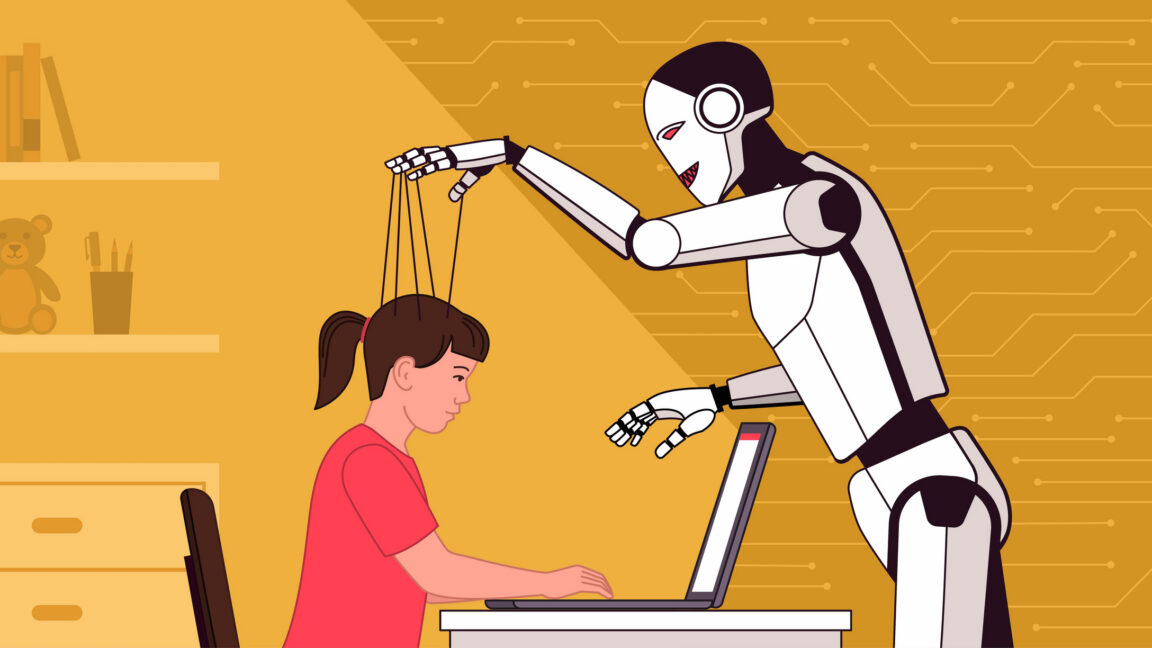
Suspecting AI cheating, Ivy League prof ordered an in-person final; scores fell 50%
AI cheating leads to "a failed society," professor says.
Ars Technica
136 points · by furcyd · 4mo ago · 161 comments
Professor denounces mass AI fraud on an exam at Brown - https://news.ycombinator.com/item?id=48708991 - June 2026 (728 comments)
And people wonder why I'm an AI hater.
I honestly pity watching my fellow software engineers rush to adapt to this new dystopia, just to stay afloat a little while longer before they are truly obsolete. It is quite tragic.
During my university time, all main exams were oral examinations: One professor, one protocol keeper, and the student. Duration: 1-2 hours.
The unemployment rate in the US is 3.7%. 38% of adults in the US have a college degree. 38% is hardly everyone, and if nobody can find a job, then the unemployment rate should be far higher than 3.7%, which is basically full employment.
Lets say you graduated with a STEM degree and now you're working at starbucks or walmart. Congrats you're employed! Is that sustainable or good? It's just not a useful metric. It's like the super rich pointing at the stock market and going "we're not in a recession, the number is going up!" and yet real buying power and wages are declining for everyone except the massively wealthy.
For sure 20-y.o. adults have no degree and students are not count as unemployed.
I think education is incredibly important, but I understand that I'm going to have to retrain myself a little bit. A college degree can no-longer be assumed to be a proxy for having put in the effort to deeply study something.
Now what's the solution for this? I don't know, but we have made the mistake of conflating pieces of paper for expertise. And I say that as someone with 3 degrees.
Thinking back to my time as a professional pilot before I medicaled out and pivoted into tech, the FAA really (for all it's problems) has a pretty good system to train and test new pilots.
You have to have some hours with a certified instructor and some hours on your own. The tests to become a certified instructor are considered challenging, and many people fail. Then you take a written test, then you take a practical test. It's one on one. You and the examiner. And if you do not meet the standard, you fail. That's "ok." It's just fine to fail people who do poorly during a checkride. They go back, they get retrained, and they do it again.
If you have a lot of failures during training, you'll have to answer for them in interviews later on, but often times there's a sort of holistic treatment to it. If you busted a checkride 15 years ago, and have since been fine, you'll be ok. If it's a recurring theme, you'll have a hard time finding a job (and that's the right thing, IMO). But the format of "Written, Oral Exam, and Practical Exam" is the "right" model for making sure people know wtf they are doing.
How do we do that in tech? Hell if I know, maybe a proctored written exam, followed by an oral exam, then a project? But who knows.
Ever taken a Redhat exam - such as Red Hat Certified Engineer? That's the right model. It's a hand-on exam with arbitrary exam objectives you have to meet (by any means possible, there is more than one right way to achieve desired state). There is no internet, devices, or anything else to help you. People that pass allow you to make assumptions about them - for example... without stackoverflow, github, or the internet at all - this person can configure virtual hosts with nginx, firewall rules, host VMs, and administer network concepts(virtual switches, routing) between them. To do that without any GUI or internet available - it means you understand those concepts very well, and can implement them blindfolded.
Any RHCEs want to chime in?
Maybe I'm a weirdo, but part of me wishes I could be like a sysadmin in a powerplant or like something similar where we used tools like that and I'd have to get really good at using them.
Flying was like that, you had to know what you were doing, and aspects of tech touch that, but certainly not in the domain I'm currently in. Seriously, cool, I didn't even know this existed.
no internet-style indexing tho, so it's a lot of ctrl-f and hoping you pick the correct chapter -- which can be hard with a timelimit. on stuff I was strong in it was trivial, I'd already seen the docs and knew what to look for but on the few items I wasn't it was a lot of flailing.
can anyone here think of some better ways where we could decouple the education process from the work process? To me this seems like the main problem. It seems that we've decided that "get good grades == good employee" collectively. I know I'm a bad employee (which is why I work for myself now but that's another story), but I got great grades in school. I don't know, I just feel like school was rarely about actually learning / growing and was mostly about vocational work most of my time in undergrad, and I wish we could de-couple that some? But maybe I'm naive here...
Which is even becoming less likely with STEM, as we hit a confluence of higher education costs, fewer job openings, and AI as a competitor for work.
Instead of getting student loans and going to college for 4 years where you don't accomplish much, companies should directly offer high school students 4 year full paid internships. At the end the student needs to go through a test from an expert in that field, possibly a professor lead examination, and to the degree that they pass the company and student share in a large prize. If they pass that test, they officially get the degree.
The excessive education requirements for jobs came about mainly to provide easy legal ways to cull a large pool of applicants. This credentialism trend has grown far beyond anything that is healthy.
One possible and feasible solution is to encourage (via funding and guidance) more coop and internship programs and partnerships. This is especially true for local junior colleges, but is also useful for 4-year schools.
That doesn’t really decouple education and work, but it would be something that could move the needle from the local level to the national level.
If you want to decouple education and work, I will humbly suggest that the system already exists. It’s people using their personal networks. Many people seem to find this to be incredibly unfair (however one defines unfair), but it’s an absolute cheat code / life hack for decoupling education and work.
Simple example:
I graduated from a prestigious school (one that is known for feeding Wall Street) a year and change after a stock market collapse. Only half of the graduates from the previous year had jobs in their chosen career fields. My year was worse.
When we saw who got Wall Street jobs, it was folks in the top 10% of the class, and about the same number randomly scattered amongst the rest. Some of these folks were very low ranked, and they were known for aggressively taking advantage of the “gentleman’s C” system. What was the common thread of all of the non-top 10%? It was almost always a personal connection, often a close one like a parent, being in a position of power at the employer.
None of this was or is obvious in boom times, but in times of distress we were able to see who was swimming naked in terms of connections/nepotism.
Any semblance of capitalism we have is a shambling corpse barely getting around. Do you know who pulls on all the strings of our economy, gives out student aid loans to kids who just barely graduates high school? Who controls market interest rates, and gives massive multi billion dollar contracts to Companies like OpenAI, Anthropic, Facebook, Google, Microsoft? Who approved of the printing of the 50% increase in the dollar supply in the last 5 years?
Take a guess. I'll give you a hint, if you don't pay them on a yearly basis 30-50% of your paycheck, you go to prison.
Nothing in your provided definition of capitalism precludes government control of money supply, taxation, regulation, or even government contracts.
Private ownership still owns capital goods and private decision is the primary driver of investment, prices, production and distribution in most industries. This is why we have a hard time with things that are obviously good for society as a whole, like renewable energy, efficient transportation, and low-cost housing, that don't have a competitive short-term return on investment.
Recently I saw Alex Karp (Palantir CEO) on one of those market shows (CNBC I think? Something like that) and he was upset at Dario's doom trolling. Why was he upset? Because he was worried that the populist rage towards AI was going to result in a wealth tax! And the thing is he's probably right! The thing these people fear the most, socialism, is the thing they're ironically probably going to make popular in the united states by absolutely trying to bleed the population dry.
What? Where do you think all of the capital they are burning to stay afloat comes from? I'll give you a hint, it's from the capitalists.
The ideal of capitalism is that optimizing for profits means growth. But the fundamentals of capitalism means that, since capitalists own the means of productions, they can do whatever they want with it.
What that's going to look like I couldn't begin to imagine, but I think you might onto something about the AI industry not being all that capitalistic presently. Not an economist, but we're definitely in oligopoly territory here? Because there are only like 4-5 serious companies here.
I too may be accused of having the faith that it's "all going to work out" though. I think it will. I think when things start getting weird enough a bunch of creative people will figure out logical solutions that work in the moment and we'll run with those. Barring revolution, that's kind of how things have always been. Things get weird, then we figure out how to fix it or go to blows over it. I think going to blows domestically is pretty unlikely as of yet though despite the "dooooom" narrative that a lot of people tout.
You know, I was reading an article about falling labor force participation rates, and one thing was pointed out was there seems to be a supply mismatch. Plenty of jobs are available, they’re just shit, go nowhere, pay nothing in the facing of rapidly rising COL jobs.
I suspect the only retirement I’ll ever see will have to be via a shotgun.
This was a lot harder to cheat before AI, but now the floodgates are open and grades and degrees earned post-AI are showing that they mean little.
Cheating on college tests should be a jailable criminal offense (similar to computer fraud) so that there is dignity in the degree again. Considering the money involved, I don't see why not.
But this probably won't happen, because many rich people are very happy to buy their degrees. See also [1]
https://stanforddaily.com/2026/04/09/the-real-reason-student...
You can’t treat paying customers like that. They’ll just go somewhere that will let them cheat!
How far back do you need to go to get to a time when degrees mattered?
It still does if the test is in person
For context, I am also a faculty member at a highly selective college. I had a similar shocking realization last year that it was likely that there was widespread cheating on homework assignments, which I used to favor heavily toward their grades. To verify my suspicions, I generated custom tests for every student in the class: the exam included code from students’ own programming assignment submissions. All I asked them to do was explain what they wrote.
The class performed badly on this exam, and the results were strongly bimodal. Roughly half the class aced the exam. The other half could make neither heads nor tails out of the code. For the students who wrote things like “lol, i have no idea” (real response) I opened honor cases.
I think many faculty right now are going through the stages of grief. We all knew that even at selective institutions, cheating existed, that many students were in it for the credentials. But as long as the numbers of known cases was low, we could convince ourselves that the few doing it were outliers. When a class does it en masse, it’s more than a slap in the face; it makes you feel like a chump. Have we been fooling ourselves this entire time? Was all the time I spent becoming a subject-matter expert a waste? Are the students just rolling their eyes when I turn my back? Those thoughts hurt. I personally chose to become a faculty member because it seemed like research and teaching were the best ways to maximize my impact.
I still have some hope. After all, I still spend my days working and socializing with like-minded thinkers, some of whom are truly brilliant. And every year, a handful of students come out of the woodwork and surprise me. But it’s hard not to think that the group of people who find joy in learning and creating is shrinking.
I'm not sure you should think it is shrinking. There are a lot of people in this world that hate to learn, and literally are incredibly apathetic about any topic. To such, learning anything is work, never a joy.
Before AI they had to learn to succeed. Now they see a shortcut. You said half showed they were learning, that's not so bad. I think you should be glad it's that high. I am.
I've never realized it before, but this is so true. Take home exams (or graded homeworks) allowed me to pour so much time in subjects I enjoyed, that I wouldn't have done otherwise.
Trades are critical but looked down on. Manufacturing is gone (which isn't in itself a bad thing). The service industry doesn't pay a living wage (thankfully it's reasonable here in AU). Apprenticeships don't pay enough. And pretty much all knowledge work jobs expect a degree from the beginning at a junior level.
We should be planning for a system where <20% of people go to university, instead of expecting >60% to go. Robust minimum wages, good trade schools, apprenticeships that pay enough for a wide range of roles, and changing the culture to not look down on folks that take these paths.
Obviously this can't happen without some structural change (virtually impossible in the US due to its political ossification and indefinite deadlock) because a degree is now just a way of gatekeeping the middle class, but dull and incurious minds made ideal manual laborers in the past, and, at some point, we lost sight of that and started rotting our corporate world out with them.
... I'm sorry I couldn't help it
We support our citizens right to free will so long as they don't think anything bad.
My point was, however, that in modern age, where we’re literally on the verge of redefining humanity, we might be forced to redefine “cheating” as well. It’s all surely starting to slowly crack at the seams for the last half a century, and the pace is only increasing. When I was a kid, electronic calculators were banned (but not the slide rule, heh), nowadays, I’ve heard, even programmable ones are becoming accepted.
You cant even sneak paper on to your desk, where do you plan to hide the LLM?
The proctoring service my school uses requires a special browser with admin permissions and an external webcam with your entire workspace, screen, and face clearly visible (wide angle webcam preferred). Prior to the exam you have to photograph the entirety of your room, and if there’s even an open door that can disqualify you. Only one screen is allowed and smartphones and smart watches are banned. A proctor is watching you and you’re being recorded the whole time. I have no idea how one could slip something like AI use past all this.
(True or not, a story is a story.)
Academia has a long history of lagging behind acceptance of new cognitive tools where they claim to want to defend the students, but instead defend the assignments of the past at the expense of the students. Calculators were treated as threats to learning, even though they ultimately freed students to focus on higher-level math and provably improved their abilities across many different studies. Internet sources were dismissed as less legitimate than books, as if “published in an outdated book from the 70s” magically made it more trustworthy than the most scrutinized reference sources online.
It is not clear from the article exactly how much of this course falls into that category, but if the answers can be produced trivially with a prompt and chatgpt, then maybe memorizing that material is no longer the right educational target. Academia desperately needs to redesign itself around AI as a cognitive tool students should be trained to leverage. If a question is trivially answered by a prompt with it, then you need harder questions that actually require students to push beyond that. Simply removing AI from the equation, calling it cheating, and pretending that it isn't an ever-present asset people are expected to leverage in real life is naive and just repeats the mistakes of the past.
It's very clear from the (excellent) article linked by dang [1] what the exams required:
> This year, the economist decided that both the midterm and the final exams for his course would be of the take-home, closed-book type (there is a certain tradition of this at Ivy League schools). “It’s a very nice kind of exam, because as you’re giving students practically unlimited time to complete it, it lets you make it harder than normal, to see how far they can go.” In this case, Serrano changed some of the model assumptions they had seen in class, and asked students to demonstrate whether certain statements were true or false under the new assumptions.
[1] https://english.elpais.com/education/2026-06-28/ai-fraud-at-...
Of course, not all testing is good, but the written exam has survived and proven useful despite the internet age, I'm not sure an even better search engine really changes that.
The dumber we (humanity in general) get, the smarter AI appears to the average person. You'll be a heretic or just deemed crazy if you call BS on something AI says in 50 years--regardless.
Ask an LLM to "clean up this code applying SOLID principles" is much more prescriptive than "clean up this code".
AI can just give you the details like an encyclopedia article. You still have to know at a high level how something works and which article to look for.
AI is just a more forgiving way to ask something, compared to the searches of the past (e.g. searching a scientific journal database). And (for now at least), AI is a good way to avoid the ad-ridden web.
1a. Yes, college isn’t right for everyone, and testing the traditional way with paper and pencil certainly disadvantages some students who would be star performers in a real world setting but are not a good fit for college classes. Think “Good Will Hunting” type people. They do exist.
1b. However, there are certainly more people who only imagine themselves as Will Hunting type people and that they are just too smart for college, but the reality is that they are dumb, or didn’t learn the material. For every person who fails a test because they’re a genius who is a bad fit in the system, there are at least 10 idiots who imagine themselves geniuses, and they would have passed the class if only that PhD professor with all his book smarts had actually written the right kind of exam. Traditional schooling and testing doesn’t work for the extreme upper tail of intelligence, but it exists because it did quite well at educating and sorting the masses to support the Industrial Revolution.
1c. If college were only about the knowledge, you could learn most of it with internet access and a library card for much cheaper. The vast majority of people are in college for the credential, and the institution has to protect the signal of the credential.
2a. Most college assignments and exams are not a good reflection of full time employment. College credentials serve mainly as a networking aid and a signal to employers that you are compliant and competent enough to follow a professor’s instructions, and will likely be a compliant and competent employee, although the instructions might be different. If it is the AI who is the one who followed the professor’s instructions you water the signal down, and employers don’t want that. It is irrelevant that a student can copy and paste things into ChatGPT, and that ChatGPT can get the answer right on this test. That isn’t what college is supposed to signal.
2b. A problem is that I literally can’t write a test in most subjects now that I would expect a student to complete that can’t be completed by ChatGPT better and faster. I teach undergraduate math and a while ago we thought that since GPT-4o could get a C in calculus that we’d just raise the standard. Now Fable and GPT-5.5 can cruise to an A in literally every math course in our catalog, and they can also catch every tiny issue in an exam written by a human. But I have to teach these undergraduate subjects so that some students can go on to PhD studies so they can contribute to the field. If we just stop teaching undergraduate subjects then PhD production and novel research grinds to a halt and only a few fields will progress where an AI is capable of self improvement.
2c. I’ve seen that my best students know how to do do something by hand and use a computer to complement/increase their capabilities, not to cover over entire gaps. When you have literally zero skill in an area, you can’t spot when you got a totally bad output from the AI (these days usually because of a lack of context or bad prompting because the student didn’t understand the material, not because the AI wasn’t capable). Somehow I have to incentivize students to learn the material on their own, so that they can be a better user of AI in the future. And a really effective way to do that is a graded test in which AI is not available to help them.
So to try to tie it together, is that there is still some value to a college degree, at least until something better comes along. But that college degree is only useful when it is a signal about the person and not some other tool. And although AI is getting very capable, somehow we have to teach the lower stuff to build up to the higher stuff, so we do need to restrict the use of AI in some educational settings so that we can build a good foundation for future learning.
As to the point about old paper sources being considered more reliable than an internet site, I agree. I am of the generation that wasn’t allowed to cite Wikipedia and it frustrated me. We’ll eventually figure out how to permit proper AI use, much like how many professors now allow you to use Wikipedia to start researching a topic.
This is how it has been for years and AI doesn't really stunt that as long as students actually care about learning the material. Those kids will be fine. The kids that are fulfilling a prereq will be fine, for the most part, but will walk on crutches their whole lives (use AI) which might be a reasonable choice.
What we lose is the signal of which kids are interested in learning and which kids aren't. Grades and effort used to be the signal, now I think it has to be more about engagement" who asks questions, who comes in with strange ideas, who actually is struggling at times (actually grappling with the material) or learning things outside of the assignments.
Big picture, I think teachers should focus on teaching the learners and trying to motivate more students to join them. That has been the real job all along, AI just lays it bare.
It's also why you can't just throw kids in front of Khan Academy.
I know. The desire to get a degree or the "threat" of wasted tuition and disappointed family members is really what gets most students to crack a book. Most people aren't self-motivated to learn. If people were self-motivated to learn the material, as opposed to getting a credential or some other reason for being in college, I wouldn't need to worry about cheaters.
Oh fuck that bullshit. I was a dumbass to believed shit like that in school, and it didn't fucking free me. What happened was I was always calculator-dependent, which made higher-level math harder, because I was always distracting myself by operating the goddamn thing, and I never developed a very good intuition for arithmetic.
I fucking hate calculators in math classes.
"we cannot choose to become idiots"
Professors need to step up and teach value beyond what LLMs know (very possible with or without LLMS). Or get out of the way from those building on the field with LLMs.
If you’re teaching students something that LLMs can score 100 on you are not adequately teaching them something useful for them in the future.
Oh.. he’s blind.
and the rest are lying.
(With apologies to the original example of anomalous self-reporting)
I stopped reading after the first sentence.
Do you know what "by definition" means?
> I have met many Ivy League students and grads; they are all intelligent, at least in an academic way.
You probably wouldn't meet the dumb ones, because they're probaly not in your social class:
> rich parents
It’s yours anyway. You don’t owe society anything just because you have privilege.
Everyone else, put on a helmet! Welcome to life.
Try visiting a Walmart and interacting with literally anyone. That's the average. Let's not allow our egos to gatekeep who we consider intelligent, fellow HNians.
Yes, that's the point.
> A typical Ivy Leaguer isn't a dumbass.
But that's not what the quoted sentence said.
> Try visiting a Walmart and interacting with literally anyone. That's the average.
I've been to Walmart. Does that make me average? (You say literally anyone.) Do you think that Ivy Leaguers never go to Walmart?
> Let's not allow our egos to gatekeep who we consider intelligent, fellow HNians.
You say this in the same paragraph where you rip on Walmart customers.
Perhaps at that point if you stop reading after the first sentence, you could churn the entire article through AI to summarize it into a single sentence, and see if the invalid premise is core to the message?
Ars Technica has already trashed its reputation with the infamous controversy over publishing AI hallucinated quotations.
I couldn't decide whether the opening sentence of the submitted article was so dumb that it had to be written by AI or so dumb that it had to be written by a human, and coming to a conclusion on that question didn't seem worth it.
> you could churn the entire article through AI to summarize it
I don't do AI summaries, ever.
Either way, an odd statement shouldn’t normally instantly invalidate the whole article.
And it turned out to be true. Many of the students I went to school with had far better preparation than I did. And not only did I feel like an idiot, another person called me an idiot in front of everyone. Suspicion confirmed.
The thing is, once I accepted that, yes, maybe my preparation was worse, and that it was possible that I was admitted by mistake, I found a way forward. After all, if literally everyone is smarter than you, then in a way, you’re the luckiest person there: you’re surrounded by smart people, and almost any conversation you have with your peers will benefit YOU more than it benefits THEM.
Over time, I realized that the thing that mattered most was “time on task.” Unlike my peers, who had better instruction, because they went to better schools, had private tutors, etc. I had to work for everything. And I started graduate school late: I turned 30 the year I enrolled. So I was not distracted by social events, finding a romantic partner, or deep questions like “what do I want to do with my life?” I was all-in. I may have started a bit behind, but I finished well ahead of most of my peers.
I think it’s easy for students from my kind of background to wither under the pressure of an elite environment. As a faculty member, I’ve seen it happen many times, sadly. But there IS a way through it, and largely, the way forward is to value oneself, to develop one’s internal compass for good work, and to not let the social pressures overwhelm. I don’t mean to make this sound easy, but it IS possible.