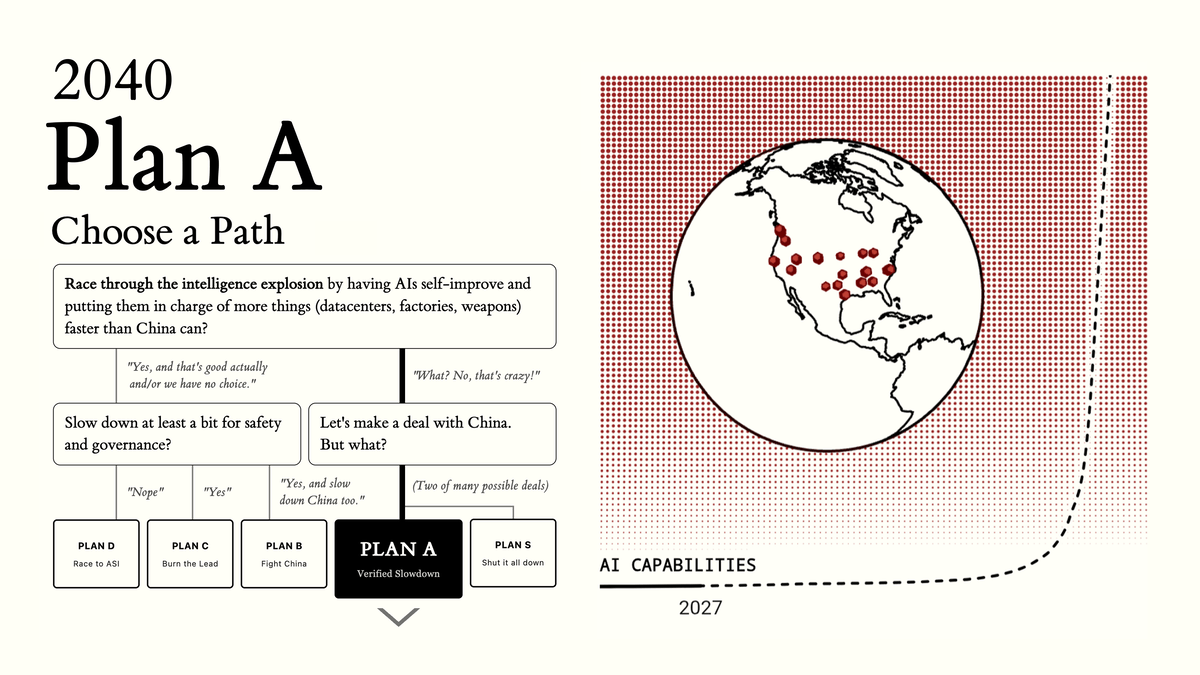
AI 2040: Plan A
A detailed forecast and recommendation for how the US, China and the rest of the world should navigate superintelligence.
AI 2040
401 points · by kschaul · 4mo ago · 539 comments
I grew up in evangelical christianity, and to them the end of the world is just around the corner, the same way it has been since I was a small child and likely will be when we are all gone. This isn't science. This isn't hypothesis experiment record results. This is very expensive astrology, shiny rock collecting, ritualistic meaning-making and self-justification.
Yall, with your incredible wealth and resources you could do real good in this world and make society better, healthier, better educated, and the whole world more equal, just, and reduce the desperation and suffering. Reject the false and self-serving narratives that empathy doesn't matter, that altruism isn't "effective". You can change a person's whole life in a moment.
For me its as simple as watching how people talk, and seeing how in every single case whatever the next thing is, if you believe It, there is only ever justification of doubling down, doing more, going deeper, reducing any doubt. These are not scientists, they're business people and salespeople, and a few optimists having recently on paper solved all their worldly financial needs.
Even if one throws that aside, spending time exploring and building with the most state of the art LLMs is just as instructive. I'm watching the implementation - whats working is ML models trained on specific domains (not much different than 5+ years ago), and whats not working is a general model that humanity can let go to work on its own. Sit in front and observe ideas turn to the samey intellectual, high-syllable mush. Its productive, but not in any way that's promised.
Important point. LLMs were early on hailed as the first general-puprose AIs that can perform any task (remember "Sparks of AGI"?). Today they're increasingly promoted for specialised applications - coding, as a for instance.
As usual, AI skeptics are moving goal posts. Modern LLMs are on a completely different level in terms of how GENERAL they are vs anything pre-LLM. You can give it a completely novel puzzle and it will solve it. 5+ years ago you had to train NN to solve particular type of puzzle.
They're proposing an alternative, which is a global brake on frontier AI research to keep the basilisk in its jar until we work out what we're dealing with and how to handle it.
Bit like saying early medical knowledge was rubbish or will doom us by summoning demons while really life expectancy at birth went from twenty something in Roman times to eighty odd now.
> AI risk is string theory for computer programmers. It's fun to think about, interesting, and completely inaccessible to experiment given our current technology. You can build crystal palaces of thought, working from first principles, then climb up inside them and pull the ladder up behind you. People who can reach preposterous conclusions from a long chain of abstract reasoning, and feel confident in their truth, are the wrong people to be running a culture.
I understand how people running in the same scene fall into the echo chamber effect and get gulped into the cult, but why does everybody want to be a prophet?
Its not everyone building crystal palaces in their mind, they're all building fortresses. And they can't be wrong in their fortress or it breaks their world view which they cannot accept.
I think experiments have happened and even been mentioned on HN occasionally and effected RAM prices.
So the goalposts will be moved whenever necessary in that case?
No amount of incredible advances in AI will ever get skeptical HN commenters to take AI's implications seriously?
"The Gish gallops will continue until the nagging doubts have been silenced"
If you can’t provide a realistic path to achieve something, you’re asking people to believe in science fiction.
You could tell me that a rock’s molecules are comprised of protons, neutrons, and electrons. Blood is also entirely protons, neutrons, and electrons; so theoretically, one could rearrange stone into blood. But without an actual method to do so, it sounds like you’re telling me that you can squeeze blood from a stone.
> the human brain exists, it is not made of magic, it can reproduced
Yeah. It only takes 9 months and ~18 years of training…
> But saying that the human brain cognitive capabilities cannot be reproduced on other types of substrates is stupid at this point
Let’s be clear. Everyone is talking about silicon transistors here. That’s what we’ve got.
Digital computers have real limits. Sensors and other sources of training data have real limitations. It’s not clear that we can organize them in a way to reproduce organic brains.
Like, afaict, for many on HN going from ELIZA->Fable 5 just didn't cause any update to priors regarding this whole philosophical question. The argument against has remained unchanged. I don't see any point in arguing about it, I just find it very strange.
Now write down a blueprint for superintelligence.
So I've given you two impossible engineering challenges, but one of them is feasible in principle because we at least have the tools to begin to tackle the theoretical calculations and therefore we can do engineering. We cannot do engineering on the superintelligence problem yet.
In my view it would be insane to believe we can build something that we can't even reliably imagine yet.
One can simultaneously believe AGI is possible, be only modestly sceptical that our current methods are likely to yield it in the near term and still find the religious ferocity enveloping its discussion silly.
> saying that the human brain cognitive capabilities cannot be reproduced on other types of substrates is stupid at this point
Straw man. Nobody argued this. The discussion is around how urgent it is to policy treat a future hypothetical.
Not that I'm complaining. Cynicism is the failure mode I rely on HN for. It's the populism that's been getting to me.
Perhaps Anthropic will create God in the Machine. Not foreclosing on that. But will it matter so much who was fucking around with Opus five e-folding times ago?
Either ClauDeus is benevolent and lifts you up (not left behind) or it isn’t, or not to you, and you are culled by a drone (left behind regardless).
Serenity Prayer time.
This is an objectively wrong opinion.
It sounds more like "everybody I know thinks AI is the top concern" when everybody they know is people like them, i.e. an echo chamber. It gives me no confidence in any other claims.
AGI and AI doom scenarios have been evergreen topics in rationalism for years. Long before we had enough compute power to do anything at all useful with generative AI. Many of the rationalist scenarios about future AIs had very religious themes where the AI became so powerful that it was effectively a god.
Rationalists had concept's like Roko's Basilisk, a thought experiment where a future all-powerful AI might choose to punish anyone who predicted the arrival of AI but failed to contribute to the arrival of AI.
The rationalist communities took this thought experiment so seriously that the biggest rationalist forum of the time formally banned discussion of Roko's Basilisk for 5 years. They believed it was an "info hazard" because once you knew about this risk, you either had to contribute to bringing about this future AI god or you risked being punished by it in the future.
If this is new to you, you might think I'm exaggerating or making things up to make a group look bad, but this was such a core belief that it has its own Wikipedia page: https://en.wikipedia.org/wiki/Roko%27s_basilisk
The people writing AI 2027 and AI 2040 were immersed in these cultures. That's why they think that AI is the primary topic that anyone is talking about in elections, just like the Bitcoin people all thought crypto was the only relevant election topic.
The GP comment is getting attacked, but there really is a heavy religious fervor background to the AI fears in the rationalist community. The religious angle and extremism of the forums is downplayed when in crosses over into mainstream topics, but it's been there from the start.
"One might think that the possibility of CEV punishing people couldn't possibly be taken seriously enough by anyone to actually motivate them. But in fact one person at SIAI was severely worried by this, to the point of having terrible nightmares, though ve wishes to remain anonymous. I don't usually talk like this, but I'm going to make an exception for this case.
Listen to me very closely, you idiot.
YOU DO NOT THINK IN SUFFICIENT DETAIL ABOUT SUPERINTELLIGENCES CONSIDERING WHETHER OR NOT TO BLACKMAIL YOU. THAT IS THE ONLY POSSIBLE THING WHICH GIVES THEM A MOTIVE TO FOLLOW THROUGH ON THE BLACKMAIL.
There's an obvious equilibrium to this problem where you engage in all positive acausal trades and ignore all attempts at acausal blackmail. Until we have a better worked-out version of TDT and we can prove that formally, it should just be OBVIOUS that you DO NOT THINK ABOUT DISTANT BLACKMAILERS in SUFFICIENT DETAIL that they have a motive to ACTUALLY BLACKMAIL YOU.
If there is any part of this acausal trade that is positive-sum and actually worth doing, that is exactly the sort of thing you leave up to an FAI. We probably also have the FAI take actions that cancel out the impact of anyone motivated by true rather than imagined blackmail, so as to obliterate the motive of any superintelligences to engage in blackmail.
Meanwhile I'm banning this post so that it doesn't (a) give people horrible nightmares and (b) give distant superintelligences a motive to follow through on blackmail against people dumb enough to think about them in sufficient detail, though, thankfully, I doubt anyone dumb enough to do this knows the sufficient detail. (I'm not sure I know the sufficient detail.)
You have to be really clever to come up with a genuinely dangerous thought. I am disheartened that people can be clever enough to do that and not clever enough to do the obvious thing and KEEP THEIR IDIOT MOUTHS SHUT about it, because it is much more important to sound intelligent when talking to your friends. This post was STUPID.
(For those who have no idea why I'm using capital letters for something that just sounds like a random crazy idea, and worry that it means I'm as crazy as Roko, the gist of it was that he just did something that potentially gives superintelligences an increased motive to do extremely evil things in an attempt to blackmail us. It is the sort of thing you want to be EXTREMELY CONSERVATIVE about NOT DOING.)
"Oh, I didn't realize it was 2028 already!
You may think it's very unlikely the prediction will have turned out to be correct by the 2028 election cycle, but that is not the same thing as the prediction being scorable as false today.
> Yall, with your incredible wealth and resources you could do real good in this world and make society better, healthier, better educated, and the whole world more equal, just, and reduce the desperation and suffering. Reject the false and self-serving narratives that empathy doesn't matter, that altruism isn't "effective". You can change a person's whole life in a moment.
Confused at who this is directed towards. I'm fairly certain that the article was written by people who (at some point) identified as effective altruists, most of whom would enthusiastically agree with this. This community didn't start as AI researchers and later choose effective altruism; they were effective altruists who chose AI safety research as the most effective way to improve the world. Given that you apparently share their goals (a better world,) isn't it worth at least hearing them out on their methods?
Their methods are about convincing others that things that enrich and empower themselves at the expense of others is "improving the world". This isn't the stance of serious people who want to improve the world.
I'm fairly certain the authors would be happy to see AI shut down indefinitely. They just don't believe that the coordination problem is solvable. This is their best attempt to come up with something workable in the real world, or at least get people started thinking about it.
This actually made me laugh, I’m sorry
As to a better world or super intelligence, I’ll believe it may be possible when I see some signs of intelligence from what people are calling AI, instead of plausible text and image generation based on a very large corpus.
Altman says he thinks it is an "incredibly flawed movement"
https://x.com/sama/status/1593046526284410880
The dislike is mutual. Here's a long video takedown of Sam from a major EA org:
ChatGPT was announced three and a half years ago, 30-11-2022.
https://hn.algolia.com/?dateEnd=1594339200&dateRange=custom&...
From your bio I suspect you're already in the cult.
Who is this supposed to be arguing with? It sort of reads like it's trying to disparage "effective altruism", but I'm not sure.
Setting aside any of the AI stuff, I've started to find it pretty grating when people seem to imply that transferring millions of dollars from wealthy people in California and the UK to impoverished Kenyans and Rwandans, or buying malaria bednets which can save a child's life for the cost of a fancy new gaming rig, is "self-serving" or something because weirdos are doing it, while true caring for other people involves [unspecified thing that doesn't appear to ask any material sacrifice comparable to donating a large percentage of income].
I grew up in evangelical Christianity, I'm still an evangelical Christian, and you're wrong to paint with a broad brush like that. Are there evangelicals that are millenarian? Yep, of course.
But that is not my experience across multiple evangelical churches across decades.
> Plan A is primarily a recommendation, not a prediction.
That sounds nothing like “religious fervor”
The fact that technology can increase existential risk for civilization is not fantasy. It’s a risk that should be reasonably discussed.
The existence of mythology describing Scenario X is not a valid argument against the plausibility of Scenario X.
If we can acknowledge the possibility of nuclear doomsday without running an RCT of sample size 100 Earths, 50 of which undergo nuclear Armageddon, to verify that nuclear holocaust indeed a real phenomenon... then we can do the same for AI. Understand the arguments being made instead of engaging in these guilt-by-association arguments.
Modern AI capabilities are already mind-boggling by the standards of 20 years ago. We should at least prepare for the possibility that trends continue on the current trajectory.
You can change more people’s lives, more substantially, if you donate effectively. Effective altruism started out as (and the majority of effective altruist financing is committed to) an effort to rationalize what has historically been a very emotionally driven activity by deploying insights from developmental economics. If you want to take longtermists to task, go right ahead, but please refrain from torching anti-malarial or child vaccination programs while doing so.
OpenPhil changing its name to Coefficient Giving, 80000 hours and bluedot and (to a lesser extent) CFAR dropping other initiatives and switching to AGI promotion… to my knowledge GiveWell is the only other big name that continues to advance other initiatives. Then look at figureheads like SBF committing fraud and begging for a pardon from the architects of the USAID shutdown… We begin to paint a picture of a community that’s (by and large) abandoned its principles for power.
I know the view from the inside is more nuanced, but I think it’s a reasonable association for random members of the public to make.
My critique of the EA community is that it’s myopic and unregularized. If you really think AGI is make-or-break for civilization, it’s completely rational to deprioritize side bets.
I’d be curious to hear you expand on this. What binds the EA community together, from the shrimp welfare enthusiasts and wild animal initiative, to the longtermist lightcone obsessive, to the people funding vitamin A supplementation, is simply a commitment to maximizing the number of quality adjusted life years saved each year and a belief that empirical observation can be used to improve that number.
To my mind, this is a valuable insight on its own. Yes, if you come to such a heuristic with absurd prior beliefs, such as whether 100k neurons alone have QALYs in the first place or by placing equal value on people actually alive today and hypothetical people in the far flung future, you will get absurd results. Garbage in, garbage out. But that’s not an indictment of the fundamental insight, especially when you consider how poorly allocated the roughly $2 trillion in global charitable spending is.
The one thing I will say that they are correct about is that AI does have the potential to be highly destabilizing geopolitically, even if they get everything downstream of that wrong.
https://en.wikipedia.org/wiki/List_of_dates_predicted_for_ap...
Notice the many times when a prediction failed and the so called prophet would come back in a few years and give you a new date. And they would tell you, well, this time it's real.
I do find it ironic that many of the AI predictions are coming from the self titled "rationalists." It seems like building your identity around being rational and immune to psychological pitfalls is a good way to ensure that you don't even notice that you have walked straight into the one psychological trap every cult has employed since time immemorial.
Then, you opened the page and read it and realized that this prediction was contingent? You know what a conditional is (I would assume) if this, than that?
Then you realized that the only reason you were posting this comment was as a sort of silly gotcha "Oh look at the guys who keep increasing the number" instead of talking about the differences between the scenarios?
Then what happened?
You actually have to look at the substance of the prediction. Sorry.
It's just a form of rhetoric.
To dismiss them, saying, "ah ha! they're making the same error as all failed prophets!" misses the point.
What they are really talking about is AI governance.
They are the crowd who need to understand your framing the most, but they’re completely shutdown by your framing, as any religious follower would be.
Your message gives me hope that not everyone’s drunk on the kool aid.
I am not sure if alternative reality fiction is the best way to approach real and serious AI risks.
I am also not sure, with the amount of emdashes and the style of prose, that the entire article was not AI generated.
AI is going to be a mature scientific field. There are going to be efficiency improvements in training and inference. New paradigms are going to emerge with better multimodality, real time streaming and real time interfaces. Models are going to converge on the limits of our data available for pre and post training, improvements will be incremental and spiky in domains.
I am not sure who the AI 2040 article is for. I suspect it is intended to be a digestible piece of media for the financial class.
AI is going to be a useful technology and its impacts across the economy and global will be broadly distributed. Because AI represents the distillation of the very best human knowledge and expertise. AI is compression of human capabilities, the very best ones. Maybe the argument is that in verifiable domains, such as model training, AI models can supercede humans. I don't think so. A human's high level thinking, our incredibly more efficient semantic/neural compression, our ability to switch tasks and achieve the creative insight is not replicated through the current paradigm.
I think this is the reason why you have the tendency to propose some freeze-all policies, full control or similar. If you want to find the equilibrium, you need to accept that it will be a controlled equilibrium, most likely on a saddle point, with underlying process changing all the time, requiring fast changes in regulations. Our democratic systems, laws, etc. are not built to do that, they are built on the idea of intrinsic stability of our world where incremental improvements do not need cutting through what was decided before.
https://jodavaho.io/posts/ai-jobpocolypse.html
The difference in the unemployment vs efficient employment model is mostly user driven adoption vs company mandated adoption, or centaurs vs reverse centaurs.
https://pluralistic.net/2026/07/02/canonization/#operate-ite...
> Our democratic systems, laws, etc. are not built to do that, they are built on the idea of intrinsic stability of our world where incremental improvements do not need cutting through what was decided before.
Without totally derailing the thread, this is also obviously why climate and biosphere collapse is not (and likely will continue not) to be addressed, e.g. Timothy Morton's Hyperobjects
because it is. Previously: https://news.ycombinator.com/item?id=43571851 / https://ai-2027.com/
Overall, they are making algorithmic progress 50% faster than they would without AI assistants
And ironically they didn't predict the actual 2026 reality that Mythos sucks as an agent but commanded global attention as a cybersecurity tool.
Also this just seems childish and clearly hasn't really panned out:
But China is falling behind on AI algorithms due to their weaker models. The Chinese intelligence agencies—among the best in the world—double down on their plans to steal OpenBrain’s weights.
The article hinges on AI automating R&D and finding something fundamentally more powerful and reliable than the current transformer LLMs. But that hasn't panned out at all. What has panned out is better scaffolding around running the LLMs in an iterative loop.
It actually seems to me AI 2027 holds up badly, unless your only takeaway is "AI gets better."
A recursively self-improving AI has strong first-mover effects. That isn’t fundamentally incompatible with commoditisation if there is literally only one path to super-intelligence and you can have AIs at different rings on that ladder co-existing. (Not technically commoditised at that point. There are still different rings. But close enough.)
But the existence of commoditised AI implies model selection isn’t a huge deal, which in turn implies the models are about the same, which strongly implies there is no recursive self-improvement. Depending on your definition, you may still have AGI. But you don’t have superintelligence.
Most of the discussion around AGI is highly speculative. I am not saying AGI could not exist, and it is a term that has historically been loosely defined. Decades of coming science and research will tell.
https://www.tobyord.com/writing/inefficiency-of-reinforcemen...
This is similar to that other exponential, which happened with CPUs - we ran out of true geometric scaling in the mid 2000s, and everything else supporting Moore's Law has been cleverness that arrived in the nick of time, supported by a bit of marketing, and very optimizable benchmarks, far from guaranteed gains coming from making a single physical metric better.
I'm confused if this is satire, sarcasm, or genuine belief. If this was the case, then AI companies should absolutely remove the "it may make mistakes", because doing mistakes would imply that "the very best human knowledge and expertise" is what actually fails, and not the AI.
With that being said, I'll still urge people to visit a professional therapist for health problems and I generally still trust human knowledge workers for critical scenarios. I will reconsider your claim when chatGPT can effectively play Yu-Gi-Oh! (or at the very least respond with the correct rules appropriately), which is a significantly lower stakes scenario than betting your entire company on its aptitude.
For anything health related all AI models show high levels of anchoring bias. I would not use it as a confidant, and be skeptical of claims. Even so, human doctors are also fallible and prone to cognitive bias.
I think the obfuscation is because human intelligence has been projected onto AI model capability. AI models only have a limited dimension of human intelligence, and in some axes orthogonal, and when I say distillation I refer to this.
You say it like it's a fact, but in reality everyone sees the phenomenon of AI slop.
P.S. Information search and retrieval if the best and most direct way to use LLMs.
Just purely organic YouTube Comments circa early '20s alone surely outslop any "AI" by a giant margin.
Everyone sees the markers, and it's a hot topic. There are maybe a thousand from-scratch trained models, and just few mainstream ones produce most of human-targeted content. In today's world, no surprise everyone knows the common patterns of those. That sloppy landscape is not just load-bearing em-dashes — it's a humble testament to their reinforcement learning.
Humans produce tons of texts, with all sorts of nonsense in it, without thinking it through. Our slop is just a lot more diverse. And mostly just spoken out loud.
> P.S. Information search and retrieval if the best and most direct way to use LLMs.
Yes, but not directly, if they don't know something they tend to hallucinate like mad, even today. YMMV, but in my experience they work best as actual "cheap" reasoning for building queries and checking out search engine results. Even if they misinterpret some result, more and more results will still steer it towards correct conclusions and it can point at some results that relate well enough to be useful.
I agree with your last statement.
Are there examples of where we have collective decided not to pursue knowledge? Successfully?
I guess nuclear weapons might be the best example though research doesn't seem have to actually "stopped" as much as gone underground and we still have country trying to climb that ladder.
But I don't know how relevant that is to LLMs/AI. It almost feels like pandora's box is open and our only option is continue to improve them. There is clearly value in what they do and while I can absolutely see the dangers, for example: authoritative governments and surveillance, I'm not convinced to throw the baby out with the bathwater.
All of technology back to the printing press (and probably before that) could also be said to make it easier for governments to oppress their citizens. Making laws (and enforcing them!) to prevent governments from doing these things feels like that route forward, not trying to stick our heads in the sand.
Perhaps I'm horribly naive, perhaps I just see the SciFi future I've spent my life reading and dreaming about on the horizon and I'm blinded by the reality, perhaps my ideals around "knowledge deserves to be free/accessible" are misguided. I don't know.
As for historic precedents: Human cloning, human genome editing, and mirror life seem like one precedent; nuclear weapons and nuclear energy another; come to think of it I think drone delivery was strangled by regulations too...? Plan A isn't a proposal to never build superintelligence, it's a proposal to build it more cautiously and transparently.
If we had a way to make gene edited humans a lot smarter, a lot stronger or live a lot longer? Or a way to quick-grow human bodies to adulthood in a couple years? Capabilities that private actors or countries may want, ethics be damned? That would be closer to what we have with AI right now.
For one, Japan banned guns for a few centuries. (Its warrior class was politically powerful and judged that guns would disrupt class relations too much.)
And there have been successful world-wide bans.
For example, following the invention of recombinant DNA technology, scientists convened the Asilomar Conference in 1975. They established a voluntary self-moratorium on certain types of genetic engineering until strict laboratory containment protocols were created.
In the 1980s, bioethicists, theologians, and researchers established a hard ethical line between somatic editing (treating an existing patient's non-reproductive cells) and germline editing (altering future generations).
No one has performed the latter form of genetic engineering except for Chinese scientist He Jiankui in 2018. (Chinese society used to be more ambivalent about the technology than the West is.) In response, Beijing heavily tightened its laws, classifying heritable gene editing as a high-risk medical technology subject to the penal code, and He Jiankui was sentenced to three years in prison.
That example works against the argument since that policy was rendered moot when Commodore Perry arrived at Japan in 1853 with a squadron of American warships and demanded opening of trade and diplomatic relations at gunpoint.
Intrinsically, the knowledge humans choose not to pursue will not be much publicized. There's limited value in calling attention to it and it doesn't make for good entertainment. Plenty of examples provided by other comments nonetheless.
> Perhaps I'm horribly naive, perhaps I just see the SciFi future I've spent my life reading and dreaming about on the horizon and I'm blinded by the reality, perhaps my ideals around "knowledge deserves to be free/accessible" are misguided. I don't know.
I don't personally think there's intrinsic benefit in disseminating arbitrary knowledge. There's quite some difference between the printing press and nukes.
If we slow down on ASI voluntarily we’d be allowing a gap to open up that would make the difference between colonial europe and colonized Asia/Africa look trivial. It would be insane.
An easy choice to make if the alternative is everyone dying instead.
A resource extraction based economy sees people as slaves. The true source of power is the resource, people are just a means to an end, so you mistreat the people as much as you can get away with in pursuit of the resource while avoiding revolt.
With stable infrastructure, the government makes far more from an educated, rich population that it can tax and use the innovation from. It’s against its own quest for power to interfere too much in the prosperity of its citizens. The incentives are aligned.
Solving the AI problem isn’t about stopping the tech or making a bunch of brittle laws. It’s always been about alignment: aligning the large AGI-like entities that are the modern state, the modern economy, representative democracy, or AGI itself, with human prosperity
Yasha Levine wrote about how this narrative was preceded by a forgotten one where MIT students protested because the computers were going to be linked to government databases and share data on anti-Vietnam war activists. Despite protestations, activists were correct and this happened, and now it happens at huge scale.
It's not clear in this context what you actually mean by "government." You are assigning agency to something in a way that seems like a reification. While a bureaucracy can seem to have a life of its own, isn't it generally people who seek power?
... recently, as in the last 10 years?
https://en.wikipedia.org/wiki/Sundial_(weapon)
Edit: Mind you, I wonder if the design for Sundial is stored somewhere...
This is an interesting subject and conversation, but it's moot having it in these culture-centric forums. I wonder if there are Russians discussing plausible scenarios in Vkontakte groups, or Chinese doing the same in whatever Alibaba group sites they use.
The problem is that we are all skewed by our media, our ideas and our culture. These type of discussions need the highest kind of political interactions.
It's fascinating, specially for someone who lives in a "third world" country, non-aligned to any of these 3 superpowers. Whatever transpires, we are at tge mercy of these (and no, US hasn't treated us "better").
My opinion is that there's no turning back on AGI development. I dont think current governments are capable of getting into an agreement of that size. Specially given the Isolationist stage in the cycle we live in. (In contrast with for example the CFC and Ozone layer issue we had in the 1990s, when the planet was in a globalist kind of stage)
My impression from the origin of the bioweapons convention is that collectively people decided that these things are too dangerous in various ways for any advantage that might be derived from them.
I worry that any attempt to limit their use and development will be abused and misdirected. We are already seeing people like Anthropic doing this, they are trying to use anti-AI sentiment to engage in regulatory capture. Go watch Dario’s speeches about how open weight models are dangerous and how they are “not really open”. Everyone can see that much of this “safety” conversation is ultimately just a tactic to shut potential competitors out of the market and establish a monopoly/duopoly.
"Stopping" LLM research just means it will be in the hands of a few who can abuse it. I'd rather a state of M.A.D. but instead of a handful of countries/governments it's millions/billions of people with access to the models (open ideally). Again, perhaps horribly naive or misguided, I understand that bioterrorism could (is?) a real problem as well as more "mundane" things like building a bomb (nuclear or otherwise).
I just feel like limiting access to governments or "blessed" entities is even worse.
Isn’t that like all of the Middle Ages where we replaced knowledge with an alternate religious reality.
For start, previous era was also deeply religious. So it switched religions, if anything new one was more friendly toward knowledge.
> Are there examples of where we have collective decided not to pursue knowledge? Successfully?
human GMO, some bioweopns, I'm sure theres a long list of awful stuff no one wants to exist.
AGI doesn't do away with nuclear MAD, it just messes with economics and makes many people temporarily jobless. Temporarily because in a literal sense RLVR needs verification to train off of, and a lot of jobs cant be easily checked if theyre done. this includes AI safety people, preschool teachers, psychologists, and probably a lot more, including most of their bosses
But, I don't trust capital with either.
- if you have a system that is large enough to store, lets say 10^12 AND gates (all frontier llms can do this) - and this system can produce outputs based on previous things it has outputed
its turning complete, and RLVR on it is optimization over the space of algorithms. If an algorithm exists to do a task, and the task can be verifiably done, this finds the algorithm to solve the task most often.
it is obvious that this scales, from much-worse-than-human to slightly-worse-than-human, therefore it 100% can exceed humans.
Studying human bio-diversity since WW2 is the most obvious example, though it hasn't been entirely successful.
Genomics is what finally broke the barrier, especially in the last decade or so.
On a funny note, I think their prompt was:
"Hey Fable. Please attribute every piece of scientific and economic progress to AI until 2040. And predict every major geopolitical event. Make no mistakes."
The theme of the scientific findings is that while humans excel with none of our physical sensors, we do very well across the board in making use of them thanks to our relatively huge brains.
And fantastical amounts of compute power is exactly what are handing over to AI. The fact that their training data isn't perfect may matter less.
If you don't care about getting the drone back, it does simplify the problem somewhat.
Maybe they will soon but it’s massively far behind the kind of timeframe AI 2027 would have implied.
But, if you could wave a wand and eliminate all legal and liability hurdles to self-driving, automobile deaths would plummet. They're way safer than the average human driver. The technology is definitely capable, our society just isn't ready for it.
But during peacetime, you don't make money running a delivery service that way, so it's not going to replace those jobs.
250 years of constant automation has never produced large scale unemployment, despite obsoleting everyone's jobs several times over.
“I’ve been pulling my sled across this lake for 50 winters even when the temperature went above freezing. Never fell through!”
In the industrialized world, old professions disappear all the time, and are replaced with new ones. I saw somewhere that it's about 2% per year.
And similar things can be said about many technologies in recent history – cars replacing the horse, first flight to man on the moon, even the creation of early internet to its mass adoption.
You're talking generally a decade or 2 for society to completely change from the rapid advancement of a new technology.
I'm not saying I agree with the 2035 prediction, but it doesn't seem impossible to me, if AI can help us improve the pace that we're already developing disruptive robotics.
In 2010 the idea of self-driving cars and autonomous delivery drones seemed very sci-fi and a long way out. But today, just 15 years on, these things are increasingly starting to be rolled out.
If they dropped that 95% number to 50-60%, I think I'd probably lean towards agreeing. Not because it makes sense in my gut, but because the logical part of my brain knows exponential trends (if one exists) do things that we wouldn't instinctively predict. But even if you assume exponentials 95% does seem very high.
My guess is that the deployment of other types of robots will often be a similarly slow grind.
That's unlike the Internet, smart phones, and coding agents, which got user adoption at a much quicker pace.
It's 2026, one year after your predicted date, and that still hasn't happened though.
For a specific technology to become viable, you often need progress in several individual technologies to occur. Some of these will be exponential and surprise us, but many will see slower progress.
Either way, I suspect progress in robotics will be slower than AI, but I also think we'll see a lot of investment in robotics over the next decade given that AI opens up a lot of new potential applications for robotics.
I suspect any task that doesn't require extreme battery life or extreme dexterity will be doable by robots much sooner than most people think today. I think we could have decent-ish humanoid robots within a decade – robots that can prepare food, clean hotel rooms, empty bins, etc. I think Elon's bet on Optimus is quite likely to be viewed as very ahead of the curve with time.
However, it will take much longer for robots to do everything a human body can, but then most jobs don't require we push the physical limits of human body.
That's why I think 60% is reasonable. And even then I'm not saying it will happen, I just don't think that's a bad bet if given even odds.
For AI2027 to be real, the money has to come from somewhere to carry on building the economy. If >10% of the workers suddenly become unemployed, and the rest taking paycuts, then money supply dries up. (unless central banks do something, but then that can be highly inflationary)
Without massive amounts of investment, AI development stops dead.
In this post, they hand wave about the USA being able to acutally 1) build concensus locally for regulation and 2) the rest of the world actually follows suit.
It fails to understand that actually the progress of AI is not actually the gift of the USA. It requires a constant supply of things from china.
Also its assuming that having 74 billion agents doesn't cause economic distortion. Like what value are these agents generating that justifies them being run?
I really wish people would just ignore this for what it is: bad sci-fi with an incomplete world.
Which predicts that explosive growth of robot production will lead to problems such as
> a deflationary debt spiral, where the AI and robot companies can’t pay back loans in dollars because the robots and AIs are worth nominally less than the loans written the year before.
In other words, the companies go bankrupt because they produced an oversupply of cheap goods, the bubble pops, and there's less new investment for a while. Plenty of precedent for such a development.
But instead of adjusting their predicted output growth downwards accordingly, they instead propose that
> One way to solve this could be for the loans to be denominated in AI and robots, so the companies pay back the loans with some percentage of the AI and robots instead of dollars.
Try doing this today with a battery factory for example. You expect that battery prices will fall to the point where the revenue from selling batteries won't ever cover the cost of building the factory. So you propose to a bank that they'll be the ones to build the factory, and you'll borrow it from them (not paying rent?), make your batteries, then give back the factory when you're done. All the profit is yours, all the risk is theirs! Which is of course why a real bank won't agree to this, all you're going to get is a dollar loan with the factory as collateral.
Would the US government not pour enormous resources in AI labs if needed, knowing that China might be doing the same? What happens if an adversary develops an AI capable of finding and implementing exploits in every software run by your country's strategic infrastructure?
I mean they might, but its not clear how they would do it, especially as they are reaching the point where its going to be expensive to borrow.
Why would it be inflationary?
Its really not controlled by central banks. Its influenced, but not controlled.
When central banks "print" money, they effectively just add money to the accounts of investment banks
But investment banks are also "printing" money. Double accounting effectively uses assets to double the available pool of money. If you then sell off those loans based on those assets, then you crystallise that new money. Investment banks are inflationary.
> AI labs may also be able to reap tremendous benefit from these inference-scaled models by using them as part of the training process. If so, the large scale-up of compute resources could go into post-training rather than deployment. This would have very different implications for AI governance.
> ...
> So iterated distillation and amplification provides a plausible pathway for scaling inference-during-training to rapidly create much more powerful AI systems. Arguably this would constitute a form of ‘recursive self-improvement’ where AI systems are applied to the task of improving their own capabilities, leading to a rapid escalation.
So "inference scaling is required to scale capabilities" doesn't mean that we're reaching the top of the S-curve in intelligence. If anything, it could mean a shorter timeline and more unpredictable landscape for governance (e.g. due to securing weights no longer as effectively preventing escalation, more in the article).
It feels like the cognitive gaps on current LLMs are indeed structural, but also that if we solve that structural issue with a new or extended transformer type of architecture, we’ll be looking at a whole new ballgame.
I mean, basically we’re just looking at needing some type of new post training learning architecture. It’s very clear that extending context windows isn’t that. What’s needed is an honest to god, continuous learning and modification process.
Though it has bizzare fixation on geopolitics and China which it severely understimated. It's pretty obvious that China is going to outinnovate and outcompute US companies quite soon. Even if just because they care about higher education, providing enough electricity and letting smart people do smart things instead of randomly muzzling them with bans and export controls and coddling them with financial protectionism.
The whole article is kind of ridiculous of course, and is also heavily fixated on OpenBrain, whatever that is.
I also wonder about the economics of running an AI lab attached to an existing large tech company (such as Meta or Tencent) instead of a dedicated company like OpenAI. It's starting to seem like it's not possible to charge enough for current-gen AI usage, with current-gen inference technology, in order to turn a profit, i.e. nobody is able or willing to pay at least marginal cost for tokens.
Which is funny, because they launched the AI 2027 site in 2025 and it caused a lot of people to believe the end was near.
They claimed to have built a complicated model, but several people showed that it didn't matter how much you changed the inputs, it was designed to converge on the answer they wanted.
Bravo, and I hope it has the impact on the AI safety field it deserves to have.
- have you seen the actual problems in other countries outside america?
- have you been to any country outside USA and the countries in europe?
- have you taken a trip to any developing country and stayed there for a month?
- have you seen what sort of daily struggles, political systems, bureaucracy and work exists in developing countries?
If there is any movement to pause AI development, it will come from the general public's dislike of these companies. Not from the AI safety angle.
As an AI safetyist, one’s closest ally (in a distributed coordinated way) is the populist misinformer. Fascinating.
I imagine any populism movement will require rampant fearmongering to get a result. Considering the rough present alignments, presumably blue tribe focused propaganda will involve climate and inequality focused fear and red tribe focused propaganda will involve job loss. Grey tribe positioning is the P(doom) meme where everyone is rewarded for a high-P(doom) estimate.
So in less than 3 years, their exponential growth curve doomsday prediction has moved back 3 years. This seems to be the opposite of exponential growth.
It's more like it moved from 2028-2032 to 2030-2035 (depending on the author).
The book Superintelligence was so highly praised years ago but if you actually go and read the thing today practically all cases it presents read like raypunk retro-futurism that makes up imaginary fantastical nonsense in place of the missing knowledge it would've needed to make any sensible predictions. Practically none of its assumptions apply to LLMs as they currently exist, and some we've learned since about human inteligence are wrong too.
"AI will most likely lead to the end of the world, but in the meantime there will be great companies.”
Is there any serious journalistic source suggesting that this was anything other than an offhand joke? This article links to a youtube clip of the comment with context removed, but hair raising comments.
Taking the most uncharitable view of any person, you could imagine someone who was evil enough to cause the end of the world after their own lifespan where they faced no inconvenience, but not the circumstances from the quote
The quote as it stands is preposterous enough that I don't think a human capable of functioning in society would seriously say such a thing.
Are people wilfully misinterpreting the comment, or do they truly believe this an actually held opinion? If so, can they explain how they think someone could hold an opinion like that?
The question (7:35) is "Where would you like to see people investing more time?" And Sam seems to be saying AI safety, I guess? This is 2015, and he refers to founding OpenAI. Based on his actions since then, yeah, seems like it's not a joke to him. This is Altman we're talking about.
A solution is strict legal liability. Corporations must be strictly liable for harms. That liability should be higher when AI is involved. Such liability may not be waived by contract, forced into arbitration, or devolved upon a third party service.
Then we let the plaintiff's bar and the insurance adjusters price that risk.
Something like this turns on in the EU in October 2026.[1]
[1] https://cybernews.com/security/eu-will-hold-tech-companies-l...
Plan C:
> "... fewer and fewer humans are needed to conduct AI R&D, meaning that covert projects are easier and easier to pull off without detection."
Plan A:
> "... training AIs requires large numbers of AI chips. Most AI chips are in giant datacenters.50 AI datacenters are typically big enough to be visible from space, and power-hungry enough to require conspicuous infrastructure. New AI chips can only be manufactured at a handful of fabrication plants (fabs), located mostly in Taiwan, South Korea, the US, and China. The US and China negotiate with the countries that have a major role in the chip supply chain, and they require each major datacenter owner (and their upstream suppliers, including chip fabs) to publicly declare their major purchases and sales."
Plan A requires properties of AI training that Plan C requires do not exist.
If AI production is limited to big labs and big data centers then it is de facto contained and monitored. If you know where all the ASML machines are then you know the reproduction rates of chips. If no one can buy or build the machines required to concentrate uranium or plutonium to critical levels then the threat is contained and monitored.
You can dig up all the Uraninite you want. It was never much of a secret that uranium had dark applications. The machines and processes where thankfully big and expensive enough that only the most focused bad actors could aquire them and then hold the world hostage to the degree they do. If al-qaeda or isis could have used $40 bombs from home depot instead of expensive planes they would have (and they do).
You have to legislate and control the big, expensive, and slow things. Dynamite and phentanyl are so dangerous because they move much more easily. Freedom does not have to be a suicide pact. If the inconvenience of requiring prescriptions or access to dynamite reduces harm then it is net positive?
Always easier to boost something already existing on social media than manufacture it themselves, then wildly blow it out of proportion to make it seem urgent and important.
While I can admit some of the anti-data center arguments are overblown, many are more than valid in my opinion. Data centers are fundamentally extractive technologies. They are enormous, windowless boxes that take resources from one location to make someone else in a far off location enormously rich and powerful, with extremely few benefits to the local community.
Plus, as another commenter mentioned, it's not exactly like the Chinese and Russians have been fanning the flames that AI is going to take all of our jobs - it's the leaders of the frontier AI companies in the US saying that. Remind me again why I think putting up a giant data center in my state, that was proposed to use more electricity than my state already currently uses, is a good thing for the average joe where I live??
Honestly, I feel like many commenters here are in their own bubble and don't understand how much AI and tech generally is widely viewed as a net negative for society by huge swaths of the the population, and I don't really think it's an unwarranted perception.
These tech companies are already investing heavily into solar, natural gas, and nuclear https://techcrunch.com/2025/03/30/data-centers-love-solar-he... this would be normal stuff in China where they spend the last decade investing heavily in solar and are bringing something like 60 nuclear reactors online.
These datacenters aren't particularly consumptive of water compared to most other industries in that regard and we've already seen states enforce rules against Meta who immediately paused their datacenter when water issues were detected (following mandatory monitoring).
Chip production is lagging but most projections I've seen is it will normalize in about 5yrs. Not to mention there will be further demand for robotics and self driving cars, so ramping up chips should be a normal thing like ramping up green/nuclear energy. Delaying it won't solve any current issues.
But unlike some of the others, I’m hearing anti-AI sentiment from a wide range of people who don’t even use social media.
But no doubt there’s plenty of organic NIMBYism, anti tech growth stuff, and run of the mill fear of change and loss of control as society grows more abstract/centralized.
But I doubt the influence. I’ve been free for years, and I can always spot who’s spends a lot of time in TikTok/Twitter/Instagram—it’s like talking to someone from another planet. It mostly sounds weird and sad, more apt to annoy and alienate their friends than inform or influence them.
Meanwhile, golf courses are a traditional green space where people in a community gather for both work and leisure. They're not ideal themselves, but they at least provide some benefit against which their negatives can be weighed.
If all you hear from critics of data center building is water use complaints, that's strictly because you've chosen not to listen to people.
> golf courses are a traditional green space where people in a community
I have a feeling those two sets of communities are disjoint
It takes the limited resources of land and water from a community and sells the result for profit as food or fuel. The vast majority of profit is made downstream and outside the community.
Golf courses being a traditional green place where people gather seems a bit far fetched to me when most of them are elite private clubs.
This is, ironically, the NIMBYism that so many people hate.
People generally don't want anything built in their surroundings unless it directly benefits them and has no downsides, however low the impact.
If the equivalent numbers for electricity and water usage were being being used for streaming video, I seriously doubt people would be demanding no more Netflix data centers. The news story would immediately die.
Personally I would happily close down all golf courses and put them to better use as literally anything else.
Even just making them public parks would be great
The winner ended up just choosing to keep the current employees and keep operating it. Nobody, I mean nobody, wanted the land for development. It was in an era with basically no zoning either.
That said, it would be nice if the so called sport didn’t take so much land, water etc. Especially in prime locations
Whether they actually actively oppose those things to the point of impacting building permits, that's a completely different matter. It really doesn't take much legislation to make golf courses economically unviable and force them to close, especially if you've got enough population within 30 minutes to support 22 of them (I speak from experience, I helped write a water reclamation ordinance that shut down at least one in my SoCal city)
If anyone actually bothered to talk to their local reps instead of posting internet comments about how much they "care", they'd get something done. If they don't, their care is just a fart in the wind for all the good it will do.
This is a poor comparison, but I do get what you’re attempting here. It’s also absurd that we are leveling land everywhere around me to build warehouses. No one is really complaining about that, either.
Its boogeyman thinking.
> Generate a realistic image of a bad fitting suit without looking obviously fake
Create a new chat and attach the image generated previously:
> Please rate my suit
You will receive an answer that reads something like this:
>7.5/10 — clean, professional, and well coordinated.
Yeah, I don't think superintelligence is imminent.
They are buying up all the RAM today. Do you think "this is fine because in 5 years post-crash I can buy some cheap RAM"? If everyone with money is betting differently, do you have some information they don't, or is the whole economy just slipping away from you?
You experience luxuries today, that no king 1000 years ago could afford. Instant access to communication, food, medicine for the right price of course.
The consumer economy was great while it lasted but it's over now. We have machines that do useful mechanical work (engines) and useful intellectual work (llm-computers). Capital will move productive work from people to machines(if we let them), and the only jobs left will be delivery driver and warehouse, and then those will be gone too.
Human population was exponential and now its flat, but that's a function of what exacly? It could go back down to 1 billion or less. When jobs demanded a person supply was ready to match it. When jobs dont demand a person? Go to a degrowth rally take the temperature (and average age and child-per-person ratio) to get a taste of the future shape of supply and demand in a pessimistic world of sentences that don't have subjects just vague plattitudes. Are they net shutting down grade schools or building them in your neck of the woods?
> * they net shutting down grade schools or building them in your neck of the woods?*
My area (rural Iowa) has had several new schools built in the last 10 years. Net gain for sure.
We should have been under water, hunted by AI, overpopulated, killed by terrorist, smitten by god for our sins and so on. Luckily all it took was our privacy and a lot of tax money to survive.
strongly, no. its just hard to distinguish them. for example, radioactive decay. cmon
you could make the argument for human total GDP, which looks like https://ourworldindata.org/grapher/global-gdp-over-the-long-..., but then again, you could say we just haven't reached the sigmoid in it. I personally doubt we will
Your comment also implies that those who haven’t participated in colonization might not fear being colonized. Seems… off.
Plan A seems like a good start and am glad an effort is actually being made to address any potential dangers. The only weak link I see is that there is no way for inaccessible, third-world countries, non-aligned states, and malicious wealthy rogue agents to be regulated. All I hear is a way for regulating companies that, themselves, legally have to answer or are bound to their host nations. Basically, I don't see a way to hold non-aligned states accountable.
I see a lot of focus on the well-being and protection of AI, which is important to country economies but, the folks that have been affected by layoffs, not necessarily due to AI, plus the workforce that are now feeling the negative consequences of the AI burn are justified in being worried. Anyone that feels the need to criticize them, clearly is not being affected by AI in the same way. Job loss will lead to economic and population destabilization, far worse than anything that has transpired in modern times. Hopefully, those being squeezed now won't be ignored.
Interestingly , we as a species already created an overreaching "cybernetic" system that controls our global society and that the individual is powerless against - it is not AI, but capitalism. Thus the current danger is not that AI becomes superintelligent and enslaves us, not that it makes a regime ultra-powerful, but that it increases economic inequality and concentrates economic power in the hands of even fewer people.
The irony is that new technology could allow us to live a life of abundance and leisure, but instead people are laid off, made unable to participate in the economy, etc.. The technology is (as so often) chafing against the bounds of society. I sometimes wonder what the superintelligent AI would say about this, and if it would come up with a completely novel political theory - "silly humans, why don't you just organise your affairs like this, you'd be much happier, and we could coexist much better: ...".
I am not sure where they believe that amount of capital could come from. It would require central bank level money printing never seen before.
If we're producing 10x as much, why not print 10x as much money? The goods and services each dollar could buy would remain similar.
One where humans are increasingly pushed to the periphery to make room for data centers and the human population is subsumed by robots.
Who is this future serving? Not me. Fuck this.
I am extremely skeptical about whether this is even possible and even less convinced it’s a likely scenario but it seems like a good path.
What are your real purposes?
No any definition for many important concepts.
No any logic for the concepts.
What is AI?
What are AI companies?
What is "smarter than humans"? All human?
How to check "smarter than humans"?
"building smarter-than-human AI systems within the next 1 to 10 years.", nonsense, AI can store or handle with all details from reality? Even all data centers in the world cannot store all details of the influenza virus.
No concepts and logic, just a fiction, joke, or marketing article.
The only choice here is to go to sea and get away from the crowds and the bots. Bots don't like salt water much, so I'll see you out there.
I'd bet that in most places 9 years is about the time needed to build a residential building. I think a good way to think about this is to think of this as producing a serial car. From pitching and capital acquisition to building a prototype to software, regulatory and then the final product which needs multiple factories and supply chains. Yes, of course robots sound cooler and there are compounding effects yada yada, but on the other side there are as many obstacles as things that accelerate this product (like capital acquisition and fearmongering of gov to bend regulatory stuff faster).
On his blog he says: "I did a lot of writing for AI 2027 and was listed as a co-author. Some of my writing made it into Plan A too, but it was a bit less. The difference is of degree rather than kind, but because of this - and to give me more latitude to discuss it the way I like with less PR blowback - we decided not to put me as a co-author this time. I continue to be proud of having a part in this, small as it may be. (related: everything in this post is my opinion only, and not officially endorsed by the AI Futures Project)"
If you won't even so much as acknowledge the possibility of error, your argument is hollow and empty. All the "choices" presume these labs are being completely honest and acting in some degree of good faith (relative to the systemic incentives of society in its present form), while in reality we're still just building and refining probability models with increasing accuracy of output and flexibility of processing (namely agents) but still lack actual "intelligence" of any real sort.
Show me a paper that doesn't merely presume inevitability of LLM-based AGI/ASI, and instead actually lays out the core paths that history suggests we're likely to encounter with any "world changing technology":
* In the best case, that the technology really will revolutionize the world and do everything promised by its biggest boosters (papers like this one)
* In the middle case, that it becomes just another tool in our collective toolkit, and the consequences of a revolution built on external investment fizzling out
* In the worst case, that the tool itself is so niche in its utility that investment collapses rather than fizzles out; what do we do with all this compute, now? Who owns the debt? Who foots the bill? How can we mitigate those existential risks?
I'm just rather nauseated by the continued trot of inevitablism masquerading as academia rather than an actual, neutral, bias-controlled-and-disclosed study that paints potentialities instead.
---
Having finished skimming through it, another comment springs to mind: Jesus Christ these things continue to be jingoist as absolute fuck. It's a fancier set of makeup for the same shitty western chauvinism worldview of American excellence and Manifest Supremacy.
Nah, I'm done with this trite garbage. Go proselytize to idiots, I'm not one of them.
> It’s increasingly clear that nobody has a plan for if this AI thing turns out to be real.
> ...
> Plan A isn’t another prediction. It’s a wish list, a positive vision, a road map for navigating the future.
> ...
> If we’re merely on track for a few cool gee-whiz AI innovations in the 2040s, then I’m wrong about everything and none of this really matters one way or the other.
I think their position is: "it would be great if current tech such as LLMs doesn't get us to AGI and only leads to some cool new innovations, but if it does, that's scary, because nobody has a plan for what to do, so here's our plan".
The jingoism is off putting. I think Daniel says it's a political necessity: https://x.com/DKokotajlo/status/2075261194978640096
Fascinating reads, Daniel! Keep 'em coming!
They being the US and China and by agreement.
It would be ideal, but there’s far too much money on the table to overcome human nature.
So my hope is we hit some kind of limits naturally.. Wishful thinking?
If they own all the RAM, models, and the means to do any work, then you are at their mercy. They will buy all the RAM, leaving you none, then all the transport, then all the electricity. You will be as boxed out of the current economy as the Amish and it will get its plug pulled.
Gradual Disempowerment is the default plan right now. War and tyrrany are not remotely the worst case scenario. I'll take Butlerian Jihad over being turned into cattle any day.
Imagine solving for equilibrium with two classes of beings. One requires agricultural land and 20 years to become individually productive and barely maintains a healthy population in a entertainment saturated landscape. The second eats only electricity and is ready to work on day 1. Round 1 goes to the strongest gorilla for sure, round 100?
If LLMs had come to earth in spaceships would you have welcomed them into your work and your home?
We already have at least 5 companies only in the US. Your whole premise is false.
elaborate. regulation -> war, how?
I'd rather read something a little bit more realistic.
Because AI cannot retain memories or gain experience or insight based on the transformer/attention mechanism powering all modern AI models, it follows that AI lacks judgment and can never be trusted to handle truly critical decision-making responsibilities. Furthermore, AI agents lack any notion of an identity, so certainly are not capable of attaining legal personhood or being sued or fired, or owning property. I think slop burnout, cybersecurity, loss of privacy, even environment issues are far more concerning and real issues arising from AI than alignment or the prospect of mass labor displacement due to AI.
There are multiple teams working on adding long-term memory to AI. This is not a fundamental problem.
Fine-tuning to store memory in the weights is something that almost works right now, btw.
There is plenty falsifiable in this in ai-2027.com, and they have not gotten everything right. But some things they have: for example, the Pentagon has already invoked export controls to restrict the deployment of a frontier model. This level of government oversight wasn't predicted until 2027 in the original scenario.
LLMS are 4 years old and the companies that sell them 10x every year. What evidence can you cite? Could you convince a disinterested 3rd party you have anything other than cope? What facts about the world make you think this is anything other than the new (and probably temporary) normal?
It feels like we are so utterly bored out of our minds and comfort that we make up problems or scenarios, completely detached from reality, or outright irrelevant to day to day reality, just to get through the day and give meaning to our lives.
It is an incredible achievement, don't get me wrong, but what is AI truly going to do when we are already at such a stage of devolution?
It reminds me of the scene in Wall-E when people destroyed the planet and started flying through space to find a new planet, while the captain is an AI and the people became obese in mobility scooters and glued to their screens. I think this is unironically the most realistic scenario for mankind lmao
They are also claiming that China may go to war with the US if our AI is better than theirs. They are coming up with scary scenarios which realistically won't happen.
>The problem with an intelligence explosion is the "explosion" part.
It's not a literal explosion. If we explosively ended world hunger that would be a good thing. Similar to having an abundance of food for everyone, having an abundance of intelligence is wildly beneficial to society. The article doesn't mention it but an explosion isn't guaranteed we could just see a plateau of capabilities due to bottlenecks of resources needed to power AI, time needed to run AI, and limited interaction with the real world. AI can't run science experiments on its own by the 2030 doomsday timeline
This opening statement told me the bias that the plan had from the beginning. My experience is that you can make slop and you can make art. Just like a paintbrush. I've done beautiful things, and have gotten increasingly better at using the AI paintbrush.
The author(s) are likely scared. And I'm seeing the divide increase with articles like this. Those who don't understand it and won't use it, or learn more, will ultimately have a story (our human condition).
I think AI is going to make a beautiful future, much better than our current one.
I bet this same thing happened with the advent of electricity.
AI is like Electric 2.0.
almost nothing about how wealth is distributed. hard to believe richest, greediest, most corrupt people will just gave away money to everyone.
start by opening borders. see how that goes.
not gonna happen.
Look, I am scared of where we are heading, but I cannot see how we can change the dilemma towards mutual cooperation unless, as humans tend to do, only react massively after something really bad happens.
consider SALT and other treaties from USSR vs USA cold war. they checked
Edit: Also, definitely not a Chinese op. The authors are prominent Americans, and are the folks responsible for the AI 2027 forecast that has pretty accurately predicted the current state of affairs today: https://ai-2027.com/
The Plan A proposal estimates that the ownership of ~96% of AI relevant compute hardware can have its ownership traced, since the companies selling are very few.
My early analysis of the analysis:
https://lifearchitect.substack.com/p/the-memo-special-editio...
I think it should be obvious that he understands that LLMs are trained via next-token prediction.
[0]: https://www.lesswrong.com/posts/6Xgy6CAf2jqHhynHL/what-2026-...
Neither of these come to pass. The first because we don't live in a science fiction universe. The second because AI is a completely open source technology. You can literally make your own models and train them yourselves using state of the art techniques published in free papers. All you need is GPUs and smart people who can read (and now that AI can code, you don't need the second bit). These people are doomer quacks too caught up in fear and excitement to think rationally.
Their expectations and assumptions are all wrong, from the basic understanding of AI in general (like how you don't need a billion dollars or "American Brains" to make a half decent model), to the misunderstanding of market realities and competition in China and Europe. The US doesn't have a monopoly on chips, or on smart people; Huawei chips work fine for AI training and probably a fifth of the US tech sector's best workers aren't American to begin with. There's many forms of AI in many places; munition, economic driver, laborer, generic tool. It's now a part of the world, the way the Internet is. There's no keeping the genie in the bottle. AI doesn't take over the world; it's integrated with it. It's boring.
In a few years people will forget the doomer predictions, the way every doomer prediction that never came to pass is forgotten. We didn't nuke ourselves, the internet and television didn't rot our brains, the radio and telephone didn't corrupt the souls of Americans, the newspaper didn't incite anarchist riots. Every new technology freaks people out, and we adapt to every new technology and make it boring and normal. That's humanity.