World-First 'Super Alloy' Could Transform The Way Metals Are Made
Metal alloys are used everywhere from aircraft to cutlery, making them an indispensable part of modern life.
ScienceAlert
101 points · by tejohnso · 4mo ago · 59 comments
The paper: https://www.science.org/doi/10.1126/science.aec4995
As an aside, “super alloy” is not the best wording choice on the part of the author of this sciencealert article, superalloys are an established alloy family that follow a different design strategy and have a very different composition profile https://en.wikipedia.org/wiki/Superalloy
There’s some precedent for mechanical deformation to get nanocrystalline grain structure, and some precedent for mechanically induced phase transformations (see TrIP steels) but I consider both of those concepts pretty advanced
TrIP is probably the closest thing, but I’m not sure how widely known there are among the “metal forging” community? TrIP is usually targeting well known phase transformations to two-phase microstructures, here we have three nanostructured phases.
Finally high entropy alloys are absolutely not well understood, even if the idea of mixing a lot of elements and getting a disordered solution seems simple on its face.
This is sleight-of-hand.
For metals, the operative properties are usually ultimate tensile strength and tensile yield strength. Compressive strength is typically a non-factor for most engineering alloys; only concrete is judged by its compressive strength, and sometimes various engineering ceramics. (e.g. SiC, compressive strength = 3.9 GPa.)
About ten years ago, there were a lot of papers on amorphous metal alloys that had "extreme strength" -- compressive strengths in the 5-6 GPa range -- but tensile strength was not reported and very low. Some measure of ductility was also present, but it too was very low. Those amorphous alloys were classical brittle materials; more ceramic-like than metal-like. I fear the same is probably the case here, with the alloy potentially fracturing along crystal type grain boundaries.
Until they report actual tensile strength and elongation, don't believe the hype. High compressive strengths are not very useful.
I mean, it depends on the use case right? Modern tall buildings/skyscrapers with metal framing use metal pillars where high compressive strength is very useful.
For compressive strength alone to matter, you’d essentially need a solid steel column - which is so prohibitively heavy, it would often end up collapsing under it’s own weight (in tensile failure, most likely) before it got up to a useful height.
And yes, when we design beams, we check the stresses in both tension and compression. For a symmetrical shape like an I-shaped beam, both verification will be the exact same formula so we don't need to calculate both explicitly.
For columns, we do check the compressive stress, and it is the controlling failure mode for short columns. Long, slender columns will buckle before the compressive stress exceeds the allowable limit.
Is that correct? Pardon for asking a bit of a question to your comment. I don't know too much about growing crystals for things like jet engine blades.
Statements like this had me confused for years about how steel is made. Steel is raw iron ore with some carbon removed. (Among other things) Pure iron isn't common in nature, it's usually found instead with too much carbon. That is, to have the properties we like in steel.
"Steel" is defined as carbon content between .02% and 2%. If the metal has less than that it's wrought iron. If it had more than that it's cast iron.
So steel is a range of carbon contents that gives particularly useful properties.
Historically the lower end of that was higher but with that addition of other alloys we have "low carbon steels" that behave like steel with very little carbon.
Ugh. The most basic bitch metallurgy discussion possible.
Oh! It’s stronger than aluminum?! So is bronze, we’ve hard that for awhile! Is the new material lighter than aluminum while being stronger? Is it corrosion resistant? Is it machinable? Can you weld it? Does it oxidize? Does it lose all its strength under moderate heat? Does it temper, do you have to temper it? Is it inert? Can it extrude? Can it be formed into billet or just plate/bar? Does it shatter?
Oh but 2x stronger than <some steel> and 3x stronger than <some aluminum>… is that 2024 aluminum? 6061 common, 7075 aero? Is the steel cold roll or 600-series inconel?
This is an area where if you don’t know what you are talking about, STFU, because anything you say is just going to be embarrassing. This is a you don’t know what you don’t know topic.
As to “high entropy metals”, I’ve heard about this for awhile, I would expect it to be stupid low yield, stupid expensive, and hard to use. There is probably some grade-40 titanium ultra alloy that could make the same “strength” claims but no articles about it because it’s “cost prohibitive”.
… I count this as clickbait metallurgy. No thanks.
I am no metallurgist, or machinist, or work in fabrication, at best I can qualify as a welder made by grinder and paint. Yet, reading that feels more like a sci-fi story (and even technologies that haven't been imagined yet) than just sci.
Yes, I can force myself to act unnaturally to an extent. I even did. What I'm saying is that I wish I didn't need to, because it sucks.
There is only one new fact in this research, which is however very interesting.
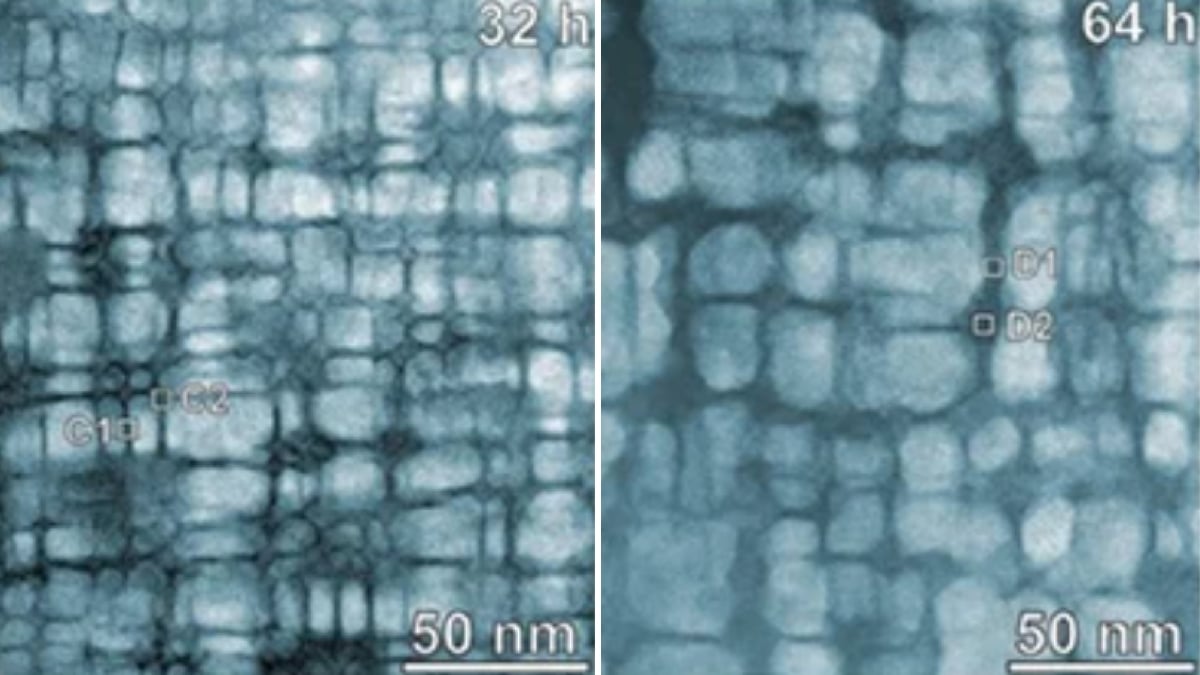
By mechanical working of the alloy, its crystal structure has changed to a mixture of grains with 3 different crystal structures, instead of being composed of homogeneous grains, like most solid-solution metallic alloys.
This change of crystal structure induced by mechanical working has doubled the strength of an already strong alloy, which is the novel and interesting result of this research.
The reason why this could happen is that the alloy contains similar amounts of metals that normally have distinct crystal structures. In alloys with a dominant metal, the alloy tends to have the same crystal structure as that metal, but in this alloy none of the crystal structures is preferred, so the grains take one of them randomly, during deep mechanical deformation.
> It's two times stronger than steel, three times stronger than aluminum, and twice as strong as the same alloy made in a conventional way.
The source paper in Science, fwiw:
https://www.science.org/doi/10.1126/science.aec4995
And as a personal exercise in intellectual humility, I cast my eyes over the supplementary materials (as those are free-to-the-public)… I’d recommend it:
https://www.science.org/doi/suppl/10.1126/science.aec4995/su...
I get a huge thrill out of looking at serious work outside my expertise. When I’m tempted to imagine the proposition is as simple as it seems from the headline (or the article, or the editor’s note, or the abstract), it excites me to remember just how deeply and carefully and thoroughly people think through things I barely understand.
It's hard to know just how much stronger this new processing of the alloy is than other common high strength alloys, as they list compressive yield and not tensile yield strength ... that's if the person writing didn't get the two terms confused.
As a note, I use duckduckgo and smirked somewhat at its search assist results for the few efforts to find the compressive yield of Bisalloy 400 (something I've had to drill) - checking out the listed sources it was clear it had mistakenly used the tensile yield ...
As an illustration for the differences, I found a page [2] for 4140 alloy and similar yield strengths. 4140 is reasonably workable, drilling isn't the greatest amount of effort either before it's tempered and annealed.
[1] https://www.practicalmachinist.com/forum/threads/milling-mp3...
[2] https://amesweb.info/Materials/Steel-Tensile-Yield-Strength-...
Instead of one invincible giant robot, we will have invincible huge swarms of dwarf robots, which will be much more dangerous than any single entity.