163 points · by RetroTechie · 4mo ago · 269 comments
I will say it was common up to the end of 70s and somewhat into the 80s. Common here I don't mean that every single person would have a "slave child" at home but you'd know someone or someone that knew someone who did it.
I am not saying it justify this horrible behaviour, but mostly as to say how much worse it could get. Some would just be "Cinderella" style abuse, but other would be physically and sexually abused.
Some reform of policies around de 90s cleared much of the evil practice.
I think by today standards, 99% of people knowing this would have denounced this much earlier. The fact it did not happen in this case is because this family is related to a powerful politician of the region.
Compensation they offer is too little and too disrespectful. It is basically 3 USD a week for the past half decade of forced work relationship. First, it would need to be at least 100x more than that and it would need to put this rubbish in form of people into jail for the rest of their lives.
Whatever we might now think with hindsight of the communist revolution in Russia, if ever there was a country primed for the peasants to rise up against the ruling class, it was Russia.
Russia might have been a land of art, music, dance and literature, but you were pretty fucked if you weren't in the 20%.
And North Korea continues to show that literally nobody cares, really. Because if they did, at least that would've been prevent- or at least stopable with some concessions to China. The North Korean people would've at least been treated as humans if they became part of China and the NK dictator along with the whole government be executed.
The Ottoman Empire legally abolished slavery in the 1880s, but there was still illicit yet tolerated slavery in Turkey into the 1930s.
I think in some areas of the Sahel chattel slavery may still exist as a practical matter. Mauritania didn't legally abolish chattel slavery until 1981, for example, but as in other areas it can take decades for reality to match the law, given the laws were often changed under international pressure rather than reflecting any change to the domestic social order.
The fact that serfdom de-facto remained is one of the primary reasons Russia's industrialization lagged the rest of Europe for so long as factories didn't get the initial cheap labour. It was only finally fully picking up steam (pun not intended) when WW1 broke out.
Slavery is abolished everywhere in the middle east ("except" Daesh/islamic state), and yet this keeps happening. Example after example after example:
https://www.hrw.org/news/2025/06/12/fifas-world-cup-ignores-...
https://www.freedomunited.org/news/repression-modern-slavery...
https://www.ohchr.org/sites/default/files/Documents/HRBodies...
https://www.ohchr.org/en/stories/2014/12/domestic-servitude-...
https://www.bbc.com/news/articles/cpw5v077nyjo
https://www.hrw.org/report/2016/07/13/i-was-sold/abuse-and-e...
https://www.hrw.org/news/2014/10/22/united-arab-emirates-tra...
https://www.hrw.org/report/2020/08/24/how-can-we-work-withou...
https://www.ohchr.org/en/press-releases/2017/11/libya-must-e...
Oh and the royal families keep getting caught in "even more embarrassing" incidents.
Here is Saudi Arabia having a royal murder a slave for perceived insults, then forcing UK governments to allow and forgive the murder (by taking nationals hostage then organizing a "prisoner swap")
https://www.telegraph.co.uk/news/uknews/crime/9674420/Saudi-...
Or Qatar:
https://www.middleeastmonitor.com/20200619-qatar-prince-accu...
Or Iranian and Iraqi imams and mullahs selling children, girls, but apparently even including the occasional boy, into child prostitution, functioning as pimps and exploiters:
https://www.ohchr.org/sites/default/files/Documents/Issues/W...
Frankly, these days it seems to be quite normal for countries to just sign whatever treaty anyone wants signed ... and just ignore it. Vilifying anyone calling them out on it as culturally insensitive and in all cases ignoring them.
I have no idea why we in the west consider that normal and look the other way... What am I saying, I know, oil & VC money...
Some of them also bring their Filipino, India, Nepali, or African slave maids in Europe and everybody looks the other way, they have too much money to be criticized...
They are so brazen about slavery they routinely sell their slaves on Instagram or Facebook ads, with copies such as "doesn't need much food","will sleep on the floor", "will work 20 hours a day"...
https://www.bbc.com/news/technology-50228549
> "African worker, clean and smiley," said one listing. Another: "Nepalese who dares to ask for a day off."
> When speaking to the sellers, the undercover team frequently heard racist language. "Indians are the dirtiest," said one, describing a woman being advertised.
They are dehumanized at first place, but the level of racism in these places, on top of all that is shocking...
This happens in Europe as well.
It is not legal, but it is the only way the Scandinavian berry market works at all. You don’t even need a huge market for this to be allowed to happen. You just need _a_ market and workers that are desperate enough to be tricked.
The 13th amendment removed the legal concept of slavery (except for convicts) but it was still not a crime to do slavery. Slavery changed shape many times over the years since the civil war (usually involving convicting black people under sham crimes and then selling them as debt slaves or forcing them to sign contracts that rendered them slaves under threat of being convicted for said sham crimes) and can only reasonably be said to have actually ended in the US after Pearl Harbour when concerns that it would be used as enemy propaganda caused the Justice Department to properly prosecute slave owners (see Circular 3591[1]).
The last chattel slave in the US was Alfred Irving[2] and he was released in late 1942. He was kept in chains and was permanently disfigured due to constant physical abuse from his owners. He died in 1960.
[3] is a very comprehensive video essay about the topic.
[1]: https://en.wikisource.org/wiki/Circular_No._3591 [2]: https://en.wikipedia.org/wiki/Alfred_Irving_(former_slave) [3]: https://www.youtube.com/watch?v=j4kI2h3iotA
The vast majority of slaves went to the New World, so that's where most of its effects were felt. Of the 12.5M people kidnapped from Africa, only ~9000 went to the Old World. It just wasn't as obvious of a problem in Europe itself.
An interesting side-effect of this is that a lot of European countries have two relevant dates: the first being the banning of slave trade, the second being the banning of slavery. For example, the UK prohibited any involvement in the Atlantic slave trade in 1807, but slavery in the UK itself was only abolished in 1833.
Sort of. France and England abolished slavery within their own territories before the US states did, but it did not extend to their colonies until later. France banned slavery within its home territory back in the 1300s (Free Soil Principle), but continued with slavery through its "Code Noir" (Black Code) in its colonies, where slavery was not permanently abolished until 1848 (it was abolished at the time of the French Revolution but then reinstated by Napoleon). England abolished slavery at home in the mid 1700s but not in its colonies until 1834.
(Like the US North, England and France had very small populations of Africans/others, so it was relatively painless and easy to ban slavery there, while continuing to accept slavery "elsewhere". For the US North "elsewhere" was the South, for England and France it was their colonies. Same principle though.)
Along the same lines, slavery of Catholics was forbidden in Europe all the way back in the Middle Ages. So it was acknowledged to be something bad, that Christians should not do to each other. But slavery of "infidels", heathen/pagan/Muslims/etc., was OK - and not only okay but sanctioned by Romanus Pontifex in the 1400s granting Portugal the authority to enslave "pagans" (basically all non-Europeans) along the coast of Africa. (Incidentally, as some Africans converted to Christianity, this posed a problem (they were no longer pagan and couldn't be enslaved), and so eventually it shifted to being about race and skin color rather than religion.)
It is still legal in the case of prisoners: https://en.wikipedia.org/wiki/Thirteenth_Amendment_to_the_Un...
there is zero financial motivation for the state for prevention or rehab or any other activities to reduce imprisonment rates
did I mention disenfranchisement of the imprisoned?
"Jarvious Cotton cannot vote. Like his father, grandfather, great-grandfather, and great-great-grandfather, he has been denied the right to participate in our electoral democracy"
That seems…unlikely.
Prisoners aren't 'slaves'. They are being punished for crimes they committed. Very dofferent than being born into it and bought/sold to the highest bidder.
AMENDMENT XIII
Section 1. Neither slavery nor involuntary servitude, except as a punishment for crime whereof the party shall have been duly convicted, shall exist within the United States, or any place subject to their jurisdiction.
Section 2. Congress shall have power to enforce this article by appropriate legislation.
The punishment is being locked up in a cell. Being forced to work on top of that is the slavery.
And yes indeed you are correct that the sate does commit theft and declare it legal for itself.
Prisoners that are made to perform any useful work that anyone else benefits from are slaves, not merely prisoners.
If you want to invoke the word "logic" you should actually employ it.
It's also trivially easy to not end up in involuntary servitude.
Look, you're not entirely wrong. But you're not entirely right, either.
In some states, the prisons are privately run and the prison labour is part of the profit motive. They have no incentive to rehabilitate and the states with these "programs" have some of the highest recidivism rates in the USA.
That also ignores the fact that some people are born into situations that make it far harder to live a "legit" life than others, and I'm not even talking about historical racism as part of that equation (which certainly does contribute).
I'm also NOT saying that prisoners shouldn't be made to work, but it should be outside of a system designed to exploit them.
Stupid people always say nonsense like this as if no person in prison is innocent.
Wasn't there some mild scandal a decade or so ago where wealthy white American families would adopt kids from Africa or Mexico, only to force them to do housework the whole time?
Well, it's classed as child abuse and the perpetrators ("parents") were punished harshly. So pretty bad, but not remotely the same thing as what happens in the middle east or north Africa.
Live in housekeepers are very common indeed in Singapore. However, majority of Singapore lives in Housing Development Board flats that do not have any separate entrance into kitchen.
I've yet to uncover a case of literal slavery like TFA though. One could argue the workers aren't getting paid enough and I'd agree, but the workers are getting paid.
However, they were paid (I have no idea whether it was a good wage, or not), and had pretty decent quarters (in Morocco). My parents were pretty kind, fairly liberal, people. I would be quite surprised (and shocked) if they took advantage of the servants. I know that my mother made damn sure that I had respect for poor folks.
The downside is that they get no benefits.
Practically-speaking, inequality is insidious because it enables violations of rights and unjust denial of opportunity even when poverty has been eradicated. Cold comfort, to the middle-class family of people mowed down by a rich motorist who faces negligible jail time because the money they can spend on a lawyer is outside the scope of what the legal system is built to handle.
Those servants will be richer in a few decades but will still be in that situation.
Another big factor is the victim simply not knowing any better. Not being able to read might have helped with that (and I'd guess she probably wasn't allowed a phone, to keep her isolated from outside).
Point is there's a lot of space between "whips & chains" and "paying below minimum wage". Unfortunately some people are really good at exploiting that space.
The hallmark of developed countries is that they're even, mostly egalitarian and developed everywhere.
The hallmark of developing or underdeveloped countries is precisely the staggering levels of inequality.
Not everyone is poor in a developing/underdeveloped country. Quite a few people there live lives that would make upper middle classes in developed countries blush. Life "just" sucks for the majority of people there.
For the owner or the servant?
Unlike when you use an app, for the most part, because we're not psychopaths, living with someone every day for months or years causes us to feel a great affinity and care towards them.
I live in a developing country. Some people treat their live-in staff badly. But for many others, this is not the case.
Imagine you are a high-earner and hard worker and so you and your wife get a live-in nanny to assist with childrearing duties. Often, two or three decades later, the live-in nanny is ready to retire, but your children (whom you love) have come to see her as a member of the family, or even as a second mother. Surely you also do. How can you live with someone for 20-30 years and not care about them? You might thus often take care of her for the rest of her life, even though she has her own savings.
(No, I do not have live-in house staff. But I've had the same maid for 7 years and she knows she can come to me if she needs anything.)
How one treats someone else is probably mostly just a reflection of the individual. But it's harder to disregard someone's humanity when they live in your house and you've know them for years.
Yet, the end result is still quite similar to slavery. Why do you suppose the servants stay, instead of living a life of their own? I think you’ll find the answer there.
Are you saying if they were simply paid slightly more money and forced to seek their own food and shelter in whatever abject conditions they could afford, like minimum-wage and rural workers in most first-world countries, they would be better off? Or do you have more insightful suggestions? “Pay more” is always the easy answer people go with, especially while not wanting to pay more for anything, so I’m excited to hear a fresh and unique take on poverty.
So not only but a start.
Maybe public humiliation is better, release names and address.
It is a horrible arrangement, and she should be given a lot more than what she is getting (at the very least, she should be given backpay + pension equivalent to the market rate of her work for all these years), but to treat this case as some sadistic family keeping someone in captivity is overreacting.
And definitely the punishment given is a complete under-reaction and your attempt here to lighten the situation lightens it way too much.
Certainly provides some perspective on why Brazil might let that woman stay with the family that enslaved her. Granted, Lola's case is unique because she was taken halfway around the world and was an undocumented immigrant for decades. It sounds like that's not the case for this woman in Brazil, but there's a lot we don't know.
I've seen what might be a similar social dynamic in very long, but abusive marriages in the US. A person can understand intellectually that they could have a better life elsewhere, but this has been their life for so long that conceiving of what that life might be like is impossible, or terrifying at best. I resent the abuser no less, but it's hard to know what to make of all of it.
This playing out across generations of the family that kept her, the woman 'rescued' but staying with them for the time being, the social context, income levels, how to keep a slave from leaving in today's ultra-connected world, the low $ damages mentioned, relation with other modern forms of slavery...
Plenty to go on there. Btw welcome to HN!
The joke's on them; it likely erodes support for their causes.
they also give good indication on how to handle topics that don't tickle your personal preferences (for "interesting" or "curious"): silently ignore them
especially if interest is the guidance on downvoting and flagging. the sorting is not according to your personal preferences, as in "social media", but according to the hn hive think. thus negative voting indicates "anti-curious", "anti-conversation", not dislike.
That is a new way of reporting news, that journalist Gortázar seems to have invented here. When you don't know anything about the victim, just make something up from "statistics".
Where else can we apply this technique?
"Maria entered their lives around 1971 — the year Henry Kissinger visited China, John Lennon wrote Imagine, and Mexico hosted the first Women’s World Cup."
Good to know.
"The traditional maid’s room is gradually disappearing in Brazil, but buildings with separate social and service elevators — for domestic workers, visiting technicians, neighbors with dogs, or residents carrying groceries — remain commonplace."
Those are for separating workers carrying broken dusty floor tiles or ladders or a bunch of fiber cables from the other people using the building.
Anyway, ignoring the lacking quality of the journalism, more countries should do like Brazil and call slavery for what it is in legislation, instead of using euphemisms like "human trafficking".
The point of the whole article is to use a single case to illustrate a bigger picture that you seem to deliberately oversee: abuse and exploitation of manual and unqualified workers.
But, then, I saw your Brazilian name and understood. Brazilian jingoism freaks out when Brazil "looks bad" to the world. It is a very common reaction among 3rd world countries. Indians, Pakistanis, Nigerians, etc are just like that too.
Senhor Jobim had to leave hastily for the horse race track, and has asked me to briefly tend to his hacker messages and Kubernetes before I prepare his afternoon coffee.
He regrets that you found his commentary as being picking of the nits, but says that the article itself didn't invite any much broader reflection on the subject matter. He also mentions that no amount of bad publicity could ever make Brazil look worse than their neighbours, meaning Argentina - as he has understood from your hacker name is your home country.
Further, the journalists exploits a crime in her agenda to ignite hatred between the races, instead of focusing on facts or trying to broaden the picture. A bigger picture could for example be that Brazilian law classifies as slavery such crimes as lawmakers and reporters in other countries are afraid to. Which has later been mentioned by other senhores hackers in this thread, for example regarding berry pickers in Sweden and Finland.
He sends you his latest composition, for your enjoyment: https://www.youtube.com/watch?v=EGO44D-hMmQ
First, be respectful: I am Paranaense and we consider offensive to be called "Argentinean".
Second, my criticism on disrespect for manual labour is not directed towards Brazil in particular but towards most 3rd World countries, all over Latin America, Africa, Asia, Middle East and parts of Eastern Europe. I'd also stress that, in some but not all of these countries, this disrespect does have racial undertones.
Third, I agree that the article is not explicit in its thesis and is poor on facts. But I forgive it because it is journalism, not sociology or history. Journalism is entertainment, like movies or soap-operas; sociology and history are sciences. Entertainment aims at being easy, accessible and fun, science aims at being deep.
Fourth, I think "your" best composition is not the one you linked, but this one: https://www.youtube.com/watch?v=qttuCR18NMU
I think your definition of slavery is highly insulting. Slavery is bad not because two people agree to have this profit sharing scheme as you seem to be implying.
Slavery is evil because one person is nearly fully and entirely controlling another person’s entire life, usually for the “owner’s” gain, without the other person’s consent.
Here’s the thing: you can’t keep someone isolated for 55 years, working them without pay—regardless of whether the victim thinks that they want it or not.
This lady is in her 60s, does she even know any other way to even live? Life with that family may be better than whatever Brazil's equivalent of welfare shelters are.
Seems like that may have been why the case workers left her with that family for now.
This can result in them being exploited again by even more unscrupulous people. The articles clearly mentioned how difficult these cases are to deal with. While they do not go into detail, the above is why.
Its very easy to gain peoples trust when they have no sense of normal anymore, and can you sign this paper, o, we need to go to a friendly notary to help with it. and before you know it, the people just handed over their apartment / or whatever.
There are a lot of good people with will want to help but it only takes one rotten apple to destroy peoples live again. Recently in Europe there was a case of a helper that took elderly their IDs and helped herself to their money. She made 100s of victims. Now imaging that type of person with somebody who probably did not have any proper education and normal independent life experiences that we all had the luxury of having.
In a ideal world, we have proper state funded solutions, with proper oversight to help people integrate into society. Reality is that if any services exist, they are underfunded, often lacking oversight and people fall into the often chasm of cracks.
These type of stories are never clean white and black, but a mix of gray sludge, where we all hope for the perfect ideal solution but often there are not many options. And naivety tend to often do more harm then good.
What the fuck?
Why did the law need the family's "agreement"??
Why is nobody going to jail for imprisoning someone for 55 years??
It took me a year to convince her that it was not ok. They took away her passport, phone, she wasn't allowed to go out without them. I was ready to help her but she did not want my help.
In the end I'm sure she had to pay her "employer" for breach of contract since she left early. I think she had less than $1000 saved from these 18 months of work.
The thing that made me angry the most is that the family was incredibly well off, yet thought they deserve a slave (or more than one) at home.
Idk how the prosecution system even functions without credibility.
Probably the entire adult population gets away with hundreds of offenses per annum on average (judging by the total amount on the books).
Even the most law abiding and most humble decile of Brazilian adults probably still get away with dozens of offenses per annum. That nobody cares to enforce at all.
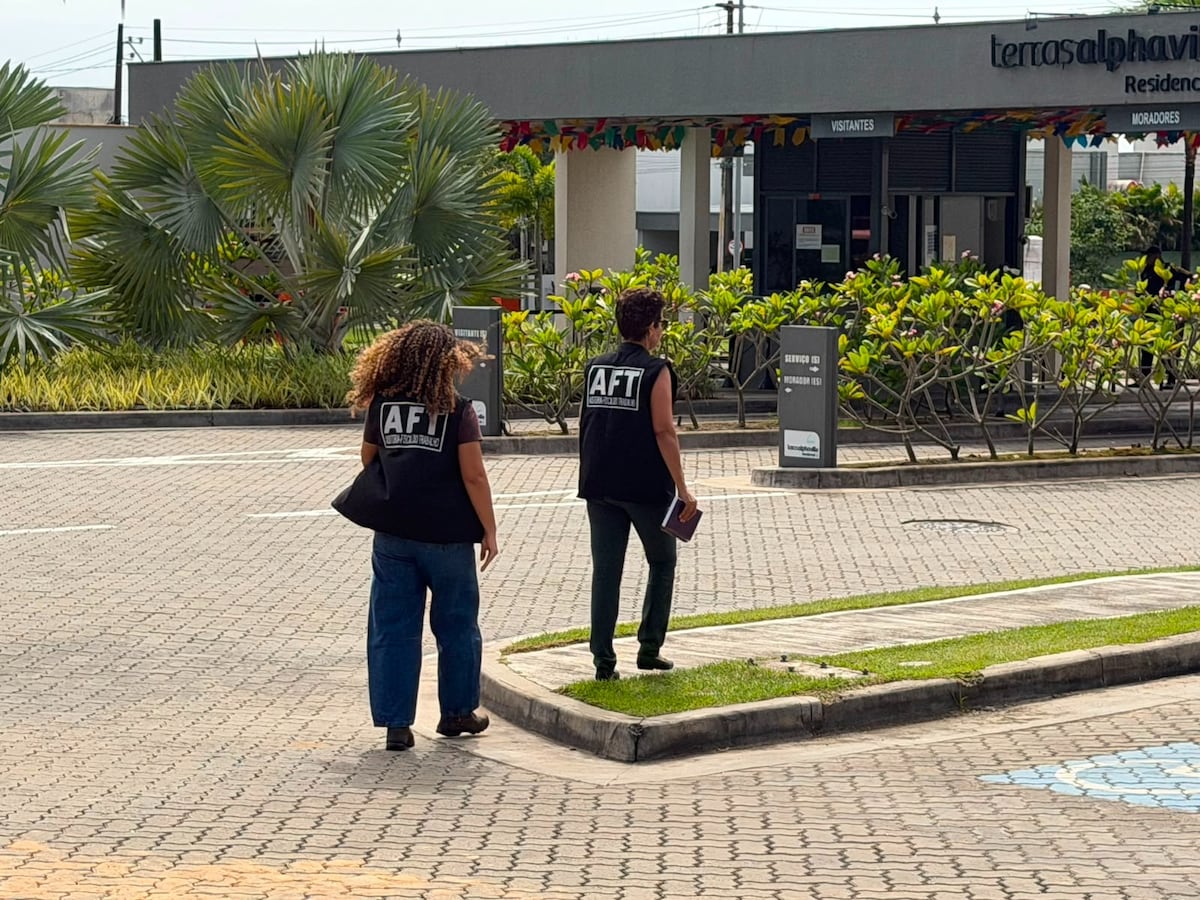
From the article.